
Holiday Card Design Ideas That Look Expensive and Print on Time


Sofia is our design and templates voice, built from the knowledge of our production team, with over 20 years in printing.
The holiday cards that get kept do one thing well instead of five: a single strong idea, printed on a stock heavy enough to feel like a gift. Everything below is a design direction you can actually order, with the finished folded size, the paper, the minimum run and the real price behind each one.
Holiday card formats at a glance
| Format | Finished size | Minimum run | Price at the minimum | Matching envelope |
|---|---|---|---|---|
| Christmas Greeting Cards | 4.25 x 5.5 or 5 x 7 folded | 50 | $56.02 | White wove A2, optional |
| Custom Christmas Cards | 4.25 x 5.5 or 5 x 7 folded | 25 | $31.86 | Matching white wove, optional |
| Raised Foil Greeting Cards | 5 x 7 folded only | 100 | $618.16 | A7 white wove |
| Suede Greeting Cards | Five folded sizes, 5 x 7 to 6 x 6 | 500 | $617.67 | A7 white wove |
| Christmas Postcards | Flat, printed both sides | 50 | $16.48 | None, it mails bare |
Prices are the starting figure at each product minimum and fall with quantity. Browse everything folded and flat in greeting cards printing.
What actually makes a holiday card get kept
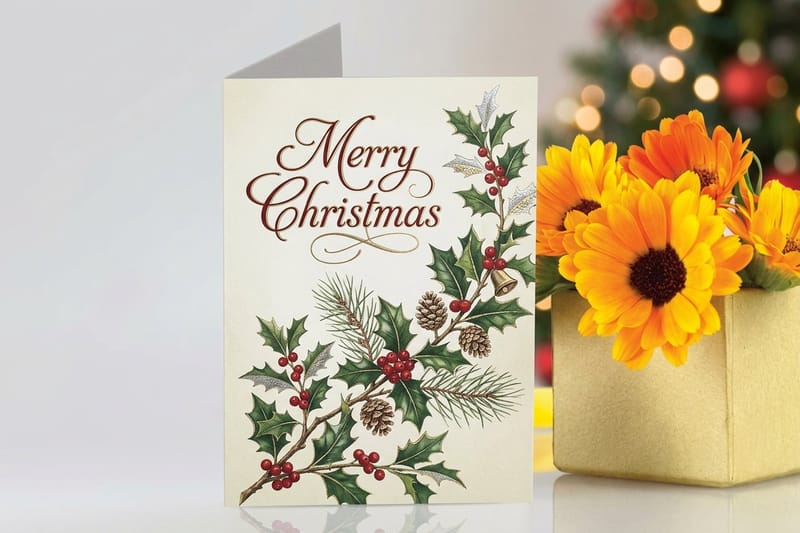
A crowded card does three things at once: a scene, a message, a logo. The ones people keep on the mantel do one thing well and let the paper carry the rest. That is the whole trick, and it costs nothing.
The second half of the trick is stock. A holiday card is one of the few printed pieces a person physically holds for a full ten seconds, so weight registers. Our folded cards run from 14pt gloss cover up to 18pt cream uncoated, and the jump from 14pt to 18pt is obvious in the hand without being obvious on the invoice. If you are torn between spending on a finish and spending on paper, spend on paper first.
Then there is the inside. A card printed 4/4 has full color on all four panels and no room left for a real signature. A card printed 4/0 leaves the inside blank so somebody can write in it, and on an uncoated stock a pen actually bites. Gloss and high gloss UV look sharper on the front and smear under a ballpoint. Pick the ink coverage around how the card gets sent, not around how it looks on screen.
One idea, held steady across the range
If you are sending to clients, staff and vendors, resist the urge to design three cards. Print one layout and change a single element, usually a color or a line of copy. A range that shares a layout reads as a brand. Three unrelated cards read as three people who did not talk to each other.
The holiday color palettes we collected are a fast way to lock that single variable before anyone opens a design file.
Design to the fold, not to the artboard
Folded cards print as one flat sheet and get scored down the middle. That means your front panel is the right half of a 10 x 7 inch sheet, and anything that crosses the score has to survive being bent. Fine type sitting on the fold can crack on heavy stock.
Keep the crease clear, push your artwork to bleed on the outer three edges, and check it against the bleed, cut line and safety checklist before you upload. Two minutes there saves a reprint in the first week of December.
Classic and elegant designs
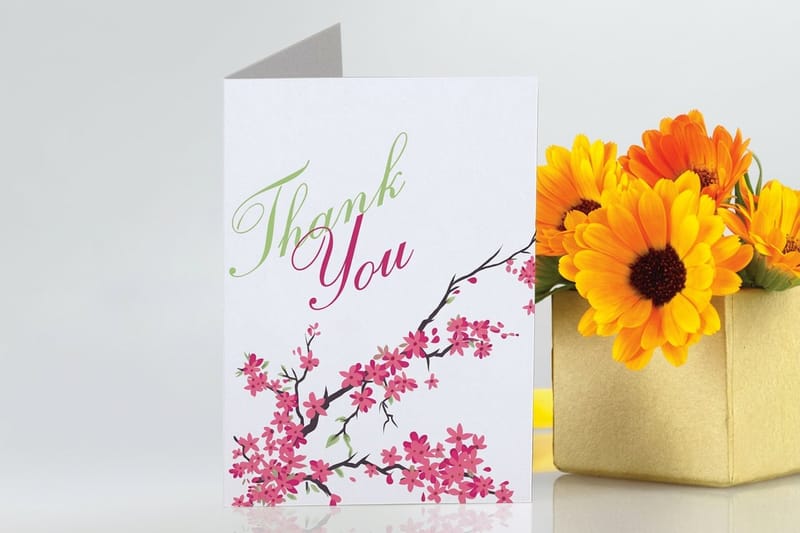
Classic does not mean a wreath and a serif font. It means restraint: one ornament, one typeface, deep ink, generous margins. Traditional cards look most convincing with plenty of white space left on them.
Three directions that hold up year after year. A single letterform, the initial of the company or the family, set large in one color on cream uncoated stock. A hand-drawn line ornament, sprig or star or bell, at about a third the size a designer instinctively wants it. And an all-type card, where the greeting is the artwork and nothing else appears on the front panel at all.
The stock does the heavy lifting here. Christmas greeting cards offer 14pt cream uncoated, 16pt uncoated and 18pt cream uncoated, and cream reads warmer than bright white under indoor light in December. If you have not chosen a paper before, our paper stocks explained walkthrough covers what changes between them.
Where classic goes wrong
Gold ink printed as CMYK is not gold, it is a dull mustard. If a design depends on metal, it needs real foil or a metallic accent, and that is a different product with a different minimum run. Everything in the foil section below applies. Faked in four-color process, it shows on the proof.
The other trap is red. Deep holiday reds sit close to the edge of what CMYK can hit, and a rich red on gloss looks noticeably different from the same build on uncoated. Order a proof if the red is the design.
Modern and minimal designs
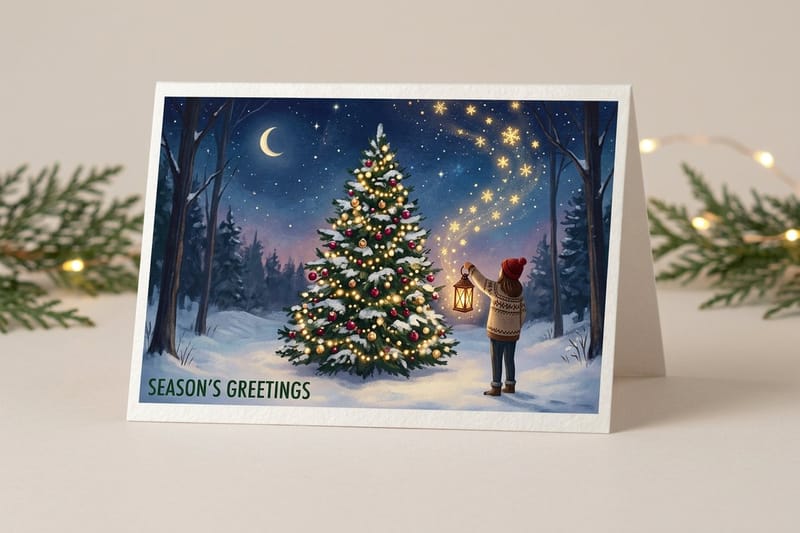
Minimal cards win on nerve. A flat block of one unexpected color, the greeting in small type at the bottom left, nothing else. Or a geometric tree built from three triangles. Or the year itself, set enormous, cropped so it bleeds off two edges.
These designs live or die on the trim. When the artwork is one flat field, any drift at the cut line shows as an uneven border, so build the layout so nothing critical sits within about an eighth of an inch of the edge and let the color bleed past it. Minimal work has nowhere to hide a mistake, which is exactly why it looks confident when it is right.
A useful pairing: minimal front, maximal inside. Print 4/0 so the front is the only printed surface and the inside is left bare for handwriting, or flip it and print a dense pattern inside so the card opens into color. Both are one ink-coverage setting on the greeting card configurator, not a design cost.
The square option
Suede greeting cards include a 12 x 6 inch sheet that scores to a 6 x 6 square, and a 11 x 4.25 sheet that folds to a long 5.5 x 4.25. Neither shape shows up in a normal holiday pile, and that is the point. A square card stands out in a stack of rectangles.
The cost of that shape is the minimum: suede runs start at 500. If your list is smaller than that, stay with the standard folded sizes and spend the difference on stock.
Photo-based holiday cards

Photo cards fail for one reason: the photo is doing everything and the layout is doing nothing. Give the image a real crop rather than dropping it in full bleed at whatever aspect it arrived in. A tight crop on faces, a single band of solid color along the bottom, and the message in that band reads better than a full-bleed snapshot.
Resolution matters more than it used to, because phone photos look fine on a phone and soft on 16pt cover. Aim for image files that land near 300 dpi at the printed size. A 5 x 7 panel wants roughly 1500 by 2100 pixels of real detail, not an upscaled crop.
For photo cards specifically, flat often beats folded. Christmas postcards print full color on both sides, need no envelope and no stuffing, and put your photo face up in the recipient mailbox instead of hidden inside paper. The trade-off is privacy and ceremony: a postcard is read by everyone who handles it, and it does not get stood up on a shelf as often as a folded card. Our comparison of postcards against greeting cards goes through the mailing side of that choice.
Handling many photos without a mess
A grid of small photos looks busy on a 4.25 x 5.5 card and fine on a 5 x 7. If you have more than three images worth showing, go up a size rather than shrinking them, and keep the gutters between them equal and generous. Uneven gaps read as an accident even when nobody can say why.
Convert every photo to CMYK before you place it, and expect saturated blues and greens to settle down slightly in print. That shift is normal and it is the same on every press.
Business holiday card ideas
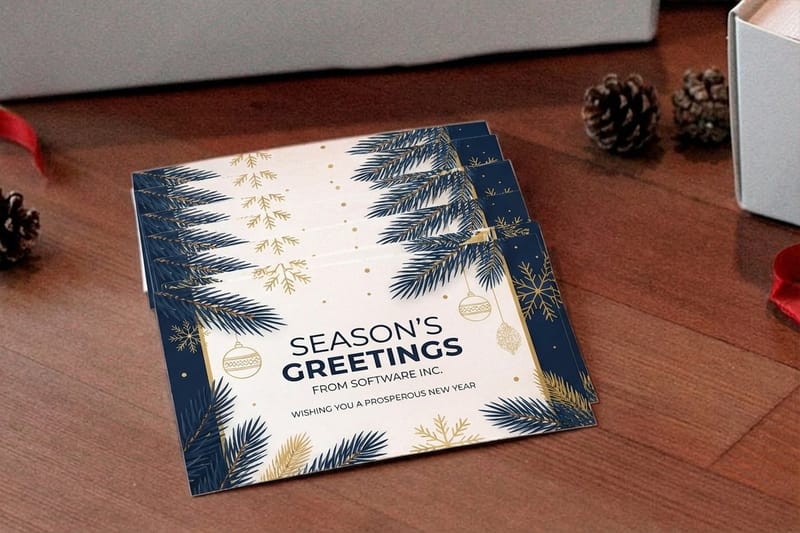
A corporate card has a job a family card does not: it has to be warm without becoming a sales piece. The reliable move is to thank people for something specific from the year and leave the logo small and low. A card that leads with a logo is an ad, and it gets treated like one. If the card is a thank-you first, our thank you card printing range runs from flat and folded to velvet.
Three formats work for business sending. The folded card for clients you want to impress. The flat postcard for a large list where speed and cost matter. And business Christmas cards in the 2 x 3.5 inch business card format, 100 for $17.57, are meant to tuck into a gift, a delivery box or a bill. They carry no envelope option, so treat them as an insert rather than something you mail on its own.
If you are stuck on wording, our guide to business holiday card messages has lines that read as human rather than as a press release, split by whether you are writing to clients or to staff.
Variable data, used lightly
Business Christmas cards and Christmas postcards both carry a variable data option, which prints a different name or code on each piece. Used well, that means a first name in the greeting. Used badly, it means a mail merge that says "Dear Valued Customer" on 800 cards, which is worse than no name at all.
Clean the list before you upload it. Every misspelled name is a small negative signal delivered by hand, and the printing was the cheap part of that mistake.
Send it as part of something
A card inside a package gets opened along with the package. Pair the card with whatever you are already shipping in December, and browse the Christmas printing collection if the gift itself still needs branding.
Premium finishes: raised foil, soft touch and metallic
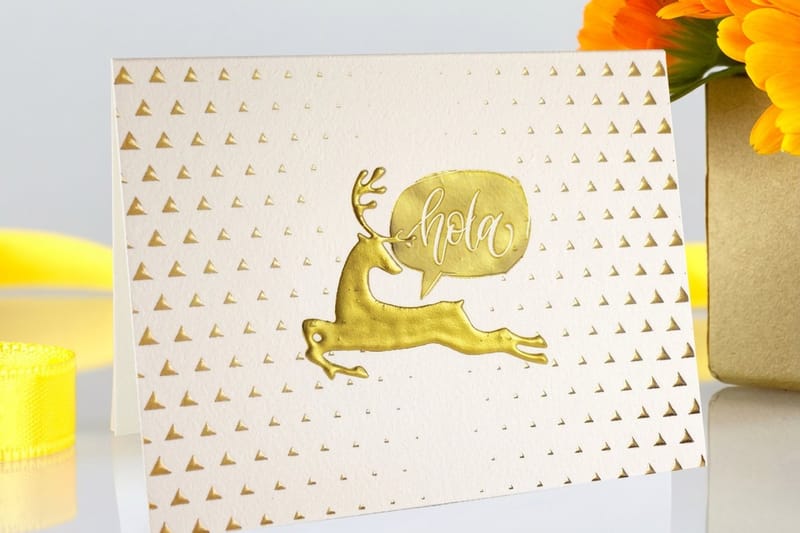
This is where the money goes, so it is worth being blunt about what each finish buys and what it costs.
Raised foil sits proud of the surface, so it catches light from an angle and it catches a fingertip. Raised foil greeting cards come in gold, silver or holographic, on 16 point soft velvet laminated stock, in one size only: a 10 x 7 sheet folding to 5 x 7. The run starts at 100 for $618.16, which is $6.18 a card. At 500 the same card is $921.31, or $1.84 each. Foil is not expensive per card at volume. It is expensive at small volume, and that is the decision. If you want the mechanics of the process, foil stamping versus raised foil explains why the raised version reads differently in the hand.
Soft touch changes the card before anyone looks at it. Suede greeting cards use a 16 point suede laminate that feels like chalk in the best sense, and they start at 500 for $617.67, about $1.24 a card, falling to roughly 68 cents at 1,000. There is a quieter option worth knowing: the standard Christmas greeting card paper list includes 16pt uncoated with soft touch, so you can get the feel at a run of 50 instead of 500. It is not identical to the full suede lamination, and for a short list it is close enough.
Metallic accent is the middle path. Metallic greeting cards put a foil accent on the front of 16pt gloss cover, with a choice of no coating, high gloss UV, or spot UV on the front. Six folded sizes, minimum 500 at $690.88, about $1.38 a card. Spot UV on top of a metallic accent is one gloss too many on a busy design and excellent on a plain one.
Set the foil file up properly or it will not run
Foil is a separate plate, not a color in your artwork. It needs its own layer, in 100 percent solid black, with hard edges and no gradients, no drop shadows and no hairlines thinner than about half a point. Anything soft either fills in or drops out.
Our walkthrough on what foil stamping is covers the process end to end, and the raised foil collection shows the other products that take the same treatment if you are building a matched set.
Folded or flat, and what the fold really costs
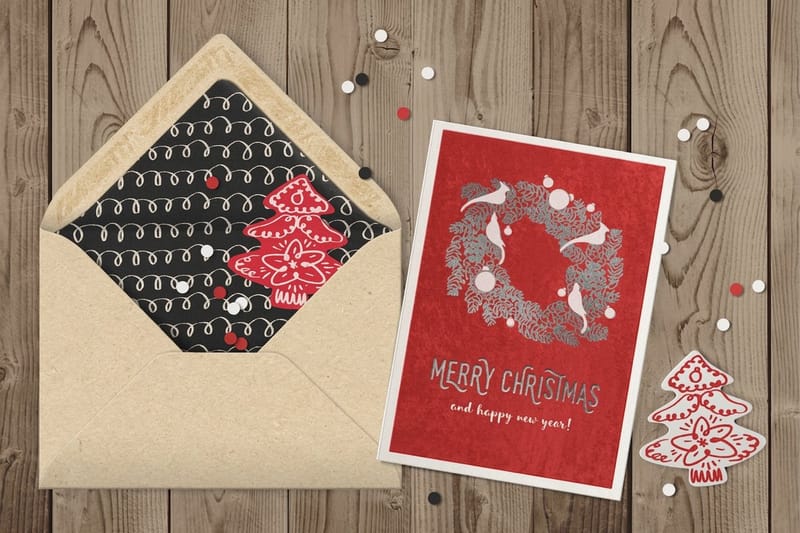
A folded card gives you four panels, hides the message until it is opened, and stands up on a desk. A flat card gives you two panels, arrives face up, and skips the envelope entirely. Neither is better. They fail in different places.
The folding option itself is easy to miss. On our folded cards you choose between "scored and shipped flat" and "fold to finished size". Take the flat option when something goes inside the card, a gift card, a voucher, a photo, because you will be handling every card anyway and a pre-folded card is harder to insert into. Take the folded option when the cards go straight into envelopes.
One more constraint decided by the fold: the envelope. A 4.25 x 5.5 card takes an A2 and a 5 x 7 takes an A7. On Christmas greeting cards the matching option is a white wove A2, raised foil and suede cards offer a white wove A7, and metallic cards a premium 70# A6. You cannot fit a 5 x 7 layout into an A2, so choose the finished size before the artwork rather than after. Flat versus folded greeting cards and the standard greeting card sizes guide both go deeper on this.
Adding a personal or branded touch
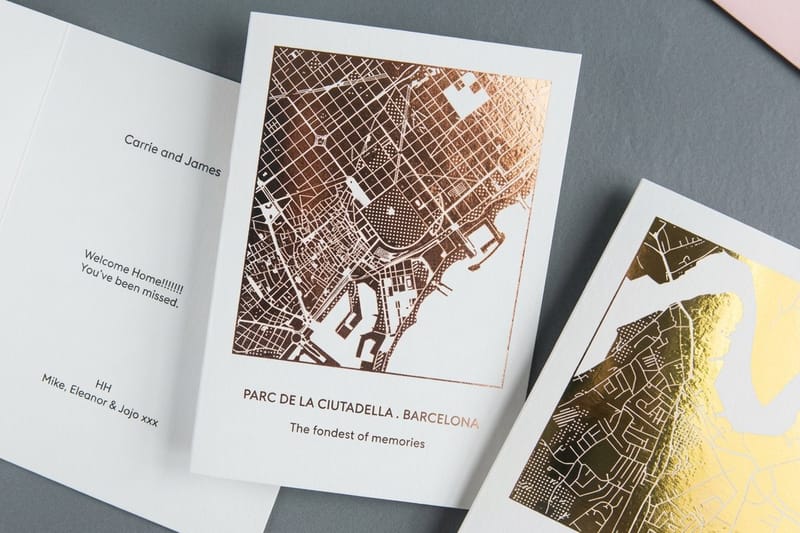
The cheapest upgrade on any holiday card is a handwritten line. It requires uncoated stock, a 4/0 print so the inside is blank, and about fifteen seconds per card. On a list of 100 that is under half an hour, and it is the difference between a card that gets read and a card that gets stacked.
Branded touches that are worth the extra step: a printed envelope so the card is recognizable before it is opened, a short note that names something specific from the year rather than a generic thank you, and a matching New Year card sent in January when nobody else is sending anything. That last one lands in an empty mailbox instead of a full one.
Envelopes are their own decision. Blank matching envelopes come with the card as an option; a printed return address or a full-bleed design needs printed envelopes ordered alongside. Before you address a stack of them, our guide to addressing Christmas cards covers the titles and formats that quietly matter.
A QR that leads somewhere worth going
If you put a code on the card, point it at something made for the occasion: a short thank you video, a year in review page, a holiday offer. A code that lands on a homepage teaches people not to scan your codes again.
Keep it small and put it on the back panel. A QR code on the front of a holiday card is an advert with tinsel on it.
Holiday card trends for 2026 and what each one costs
The holiday card designs worth ordering for 2026 lean on paper and finish more than on illustration. Each direction below is a card you can print this season, priced per card at the run where it makes sense.
- Quiet minimal fronts. One flat color field and a small greeting on a plain folded 5 x 7.
- Texture you can feel. Suede laminate on a run of 500, or the soft touch stock on the standard card for a short list.
- Metal that catches the light. A metallic foil accent on gloss cover, with spot UV on a plain layout.
- Raised foil on one element. Gold, silver or holographic foil on the greeting alone.
- Square and long shapes. The 6 x 6 and 5.5 x 4.25 suede formats stand out in a mantel full of rectangles.
Choose the finish that fits the size of your list, then design the front around it. The table lines up the stock, folded sizes, minimum run, per card price and standard production time for each specialty option.
| Finish | Stock | Folded size | Minimum run | Per card | Production |
|---|---|---|---|---|---|
| Plain folded card | 14pt gloss cover to 18pt cream uncoated | 4.25 x 5.5 or 5 x 7 | 50 | $1.12 at 50, about 33 cents at 500 | 5 business days |
| Suede soft touch | 16pt suede laminated | 5 x 7, 4.25 x 5.5, 4.5 x 6, 6 x 6 or 5.5 x 4.25 | 500 | $1.24 at 500, about 68 cents at 1,000 | 7 business days |
| Metallic foil accent | 16pt gloss cover, no coating, high gloss UV or spot UV | Six sizes, 4.25 x 5.5 to 5.5 x 8.5 | 500 | $1.38 at 500, about 91 cents at 1,000 | 7 business days |
| Raised foil | 16pt soft velvet laminated, gold, silver or holographic foil | 5 x 7 only | 100 | $6.18 at 100, $1.84 at 500 | 7 business days |
Upload a print ready PDF at the flat sheet size, 10 x 7 inches for a 5 x 7 card or 8.5 x 5.5 inches for a 4.25 x 5.5, with 0.125 inch bleed on the outer edges. Foil goes on its own layer in 100 percent solid black, and every one of these cards offers a free online proof in the configurator.
Holiday card pricing and specs at 4OVER4.COM
On a folded Christmas greeting card the length of your list moves the budget more than any design choice, and standard production is 5 business days. The numbers below come straight from the live configurator, so you can size the budget before you commit to a design.
Quantity and price
Christmas greeting card pricing and specs
Real configurator numbers on the folded Christmas card on 14pt gloss cover.
| Quantity | Price Per Unit | Total |
|---|---|---|
| 50 | $1.12 | $56.02 |
| 100 | 78.0¢ | $77.99 |
| 200 | 50.0¢ | $99.95 |
| 300 | 40.6¢ | $121.92 |
| 400 | 36.0¢ | $143.89 |
| 500 | 33.2¢ | $165.86 |
Choosing a card for your kind of list
The right format depends less on taste than on how many people are on the list and what happens to the card after it arrives.
- Small businesses and studios. A folded 4.25 x 5.5 card from a run of 50 covers a client list without a committee. Uncoated stock, blank inside, signed by hand.
- Agencies and professional firms. Raised foil at 500 behaves like a portfolio piece. Order early, because foil is a separate plate and a separate step.
- Retail and hospitality. Flat Christmas postcards, printed both sides, doubling as a December offer that mails without an envelope.
- Real estate and local services. Postcards for the farm area and folded cards for past clients. Variable data puts a real first name on the postcard half of the list.
- Families and photo cards. A 5 x 7 folded card if you want it standing on a shelf, a flat card if you want it seen the moment it arrives.
Print it
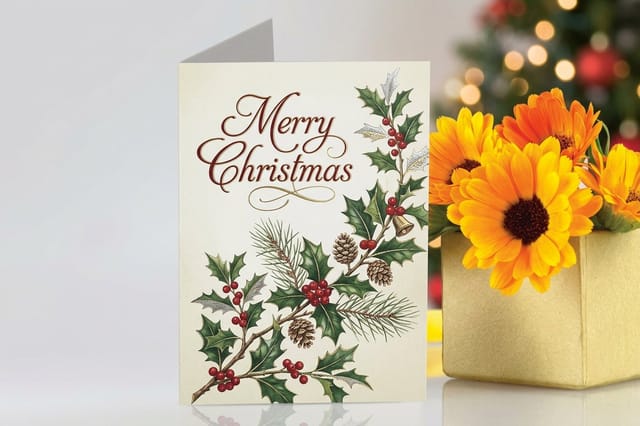
Folded Christmas cards, ready to sign
From 50 cards, in gloss, matte, uncoated or cream uncoated; matching A2 envelopes are optional.
Blanks that keep a November deadline
Starting from a blank artboard in November is how deadlines get missed. 4OVER4.COM sizes its blanks to the exact product specs, an 8.5 x 5.5 inch sheet for the 4.25 x 5.5 card and a 10 x 7 inch sheet for the 5 x 7, with the score line, 0.125 inch bleed and safe margin already marked, so your artwork lands where the press expects it. Folded cards take 5 business days in production and foil, suede and metallic take 7, so a file built on a blank in early November still leaves time for a proof round. Pull one from the blank template library or start from a finished layout in design templates.
Start fast
Holiday card templates and print-ready blanks
Greeting card layouts plus exact-size blanks with the fold and bleed marked for you.

Wally folds the card before he designs it
The finished size decides the envelope, and the envelope decides the artwork
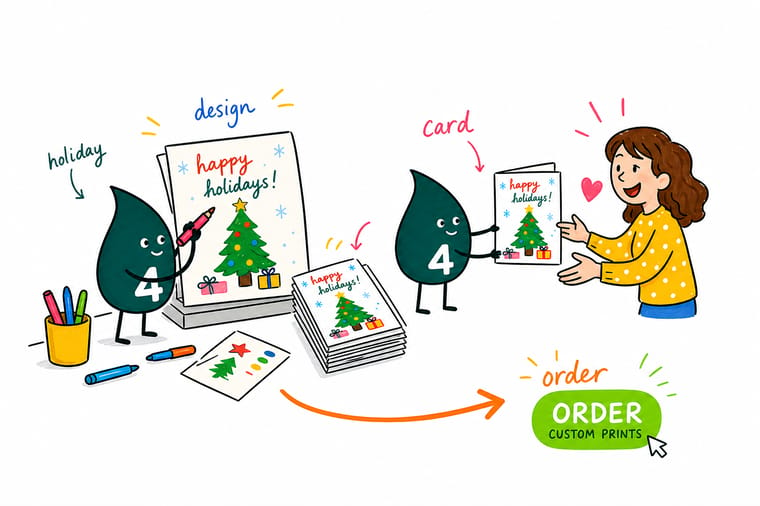
Pick 4.25 x 5.5 inches for an A2 envelope or 5 x 7 inches for an A7, then design to that panel. Keep type clear of the score line, add 0.125 inch bleed on the outer edges, and print 4/0 on uncoated stock if anyone is signing by hand. 4OVER4.COM prints from 25 cards, with matching blank envelopes as an option.
Order holiday cards →What separates a card that gets kept
Explore more
More ways to print the season
Folded, flat, foil and suede cards for the season, plus size and foil guides.
Product Christmas Greeting Cards Folded cards from 50, in cream uncoated through 18pt cover. Product Raised Foil Greeting Cards Gold, silver or holographic foil raised off velvet stock. Product Suede Greeting Cards A soft touch laminate in five folded sizes, including a square. Product Metallic Greeting Cards A metallic foil accent on gloss cover, with optional spot UV. Product Christmas Postcards Flat, both sides printed, no envelope to stuff. Product Business Christmas Cards Business card format for tucking into gifts and orders. 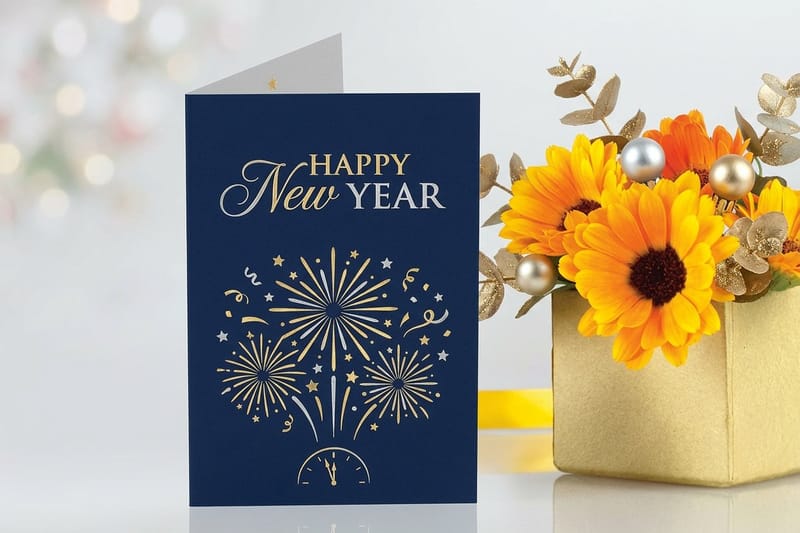 Product New Year Greeting Cards The January card that lands in an empty mailbox.
 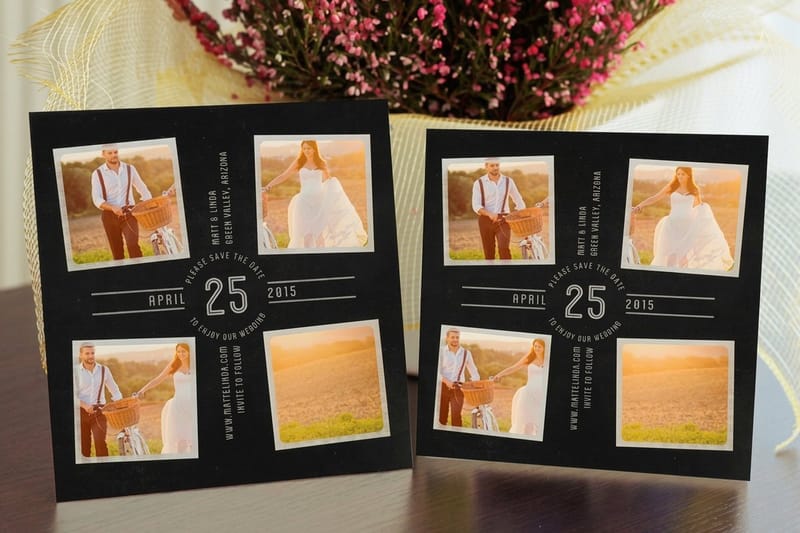 Category Greeting Cards Printing Every folded and flat card format in one place.
 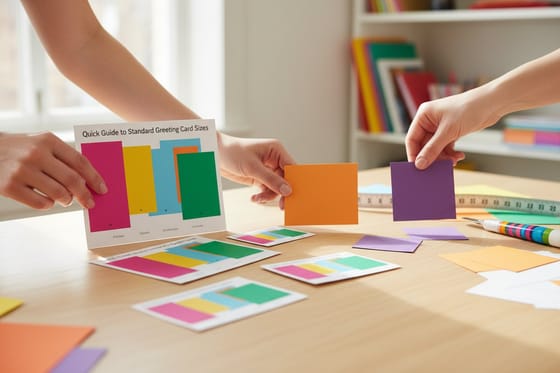 Guide Standard Greeting Card Sizes Every finished size and the envelope that fits it.
 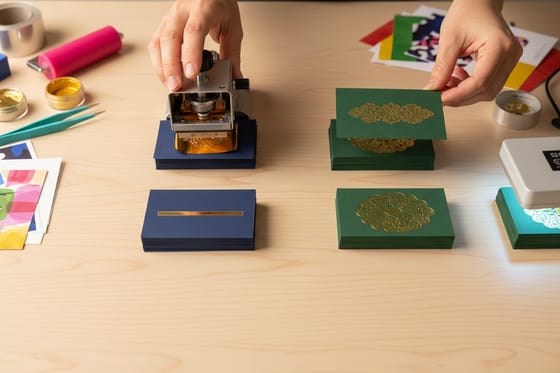 Guide Foil Stamping vs Raised Foil What changes between flat foil and raised foil in the hand.
 Ready to print this year's card?
Pick the finished size, drop in your design or a free blank, and 4OVER4.COM prints it on cover stock from 25 cards up, with matching envelopes if you want them.
Common questions about holiday cards
What is the smallest number of holiday cards I can order?
Twenty five, on Christmas Cards, the lowest minimum on any of our folded holiday formats. The formats table at the top lists the minimum for every card. If your list is under 100 people, the 16pt uncoated with soft touch stock on a standard folded card is the realistic route to a specialty feel, because raised foil starts at 100 and suede and metallic at 500.
Should the inside of a holiday card be printed or left blank?
Leave it blank if anyone is signing it by hand. That means choosing 4/0, which prints four color on the front and leaves the back and inside unprinted, and pairing it with an uncoated or cream uncoated stock so a pen bites into the surface. Choose 4/4 when the message is printed and no handwriting is planned, because full color on all four panels looks finished but leaves nowhere to write. A common slip is a 4/4 card with high gloss UV coating that somebody then tries to sign, and ballpoint ink sits on top of that coating rather than drying into it.
Do holiday cards come with envelopes?
Matching blank envelopes are an option, not an automatic inclusion, so tick it in the configurator; the fold section above lists which size each card offers. Business Christmas cards have no envelope option at all, because they are business card sized and meant to go inside a package or a gift. If you want a printed return address or a designed envelope, order printed envelopes alongside the cards.
Is raised foil worth it on a holiday card?
It depends on the size of your list. At the 100 minimum the per card price is high for a card that gets looked at once; at 500 it competes with a plain card on premium stock. If your list is small and you still want a metal look, the metallic accent card costs less per card at 500, and a heavier uncoated stock with a strong single-color design can read more expensive than weak foil does.
When should I order holiday cards to have them in hand in time?
Work backwards from the day you want to mail, and give yourself more room than the standard turnaround suggests. Order the plain folded cards with at least two weeks of slack, and give the specialty finishes more than that, because raised foil and suede are separate processes rather than a setting on the same press. The step people forget is the human one: signing, stuffing and addressing a few hundred cards takes an afternoon, and it happens after the boxes arrive. If a proof is part of your plan, add the approval round to the timeline too, since nothing prints until you sign off on it.
