
Panoramic Photo Prints and 5 Ways to Use Panoramic Canvas Artwork


Tobias is our voice for cutting, binding and large format, built from the knowledge of our production team, with over 20 years in printing.
What Counts as a Panoramic Photo Print

Panorama photo printing starts with the shape of the photo rather than its subject: once the long side runs at least twice the short side, the print counts as panoramic, and 4OVER4.COM prints it on canvas from $59 or on acrylic from $152.72. At that ratio the eye stops reading the picture as a rectangle and starts travelling across it. That is why a 12 by 36 inch canvas of a shoreline holds a room's attention far longer than the same shoreline cropped down to 8 by 10. To compare framed and stretched options for a panoramic canvas print, start with the canvas collection.
Panoramas reach the print queue three ways. A phone sweep in pano mode, a stitched sequence from a mirrorless or DSLR body, or a wide crop pulled out of one high resolution frame. All three can print beautifully, but each arrives with a very different pixel budget, and that budget decides how large the finished piece can go.
How big a panoramic photo can print
A panoramic photo has no fixed size. The ratio defines it, and the pixel width decides how far it stretches. Divide the pixel width by 100 for a wall seen from six feet or more, or by 150 for a piece people stand close to, and the answer is the largest sharp print in inches. A stitched 6,000 pixel wide file prints at 60 inches wide at 100 PPI, and a 5,400 pixel wide phone pano gives a crisp 36 inch canvas at 150 PPI. Phone files that come out closer to 5 to 1 usually get cropped back to 3 to 1 first.
4OVER4.COM has produced 10 billion+ print products since 1999, and wide-format canvas is the format customers most often order twice, almost always for the same reason. They choose the size that fits the wall first and open the file second. Reverse that order and panoramic printing gets simple. Read the pixel dimensions, divide by the print size in inches, and let the resulting number tell you how big the image is willing to go.
Start with the aspect ratio
Divide the long pixel side by the short one. A result near 2.0 suits a 24 by 48 inch canvas, near 3.0 points at 12 by 36 or 20 by 60, and anything past 3.5 belongs in a hallway or above a headboard where the wall itself is long.
Check the pixel dimensions before the price
A 6,000 pixel wide file supports a 60 inch canvas at 100 PPI. The same file forced onto 96 inches drops to 62 PPI and the horizon line goes soft. Pixels, not enthusiasm, set the ceiling.
Decide the viewing distance
Resolution requirements fall as viewers step back. Artwork seen from six to ten feet across a living room prints cleanly at 100 to 150 PPI. Only pieces people lean into, like a print behind a desk, need to push higher.
Choose the material last
Canvas, framed canvas, and acrylic each change how a wide image reads. Settle the ratio, the size, and the file first, then pick the surface that matches the room's light and the mood of the photograph.
Shop the format
Canvas printing collection
Long formats, squares and wraps for photo artwork of any width.

Panoramic Canvas Sizes and the Resolution Behind Them
Standard panoramic print sizes by ratio
Standard panoramic print and frame sizes fall into two ratio families, starting at $59 on premium canvas, with the minimum file size for a sharp print at 100 PPI beside each one.
- 2 to 1. 24 x 48 inches, from a file at least 2,400 by 4,800 pixels.
- 3 to 1. 12 x 36 inches from 1,200 by 3,600 pixels, 16 x 48 inches from 1,600 by 4,800, and 20 x 60 inches from 2,000 by 6,000. At 150 PPI the 12 x 36 wants 1,800 by 5,400.
- 4 to 1 and wider. No standard canvas size; crop to 3 to 1 or split the image across three square canvases.
There is no single official panoramic size, which trips up everyone searching for one. What exists instead is a family of long ratios, and the standard canvas sizes that fit them. The math never changes: pixels divided by inches equals PPI, so a 5,400 pixel wide file on a 36 inch canvas lands at exactly 150 PPI, comfortably sharp for wall art.
Prices below start from the live configurator. Premium Canvas Prints begin at $59 and cover the long single-panel formats, while Square Canvas Prints also start at $59 and let you build a panorama out of panels.
- 12 x 36 inches, a 3:1 ratio. Wants about 1,800 by 5,400 pixels at 150 PPI. The most forgiving panoramic size and the safest home for a phone pano.
- 16 x 48 inches, a 3:1 ratio. 2,400 by 7,200 pixels at 150 PPI, or 1,600 by 4,800 at 100 PPI for a hallway people walk past rather than study.
- 20 x 60 inches, a 3:1 ratio. 2,000 by 6,000 pixels clears it at 100 PPI, which most three-frame stitched landscapes deliver without any upscaling.
- 24 x 48 inches, a 2:1 ratio. 2,400 by 4,800 pixels at 100 PPI. A gentler ratio that flatters a landscape carrying a big sky or a wide reflection.
- Three 20 x 20 inch squares. Hung with 2 inches of wall between panels, a triptych reads as one 64 inch panorama while shipping in three easy boxes.
If your file lands between two sizes, size down rather than up. Interpolating a photo to fill a bigger canvas invents pixels that were never captured, and the softness shows up worst in the exact places panoramas draw the eye: the horizon, a skyline, a row of windows. Printing 20 by 60 from a file that truly supports it beats printing 24 by 72 from one that does not.
Print picks
Three formats that suit a panorama
Live starting prices, ready to size and configure for your file.
 Premium Canvas Prints $59 each Gallery-wrapped canvas in long formats built for wide landscape files.
 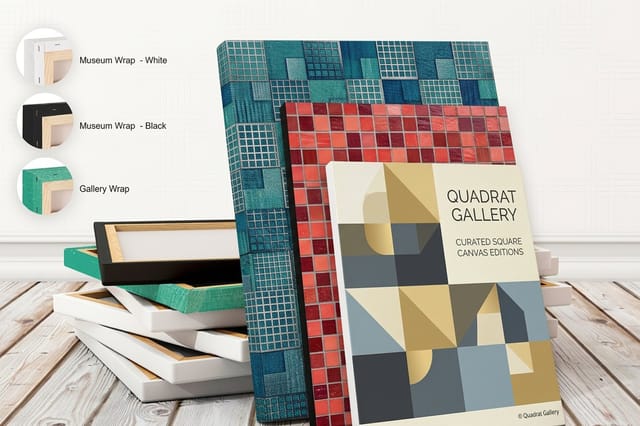 Square Canvas Prints $59 each Split one panorama across three squares for a triptych that spans a wall.
 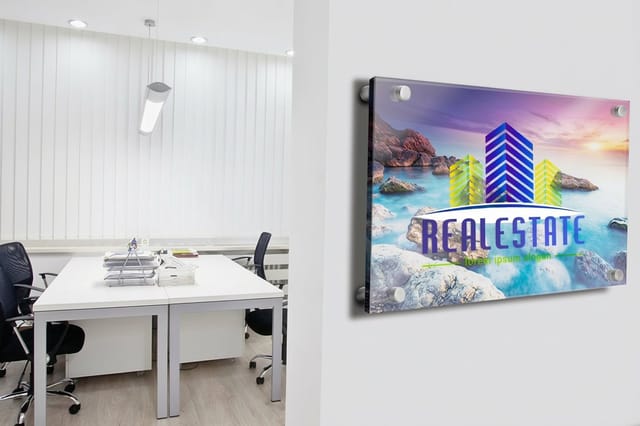 Acrylic Prints $152.72 each Glossy depth and saturated color for panoramas hung in bright rooms.
 Five Ways to Use Panoramic Canvas Artwork

A panorama is a shape looking for a wall that shares its proportions. These five placements come up again and again in customer photos, and each one solves a specific problem that ordinary rectangular art cannot.
1. Above the sofa or the headboard
The wall above a three-seat sofa is roughly 84 inches wide, and a single 20 by 60 inch canvas fills it in the proportion designers aim for, about two thirds of the furniture width. One long piece also skips the alignment headache of hanging three separate frames over a couch nobody wants to move twice.
2. A hallway that finally has a subject
Hallways are viewed at an angle and in motion, which forgives resolution and rewards a strong horizontal line. A 16 by 48 inch canvas of a coastline or skyline turns a pass-through into a destination, and because nobody stands still to study it, a 100 PPI file does the job.
3. A triptych split across three canvases
Cut one wide image into three equal panels and print each on a square canvas. The gaps between panels become part of the composition, and the piece scales to almost any wall by changing the spacing. The canvas photo collage guide walks through slicing the file so the seams fall in quiet parts of the frame.
4. Over a doorway, window, or built-in shelf
The band of wall above a door or between cabinetry and the ceiling is often 12 to 16 inches tall and several feet wide, a shape that fits nothing except a panorama. A 12 by 36 inch canvas slotted there uses space that would otherwise stay blank, and it draws the eye upward in rooms with low furniture.
5. Reception walls and conference rooms
A stitched city skyline behind a reception desk, or a wide shot of the team on the conference room wall, does more brand work than a logo decal. Businesses usually order these in pairs or threes for consistent rooms, and canvas keeps glare down under the overhead lighting most offices run.
Canvas, Framed Canvas, or Acrylic for a Wide Image
The material changes the photograph. Canvas weave scatters light, which softens harsh digital edges and flatters landscapes, portraits, and anything with skin or foliage. Acrylic does the opposite. It deepens blacks and makes saturated color pop, which suits night skylines, water, and neon, though it will mirror a window if you hang it opposite one.
Two guides go deeper on the comparison. Acrylic prints vs canvas prints covers the surfaces head to head, and acrylic vs canvas vs framed canvas adds the framed option, which matters most for panoramas because a long unframed edge is the part people notice first.
- Gallery-wrapped canvas. Lightest option per square foot, easiest to hang at 60 inches wide, and no glass to catch a lamp. Budget about an inch of image loss on every edge.
- Framed canvas. A floating frame gives the long edges a finished line and stops a wide canvas from reading as unfinished on a formal wall.
- Acrylic. Highest contrast and a sense of depth behind the surface, heavier to mount, and the strongest choice for skylines, water, and low-light photography.
One practical note on weight. A 20 by 60 inch acrylic panel is substantially heavier than the same canvas, so plan the hardware before the order rather than after the delivery.
Compare finishes
Popular canvas formats, side by side
Sizes, surfaces, quantities and turnaround lined up in one table.
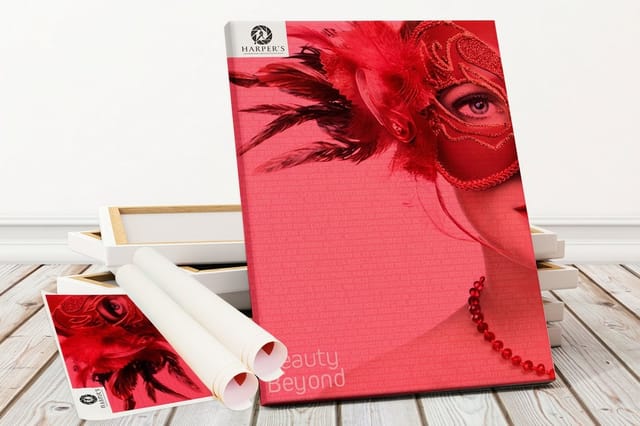 Rolled Canvas | 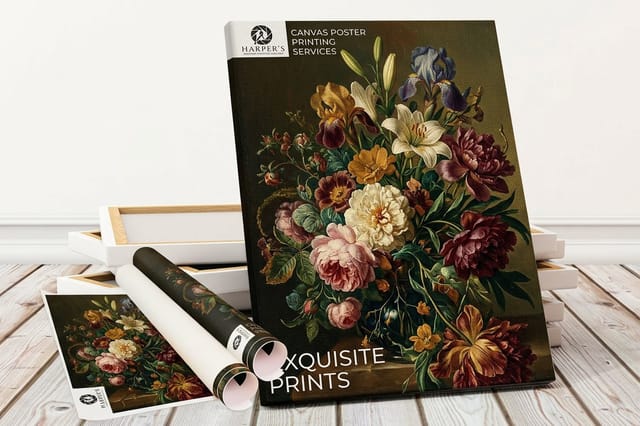 Canvas Posters | Premium Canvas Prints | Square Canvas Prints | |
|---|---|---|---|---|
| Min price | $25.00 | $25.00 | $59.00 | $59.00 |
| Paper / stock | Semi Gloss Canvas | Semi Gloss Canvas | - | - |
| Size | 11" x 14" | 11" x 14" | 11" x 14" | 11" x 14" |
| Default qty | 1 | 1 | 1 | 1 |
| Turnaround | 2 business days | 2 business days | 3 business days | 3 business days |
| Rating | ||||
| View & customize | View & customize | View & customize | View & customize |
Preparing a Panoramic File So It Prints Sharp
Most disappointing panoramic prints trace back to the file, not the press. Five checks catch nearly everything, and all of them take less time than choosing the photo did.
- Match the ratio exactly. Crop to the ordered ratio yourself. Leaving it to an automatic fit means the system decides which part of your horizon gets cut.
- Respect the wrap. Gallery-wrapped canvas pulls roughly the outer inch around the frame. Keep horizons, faces, and signage well inside the safe area.
- Check the stitch seams. Zoom to 100 percent along the joins in a stitched pano. Misaligned rooflines or a doubled cloud are invisible on a phone and obvious at 60 inches.
- Export at print scale. Send the largest available pixel dimensions rather than a resized web copy, and use a lossless or high quality export.
- Sharpen for the surface. Canvas absorbs a little detail, so a modest output sharpening pass helps. Acrylic needs almost none.
The pricing and specification tables below come from the live configurator, so the numbers move with your quantity and size selection rather than sitting in a static chart.
Quantity and price
Premium canvas pricing and specs
Real configurator numbers. Size and quantity both move the price.
| Quantity | Price Per Unit | Total |
|---|---|---|
| 1 | $59.00 | $59.00 |
Hanging and Lighting a Panorama Without Guesswork
Hang the center of the piece at about 57 to 60 inches from the floor, the standard gallery eye line, and measure to the center rather than the top. On a wide canvas that difference is several inches, and getting it wrong makes the whole wall feel tilted even when the piece is level.
Long pieces need two hanging points, spaced roughly a third in from each end, so the frame cannot pivot. For framing questions the canvas framing guide covers floating frames and hardware, and the foamboard hanging article is useful if you are testing a layout with a lightweight proof before committing to canvas.
Light a panorama from the front at an angle of about 30 degrees. Straight-on light flattens the canvas texture, and steeper light rakes across the weave and exaggerates it. If the piece hangs opposite a window, acrylic will show that window, so canvas is the safer surface on a wall that faces glass.
Premium finish
Acrylic prints
A glossy panel that adds depth and holds contrast under bright hallway lighting.
Where Panoramic Prints Earn Their Space Beyond the Living Room
Panoramic artwork solves problems in commercial spaces that standard sizes cannot. Restaurants use a long print above a banquette because it follows the seating line. Clinics use one above a reception counter because it sits in the only clear band of wall. Studios and gyms use wide crops because the shape suits equipment-heavy rooms with limited free wall.
Multi-panel sets are the flexible choice for these rooms. Three or four square canvases can be re-spaced when furniture changes, they ship and carry more easily than one oversized piece, and a single panel can be swapped for a seasonal image without redoing the whole wall.
Photographers selling prints benefit from the same logic. A panorama is a format clients rarely find at big-box retail, which makes it an easy upsell after a landscape or venue shoot.
Multi-panel option
Square canvas panels
Split one wide photograph across three squares, then space them to fit the wall.
How Panorama Photo Printing Works at 4OVER4
You can get a panoramic photo printed on canvas or acrylic at 4OVER4.COM in six steps, from the file on your phone to a piece that arrives ready to hang.
- 1. Check the ratio and pixel width. Long side divided by short side, then pixel width divided by print width, at 100 PPI or better.
- 2. Pick the size. The standard panoramic size closest to your crop, or a custom size where the file supports it.
- 3. Pick the surface. Premium canvas from $59 on semi gloss canvas with a 1.5 inch gallery wrap or museum wrap, square canvas panels from $59 for a triptych, or acrylic from $152.72 on 1/4 inch plexiglass.
- 4. Upload the file. The largest export you have, cropped to the ratio you ordered.
- 5. Approve the proof. Choose the free online proof in the configurator and check the wrap edges before production.
- 6. Receive it ready to hang. Canvas is produced in 1 to 3 business days and acrylic in 1 to 4, then shipped.
Ordering Your Panoramic Canvas
Work in this order and the order goes right the first time. Measure the wall, subtract about a third for breathing room, pick the closest standard panoramic size, then divide your pixel dimensions by that size in inches to confirm you are at or above 100 PPI. Only then choose canvas, framed canvas, or acrylic.
If you are pricing a larger project or comparing wall art formats before committing, the guide to affordable photo and poster prints lays out where the cost actually sits. Templates and print-ready blanks below give you the exact working dimensions, so your crop matches the press file with no surprises at the edges.
A quick pre-order checklist
- Ratio confirmed. Long side divided by short side matches the size you are ordering.
- Resolution confirmed. Pixels divided by inches lands at 100 PPI or better.
- Wrap allowance made. Nothing important sits within an inch of any edge.
- Surface chosen for the room. Canvas for glare-heavy walls, acrylic for contrast and depth.
Start fast
Canvas templates and print-ready blanks
Exact working dimensions so your crop matches the press file at every edge.
Wally sizes your panorama for you
Right ratio, right resolution, right wall
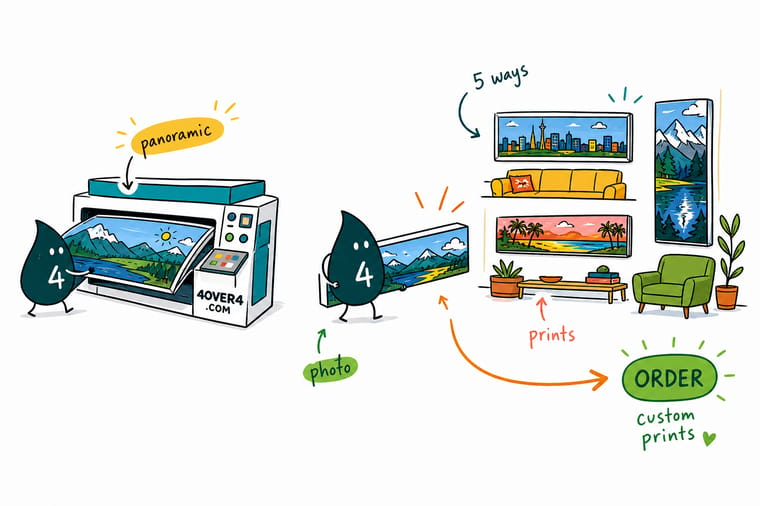
Wide photos fail for one boring reason: the wall gets chosen before the file gets checked. Wally does it the other way round. Read the pixel width, divide by the canvas width in inches, and if the answer is 100 or more you are clear to print. Keep the horizon an inch away from every edge so the gallery wrap does not eat it, then pick canvas for soft light or acrylic for punch.
Design your panoramic canvas →Getting a Wide Photo Onto a Wall
By the numbers
Panoramic printing at a glance
The production record behind the press and the two numbers that decide your print.
- 10B+ Print products, produced since 1999.
- 150,000+ Businesses served, across every industry.
- 3:1 Most common panoramic ratio, 12x36, 16x48 and 20x60.
- 100 PPI Working minimum for wall art, viewed from six feet.
Go deeper
Guides for canvas and wall art
Surfaces, framing and multi-panel layouts, explained step by step.
Guide Acrylic Prints vs Canvas Prints The two surfaces compared head to head for photo artwork. Guide Acrylic vs Canvas vs Framed Canvas Adds the framed option, which matters most on long edges. Guide How to Frame Canvas Prints Floating frames and hardware for wide, heavy pieces. Guide Canvas Photo Collage in Four Tips Slice one wide image into a clean multi-panel set. Explore more
More ways to print photographs big
Related pages across 4OVER4.COM, one card per page type.
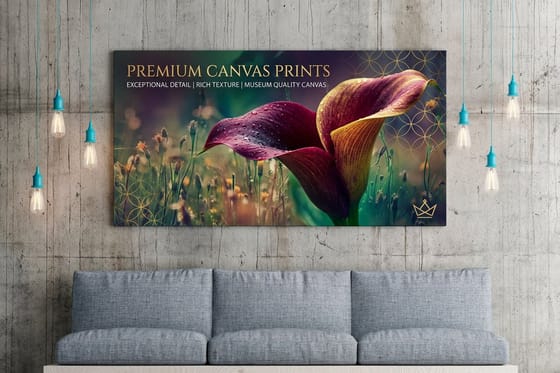 Guide Canvas Print Ideas for Offices, Lobbies and Storefronts Size canvas for every wall in the building, choose a gallery or museum wrap, and hang it clear of glare.
  Article Best Canvas Prints for Museum Worthy Wall Art at Home Which canvas prints actually look museum worthy? Compare canvas texture, ink longevity, frame depth, and photo
  Collection Canvas Printing Collection Every canvas format, size and wrap in one place. Product Premium Canvas Prints Gallery-wrapped canvas built for long panoramic files. Product Square Canvas Prints Panels that combine into a panoramic triptych.
  Product Acrylic Prints High-contrast depth for skylines and night photography.
  Guide Acrylic vs Canvas Prints Which surface suits your photograph and your room. Guide Acrylic vs Canvas vs Framed Three finishes compared for wall-sized photo art.
  Guide How to Frame Canvas Prints Finish the long edges of a wide canvas properly.
  Guide Canvas Photo Collage Tips Turn one panorama into a multi-panel display.
  Guide Affordable Photo and Poster Prints Where the cost really sits on large-format artwork. Article Four Ways to Hang Foamboard Prints Test a wall layout before committing to canvas.
 Ready to put that wide shot on the wall?
Check the ratio, confirm the resolution, then choose canvas, framed canvas or acrylic. Premium Canvas Prints and Square Canvas Prints both start at $59.
Panoramic Printing FAQ
What size is a panoramic photo?
There is no single official panoramic size. A photo becomes panoramic once its long side measures at least twice its short side, which covers ratios from 2:1 through 4:1 and beyond. In printed canvas the common standards are 12 by 36, 16 by 48 and 20 by 60 inches at a 3:1 ratio, and 24 by 48 inches at a gentler 2:1. Phone panorama modes often produce even wider files, closer to 5:1, which usually get cropped back to a printable standard. Start from your file ratio and choose the canvas size that needs the least cropping, as covered in the acrylic vs canvas vs framed canvas guide.
How do I choose the right panoramic print for my wall?
Measure the usable wall width and aim for artwork covering about two thirds of it, or two thirds of the furniture below it. Then check your file: divide the pixel width by the print width in inches and confirm the result is 100 PPI or higher. If it is, order the single long canvas. If it falls short, either drop one size or split the image across three square canvases, where each panel only has to carry a third of the width.
What does printing panoramic photos cost and how is the price set?
Premium Canvas Prints and Square Canvas Prints both start at $59, and Acrylic Prints start at $152.72. Price moves with three things: the finished dimensions, the material, and the quantity ordered. Canvas is priced by surface area, so a 20 by 60 inch piece costs more than a 12 by 36 even though both share a 3:1 ratio. Acrylic carries a higher base because of the panel and the mounting hardware. Multi-panel triptychs are priced per panel, so three squares are quoted as three items. The live configurator on each product page shows your exact number before checkout.
What sizes, stocks and finishes are available for panoramic canvas?
Canvas comes gallery-wrapped over a wooden frame, with the image continuing around the sides, and long formats including 12 by 36, 16 by 48, 20 by 60 and 24 by 48 inches. Square canvases at sizes such as 20 by 20 inches can be combined into panoramic sets. Acrylic offers a glossy, high-contrast surface with visible depth and is the better pick for night scenes and water. Framed canvas adds a floating frame that gives a long edge a finished line. Custom dimensions are available where the file supports them.
How long does a panoramic canvas take to print and ship?
Turnaround depends on the product, the size and the finishing you select, and every option shows its own production time in the configurator before you pay. Large-format canvas and acrylic need stretching or mounting after printing, so they run longer than flat paper products. Shipping time is separate from production time and depends on the destination, which matters most on oversized pieces travelling in a large box. If a piece is meant for an event or a client handover, check the combined production and transit estimate at checkout and order with a few days of slack.
