
Print Postcards With Cool Options You Did Not Know Existed


Nadia is our customer education voice, built from the knowledge of our production team, with over 20 years in printing.
The Standard Flat Postcard Is Only the Starting Line
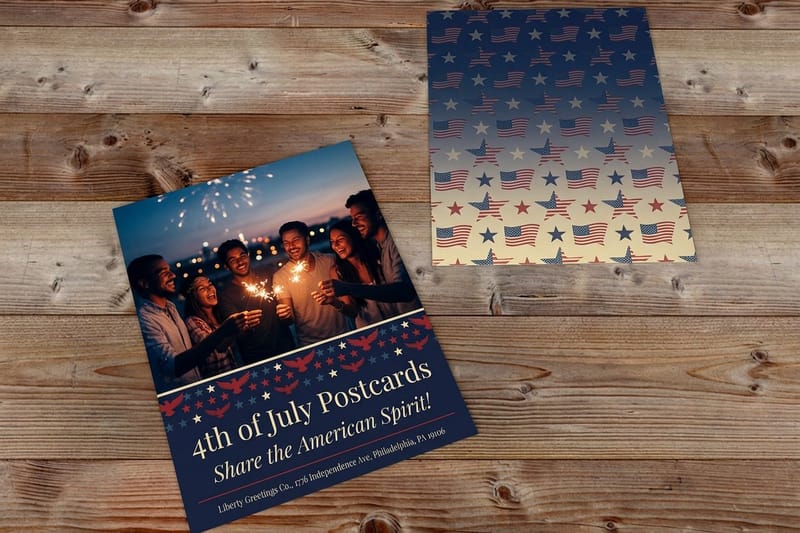
Almost every postcard that lands in an American mailbox is the same object. A flat rectangle, roughly four by six inches, printed both sides, coated gloss. It mails at the cheapest rate and it disappears just as fast, because the hand holding it has already sorted ten thousand identical cards and knows the arc from the mail pile to the recycling bin without reading a word of it.
The press does not care about that habit. The same equipment that runs flat cards will fold them into panels, cut them into silhouettes, stretch them well past letter size, laminate them so the artwork moves when tilted, or hand them straight to a carrier route with no mailing list attached. Every one of those options sits on the same order form.
4OVER4.COM has printed more than 10 billion cards and print products since 1999 for over 150,000 businesses, so the unusual formats here are not experiments, they are standing production. A trifold postcard runs on the same schedule as a flat one. A die cut shape needs a cutting die and a little more planning in the file, and that is genuinely the whole difference.
What makes an upgraded format worth paying for
One question settles it. Does the format do a job the flat card cannot do? More panels for a menu or a schedule. More square inches for a photograph that has to carry the message. An odd silhouette that gets pinned to a corkboard instead of tossed. A mailing program that covers a whole neighborhood. If the answer is no, print the flat card and put the savings into a better list.
Shop the format
Postcards printing at 4OVER4.COM
Every size, stock, fold and finish, priced live as you configure the run.
Half Fold Postcards Give You Four Panels for One Mailer
A half fold postcard is a single sheet scored down the middle and folded once, so a card that measures six by nine flat opens into four printable panels. It still travels as one piece, it still gets an address block and a stamp area, and it still costs a postcard rate when it stays inside the size the carrier expects. What you gain is sequence. The recipient sees a cover, then opens it and sees the rest.
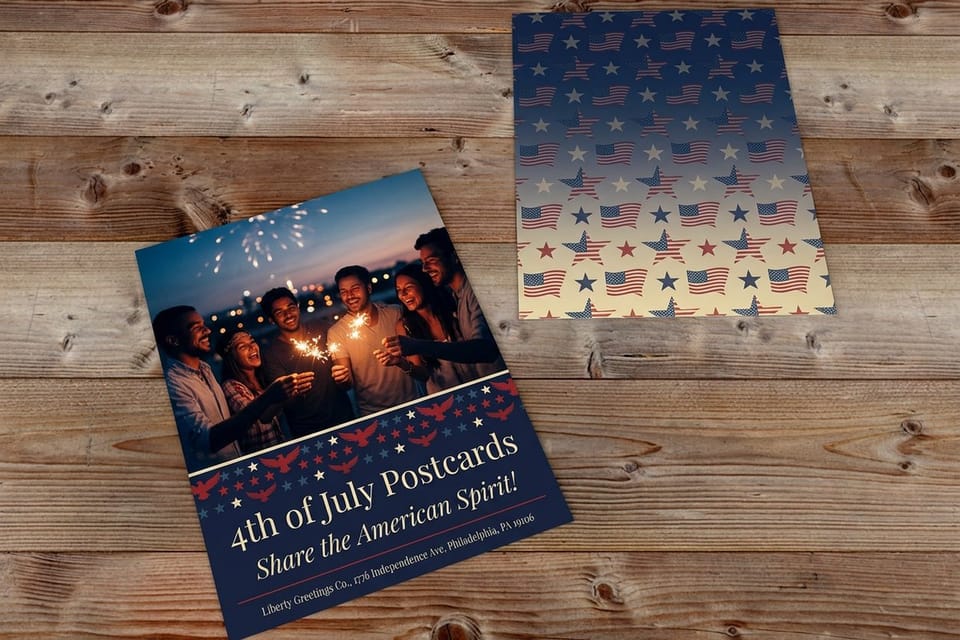
That reveal is worth more than the extra ink. Put the hook and one image on the outside, keep the inside for the detail that would have crowded a flat card, and hold the back panel for the offer and the address. Seasonal runs like 4th of July Postcards work especially well folded, because the date and the event details need room the front cannot spare. Watch the 4th of July Postcards video before you plan the panels.
Panel discipline matters more than design flair here. Every panel needs one job, and a panel that tries to do two ends up doing neither, the same trap described in what you should not put on a business card.
- Restaurant and menu mailers. Cover photograph outside, the full menu inside, hours and address on the back panel.
- Event invitations. The invitation on the cover, the schedule and parking inside, the RSVP path on the back.
- Service price lists. One headline claim outside, a clean price table inside where nothing has to be abbreviated.
- Real estate. The listing photo outside, the room by room detail inside, the agent contact on the address panel.
- Membership renewals. A warm cover line, the renewal terms inside, a tear friendly reply area on the back.
Print picks
Three postcard runs worth a closer look
Live prices, ready to configure with your own artwork.
 3D Lenticular Postcards 500 for $1097.28 A layered lens that animates the artwork as the card moves in the hand.
  4th of July Postcards 50 for $16.48 Seasonal stock sizes with room for an offer, a date and a map.
 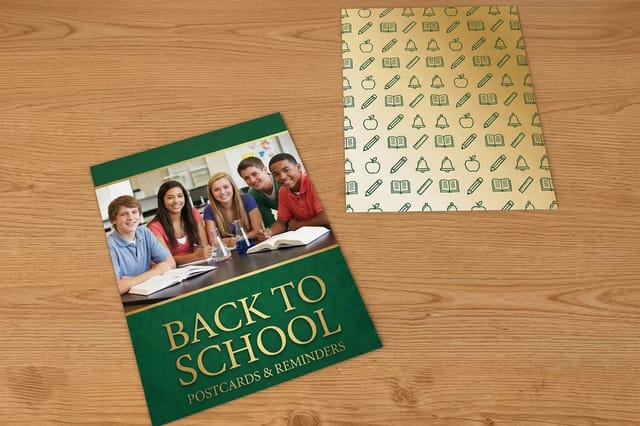 Back to School Postcards 50 for $16.48 Built for enrollment pushes, class schedules and August promotions.
 Trifold Postcards Carry a Brochure Through the Mail
A trifold postcard folds twice into six panels and still mails without an envelope. It is the closest thing print offers to a brochure that skips the packaging step, and for a business with a real catalog of services it turns one mailing into a document people keep in a drawer. The trade is thickness. Fold a heavy stock three times and the spine fights back, so the stock choice and the scoring have to be right before the run starts. When the piece will sit in a rack rather than go in the mail, choose bi-fold brochure printing instead.
Practically that means a lighter coated stock or a proper score, not a crease pressed in at the end. On a well scored trifold the panels lie flat, the folds stay sharp after a week in a bag, and the piece opens in one motion instead of three. If your project is heading toward something even more substantial than six panels, the binding options collection is where a mailer becomes a booklet.
- Multi service businesses. One panel per service, so nobody has to guess what else you do.
- Tour and travel operators. Itinerary across the inside spread, map on the outer panel, booking details on the back.
- Nonprofit appeals. Story on the inside spread, impact figures on one panel, donation path on the last.
- Clinic and practice mailers. Provider bios, insurance accepted, and directions without a single line of fine print.
- Product launches. Specifications inside, hero shot outside, dealer list on the panel that faces the address.
Oversized Postcards Win the Mailbox on Size Alone
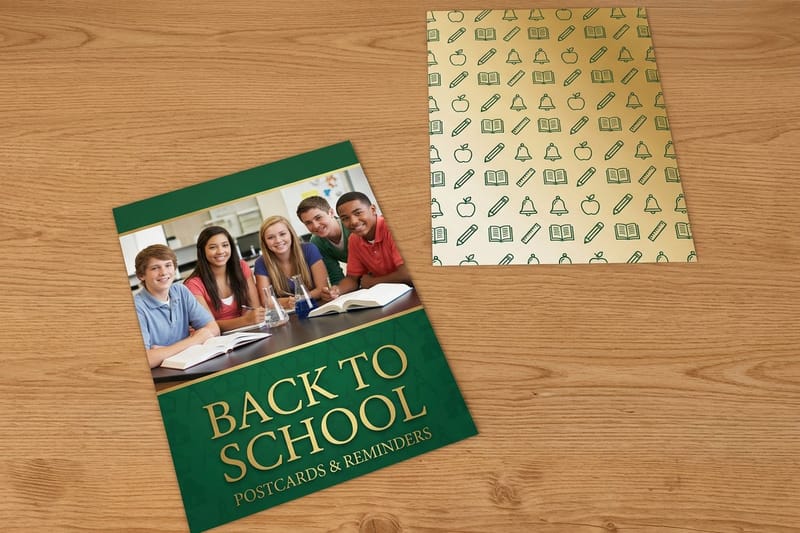
An oversized postcard is the least clever idea on this list and often the most effective. When a card is six by eleven or larger it cannot hide inside the stack of envelopes, it has to be handled separately, and handling is the moment where reading happens. There is no trick to it. You are buying physical presence, and physical presence is the one thing a screen cannot copy.
Postage is the honest catch. Past a certain size a postcard stops qualifying for card rates and moves up to letter or flat rates, which changes the per piece math. Run the postage before you commit to the dimensions, because a slightly smaller card mailed to twice as many people usually beats a giant card mailed to half the list. Seasonal runs such as Back to School Postcards are a good place to test the size question against a known audience. Watch the back to school postcards video before you settle the size.
- Grand openings. One address, one date, one photograph, at a size nobody can misfile.
- Retail sale announcements. A price or a percentage large enough to read from across the kitchen counter.
- Home services. Before and after photography that finally has room to be convincing.
- Political and civic mail. A single message and a date, where legibility beats cleverness every time.
- Menus for delivery. Large enough to live on a refrigerator door for the whole season.
Quantity and price
Postcard pricing and specifications
Real configurator numbers. The more you print, the lower the cost per card.
| Quantity | Price Per Unit | Total |
|---|---|---|
| 50 | 33.0¢ | $16.48 |
| 100 | 24.2¢ | $24.16 |
| 200 | 15.9¢ | $31.86 |
| 300 | 12.8¢ | $38.45 |
| 400 | 11.3¢ | $45.04 |
| 500 | 10.3¢ | $51.62 |
Die Cut Postcards Break the Rectangle
A die cut postcard is trimmed to a custom outline instead of a rectangle. It can follow the silhouette of a product, a building, a leaf, a coffee cup, or your logo mark. Because the shape itself is unusual, the card gets held longer, and cards that get held longer get read. Some die cut work also includes an interior cut, a window or a punched hole that turns the mailer into a hang tag or an ornament.
The file needs a cut path drawn as a vector on its own layer, plus enough bleed outside that path that a small shift on press never shows white edges. Keep type well inside the shape. Shapes built from a strong mark work best, which is a good reason to look at how the most recognizable logos are constructed before you hand a designer the outline. Product shaped cuts also translate well to other printed pieces, including the sleeves and boxes covered in the guide to food packaging options for small businesses.
- Product silhouettes. A card cut to the shape of the thing you sell needs no explanation at all.
- Hang tags and door hangers. An interior punch turns the same artwork into a piece that hangs.
- Rounded corner premium cards. The smallest die change available, and it reads as more expensive instantly.
- Bookmarks and keepsakes. Long narrow cuts that survive in a book long after a mailer would be gone.
- Seasonal shapes. Ornaments, leaves and stars that get displayed instead of filed.
EDDM Postcards Reach Every Door on a Route
Mail it smarter
Route level postcard mailing
Print a card sized for the mailing program, then cover every address on the routes you choose.
Every Door Direct Mail removes the hardest part of a mailing campaign, which is owning a good list. Instead of addressing individual households you choose carrier routes on a map, print the card at a size the program allows, bundle it the way the program requires, and the carrier delivers to every address on those routes. For a business whose customers are simply the people who live nearby, that is exactly the right targeting.
The rules are specific and unforgiving. The card has to fall inside the EDDM size range, it needs the correct indicia and route markings, and the bundles have to be counted and faced the way the post office expects. Get those right once and the format becomes repeatable. If you are weighing mail against every other channel, the numbers collected in these direct mail statistics are a useful reality check, and if you are coming from a design tool that also offers mailing, the comparison in does Canva mail postcards covers what changes when a real printer handles the run.
- Neighborhood restaurants. Everyone inside a delivery radius, no list purchase required.
- New location announcements. Saturate the blocks around the door on opening week.
- Home and lawn services. Route level coverage that matches how crews actually schedule a day.
- Dental and medical practices. Introduce a new provider to the households that can reach the office quickly.
- Seasonal retail. One route sweep before a holiday weekend, repeated the following season.
Lenticular, Foil and Texture, the Finishes People Touch
Finish is the option people forget is even available on a postcard. A lenticular card carries a ridged lens over interleaved images, so tilting it swaps one picture for another or pushes an object forward in apparent depth. It is the closest print gets to motion, and it is the only postcard format that people hand to someone else just to show them what it does.
Below that ceiling there is a whole range that costs far less. Soft touch coating changes how the card feels before it changes what it says. Spot gloss puts a wet shine on one element while the rest stays matte. Foil throws real metallic light. Uncoated stock takes a handwritten note, which quietly turns a mailer into correspondence. 3D Lenticular Postcards sit at the top of that ladder, and if you are comparing premium card quality across printers, the breakdown in this MOO postcards alternative is worth reading first.
- Lenticular. Two images or a depth effect, for launches and trade show handouts that need to be shown around.
- Soft touch. A velvet surface that reads as premium in the half second before anyone reads the copy.
- Spot gloss. Shine restricted to a logo, a product or a headline against a matte field.
- Foil accents. Metallic light on a small area, best on dark stock where the contrast is highest.
- Uncoated stock. Takes pen ink cleanly, so a real signature or a note can be added by hand.
Specialty finish
3D lenticular postcards
A layered lens that turns two images into motion the moment the card tilts.

How to Choose the Format for the Job
Start from the message, not the catalog. Count how much the recipient actually has to know. One idea and one image fits a flat or oversized card, such as a 5.5 by 8.5 oversized postcard from $51.62 for 50. Three or four related ideas want a half fold, 6 by 8 inches folding to 4 by 6, from $84.36 for 50. A full offering with prices and a map wants a trifold, 6 by 12 folding to 6 by 4. Something that has to survive on a desk or a refrigerator wants a die cut, from $34.05 for 50, or a heavy uncoated stock. The format is a container, and containers should be sized to their contents.
Then check the two constraints that quietly decide everything. Postage class, because size and thickness change the per piece cost more than the printing does, and list quality, because a beautiful card sent to a stale list performs worse than a plain card sent to a good one. Only after those two are settled does finish become worth arguing about.
- One message, wide audience. Flat or oversized card, cheapest per piece, easiest to scale.
- Sequenced message. Half fold, so the cover earns the open and the inside carries the detail.
- Full catalog or schedule. Trifold, six panels, no envelope needed.
- Keepsake or shelf life. Die cut shape or uncoated premium stock that invites handling.
- Neighborhood saturation. EDDM, chosen by carrier route rather than by name and address.
- Show stopper for a launch. Lenticular or foil, printed in smaller quantity for the people who matter most.
Compare formats
Popular postcards, side by side
Stock, finish, size, quantity, turnaround and price in one table.
 Standard Postcards |  Metallic Foil Postcards | 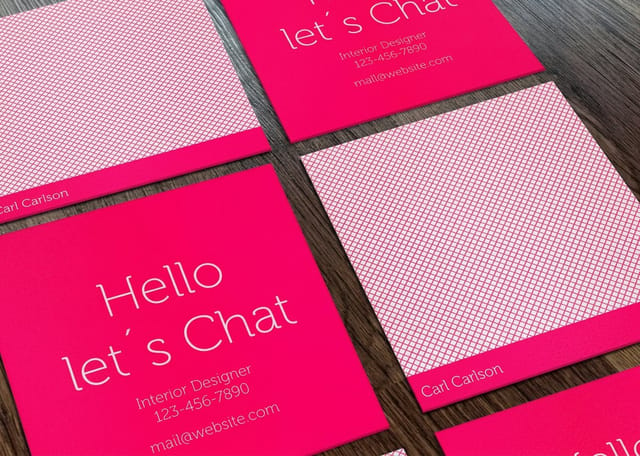 Mini Cards | 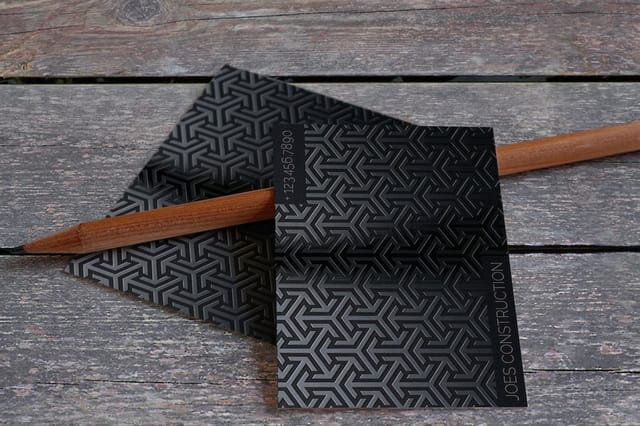 Spot UV Postcards | |
|---|---|---|---|---|
| Min price | $16.48 | $421.91 | $17.57 | $190.02 |
| Paper / stock | 14pt Gloss Cover | 16 Point Silk Laminated | 14pt Gloss Cover | 16pt Gloss Cover |
| Finish | Standard Finish | - | Standard Finish | - |
| Size | 2.5" x 2.5" | 4" x 6" | 2" x 2" | 2" x 6" |
| Default qty | 50 | 500 | 100 | 1,000 |
| Turnaround | 3 business days | 7 business days | 3 business days | 5 business days |
| Rating | ||||
| View & customize | View & customize | View & customize | View & customize |
Files, Templates and Getting It Printed
Unusual formats fail in prepress, not on press. Folds need panel measurements that account for the panel tucking inside being slightly narrower. Die cuts need a labelled vector cut path. Oversized cards need the address area kept genuinely clear. Every one of those is a five minute fix before the file is uploaded and an expensive reprint after.
Working from an exact size template removes the guesswork, because the bleed, the trim and the safe area are already drawn where the press expects them. Build inside the template, keep live text away from every fold and every trim edge, export a print ready PDF with fonts embedded, and review the online proof properly rather than clicking through it. If a deadline is driving the decision, the turnaround comparison in this Next Day Flyers alternative lays out what fast printing actually means in practice.
The checklist before you upload
- Bleed. Extend artwork past the trim on every edge so no white slivers appear after cutting.
- Safe area. Keep type well inside the trim, and further inside on folded and die cut work.
- Resolution. Place images at full print resolution, not the web version that looked fine on screen.
- Color. Supply CMYK artwork so the screen preview and the printed sheet agree.
- Address area. Leave the mailing panel clear of artwork so the carrier and the software can both read it.
Start fast
Postcard templates and print ready blanks
Free layouts plus exact size blanks so bleed, trim and fold marks are already correct.


Wally sorts the postcard formats for you
Pick the shape that fits the message, then print it
Wally starts every postcard job with one question. How much does the reader need to know? One idea fits a flat or oversized card. A few connected ideas want a half fold, so the cover earns the open. A full price list or schedule wants a trifold. Something that should get kept wants a die cut shape or a heavy uncoated stock. Choose the container first, check the postage class second, and only then argue about the finish.
Configure your postcards →Postcard Printing at a Glance
Keep reading
Guides and articles that pair with this one
Deeper reading on mail response, cut shapes, and the panels of a 6 by 8 half fold or a 6 by 12 trifold.
Explore more
More ways to print and mail a postcard
Postcards from $16.48, die cuts from $34.05 and lenticular cards for the mailing that has to be noticed.
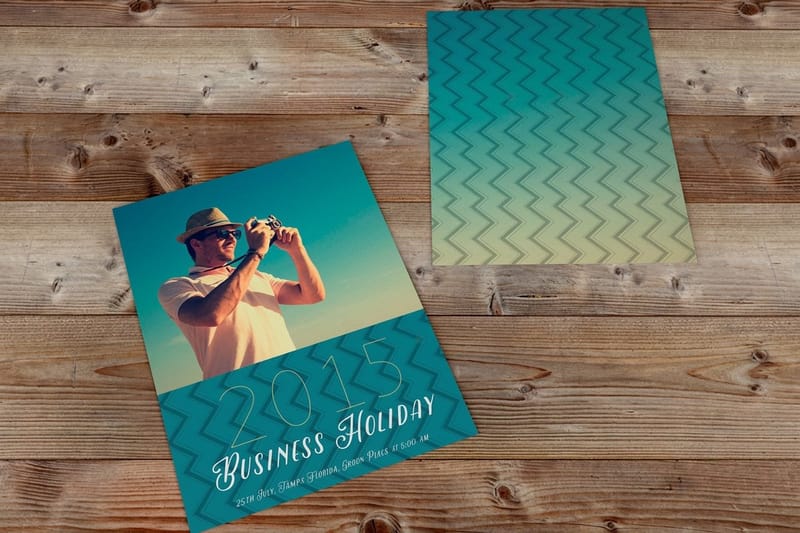 Shop Postcards Printing Every postcard size, stock, fold and finish in one place.
  Product 3D Lenticular Postcards Artwork that shifts and moves as the card tilts. Product 4th of July Postcards Seasonal cards sized for offers, dates and directions. Product Back to School Postcards Enrollment and August promotion mailers, full color.
 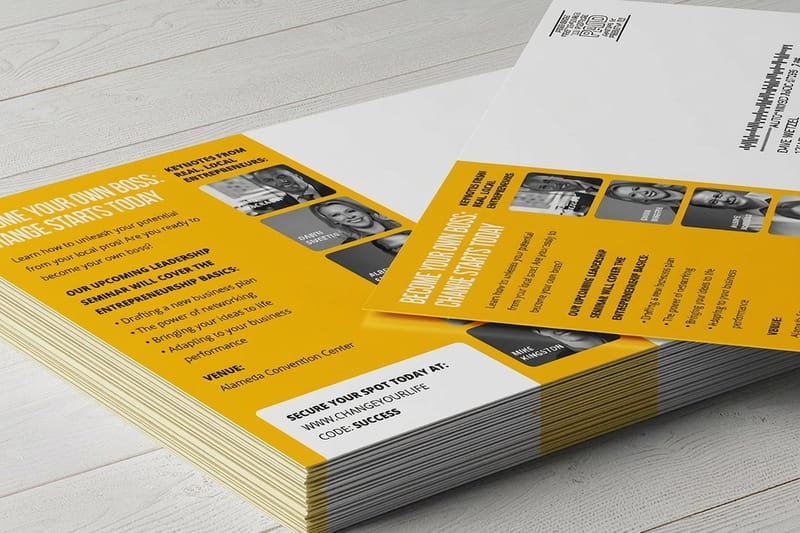 Article Direct Mail Statistics What the response data says about printed mail.
 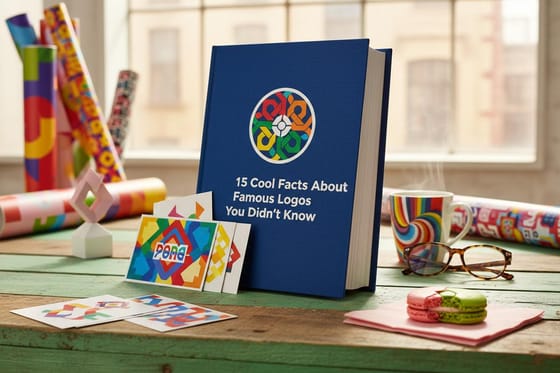 Article 15 Facts About Logos How strong marks are built, useful before a die cut.
  Article What Not to Put on a Card The clutter that weakens any small printed piece.
  Guide Food Packaging Options Custom shapes and cuts for small food businesses.
  Collection Binding Options Printing Saddle stitch, wire-o and perfect bound formats.
  Alternative Does Canva Mail Postcards Design tool mailing compared with a real print run. Alternative MOO Postcards Alternative Premium card quality and pricing, side by side.
  Alternative Next Day Flyers Alternative What fast turnaround actually delivers in practice.
 Print a postcard nobody files away, from 50 cards at $16.48
Pick the format that matches your message, choose a stock and finish, upload artwork built from an exact size template, and approve the proof before it runs.
Postcard Format Questions Answered
What counts as a cool postcard format?
Anything that departs from the flat rectangle. That includes half fold and trifold postcards that open into extra panels, oversized cards that cannot hide in a mail stack, die cut cards trimmed to a custom silhouette, lenticular cards whose artwork moves as they tilt, and EDDM cards mailed by carrier route instead of by name and address. All of them print on standard postcard equipment, so the difference sits in the file setup and the finishing, not in some exotic production process.
How do I choose the right postcard format for my campaign?
Count the ideas first. One idea and one image belongs on a flat or oversized card. Three or four related ideas want a half fold so the cover can earn the open. A full price list, schedule or catalog wants a trifold. If the piece has to survive on a desk or a refrigerator door, choose a die cut shape or a heavy uncoated stock. Then check postage class and list quality, because those two decide the real cost per response more than the printing ever will.
What do these postcard options cost and how is the price set?
Price is driven by quantity, size, stock, sides printed and finishing, and it drops steeply as quantity rises because setup is spread across more pieces. Seasonal runs such as 4th of July Postcards and Back to School Postcards start at $16.48 for a full order, which puts a standard format within reach of a small local campaign. Specialty finishing sits at the other end, with 3D Lenticular Postcards starting at $1,097.28 because of the lens material and the interleaving work behind it.
What sizes, stocks and finishes can I print postcards on?
Sizes run from compact handout cards through the classic four by six, up to oversized formats past six by eleven, plus folded panel sizes and fully custom die cut outlines. Stocks range from light coated cover through thick premium cover and uncoated sheets that accept pen ink. Finishes include gloss and matte coating, soft touch, spot gloss, foil accents, rounded corners and lenticular lamination. Configure the exact combination on the product page and the live price updates as you change each option.
How long does it take to print and ship these postcards?
Standard flat postcards move fastest because they need no extra finishing step, and short turnaround options are available on most of those runs. Folded cards add scoring and folding time. Die cut work adds a day or two when a new cutting die is required, and lenticular cards take longest because the lens has to be laminated and aligned. EDDM orders need bundling and paperwork before they reach the post office. Choose your production speed at checkout and the estimated ship date is shown before you pay.
