
Trade Show Booth Design Examples That Work, and the Printed Pieces Behind Them


Tobias is our voice for cutting, binding and large format, built from the knowledge of our production team, with over 20 years in printing.
A trade show booth works when your name reads from across the aisle, what you sell reads from ten feet, and the offer only appears once someone is at the table. Every example below is broken into the exact printed pieces that produce that, with the real starting price of each one, so an idea you like becomes a shopping list rather than a mood board.
Booth sizes and the print that fills them
| Booth | Wall you get | Print that fills it | Relative cost | Products at 4OVER4 |
|---|---|---|---|---|
| Tabletop, 6 ft | None, the table is the booth | Table throw, tabletop display, one small stand | Lowest | Table throws + table top displays |
| 10 x 10 in-line | 8 ft back wall, no side walls | Backdrop, two retractable stands, table throw | Low to middle | Step-and-repeat + retractable stands |
| 10 x 20 in-line | 16 to 18 ft of back wall | Two backdrops or one wide banner, counter, four stands | Middle | Vinyl banners + banner stands |
| 20 x 20 island | No walls, seen from four sides | Hanging or double-sided graphics, tall flags, counters | Highest | Feather flags + fabric graphics |
| Outdoor 10 x 10 | Tent canopy is the wall | Printed tent, table throw, flags, mesh banner | Middle to high | Event tents + feather flags |
Booth dimensions come from the exhibitor kit, never from the floor plan drawing, because aisles and pillars change the usable width. Check the back wall height rule and the front-third height rule before artwork starts. The full trade show print collection groups every piece by booth type.
What a trade show booth has to do as people walk past
A booth works when three different messages land at three different distances: your name from across the aisle, what you sell from about ten feet, and the offer once someone is at the table. Booths fail when all three are printed at the same size on the same panel, because the visitor walking past reads none of them.
That is the whole test, and it is why a plain backdrop carrying four words beats an expensive wall covered in paragraphs. Attendees are walking, talking and holding a coffee. The back wall gets a glance from the corner of an eye, and making them turn their head is the only job it has.
The second thing nobody plans for is the crowd. Once two staff and three visitors are standing in a 10 x 10, everything between about 30 inches and 60 inches off the floor is hidden by bodies. Put your key message in that band and it disappears exactly when the booth is working. Height is the cheapest fix, which is why retractable banner stands at 81 inches tall earn their space and a poster on an easel does not.
The three pieces that carry a booth
A back wall graphic, two vertical stands, and a fitted table cover. That combination fills a 10 x 10 properly, packs into two cases, and sets up in under twenty minutes without tools. Everything after that is refinement.
The order matters if the budget is tight. Buy the table cover first, because a rented table with a wrinkled cloth and visible cardboard boxes underneath undoes every other piece. Then the stands, because they add height. The backdrop comes third, since a good pair of stands can carry a booth on their own if the hall lighting is decent.
Measure the booth before you design anything
Show organizers publish a booth spec with a maximum back wall height, usually 8 ft for in-line booths, and a lower limit for the front third so you do not block your neighbor. Read it before artwork starts. A backdrop printed at 10 ft tall that has to be folded down at setup is a wasted piece.
Also check what the table actually is. A 6 ft table and a 8 ft table need different throws, and some halls supply a 30 in high table where you assumed 42 in counter height. Our table cover printing options list the sizes each cover fits.
Nine booth examples and why each one converts
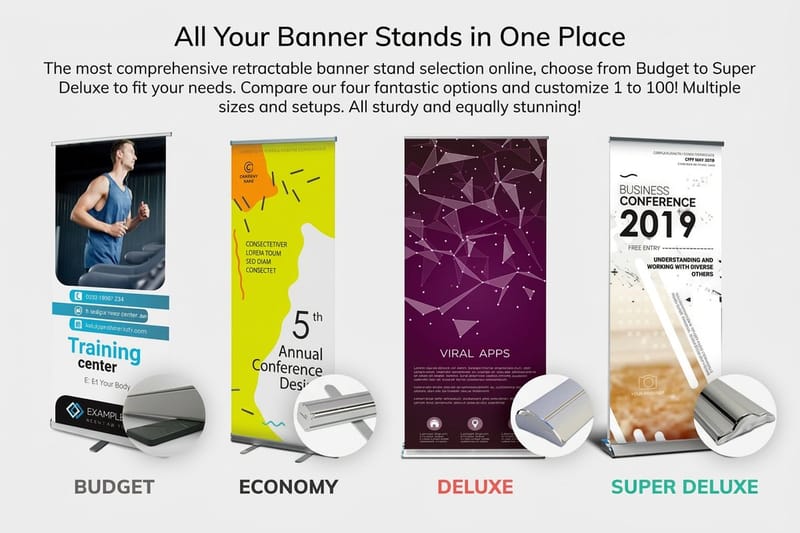
These are booth setups we print for regularly, described by what is physically in them rather than by mood. Each one is buildable from the catalog, so treat the list as nine shopping lists rather than nine photographs.
Prices below are the starting configuration on each product page. Example two, the setup most exhibitors end up with, is a backdrop plus two stands at $495.50 before artwork, and it fits in a car.
Examples one to five: the in-line booth
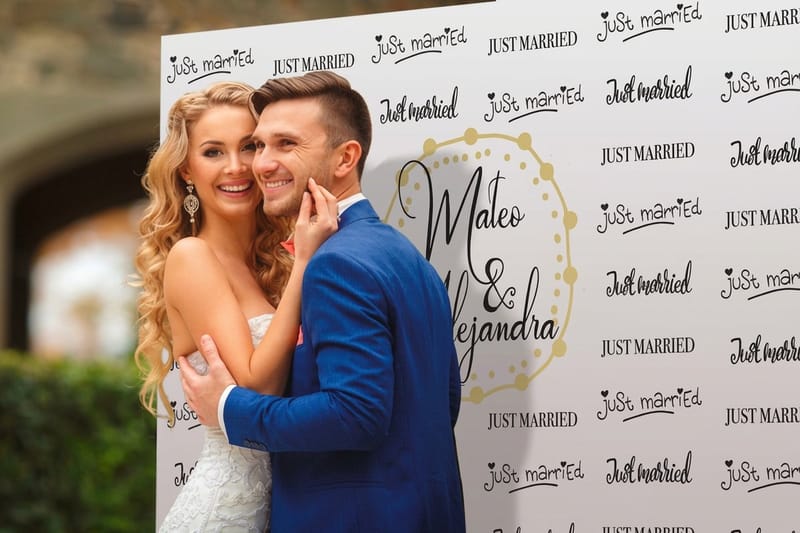
1. The logo wall. One step-and-repeat backdrop at $217.50, brand mark tiled edge to edge, nothing else. It photographs well, so every selfie taken in your booth carries the logo. Works because it makes the visitor the content and you the background.
2. Backdrop plus bookends. The same wall with a retractable stand at each front corner, one carrying the product, one carrying the offer. The stands frame the opening and stop people cutting the corner across your space.
3. The single statement stand. One stand, one table, one sentence. Cheapest credible booth there is, and it beats a crowded wall at small regional shows where visitors are scanning twenty tables in ten minutes.
4. Product on the throw. A printed table throw at $225.00 carrying a single large product photograph on the front panel, with the wall left plain. Good when the product is visual and the name is not yet known.
5. The demo counter. Table pushed forward, staff standing beside it rather than behind, and a table top display at $49.41 holding the spec sheet at reading height. Removing the barrier between staff and aisle changes the conversation rate more than any graphic.
Examples six to nine: island, outdoor and low budget
6. Four-sided island. No back wall exists in an island, so the brand goes up instead of back. Tall feather flags at $108.75 each, one per corner, read from anywhere in the hall and cost a fraction of a hanging sign.
7. The printed tent. Outdoor shows and sponsor villages reward the printed event tent at $987.45, because the canopy is the only surface visible over a moving crowd. Print the valance on all four sides, not just the front.
8. Long wall, one message. A 10 x 20 with a single vinyl banner from $79 running the full width, hung tight, with the detail split across two stands below it. One long line of type beats two competing panels.
9. The borrowed table. Everything the show supplies, upgraded: fitted throw, one stand, and a stack of printed takeaways. Under $400 of print, and it looks deliberate rather than cheap, which is the actual goal at that budget.
Backdrop and banner ideas that hold up

The back wall is a typography problem before it is a design problem. The working rule for signage is one inch of cap height for every ten feet of viewing distance, so a headline meant to cross a twenty foot aisle needs type about two inches tall, and very little around it.
Material decides how the wall looks under lights. Fabric absorbs the harsh overhead spots and stays matte, which is why step-and-repeat walls are printed on fabric almost everywhere. Vinyl is brighter, cheaper and tougher, and it flares badly when a spotlight hits it at an angle. Our banner material guide works through the trade-off in more detail, and the backdrop banner sizes and setup guide covers the frames.
The limit worth naming: a printed backdrop will crease along its fold lines, and fabric shows those creases for the first hour. Hang it the night before if the hall allows access, or plan to steam it. A vinyl banner rolled on a tube avoids the problem entirely but weighs more to ship.
Retractable stands, and where they let you down
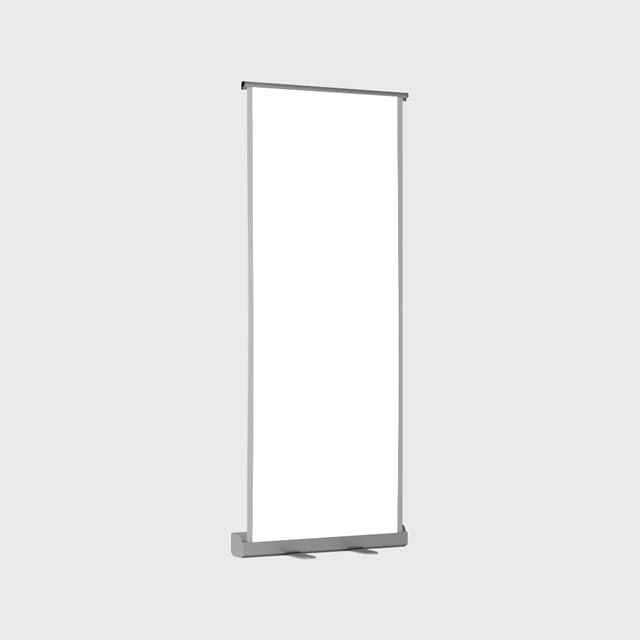
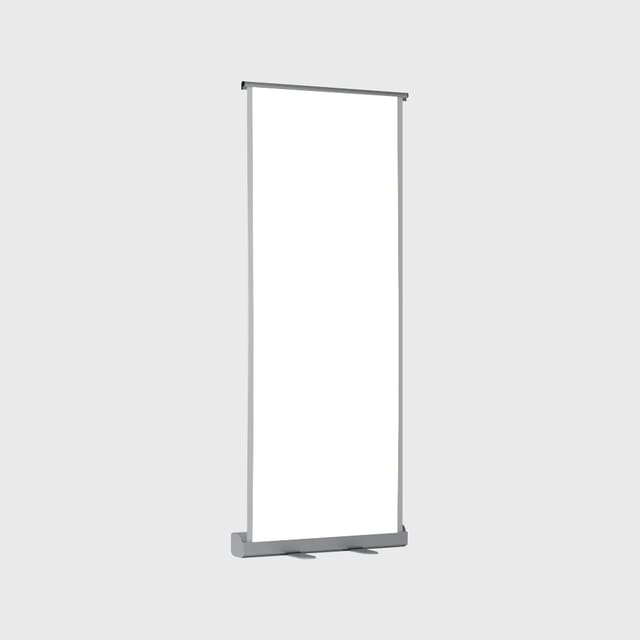
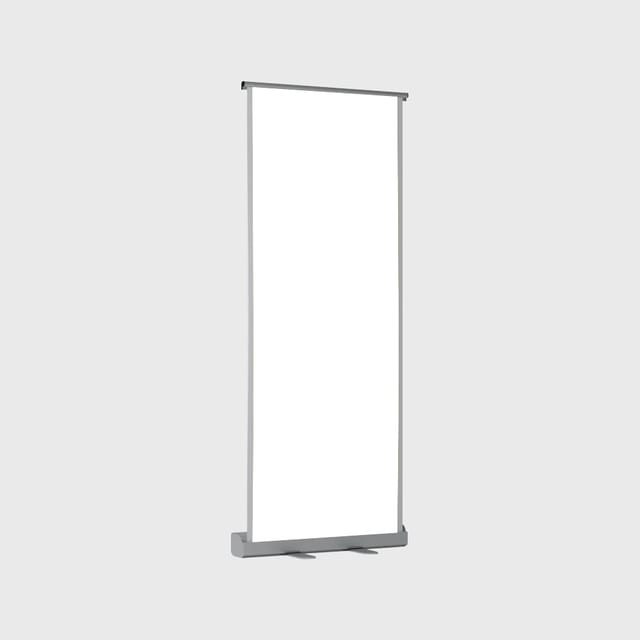
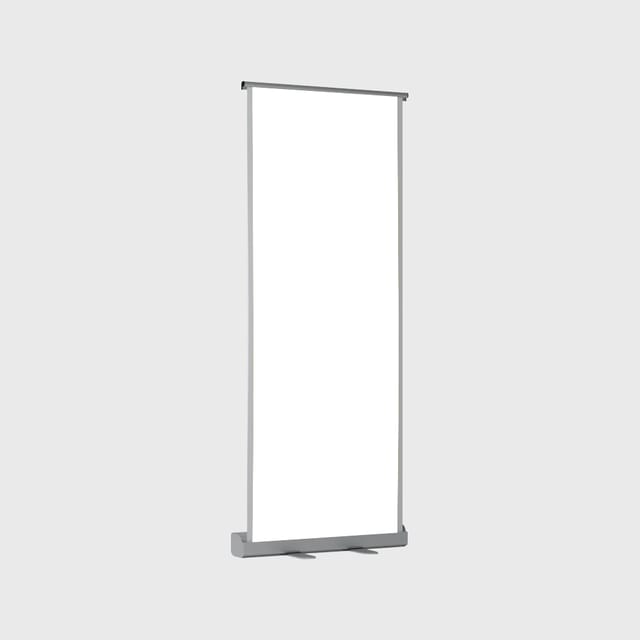
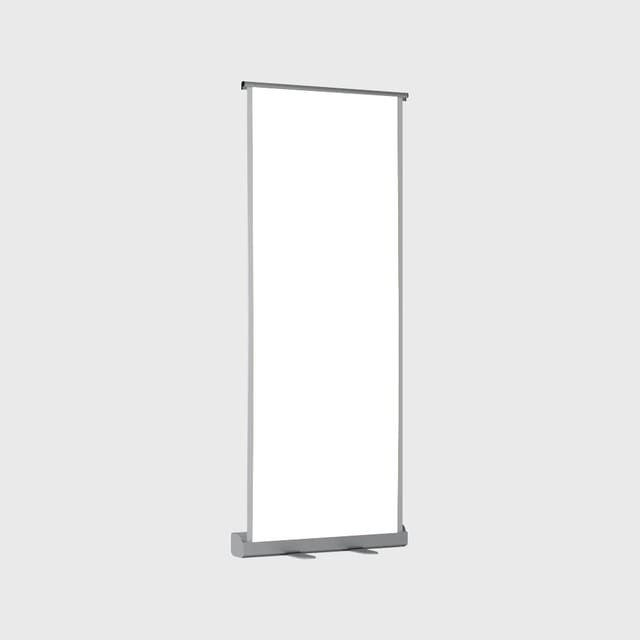
A 33 x 81 inch retractable is the standard piece of trade show print. It carries in one hand, sets up in thirty seconds, and stands on its own base. Two of them cost less than one custom wall and can be reused at any show, in any booth size.
They fail in two situations. In a windy outdoor booth they tip, so weight the base or leave them at home. And a cheap mechanism will not roll the graphic back flat after a few shows, which is why the pull up banner guide spends more time on the hardware than the printing. Browse the banner stand range when you are comparing base weights.
Table and counter setups that actually get used
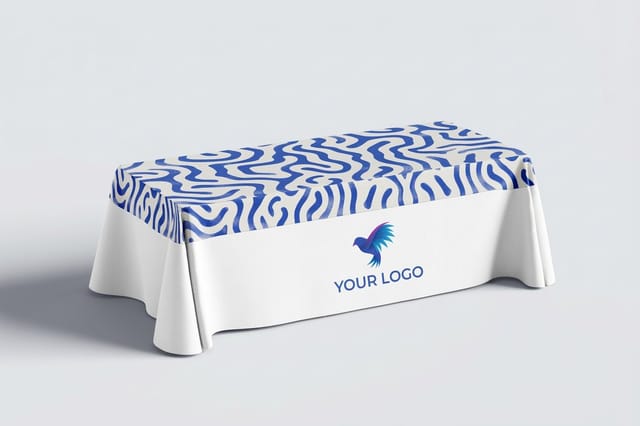
Most halls hand you a 6 ft table and a folding chair, and most exhibitors leave it as they found it. A fitted throw covering all four sides turns that table into a branded surface and hides the cases, the coats and the box of brochures underneath, which is the single fastest upgrade available to a small booth.
Print it
Table throws, cut to the table you get
Four-sided fitted covers for 6 ft and 8 ft show tables, printed edge to edge.
Where the table sits changes the conversation. Pushed to the back wall it becomes a desk and your staff sit behind it, which reads as a service counter. Pulled forward with staff standing beside it, the table becomes a demo surface and people stop rather than walk. Neither is wrong, but a booth built to sell software and a booth built to sample coffee should not be laid out the same way.
Keep the tabletop nearly empty. One product, one table top display holding the spec sheet upright, and a small stack of cards. Everything else goes in a box underneath. A table covered in literature signals that nobody is minding the booth, and the pieces at the back never get picked up anyway.
Lighting and large-format graphics
Exhibition halls light from high above with cool white fixtures, and that light hits your graphics at a steep angle. Two things follow. Gloss surfaces flare into a white patch exactly where a visitor is standing, and mid-tone colors sit two or three steps darker than they looked on a monitor. Push key colors a touch brighter than feels right on screen, or accept a wall that looks flat under the rig.
Booth lights you bring yourself are worth more than extra graphics. Two clamp lights on the top rail of a backdrop lift it out of the surrounding gloom and cost less than an extra banner. Aim them down the face of the graphic rather than straight at it, so the light grazes the surface instead of bouncing back into people's eyes.
Quantity and price
Retractable stand pricing and specs
Live configurator numbers for the piece most booths buy two of, with the hardware and graphic specs beside it.
| Quantity | Price Per Unit | Total |
|---|---|---|
| 1 | $139.00 | $139.00 |

For islands and outdoor spaces, the graphic that matters is the one above head height. A printed event tent carries the brand at roof height across an entire field, and printed flags do the same job indoors for a fraction of the cost of a hanging sign. Both are covered in our event tent template guide if you are setting up the artwork yourself.
Must-have printed booth materials
Strip a working booth back to its parts and the same short list appears every time. These are the pieces that do a job, rather than the ones that fill a shipping crate.
- Back wall graphic. A step-and-repeat backdrop from $217.50, or a wide vinyl banner from $79 if you have a frame.
- Two vertical stands. From $139 each, reusable at every show regardless of booth size.
- A fitted table cover. From $225.00, sized to the table the hall actually supplies.
- Something to hand over. A card at minimum. Standard business cards start at $17.57 and flyers at $39.54.
- Height for a crowded hall. Feather flags from $108.75, or a tent outdoors.
The list that beat every other list for us is in 10 must-have print products for trade show booths, and if you are still choosing which shows to exhibit at, the best B2B trade shows is the companion piece.
Planning your booth on a budget
Print is rarely the expensive part of a trade show. Space, travel and staff time dominate the budget, which means the graphics are the place where a small increase buys the most visible improvement. Spend on the pieces you will reuse, and keep the show-specific pieces cheap.
Reusable means no dates, no show names and no booth numbers on the wall or the stands. Put those on one small piece that is cheap to reprint, and the expensive graphics survive the whole season. A backdrop and a pair of stands carry over to any booth size, any hall, any year the branding stays the same.
You can also earn coins on every order and redeem them against the next set of graphics, which helps when a booth is built up over two or three shows rather than bought at once. For the wider range of large pieces, the large format printing hub lists everything by size.
Choosing a setup by industry
What belongs in the booth depends on what you are asking a stranger to do next.
- Software and B2B services. Nothing physical to show, so the booth sells a conversation. Four words on the wall, a demo screen at standing height, and a printed one-pager that survives the flight home.
- Manufacturing and industrial. Bring one real part, put it on the table where people can pick it up, and use the backdrop for scale photography of what the part goes into.
- Food and beverage. Sampling means the table is the booth. A fitted throw, a tall stand behind so the brand clears the queue, and flags to pull people over from two aisles away.
- Franchise and multi-location brands. One backdrop design, printed per market with a swapped city line. Same file, one text layer changed, so every location looks like the same company.
- Outdoor expos and sponsor villages. A printed tent, a mesh banner that lets wind through, and weighted stands. Wind is the whole design constraint, not the graphics.
Blanks for graphics too big to get wrong
Booth graphics are large, which makes a setup mistake expensive. 4OVER4.COM sizes its blanks to the exact product spec with bleed and safe area already marked, so your artwork lands inside the cut. A step-and-repeat blank opens at 96 x 96 inches for the 8 ft by 8 ft wall or 120 x 96 inches for the 8 ft by 10 ft, and a tablecloth blank at 84 x 126.5 inches for a 6 ft table. Pick the blank for the size you are ordering, because a logo scaled from the 8 ft wall to the 10 ft one stretches or loses its edges. Start from a print-ready blank rather than an empty canvas.
Start fast
Banner templates and blanks
Editable banner designs and exact size blanks for backdrops, stands and covers.
Wally lays out a 10 x 10 booth that reads from the aisle
One message per surface, and nothing important between knee and shoulder
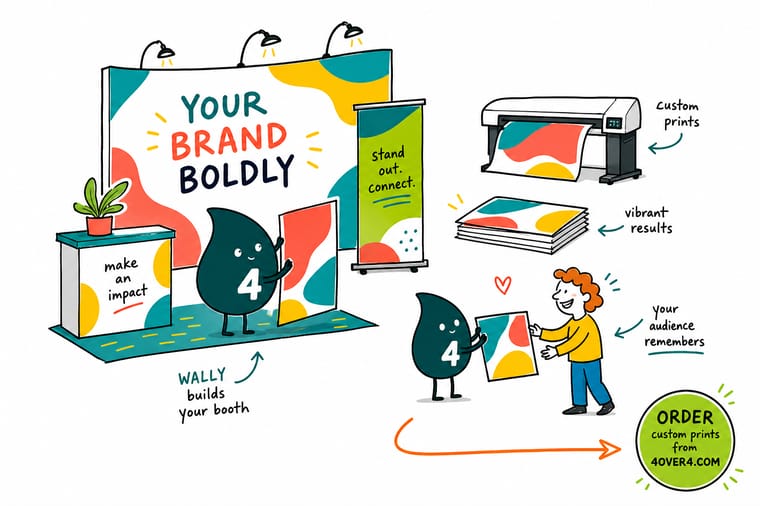
Give the back wall your name at one inch of cap height for every ten feet of viewing distance, put what you sell on two 33 by 81 inch retractable stands at the front corners, and save the offer for the table. Keep the 30 to 60 inch band clear because bodies block it, print the backdrop on fabric so hall spotlights do not flare, and 4OVER4.COM ships the whole set in time for the crate.
Build your booth kit →What an eight foot back wall has to do
Design rules that hold at every booth size
- One inch of cap height per ten feet. Two inch type crosses a twenty foot aisle, four inch type crosses forty. If your headline is smaller than the rule allows, it is decoration, not communication.
- Keep the 30 to 60 inch band empty. That band is blocked by people the moment the booth gets busy. Put logos and headlines above it and the detail below it on the table.
- One idea per surface. The wall gets the name, the stand gets the offer, the throw gets the product. Two ideas on one surface means neither is read.
- Design for the lights you will get. Halls light from above and behind. Matte fabric holds up, high gloss vinyl flares, and dark backgrounds hide the spill from your neighbor.
- Print a proof at full size before the show. Tape a full size proof to a wall and stand twenty feet back. Every booth that reads badly at the show read badly on a screen too, and nobody checked.
Explore more
More ways to print and promote
Feather flags run 1 for $108.75 in 4 business days and event tents 1 for $987.45 in 5.
Product Step-and-Repeat Banners The photographed back wall, from $217.50. Product Retractable Banner Stands 33 x 81 in of height, up in thirty seconds. 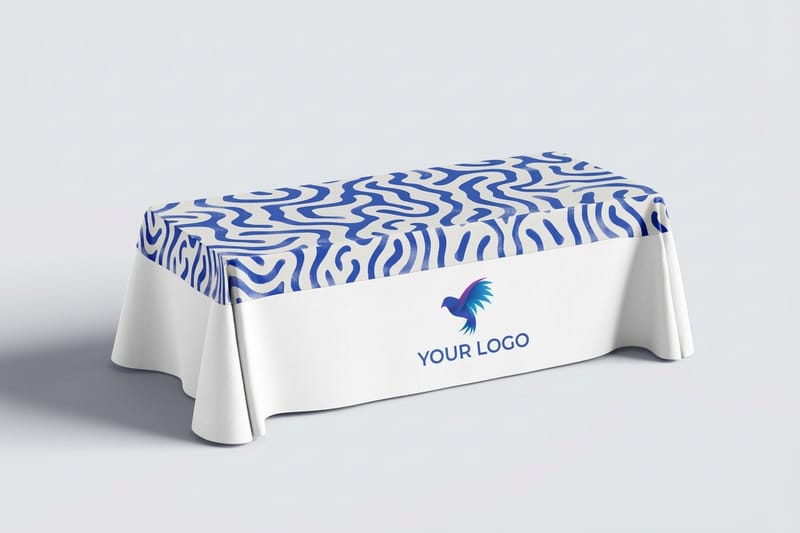 Product Table Throws Fitted covers that hide the rented table and the boxes.
 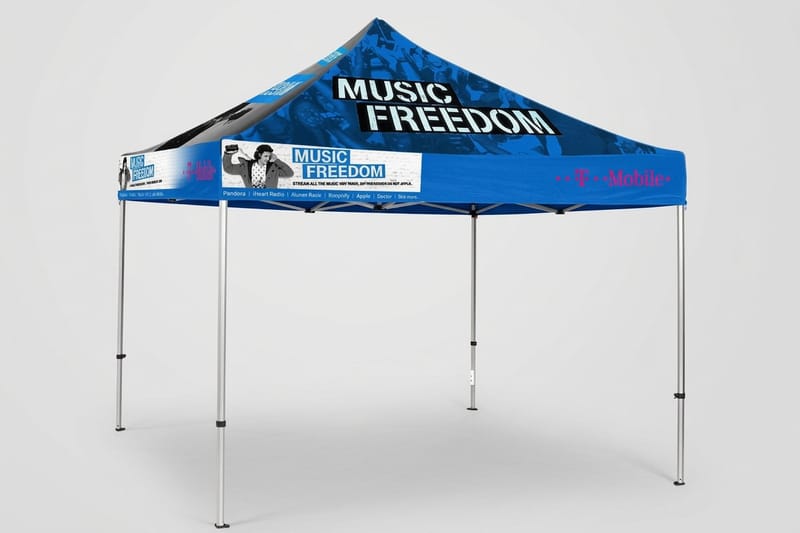 Product Event Tents A printed canopy for outdoor shows and sponsor villages.
 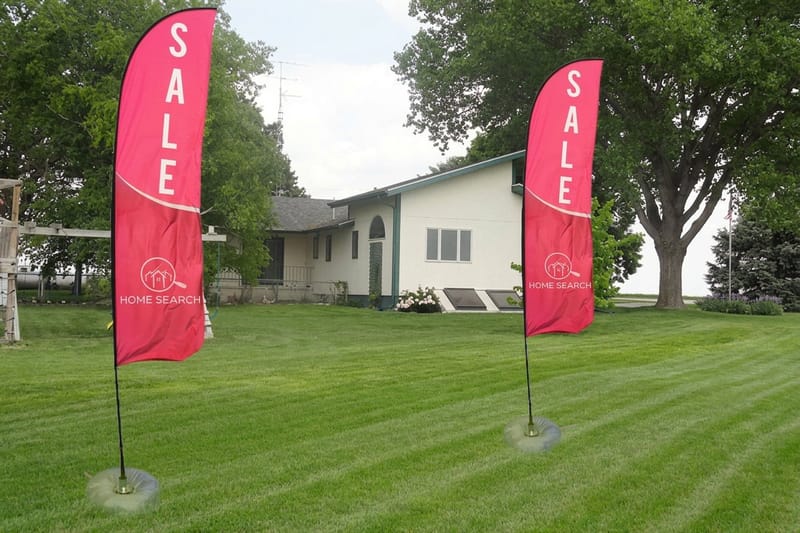 Product Feather Flags Cheapest way to be seen above a moving crowd.
 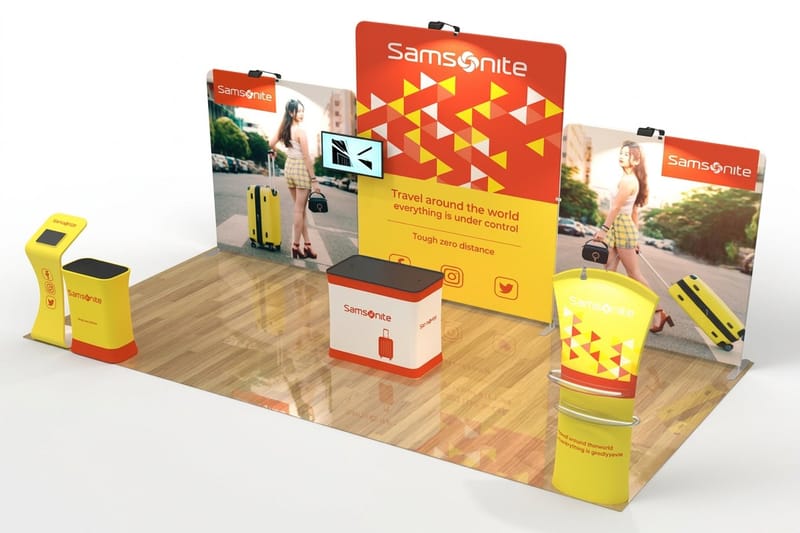 Category Booth Kits Backdrop, stands and covers packaged as one setup.
 Ready to print your booth?
Pick the pieces, drop in your artwork or a free blank, and 4OVER4.COM prints them sharp and ships in time for the crate.
Common questions about trade show booths
What size should a trade show backdrop be for a 10 x 10 booth?
Design to about 8 ft wide by 8 ft tall for a standard in-line 10 x 10. The booth is ten feet across, but the two front feet on each side are usually kept clear so your neighbors are not boxed in, and most show rules cap back wall height at 8 ft with a lower limit across the front third. Read the exhibitor kit for the specific show before artwork starts, because a wall printed taller than the rule allows has to be folded down at setup and looks it. Step-and-repeat backdrops at 4OVER4.COM start at $217.50.
How many banner stands does one booth need?
Two for a 10 x 10, four for a 10 x 20. Place them at the front corners rather than against the back wall, where they frame the opening and give the booth a defined edge without blocking the aisle. A single stand is enough for a tabletop booth or a shared space. Beyond four in an in-line booth they start competing with each other and the space reads cluttered, which is the point where a single wide banner does the job better. Retractable banner stands start at $139.
Is a fabric backdrop better than a vinyl one for trade shows?
For indoor halls, usually yes. Fabric stays matte under the overhead spotlights that light most exhibition halls, so photographs taken in front of it are clean, and it folds into a bag rather than shipping on a tube. Vinyl is cheaper, tougher and better outdoors where rain and handling matter more than glare. The trade-off is creasing: a folded fabric graphic shows its fold lines for the first hour or so, which is worth planning for if you set up the morning of the show rather than the night before.
What is the cheapest booth setup that still looks professional?
A fitted table throw, one retractable stand, and printed takeaways. That is under $400 of print and it fixes the two things that make a budget booth look neglected, which are a bare rented table and a booth with no vertical element. Custom tablecloths come cut for a 6 ft or an 8 ft table, so order the one that matches the table the hall supplies. Skip the folding poster boards and the tablecloth clipped on with binder clips. Add a backdrop at the next show once you know the layout works, and reuse the stand at every show after that.
How far in advance should booth graphics be ordered?
Order large-format booth pieces at least two weeks before you need them in hand, and set your deadline as the day the crate ships rather than the day the show opens. Backdrops, tents and table throws are made to size rather than pulled from stock, so they are not the pieces to rush. Business cards and flyers can be added later on a shorter turnaround, but check the shipping address the show uses, because advance warehouses often close their receiving window a week before the doors open.
