
Trade Show Marketing Strategies That Fill Your Booth and Your Pipeline


A busy booth is booked, not attracted: name the accounts you want, offer them a specific time, and put your booth number on everything you send in the six weeks before the doors open. The stand itself has one job at the show, which is to be readable from twenty feet down the aisle, so the name and the positioning line go in the top third of the backwall and everything time-limited goes on a banner you can afford to reprint.
What each piece of the booth is for
| Piece | What it does | Where it sits | Reusable? | Product at 4OVER4 |
|---|---|---|---|---|
| Backwall graphic | Says who you are from twenty feet down the aisle | Behind the booth, message in the top third | Every show, if you leave the date off it | Trade show booth kits |
| Fabric graphic swap | Changes the message without buying a new frame | Same frame, new printed skin | Frame keeps, graphic changes per campaign | Fabric booth kits |
| Retractable banner | Carries the offer that is specific to this show | Booth corner, angled into the aisle | Cheap enough to reprint per show | Trade show printing |
| Counter graphic | Holds the demo, the samples and the lead capture | Side of the booth, never across the entrance | Every show | Booth kits printing |
| Handout card | The thing that survives the flight home | In hand, at the end of a conversation | Per campaign | Trade show printing |
Split the stand into what you keep and what you replace. The frame and the undated backwall survive every show; the banner, the counter wrap and the handout carry whatever is true this month. You can configure a booth kit and price the reprints separately.
The traffic is booked before the doors open
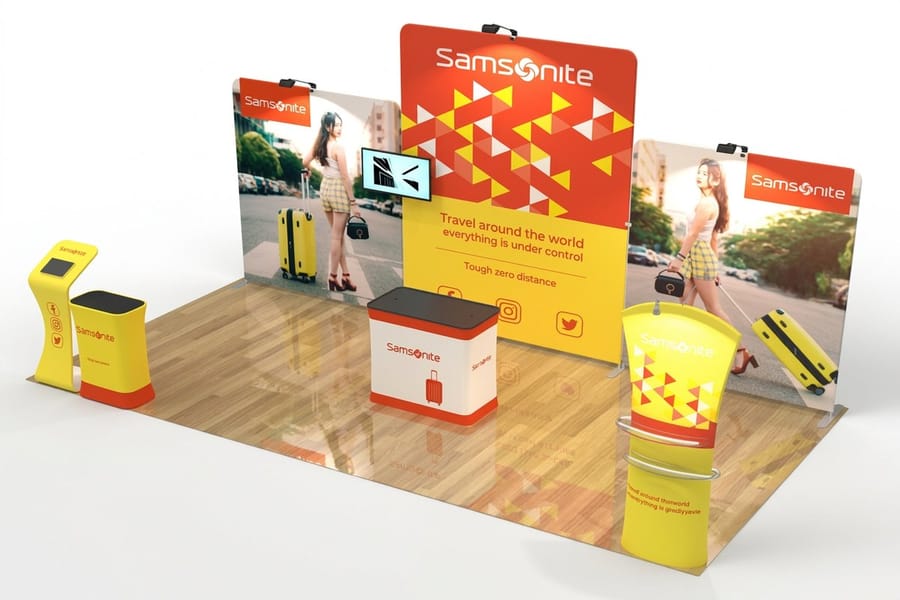
Most exhibitors treat the show as the campaign. The show is the delivery date. The work that decides whether your booth is busy happens in the six to eight weeks before it, when the organizer publishes the exhibitor list and starts mailing attendee promo codes, and when your competitors are quietly booking the same people you want to see.
Start from your own list rather than the show list. Pull the accounts you already talk to, filter to the ones registered or based near the venue, and send a specific ask with a time in it. "Stop by booth 412" is not an ask, it is a hope. "Tuesday at 10:20, twenty minutes, we will have the new stock samples on the counter" is something a person can say yes to.
Printed outreach earns its keep here precisely because it is narrow. A mailed card with the booth number, a time slot and a reason to show up lands on a desk instead of at the bottom of a full inbox, and at a target list of eighty named accounts the cost is trivial next to the booth space. Blast the same card to four thousand names and you have bought postage. The first-time exhibitor checklist lays out the timeline if you have never run one of these.
What to send, and to whom
Split the list into three. Existing customers get an invitation to something with a time on it, because they already know you and the show is a cheap way to have the conversation you have been rescheduling. Active opportunities get the same, plus whatever they asked to see. Everyone else gets a reason to walk past, which is usually a demo, a sample, or a person worth meeting.
Keep the piece to one job. A card that carries the booth number, one line about what is on the counter, and a QR code pointing at a booking page will beat a brochure that carries your full catalog, because nobody reads a catalog while deciding what to do with a Tuesday morning.
The booth number is the only detail people need
Booth numbers are how attendees navigate a hall of four hundred stands. Put yours on every pre-show email signature, every mailed card, every social post and the confirmation you send after a meeting is booked. It costs nothing and it removes the one obstacle between an interested person and your carpet.
Then check the floor plan before you finalize the artwork. A corner booth reads from two aisles and wants a different layout than an inline booth crowded on both sides, and a stand near the back of the hall needs a hanging or top-of-frame element more than one near the entrance does.
Design the booth for the aisle, not for the photo
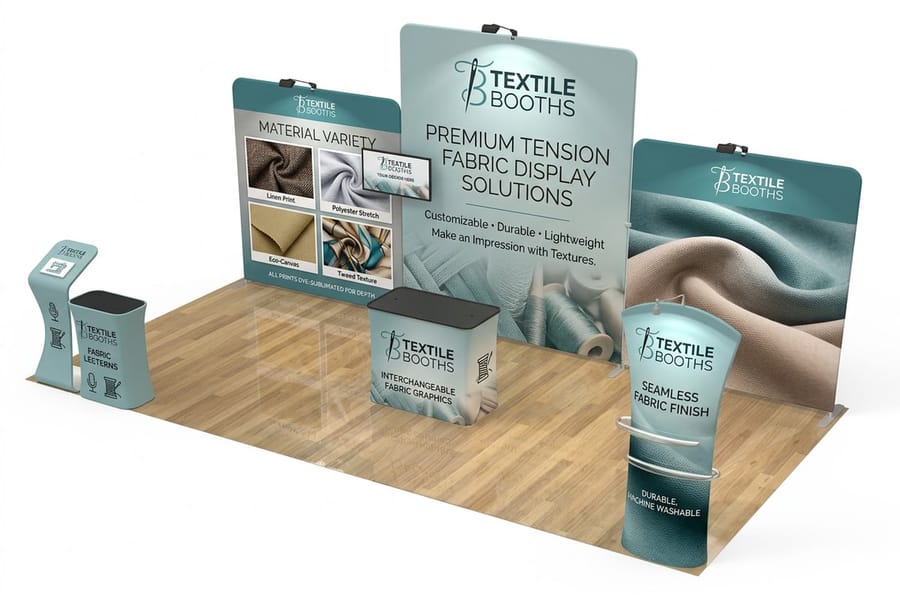
Booth graphics get designed on a monitor, straight on, at arm’s length, and then get used from twenty feet away, at an angle, by someone walking past with a bag on their shoulder. Design for the second situation. The name of the company and one line about what you do belong in the top third of the backwall, above head height, where they stay visible when four people are standing in front of the stand.
Everything below roughly three feet is furniture height. Put nothing there you need read: it sits behind a counter, a case, a chair, or a person. That single constraint kills most of the layouts that look balanced on screen, and it is the reason experienced exhibitors leave the lower half of a backwall as plain color.
Convention halls light everything with the same flat overhead gray, which drains saturated colors and closes up dark areas. A deep navy panel that looks rich on a calibrated monitor turns into a hole in the wall under hall lighting. Push contrast harder than feels right, keep type either very dark on light or very light on dark, and avoid fine reversed type at small sizes. Our trade show booth design guide goes further into layout and sightlines.
Fabric or rigid, and what each one costs you
A tension fabric graphic is dye-sublimated into the cloth, so the color is in the fibers rather than sitting on a laminate. It folds into a case, travels as checked luggage, and comes out of the bag with soft creases that hang out in an hour. Rigid laminate panels hold a sharper edge and a harder gloss, and they scuff, corner-ding and need a crate, which means drayage charges at the venue that can rival the cost of the panels.
The honest trade-off: fabric wins on shipping, storage and reprint cost, rigid wins on the crispest possible finish for a stand you will only ever set up in one building. For most exhibitors doing three or four shows a year, fabric booth kits at $2,599 are the cheaper system across the year even when the first invoice looks the same as the rigid one.
Whichever you pick, the frame is the asset and the graphic is the consumable. Buy the frame once, then reprint the skin when the message changes. That is the whole economic argument for a kit over a custom build.
Never print the year on the main graphic
This is the most expensive small mistake in the category. Put "Spring Expo 2026" across your backwall and you have converted a reusable $2,599 kit into a single-use one. The same goes for a show-specific promo code, a booth number, or an event hashtag baked into the big panel.
Keep the backwall permanent: name, positioning line, one strong image. Put everything time-limited on the pieces that are cheap to replace, a retractable banner in the corner, a counter wrap, or a printed card. When the offer changes you reprint a banner instead of a wall. Sizes and formats for those replaceable pieces are covered in the trade show banner sizes guide.
The 10 by 10 mistake
In a 10 ft by 10 ft space, the instinct is to put a table across the front. It creates a counter to lean on and a barrier nobody crosses, and it turns a small stand into a service window where two staff stand behind a line waiting for people to approach. Move the table to one side, leave the front open, and stand at the edge of the carpet instead of the back wall.
Then subtract. A 10 by 10 fits a backwall, one counter, one banner and two people comfortably. Adding a third person, a second banner and a literature rack makes the space feel occupied rather than busy, and attendees walk past a full booth for the same reason they walk past a full restaurant with no free table.
Giveaways, demos and the honest math on badge scans
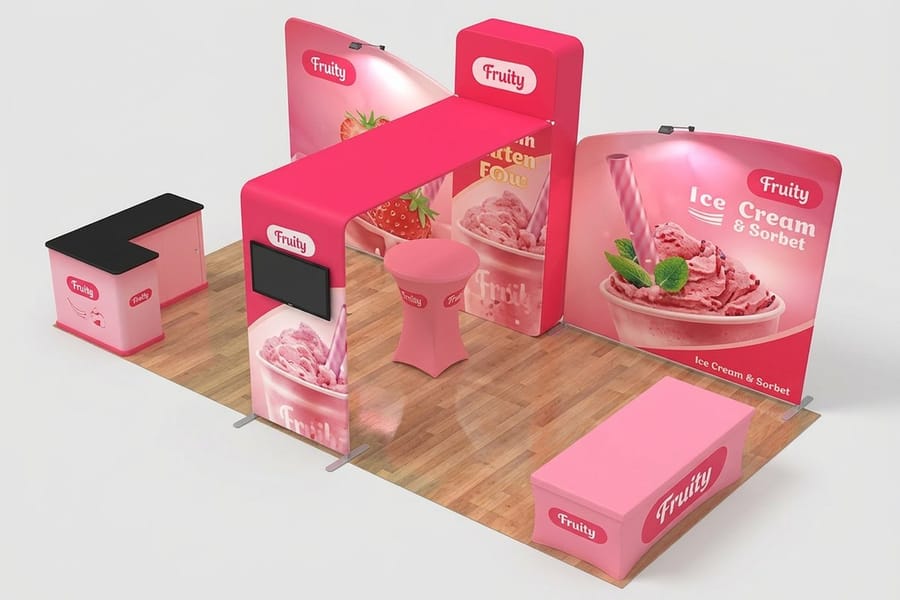
A bowl of branded pens will get you a crowd. It will also get you a scan list full of people whose interest ended at the pen, and a sales team that spends the following week calling them. High scan counts feel like a good show and read like one in the post-show report, which is exactly why the metric misleads.
The better test for a giveaway is whether a person who does not want to buy from you would still take it. If the answer is yes, it is attracting the wrong crowd. Something tied to the job your buyer actually does, a printed swatch book, a sample of the material you sell, a reference card they will pin above a desk, filters the aisle for you instead of flooding it.
Demos beat descriptions in the same way. Put the physical thing on the counter and let people handle it. A sample someone has bent, held to the light and put in their bag does more for recall than any amount of explaining, which is why print sells so well at shows and slide decks do not. The booth ideas and materials checklist covers what to bring.
Qualify at the booth or not at all
A badge scan captures a name and a company. It does not capture whether they have a budget, a timeline, or any memory of speaking to you. Add two fields yourself: what they asked about, and what you promised to send. Most lead-capture apps allow a note, and a paper form on a clipboard works when the app does not.
Sort the list into three piles at the end of each day while the conversations are still fresh, not on the flight home. Real opportunities, worth-a-call, and pen-collectors. The third pile is not a failure, it is just not a lead, and treating it like one is what makes the next show harder to get budget for.
The follow-up window is shorter than you think
Attendees come home to a backlog and a hundred vendor emails that all open the same way. Send yours within forty-eight hours, reference the specific thing you talked about, and attach or send whatever you promised at the booth. A follow-up that says "great to meet you at the show" and nothing else is indistinguishable from every other one in the inbox.
For the accounts that mattered, a physical piece works again here for the same reason it worked before the show: it arrives alone. A printed sample of the exact thing they were holding at your counter, mailed the week after, restarts the conversation without asking for a meeting.
Where trade show promotion is going
Two shifts are visible on most floors now. Lead capture has moved onto phones, so the QR code is doing work that a printed brochure used to do, but only when it points somewhere specific. A code that lands on a homepage teaches people not to scan your codes; one that lands on the exact sample, spec sheet or booking page you just discussed gets used.
The second shift is that print at shows has become more targeted and less bulk. Fewer catalogs stacked on a rack, more short-run pieces printed for one audience, and reusable fabric graphics instead of panels that get recycled after one event. Both trends point the same way: buy the durable frame, print the message short and print it often. Browse the whole range in the trade show printing collection.
Booth kit pricing and specs at 4OVER4.COM
A booth kit is priced as a system: frame, printed graphic, case and hardware together, which is why the number looks larger than a banner and smaller than a custom build. The figures below come from the live configurator, so you can put a real number in the show budget before you commit the space.
Quantity and price
Trade show booth kit pricing and specs
Live configurator numbers for the kit, including the frame, the printed graphic and the travel case.
| Quantity | Price Per Unit | Total |
|---|---|---|
| 1 | $2,599.00 | $2,599.00 |
| 2 | $2,599.00 | $5,198.00 |
| 3 | $2,499.00 | $7,497.00 |
| 4 | $2,499.00 | $9,996.00 |
| 5 | $2,499.00 | $12,495.00 |
You can also earn coins on every order and redeem them against the reprints, which matters more than it sounds when you are replacing a banner graphic three times a year.
What the graphic is printed on, and why it matters
Two things decide how a booth graphic ages: the substrate and how it travels. Dye-sublimated fabric carries the ink inside the fiber, so a scratch does not remove color and a fold does not crack it. Rigid laminate carries the ink on a surface, which holds a harder gloss and shows every corner knock the freight company gives it. Neither is wrong. They fail differently, and the one that suits you depends on how many times a year the stand comes out of storage.
Print it
Fabric booth kits, ready to travel
Tension fabric over an aluminum frame, folded into a case instead of crated.
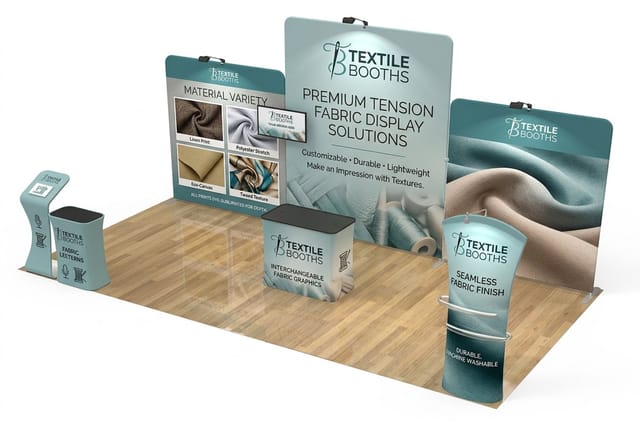
Storage is the part nobody budgets for and everyone pays. A crated rigid stand needs floor space in a warehouse and a forklift at both ends; a fabric kit lives in a case in a closet and goes on the plane with whoever is working the show. Over a year of three or four events, that difference usually costs more than the graphics themselves. If you are choosing between formats for the smaller pieces around the stand, choosing trade show banners covers which type suits which spot, and the full range sits in booth kits printing.
What changes by exhibitor type
The principles hold across the hall, but where you spend the budget does not. Here is where each kind of exhibitor gets the most back.
- First-time exhibitors. Buy a kit, not a custom build, and spend the difference you save on pre-show outreach. The stand matters less than whether anyone knew you would be there.
- Manufacturers and suppliers. Bring the physical product and a counter to put it on. A sample in a buyer’s hand outperforms the backwall behind it, so plan the counter before the graphics.
- Service businesses. You have nothing to hand over, so the demo is the conversation. Book meetings ahead, keep the booth open, and use printed reference pieces people keep at a desk.
- Franchise and multi-location brands. One frame per location, one shared undated backwall design, and location-specific messaging on the replaceable banner. It keeps the brand consistent and the reprints cheap.
- Small teams doing several shows a year. Fabric packs into a case and travels as luggage. Rigid needs a crate and pays drayage at every venue, which quietly doubles the cost of a light stand.
Artwork set-up before you send it
Large-format artwork fails in predictable places: type too close to the frame line, an image scaled up past its resolution, and a color that shifts when it hits fabric instead of paper. Build at the supplied template size, keep critical elements well inside the safe area because tension fabric pulls at the edges, and ask for a proof on the actual material when the brand color has to match something. Print-ready blanks with the bleed and trim already marked sit in the blank template library.
Wally sets up a booth that reads from the aisle
Book the meetings first, then design for twenty feet
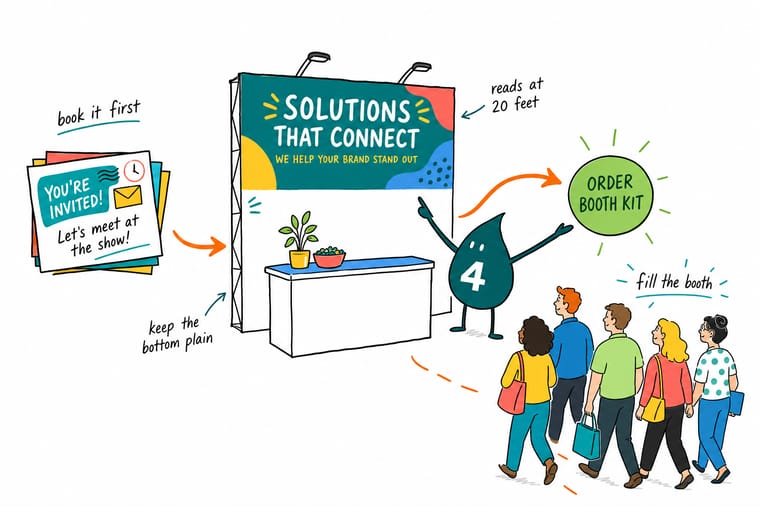
Send invitations with a real time slot six weeks out and put your booth number on everything. Keep the company name and one line in the top third of the backwall, leave the bottom three feet plain because a counter hides it, and push contrast harder than your monitor suggests because hall lighting is flat and gray. Print the year on a banner you can replace, never on the wall you want to reuse. 4OVER4.COM builds the kit from $2,599 and reprints the skin when your message changes.
Order a trade show booth kit →What to remember before the next show
Design rules that hold in any hall
- Top third or nothing. The company name and one line about what you do go above head height. Anything under three feet is hidden by a counter, a chair or a person.
- Push contrast past comfortable. Hall lighting is flat and gray. Saturated colors go muddy and dark panels close up, so build for that room rather than for your monitor.
- Leave the date off the backwall. A year, a hashtag or a show name printed on the main graphic makes a reusable kit single-use. Put time-limited copy on a banner you can reprint.
- Open the front of a 10 by 10. A table across the entrance is a barrier. Move it to the side and stand at the edge of the carpet instead of behind the furniture.
- One offer, one QR destination. Point the code at the exact thing you discussed, not the homepage. A wasted scan teaches people to stop scanning.
Explore more
More ways to print and promote
A fabric booth kit is $2,599.00 and takes 8 business days, which sets the artwork deadline, not the show date.
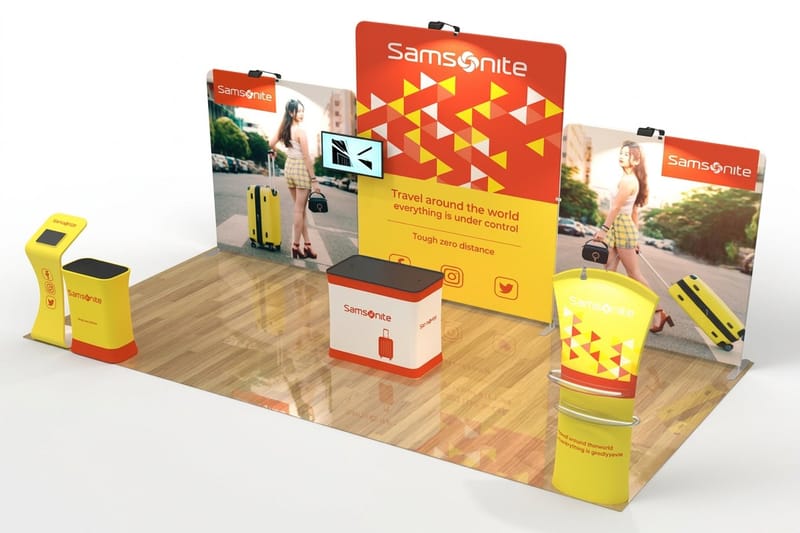 Product Trade Show Booth Kits Frame, backwall graphic and case, from $2,599.
 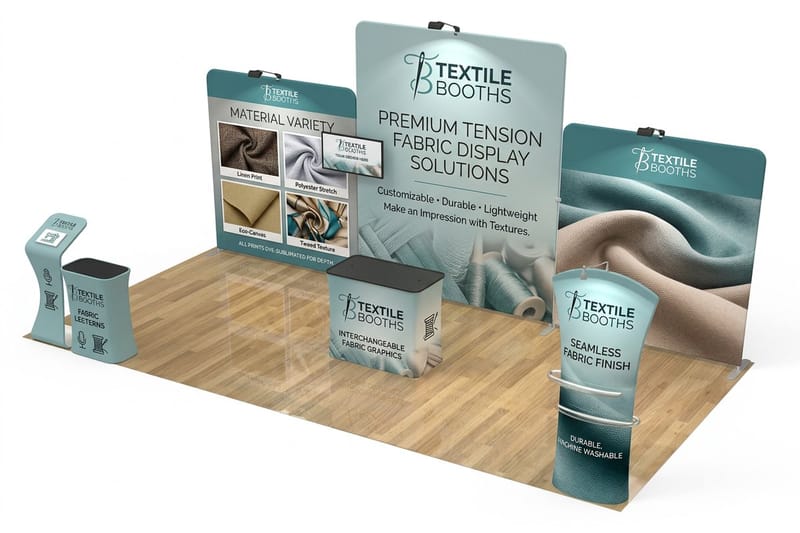 Product Fabric Booth Kits Dye-sub tension fabric that packs into checked luggage.
  Category Trade Show Printing Banners, counters, handouts and everything else on the stand. Category Booth Kits Printing Complete booth systems sized to 10 by 10 and larger spaces.
  Guide Trade Show Booth Design Layout, sightlines and what reads from the aisle.
  Guide How to Choose Trade Show Banners Which banner type suits which spot in the booth. Guide Trade Show Banner Sizes Standard sizes and where each one fits.
  Article 7 Steps to Trade Show Marketing Success The sequence from booking the space to the follow-up.
  Article Booth Ideas and Materials Checklist What to pack, what to print, what to leave at home.
 Ready to print the stand?
Pick the kit that fits your space, upload your artwork or start from a free template, and 4OVER4.COM prints it sharp and ships it in a case you can carry.
Common questions about trade show marketing
How far ahead should I start promoting a trade show appearance?
Six to eight weeks for outreach, and longer than that for anything printed. Organizers usually publish the exhibitor list and start mailing attendee codes around that point, which is when your target accounts begin planning which stands to visit. Work backwards from the show date: invitations out at six weeks, a reminder at two weeks with the booth number, and a confirmation the day before to anyone who booked a slot. Print production sits earlier still, because a booth kit and its graphic need artwork approval, production and freight before the venue accepts deliveries.
Should I print the show name and the year on my booth graphic?
No. It is the fastest way to turn a reusable stand into a one-show expense. A booth kit at $2,599 is only good value if you set it up several times, and a graphic that says which event it was made for cannot be used at the next one. Keep the backwall permanent with your name, a positioning line and one strong image, then carry the show name, the promo code and the dated offer on a retractable banner or a counter wrap that costs a fraction to reprint.
Are trade show giveaways worth the money?
Only when the item filters the aisle instead of flooding it. Pens, tote bags and candy attract people who want pens, tote bags and candy, and they inflate your scan count with contacts nobody will convert. A giveaway tied to the buyer’s actual job does the opposite: a sample of the material you sell, a swatch book, or a printed reference card that ends up pinned above a desk. The test is simple. If someone who will never buy from you would still take one, it is working against you.
Fabric or rigid graphics for a booth?
Fabric for most exhibitors, rigid only when you want the hardest possible finish and the stand rarely moves. A dye-sublimated tension fabric graphic has the color printed into the cloth, folds into a case, travels as checked luggage and hangs its creases out in about an hour. Rigid laminate panels look sharper up close but scuff at the corners, need a crate, and pick up drayage charges at the venue that can approach the cost of the panels themselves. Fabric booth kits and trade show booth kits both start at $2,599 at 4OVER4.COM, so the difference shows up in freight and reprints rather than the first invoice.
What should I actually hand out at the booth?
One piece, given at the end of a conversation, that carries what you promised. A card with a QR code pointing at the specific sample, spec sheet or booking page you just discussed will outperform a catalog every time, because a catalog gets weighed against luggage allowance and left in a hotel room. If you sell something physical, the sample itself is the handout and the card goes with it. Stack a literature rack with brochures and you will mostly be paying to print recycling.
How quickly do I need to follow up after the show?
Inside forty-eight hours, and reference the actual conversation. Attendees land back at a backlog and a hundred near-identical vendor emails, so a message that opens with "great to meet you at the show" reads as a mail merge and gets treated as one. Note at the booth what each person asked about and what you agreed to send, then send exactly that. For the handful of accounts that matter most, mailing a printed sample of the thing they held at your counter restarts the conversation without asking them for anything.
