
Traditional Wedding Invitation Wording Examples to Copy


Sofia is our design and templates voice, built from the knowledge of our production team, with over 20 years in printing.
How Traditional Wedding Invitation Wording Works, Line by Line
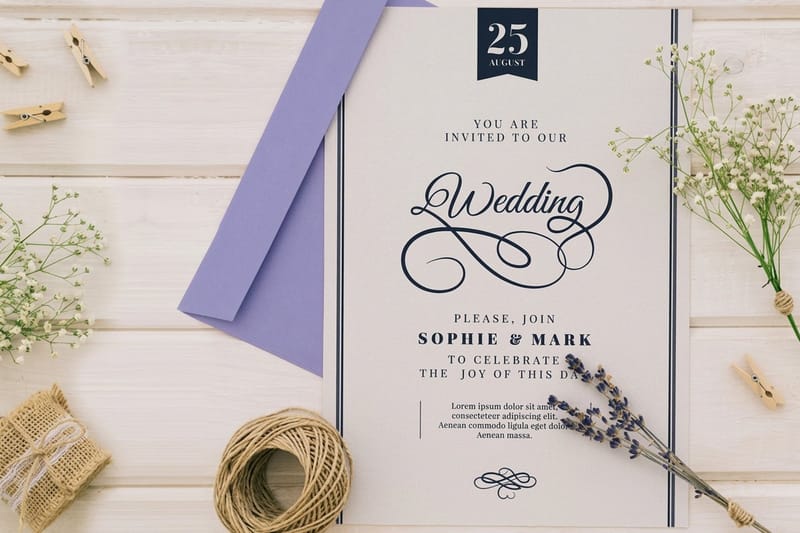
Traditional wedding invitation wording is five short statements stacked in a fixed order on the printed card, each one on its own line, each one answering a single question a guest needs answered. Those lines fill the front of a 5x7 flat wedding invitation, or an embossed or foil card when the couple line should stand off the paper, and everything they leave out goes on the reply card and details card printed with it. Who is inviting me. What am I being invited to do. Who is getting married. When. Where. Once you see the stack, the whole card becomes easy to write and almost impossible to get wrong.
The order carries meaning of its own. Placing the hosts first is an old courtesy that credits the family issuing the invitation, and moving the couple to the center of the card gives them the visual weight the day deserves. Break the order and readers stumble, because they are scanning for information in the place they expect to find it.
Formality also lives in small mechanics rather than in flowery language. Traditional suites spell out the date, the year and the hour in full, avoid abbreviations and punctuation at the ends of lines, and let generous white space do the decorating. That is why the wording and the printing decision are really one decision: a spelled-out line needs room to breathe, and room to breathe is a paper and format question. 4OVER4.COM has printed 10 billion+ pieces since 1999, and the invitations that read best are almost always the ones where the type was given space before any ornament was added.
Line 1: the host line
The host line names whoever is issuing the invitation, historically the bride's parents, today just as often the couple themselves or both families together. Write it in full form with titles, and give it its own line so nothing else competes with it.
Line 2: the request to attend
Two phrases dominate. "Request the honor of your presence" is reserved for a ceremony inside a house of worship, with the British spelling of honor intact. "Request the pleasure of your company" covers every other venue, from a hotel ballroom to a vineyard lawn.
Line 3: the couple
Names sit at the visual center of the card. Traditional form gives the bride first and full middle names, then the joining word, then the groom with full name and title. Same sex couples use whatever order sounds right when read aloud, most often alphabetical.
Lines 4 and 5: date, time and place
Spell the day, the date and the year, then the hour, then the venue name, then the city and state. House numbers and street addresses are usually left off unless the location is genuinely hard to find, in which case they belong on the details card instead.
Shop the day
Wedding printing collection
Invitations, reply cards, programs and signage printed on matching stock.
Classic Wedding Invitation Wording in One Complete Card
Classic wedding invitation wording is the church form: the hosts by full name and title, "request the honor of your presence", the couple in full names, the date and hour in words, then the venue with its city and state. Set on a 5x7 card, centered, one statement per line, it reads like this.
Mr. and Mrs. Robert Hale
request the honor of your presence
at the marriage of their daughter
Anna Louise
to
Mr. James Edward Carter
Saturday, the twelfth of September
two thousand twenty six
at four o'clock in the afternoon
Grace Church
Hartford, Connecticut
That card carries eleven lines, which fits a 5x7 with room for white space and leaves the reply details for a 3.5x5 reply card. Flat invitations print in 3 business days from a run of 25, embossed in 10 and foil in 7, so set the wording before you choose the finish and leave the longer lead time for the raised or metallic version.
Who Hosts the Wedding and How to Say It
The host line is where most couples stall, because modern families rarely match the template a 1950s etiquette book had in mind. The rule that still works is simple: name whoever is paying for and issuing the invitation, in the warmest accurate phrasing you can find, and never leave a contributing parent unnamed if their absence would be noticed.
Pick the line that describes your situation, then read the whole invitation aloud once. If it sounds like a sentence a real person could say at the door, it is right. Set it in the same typeface as the rest of the card so nothing looks bolted on.
- Bride's parents hosting. "Mr. and Mrs. Charles Whitfield request the honor of your presence at the marriage of their daughter"
- Both families hosting. "Mr. and Mrs. Charles Whitfield and Mr. and Mrs. Daniel Reyes request the pleasure of your company at the marriage of their children"
- The couple hosting. "Together with their families, Eleanor Grace Whitfield and Marcus Daniel Reyes request the pleasure of your company at their marriage"
- Divorced parents. "Mrs. Katherine Whitfield and Mr. Charles Whitfield request the honor of your presence at the marriage of their daughter", with each name on its own line
- A parent who has passed. "Eleanor Grace Whitfield, daughter of Katherine Whitfield and the late Charles Whitfield, and Marcus Daniel Reyes invite you to share in their joy"
Once the host line is settled, everything below it falls into place quickly. That is also the moment to decide on format, because a longer host line needs a wider card or a smaller point size to stay on one line, and a broken host line is the single most common layout problem we see on wedding files.
Print picks
Three wedding invitation formats worth a look
Live prices, ready to customize with your own wording.
 Flat Wedding Invitations 25 for $19.77 The classic single panel that carries traditional wording with nothing to distract from it.
 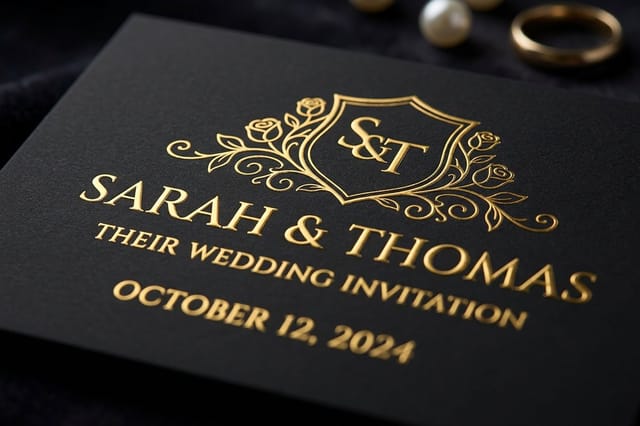 Embossed Wedding Invitations 100 for $220.20 Raised lettering you can feel under a thumb, ideal for the host and couple lines.
 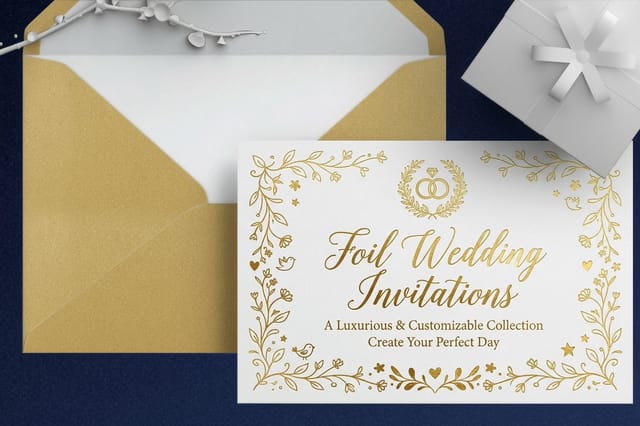 Foil Wedding Invitations 500 for $421.91 Metallic script for black tie evenings, formal venues and heirloom keepsakes.
 Wording When the Groom's Parents Host a Black Tie Wedding
When the groom's parents host, their names take the host line and the bride is introduced with her full name, often with her own parents named after her, since the invitation comes from the other family. Black tie goes in the lower right corner in small capitals, where this page places any dress code, and the request line still follows the venue.
- House of worship. "Mr. and Mrs. Daniel Reyes request the honor of your presence at the marriage of Miss Eleanor Grace Whitfield to their son Marcus Daniel Reyes"
- Ballroom or hotel. "Mr. and Mrs. Daniel Reyes request the pleasure of your company at the marriage of Eleanor Grace Whitfield, daughter of Mr. and Mrs. Charles Whitfield, to their son Marcus Daniel Reyes"
- Dress code line. "Black tie" in small capitals when evening dress is expected, or "Black tie optional" when a dark suit is welcome.
A host line naming both families runs long, so check it on a 5x7 proof and drop the point size a step if a name breaks onto a second line. For a black tie evening, embossing lifts the couple line off the stock and foil sets the names in metallic script, the two finishes guests read as formal before they reach the dress code.
Names, Dates and Times Written the Traditional Way
The traditional suite spells things out. Numerals feel like a form, words feel like an occasion, and the difference is readable even to guests who could not tell you why. Follow four conventions and your card will look correct to anyone who knows the rules, while staying perfectly clear to everyone who does not.
- Dates. "Saturday, the fourteenth of June, two thousand twenty six" rather than 06/14/2026. The day of the week comes first, the year sits on its own line.
- Times. "at half after four in the afternoon" is the traditional form. Use "in the morning" before noon, "in the afternoon" until six, and "in the evening" after that.
- Names. Full first and middle names, no nicknames, no initials. Titles such as Doctor are spelled out in the formal version.
- Punctuation. No period at the end of a line. Commas appear inside a line, for example between a city and a state, and nowhere else.
Traditional invitations also avoid the word "and" between a time and a place, and they never mention money, registries or gifts. Reception details, hotel blocks and shuttle times all live on separate enclosure cards, which is why suites are usually quoted as a set rather than as a single piece.
Quantity is the other lever. Invitations go out per household rather than per guest, so a 180 person guest list often lands closer to 95 invitations. Set the wording first, then price the real count, then decide how much of the budget belongs to the stock and how much to a finish.
Quantity and price
Flat wedding invitation pricing and specs
Real configurator numbers. The more households you print for, the lower the per piece cost.
| Quantity | Price Per Unit | Total |
|---|---|---|
| 25 | 79.1¢ | $19.77 |
| 50 | 50.5¢ | $25.27 |
| 100 | 42.8¢ | $42.84 |
| 200 | 25.8¢ | $51.62 |
| 300 | 20.1¢ | $60.42 |
| 400 | 17.3¢ | $69.20 |
Venue, Reception and Reply Lines That Guests Can Follow
The bottom third of the invitation is pure logistics dressed in formal clothes. Name the venue, then the city and state, and stop there. Guests who need a street address will find it on the details card or the wedding website, and a full address on the main invitation crowds the very lines that should look calm.
- Ceremony venue. "Saint Andrew's Chapel" on one line, "Charleston, South Carolina" on the next.
- Reception at the same place. "Reception to follow" is enough. Nothing more is needed and nothing more should be added.
- Reception elsewhere. "Dinner and dancing to follow at The Harbour Room" on the invitation, with the address moved to the enclosure card.
- Adults only. Never state it on the invitation. Address the outer envelope to the named adults and let the details card carry the note politely.
- Reply line. "Kindly respond by the first of May" on the reply card, paired with a stamped return envelope in a traditional suite.
Set your reply deadline three to four weeks before the wedding, and at least a week before the caterer needs final numbers. Print the deadline in words to match the invitation, then keep the reply card wording short enough that a guest can complete it in under a minute. If you want the full reply card treatment, our wedding RSVP wording guide walks through every line, and the RSVP design examples show how those lines look once they are typeset.
Premium finish
Foil wedding invitations
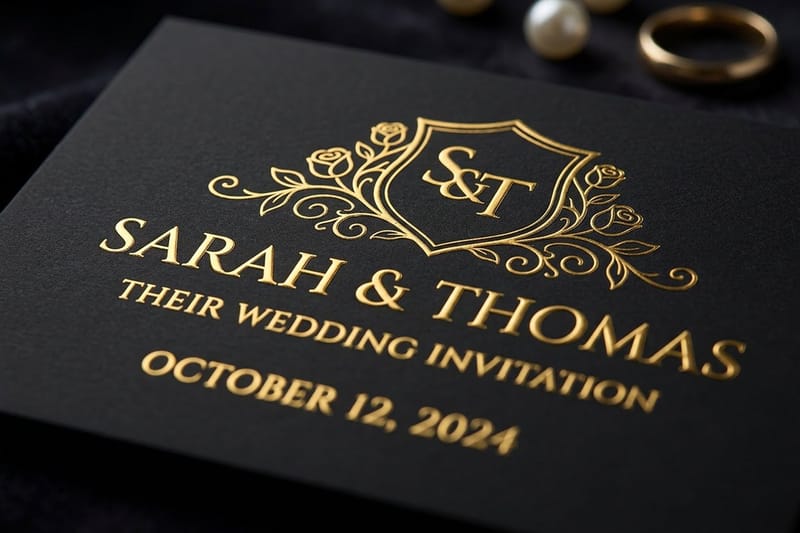
Metallic script that catches the light and tells guests the evening is formal.
Formal Wording Versus Modern Wording
Formal and modern wording make different promises about the evening. Formal wording tells guests to expect a ceremony with structure, a seated dinner and a dress code. Modern wording tells them to expect warmth and a little informality. Trouble only starts when the card promises one thing and the day delivers another.
- Formal. "Mr. and Mrs. Charles Whitfield request the honor of your presence at the marriage of their daughter Eleanor Grace to Mr. Marcus Daniel Reyes"
- Semi formal. "Together with their families, Eleanor and Marcus invite you to celebrate their marriage on Saturday, the fourteenth of June"
- Modern. "Eleanor and Marcus are getting married, and the day would not be the same without you. Join us on June 14, 2026 in Charleston."
- Religious. "at the celebration of their marriage in the presence of God and their families" keeps the traditional structure with a faith centered request line.
- Second marriage. "Eleanor Grace Whitfield and Marcus Daniel Reyes, together with their children, invite you to share in the beginning of their new life"
Whichever register you pick, hold it across the whole suite. A formal invitation followed by a chatty details card reads as two different weddings. Font choice does the same work as vocabulary, which is why the best wedding fonts breakdown is worth reading before you lock the layout.
Feel the difference
Embossed invitations
Pressed lettering raises the couple line off the stock, so the most important words are felt before they are read.
Copy and Paste Wedding Invitation Templates
Lift these four complete invitations as they are, swapping names, dates and venues. Each line break below is a real line break on the printed card. Keep them centered, keep the couple's names largest, and resist adding a fifth typeface.
Template 1: fully traditional, church ceremony
Mr. and Mrs. Charles Whitfield
request the honor of your presence
at the marriage of their daughter
Eleanor Grace
to
Mr. Marcus Daniel Reyes
Saturday, the fourteenth of June
two thousand twenty six
at half after four in the afternoon
Saint Andrew's Chapel
Charleston, South Carolina
Template 2: both families hosting
Mr. and Mrs. Charles Whitfield
and Mr. and Mrs. Daniel Reyes
request the pleasure of your company
at the marriage of their children
Eleanor Grace and Marcus Daniel
Saturday, the fourteenth of June
two thousand twenty six
at five o'clock in the evening
The Harbour Room
Charleston, South Carolina
Dinner and dancing to follow
Template 3: the couple hosting
Together with their families
Eleanor Grace Whitfield
and
Marcus Daniel Reyes
invite you to share in the joy of their marriage
Saturday, the fourteenth of June
two thousand twenty six
at four o'clock in the afternoon
Magnolia Gardens
Charleston, South Carolina
Reception to follow
Template 4: warm and modern
Eleanor and Marcus
are getting married
and would love you there
Saturday, June 14, 2026
four in the afternoon
Magnolia Gardens, Charleston
Dinner, dancing and a very long toast to follow
Compare finishes
Popular wedding formats, side by side
Embossed invitations run 100 for $220.20 in 10 business days and foil 500 for $421.91 in 7.
| Flat Wedding Invitations | 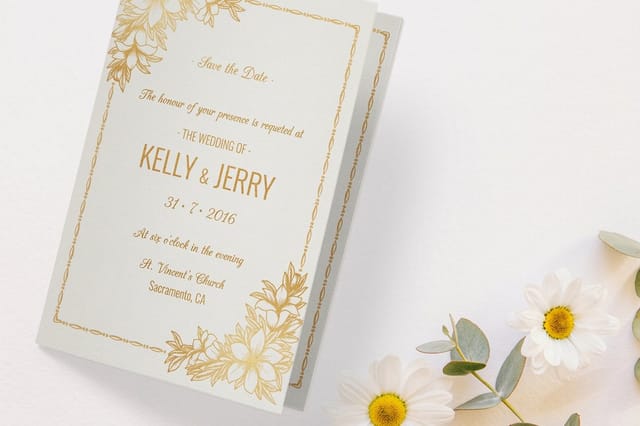 Folded Wedding Invitations | 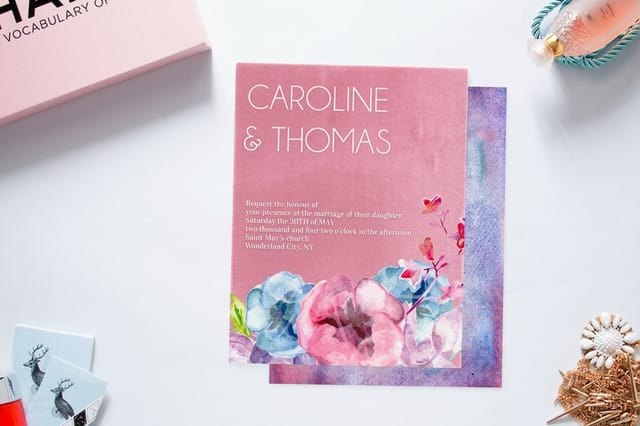 Velvet Wedding Invitations | 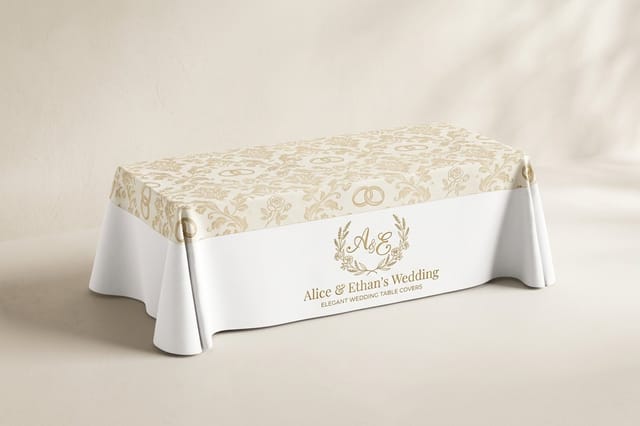 Wedding Table Covers | |
|---|---|---|---|---|
| Min price | $19.77 | $38.22 | $251.36 | $225.00 |
| Paper / stock | 14pt Gloss Cover | 14pt Gloss Cover | 16 Point Soft Velvet Laminated | 9oz Premium Polyester |
| Finish | Standard Finish | Standard Finish | - | - |
| Size | 4.25" x 5.5" | 8.5" x 5.5" fold to 4.25" x 5.5" | 4.25" x 5.5" | 84" x 126.5" (6ft Table) |
| Default qty | 25 | 25 | 500 | 1 |
| Turnaround | 3 business days | 5 business days | 7 business days | 4 business days |
| Rating | ||||
| View & customize | View & customize | View & customize | View & customize |
Dress Code, Enclosures and Printing the Suite
A traditional suite is rarely one card. The invitation carries the wording above, and everything practical moves to enclosures so the main piece stays uncluttered. Decide the pieces before you print, because a suite ordered together stays consistent in stock, ink and trim, while pieces ordered weeks apart rarely match.
What belongs on each piece
- Invitation. Hosts, request, couple, date, time, venue city. Dress code sits in the lower right corner in small capitals if you use one.
- Reply card. A line for names, an accept or decline choice, the reply deadline and a meal selection if the caterer needs it.
- Details card. Full addresses, parking, shuttle times, hotel block, wedding website and any adults only note.
- Envelopes. Outer envelope for formal names and titles, inner envelope naming exactly who is invited.
Address the outer envelopes in the same formal register as the wording, since it is the first thing a guest reads. Our envelope addressing guide covers titles, plus ones and children, and the wedding program wording guide carries the same voice through to the ceremony itself. For every other card you will write this year, the wording and messaging guides keep the phrasing consistent.
Start fast
Invitation templates and print-ready blanks
Free layouts plus exact-size blanks so your wording lands inside the trim every time.

Wally helps you word the invitation
Get the five lines right, then choose the stock they are printed on
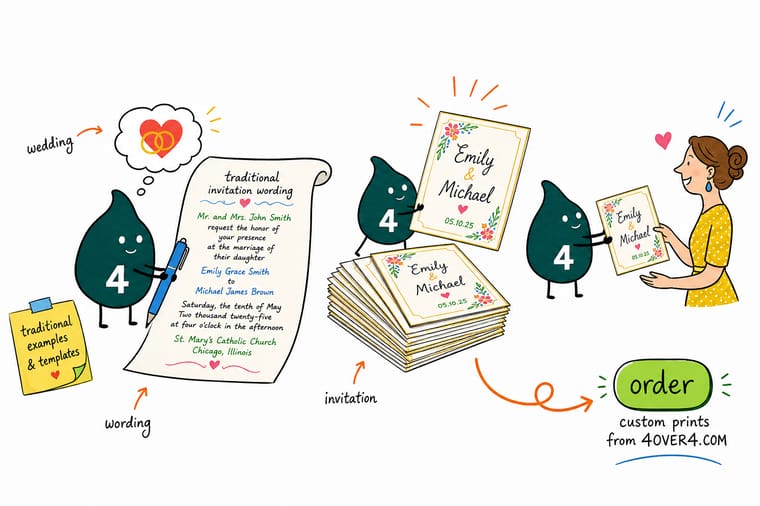
Write the host line first, because it sets the register for everything under it. Add the request line, then the couple in full names, then the date and hour spelled out, then the venue with city and state. Move addresses, registries and shuttle times to the details card. When the wording reads cleanly aloud, pick flat, embossed or foil and print the whole suite together.
Design your wedding invitations →Wording That Sounds Formal and Still Sounds Like You
Keep reading
Guides that finish the rest of the suite
Outer and inner envelope titles, a reply deadline three to four weeks out, and an order of service worded to match the invitation.
 Guide How to Address Wedding Envelopes Titles, plus ones and inner envelopes done correctly. Guide Wedding RSVP Wording Reply card lines, deadlines and meal choices.
 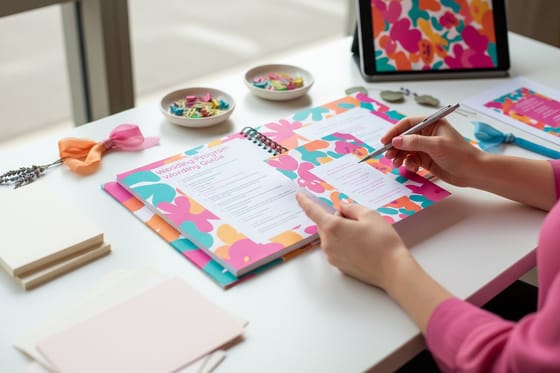 Guide Wedding Program Wording Carry the same voice through the ceremony. Guide Wording and Messaging Guides What to write for every card and invitation.
 Explore more
More wedding printing across 4OVER4.COM
The wedding collection, flat, embossed and foil invitations, and the font and RSVP pages that finish a 5x7 suite.
Collection Wedding Printing Collection Invitations, RSVP cards, programs and signage in one place. Product Flat Wedding Invitations The classic single panel for traditional wording. Product Embossed Wedding Invitations Raised lettering that guests can feel under a thumb. 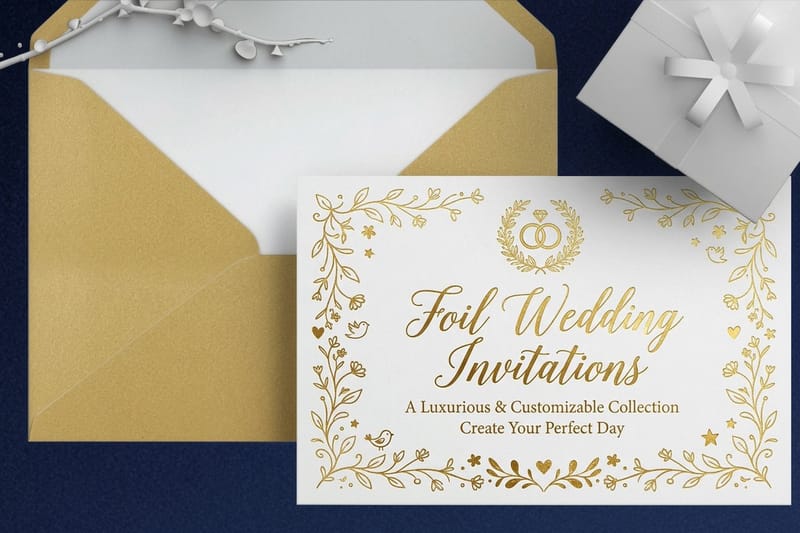 Product Foil Wedding Invitations Metallic script for formal evening weddings. Article Wedding RSVP Wording Reply card wording paired with real design examples.
  Article The Best Wedding Fonts Typefaces that keep formal wording readable. Guide Addressing Wedding Envelopes Outer and inner envelope etiquette for US mail. Guide How to Write RSVP Wording Deadlines, meal choices and polite phrasing. Guide Wedding Program Wording Order of service wording that matches the suite. Guides Wording and Messaging Guides Every wording guide we publish, in one hub.
  Showcase Letterhead Examples Formal layout ideas that translate to invitations.
  Alternative 4OVER4 vs MOO Invitations How the two compare for wedding suites.
 Ready to print the invitation your guests will keep?
Set the wording, pick flat, embossed or foil, then print the whole suite together so every card matches from the first envelope to the last program.
Wedding Invitation Wording FAQs
What is the line-by-line wording of a wedding invitation?
Five lines in a fixed order. The host line names whoever is issuing the invitation, the request line uses "the honor of your presence" for a house of worship or "the pleasure of your company" everywhere else, the couple sits at the visual center in full names, the date and time are spelled out in words, and the venue closes with its name plus city and state. Reception, addresses and reply details move to enclosure cards. For the reply card itself, follow our wedding RSVP wording guide.
What is traditional wedding invitation wording?
Traditional wording is the formal register your grandparents would recognize: third person phrasing, no contractions, no abbreviations, the British spelling of honor when the ceremony is in a house of worship, and the date, year and hour written out in full. It never mentions gifts, registries or money, and it carries no end of line punctuation. The tone signals a structured ceremony and a seated reception before a guest reads a single logistic detail.
How do I choose the right traditional wedding invitation wording?
Start with who is hosting, because that single line determines the phrasing of everything below it. Then match the register to the day itself: fully formal wording for a religious ceremony and black tie reception, semi formal when both families host a hotel or garden wedding, and warmer modern wording for a relaxed celebration. Read the finished card aloud once. If it sounds like something a real person could say while welcoming you at the door, the register is right. A hotel weekend can carry the same wording onto Wedding Hotel Door Hangers for the guest rooms.
What does a traditional invitation suite cost to print?
The wording is free, the printing is what you budget for. Flat Wedding Invitations start at $19.77, Embossed Wedding Invitations start at $220.20 and Foil Wedding Invitations start at $421.91 at 4OVER4.COM. Price moves with quantity, paper stock, size and finish, and the per piece cost drops sharply as the run grows. Count households rather than guests when you quote, since a single invitation usually covers a couple or a whole family.
What sizes, stocks and finishes are available for traditional wedding invitation wording?
The classic sizes are 5x7 for the invitation and 3.5x5 for the reply card, with heavier cover weights holding formal type crisply. Choose flat printing for clean traditional layouts, embossing to raise the couple line off the surface, or foil for metallic script that catches candlelight. Matte and uncoated stocks suit calligraphic typefaces best, since ink sits softly and script strokes stay legible. Order the whole suite together so stock and ink match across every piece.
