
Why Glossy Pictures Look Sharper and When Gloss Works Against You


Emma is our prepress and print production voice, built from the knowledge of our production team, with over 20 years in printing.
Gloss is a surface decision, not a quality decision. The shine deepens black and color, some rooms and subjects turn it against you, and which prints carry it.
A glossy photo finish is a smooth sealed coating that reflects light at one angle instead of scattering it, which keeps stray light off the dark areas so blacks stay deep and colors read stronger. The same mirror-flat surface throws a bright hot spot back at anyone standing in the wrong place and holds every fingerprint that touches it. Gloss suits saturated, high-contrast subjects on a wall with controlled light. Portraits, black and white work, and any wall facing a window are better served by matte or canvas.
Quick answer
One light path explains every trade-off
Gloss reflects, matte scatters, and everything else follows from that. Because a glossy coating sends room light away at the mirror angle, almost none of it lands back on the dark parts of the image, so black holds its density and the colors above it look more saturated. Because it is level and sealed, it also sends a hot spot straight at anyone standing opposite a light source, and it shows fingerprints that a textured surface would hide. Choose gloss for saturated, high-contrast work on a wall you can control, and matte or canvas for portraits, fine detail and bright rooms. On our wall pieces the choice is concrete: acrylic prints are the gloss option on 1/4 inch plexiglass, mounted prints come on 10.4 mil semi gloss or hi gloss or 32# uncoated, and stretched canvas prints on semi gloss canvas.
What a Glossy Finish Actually Does to Light
A glossy finish is a clear, level coating sitting over the printed image. Level is the whole story. When a surface is smooth at the scale of a light wave, light bounces off it the way it bounces off a mirror, leaving at the same angle it arrived. When a surface is rough, the same light breaks into hundreds of weak rays going everywhere at once.
That difference decides how black your blacks look. On a matte print, part of the scattered room light lands back on the dark areas and adds a thin veil of brightness to them, so the deepest tone you can achieve is limited by the room, not by the ink. On a glossy print, that light leaves in one direction and mostly misses your eye, so the black holds. Wider distance between the darkest and lightest tone is what people are actually describing when they say glossy pictures have more punch.
Color follows the same logic. Nothing about a glossy coating adds pigment, and the ink laid down is identical to the ink on a matte version of the same file. The saturation you see is the result of a deeper black underneath the color and less stray white light sitting on top of it.
There is a second effect worth knowing. Higher edge contrast reads to the eye as higher resolution, so a glossy print often looks sharper than a matte print made from the same file at the same size. The resolution has not changed by a single pixel. If your file is soft or upscaled, gloss will show you that just as loudly, which is why it pays to check pixel dimensions against final print size before ordering. Our guide to DPI and PPI sets out the numbers to check.
One quirk of very deep gloss: viewed at a low grazing angle, large black areas on some coated surfaces can take on a faint bronze or greenish sheen. It disappears when you look at the print straight on, and it is one more reason to think about where a piece will hang before you choose the shine.
Gloss, Satin, Matte and Canvas Compared
Four surfaces, four different bargains. Every one of them trades something, and the table below is the trade laid out plainly rather than the marketing version.
| Finish | What the surface does to light | Black and color | Glare and fingerprints | The wall it suits |
|---|---|---|---|---|
| Gloss | Reflects at the mirror angle, almost no scatter. | Deepest black, strongest saturation, highest apparent sharpness. | Strong hot spots from any light source facing it. Shows every fingerprint. | Controlled light, no window opposite, one hero piece. |
| Satin or luster | Partly reflective with a fine texture that breaks up the reflection. | Close to gloss, a step back in depth. | Softens the hot spot into a broad sheen. Hides light handling marks. | Most rooms, and the safe answer when you are ordering blind. |
| Matte | Scatters light in every direction. | Black lifts toward charcoal, color reads calmer. | Effectively glare free, and forgiving of handling. | Bright rooms, portraits, black and white, anything read up close. |
| Canvas | Woven texture scatters light and adds its own surface pattern. | Similar to matte, with the weave visible in flat areas. | No glare. The texture eats fine detail along with the reflections. | Large pieces, painterly subjects, rooms with windows on two sides. |
Read the fourth column before the second. Almost everyone chooses on the second column, falls in love with the depth of gloss in a showroom, then hangs the print opposite a window and spends a year looking at a reflection of their own curtains. If you already know the wall is bright, matte posters at $25 or a stretched canvas at $59 will please you more than a glossy panel twice the price. Our canvas versus posters comparison goes further into that choice.
The Photos Gloss Flatters and the Ones It Exposes

Gloss is a contrast amplifier, so it rewards subjects that already have contrast to amplify and punishes subjects built on subtlety.
Subjects that gain from gloss. Night cityscapes and anything with points of light against dark. Water, wet streets and reflective metal, where the finish echoes what the photo is about. Deep saturated skies at either end of the day. Product and food photography shot on a controlled set. Motorsport, surf and other saturated action work. Vector art, posters and graphic design with large flat areas of strong color, which suffer nothing from being made stronger.
Subjects that gloss works against. Portraits, because the finish exaggerates specular highlights on skin at exactly the moment you want them softened. Black and white fine art, where the pleasure is in the mid-tone separation rather than the deepest black. Delicate high key work, pale palettes and film scans with visible grain. Documents, certificates and anything with dense small text, which becomes harder to read as soon as a reflection crosses it. Any image whose file is thin, since gloss magnifies noise, compression artifacts and over-sharpening halos as readily as it magnifies real detail.
There is also a viewing-distance rule that gets overlooked. A print you stand close to and read is a matte candidate, because you cannot move your head far enough to escape a reflection at that range. A print viewed from across a room is a gloss candidate, because at three or four metres you can pick a standing position that keeps the hot spot out of the frame.
Color management matters more on gloss too, since the wider tonal range shows profile mismatches that a matte surface would flatten out. Set the file up correctly first with our guide to the best color profile for printing, then choose the finish. If you want to see the gloss and texture argument settled on one photograph, the acrylic versus canvas comparison puts both side by side.
Where to Put the Shine and What It Costs

Four ways to hang a photograph at 4OVER4.COM, ordered from the most reflective to the least, with the reason to pick each one.
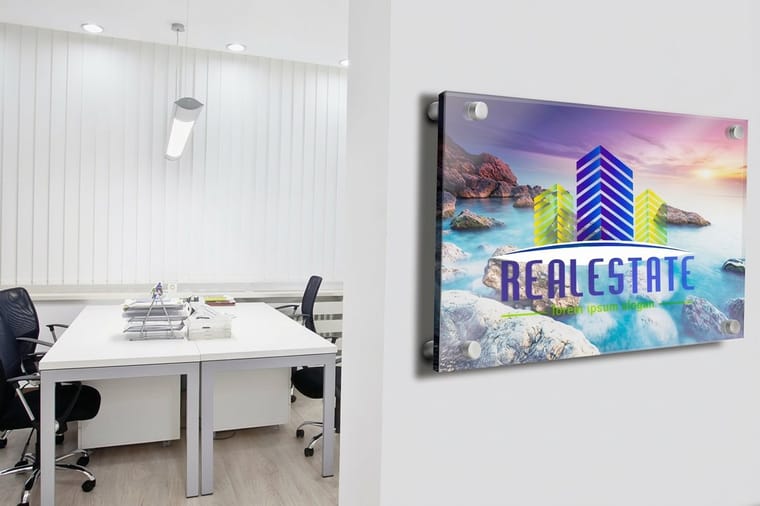
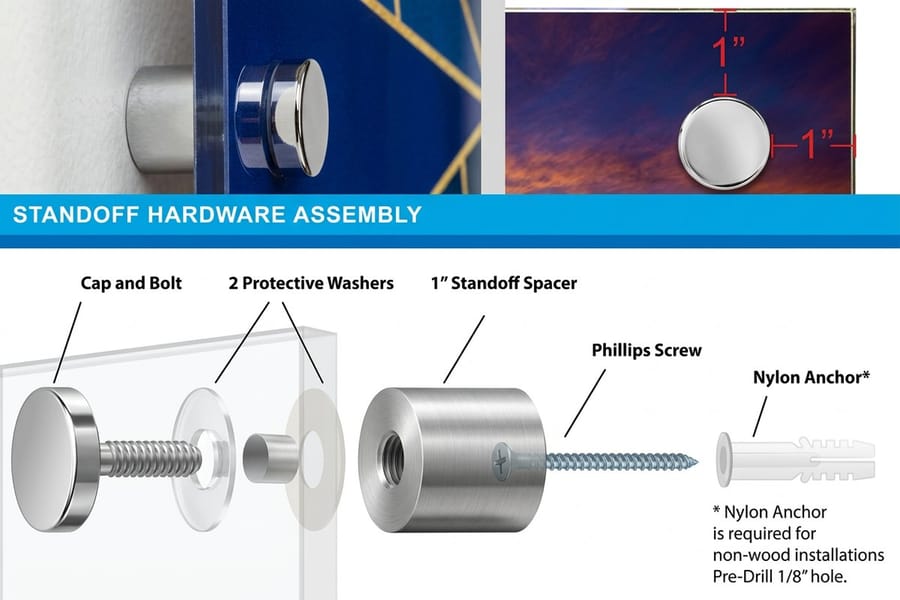
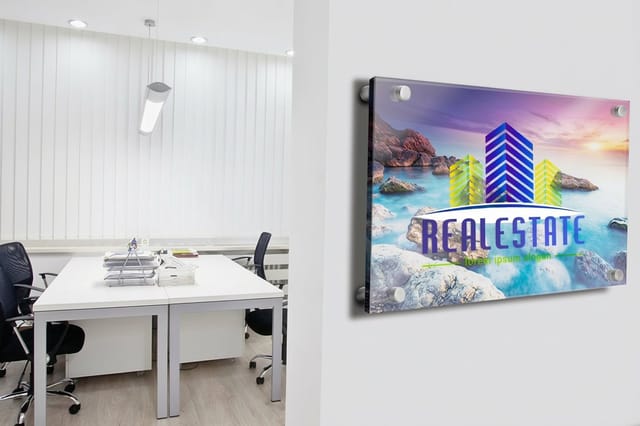
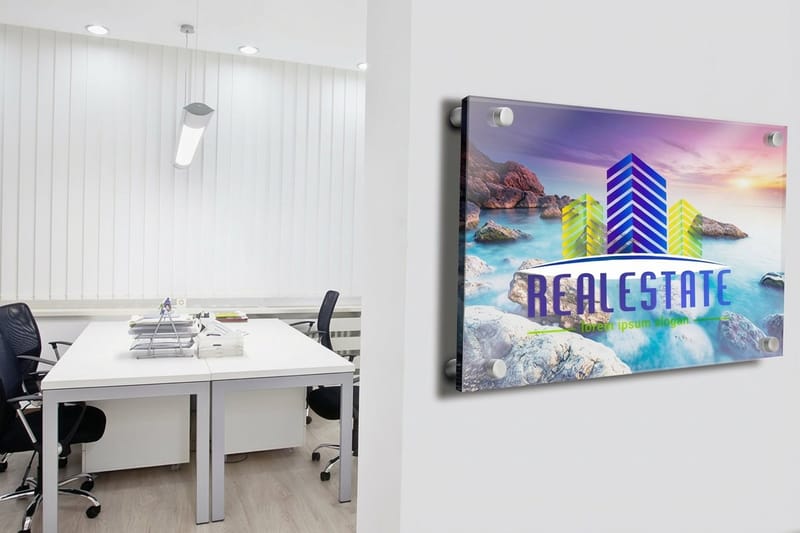
Acrylic prints, from $152.72. The image is face mounted to the back of a clear acrylic sheet, so there is no air gap and no second reflective plane. This is the deepest gloss and the deepest black we make, and it is the right home for a night shot, a saturated landscape or a single hero piece in a room where you control the lighting. It is also the most expensive way to hang one photo, and it is the least forgiving of a weak file.
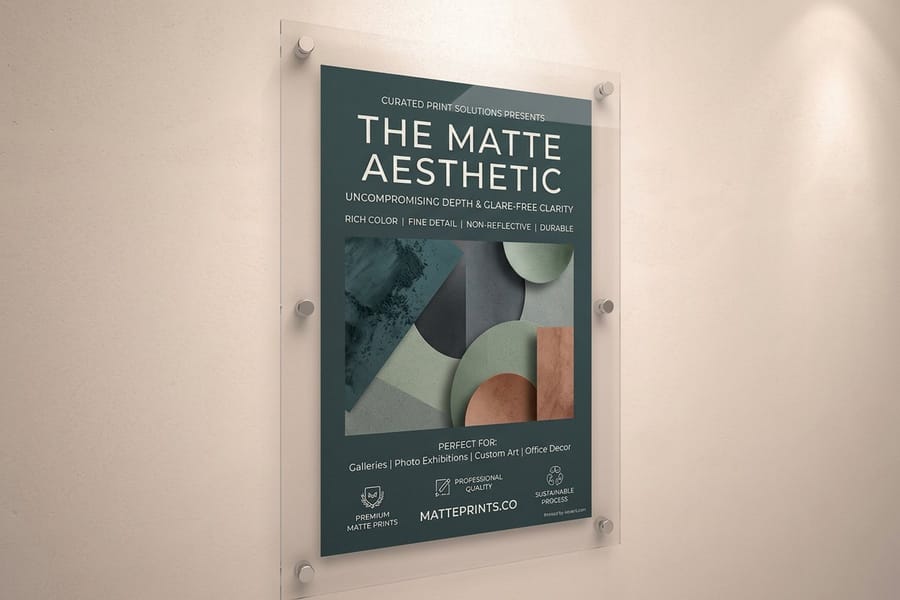
Framed prints, from $73.57. A finished piece ready to hang, where the glazing in front does as much to the look as the print behind it. Choose a matte or satin print here if the wall is bright, because glass plus gloss is two reflections fighting each other. Choose the frame when the piece has to sit alongside other framed work and match it.
Mounted prints, from $39.99. The print is bonded to a rigid board, no frame, no glass. It is the cheapest way to get a photo on a wall with a clean edge, it stays flat, and with a glossy surface you get most of the acrylic look for a quarter of the outlay. The compromise is that a bare edge and an unglazed surface are more exposed to knocks in a hallway or an office corridor.
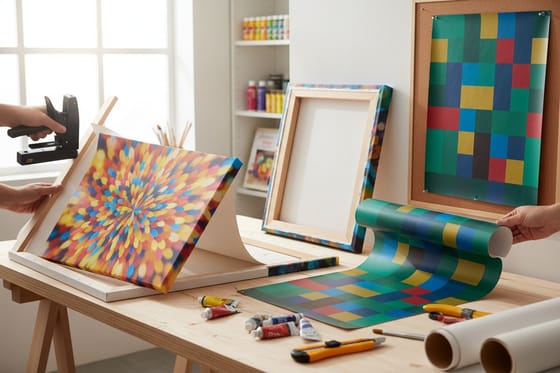
Stretched canvas, from $59. The deliberate opposite of gloss. The weave scatters light, so it never glares, and it flatters portraits, painterly subjects and any file that is not quite as sharp as you would like. What it costs you is fine detail, since the texture sits between the viewer and the image.
Ordering more than one piece for the same room is the case where mixing finishes goes wrong. Two prints on the same wall, one gloss and one matte, will not read as a set, because the blacks sit at visibly different levels. Pick one surface for the group. The full range of face-mounted options sits under acrylic print sizes and pricing, and correctly sized starting files are in the blank template library.
Wally explains the shine
Gloss bounces the light away, matte spreads it around
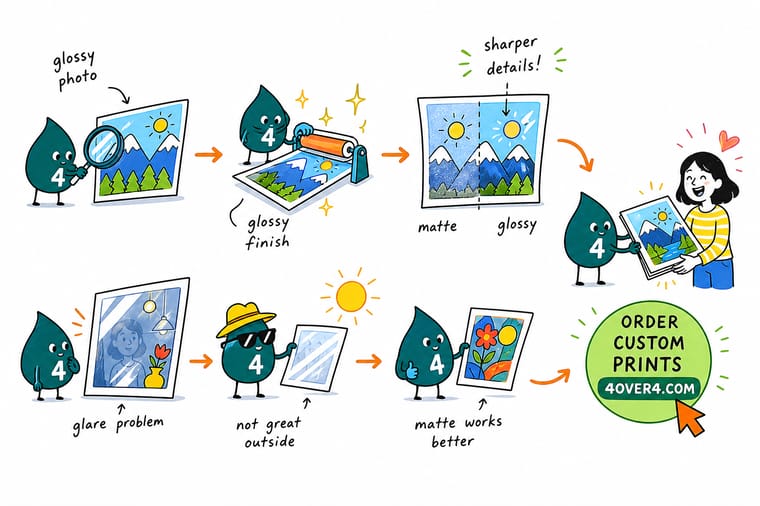
Wally holds one lamp and two prints. On the glossy one the beam leaves at the same angle it arrived, so it misses the picture and the black stays black, but it lands right in your eye if you stand in the wrong spot. On the matte one the same beam breaks into a hundred weak rays going everywhere, so there is no hot spot, and a little of that light settles on the shadows and turns them gray. Same file, same ink, opposite bargains. Pick gloss for a night shot on a controlled wall, matte for a portrait opposite a window.
Order glossy acrylic prints →
Specs and pricing
Sizes, options and starting prices for wall photos
The three ways we hang a photograph. Acrylic prints start at $152.72 for one panel at 16 by 24, 20 by 30 or 24 by 36 inches, framed prints at $73.57 from 16 by 20 to 24 by 32 inches, and mounted prints at $39.99 from 8 by 10 to 40 by 60 inches or any size, all with 4 business days of production.



Print it
Print the photo on the surface it deserves
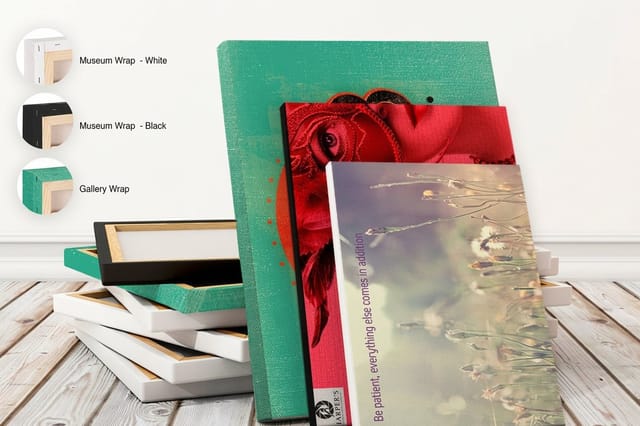
Stretched canvas starts at $59 in 12 sizes from 11 by 14 to 36 by 36 inches, with a 1.5 inch gallery wrap or a museum wrap in a white or black edge, in 3 business days. Acrylic and framed prints take 4.

Explore more
Where to go next
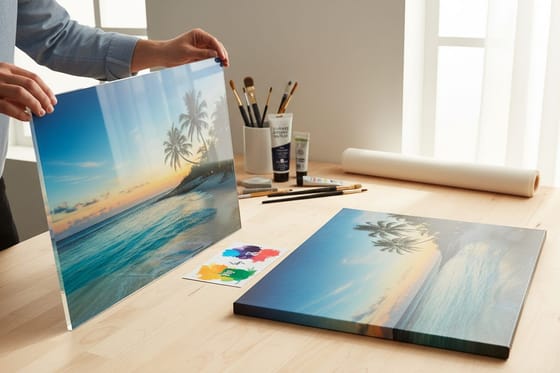
Judge acrylic against canvas on the same photo, weigh canvas against a poster, mount on foam board without a frame, pick the color profile, and check the resolution a wall print needs. The category card prices every acrylic size.
By the numbers
Photo finish work counted in years on press
Common Questions
Your glossy finish questions, answered
What is a glossy photo finish?
It is a smooth, sealed coating over the print that reflects light in one direction instead of scattering it. Because the surface is level and non-porous, room light bounces off at the mirror angle and leaves the image, rather than washing back across it. That is what produces the wet-looking blacks, the higher apparent contrast, and the saturated color people mean when they say a print looks glossy. The ink underneath is identical to the ink on a matte print of the same file. Only the surface changed.
Is glossy or matte better for photo prints?
Neither is better in general, and the honest answer depends on two things: the subject and the wall. Gloss wins on saturated, high-contrast subjects such as night scenes, water, deep skies, sports and product shots, and it wins in a room where you can control the light. Matte wins on portraits, black and white work, anything with fine tonal gradation, and any wall facing a window or sitting under bright downlights. If you cannot decide, look at where the light comes from first, because glare ruins a print faster than a slightly flatter black does.
Do glossy prints show fingerprints?
Yes, and there is no version of gloss that does not. The coating is level and sealed, so the oil from a fingertip sits on top of it and changes the way that patch reflects. It wipes off a glossy acrylic or a laminated surface with a microfibre cloth and no liquid. What you should not do is handle a glossy photographic print by the face and then stack prints together in a humid room, because two glossy faces pressed against each other can stick. Handle by the edges, and let prints breathe before you box them.
Can you put a glossy print behind glass in a frame?
You can, and plenty of people do, but you are then looking through two reflective surfaces instead of one. The glass reflects the room, the glossy print reflects whatever gets through, and the two do not line up, so bright spots can appear doubled. If you want the frame, a matte or satin print behind standard glass is the calmer combination. If you want the gloss, a face-mounted acrylic print puts the image in direct contact with the sheet so there is only one reflective plane, or a mounted print on rigid board skips glazing altogether.
Does a glossy finish make a low resolution photo look worse?
It makes everything in the file more visible, so yes, weak files suffer. Gloss raises edge contrast, which is why sharp detail looks sharper, and the same effect exposes sensor noise, JPEG compression blocks, and the bright halos left by over-sharpening. A phone photo blown up to 24 by 36 inches will show its limits faster on gloss than on canvas or matte. Check the file at full print size before you commit, and if the pixels are not there, a textured surface is the more forgiving choice.
Do glossy prints fade faster than matte prints?
The finish is not what determines fading. Light exposure, the ink set and the substrate do. What the surface changes is how quickly you notice: a glossy print holds a denser black to begin with, so any loss of density reads as a bigger change. A laminated or face-mounted glossy surface actually adds a physical barrier against handling, moisture and abrasion. Keep any photographic print off a wall in direct sun, whatever finish it carries, and it will hold up far longer than the coating choice alone would predict.
Get Started
Matte posters ship in 2 business days, acrylic prints in 4
Pick a size, choose a face-mounted acrylic panel for maximum gloss or a canvas for a bright room, and we print it on the surface that suits the picture.
Legal Disclaimer
Gold Standard guarantees apply to all standard orders placed through 4over4.com. Price match requires verifiable proof of a competitor's published price for an equivalent product with matching specifications and turnaround time. Satisfaction guarantee covers manufacturing defects and print quality issues. Contact support with order number and documentation.
