
How to Measure the Girth of a Box Step by Step


Girth is the wrap around a box, not any single side. Length plus girth is the number carriers cap, and a taller box costs more than a longer one.
Box girth is two times the width plus two times the height. Measure the longest side as the length, the next longest as the width, and the shortest as the height, all on the outside of a closed box. Double the width, double the height, and add them for the girth. Add the length to that girth, round up, and compare it to your carrier limit before you buy postage.
Start here
The wrap, not the side
Girth is the distance around a box the short way, equal to two times the width plus two times the height. Measure the outside of a closed box, call the longest side the length, and add that length to the girth for the figure carriers check against their oversize limit. Round every dimension up to the next inch, and size the box to its contents to keep both girth and dimensional weight low. The diagram below shows exactly which sides feed the wrap.
What box girth actually measures
Girth sounds technical, but it describes something simple: the distance a tape measure travels if you wrap it all the way around a box the short way, perpendicular to its longest side. Picture tying a ribbon around a parcel around its middle rather than lengthwise. The path that ribbon takes is the girth.
Because the wrap crosses two sides twice, girth always combines the width and the height, never the length. A tall narrow box and a short wide box can share the same length yet have completely different girths, which is exactly why carriers track it. It is their way of accounting for how much room a package claims beyond its longest edge.
Get the idea of the wrap clear in your head and the arithmetic that follows is easy. Everything in this guide builds on that one picture: length runs down the longest side, girth runs around the other two.
The girth formula: two times width plus two times height
For any rectangular box, girth is two times the width plus two times the height. Double the width, double the height, add the two, and you have the girth. The length stays out of this step entirely and gets added later when carriers combine length and girth.
Say a box is 12 inches long, 8 inches wide, and 6 inches high. The girth is two times 8 plus two times 6, which is 16 plus 12, or 28 inches. That 28 is the wrap around the box. It does not matter which face you call the top, only that length is the longest side and the other two go into the girth.
The formula is the same whether you print a small run of shipping boxes or a pallet of mailer boxes. When you order custom boxes, you set the width and height yourself, so you can design a box whose girth lands comfortably under your carrier limit rather than reverse-engineering it after the fact. Our online design tool and custom box printing service let you lock those dimensions in before a single box is made.
How to measure girth by hand, step by step
Start with the box closed and taped exactly as it will ship, sitting square on a flat surface. A box that bulges or gaps measures larger than the one that actually leaves your dock, so measure the real, packed parcel.
Measure the longest side first and call it the length. Then measure the second longest side for the width, and the shortest remaining side for the height. Always run the tape along the outside of the box, since that is the surface carriers price. Double the width, double the height, and add them for the girth. Finally, add the length to that girth for the number carriers actually check.
One habit saves most oversize surprises: round every measurement up to the next whole inch. Carriers record outer dimensions and round up, so if your box measures 8 and a quarter inches wide, treat it as 9. Measuring the outside and rounding up means your figures match theirs, and nothing gets reclassified at the counter.
Length plus girth and why carriers rely on it
Weight alone does not tell a carrier how much room a package needs. A light but bulky box can hog as much truck space as a dense, compact one, so carriers add a size measure: length plus girth. They take the longest side and add the girth wrap to it, then compare the total against a threshold.
Common domestic limits sit around 130 inches of length plus girth for standard ground service, with a separate maximum on the longest side itself. Cross either and the parcel is treated as oversized, which brings a surcharge or a different service tier. The exact numbers vary by carrier and service, so confirm the current limit for the one you use before you commit to a box.
The practical takeaway is to compute length plus girth for your chosen box before you print or buy postage. If the total is close to a limit, shaving an inch off the width or height, or picking a slightly slimmer box, can drop you back into standard pricing. Sizing custom boxes to the product is the cleanest way to keep this number where you want it.
Worked examples you can copy
Numbers make the formula stick. Take a book box at 12 by 9 by 3 inches. Girth is two times 9 plus two times 3, which is 18 plus 6, or 24 inches. Length plus girth is 12 plus 24, or 36 inches, well inside standard limits.
Now a bulkier box at 24 by 18 by 18 inches. Girth is two times 18 plus two times 18, which is 36 plus 36, or 72 inches. Length plus girth is 24 plus 72, or 96 inches. Still under a 130 inch limit, but you can feel it climbing as the box grows.
Push to a large box at 40 by 30 by 30 inches. Girth is two times 30 plus two times 30, or 120 inches, and length plus girth is 40 plus 120, or 160 inches, which is over a 130 inch ceiling and would ship oversized. The pattern is clear: as width and height grow, girth grows twice as fast, so the fastest way to rescue a shipment is to trim the two sides that feed the wrap.
Avoiding oversize and dimensional weight fees
Two size charges catch shippers by surprise. The first is the oversize surcharge, triggered when length plus girth crosses a carrier threshold. The second is dimensional weight, where a carrier converts the box volume into a billable weight and charges on whichever is greater, the real weight or the dimensional one. Both punish empty space.
The cure for both is the same: ship in a box sized to the contents. Every extra inch of width or height inflates girth and volume together, so a box that is one size too big can quietly cost more on every single parcel. Snug the product in, use only the padding you need, and choose the smallest box that still protects the item.
This is where printing your own boxes pays off. With custom mailer boxes and shipping boxes you specify the interior dimensions instead of squeezing your product into a stock size, so the box, the girth, and the dimensional weight all shrink to fit. Fewer surcharges, less filler, and a cleaner unboxing all come from the same decision.
Choosing the right box size for your product
Right-sizing starts with the product, not the box. Measure the item at its widest points, add a small allowance for cushioning, and that interior target tells you the smallest box that will work. From there, confirm the outer length plus girth clears your carrier limit with a little margin to spare.
Stock boxes rarely land exactly on that target, which is why custom sizing matters. When you set the dimensions yourself, you avoid both the too-tight box that crushes and the too-loose box that racks up dimensional weight. You also get a box that presents the product well the moment it is opened.
Use the live specs and pricing panel below to build custom shipping boxes to the exact length, width, and height you need, or browse the full custom box printing range to compare mailer and shipping styles side by side.
Wally wraps the box before the carrier does
Girth is just the tape going around the short way
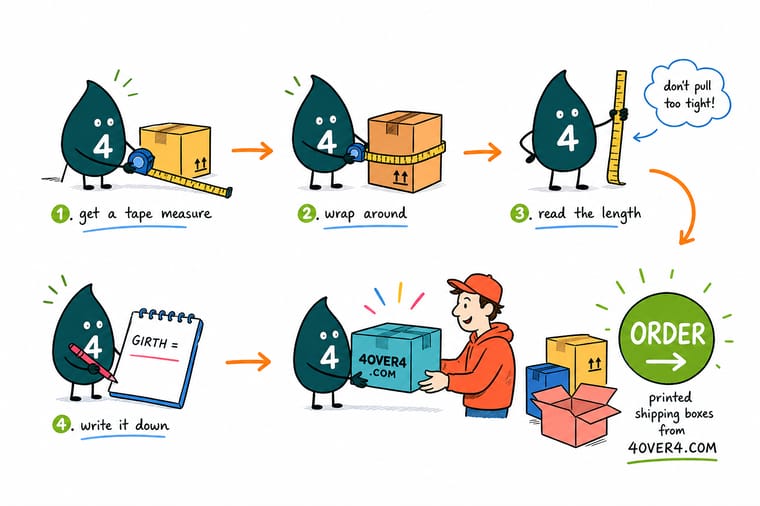
Wally measures the outside of a closed box, doubles the width, doubles the height, and adds them for the girth, then drops the length on top. Keep length plus girth under the carrier limit and there is no oversize surprise. Size a custom box to your product and the girth, the filler, and the fees all shrink together, so 4OVER4 prints a box that ships lean.
Print a right-sized box →Quick reference
Girth measurement, at a glance
Every girth question comes down to the same handful of measurements. Match these and your figures will line up with what a carrier records.
| Measurement | What it is | Why it matters |
|---|---|---|
| Length | Longest side | The single longest edge of the box, measured on its own and never doubled. |
| Width | Second longest side | One of the two sides used in the girth wrap, measured across the box. |
| Height | Shortest side | The remaining side, also part of the girth wrap around the box. |
| Girth | 2 x width plus 2 x height | The full distance around the box perpendicular to its length. |
| Length plus girth | Length + (2 x W + 2 x H) | The combined figure carriers compare against their size limit. |
| Rounding | Up to the next whole inch | Carriers round outer dimensions up, so measure the outside and round up too. |
Step by step
Measure girth in 7 steps
- Set the box on a flat surface Close and tape the box as it will actually ship so the walls sit square. A bulging or half-open box measures larger than the one that leaves your dock.
- Measure the length Find the longest side of the box and measure it edge to edge along the outside. Write it down as the length and set it aside, since length is not part of the girth math.
- Measure the width Measure the second longest side across the outside of the box. This is your width and it is one of the two numbers the girth formula doubles.
- Measure the height Measure the shortest remaining side, again on the outside. This is your height, the other number the girth formula doubles.
- Calculate the girth Multiply the width by two, multiply the height by two, and add the results. That total is the girth, the distance the tape would travel wrapping around the box the short way.
- Add length to girth Add the length you set aside to the girth you just calculated. Length plus girth is the figure your carrier checks against its oversize limit.
- Round up and compare Round every measurement up to the next whole inch, recompute if needed, and compare length plus girth to your carrier limit before you buy postage.
Infographic
The length plus girth cheat sheet
One box, four numbers. Measure the outside, run the wrap, add the length, and check the total before you ship.
Trim the width or the height and girth drops twice as fast, which is the quickest way to pull a bulky parcel back under an oversize limit.
Specs and pricing
Shipping box specs and live pricing
Once you know the girth you need, set the size, board and quantity. Shipping boxes run 250 for $711.78, which is $2.85 a box.

| Quantity | Price Per Unit | Total |
|---|---|---|
| 250 | $2.85 | $711.78 |
| 500 | $1.42 | $711.78 |
| 1,000 | 79.7¢ | $797.02 |
| 2,500 | 53.5¢ | $1,338.30 |
| 5,000 | 44.6¢ | $2,231.42 |
| 10,000 | 40.4¢ | $4,044.70 |
| 15,000 | 39.0¢ | $5,844.45 |
| 20,000 | 38.3¢ | $7,657.73 |
Print it
Print boxes sized to stay under the limit
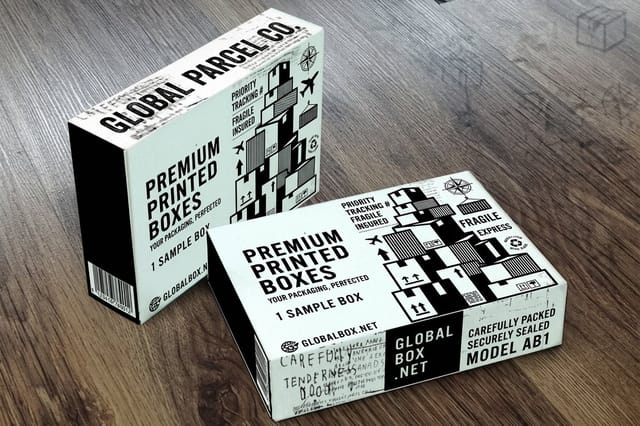
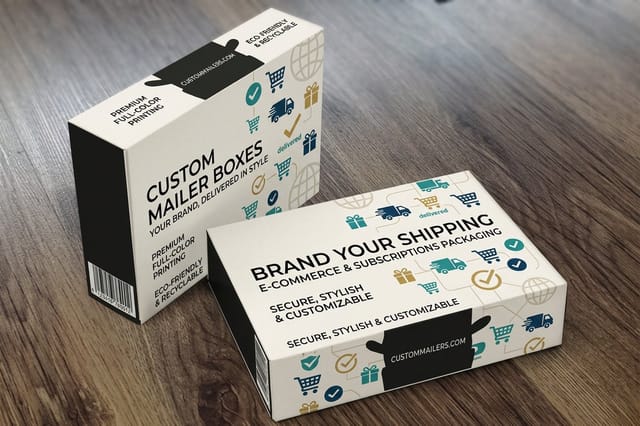
See it in use
Custom boxes we have printed
Explore more
Where to go next






By the numbers
Board weights behind a shipping box
Common Questions
Common questions about box girth
What is the girth of a box?
Girth is the distance all the way around the thickest part of a box, measured perpendicular to its longest side. For a standard rectangular box you find it by doubling the width, doubling the height, and adding the two results together. It is not the measurement of any single side. Carriers use girth alongside length to judge whether a parcel is a normal size or an oversized one, because a long thin tube and a short fat cube can weigh the same yet take up very different amounts of space on a truck.
Which dimension should I shrink to drop the girth?
Pick a box that fits your contents closely with just enough room for padding. Extra empty space raises both the girth and the dimensional weight, and both push your cost up. Measure the item, add roughly half an inch to an inch on each side for cushioning, and choose the smallest box that still protects the product. Custom boxes help here because you set the exact interior size instead of forcing your item into a stock box that is bigger than it needs to be.
What does it cost to print custom boxes, and how are prices set?
Box printing price scales with a handful of levers: the box size and style, the board stock, the print coverage, and the quantity, where larger runs lower the unit price. You choose each option in the configurator and the price updates live as you adjust it, so you can see exactly what a bigger box or a heavier board does to the number before you commit. Sizing the box to your product keeps material, girth, and shipping cost all moving in the right direction at once.
What sizes, stocks, and styles are available for custom boxes?
We print mailer boxes, shipping boxes, and custom-sized boxes in a wide range of dimensions and sturdy corrugated and paperboard stocks, with full-color printing inside, outside, or both. Because you set the length, width, and height, you can dial the box in to the exact girth you need to stay under a carrier limit. Use the live specs and pricing panel below to see the current size ranges, board options, and finishes for shipping boxes.
How long do custom boxes take to print and ship?
Turnaround depends on the box style, quantity, and finishing you select, and the estimated production time is shown in the configurator as you build your order. Simpler stock sizes move faster than heavily customized structures. You can see the live turnaround and shipping options for your exact specification on the product page before you check out, so the delivery date is never a surprise.
Do I measure the inside or the outside of the box for girth?
Measure the outside. Carriers price a parcel by the space it occupies on their vehicles, which is the exterior footprint, so always measure the outer walls of a closed, taped box. The interior dimensions matter for fitting your product, but for girth, length, and any oversize check, the outside numbers are the ones that count. Round each outer dimension up to the next whole inch to match how carriers record them.
Why do carriers use length plus girth instead of just weight?
A lightweight but bulky package still takes up room a heavier compact one would not, and space on a truck or plane is finite. Length plus girth captures how much room a parcel claims, so carriers combine it with weight to price fairly. This is also why they apply dimensional weight, which converts a package size into a billable weight. Keeping length plus girth low, by right-sizing the box, is the simplest way to keep both the size surcharge and the dimensional weight in check.
Get Started
Order 250 mailer boxes sized under your carrier limit
Set the exact length, width, and height, keep your girth under the limit, and print custom boxes at 4OVER4.COM. Mailer boxes price the same at 250 for $711.78.
Legal Disclaimer
Gold Standard guarantees apply to all standard orders placed through 4over4.com. Price match requires verifiable proof of a competitor's published price for an equivalent product with matching specifications and turnaround time. Satisfaction guarantee covers manufacturing defects and print quality issues. Contact support with order number and documentation. On-time delivery rate based on tracked orders 1999 to 2026. Individual results may vary based on shipping carrier performance.
