
Postcard Marketing That Drives Real Direct Mail Response


Postcard marketing keeps working while inboxes overflow and ads get scrolled past. A postcard is physical, hard to ignore and cheap to mail. Here is how to plan, design and send direct mail postcards that actually drive a response you can measure.
Postcard marketing is a direct mail tactic that puts a printed offer straight into a prospect hands, driving response through a clear message, a strong call to action and a targeted mailing list. It works because a postcard needs no opening, gets read at a glance, and is cheap to produce at scale. Plan the list and offer first, design for one message, and track with QR and promo codes.

Start here
Postcard marketing in one paragraph
Postcard marketing puts a printed offer directly into a prospect hands, driving measurable response through targeting, a single clear offer and a strong call to action. It works because a postcard needs no opening, is read at a glance, and is cheap at scale. Plan the list and offer first, design for a two-second read, and track every response with a QR or promo code. The diagram below shows the campaign loop.
Watch it printed
See direct mail postcards on the press, in 135 seconds
Why postcard marketing still converts

Postcard marketing endures for reasons digital cannot match. A postcard requires no opening, so there is no subject line or ad-block between your message and the reader. It is tangible, so it sits on a kitchen counter for days instead of vanishing on scroll. And it is inexpensive to produce in volume, which keeps the cost per impression low. As inboxes overflow and ad fatigue grows, a physical mailer stands out precisely because fewer businesses send them.
The numbers back the instinct. Direct mail consistently earns strong response and return figures, which we cover in our direct mail response rate benchmarks. For a fast operational primer, our five steps to send direct mail postcards is the quickest on-ramp.
Does postcard marketing work?
It works when the math works, and the math is simple enough to run before anything goes on press. Response rate is the number of people who act divided by the number of pieces you mailed. Cost per response is the whole campaign cost, printing plus postage plus any list rental, divided by those responses. Return is the revenue those responses produced measured against that same cost. Three numbers, no mystery, and every one of them is knowable on a single sheet of paper.
Run that math backward before the drop instead of forward after it. Take your average order value, your closing rate on an inquiry, and what a customer is worth over a year rather than on a single sale, and you can work out how many responses per thousand pieces you need just to break even. That break-even figure, not an industry average lifted from someone else's blog post, is the honest test of whether a mailing worked. Published benchmarks are still useful for setting expectations, and we keep ours in the direct mail response rate benchmarks, but your list, your offer and your trade decide the result you actually get.
Two things separate the campaigns that clear that bar from the ones that do not: who you mail and whether you can prove what came back. Mail addresses that already look like your buyers, either through a targeted list or an EDDM service route, and put a unique QR code, promo code or dedicated phone number on the card so a response can never be confused with a walk-in. Print a small test drop of direct mail postcards first, measure it against your break-even number, then scale the version that paid and kill the version that did not. If you want the short operational version of the whole sequence, start with our five steps to send direct mail postcards.
The mailing list is your biggest lever

Nothing moves response like the list. A brilliant postcard mailed to the wrong people underperforms a plain one mailed to the right people, because relevance beats polish. You have two broad paths: a targeted list, filtered by geography, demographics or your own customer data, or Every Door Direct Mail, which blankets chosen postal routes without buying a list. Our direct mail postcards are built for both, and our EDDM service handles the route side.
Choose based on the offer. A neighborhood restaurant or home service often wins with EDDM saturation, while a high-value B2B offer wants a tightly targeted list. Either way, invest here first, because the list decides the ceiling on everything the design can do.
One offer, one action
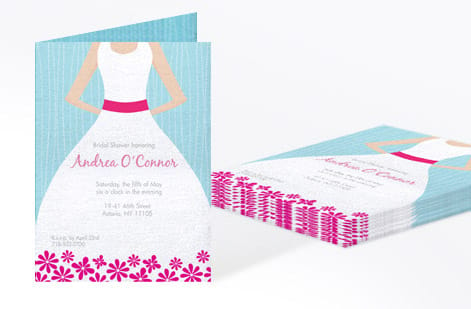
A converting postcard is disciplined. It makes one clear offer, gives it a deadline to create urgency, and asks for a single specific action, call this number, scan this code, visit before Friday. The temptation is to list everything you do; resist it. A reader glancing at the mailbox will act on one obvious next step and ignore a menu of five.
Write the offer as a benefit, not a feature, and make the deadline real. If you are unsure how to structure the piece, our guide on the ten elements of an effective direct mail postcard breaks down exactly what earns a response.
Design for the two-second glance

Most postcards are read in the few seconds between the mailbox and the recycling bin, so the design has to land instantly. Lead the front with a bold headline and the offer, keep it uncluttered, and use a coated stock so the piece feels legitimate. The back carries the details, the address block and the call to action, laid out so the eye flows naturally from hook to action.
If you do not have a designer, our online design tool provides postcard templates you can adapt, and the free file check catches setup issues before printing. For folded formats that hold more content while still mailing flat, consider folded postcards.
Make every mailing trackable

The reason many businesses think direct mail is unmeasurable is that they forget to build tracking in. Add a QR code, a dedicated phone number, a personalized URL or a one-time promo code, and every response ties straight back to the mailing. Our guide on adding a QR code to your postcards walks through the setup.
With codes in place, you count responses against pieces mailed for a response rate, then weigh revenue against print and postage for return. Our direct mail ROI data and calculator helps you model it before you spend, so the campaign is a measured investment rather than a guess.
Timing, follow-up and scaling

A single postcard rarely maxes out a campaign. A short sequence, an initial drop followed by a reminder to non-responders, usually lifts total response, because repetition builds recognition. Plan the drop dates backward from your offer deadline, and decide up front whether you will re-mail the people who did not act.
For neighborhood saturation at qualifying sizes, EDDM keeps the postage simple, as covered in our EDDM postcard sizes guide. For high-volume targeted mailings, our team can help with kitting and fulfillment. Whatever the scale, keep refining the list and offer, since that is where compounding returns come from. See how a nonprofit doubled donations with direct mail for a real example.
Wally mails a postcard that gets a call back
One offer, one action, one trackable code
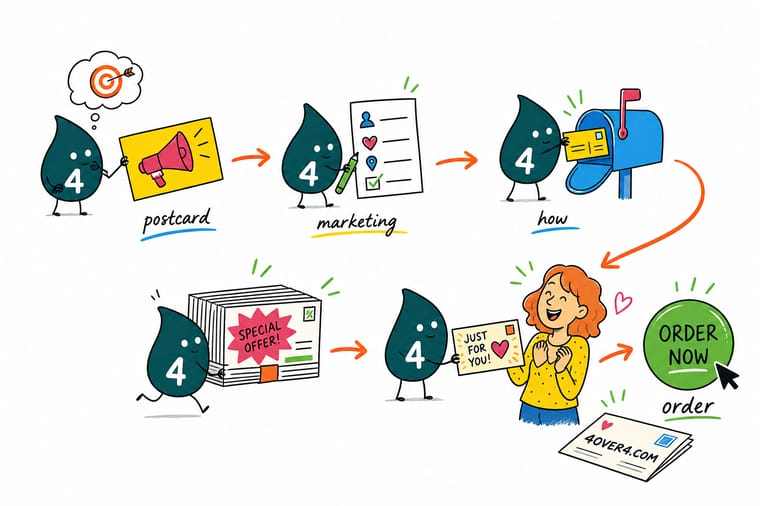
Wally does not shout at everyone. He targets the right addresses, prints one bold offer on a sturdy postcard, and adds a QR code so every response is counted. It lands in a hand, gets read on the walk back from the mailbox, and drives a call or a visit he can measure. Plan the list and the offer, and postcards pay for themselves.
Order your marketing postcards →Quick reference
The postcard campaign spec, at a glance
A postcard campaign comes down to list, offer, design and tracking. Use this to plan before you print.
| Element | Common choice | Why it matters |
|---|---|---|
| Size | Standard, EDDM or oversized | Bigger postcards stand out in the stack; EDDM sizes qualify for simplified mailing. |
| Stock | Coated cardstock, gloss or matte | A sturdy stock survives the mail and signals a real business, not junk. |
| List | Targeted or EDDM route | Response rises or falls on who receives it, so targeting beats volume. |
| Offer | One clear, time-bound offer | A single strong offer with a deadline drives action better than a menu. |
| Call to action | One specific next step | Tell the reader exactly what to do: call, scan, or visit. |
| Tracking | QR code or promo code | A trackable code is how you measure response and prove ROI. |
Step by step
Run a postcard campaign in 7 steps
- Set the goal and offer Decide the single action you want and the one offer that will drive it, with a deadline that creates urgency.
- Build the mailing list Target the right addresses by geography or customer data, or choose an EDDM route to blanket a neighborhood.
- Pick the size and stock Choose a postcard size that stands out and a coated stock that survives the mail and feels legitimate. Size sets two costs at once: a 4 x 6 card mails at the USPS postcard rate and keeps the per piece cost lowest, 5 x 7 and 6 x 9 buy attention in the stack but mail at letter or flat rates, and an EDDM route needs one of the larger qualifying sizes. On stock, 14pt coated is the workhorse, 16pt feels heavier in the hand for a premium offer, and a matte or uncoated back takes pen ink and address labels cleanly. Confirm the postage class for the size before you lock the quantity, because the size you pick prices every single piece twice, once on press and once at the post office.
- Design for a glance Lead with a bold headline and the offer, keep the front clean, and put the details and call to action where the eye lands next.
- Add a trackable code Include a QR code or a unique promo code so every response ties back to this mailing.
- Mail on schedule Plan the drop date and any follow-up mailings, since a sequence usually beats a single send. Work backward from the offer deadline: allow print turnaround for the size and stock you chose, then transit time for the postage class, then a few days of buffer, so the card lands while the offer still has runway. If you are mailing an EDDM route instead of a targeted list, book the route and the post office drop in the same plan.
- Measure and repeat Count responses through your codes, calculate the return, and refine the list and offer for the next drop. Keep one sheet per drop: quantity mailed, print cost, postage, list cost, responses, revenue, and the cost per response those numbers produce. Change one variable at a time on the next mailing, the list or the offer or the size, so you learn what actually moved the number, then reorder your direct mail postcards at the same specs so the comparison stays honest.
Specs and pricing
Direct mail postcard specs and live pricing
Once the size and stock are chosen, quantity sets the price. Here are the live specs and price-per-unit for direct mail postcards at 4OVER4.COM, straight from the configurator.
| Quantity | Price Per Unit | Total |
|---|---|---|
| 500 | 17.9¢ | $89.68 |
| 1,000 | 17.1¢ | $170.53 |
| 2,000 | 9.35¢ | $186.95 |
| 3,000 | 6.84¢ | $205.13 |
| 4,000 | 5.58¢ | $223.31 |
| 5,000 | 4.83¢ | $241.51 |
| 6,000 | 4.56¢ | $273.85 |
| 7,000 | 4.37¢ | $306.18 |
Order it
Print your marketing postcards at 4OVER4
See it in use
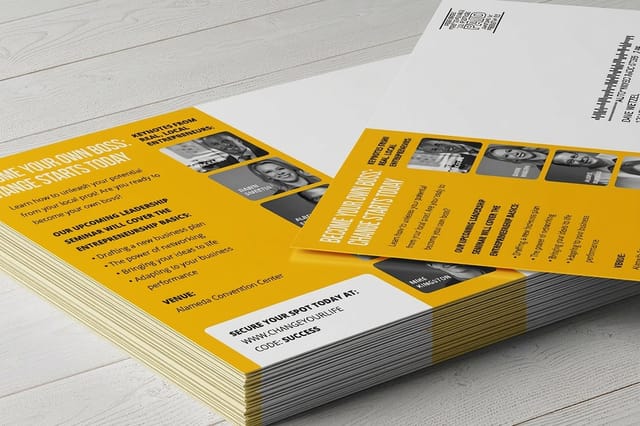
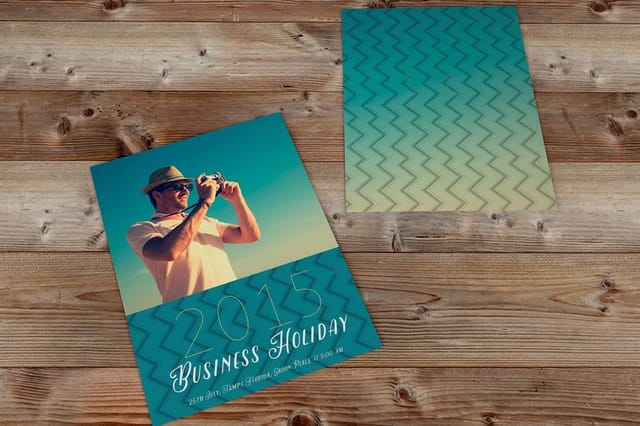
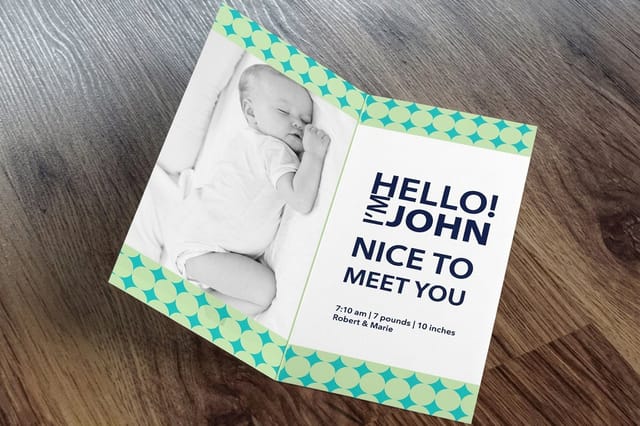
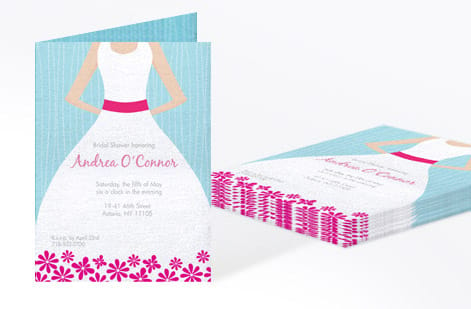
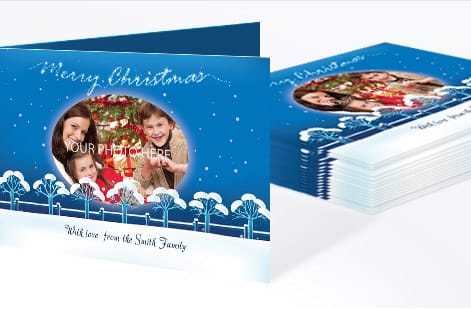
Direct mail postcards from real campaigns






Explore more
Where to go next




By the numbers
Sixty paper stocks a mailed postcard can use
Common Questions
Common questions about postcard marketing
Are postcards profitable?
They are when the revenue from the responses covers the print, postage and list cost with room to spare, and that is a sum you can run before you mail. Take your average order value and your close rate on an inquiry, and work out how many responses per thousand cards you need to break even. Mail a small test drop with a QR or promo code, count the responses against that number, then scale the version that paid.
Are postcards making a comeback?
In the mailbox, yes. Fewer businesses send physical mail than a decade ago, so a postcard now competes with less clutter than an email does in an inbox, and QR codes and promo codes made every response measurable. Direct mail postcards fit that moment because they need no opening, get read at a glance and cost little per piece at volume.
Why does postcard marketing still work in a digital world?
Because a postcard succeeds exactly where digital struggles. It needs no opening, so unlike an email there is no subject line to get past; it is physical, so it lingers on a counter instead of being scrolled past; and it is cheap to produce at scale. Direct mail also cuts through the noise precisely because fewer marketers use it now, which means your postcard competes with less clutter in the mailbox than your email does in the inbox.
How do I choose the right postcard for a marketing campaign?
Match the format to the goal and the audience. A standard size is cost-effective for broad reach, an oversized card stands out in the stack for a premium offer, and EDDM sizes qualify for simplified neighborhood mailing without buying a list. Choose a coated cardstock so the piece feels like a real business rather than junk mail. Above all, get the mailing list right, since who receives the postcard drives response more than any design choice.
What does postcard marketing cost and how is pricing set?
Two costs stack: printing and mailing. Printing scales with size, stock, finish and quantity, with the unit price dropping as volume rises. Mailing depends on the postage class and whether you use a targeted list or an EDDM route. You set the print options in the configurator and watch the live price update, then plan postage on top. Direct mail postcards start around 18 dollars for a print run, and larger quantities lower the per-piece cost substantially.
What sizes and stocks work best for marketing postcards?
Common marketing sizes run from a standard postcard up to large oversized formats, plus the specific EDDM sizes that qualify for every door direct mail. Coated cardstock in gloss or matte is the workhorse, because it survives the mail stream and looks professional. Larger and heavier cards command more attention but cost more to print and mail, so the right choice balances standout against budget and the value of the offer.
How do I measure whether a postcard campaign worked?
Build tracking into the piece before you mail it. A unique QR code, a dedicated phone number, a personalized URL or a one-time promo code lets you tie each response back to the mailing. Count those responses against the number mailed to get a response rate, then weigh the revenue they generated against the print and postage cost to calculate return. That loop is what lets you improve the list and offer on every subsequent drop.
How long do marketing postcards take to print and ship?
Printing turnaround depends on the size, stock, finish and quantity, with standard cards moving faster than specialty formats. Mailing then adds transit time based on the postage class you choose. The product page shows the live production and shipping options for your configuration, and planning the drop date backward from your offer deadline keeps the campaign on schedule.
What does a 1,000 piece postcard mailing cost, line by line?
Four line items stack, and you can price every one of them before you print. Printing: read the live quote on the direct mail postcards configurator for your size, stock, finish and quantity, then divide the run total by 1,000 to get print cost per card. Direct mail postcards start around 18 dollars for a print run, and the per-piece figure keeps falling as the quantity climbs, which is why a bigger run always beats a short one on unit cost. Postage: one rate per piece, decided by the size of the card and the class it qualifies for, so multiply that rate by 1,000. List: a rented targeted list is priced per name, while an EDDM route costs nothing to acquire because you mail every address on it. Design: a one-time cost you spread across the whole drop, and across every reprint if the artwork holds up. Add the four together and divide by 1,000 for your true cost in the mailbox, then divide the campaign total by the responses your codes counted to get cost per response, which is the only cost number worth arguing about.
Should I mail a targeted list or an EDDM route?
Let the offer decide. EDDM blankets every address on the postal routes you choose with no list to buy, so it fits businesses whose customers are simply nearby: a restaurant, a dentist, a lawn or garage service, a store opening. A targeted list costs money per name but lets you filter by geography, demographics or your own customer file, which is what a high-value or narrow offer needs, since a pile of wrong addresses costs more to mail than a short list of right ones. EDDM also carries size rules, so confirm the card qualifies for the route before you send it to press. And if you already own customer data, mail that file first, because your own past buyers are the warmest names you will ever put on a card.
Get Started
Ready to put an offer in every mailbox?
Print your direct mail postcards at 4OVER4.COM on a stock that survives the mail and gets read. Adjust size and quantity and watch your price update live.
Legal Disclaimer
Gold Standard guarantees apply to all standard orders placed through 4over4.com. Price match requires verifiable proof of a competitor's published price for an equivalent product with matching specifications and turnaround time. Satisfaction guarantee covers manufacturing defects and print quality issues. Contact support with order number and documentation. On-time delivery rate based on tracked orders 1999 to 2026. Individual results may vary based on shipping carrier performance.
