
11 Print Brand Awareness Ideas That Keep You Top of Mind


The print pieces that build awareness are the ones that stay in view: stickers, magnets, yard signs, banners, flags, table tents, totes, cards, postcards, door hangers and package inserts. Rank them by how long each piece survives in front of a person, run two or three of them at once inside one small area, and let repetition do the work that a single clever campaign cannot.
The 11 ideas at a glance
| Idea | Where it lives | Why it repeats | Best for | Product at 4OVER4 |
|---|---|---|---|---|
| Die-cut stickers | Laptops, water bottles, packaging, toolboxes | Someone else carries it for months | Any brand with a logo people would actually display | Die-cut stickers |
| Business cards | Wallets, desks, card files | Handed over face to face, kept if the stock is good | Trades, consultants, anyone meeting people | Premium business cards |
| Business card magnets | The front of a refrigerator | Sits in view for years, not minutes | Services called rarely and urgently | Business card magnets |
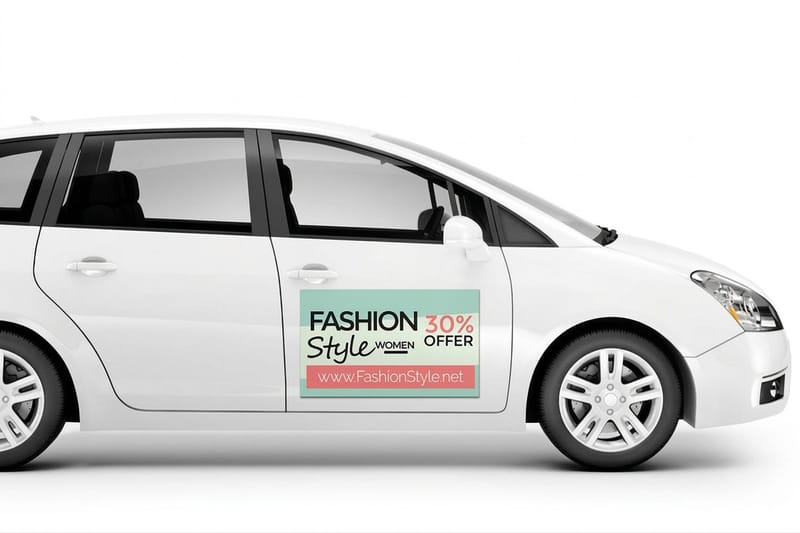
| Car magnets | Van and truck doors | Every job and every commute is an impression | Mobile trades and field services | Car magnets |
| Yard signs | The lawn of a finished job | Proof plus a name, in front of the neighbors | Roofing, landscaping, remodeling, real estate | Yard signs |
| Vinyl banners | Building fronts, fences, event backdrops | The cheapest square footage of brand you can buy | Storefronts, pop-ups, sponsorships | Vinyl banners |
| Feather flags | Sidewalks, lots, market stalls | Movement catches the eye a flat sign does not | Weekend traffic and event visibility | Feather flags |
| Table tents | Counters and tables in partner businesses | Read while somebody waits with nothing to do | Cafes, salons, clinics, local partnerships | Table tents |
| Tote bags | Grocery runs, commutes, gym bags | A useful object carried in public repeatedly | Retail, events, membership businesses | Tote bags |
| Direct mail postcards | Mailboxes inside a chosen radius | Repeatable on a schedule you control | Local services with a defined service area | Direct mail postcards |
| Door hangers | Doorknobs on the streets around a job | Cannot be missed on the way in the door | Trades working street by street | Door hangers |
Start with the two that match how your customers already find you, not with all eleven. Once both are routine, add a third. You can order die-cut stickers straight from the configurator to test the cheapest one first.
Why repetition beats reach in print
Brand awareness is a frequency problem. The reason people remember one local plumber and not the other four is almost never the artwork, it is that one of them turned up in front of the same households repeatedly, on a magnet, a yard sign and a mailer, while the others each showed up once.
That changes how you spend. A 5,000 piece mailing spread across a city reaches 5,000 households one time. The same 5,000 pieces sent to 1,000 households five times reaches a fifth as many people, and it is the version that gets remembered. Pick the smallest area your business can actually serve, then saturate it.
It also changes what you print. Rank every idea below by how long the piece stays in view. A flyer is read once. A refrigerator magnet is still there in three years. That is the whole reason the cheap items on this list often outperform the expensive ones. If you are weighing up where to have the work produced, our local vs online printing comparison covers what changes at each order size.
Pick a radius and stay inside it
Draw the area you can serve profitably, then treat everything outside it as somebody else’s market. Small brands lose to bigger ones by spreading thin, and win by being unavoidable in six streets. A yard sign on a finished job, door hangers on the same block that week, and a postcard to the same ZIP a month later are three impressions on one household for very little money.
The measurement is simple enough to do on paper. Note which pieces are running in which area and when, and ask new customers where they saw you. It is not attribution software, but it tells you within two months which of the eleven ideas is doing the work in your particular town.
One accent color, held steady across everything
Eleven separate printed items only build one brand if they look related. The cheapest way to get there is a single accent color used the same way every time, plus one typeface for headlines. Not a style guide, just a rule you do not break.
Color shifts between substrates, and that catches people out. The same file prints slightly warmer on uncoated stock than on gloss, and a vinyl banner will never match a business card exactly because the ink and the surface are different. Pick a pairing that survives that, which is what our guide to print color pairings and the companion article on brand and print color combinations both work through.
The 11 print brand awareness ideas
These are ordered by how cheaply you can start, not by how well they work. Numbers 1 to 4 are things a person keeps. Numbers 5 to 8 are things a neighborhood sees. Numbers 9 to 11 are things you put in front of people on your own schedule.
You do not need all eleven. Pick two that fit how your customers actually find you, run both for a season, and add a third when the first two are routine. Every one of them is printed at 4OVER4.COM, so a single artwork file can feed the whole set.
Ideas 1 to 4: things people keep
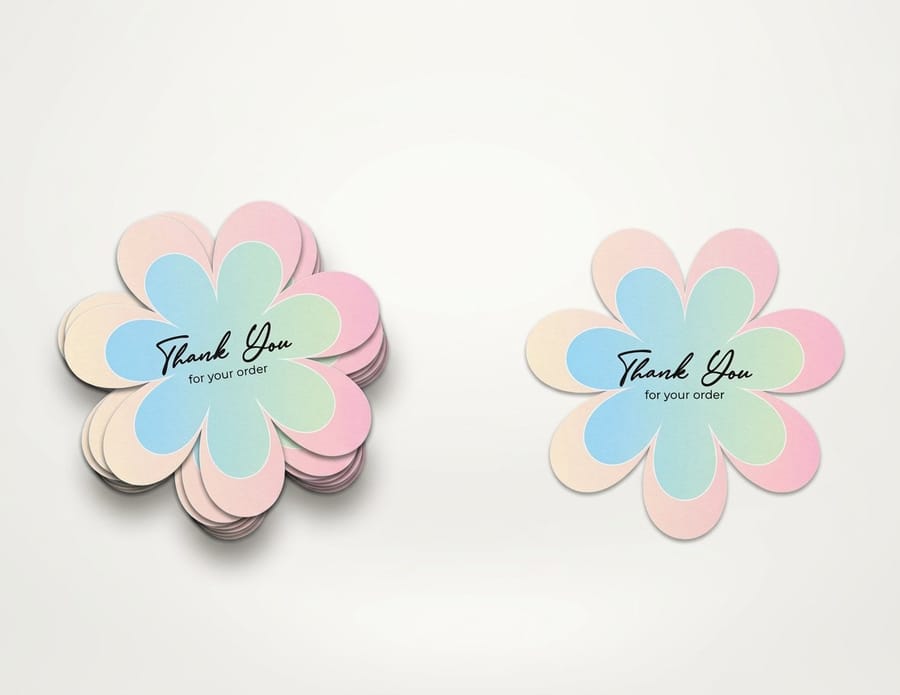
1. Die-cut stickers people want to display. A die-cut sticker cut to your logo shape gets stuck on a laptop or a bottle; a rectangle with your logo floating in white space gets binned. That is the entire difference. Matte vinyl hides scuffs better than gloss on anything handled daily, and it is worth putting a small run in with every order you ship rather than handing them out at events, because the person opening a box already likes you.
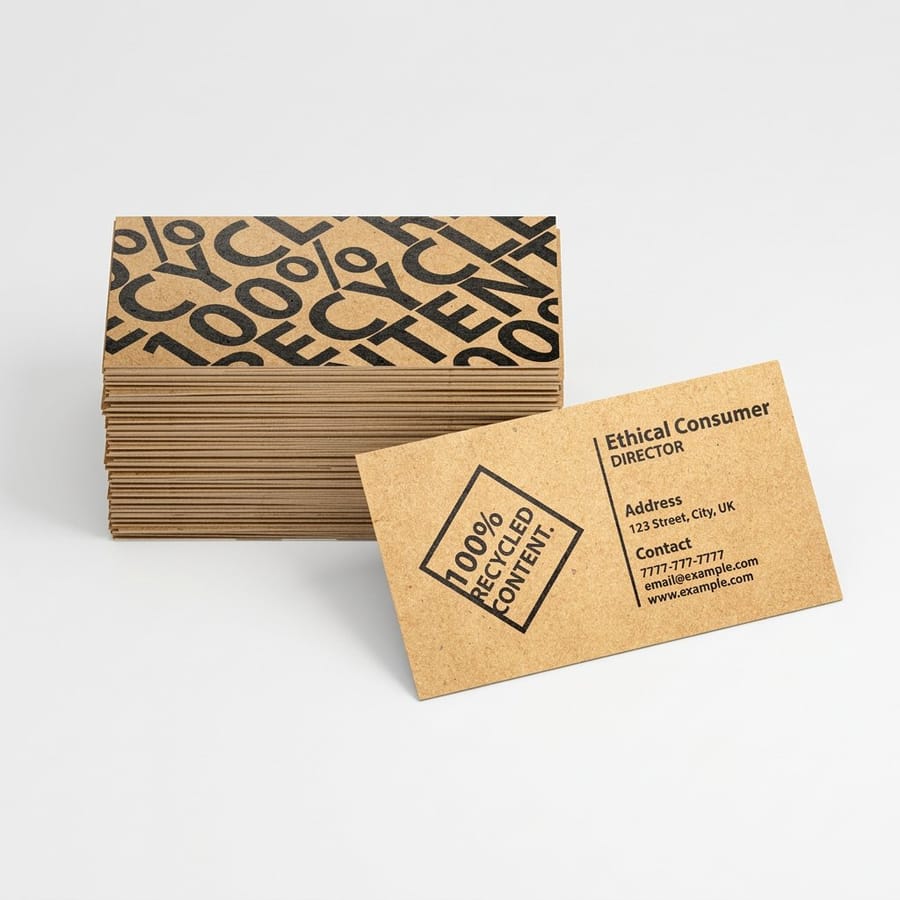
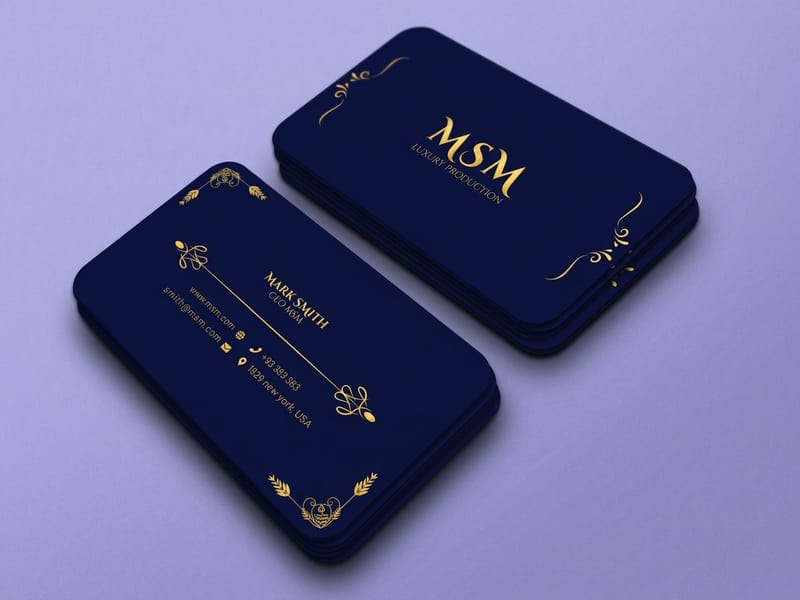
2. A business card somebody cannot throw away. Awareness dies with a limp card. Weight and finish do the remembering: a 16pt card is noticeably more rigid in the hand than a 14pt, and a soft touch or spot gloss finish gets commented on across a counter, which is a conversation your competitor is not having. Order premium business cards in a stock you would be happy to receive, and put a reason to keep it on the back rather than leaving it blank.
3. Business card magnets on the refrigerator. A business card magnet is the longest-lived piece on this list. It sits at eye level in a kitchen for years. It only works for a business people call rarely and urgently, which means plumbers, electricians, dentists, garages and vets. A coffee shop magnet comes off the door in a week, so spend that budget on stickers instead.
4. Printed tote bags that get used. A tote bag turns a customer into a moving sign, but only if the bag is good enough to reuse and the design is restrained. A giant logo across the front stays in a cupboard. A small mark on a bag someone would carry anyway goes to the grocery store weekly. If reusable packaging is part of your story, the ideas in our eco-friendly packaging article pair with this one.
Ideas 5 to 8: things a neighborhood sees
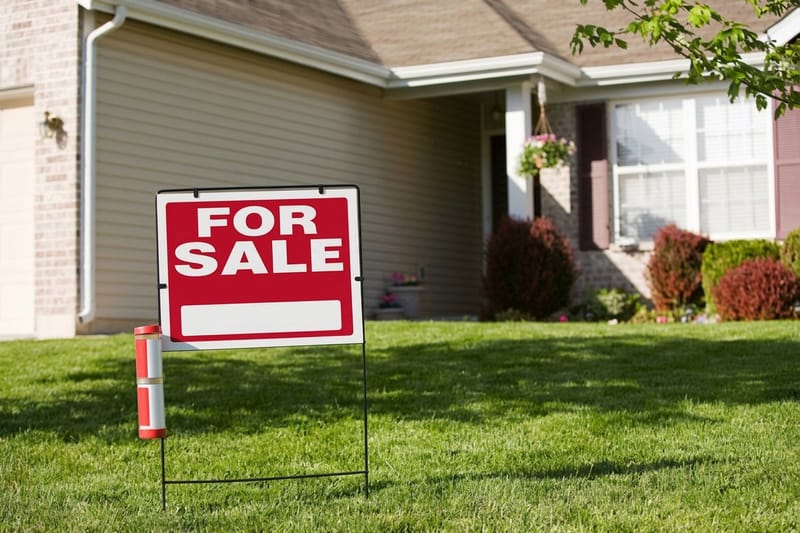
5. Yard signs on finished jobs. Ask the customer before the crew leaves, while they are happy with the work. A yard sign on a lawn is proof and a name at the same time, and it reaches the exact households most likely to need the same job. One detail decides whether it survives a storm: the coroplast flutes must run vertically so both legs of the H-stake slide into full-height channels. Flutes running horizontally means the sign folds over the stake in the first strong wind.
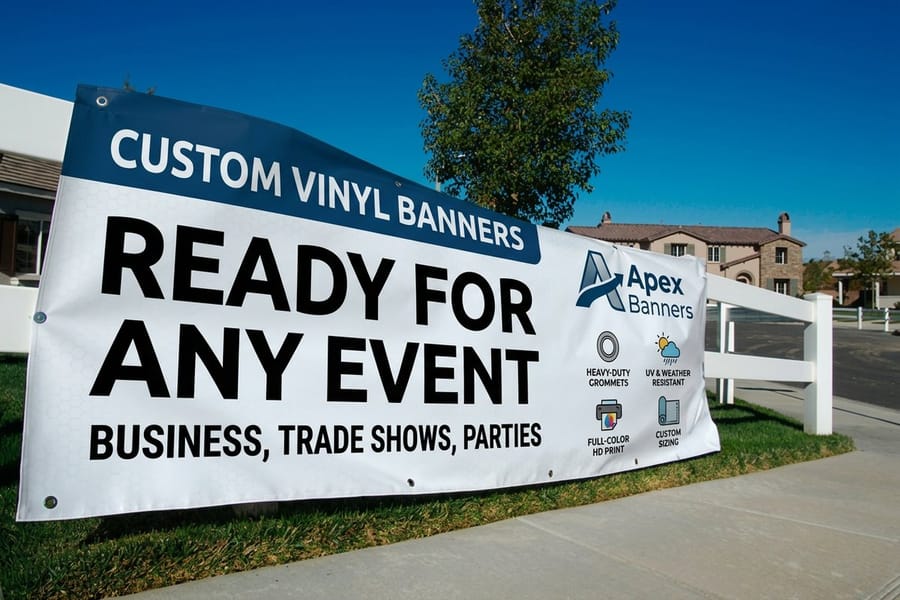
6. A vinyl banner on the building or the fence. Square foot for square foot, a vinyl banner is the cheapest brand presence you can buy, and it works for storefronts, event backdrops and sponsored fields alike. Hem the edges and put grommets roughly every two feet, and on a windy wall use mesh rather than solid vinyl. Cutting slits in a solid banner to let wind through is a myth that ruins banners.
7. Feather flags where there is foot traffic. Movement is what pulls a glance, which is why a feather flag outperforms a flat sign of the same size on a sidewalk or a lot. Know what you are buying: a single-sided flag prints on one layer, so the reverse reads mirrored, while a double-sided flag has a blockout layer sewn between two prints and costs more. Single-sided is fine when traffic only passes on one side.
8. Table tents on counters that are not yours. A table tent in a friendly local business gets read by somebody standing in a line with nothing else to look at. Trade the space rather than paying for it, and put their piece on your counter. Print on 16pt with a coating, because uncoated stock curls in a humid room and a curled tent reads as neglect.
Ideas 9 to 11: things you send on a schedule
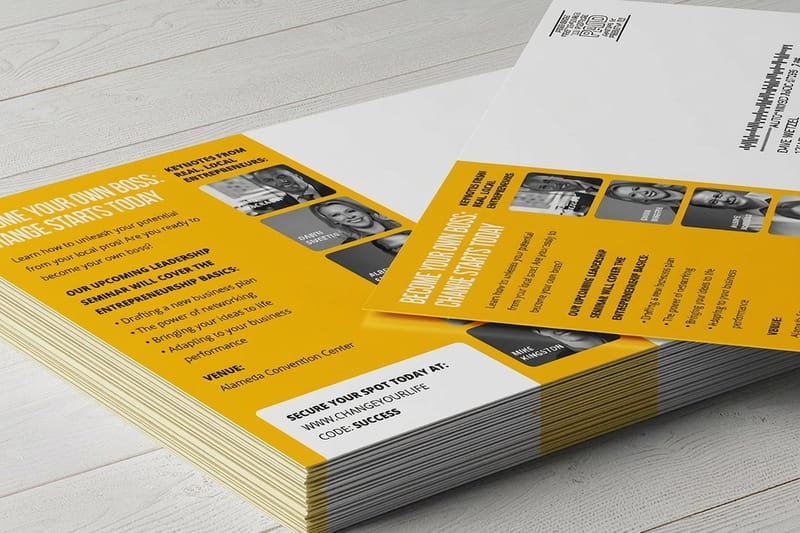
9. Direct mail postcards, repeated to one radius. Direct mail postcards are the only item here where you control both the audience and the calendar. Send to a defined carrier route on a fixed cycle rather than blasting a big list once. A 6 by 9 card sticks out of a stack of 4 by 6 mail and gets looked at even when it goes straight to the recycling, which is still an impression. Our postcard printing options cover the sizes and stocks that mail cleanly.
10. Door hangers on the streets around a job. A door hanger cannot be shuffled into a pile of mail, which is its whole advantage. Work the streets either side of a job you have just finished, on the same day the yard sign goes up. Keep the headline out of the top area where the die-cut hole and slot sit, because that band is not free design space.
11. Sticker sheets and printed inserts in every package. If you ship anything, the box is advertising you already paid to send. A sticker sheet or a printed card in the parcel costs cents, arrives at a moment of goodwill, and gives the customer something to hand to somebody else. It is the highest response rate you will get from any of the eleven, because the audience already bought from you.
Making eleven pieces look like one brand
The failure mode of a list like this is eleven items that look like eleven different companies. Awareness compounds only when the pieces are recognizable as the same brand at a glance, from a car door at 30 feet down to a sticker on a laptop lid.
Three things carry recognition across that range: the logo shape, one accent color, and one headline typeface. Everything else can vary. Build each piece from the same source artwork rather than redrawing it per format, keep the logo above a minimum size on every layout, and check what survives when the piece is small. A logo with fine detail reads on a business card and turns to mush on a magnet at highway speed.
Set the files up once, properly, and the reprints cost you nothing in time. Full bleed artwork, CMYK, 300 DPI at final size for anything held in the hand, and the safety margin respected on every side. Our bleed, cut line and safety checklist and the commercial print-ready file guide cover the setup that keeps a run from being sent back.
What changes at large format
Large pieces are viewed from further away, so the rules invert. A banner or a car magnet needs fewer words, heavier weight type, and much more contrast than a card. Six words is a good ceiling on a banner. Resolution requirements drop too, because a file viewed from 20 feet does not need 300 DPI at full size, which is why a banner file is smaller than people expect. Sizing and setup for those are laid out in our banner sizes and templates guide.
The phone number is the usual casualty. On a vehicle, a number has to be readable by a driver behind you at a light, which means it is the second largest element on the panel after the name, or it should not be there at all.
Know which pieces you will reprint
Stickers, cards and postcards get consumed and reordered. Banners, flags and table covers are bought once and live for years. Put the phone number and the address on the consumable pieces, and keep the long-lived pieces to the name, the accent color and the category of work, so a moved office or a changed number does not make an expensive banner useless.
It is a small decision that saves a reprint. It also means the durable pieces stay usable when the offer changes, which it will.
What the pieces cost to run
Awareness printing is a running cost, not a one-off, so the number that matters is what a repeat order costs rather than what the first one does. Unit price drops as the run grows on every item here, which is why the sensible move is to settle the artwork on a small run, then reorder in the quantity you will genuinely get through in a season. Live configurator numbers are below.
Quantity and price
Business card pricing and specs
Real configurator numbers, where the per unit cost drops as the run grows.
| Quantity | Price Per Unit | Total |
|---|---|---|
| 100 | 17.6¢ | $17.57 |
| 200 | 11.5¢ | $23.07 |
| 300 | 9.15¢ | $27.46 |
| 400 | 7.96¢ | $31.86 |
| 500 | 7.25¢ | $36.26 |
| 600 | 6.77¢ | $40.64 |

You can also earn coins on every order and redeem them against future printing, which matters more than usual on a tactic you are repeating month after month.
Stock and finish choices that change the result
Two decisions carry most of the difference between a piece that gets kept and one that gets dropped. The first is weight. A 16pt business card is noticeably more rigid than a 14pt in the hand, and rigidity is what people read as quality before they have looked at the design. The second is coating. Gloss lifts photography and shrugs off moisture, matte cuts glare and reads calmer, soft touch gets remarked on, and uncoated stays writable when somebody wants to add a name or a date.
Print it
Stickers, ready to hand out
Cut to your own shape on durable vinyl, the cheapest way to start.
Outdoors the question changes from look to survival. Vinyl and coroplast handle weather; paper does not, at any weight. Laminate takes the abrasion instead of the ink on anything handled daily, which is the difference between a sticker that still looks new after a winter on a toolbox and one that has gone chalky. For pieces that sit in sunlight for months, ask about UV rated inks before you commit to a long run, because fading is what dates a banner long before the vinyl fails.
What to run by business type
Different businesses reach people in different places, so here is where each type gets the most out of the list.
- Mobile trades. Car magnets on both doors, yard signs on finished jobs, and door hangers on the two streets either side of that job. All three point at the same neighborhood in the same week, which is the entire trick.
- Retail and hospitality. Stickers in the bag, a printed tote for regulars, and a feather flag out front on weekends. The sticker travels, the tote repeats, the flag catches the walk-past.
- Professional services. A heavy business card, a magnet for the clients who will need you again at short notice, and table tents in partner offices where your clients already sit and wait.
- Local services with a service area. Direct mail postcards to one carrier route on a fixed cycle, plus yard signs wherever you work. Same households, two channels, several months running.
- Events and markets. A vinyl banner as the backdrop, feather flags at the aisle end, and tote bags that carry the purchase home. The bag is the piece that leaves the venue and keeps working.
Blanks sized for each of the eleven pieces
If you are not starting from a designer, templates get you to a printable file quickly. 4OVER4.COM sizes its blanks to exact product specs, so your artwork lines up with the cut lines and the bleed instead of being resized at the last minute. Pull a print-ready blank from the blank template library with bleed and trim already marked.
Start fast
Blanks sized for each of the eleven pieces
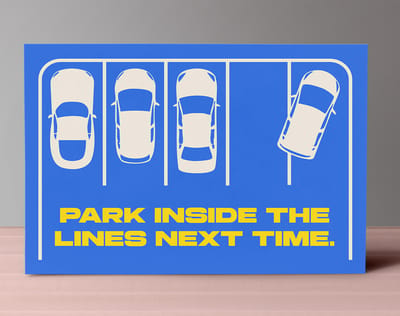
A blank for every piece here, from a 17pt indoor magnet to a 3oz polyester flag.

Wally builds awareness the boring way
Two ideas, one small radius, repeated all season
Pick the smallest area you can serve, then hit it more than once. A yard sign on the finished job, door hangers on the same block that week, and a postcard to the same route a month later is three impressions on one household. Keep one accent color across all of it, design for the smallest piece first, and let 4OVER4.COM print the set from a single artwork file.
Order die-cut stickers →What to remember about print brand awareness
Design rules that hold at every size
- Legible before clever. If the name cannot be read at the distance the piece is actually seen from, nothing else on it matters. Test a banner by looking at it on a phone screen from arm’s length.
- One accent, used identically. Pick a single accent color and use it the same way on all eleven pieces. Consistency is what reads as a brand; variety reads as a jumble.
- Design for the smallest piece first. A logo that survives a business card magnet will survive everything larger. Working the other way around gives you a mark that falls apart when it shrinks.
- Respect the die-cut areas. Door hanger holes, sticker cut lines and grommet edges all eat into the layout. Keep type clear of them or the trim decides where your headline ends.
- Put a reason to keep it on every piece. A number, a discount, a QR to something genuinely useful. A piece with no reason to survive the walk to the bin does not get to build awareness.
Explore more
More ways to print and promote
Direct mail postcards run 500 for $89.68, which is $0.18 a household, and a feather flag is $108.75 once.
 Product Die-Cut Stickers Cut to your logo shape so they actually get applied.
  Product Premium Business Cards Heavier stock and finishes people keep in a wallet.
  Product Car Magnets Turn a work vehicle into a sign that removes cleanly.
  Product Yard Signs Coroplast signs and stakes for finished jobs.
  Product Direct Mail Postcards Mail one radius on a schedule you control.
 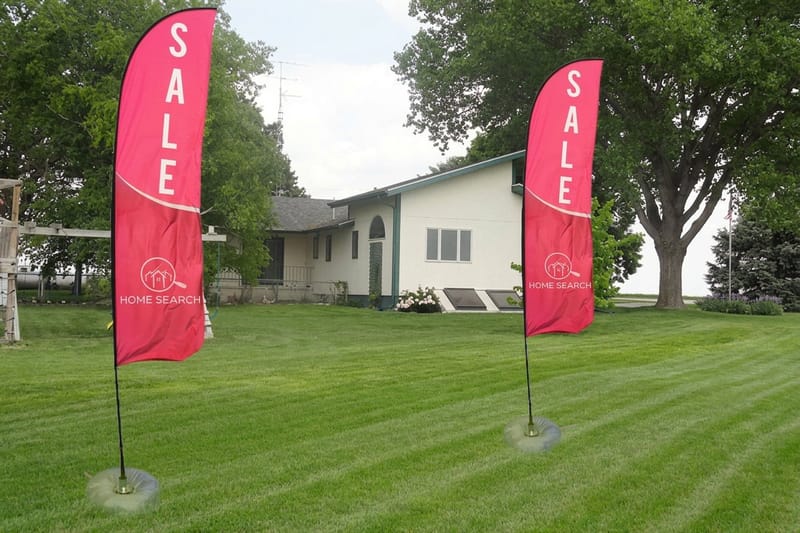 Product Feather Flags Movement at the curb, single or double sided.
  Category Sticker Printing Every shape, stock and finish in one place.
  Category Business Card Printing Stocks, finishes and sizes across the range.
  Guide Print Color Pairings That Work Ten combinations that hold up across stocks.
  Article 15 Creative Poster Ideas Poster directions worth stealing for your next run.
  Article 10 Funny Print Ads Print campaigns that earned attention with a joke.
 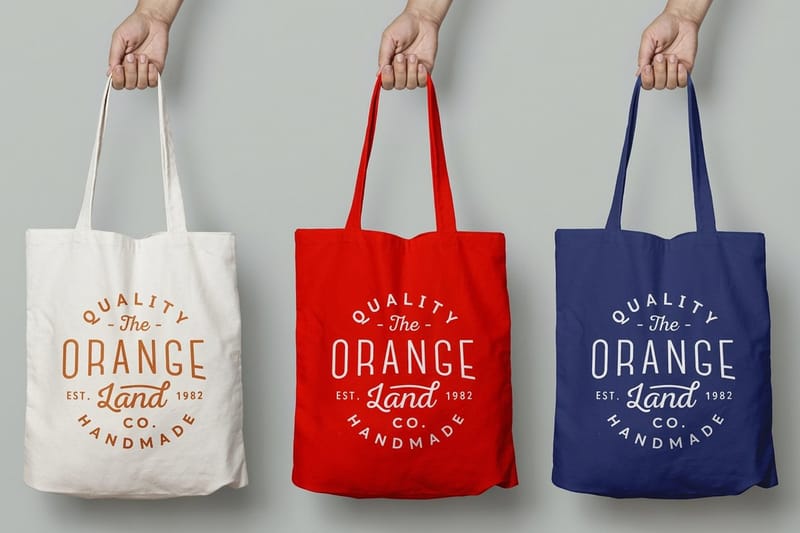 Category Tote Bag Printing Bags people reuse, printed with your mark.
 Ready to get your name in front of people?
Pick a piece, drop in your design or a free template, and 4OVER4.COM prints it sharp on stock built for the place it has to survive.
Common questions about print brand awareness
Which print item builds brand awareness fastest on a small budget?
Stickers, because they cost the least per piece and somebody else does the displaying for you. A die-cut sticker cut to your logo shape ends up on a laptop, a water bottle or a toolbox and stays there for months, which no flyer will ever do. Put a small run in every package you ship rather than handing them out cold, since a customer who has just opened a box is already inclined to like you. Business card magnets are the close second if your business is one people call rarely and urgently, because a magnet on a refrigerator is still working three years later.
How many times does someone need to see a printed piece before they remember the brand?
There is no single honest number, and anyone quoting one precisely is guessing. What is reliably true is that once is not enough and that the same person seeing you three or four times in different formats does more than three different people seeing you once. That is why the practical advice is to shrink the area rather than widen it: pick the smallest radius your business can serve, then run two or three of these ideas at the same time inside it so the same households meet your name repeatedly over a season.
Are yard signs worth it if I only finish a few jobs a month?
Yes, because the audience is precisely the one you want. The neighbors of a house that just had a roof, a driveway or a landscape done are the households most likely to need the same work, and a sign on that lawn is proof and a name at once. Ask the customer before the crew leaves, while they are pleased with the result. Order signs with the flutes running vertically so both stake legs slide into full-height channels, otherwise the sign folds over the stake the first time it blows hard.
Should a vinyl banner have wind slits cut into it?
No. Cutting slits in a solid vinyl banner is one of the most persistent bits of bad advice in signage. The slits do not meaningfully relieve wind load, they tear from the corners, and they wreck the artwork. The correct answers are a hemmed edge with grommets roughly every two feet, and mesh banner material instead of solid vinyl on any wall or fence that catches real wind. Mesh lets air pass through the substrate itself, which is what actually reduces the load.
How do I keep eleven different printed items looking like one brand?
Fix three things and let everything else vary: the logo shape, one accent color, and one headline typeface. Build every piece from the same source artwork rather than redrawing it per format, and design for the smallest item first, because a logo that survives a business card magnet will survive a banner. Expect color to shift between substrates, since the same file prints warmer on uncoated stock than on gloss and a vinyl banner will never match a business card exactly. Choose a color pairing that tolerates that shift instead of one that depends on an exact match.
