
20 Creative Custom-Shaped Business Card Ideas That Get Kept


Emma is our prepress and print production voice, built from the knowledge of our production team, with over 20 years in printing.
How Die-Cut Business Cards Get Made and Why Shape Beats Decoration
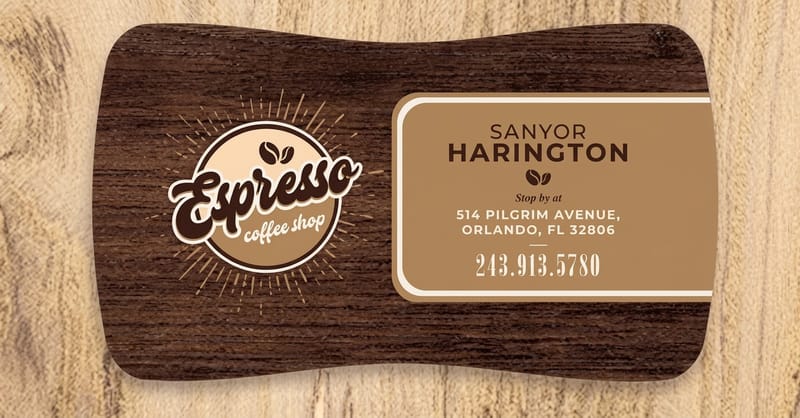
A custom shaped business card is not a rectangle with a decoration printed on it. The outline itself is the design. A steel rule die is bent to match your artwork, pressed into the printed stock, and the card leaves the press already shaped. That one production step is why a die-cut card reads as deliberate while a printed border around a standard card reads as filler.
Shape is also a strong memory trick in print. A stack of cards on a desk is a stack of identical white rectangles, and a circle or a leaf breaks that pattern before anyone reads a word.
Three products carry the ideas below. Custom Shaped Business Cards cut a 2 x 3.5 inch card into one of 80 outlines, Die-Cut Any Shape business cards cut the outline you draw, and die-cut business cards cover the common shapes for less.
The die is a real physical tool
Your outline becomes a bent steel blade mounted on a board. It gets built once, then it cuts every card in the run identically. That is why a shaped job carries a setup cost at the front and then behaves like ordinary printing for the rest of the quantity.
Your artwork needs a clean die line
Draw the cut as a vector path on its own layer, give the layer an obvious name, and keep it one closed shape with no stray anchor points. Everything the blade should follow lives on that layer, and nothing else does.
Bleed and safety do more work than usual
Extend the artwork 0.125 inch past the die line on every edge and pull logos, names, and phone numbers 0.125 inch inside it. Curved cuts wander slightly more than straight ones, so that margin is what keeps a name off the blade.
Quantity moves the price more than the shape does
The die is a fixed cost, so it weighs most on a short run: 50 Custom Shaped cards cost $1.91 each, and the per-card price keeps falling as the quantity grows.
Shop the shapes
Custom printing collection
Die-cut cards, magnets, stickers, and every other custom format in one place.
Nature Shapes That Feel Handmade
Organic outlines soften a card without making it look fussy. A curve is harder to draw well than a straight edge because everyone already knows what a leaf looks like, so keep the silhouette simple and let the stock and the finish carry the texture. These five suit growers, makers, therapists, and any brand that leans warm rather than corporate. For a practice that wants that calm first touch, the Therapist Business Cards story shows the card in use.
A leaf is one of the preset shapes on die-cut business cards; the other four need an outline you draw, cut on Die-Cut Any Shape business cards. Heavier stock holds an organic curve better than light stock, so if your shape has a narrow tip or a pinch point, go up in weight instead of fighting the geometry.
- 1. Leaf. A single leaf outline suits landscapers, florists, and wellness brands, and the tapered tip gives the eye a natural place to land.
- 2. Feather. Long, light, and immediately tactile. Print it on uncoated stock so the card feels as soft as the shape looks in the hand.
- 3. Petal. One rounded petal reads as a flower without drawing a whole one, and it stacks far better than a full bloom silhouette would.
- 4. Wave. A rectangle with one wavy long edge, for surf shops, pools, and coastal trades. The straight edges keep it wallet friendly.
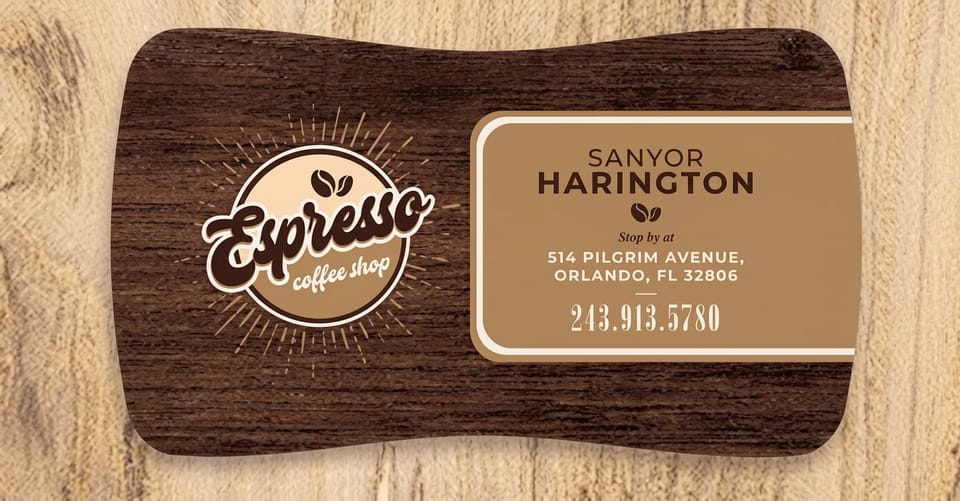
- 5. Wood slab. A rounded rectangle with a deliberately irregular edge, built for carpenters, butchers, and anyone selling craft over polish.
One warning with nature shapes. A silhouette with a long thin extension, a stem or a sharp point, is the first part to bend in a wallet and the first to snag when a stack gets fanned. Soften that extreme slightly, keep the narrowest part of the outline at least a quarter inch wide, and the card survives a week of handling instead of only looking good the day it arrives.
Print picks
Three ways to put a shape in someone's hand
Live prices for 80 ready outlines, your own outline, or seven presets.
Geometric Cuts That Read as Modern
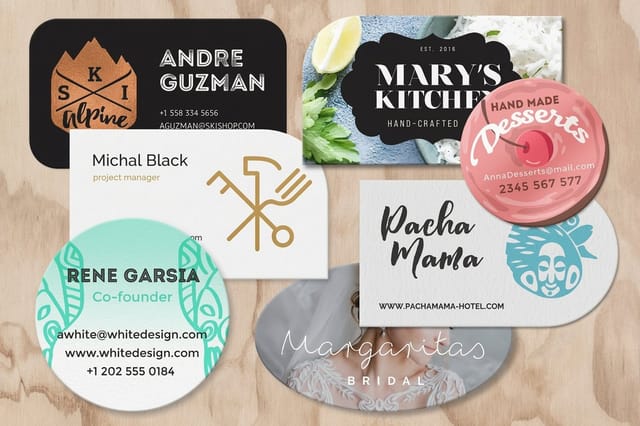
Geometry is the safe entry into shaped cards. A circle or a square still slides into a wallet, still stacks on a desk, and still fits most card holders, but it stops the eye because everything around it is a rectangle. Reach for these when the brand is minimal and the card has to behave in the real world.
Circle business cards come ready made in 2 and 2.5 inch sizes. Whatever the outline, proof it flat before the run: print the outline at final size on plain paper, cut it out by hand, and carry it for a day. If it irritates you, it will irritate the person you hand it to.
- 6. Circle. The cleanest break from the rectangle. Center the logo, keep type off the curve, and let the empty edge do the work.
- 7. Square. A 2.5 inch square feels designed rather than novel, and it is the easiest shaped card to lay out because every side is equal.
- 8. Half circle. Flat bottom, domed top, or a standard card with one half circle side, which is a preset and needs no custom die.
- 9. Hexagon. Six sides read as technical and precise, so it lands well for engineers, developers, and lab and clinical services.
- 10. Arch. Straight sides with a rounded top, borrowed from architecture and gallery signage. It photographs beautifully in a flat lay.
Object Silhouettes That Show What You Sell

A silhouette that matches the trade does half the introduction for you. Nobody needs to read a job title on a card shaped like a house or a coffee cup. Keep the outline chunky and legible at two inches wide, because fine detail inside a die is exactly where shaped cards go wrong.
Object silhouettes also work as magnets, where the shape ends up on a fridge instead of in a drawer. The magnet section below shows how to order one.
- 11. Playing card. Rounded corners and a taller format, ideal for entertainers, bars, and game studios. It also survives pockets better than a square cut.
- 12. Hang tag. A punched hole and a notched top so the card can be tied to a product, a gift box, or a booth display with twine.
- 13. Coffee cup. Cafes, roasters, and mobile carts. The lid and sleeve lines give you two natural bands for the name and the address.
- 14. House. A rectangle with a roof peak, the shortest possible way to say real estate, roofing, inspection, or home services.
- 15. Guitar pick. Small, curved, and pocket sized, built for musicians, teachers, and venues. Print it thick so it holds the triangular point.
Three production notes before you commit an object outline to a die.
- Simplify the silhouette until it survives being shrunk to one inch. If it turns to mush, the die will struggle too.
- Avoid interior notches narrower than an eighth of an inch. Thin gaps tear when the sheet is stripped from the die.
- Ask for the die line back as a proof and check it against your art before you approve, not after the tool is built.
Playful Shapes People Hold On To
The last five have a second use. A card that behaves like a small object can be pinned to a board or passed around a table, which keeps your name in view longer than a rectangle in a drawer. Both custom products start at 50 cards, so you can try one of these on a short run before the full order.
Playful does not mean unprofessional. It means the shape has a second use or a second read. Keep the typography restrained and let the outline carry the personality, because a card that is loud in both directions stops looking designed and starts looking like a flyer.
- 16. Slim bookmark. A long, narrow card that lands in a book instead of a bin. Perfect for authors, libraries, tutors, and bookstores.
- 17. Keyhole cutout. A standard outline with one interior shape punched through it, so the card frames whatever it is laid on top of.
- 18. Puzzle piece. Two interlocking halves, one for you and one for a partner or referral contact. It is a conversation starter that ships flat.
- 19. Ticket stub. A notched, torn-look edge that reads as admission. Strong for venues, events, gyms, and anything with a member list.
- 20. Speech bubble. A rounded body with a small tail, made for copywriters, coaches, translators, and customer support teams.
Quantity and price
Custom shaped business card pricing and specs
Real configurator numbers. The die is fixed, so the per-card price falls as quantity rises.
| Quantity | Price Per Unit | Total |
|---|---|---|
| 50 | $1.91 | $95.56 |
| 100 | 100.0¢ | $99.95 |
| 200 | 56.3¢ | $112.59 |
| 300 | 41.4¢ | $124.13 |
| 400 | 33.9¢ | $135.65 |
| 500 | 29.2¢ | $146.10 |
Shaped Magnets That Outlive the Handoff
A paper card gets one moment. A magnet stays on the fridge. If your work depends on being called back later, a plumber, a dog walker, a mobile detailer, a caterer, then the shape should end up on a surface people look at every day rather than inside a wallet.
All three die-cut card products offer a 17pt indoor magnet stock, so the outline you pick can go on the fridge. Business Card Magnets are the plain version: 17pt or 35pt magnet, a rectangle with optional rounded corners, from $19.68 for 25. Give the magnet one job, usually the phone number, and let the silhouette handle recognition from across the kitchen.
- Put the number in the largest type on the piece. Everything else on a fridge magnet is secondary.
- Keep the outline compact. A tall shaped magnet is easy to cover with other papers.
- Match the shape to the service so the magnet is legible upside down and half hidden behind a photo.
- Order the magnet on the same die-cut product as the paper card, so the outline matches.
- Hand the magnet out at the end of a job, when the work is fresh and the customer is already sold.
Stays visible
Business card magnets
The plain rectangle version on 17pt or 35pt magnet, with optional rounded corners.
Rounded Corners and Half Cuts When a Full Die Is Too Much
Not every project can carry a custom die on the first run. A soft rounded corner or a single rounded edge gets you most of the visual break with no custom die, and it lets you find out whether the shape actually helps before the budget goes into tooling.
Business Card Stickers are the same 2 x 3.5 inch footprint as a card, printed as a peel-and-stick label with optional 1/8 or 3/8 inch rounded corners, from $10.76 for 25. They are rectangles, so they will not test a silhouette, but they put your card on a box, a laptop or a clipboard.
- A 3/8 inch radius reads as a deliberate soft corner; 1/8 inch just takes the point off.
- One rounded corner, a preset die-cut shape, turns a rectangle into a shape while keeping the card stackable and wallet safe.
- A half circle side, another preset, gives a shaped silhouette with three straight edges.
- Whatever you test, keep the same die line file, so the winning shape moves straight into production.
A Shape Someone Already Made the Die For
Between a rounded corner and a fully custom outline sits a third option: a preset shape. Die-cut business cards come in seven of them, a 2 x 3.5 in card with rounded corners or one rounded corner, a leaf, a half circle side, an oval, and 2 or 2.5 in circles, starting at 100 for $26.37.
Choosing one of the seven means the die already exists, which is why 100 preset cards cost less than 50 cut to a custom outline.
The trade is that the outline is not yours, and anyone else can order the same one. That matters little for a circle and a great deal for an object silhouette, which is the whole point of going custom in the first place. Use a preset when the shape is geometric, and pay for the die when the shape is the idea.
Seven preset shapes
Die-cut business cards
No custom die needed, on 14pt to 18pt stocks including 17pt indoor magnet.
Custom Shapes Compared With the Standard Rectangle
A shaped card is not always the better card. It costs more per piece at small quantities, $95.56 for 50 custom shaped cards against $17.57 for 100 standard ones, it needs more setup attention, and it does not always fit the holders and scanners people already own. Decide by what the card is for.
Standard 3.5 by 2 inch cards win on cost, speed, and pure convenience. Shaped cards win on recall, on being kept, and on situations where you hand over one card in a room where fifty are circulating. Print both if you need both, and use each in the setting where it does the most work.
- Choose standard when you hand out volume, when cards go into scanners, or when the budget is tight.
- Choose shaped when the card is the whole first impression, at a pitch, a booth, or a gallery opening.
- Choose a magnet when the goal is a callback weeks later rather than a conversation today.
- Choose a sticker when you want the recipient to place your brand somewhere you will never see.
- Print a small shaped run alongside a large standard run and let the response decide the next order.
Compare formats
Popular business cards, side by side
Stock, finish, size, quantity, turnaround, and price in one table.
 free business cards |  Standard Business Cards |  3D Lenticular Business Cards | 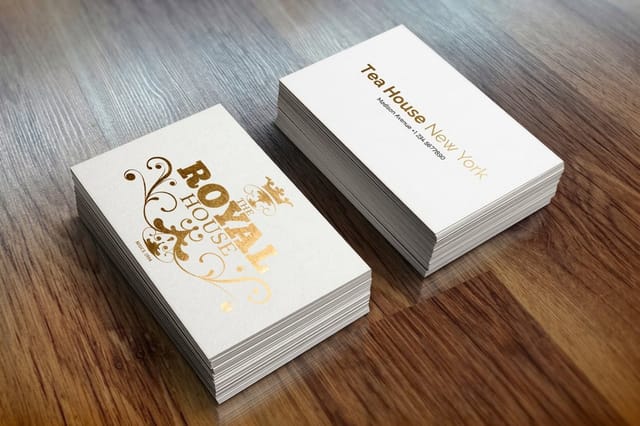 Metallic Foil Business Cards | |
|---|---|---|---|---|
| Min price | Free | $17.57 | $690.88 | $222.13 |
| Paper / stock | 14pt Gloss Cover | 14pt Gloss Cover | 31pt Lenticular Lens | 16 Point Silk Laminated |
| Finish | - | Standard Finish | - | - |
| Size | 2" x 3.5" | 2" x 3.5" | 2" x 3.5" - Vertical | 2" x 3.5" |
| Default qty | 200 | 100 | 500 | 500 |
| Turnaround | 5 business days | 3 business days | 22 business days | 7 business days |
| Rating | ||||
| View & customize | View & customize | View & customize | View & customize |
Setting Up the Die Line and Sending It to Press
The shape is decided. What remains is a file that a press and a die maker can both read without guessing. Get this part right and a shaped run is no more stressful than a rectangle. Get it wrong and you find out at the worst possible moment, after the tool is built.
Build the file at final size with the die line as a single closed vector path on its own named layer, set to a spot color that appears nowhere else in the artwork. Flatten nothing, embed your fonts or outline them, and export a print-ready PDF. If you want more layout thinking before you commit, the ideas in our business card design trends roundup and the trade-specific angles in business card ideas for crafters are a useful sanity check on the design itself.
Match the stock to the cut
- Curved outlines. Heavier stock, 16pt and up, so the curve keeps its shape in a pocket.
- Interior cutouts. Coated stock resists tearing around a punched hole or window.
- Narrow points. Thicker board plus a slightly blunted tip, never a needle-sharp corner.
- Magnets. Keep the outline simple, since a magnet is read from across a room.
Start fast
Card templates and print-ready blanks
Free layouts plus exact-size blanks so your die line sits where the press expects it.
Lining Up the Back With an Outline That Is Not Square
A rectangle forgives a little drift between the two sides because the eye has nothing to measure it against. A shaped card does not.
The die cuts the printed sheet after both sides are on it, so any front to back shift shows as a border fatter on one edge of the shape than the other. On a circle that reads immediately, because a ring of uneven width is the first thing anyone notices. On an object silhouette it reads as the back artwork sitting slightly off inside its own outline.
Design around it rather than hoping. Avoid a thin outline that traces the die on either side, hold back artwork at least an eighth of an inch clear of the cut, and if the card needs a border, make it thick enough that a small drift does not change its character.
By the numbers
Why die cutting belongs with a production printer
Shaped work is a manufacturing step, and manufacturing rewards scale and repeatability.
- 10B+ Business cards printed, since 1999
- 150,000+ Businesses served, across every industry
- 60+ Paper stocks, across the catalog
- 99.8% On-time delivery, and 82% ship early
Wally explains how a shape becomes a die
From your outline to the steel rule that cuts every card in the run
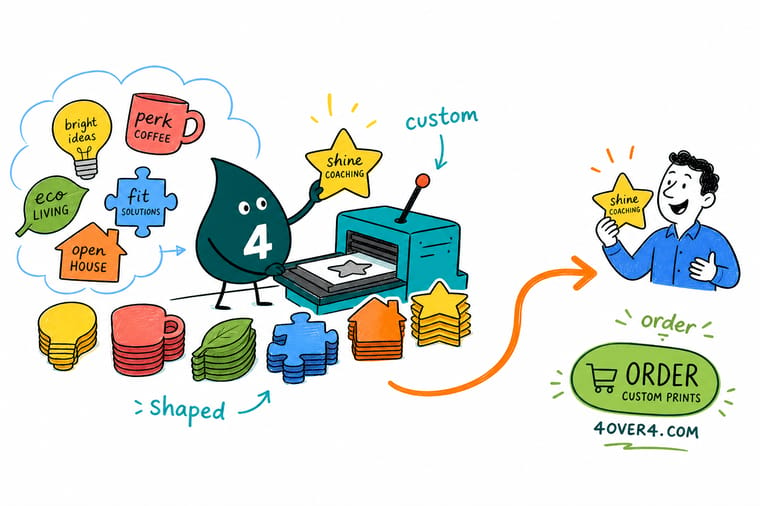
Pick a silhouette that still reads at one inch wide, draw it as one closed vector path on its own layer, and add 0.125 inch of bleed outside it with 0.125 inch of safety inside. That file becomes a bent steel die, and the die cuts every card identically. If you are not sure the shape earns its keep, print it as a sticker first, hand out fifty, and let the reaction pay for the tooling.
Design your shaped business cards →What to Settle Before You Pay for a Die
Explore more
More shaped and custom printing to look at next
Shaped card products, magnets, stickers, and card ideas by trade.
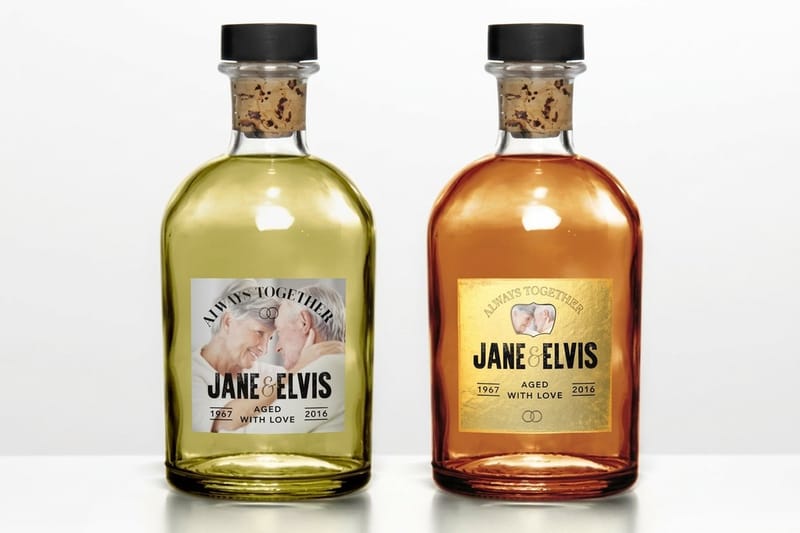 Collection Custom Printing Collection Die-cut shapes, magnets, stickers, and custom formats in one place. Product Custom Shaped Business Cards 80 die-cut outlines on a 2 x 3.5 inch card. Product Business Card Magnets Your card on 17pt or 35pt indoor magnet.
 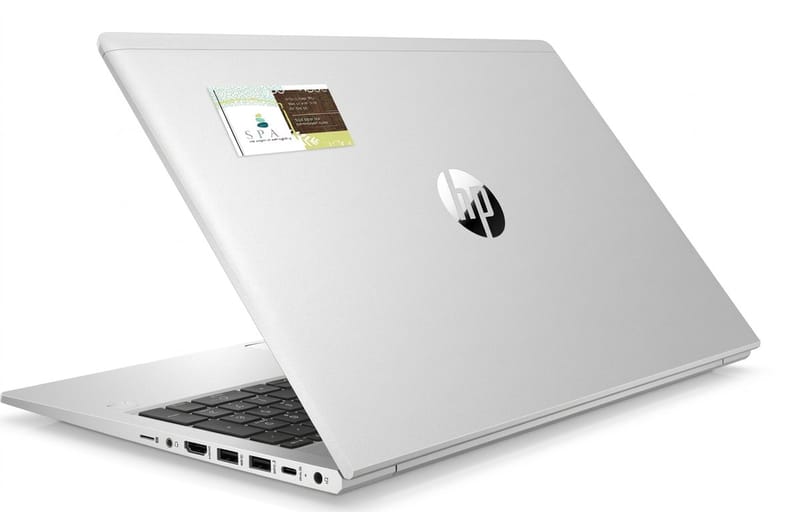 Product Business Card Stickers Your card as a 2 x 3.5 inch peel-and-stick label.
 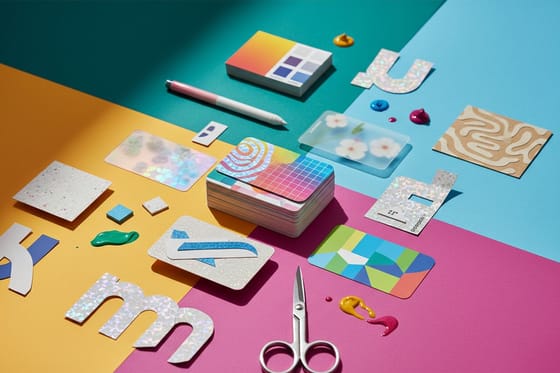 Article Business Card Design Trends What card design is doing right now, beyond the outline.
 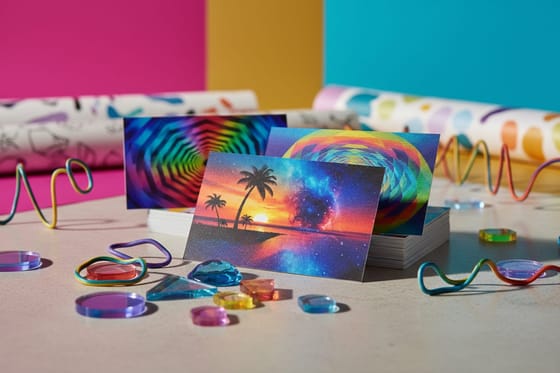 Article 3D Lenticular Business Cards Motion on a card, for when shape alone is not enough.
  Article Business Card Ideas for Crafters Handmade brands and the shapes and stocks that suit them.
  Article Cards for Personal Trainers Shapes and messaging that get a client to book again.
  Article Cards for Cleaning Services Why magnets and shaped cards win for repeat home visits.
  Article Babysitting Business Cards Friendly shapes and clear contact details for family clients.
  Article Lip Gloss Business Cards Beauty brands, custom outlines, and finishes that flatter.
  Article Thank You Card Ideas Follow up a shaped card with a note people actually keep.
 Ready to hand someone a card they cannot file away?
Pick a ready outline, or send the die line for your own, and choose a stock heavy enough to hold the cut.
Custom Shaped Business Card Questions Answered
How much should I pay for 500 business cards?
At 4OVER4.COM, 500 standard business cards cost $36.26, 500 preset die-cut cards cost $47.24, and 500 cards cut to one of the 80 outlines or to your own cost $146.10, about 29 cents a card. The preset shapes are the middle option when you want a shape for less.
What is the smallest detail a die can cut?
Keep the narrowest part of the outline at least a quarter inch wide and keep any interior cutouts simple. A steel blade cannot hold a sharp internal angle the way a printed line can, so a tight notch comes back slightly rounded, and a thin bridge of stock between two cutouts tears during cutting or later in a pocket.
What are unique business card shapes?
Unique business card shapes are outlines other than the standard 3.5 by 2 inch rectangle, cut with a steel rule die after printing. Circles, squares, half circles, leaves, hang tags, playing cards, and object silhouettes are all common. The shape is a manufacturing step rather than a printed effect, which is why it survives handling and why it changes how the card feels in the hand. For design direction that pairs with a custom outline, see our business card design trends roundup.
How do I choose the right shape for my business card?
Start with where the card ends up. If it goes into a wallet or a scanner, stay close to a rectangle and use rounded corners or one rounded edge. If it is handed over once in a crowded room, a circle, arch, or object silhouette earns its keep. If the goal is a callback weeks later, skip the wallet entirely and print the shape on magnet stock.
What do custom shaped business cards cost and how is the price set?
Custom Shaped and Die-Cut Any Shape cards share one price ladder, and the stock, the printed sides and the quantity move it. Die-Cut Any Shape adds a choice between a Basic and a Complex die. Business Card Magnets and Business Card Stickers are rectangles, so they carry no die at all.
What sizes, stocks, and finishes work best for die-cut business cards?
Both custom products are cut from a 2 x 3.5 inch card, on 27 stocks from 10pt to 18pt, kraft, synthetic plastic, rigid vinyl and 17pt indoor magnet among them. The finish is standard or high gloss UV coating. Choose the finish for the brand and the weight for the shape.
How long does it take to print and ship custom shaped business cards?
The two custom products run 1 to 5 business days depending on the turnaround you pick, and preset die-cut cards offer same-day up to 3 business days. Every option with its production time shows in the configurator before checkout. Production time starts after you approve the proof, so approve it promptly.
