
8 B2B Direct Mail Marketing Ideas for More New Clients

Nadia is our customer education voice, built from the knowledge of our production team, with over 20 years in printing.
How B2B Direct Mail Earns a Seat at the Table
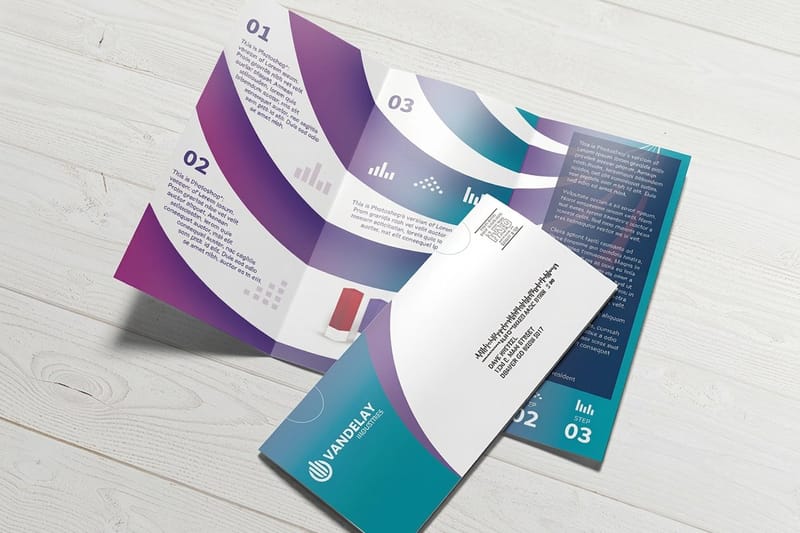
The B2B direct mail examples and ideas below all start from one habit of business buyers: they ignore most of what lands in their inbox and almost none of what lands on their desk. A printed letter, brochure or flyer has no unsubscribe link, no promotions tab and no algorithm deciding whether it gets seen. That physical advantage is the whole reason B2B direct mail keeps earning budget, and it is also why a lazy mailer wastes so much money. The format only works when the thinking behind it is sharp.
The strongest B2B direct mail examples share the same shape. A short list of accounts you genuinely want, a message written for one job title rather than a whole industry, a format that survives the mailroom, and a call or an email that lands within 48 hours of delivery. Miss any one of those four and the piece becomes decoration.
4OVER4.COM has printed 10 billion+ pieces since 1999 for more than 150,000 businesses, and the campaigns that come back for a second round are rarely the biggest ones. They are the tightly targeted ones. A brochure mailed to 200 operations directors at companies already showing intent will beat a generic postcard blast every time, because the cost per piece stops mattering once the cost per meeting drops.
Step 1: build a list you could defend in a meeting
Start from accounts your sales team already named, not from a purchased file. Verify the title, the mailing address and whether the office is actually staffed. A list of 150 verified contacts is worth more than 15,000 rented rows, and it makes personalization affordable.
Step 2: pick the format the message deserves
A one line offer belongs on a flyer. A proof heavy story needs a brochure. A sensitive executive pitch reads better as a letter. Choose the format from the message, then let the print specs follow, never the other way around.
What each mailed format prints on
- Sizes. Letters, flyers and brochures print at 8.5" x 11", 8.5" x 14", 9" x 12" or 11" x 17".
- Stocks. 100# gloss text or 100# silk/matte text for most pieces, 70# uncoated text when a letter should feel like office correspondence, and 100# gloss cover for a brochure that has to stand up on a desk.
- Folds. Brochures take a half fold, trifold, Z-fold, accordion, gate fold and four more, so a case study can open like a report.
- Quantities. Mailed runs start at 500 pieces, which covers a named account list with room for a second wave.
- Turnaround and files. Production takes 6 business days by default. You upload the print-ready file and the address list, and printing, addressing and postage run as one order.
Step 3: write one offer, not a capabilities list
Give the reader a single decision. A benchmark report, a free audit, a 20 minute teardown of their current process. Anything that asks a busy buyer to choose between five services gets set down and forgotten before the choice is made.
Step 4: schedule the follow up before you mail
Mail dates are the trigger for the rest of the sequence. Book the calls, load the email, brief the reps and hand them the exact piece the prospect is holding. Direct mail rarely closes anything on its own, but it makes the next touch welcome.
Start here
Direct mail outreach hub
Playbooks, formats and campaign breakdowns for teams mailing to business buyers.
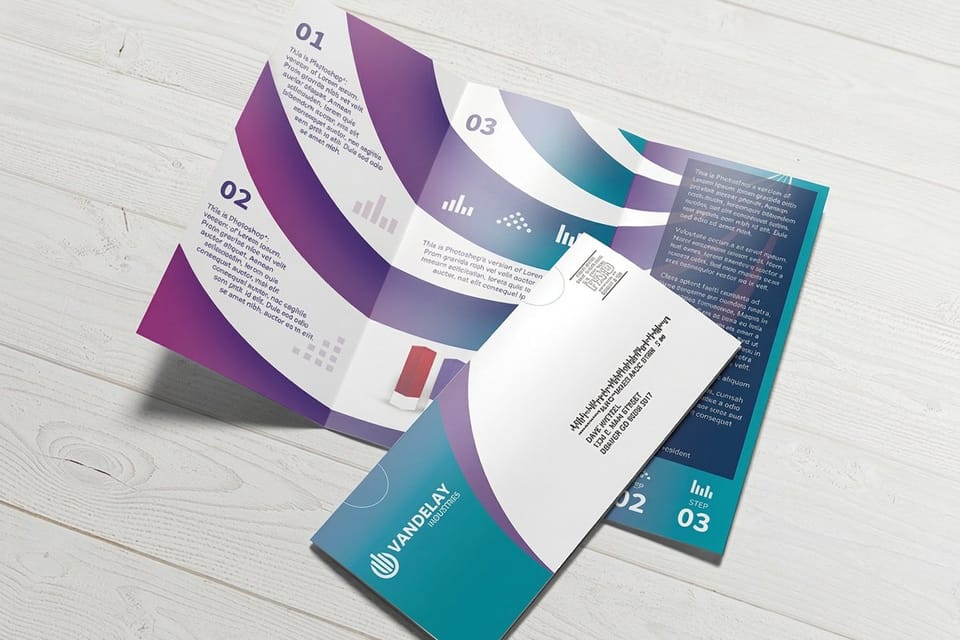
Idea 1: The Account Based Dimensional Mailer
Pick the 50 accounts that would change your year and build one package per account. Depth beats volume here. When a piece has weight and shape, it moves from the mail pile to the desk, and an executive assistant who cannot categorize it will usually hand it over rather than bin it.
Wrap the package around a printed centerpiece rather than a novelty object. A folded Direct Mail Brochure carrying that account's own numbers gives the gift a reason to exist, and a matching Direct Mail Letter signed by a named person on your team turns the delivery into a conversation instead of a promotional drop.
- Name the account on the cover. Personalized print costs a few cents more and doubles how long the piece is held.
- Include one artifact they can use. A benchmark chart, a checklist, a sample audit page they would otherwise pay for.
- Keep the object relevant. A prop that ties to your product beats a branded mug that ties to nothing.
- Give the rep a reason to call. The follow up line should reference the package, not open cold.
- Track delivery, not just mailing. Call the day the tracking confirms it arrived, while the piece is still on the desk.
Budget the campaign per meeting rather than per piece. If a package costs a few dollars and a single closed account is worth five figures, a low response rate is still a strong return. That math is the reason dimensional mail survived every prediction of its death. The case for weight and shape is laid out in full in dimensional mailers and the power of a physical presence.
Print picks
Three mailed formats built for B2B outreach
Live prices, printing and mailing handled in one order.
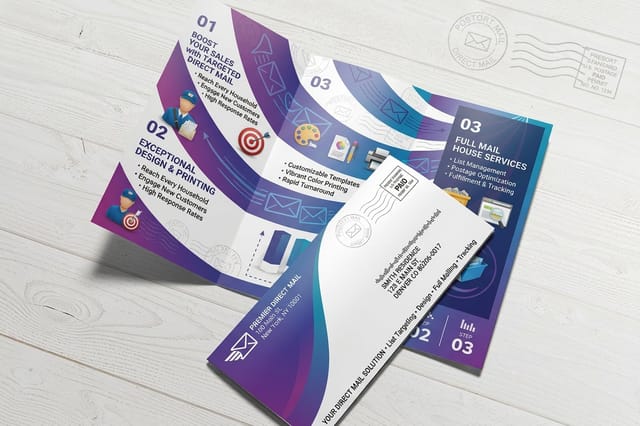
 Direct Mail Brochures 500 for $238.73 Room for a case study, a diagram and a clear next step in one folded piece.
  Direct Mail Flyers 500 for $238.73 One flat page, one offer, one deadline. The fastest format to test a message.
 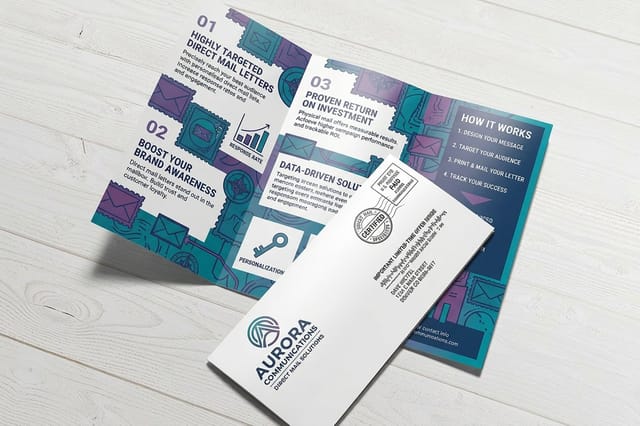 Direct Mail Letters 500 for $238.73 The quiet workhorse for executive outreach when the message needs to read personal.
 Idea 2: The Problem First Sales Letter
The plainest format in B2B mail is still one of the most effective, because a letter reads like correspondence rather than advertising. Open with the problem in the prospect's own language, prove you have solved it before, then ask for one small commitment. No stock photography, no tagline, no feature grid.
Print it on a real letterhead layout and sign it. A Direct Mail Letter mailed to a director level contact carries a different weight than the same words in an email, and because the format is cheap to produce you can afford several rounds against the same target list.
- One page, four paragraphs. Problem, proof, offer, ask. Anything longer gets skimmed and set aside.
- Write to a title, not a market. A CFO letter and a plant manager letter should barely resemble each other.
- Use a real signature block. Name, direct line, calendar link. Make replying easier than filing it.
- Reference something verifiable. A recent hire, an expansion, a filing. Proof you looked before you wrote.
- Send the second letter. Most letter campaigns are abandoned after one round, which is exactly when they start working.
Idea 3: The Case Study Drop for Look Alike Accounts

Take your best customer result and mail it to twenty companies that look exactly like that customer. Same industry, same size band, same operational headache. The relevance does the persuading, because the reader recognizes themselves in the first sentence and keeps going.
A folded brochure gives the story room to breathe. A cover line with the outcome, an inside spread with the before and after, and a back panel with the offer and a QR code to the full write up. If you want to test the story before committing to the longer format, run it first as a flat Direct Mail Flyer and see which headline pulls.
- Lead with the outcome. The number the buyer cares about belongs on the cover, not on page three.
- Name the industry, not the client. If the logo is confidential, the sector and the size still carry the proof.
- Show the mechanism. Buyers believe results they can picture happening inside their own operation.
- Add one quote from an operator. A line from the person who used the product beats a line from their marketing team.
- Close with a low friction ask. A teardown call converts far better than a demo request at this stage.
Idea 4: The Printed Invitation That Fills the Room
Webinar invitations drown in the inbox. A printed invitation to a roundtable, a facility tour or a private dinner arrives alone and signals that seats are limited and real. For a formal dinner, print it as an 8.5" x 11" letter on 100# silk/matte text; when the agenda and the speaker list need room, fold a 9" x 12" brochure into a gate fold. For high value events, mailing the invitation is often the difference between a half empty room and a waiting list.
Run it as a three step sequence. The mailed invitation goes out three to four weeks ahead, an email confirms and captures the RSVP, and a second printed reminder lands the week of the event for anyone who has not replied. Below you can see how quantity and specification move the price on a mailed piece, so you can size the drop against the seats you actually have.
- Print the date large. The single most looked at element on any invitation is the date.
- State who else will be there. Peer attendance sells B2B events better than any agenda.
- Make the RSVP one action. A short URL or QR code, never a form buried three clicks deep.
- Mail to the assistant too. Calendars for senior titles are rarely controlled by the person you are inviting.
- Send a printed thank you after. The follow up piece is where the pipeline actually gets built.
Quantity and price
Direct mail brochure pricing and specs
Real configurator numbers. Cost per piece falls as the mailing list grows.
| Quantity | Price Per Unit | Total |
|---|---|---|
| 500 | 47.7¢ | $238.73 |
| 600 | 41.1¢ | $246.31 |
| 700 | 36.3¢ | $253.88 |
| 800 | 32.7¢ | $261.47 |
| 900 | 29.9¢ | $269.05 |
| 1,000 | 27.7¢ | $276.63 |

Idea 5: The Reactivation Mailer for Dormant Accounts
Every B2B company has a list of accounts that bought once and went quiet. They already know your name, they already survived procurement, and they are the cheapest pipeline available. Email to that list has usually gone stale, which makes a printed reactivation piece the fastest way back in.
Keep the tone honest. Acknowledge the gap, state what has changed since they last bought, and give them a reason to look again. A short Direct Mail Letter works well here because it reads as a note from a person rather than a promotion from a brand. The specs below show the stocks and finishes available if you want the piece to feel more considered.
- Segment by reason for leaving. Price, timing and service issues each need a different opening line.
- Lead with what is new. A capability, a location, a certification. Give them fresh information, not nostalgia.
- Offer a low risk restart. A small first order or a pilot beats asking them to commit at the old volume.
- Route replies to the original rep. Continuity of contact removes most of the friction from a restart.
- Mail quarterly, not monthly. Dormant lists respond to persistence, but only at a respectful pace.
Executive format
Direct mail letters
The stocks, sizes and mailing options behind a letter that reads personal.
Idea 6: The Referral Request Sent to Happy Clients
Your existing clients sit inside networks you will never buy your way into. Most of them would refer you and simply never think to. A printed referral request is a rare piece of mail because almost nobody sends one, and that scarcity is exactly why it gets read and acted on.
Mail two pieces in one envelope. A short letter making the ask, plus a second piece the client can physically hand to someone else. That handover piece is doing the real work, so give it a proper job with something like the format below, and make sure it stands on its own without your letter beside it.
- Ask for one introduction. Naming a single desired connection converts better than asking for anyone they know.
- Make the pass along easy. Include a piece meant to be handed over, not a folder of everything you sell.
- Say thank you before the ask. Reference the specific work you did together in the opening line.
- Offer something to both sides. A credit, a free audit or a donation keeps the request from feeling one sided.
- Time it after a win. Mail within two weeks of a delivered result while the goodwill is fresh.
The handover piece
Direct mail flyers
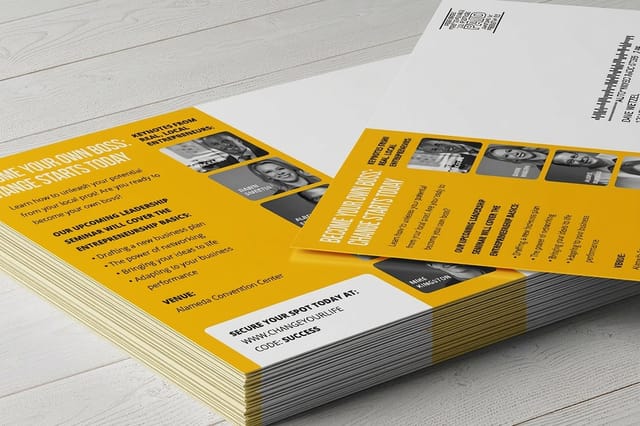
One flat page your client can pass to the person you actually want to meet.
Idea 7: The Onboarding and Renewal Kit
New client mail is not a marketing expense, it is a retention one. A printed welcome kit that arrives in the first week reassures everyone who signed off on the purchase, including the people who were not in the room. The same logic applies 60 days before renewal, when a printed summary of results makes the renewal conversation almost automatic.
Build the kit around a brochure that explains what happens next, who to contact and what good looks like at 30, 60 and 90 days. If you are deciding between formats, weigh stock, size, quantity and turnaround side by side before you commit to a run.
- Include the escalation path. Printed contact details get pinned to a wall and cut support friction for months.
- Set expectations in writing. A printed timeline prevents the quiet disappointment that kills renewals.
- Address the wider buying group. Print enough copies for finance, operations and the end users.
- Mail a results recap before renewal. Numbers on paper are harder to argue with than numbers in a deck.
- Reuse the layout every quarter. One template, updated data, and the kit costs almost nothing to repeat.
Compare formats
Popular direct mail products, side by side
Mailed postcards at 500 for $89.68 next to letters and brochures at 500 for $238.73.
 Direct Mail Postcards | Direct Mail Brochures | Direct Mail Letters | Direct Mail Flyers | |
|---|---|---|---|---|
| Min price | $89.68 | $238.73 | $238.73 | $238.73 |
| Paper / stock | 14pt Gloss Cover | 100# Gloss Text | 100# Gloss Text | 100# Gloss Text |
| Finish | - | Standard Finish | Standard Finish | Standard Finish |
| Size | 4" x 6" | 8.5" x 11" | 8.5" x 11" | 8.5" x 11" |
| Default qty | 500 | 500 | 500 | 500 |
| Turnaround | 4 business days | 6 business days | 6 business days | 6 business days |
| Rating | ||||
| View & customize | View & customize | View & customize | View & customize |
Idea 8: The Trade Show Follow Up That Beats the Inbox
Everyone who scanned your badge is getting the same templated email within 48 hours of the show closing. Almost nobody is getting mail. Sending a printed follow up in week two, when the inbox rush has passed, puts you back in front of the buyer exactly when they are sorting through what they saw.
Reference the conversation, restate the one thing they asked about and include the piece you did not have time to walk them through on the floor. Then get it out the door quickly, because a follow up that arrives a month late reads as an afterthought no matter how good the print is.
Match the format to the stage of the conversation
- Booth conversations. A flyer with the one demo they watched and a direct calendar link.
- Qualified leads. A brochure with the relevant case study and pricing bands they asked about.
- Executive contacts. A signed letter, no brochure, one paragraph and a specific meeting request.
- Partners and resellers. A kit with the program terms and the margin structure printed out in full.
Start from a print ready layout so the piece can be designed, proofed and mailed inside a week. Correct sizes, bleeds and safe margins matter more on mailed pieces than on anything else you print, because a trim error on an addressed piece is not a reprint, it is a missed campaign window.
Start fast
Mailer templates and print-ready blanks
Free layouts plus exact-size blanks so bleeds, margins and address panels land right the first time.



Wally helps you pick the right mailer
The right format first, then the list, then the follow up
Not sure whether to mail a flyer, a brochure or a letter? Match the format to the message. One offer and one deadline fits a flyer. A customer result with before and after proof needs a brochure. A sensitive executive pitch reads best as a plain signed letter. Build the list before the design, keep it verified, and book the follow up calls against your mail date.
Design your direct mail brochures →Turning Eight Ideas Into One Working Campaign
Explore more
More direct mail playbooks worth reading
Open the EDDM campaign ideas if your list is a neighborhood, the format comparison if you are still choosing between a letter and a brochure, and the outreach hub for every B2B mail playbook.
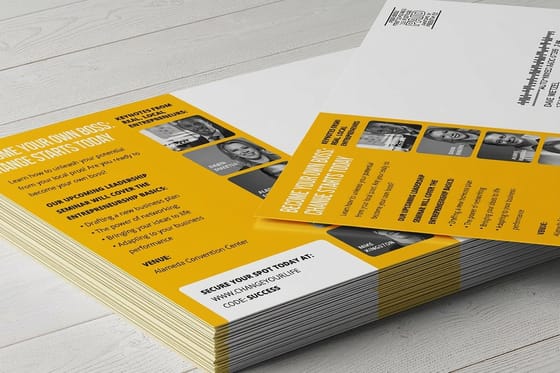 Article Direct Mail Campaign Ideas That Fill a Route Instead of a Mailbox EDDM and direct mail campaign ideas with the piece, the quantity and the drop date for each one, plus the post
 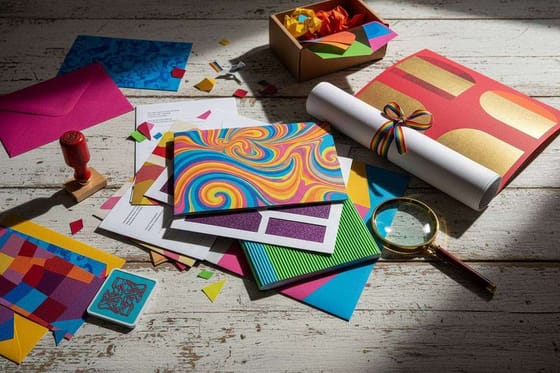 Article Brilliant Direct Mail Examples Campaigns worth stealing from, across B2B and consumer. Article 8 Most Effective Direct Mail Formats Which printed format suits which offer and audience. Hub Direct Mail Outreach Hub Every direct mail guide and campaign playbook in one place.
  Article Direct Mail Trends and What Is Next Where mailed marketing is heading and what to plan for. Article Labor Day Direct Mail Ideas Seasonal offers that give a B2B mailer a natural deadline.
  Article 21 Pool Company Marketing Ideas A service business playbook you can adapt to any trade.
 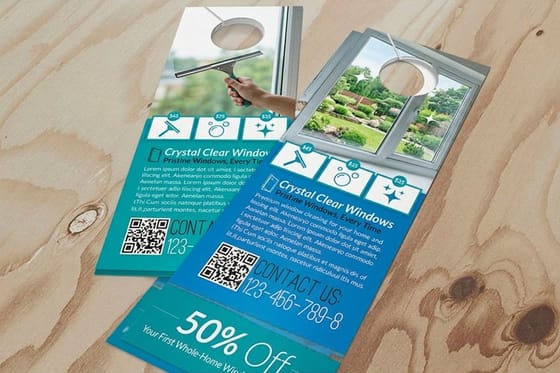 Article 26 Carpet Cleaning Marketing Ideas Lead generation tactics built around repeat local accounts.
 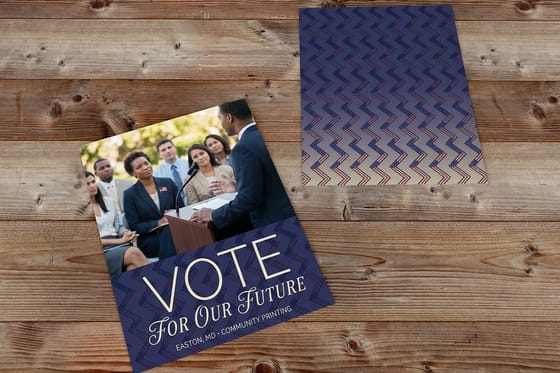 Article Political Direct Mail Postcard Ideas Persuasion mail at scale, with lessons that transfer to B2B.
 Put one of these campaigns in the mail this month
Pick the format that fits your message, upload your list and let printing, addressing and postage happen in a single order while your team preps the follow up calls.
B2B Direct Mail Questions, Answered
What are the best B2B direct mail examples to start with?
Start with the three that need the smallest list and the least production time: a problem first sales letter to a named title, a case study brochure mailed to look alike accounts, and a reactivation piece to customers who went quiet. Each one can be produced and mailed inside a week, and each has a clear follow up motion attached. Once those are running, add the account based dimensional mailer for your top fifty targets. For a wider view of what the format can do, see these effective direct mail formats.
Flyer, brochure, or plain letter for this pitch?
Work backwards from the message. If you have one offer and one deadline, a flat flyer carries it without wasting space. If you need to prove a result with before and after numbers, a folded brochure gives the story room. If the pitch is sensitive or aimed at an executive, a plain letter reads as correspondence and outperforms anything glossy. Volume matters too. Highly targeted lists justify heavier, more personalized pieces, while broad drops should stay light and simple.
Does the quote include addressing and postage?
Direct Mail Brochures, Direct Mail Flyers and Direct Mail Letters at 4OVER4.COM each start at $238.73, and the final price moves with quantity, size, paper stock, ink coverage, finishing and the mailing service itself. Direct mail pricing bundles the print run with addressing and postage, so the quoted figure covers the piece landing in a mailbox rather than arriving at your office in a box. Unit cost drops steeply as the run grows, which is why quantity is usually the biggest lever on the total.
Which stocks suit a letter against a brochure?
Mailed formats run across standard postal sizes from compact flyer dimensions up to larger folded brochure panels, printed on stocks that range from lighter text weights for letters through heavier coated cover stocks for brochures. Coating options include gloss, matte and uncoated, and folded pieces support half, tri and gate folds. Because postal regulations tie size, weight and thickness to postage rates, checking the specs before you design keeps a piece from qualifying for a higher rate than you budgeted.
How much time does the address file add?
Production turnaround depends on the format, quantity and finishing you select, and it is quoted separately from mailing time once the pieces enter the postal stream. Plan the calendar backwards from the date you want the piece on a desk, then add proofing time for the address file, because list preparation is where most campaigns lose their week. For event invitations and deadline driven offers, mailing three to four weeks ahead gives recipients room to respond without the offer going stale.
