
Direct Mail Campaign Ideas That Fill a Route Instead of a Mailbox


Choose the campaign shape first and let it pick the piece: a saturation offer rides on an EDDM flat of 6.5 by 9 inches or larger, and anything that needs a name on it rides on an addressed letter with a mailing list. Every campaign below names the piece, a starting quantity and when to drop it, because those three decisions settle the result long before the artwork does.
Campaign shapes at a glance
| Campaign | Piece | Starting quantity | When to drop |
|---|---|---|---|
| New location saturation | 6.5 x 9 postcard | The 3 to 5 routes closest to the door | 10 days before opening, repeat the week after |
| Competitor ring | 6.5 x 9 postcard | Routes that surround their location, not yours | Mid month, when the mailbox is quiet |
| Season ahead reminder | 8.5 x 11 flyer | The routes you already service | 3 to 4 weeks before the season starts |
| Fridge piece | Folded brochure or 8.5 x 11 flyer | A small route set, mailed often | In home Thursday for a weekend offer |
| Three touch sequence | Same postcard, three offers | One quarter of the routes, three times | Three drops, roughly three weeks apart |
| Two route split test | One postcard, two response codes | Two routes of similar size | Both on the same day, no exceptions |
| Named account letter | Letter and envelope, addressed | 20 to 200 names from your own list | Tuesday to Thursday in home, First Class |
Quantities are a starting point for a first campaign, not a ceiling. Expand outward from a route that responded rather than starting somewhere new. You can order direct mail postcards in every EDDM size from the configurator.
EDDM or a mailing list, the decision that shapes everything
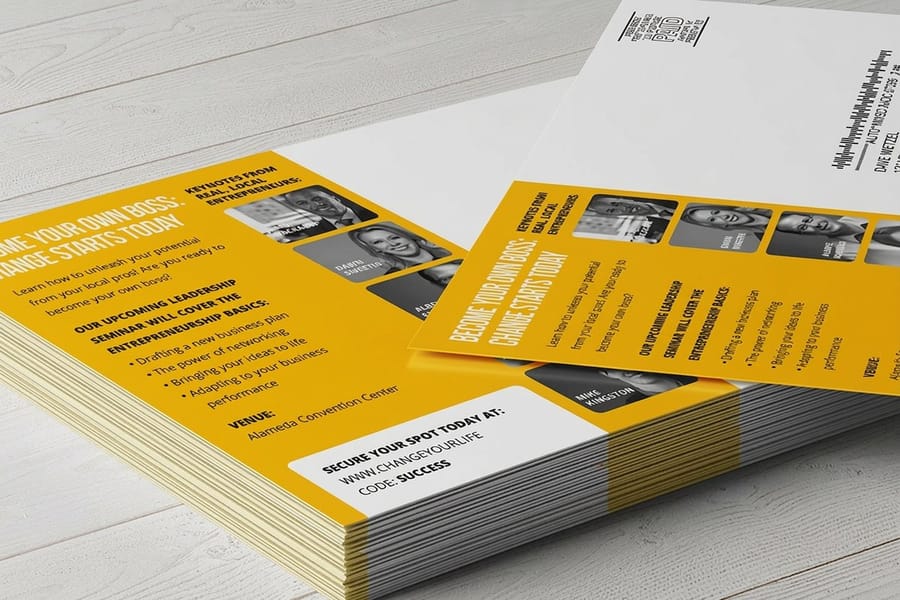
EDDM saves you the list and costs you the aim. You buy every door on a USPS carrier route, a few hundred to well over a thousand households at a time, at the flat saturation rate, and you never see a single name. For a pizzeria, a dentist or a roofer whose customer is anyone within four miles, that is the cheapest reach in print. For a firm that sells to thirty accounts across a metro area, it is a way to pay for nine hundred doors that will never call.
The second half of the trade is format. EDDM only carries flats, so the piece has to break one of three thresholds: longer than 10.5 inches, taller than 6.125 inches, or thicker than 0.25 inches, and nothing may exceed 15 by 12 by 0.75. The 4 by 6 postcard most people picture is a letter as far as USPS is concerned, and it cannot ride EDDM Retail at all. That single rule is why every EDDM size chart on earth starts at 6.5 by 9.
Our EDDM postcard sizes guide lists the qualifying dimensions in detail, and the direct mail printing and mailing services page covers what we handle once the artwork is approved. If you have never run a drop before, read how direct mail marketing works first, then come back to the campaign shapes below.
| Size | Qualifies for EDDM | Best used for | Note |
|---|---|---|---|
| 6.5 x 9 in | Yes, taller than 6.125 in | One offer, one deadline, a map | The cheapest piece that legally qualifies |
| 8.5 x 5.5 in | No, too short and too narrow | Handouts and counter cards | Mails as a letter with a stamp, not EDDM |
| 6 x 11 in | Yes, longer than 10.5 in | A coupon strip along the bottom | Reads well in a stack of mail |
| 8.5 x 11 in | Yes, on both length and height | Menus, price lists, service checklists | The piece people keep rather than read once |
| 9 x 12 in | Yes, on both length and height | Photography, before and after work | Highest impact, highest print cost per piece |
| 4 x 6 in | No, under every threshold | Addressed list mailings | Fine with a list, never with EDDM |
What EDDM Retail actually asks of you
No permit, no list, no addresses. You choose routes in the USPS online tool by ZIP code, which shows the household count on each route along with average age, average household size and average income. You bundle the pieces in stacks of 50 to 100 with a facing slip on each stack, fill in the postage statement at the counter, and pay at the Post Office that delivers those routes. The cap is 5,000 pieces per ZIP code per day. Beyond that you need a permit and a bulk mail entry unit.
The address side is where jobs get rejected. Leave the upper right corner clear for the indicia, print the words EDDM Retail in that indicia block, and set the address area as the ECRWSS endorsement over a Local Postal Customer line. No name, no street. If the artwork fills that corner with a headline, the counter will send it back and the drop date moves.
When a list beats a route
Three situations flip the decision. Selling something with a long sales cycle and a high ticket, where you know the twenty companies worth winning. Mailing your own customers, where you already have the addresses and the history. Chasing new movers or a specific trade, where the value sits in the targeting and not the volume. In all three, an addressed direct mail letter at $238.73 beats a route buy, because the piece can say something only that reader would recognize.
The B2B version of this is worth its own read: eight B2B direct mail ideas covers what to put in an envelope when the recipient has a gatekeeper. The honest limit of EDDM is that it cannot do any of that. It is a volume instrument, and pretending otherwise is how people conclude that direct mail does not work.
Eight campaigns worth the postage
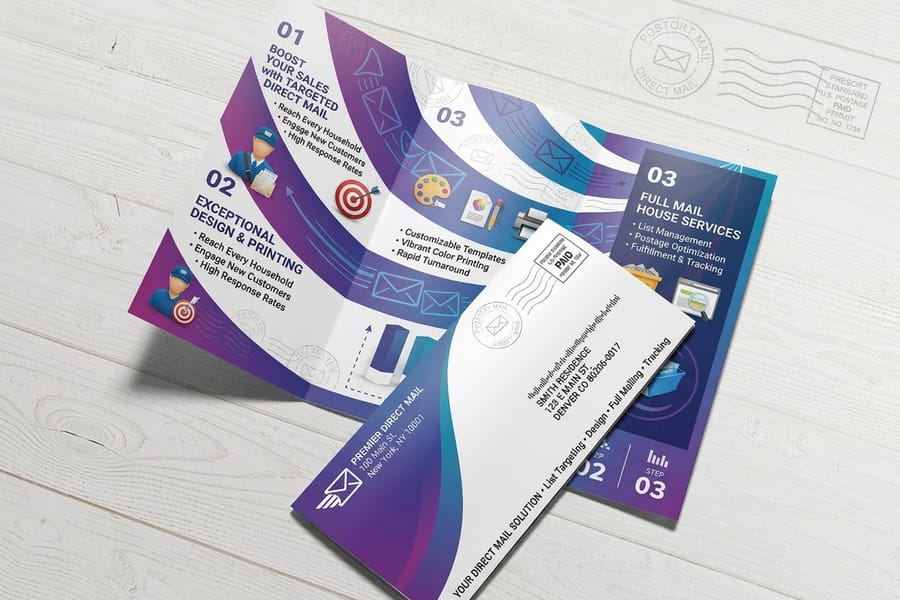
Each of these names the piece, a starting quantity and when to drop it, because those three decisions decide the result long before the design does. They are ordered from the simplest to run to the ones that need a list and a bit of patience.
The pieces come from four products: direct mail postcards at $89.68, direct mail flyers and direct mail brochures at $238.73, and letters at the same price when the campaign needs an envelope.
Four campaigns you can run on EDDM alone
1. Saturate the routes around a new door. Pick the three to five carrier routes nearest the location, print a 6.5 by 9 postcard with the address, a map and one opening offer, and drop it ten days before you open. Then drop the same routes again the week after opening. The second drop is the one that works, and it is the one most people skip because the first felt expensive.
2. Ring a competitor instead of yourself. Choose the routes that surround their location rather than yours, and lead with the one thing you do that they do not: later hours, free parking, a same day slot. This is the campaign where a weak offer shows up immediately, because the reader already has a supplier and is being asked to change.
3. Beat the season by a month. Gutter cleaning mailed in the first week of heavy rain competes with panic. Mailed four weeks earlier, on an 8.5 by 11 flyer with a checklist the reader can tick, it competes with nothing. Same logic for tax prep, heating service, pool opening, back to school. The mailbox is emptier before the rush and so is the calendar.
4. Print something that earns fridge space. A menu, a price list, a maintenance schedule, an emergency number. A folded direct mail brochure gets kept where a discount postcard gets binned, which changes the arithmetic completely: one piece that survives six weeks on a fridge door is worth several that got a glance. Aim for a Thursday in home window if the offer runs over a weekend.
Four that need a list, a code or a calendar
5. Sell an event with a window, not a date. An open house, a sale weekend, a demo day. Marketing Mail is not date guaranteed, so print a range such as valid through the end of the month rather than a single Saturday. A piece that lands two days after the event is money set on fire, and it happens to somebody every season.
6. Run the same route three times. Take a quarter of the routes you could afford to hit once, and hit them three times about three weeks apart with the same look and a different offer. Recognition is the whole point. A household that has seen your colors twice reads the third piece instead of sorting it, and a single drop across four times the area never gets that far.
7. Split two routes and count the calls. Same postcard, same drop day, two response codes: a distinct phone extension, a URL with a suffix, or a coupon code per route. Pick routes with similar household counts so the comparison means something. This is the cheapest market research a local business can buy, and it settles arguments about the offer that would otherwise run for years.
8. Write to the accounts that actually matter. Twenty to two hundred names from your own records, in an envelope, First Class, arriving Tuesday to Thursday. Reference something specific about the recipient in the first line, because that is the only thing that separates a letter from a mailer. Send it, then call the following week. The letter is not the campaign, the letter is the reason the call gets taken.
Quantity, drop date and the second touch
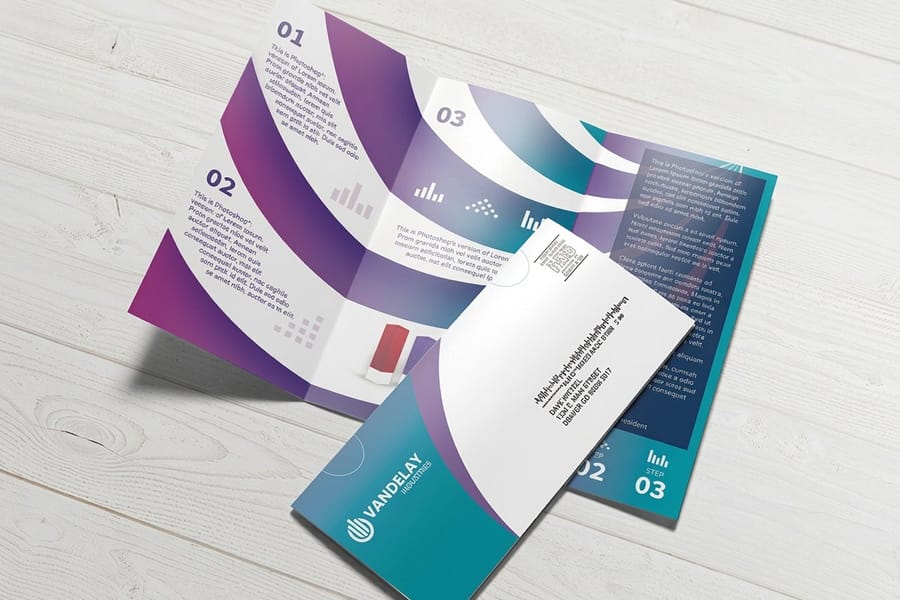
The most common mistake in a first campaign is spreading a fixed budget as thin as it will go. Twenty routes once looks impressive on a map and reads as a stranger in the mailbox. Five routes four times looks modest and reads as a business that is clearly around. If the budget only stretches one way, cut the area and keep the frequency.
Route selection deserves ten minutes rather than ten seconds. The USPS tool shows the household count, the average income, the average age and the average household size for every route, which is enough to drop a route that skews far from your customer before you have paid for it. A route full of student rentals is a poor buy for a landscaper and a fine one for a pizzeria.
Then work the calendar backwards. Print turnaround, transit to you, your bundling time, the counter visit, and the days USPS takes to work Marketing Mail through the plant and onto the route. None of that is date guaranteed, so leave slack at both ends and never build the offer around one named day. The winning direct mail campaign guide walks the full sequence, and how to create a successful direct mail campaign covers the planning side in more depth.
Making the response countable
A campaign you cannot measure is a campaign you will argue about. Give every drop its own trackable handle: a phone extension, a landing URL, a coupon code, or simply a line that tells the reader to mention the card. Then write the number down on the day it arrives, not at the end of the quarter from memory.
Response arrives in a long tail. A saturation drop produces a cluster in the first ten days and a slow trickle for a month or more, and pieces that got kept, the menus and the price lists, produce calls months later with no obvious trigger. Judge a route on a six week window, not a weekend. There are worked examples in brilliant examples of direct mail marketing.
What the printing side costs
Postage and print are separate budgets and people forget the first one. The print side is straightforward: direct mail postcards start at $89.68 and flyers at $238.73, with the unit cost falling as the run grows, which is one more argument for hitting fewer routes more often. The postage side is the flat EDDM rate published by USPS per piece, multiplied by every door on every route you chose, and it is usually the larger of the two lines.
Choose the stock with the drop in mind. A postcard needs enough rigidity to survive being bundled, carried in a satchel and pushed through a slot, so 14pt or 16pt is the sensible floor. Gloss photographs well and shows fingerprints. Uncoated takes a pen, which matters if you want a handwritten line or a name filled in. Matte sits between the two and reads calmly in a hand.
Postcard pricing and specs at 4OVER4.COM
Print cost moves with size, stock, finish and quantity, and the per piece cost falls as the run grows. That matters more on a mailer than on most jobs, because a route buy commits you to a fixed number of doors and the only way to bring the unit cost down is to print the drops together. The numbers below come from the live configurator.
Quantity and price
Direct mail postcard pricing and specs
Real configurator numbers, where a larger run drops the cost of every piece in it.
| Quantity | Price Per Unit | Total |
|---|---|---|
| 500 | 17.9¢ | $89.68 |
| 1,000 | 17.1¢ | $170.53 |
| 2,000 | 9.35¢ | $186.95 |
| 3,000 | 6.84¢ | $205.13 |
| 4,000 | 5.58¢ | $223.31 |
| 5,000 | 4.83¢ | $241.51 |
Stock and finish for a piece that gets handled
A mailer is handled more than almost anything else you print. It is bundled, carried in a satchel, pushed through a slot, dropped on a hall floor and picked up with the rest of the post. Thin stock arrives with soft corners and reads as junk before anyone has looked at the offer, so 14pt is the floor and 16pt is the safer choice on anything at 9 by 12 or larger.
Print it
Direct mail postcards, EDDM ready
Qualifying sizes on heavy stock, priced from $89.68.
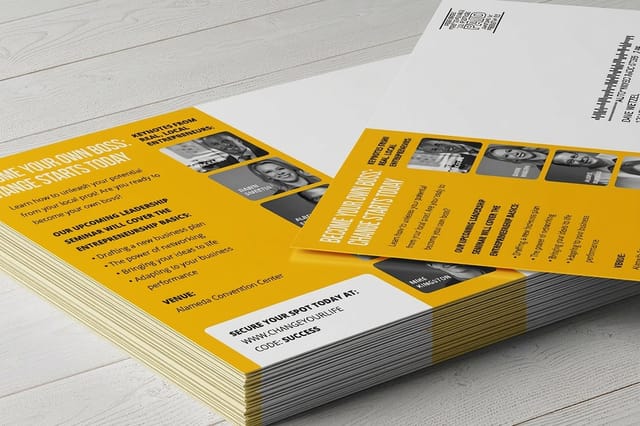
Finish changes both look and behavior. Gloss lifts photography and color and shows fingerprints, which is fine on a piece meant to be read once. Matte reads calmly in the hand and photographs poorly, which suits a service offer with little imagery. Uncoated takes pen ink, so choose it when a name, a date or a handwritten line is part of the plan. For anything that needs to survive weeks on a fridge, a folded direct mail brochure on heavier stock outlasts a single card.
Which shape suits your business
The right campaign depends far more on your travel radius and your ticket size than on your industry, but these are the patterns that repeat.
- Restaurants and takeaways. A menu that stays on a fridge beats four discount cards that do not. Print a folded brochure, mail a small route set often, and let recognition do the work.
- Home services. Season ahead reminders on flyers, sent to the routes you already service. Your van has been on those streets, so the name is half familiar before the piece lands.
- Dental and medical practices. Saturate the three or four routes inside a realistic travel radius. Nobody drives across a city for a check up, so a wide drop mostly buys waste.
- Retail and new openings. Two drops on the closest routes, one before opening and one the week after. The second is the one that produces the visits.
- Professional services and B2B. Skip EDDM. Twenty to two hundred addressed letters, First Class, followed by a call the next week, will outperform any route buy in this category.
Two more reads worth the time before you commit a budget: postcard marketing that converts for the offer and layout side, and where direct mail is heading next for how it now sits alongside digital rather than against it. If your calendar is built around holidays, Labor Day marketing and direct mail ideas is a worked example of timing a seasonal drop.
Wally picks routes before he picks artwork
Fewer routes, more drops, and a piece that legally qualifies
Start with three to five carrier routes closest to your door and mail them two or three times instead of blanketing twenty routes once. Print at 6.5 by 9 inches or larger so the piece qualifies as a flat, keep the upper right of the address side clear for the indicia, add 0.125 inch bleed, and give every drop its own phone extension or coupon code so you can count what came back.
Order direct mail postcards →What to remember about direct mail and EDDM
Design decisions that hold up in a mailbox
- One offer, not four. A postcard with four offers gets read as a list of prices. One offer with a deadline gets read as a decision. Save the second offer for the second drop.
- Keep the indicia corner empty. Upper right of the address side belongs to USPS. Design around it from the first layout instead of moving a headline the day before the drop.
- Make the deadline a range. Marketing Mail delivery is not guaranteed to the day, so print a window such as through the end of the month. A named Saturday will burn you eventually.
- Put the phone number twice. Once large near the offer and once small near the address block. People fold, cut and pin these pieces, and the number needs to survive it.
- Print one and post it to yourself. Handle the real piece before you commit thousands. Stock weight, color under household light and how it reads face down in a stack all show up only on the finished card.
Explore more
More ways to print and mail
A mailed postcard costs $0.18 at 500 and an addressed letter $0.48, which is the whole trade-off.
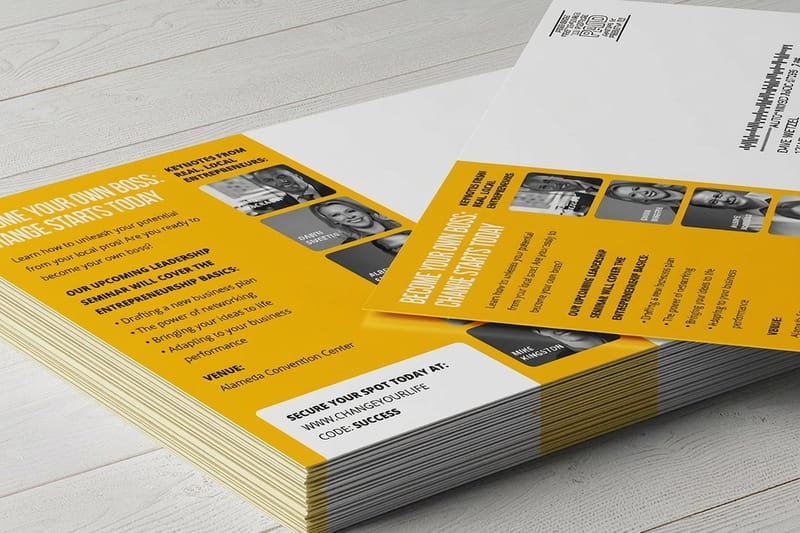 Product Direct Mail Postcards EDDM sizes from 6.5 by 9 up, printed on stock that survives a bundle.
  Product Direct Mail Flyers Full page pieces for menus, checklists and price lists.
 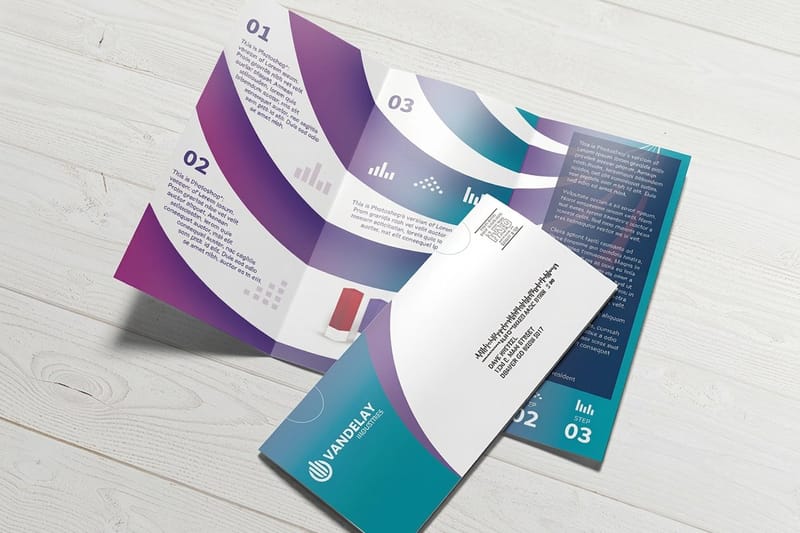 Product Direct Mail Brochures Folded pieces that get kept instead of binned.
  Product Direct Mail Letters Addressed letters for named accounts and your own list. Category Direct Mail Printing and Mailing Print, bundle and mail handled in one place.
  Guide EDDM Postcard Sizes Every size that qualifies for simplified postage, and the ones that do not.
 Ready to plan the drop?
Pick the size that qualifies, print it on stock that survives the bundle, and 4OVER4.COM turns it around fast enough to hit your in home week.
Common questions about EDDM and direct mail
Can I mail a 4 by 6 postcard with EDDM?
No. EDDM carries flats, and a piece only counts as a flat if it is longer than 10.5 inches, taller than 6.125 inches, or thicker than 0.25 inches. A 4 by 6 card fails all three, so USPS treats it as a letter and it has to be addressed and stamped like any other letter mail. The smallest size that qualifies in practice is 6.5 by 9, which is why that size dominates EDDM campaigns. If you already have 4 by 6 artwork, the fastest fix is to rebuild it at 6.5 by 9 rather than argue at the counter.
Do I need a mailing permit to run an EDDM campaign?
Not for EDDM Retail, which is the version most small businesses use. You select routes in the USPS online tool, bundle the pieces in stacks of 50 to 100 with facing slips, complete the postage statement at the counter and pay there, with a cap of 5,000 pieces per ZIP code per day. Above that cap, or if you want to drop at a bulk mail entry unit rather than the local Post Office, you need a permit. For a first campaign covering a handful of routes, the Retail path is almost always the right one.
How many carrier routes should a first campaign cover?
Fewer than you want to, mailed more times than feels necessary. Three to five routes closest to your door, hit two or three times, will teach you more and produce more calls than a single drop across twenty routes for the same money. Frequency is what turns an unfamiliar name into a familiar one, and the third piece is usually the one that gets read rather than sorted. Once a route has proven it responds, expand outward from it rather than starting again somewhere new.
How long after I drop the mail does it land?
USPS handles EDDM as Marketing Mail, which is not date guaranteed and moves more slowly than First Class. Plan on several days between the counter and the route, and build the calendar backwards from the week you want it in home rather than the day. That means printing early, allowing transit time to you, and leaving slack before the offer window opens. The practical rule is simple: never print a deadline that depends on delivery landing on one specific day.
How do I tell whether the campaign actually worked?
Give each drop its own trackable handle before it prints. A dedicated phone extension, a URL with a route suffix, a coupon code, or a line asking the caller to mention the card. Write down responses on the day they arrive rather than reconstructing the quarter later. Then judge the result over about six weeks, because saturation mail produces a cluster in the first ten days and a long trickle afterwards, and pieces people keep, such as menus and price lists, generate calls months later with no obvious trigger.
