
T-Shirt Design Ideas for Business Branding That People Wear


Marcus is our print marketing voice, built from the knowledge of our production team, with over 20 years in printing.
Business tshirt designs that actually get worn carry one readable thing inside the 8.5 by 11 inch print area: a chest mark, one graphic, or one line worth reading. Print the logo, the phone number, the website and a tagline together and you have made a walking flyer, and walking flyers stay in the drawer. Upload a 300 DPI PDF, JPG or PNG with the text outlined, approve the free online proof, and standard production takes 5 business days.
Business shirt ideas at a glance
| Industry | The idea | Where it prints | Shirt color | Product at 4OVER4 |
|---|---|---|---|---|
| Trades and field service | Company mark on the chest, phone number across the back | Small chest mark plus large back panel | Black shirt, one bright ink color | Premium T-Shirts |
| Cafes and food trucks | One illustrated icon, no address, no phone | Centered front, roughly 7 inches wide | White shirt, full color art | Custom T-Shirt Printing |
| Gyms and studios | Class name or challenge date as the graphic | Full front, fills the window | Black shirt, single accent color | Vinyl T-Shirts |
| Events and conferences | Staff shirts with a role word big enough to read at 20 feet | Back panel, chest mark on the front | Black shirt for staff, white for guests | Silk T-Shirts |
| Schools, camps and clubs | One design, one color, printed across a whole roster | Centered front | White shirt, bold flat color | Kids T-Shirts |
Every row uses the same fixed 8.5 by 11 inch print area on a white or black shirt, printed full color on the front, the back or both, in sizes Small to 2XL, so the difference between them is composition, not equipment. One shirt costs $21.96 and 25 cost $372.21. You can build a premium t-shirt order straight from the configurator and see the per shirt price fall as the quantity climbs.
Why a branded shirt outworks a printed handout

A flyer gets one look. A shirt gets worn on a Saturday, in a supermarket queue, at a kid’s football match, and every one of those is a person seeing your name without being handed anything. That is the whole argument, and it only holds if the shirt is good enough that somebody puts it on by choice.
The economics are easy to check. A single printed shirt is $21.96, 25 shirts cost $372.21, about $14.89 each, and the price per shirt drops toward $10.98 as a run climbs to 250, so a team of twenty costs less than most single-week local ad buys and the shirts keep going for a couple of years. Compare that to business cards, which are cheaper per piece but only work when you are in the room to hand one over.
The catch is that a bad shirt costs the same as a good one. Print a logo, a URL, a phone number and a tagline on one chest and you have made a walking flyer, and walking flyers live in the bottom of a drawer. Everything below is about making the other kind.
We printed the crew shirts with just the logo on the chest and the trade on the back. Two of my guys asked for spares to wear at weekends, which never happened with the old ones that had the whole phone number on them.
Marcus T., contractor
What a shirt actually costs per wear
Take a twenty shirt run for a team. At the tier pricing on the product page that is a few hundred dollars, and if each shirt is worn once a week for a year, you are paying cents per day of exposure per person. Nothing else in a small marketing budget behaves like that.
The number only works if the shirts survive. Cheap decoration cracks after ten washes and the shirt gets retired, which triples the real cost. That is why the printing method and the wash instructions matter more than the artwork on a spreadsheet.
When a shirt is the wrong choice
If your message changes every quarter, do not print shirts. Apparel is a slow medium and you will be stuck with a box of last season’s offer. Print promotional products with a shorter life instead, or put the offer on something disposable.
Shirts also fail when the audience will not wear your category. A funeral home, a debt collector, a fertility clinic: the branding is not something a customer wants on their chest, and a giveaway shirt in those industries reads as tone deaf. Internal staff shirts still make sense; public giveaways do not.
Design ideas that earn their place, by industry
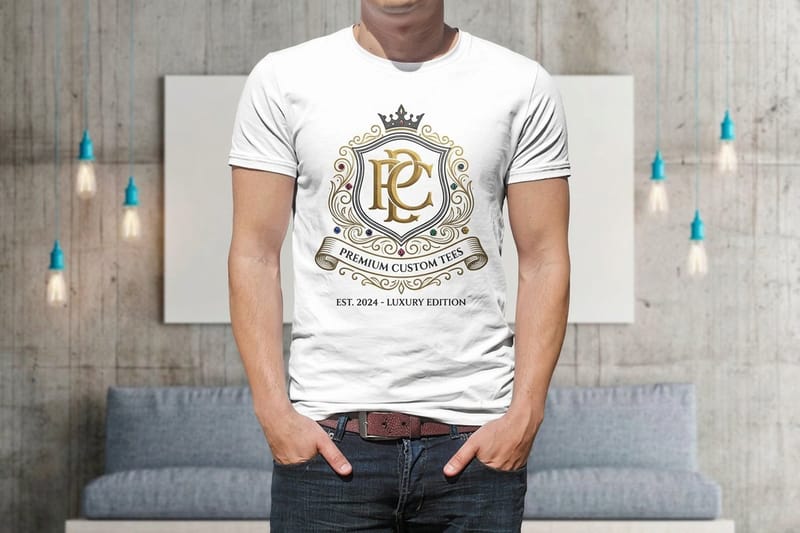
The ideas below are grouped by trade because what reads as normal on a barista reads as strange on a plumber. Each one is built around a single decision: what is the one thing a stranger should be able to read from six feet away.
All of them fit inside the same 8.5 by 11 inch print area, on a white or a black shirt, which is what you get across the whole t-shirt range. Working inside a fixed window is a constraint worth respecting from the first sketch rather than discovering at proof stage. For shirts planned around an occasion rather than a trade, such as a family reunion, a charity walk or a school club, see our shirt ideas for teams, events and fundraisers.
Trades, service and field teams
1. Chest mark, back panel. Logo at about 3.5 inches on the left chest, and the trade plus the town across the back in one heavy line. Customers read the back while your crew is bent over a job, which is exactly when they are deciding whether to ask for a card.
2. Role words, not job titles. Print INSTALL, SURVEY or SERVICE across the shoulders instead of a name. It is useful on site, it looks organized to the client, and it does not need reprinting when someone leaves.
3. The tool as the graphic. A single line drawing of the tool of the trade, big and centered, with the company name small underneath. It reads as a shirt first and an advert second, which is why people wear it off the clock.
4. Safety colors used honestly. If the crew already wears high visibility, keep the printed shirt as the under layer and put the mark where a vest does not cover it, which usually means the sleeve area or high on the chest rather than the belly.
Retail, hospitality, fitness and events
5. One icon, no contact details. A cafe or a food truck should print the icon and the name, nothing else. The address is on the building. This is the single most common upgrade we see between a first order and a reorder.
6. A date that dates well. For an event or a challenge, print the year and the event name, not the full date. A shirt that says a specific Tuesday in March stops being wearable in April.
7. Staff shirts that answer a question. At an event, the back of the shirt should say the thing people keep asking: ASK ME, ENTRANCE, or the stall number. It saves your team a hundred conversations.
8. One design across a whole roster. For a school, a camp or a club, print one design in one color across every size. Kids t-shirts and adult shirts share the same 8.5 by 11 window, so a single artwork file covers coaches and players in the same order.
9. The inside joke. A phrase only your customers understand outperforms a logo every time, because wearing it is a small act of belonging. It is also the hardest to brief, so let a member of staff write it.
Logo placement that looks good
Placement is where most first orders go wrong, and it is the cheapest thing to fix. Our print area is a fixed 8.5 by 11 inch window on the front, the back, or both, so a chest logo is not a separate print position. It is a small mark sitting in the top corner of that same file.
Three placements cover almost every business shirt. A chest mark at about 3.5 inches wide, sitting in the upper area of the window, reads as a uniform and stays out of the way. A centered front graphic between 7 and 11 inches wide is the one people wear socially. A back panel carries the line you want read from behind, which for a service business is usually the trade and the town.
The measurement that catches everybody is that the window does not grow with the shirt. Fill it on a Small and the design covers most of the chest. The same file on a 2XL leaves several inches of bare fabric around it. Decide which size the majority of your run will be, and judge the free online proof against that size rather than against the artboard on your screen.
If you want placement conventions for other garments, the screen printed polos guide covers left chest sizing on a collared shirt, and the printed sweatshirts guide deals with the extra bulk a hood and a pouch pocket introduce.
Color and fabric choices
We stock two shirt colors, white and black, in five adult sizes from Small to 2XL. That sounds restrictive until you notice it removes the decision that wastes the most time in a first order, and it makes the artwork question simple: does the design need a light background or a dark one.
| Shirt color | What it suits | Where it costs you |
|---|---|---|
| White shirt | Full color art, photographs, gradients, light backgrounds | Anything white in the file prints as nothing, so a white outline or a white logo vanishes into the fabric |
| Black shirt | Bright flat colors, single accent designs, bold type | Dark inks lose contrast, and fine mid tone detail flattens out more than it does on white |
The rule people learn the hard way is about white. On a white shirt there is no white ink laid down, so any white element in your file simply shows the fabric. A reversed logo, a white keyline, a white drop shadow: all of them disappear. If your mark only exists in a white version, order black shirts or supply a dark version of the artwork.
Within the range the differences are about how the color sits rather than what the shirt is. Vinyl t-shirts suit a bold flat graphic on a dark shirt, silk t-shirts keep a run of staff shirts looking consistent shirt to shirt, and premium t-shirts are the default for a full color design. All three share the same print area, the same two shirt colors, and the same five sizes.
Print it
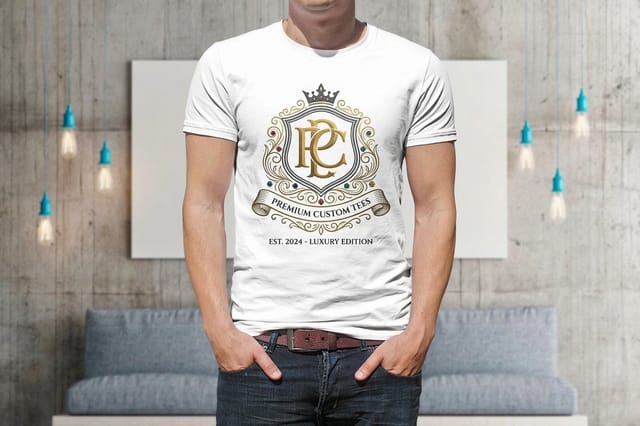
Premium t-shirts, front and back
Full color inside an 8.5 by 11 inch area, white or black, Small through 2XL.
Fabric behaves the same way across the range, so the real durability question is how the shirt is washed rather than which product you pick. Cold wash, inside out, and no tumble dryer on high heat will keep a printed shirt looking right for a couple of years. Print those three lines on the packing note when you hand shirts to a team and you will get a noticeably longer life out of the run.
If the shirts are part of a wider giveaway, keep the same mark across the other pieces. Canvas tote bags, shown in our canvas tote bags story, and printed mugs use the same artwork with different proportions, and the mug design guide explains where a wrap changes what fits. Both mug sizes sit in our custom mugs range.
Common design mistakes
These are the six that come back on proofs most often. Five of them are caught in ten minutes before you upload.
- Cramming the window. Filling all 8.5 by 11 inches because it is available. A graphic that big becomes a panel rather than a design, and it looks heaviest on the smallest shirt in the run.
- Printing the whole business card. Logo plus phone plus URL plus tagline. Pick one. The shirt is a reminder, not a directory, and the extra lines are what make it unwearable.
- Live text in the file. Type that is still editable can reflow or substitute a font on another machine. Convert it, using our guide to converting text to shapes in Illustrator, before you upload.
- Low resolution art. A logo pulled from a website is usually 72 DPI and about 300 pixels wide. Printed at 8 inches it turns to mush. Supply artwork at 300 DPI at the printed size.
- White on white. A white or very light element on a white shirt has nothing to print with. Check every light part of the design against the shirt color before the proof.
- Ignoring the size spread. The print area does not scale, so a design that looks right on a Medium looks small on a 2XL. Decide which size matters most and judge the proof against that one.
Ordering your custom shirts
Pricing moves with quantity and print position, and the per shirt cost drops steeply as the run grows. The table below comes from the live configurator, so you can size the budget before you commit.
Quantity and price
T-shirt pricing and specs
Real configurator numbers on premium t-shirts, where the more shirts you order the lower the per shirt cost falls.
| Quantity | Price Per Unit | Total |
|---|---|---|
| 1 | $21.96 | $21.96 |
| 2 | $16.47 | $32.93 |
| 3 | $16.46 | $49.39 |
| 4 | $15.93 | $63.71 |
| 5 | $15.93 | $79.63 |
| 6 | $15.93 | $95.56 |

Ordering is four decisions: shirt color, size spread, print position, and quantity. Take the free online proof unless the deadline genuinely will not allow it, because the proof is where a substituted font or a light element on a light shirt gets caught. Standard production is 5 business days from approval, so count backwards from the date you need the shirts in hand.
You also earn coins on every order, redeemable against future printing, which is worth having if shirts are going to be a repeat line rather than a one off.
Start fast
Print-ready blanks for t-shirts
Exact size blanks so your artwork lands inside the print area on the first upload.
Browse the wider blank template library for the rest of the catalog, or start from a layout in the design template collection if you would rather adapt something than draw from scratch.
Wally sizes the logo before the shirt gets printed
One readable thing, inside a fixed 8.5 by 11 inch window
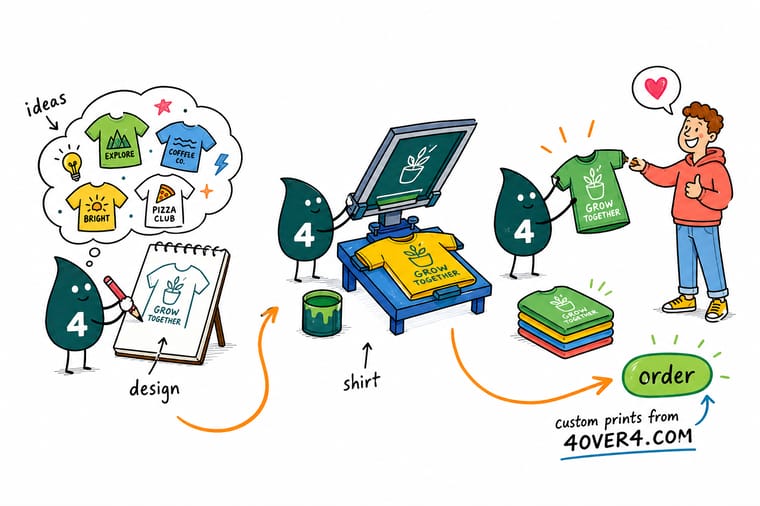
Put a 3.5 inch mark on the chest or one graphic up to 11 inches tall, supply the art at 300 DPI with the text converted to outlines, and pick black shirts if anything in the design is white. Check the free online proof against the size most of your team wears, because the print area is identical on a Small and a 2XL.
Order custom t-shirts →What the 8.5 by 11 print window decides
Explore more
More ways to print and promote
Premium and silk t-shirts both run 1 for $21.96 in 5 business days, the same as the kids shirt.
Product Premium T-Shirts Full color front, back or both, white or black, Small to 2XL. Product Custom T-Shirt Printing The base shirt, full color, front, back or both sides.  Product Silk T-Shirts Even, repeatable results across a run of matching staff shirts.
  Product Kids T-Shirts One artwork file across a whole roster of younger wearers.
  Product Canvas Tote Bags The giveaway that pairs with a shirt at an event table.
  Category T-Shirt Printing Every shirt option, size and print position in one place.
  Article Shirt Ideas by Occasion Reunion, fundraiser, club and slogan shirts with the layout for each.
  Article Promotional T-Shirt Ideas Giveaways, merch drops and event tees people keep.
 Ready to print your shirts?
Pick white or black, set the size spread, upload your artwork or start from a blank, and 4OVER4.COM prints it full color with a free proof before press.
Common questions about business t-shirts
How big should a company logo be on a t-shirt?
A chest mark works at about 3 to 4 inches wide, and a centered front graphic usually lands between 7 and 11 inches wide depending on how loud you want it. At 4OVER4.COM the whole design sits inside a fixed 8.5 by 11 inch print area, so those are the practical limits. The number that catches people out is the size run: the print area is identical on a Small and on a 2XL, so a graphic sized to look right on a Medium reads small on the biggest shirts in the same order. Pick the size most of your team wears and judge the free online proof against that one.
Should I order white shirts or black shirts?
White if your artwork is full color, photographic, or contains any white elements. Black if the design is one or two bright flat colors and you want it to look sharper than the shirt around it. The trap is white artwork on a white shirt: white in your file is simply not printed on a white tee, so a white outline or a reversed logo vanishes into the fabric. We only stock white and black, which makes the decision quicker than it sounds, and a lot of teams order both and let staff choose.
What file should I send for t-shirt printing?
A print-ready PDF, JPG or PNG at 300 DPI at the size it will print. Convert live text to outlines first so a font cannot substitute itself on another machine. Do not send a logo pulled off your website: those are usually 72 DPI and a few hundred pixels wide, which is fine on a screen and unusable at 8 inches across a chest. If you are starting from nothing, take a print-ready blank from the blank template library, drop your artwork in, and you will already be inside the correct print area.
How long does a custom t-shirt order take?
Standard production is 5 business days once the artwork is approved, plus shipping. If you choose the free online proof, the clock starts when you approve it rather than when you upload, so approve promptly if the date is tight. For an event, work backwards from the day you need shirts in hand and add a few days of slack, because a proof that comes back needing a fix is the usual reason an order lands late.
Is it cheaper to print one design in bulk than several designs?
Yes, and it is usually the biggest saving available. Pricing steps down with quantity, so 100 shirts of one design costs considerably less per shirt than four batches of 25 different designs. The practical version for a business is one shirt design across the whole team, with the variation coming from shirt color rather than artwork. If you genuinely need departments to look different, change the shirt color and keep the file identical.
