
Travel Agency Print Marketing Ideas That Book More Trips


The print that books trips is short and repeatable: a postcard carrying one destination and one departure month, a brochure a household can leave on the kitchen table, and a business card handed over at the end of every consultation. Mail your past clients first, time the drop to the booking window rather than the travel season, and keep the destination and the starting price in the top four inches of anything that sits in a rack.
Travel print formats at a glance
| Format | The job it does | Where it goes | Sensible run | Price at 4OVER4 |
|---|---|---|---|---|
| Travel brochures | Carry the itinerary, the photography and the detail a family argues over | Mailed to a warm list, racked in the office, handed out after a consultation | 250 to 1,000 | From $57.11 |
| Travel postcards | One offer, one date, nothing to open | Seasonal mailings to past clients and lookalike neighborhoods | 500 to 2,500 | From $16.48 |
| Travel flyers | Announce one group departure or one event | Bridal shows, community boards, hotel and gym counters | 250 to 1,000 | From $39.54 |
| Travel agent business cards | Close the consultation and travel home in a wallet | Every meeting, every event, two at a time | 500 minimum | From $17.57 |
| Perfect bound tour catalog | Hold a whole season of itineraries in one book | Top clients, the waiting room, supplier meetings | 100 to 250 | From $375.05 |
Run sizes assume a piece that names a departure date. If the content stays valid all season, order deeper and take the quantity break. Browse everything side by side in the travel printing collection.
Why print still books trips when a website does not
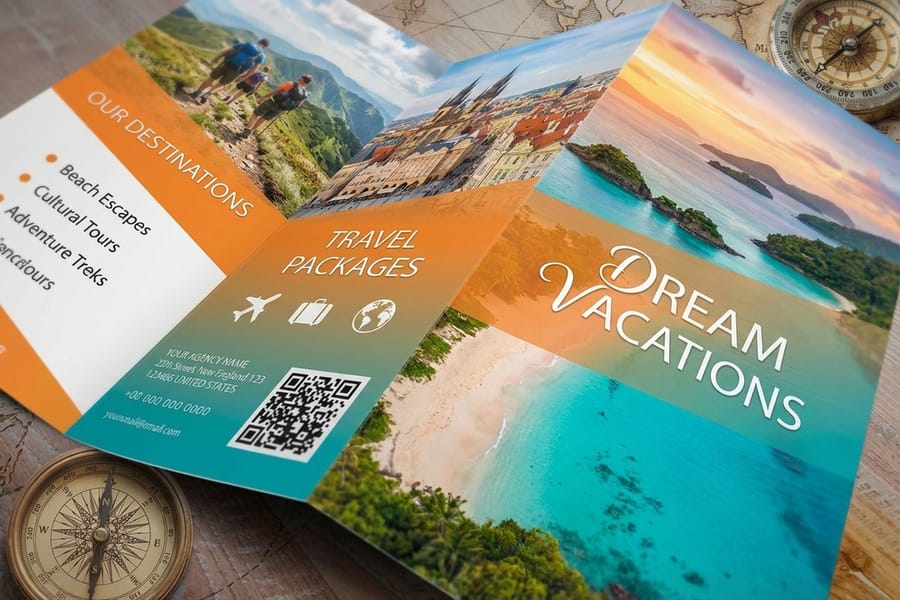
A vacation is a slow, shared decision. Two or three people in a household have to agree on a destination, a budget and a set of dates, and that conversation happens over a week or a month, usually at the kitchen table. An email is read alone and gone in seconds. A brochure sits on the counter, gets picked up by the other decision maker, and is still there on Sunday when someone finally says yes.
That is the whole mechanism, and it explains where print wins and where it does not. Print is strong on considered, high-ticket, multi-person purchases with a long decision window, which describes almost every trip worth a commission. It is weak on anything urgent.
Be honest about the limit. A distressed cabin that has to sell in nine days will be gone before the mail lands, and you cannot A/B test a postcard the way you test a subject line. Print buys you presence in the house, not speed. Run the urgent inventory through email and social, and spend the print budget on the destinations you sell every year.
The list matters more than the piece
Your past clients are the only list that reliably pays back a mailing. They have already trusted you with a deposit, they know what you charge, and they travel on a rhythm. Mail them first, mail them more often than feels comfortable, and only then buy a cold list.
A practical order for a first year of print: everyone who has booked with you, everyone who requested a quote and did not book, then a geographic list around the offices or neighborhoods that produced those two groups. Each step down costs more per booking than the one above it.
What to measure when there is no click
Give every piece its own way of being traced. A distinct phone extension, a short vanity URL, a code the client has to mention, or a QR that lands on a page built for that offer and nothing else. Then count bookings against the run, not responses against the run, because a travel campaign that produces four calls and two cruises has done its job.
Keep one number: cost per booking. At $57.11 for a run of brochures, a single family booking covers the print several times over, and that arithmetic is what tells you whether to repeat the mailing or change the offer.
The formats that pull, and what each one is for
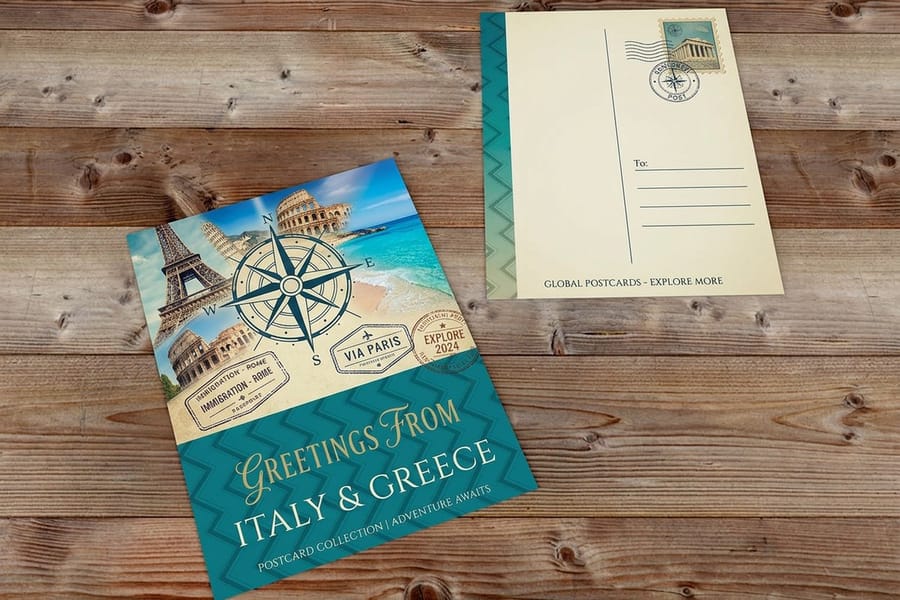
Five formats cover almost everything a travel agency needs. Each one does a different job, and using the wrong one is the most common way a campaign quietly fails.
Travel brochures from $57.11 carry detail. Travel postcards from $16.48 carry one message and cannot be ignored, because there is no envelope between your offer and the reader. Travel flyers from $39.54 announce a single departure. Travel agent business cards from $17.57 finish a conversation. A perfect bound book from $375.05 holds a full season of itineraries when you have enough of them to justify a spine.
Brochures: design for the rack, then for the mailbox
A standard literature rack only shows the top portion of the panel, roughly four inches. Everything below that is hidden by the pocket in front. If your destination name, the season and the starting price are not in that band, the brochure is invisible in a rack even though it looks fine flat on your desk.
Fold choice follows content. A tri-fold letter sheet gives you six panels and folds down to about 3.7 by 8.5 inches, which drops into a rack pocket and into a number 10 envelope. A half-fold gives you four larger panels and suits big photography and a single itinerary. If you are mailing brochures in envelopes, our guide to full color envelope sizes shows which envelope takes which fold without a jam.
Panel order is not decoration. Panel one earns the pick-up, the inside spread carries the day-by-day and the photography, and the back panel carries the price, the inclusions, the deposit terms and how to reach you. Most weak brochures put the agency history where the itinerary should be.
Postcards: the size rule that decides your postage
USPS applies the postcard rate only to pieces between 3.5 by 5 and 4.25 by 6 inches. A 5 by 7 card is a beautiful piece of print and it mails at the letter rate, which on a run of 2,000 is a real number. Decide the postage tier before the designer starts, not after.
The larger card still wins sometimes. When the image is the offer, a Caribbean beach or an Alaskan glacier reproduced big enough to stop someone at the mailbox, the extra postage buys attention you cannot get at 4 by 6. Print both, mail them to two halves of the same list, and let the bookings settle the argument.
One offer per card. A postcard listing six destinations gets read as a catalog and thrown away. A postcard with one destination, one departure month and one price gets read as an invitation.
Flyers and catalogs: the two ends of the range
Flyers are for a single event or a single group departure, and they belong where your buyers already stand still: a gym counter, a church noticeboard, a bridal show table, the front desk of a hotel that does not compete with you. Print them in small runs and expect to reprint, because the departure date on a flyer expires. There are more layout ideas worth stealing in our article on creative poster ideas.
A perfect bound catalog is the opposite decision. It only makes sense once you have a season of itineraries and a client list that keeps things. Perfect binding needs enough pages to glue a flat spine, so under about 28 pages a saddle stitched book looks better and costs a fraction of the $375.05 starting price. Above that, the square spine is what makes a catalog get shelved instead of recycled.
Timing the mail date to the booking window
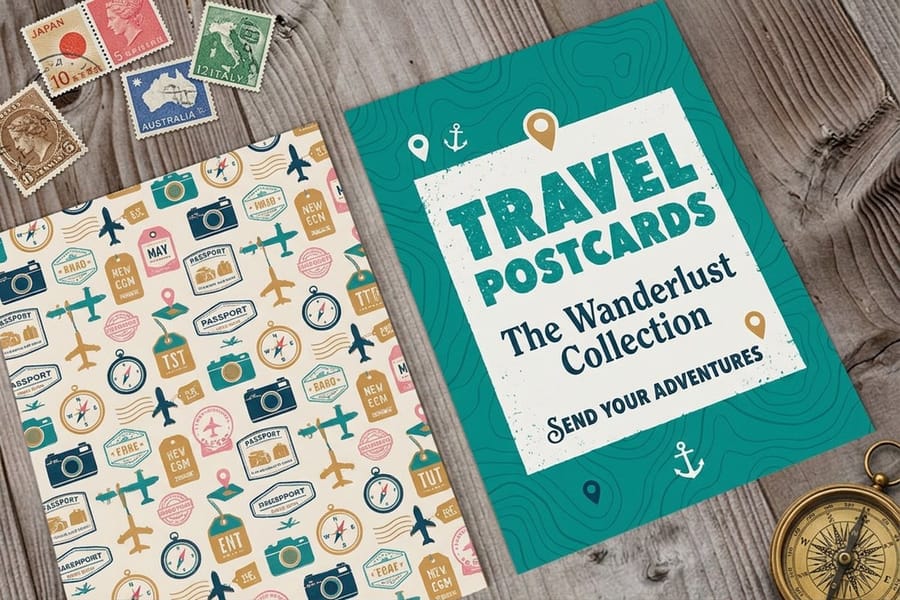
The most expensive mistake in travel print is mailing to the season instead of the booking window. Clients do not buy a winter Caribbean trip in December. They buy it while they are cold and planning, months before they fly, and by December the ones who were going to book have already booked with somebody else.
Work backward from the departure month. Long-haul, cruise and multi-generational trips are planned furthest out, so those pieces mail earliest. Domestic weekends and short-haul city breaks are decided much closer in. Summer family travel is planned around the school calendar, which means the conversation starts long before the weather does.
Then add your own production time. Allow for design, a proof, printing and mail transit before the date you want the piece in a hand, and set the drop date first so everything else has to fit behind it.
A campaign that repeats instead of one that impresses
Four modest mailings a year beat one expensive one. A brochure to past clients in early winter for next summer, a postcard for shoulder-season pricing, a flyer for whichever group departure you are filling, and a holiday card that sells nothing at all. That last one is the piece clients mention back to you.
Keep the format and the layout stable and change only the destination and the offer. Consistency is what makes a mailbox recognize you, and it also means your design cost is spent once instead of four times. The same campaign math applies in other service businesses, and our catering marketing guide works through it with different numbers.
Where door hangers fit, and where they do not
Door hangers are a neighborhood tool, not a travel tool, and they work for a travel agency in exactly one case: you have a physical office and you want the streets around it to know you exist. Hand delivery skips postage entirely, which makes a tight radius cheap to cover repeatedly.
They are the wrong choice for anything requiring detail or trust at a distance. Our guide on whether door hangers are effective for marketing campaigns is honest about the response you should expect before you commit a run.
Referrals are the cheapest bookings you will ever buy
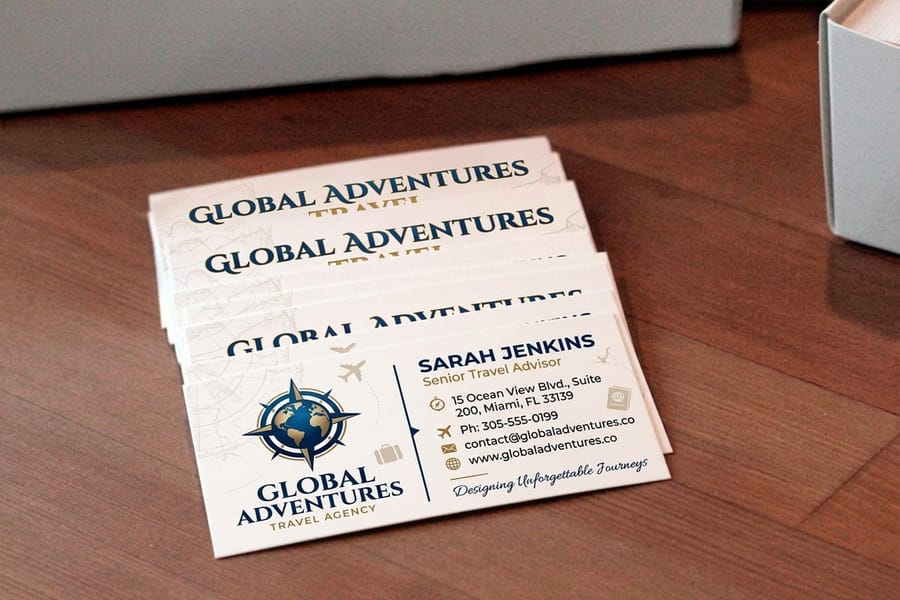
Travel is a referral business, and referrals fail for a boring reason: the happy client cannot remember your last name when a friend asks at dinner. A card fixes that for $17.57 a run.
Hand over two cards, not one, and say what the second one is for out loud. Print the back rather than leaving it blank, and use it for the one thing a friend needs to know: what you specialize in. "Cruises, Europe and multi-generational family travel" does more work than a decorative pattern.
The same logic extends to the documents clients already keep. Tuck a card into every printed itinerary, every document wallet, every welcome packet. The piece is already in their hands at the moment they are happiest with you.
Make the brand match across every piece
One typeface pairing, one accent color, one photographic style, used on the brochure, the postcard, the card and the catalog. A client who sees four pieces that look like four different agencies has no reason to remember any of them.
If you are still settling the brand itself, our article on travel agency name ideas is a useful place to start before you commit a name to 1,000 printed cards.
Brochure pricing and specs at 4OVER4.COM
Brochure pricing moves with size, fold, paper stock and quantity, and the per piece cost drops as the run grows. The numbers below come straight from the live configurator, so you can size the campaign budget before you commit artwork.
Quantity and price
Travel brochure pricing and specs
Real configurator numbers, where ordering deeper pulls the per piece cost down.
| Quantity | Price Per Unit | Total |
|---|---|---|
| 50 | $1.14 | $57.11 |
| 100 | 82.4¢ | $82.38 |
| 200 | 53.3¢ | $106.55 |
| 300 | 41.0¢ | $123.02 |
| 400 | 34.9¢ | $139.49 |
| 500 | 31.2¢ | $155.97 |

You can also earn coins on every order and redeem them against future printing, which stretches a small agency marketing budget across one more mailing a year.
Paper stock and finish for travel print
Stock is what a client feels before they read a word. For brochures with heavy photography, a coated book stock holds saturated color without the ink soaking in, and 80 lb gloss book is the common choice for folded pieces because it takes a fold cleanly at that weight. Our guide to 80 lb gloss book paper covers where it works and where a heavier cover stock is worth the money.
Print it
Travel brochures, ready to fold
Preset sizes and folds on coated stock, priced live in the configurator.
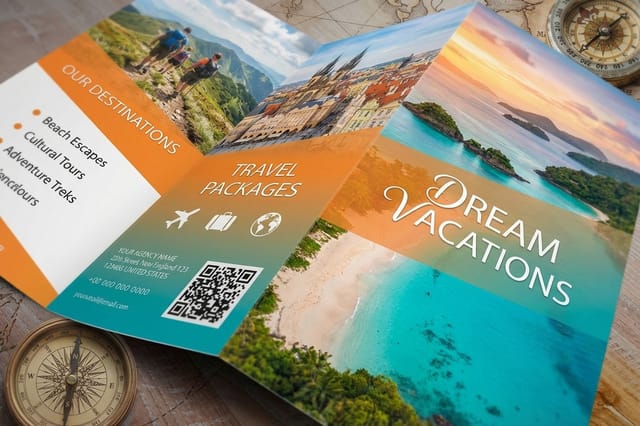
Finish changes both look and behavior. Gloss lifts destination photography and resists fingerprints, which matters on a piece passed around a table. Matte cuts glare and is easier to read under office lighting. Uncoated stays writable, so an agent can add a departure date or a price by hand at the counter. On business cards, a heavier card carries more authority in a handshake than any design choice on its face. When artwork is ready, our guide to creating commercial print ready files covers bleed, resolution and color mode before you upload.
Print ideas by agency type
Different travel businesses sell different decisions, so the format that pays back changes with the specialty.
- Cruise specialists. Brochures carry deck plans and cabin categories that a postcard cannot. Mail early, because cruise clients plan the furthest ahead of any traveler you serve.
- Luxury and honeymoon agents. Fewer pieces, heavier stock, bigger photography. A half-fold brochure on a thick sheet reads as expensive before a single word is read.
- Group and faith-based tour operators. Flyers for each departure, a perfect bound catalog for the whole season, and enough business cards that every group leader can hand them out for you.
- Corporate travel managers. Skip the destination photography. A clean capabilities brochure with service levels, response times and escalation contacts wins the meeting.
- Home-based independent agents. Postcards to past clients plus business cards, and nothing else until the referral loop is running. It is the lowest fixed cost route into print marketing.
- Destination and adventure specialists. One destination per piece, priced and dated. Specialists lose bookings by trying to look general on a page with room for one idea.
If you build campaigns around the calendar, the seasonal angles in our article on fall marketing ideas translate directly to shoulder-season travel offers, and the referral mechanics in 19 physical therapy marketing ideas work the same way in a business where clients recommend you by name.
Brochure blanks with the folds marked
If you are not starting from scratch, templates save a round of proofs. 4OVER4.COM sizes its blanks to exact product specs, with bleed and fold marks already in place, so the artwork lands inside the cut line. Grab a print ready blank from the blank template library before your designer starts.
Start fast
Brochure blanks with the folds marked
Brochure design templates and exact size blanks with bleed and trim marked.

Wally plans a travel mailing that arrives on time
Pick the format for the decision, then set the drop date first
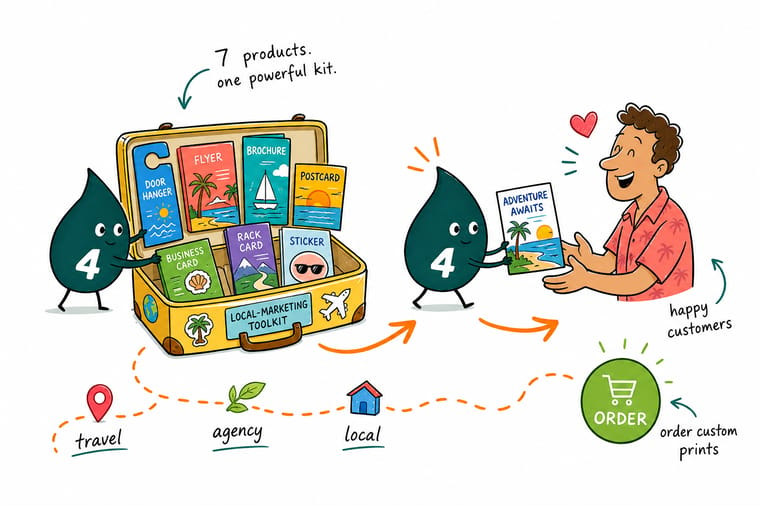
Use a postcard between 3.5 x 5 and 4.25 x 6 inches to stay on the USPS postcard rate, a tri-fold brochure when the itinerary needs six panels, and keep the destination and starting price in the top four inches for the rack. Mail past clients first, time the drop to the booking window rather than the travel season, and 4OVER4.COM prints and proofs it in time for the date you set.
Order travel brochures →What to remember about travel print marketing
Design tips that hold across every format
- Put the price where the fold hides nothing. A starting price on a hidden panel might as well not be printed. Keep it on the front or the back, never buried in an inside fold.
- Use your own photography where you can. Stock images of a beach look like every other agency because they usually are the same beach. A photo you took on a site inspection is proof you have been there.
- One offer per piece. A brochure can hold an itinerary. A postcard holds one destination, one month and one price. Adding a second offer halves the first one.
- Set up the file properly the first time. Full bleed, 300 DPI, CMYK, and the fold marks where the folder expects them. Our print-ready file guide walks through it before you send artwork.
- Leave the top four inches alone. On anything that goes in a rack, the top band is the only part anyone sees. Destination, season, price. Nothing else.
Explore more
More ways to print and promote
Travel brochures run 50 for $57.11 and a perfect bound book 10 for $375.05, which is $37.51 a copy.
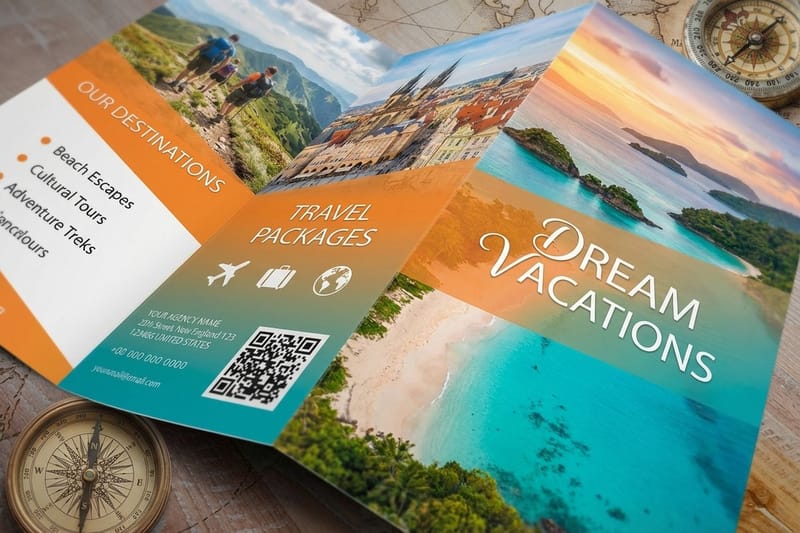 Product Travel Brochures Folded panels for itineraries, photography and pricing.
 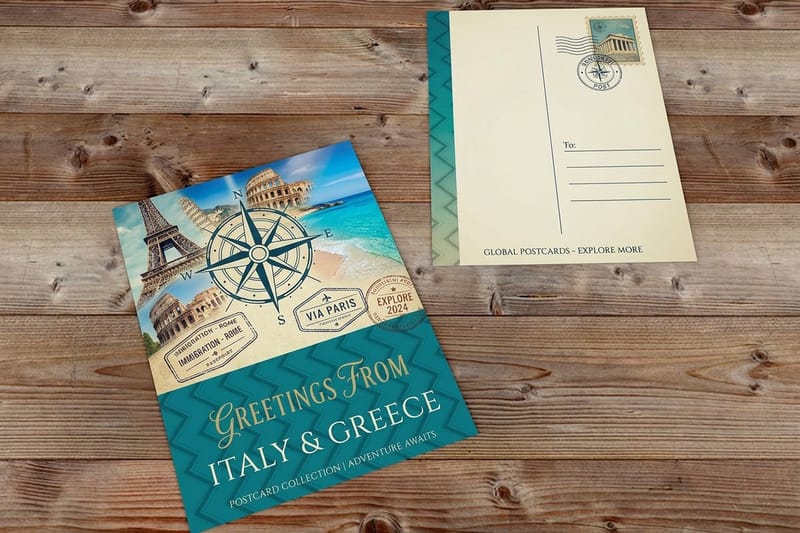 Product Travel Postcards One offer, one date, no envelope to open.
 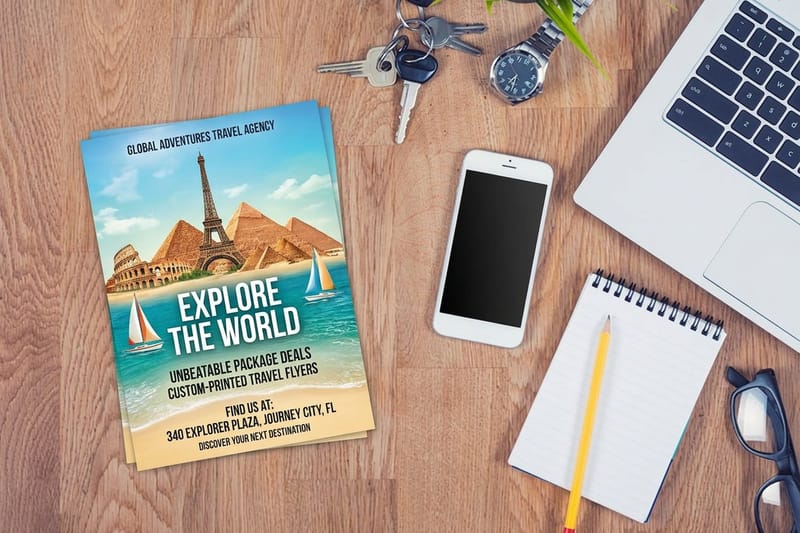 Product Travel Flyers Single-departure and event handouts in short runs.
  Product Travel Agent Business Cards The piece that makes a referral findable.
 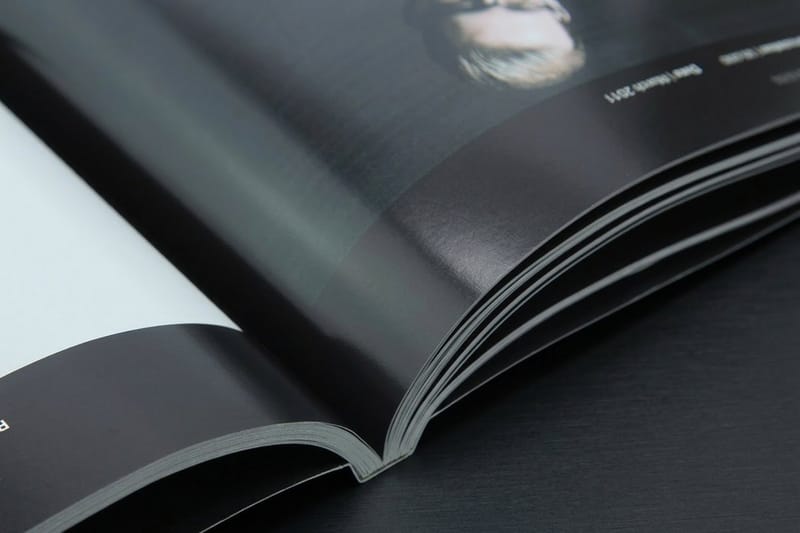 Product Perfect Bound Book A square spine for a full season of itineraries. Category Travel Printing Every travel print format in one place.
  Article 100 Travel Agency Name Ideas Settle the name before you print 1,000 cards.
  Guide Are Door Hangers Effective? What a neighborhood drop really returns.
 Ready to print your next travel campaign?
Pick the format, upload your artwork or start from a free template, and 4OVER4.COM prints it sharp on coated stock in time for your drop date.
Common questions about travel print marketing
What is the best print piece for a travel agency to start with?
Postcards to your past client list, and business cards for every consultation. Travel postcards start at $16.48 and travel agent business cards at $17.57, so both together are a small first commitment, and they cover the two things that actually produce bookings: staying in front of people who have already paid you once, and being findable when one of them recommends you at dinner. Add brochures when you have an itinerary detailed enough that a card cannot hold it, which usually means a cruise, a multi-country tour or anything a family needs to discuss for a week.
When should a travel campaign mail if the trip is next summer?
Work backward from the departure month rather than the calendar season. Summer family travel is planned around the school year, which means the household conversation starts many months before the flights, and long-haul or cruise itineraries are planned further out still. Then add your own production time on top: design, a proof, printing and mail transit all sit between your decision and the piece arriving in a hand. Set the drop date first and let the rest of the schedule fit behind it, because a mailing that arrives after the decision was made is a full cost with no return.
What size should a travel postcard be to keep postage cheap?
USPS applies the postcard rate only to cards between 3.5 by 5 and 4.25 by 6 inches. Anything larger, including the popular 5 by 7 size, mails at the letter rate, and across a run of a couple of thousand that difference is real money. The larger card is still worth it when the photograph is the offer and you need it big enough to stop somebody at the mailbox. The honest test is to print both, mail each to half of the same list with a different tracking number, and let the bookings decide which size you use next time.
How many brochures should I print for a first campaign?
Between 250 and 1,000 for most independent agencies, because that covers a warm list plus the office rack and a few months of consultations without leaving you with boxes of an offer that expired. Brochure pricing steps down as the quantity climbs, which tempts people into ordering thousands of a piece that names a departure date, and a dated piece has a shelf life. If you want the volume discount, design the brochure so the destination content stays valid and put the dated offer on a separate insert or postcard you reprint cheaply.
Do I need a printed catalog, or is a brochure enough?
A brochure is enough until you are selling a full season of itineraries to clients who keep things. A perfect bound catalog starts at $375.05 and needs enough pages to glue a flat spine, so under roughly 28 pages a saddle stitched book both looks better and costs far less. The reason to move up to perfect binding is the square spine: it is what makes a catalog get shelved in an office or a home rather than recycled, which is exactly what you want from a piece that has to stay relevant for a whole selling season.
