
Standard Menu Sizes and the Exact Inches for Every Restaurant Menu


Sofia is our design and templates voice, built from the knowledge of our production team, with over 20 years in printing.
Every stock menu size in inches, what each one holds, what a fold turns it into, and how to set the file up so nothing gets trimmed off the price column.
The standard restaurant menu size is 8.5 by 11 inches. The other four sizes in regular use are 4.25 by 11, 5.5 by 8.5, 8.5 by 14 and 11 by 25.5 inches. A menu is chosen by printable area first: 8.5 by 11 gives 93.5 square inches a side, 8.5 by 14 gives 119, and an 11 by 25.5 sheet trifolded down to 11 by 8.5 gives six panels of 93.5. Menu boards and window posters have their own restaurant poster sizes. Table tents finish at 4 by 6 from a flat 4 by 16.25 sheet. Whatever size you pick, build the file with 1/8 inch of bleed on all four sides.
Quick answer
Pick the size by printable area, then check it against the table
Menu size is a capacity problem with a furniture constraint. Work out how much printable area the list needs at 10 point type, pick the smallest stock size that carries it, then confirm the finished piece fits a two top with the place settings down. The chart below draws the five sizes to one scale with the area each one gives you, which is the comparison a size chart in inches alone never makes obvious.
Standard Single Page Menu Sizes in Inches
Five sizes cover almost every dine-in menu printed in the United States. Picking between them is arithmetic before it is taste: work out how much printable area the list needs, then check the table will take it.
| Size | Printable area per side | Folds that suit it | Where it works |
|---|---|---|---|
| 4.25 x 11 in | 46.75 sq in | Flat only, in practice. | Drinks lists, wine by the glass, daily specials standing in a tent holder. |
| 5.5 x 8.5 in | 46.75 sq in | Flat, or half fold to 5.5 x 4.25. | The bistro card. Short food menus, dessert, kids menus, anything held one handed. |
| 8.5 x 11 in | 93.5 sq in | Flat, half fold to 8.5 x 5.5, trifold. | The default full food menu, and the standard takeout sheet. |
| 8.5 x 14 in | 119 sq in | Flat, or half fold to 8.5 x 7. | Longer lists that still want to stay on one unfolded page. |
| 11 x 25.5 in | 280.5 sq in | Half fold to 11 x 12.75, trifold to 11 x 8.5. | Full service menus that need courses on separate panels. |
Two things in that table surprise people. The first is that 4.25 by 11 and 5.5 by 8.5 hold exactly the same area. They are both half of a letter sheet, cut on different axes, so the choice between them is about how the eye travels rather than how much fits. A tall narrow sheet reads as a list. A wide card reads as a page.
The second is how cheap the step from letter to legal is. Going from 8.5 by 11 to 8.5 by 14 buys 25.5 more square inches a side, roughly a quarter more room, with no fold, no scoring and no new habit for the servers. Try that before you reach for a folded format. All seven stock sizes, both stocks and all three fold options sit on standard menus, and the full range lives under menus printing.
Folded Menu Sizes and What Each Panel Measures
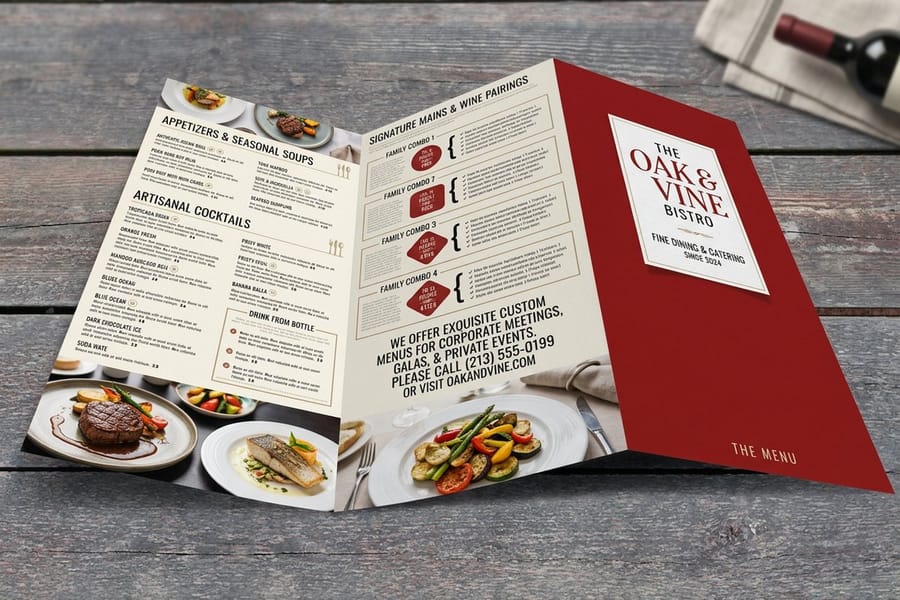
A fold does not give you more paper. It gives you more panels, and panels are what let a menu separate starters from mains without a guest losing their place. You order the flat sheet size, then tell us the fold, and the finished size falls out of that.
| Flat sheet | Fold | Finished size | Panels you can design |
|---|---|---|---|
| 8.5 x 11 in | Half fold | 8.5 x 5.5 in | 4 panels at 8.5 x 5.5 |
| 8.5 x 14 in | Half fold | 8.5 x 7 in | 4 panels at 8.5 x 7 |
| 8.5 x 11 in | Trifold | 8.5 x 3.667 in | 6 narrow panels at 8.5 x 3.667 |
| 11 x 25.5 in | Half fold | 11 x 12.75 in | 4 large panels at 11 x 12.75 |
| 11 x 25.5 in | Trifold | 11 x 8.5 in | 6 panels at 11 x 8.5 |
The last row is the one worth staring at. Six panels of 11 by 8.5 is 561 square inches of design space on one sheet, six times what a single letter side gives you, and it closes down to something a host can carry a stack of. That is the format most full service dining rooms end up with.
One detail catches designers out on any trifold. The panel that rolls to the inside has to be slightly narrower than the other two, usually by about a sixteenth of an inch, or it binds against the fold and the closed menu bows open. The paper side of that fold is covered in our guide to trifold brochure paper weights, coatings and panel math. Our prepress applies that trim, but if you are drawing your own panel guides, do not split the sheet into three mathematically equal thirds and expect the fold to sit flat. The same rule governs brochures, and our guide to brochure sizes and paper walks through the panel math in more detail. Keep at least a quarter inch of clear space either side of every fold line, and never run a price across one.
Takeout and Delivery Menu Sizes
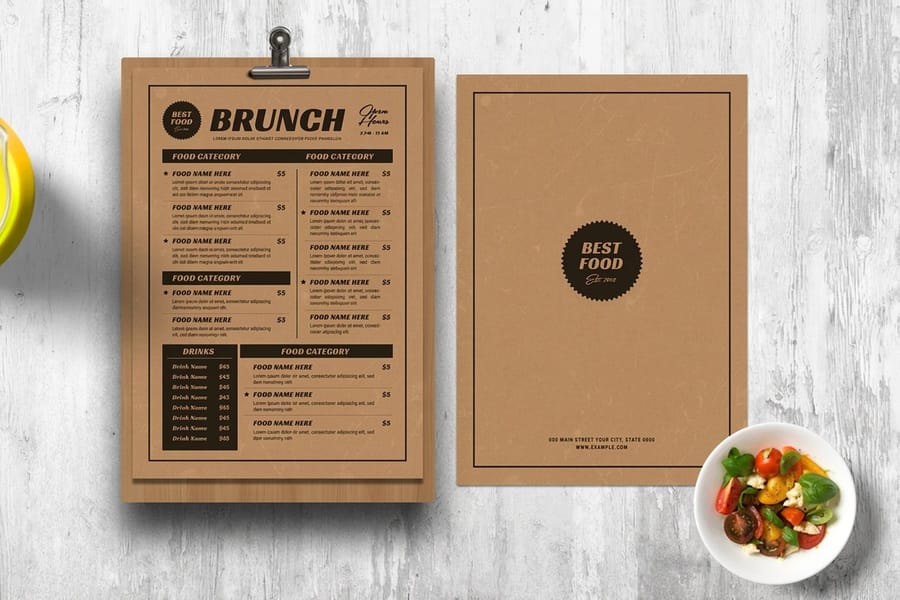
A takeout menu has a different judge. It is not read at a table, it is read on a sofa two hours later, and before that it has to survive a bag. That changes the size decision and the stock decision at the same time.
Letter, printed both sides, does most of the work. An 8.5 by 11 sheet slides flat down the side of a paper bag, staples to a clamshell lid without a driver folding it in quarters, and gives 187 square inches across two sides. When the kitchen list will not fit, go to an 11 by 25.5 trifold rather than shrinking the type; it closes to 11 by 8.5, which still lies flat in a bag. A 5.5 by 8.5 card is the size to reach for when the menu is a short list and you want one in every single order.
Stock matters more here than size. If your staff circle items, write substitutions or add a delivery zone by hand, order the 70 lb uncoated text rather than the 100 lb gloss text, because a ballpoint skates across a coated sheet and a marker beads. If the food photography is the selling point, take the gloss and accept that nobody will write on it. Matte against gloss covers how each finish behaves under a dining room light.
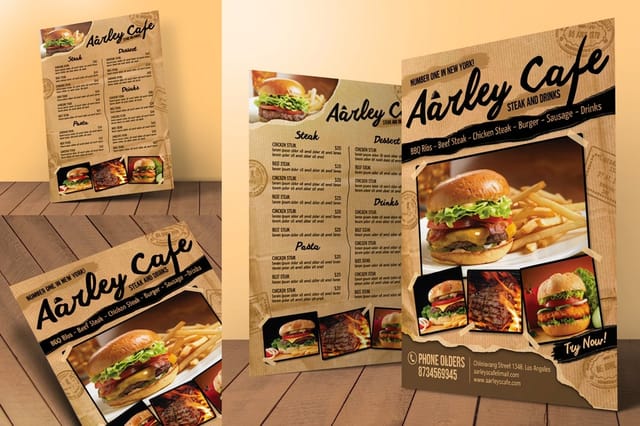
There is a third option that sidesteps both. Kraft menus print on an 18pt kraft uncoated cover made from post consumer waste, in four sizes from 8 by 10 up to an 11 by 17 tabloid, from $166.04 per 100. The brown sheet takes pen beautifully, feels like a card rather than paper in a bag, and does a lot of the branding work for a taproom or a farm-to-table kitchen before anyone reads a dish name. The kraft menus story has more on that stock.
Table Tent and Drink Menu Sizes
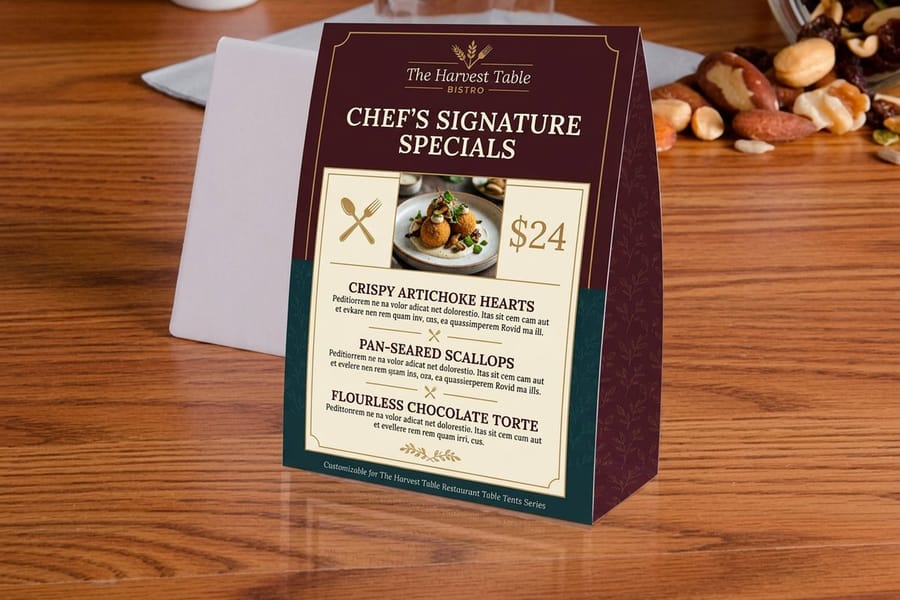
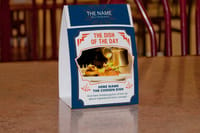
A table tent is measured twice, and the two numbers rarely match. Ours finish at 4 by 6 inches and print on a flat 4 by 16.25 inch sheet.
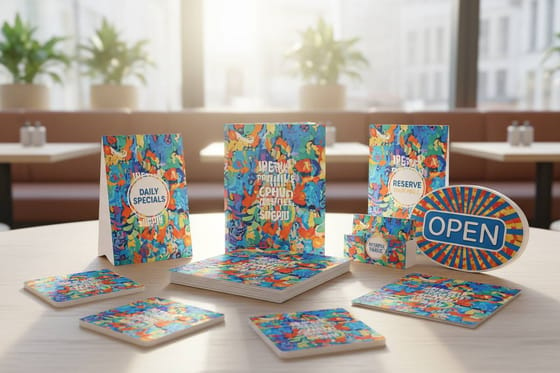
The gap between 12 and 16.25 is the whole trick. Two 6 inch faces account for 12 inches; the remaining 4.25 inches is the base flap that folds under and gives the tent a footprint, which is what lets it stand without a plastic holder and stops a passing tray knocking it over. If you are designing one, build the artwork at 4 by 16.25 with the score lines marked, not as two separate 4 by 6 faces, and remember that whatever sits in that base strip will never be seen. Table tents run on 14pt gloss cover with a high gloss UV coating, from $554.39 for 250.
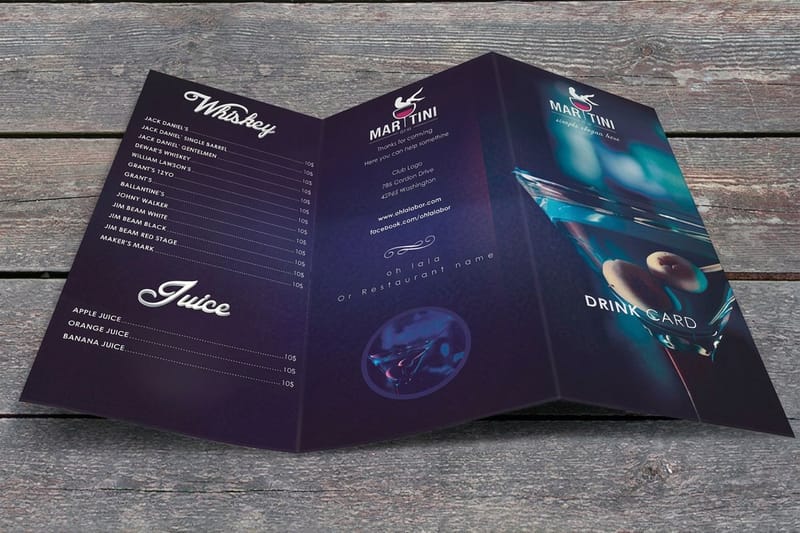
For a drinks list the answer is usually not a tent at all. A 4.25 by 11 slim menu in a simple acrylic holder shows far more of the list than a 4 by 6 face, costs a fraction of a folded tent per piece, and reprints in a day when a keg changes. Use the tent for one message with a picture, such as a dessert, a cocktail of the week, or a loyalty sign-up, and use the slim sheet for anything with more than four lines on it. Both live in the restaurant printing collection alongside the rest of the front of house pieces.
Choosing a Size by Item Count and Table Space
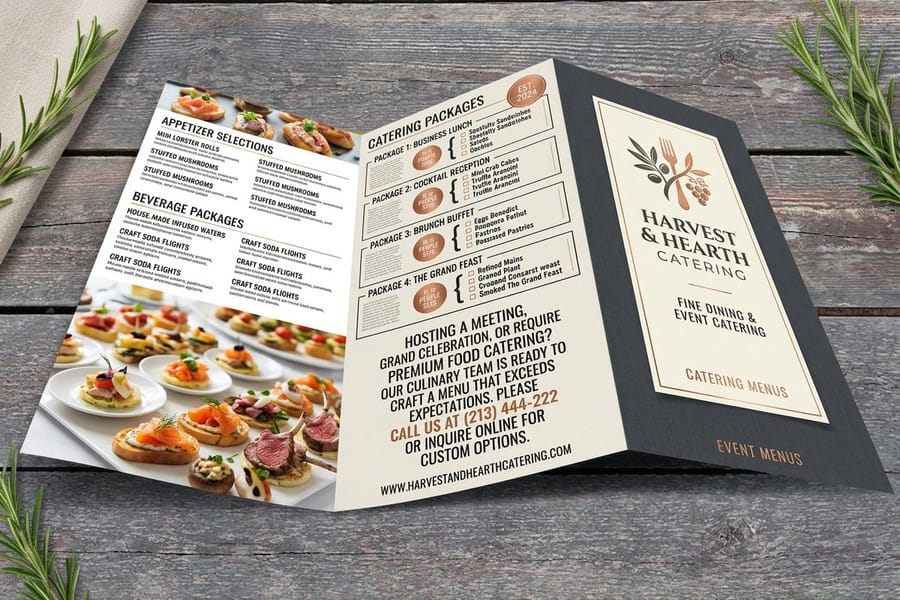
Measure a two top before you pick a size. A 24 inch square deuce loses roughly 21 inches of its width to two place settings once the plates, glasses and cutlery are down, which is why an open menu wider than about 11 inches gets held in the air rather than laid flat. Guests who cannot put a menu down read it faster and order less from it.
Then set the type before you set the size, not the other way round. Dining rooms are dark and menus are read at arm length, so keep body copy at 10 point or larger with the price column at the same size as the dish name. If the list will not fit at 10 point, add a panel. Dropping to 8 point to avoid a fold saves nothing and costs you the section a guest was most likely to order from.
A few sizes settle themselves once you apply that. A cafe with fifteen items and a drinks board fits comfortably on 5.5 by 8.5. A neighborhood restaurant with starters, mains, sides and desserts wants 8.5 by 11 or 8.5 by 14. A full service kitchen with a wine list wants the 11 by 25.5 trifold so wine gets its own panel. Event and catering work is different again, because the menu is handed out once and often mailed ahead: catering menus and restaurant menus both start at $57.11 for 50, so the size decision costs you nothing either way. If you are pulling a whole front of house set together at once, the front of house toolkit lists what usually gets printed alongside the menu. The catering menus story has more on the event version.
Whichever size wins, this is what each menu product takes on the order form:
| Product | Menu card sizes | Stock and finish | Folds | Run starts at |
|---|---|---|---|---|
| Menus and laminated menus | 4.25 x 11, 5.5 x 8.5, 8.5 x 11, 8.5 x 14, 9 x 12, 11 x 17, 11 x 25.5 in | 100# gloss text or 70# uncoated text, standard or High Gloss UV | Flat, half fold or trifold | 50 |
| Kraft menus | 8 x 10, 8.5 x 11, 9 x 12, 11 x 17 in | 18pt kraft uncoated cover, with white ink as an option | Flat | 100 |
| Table tents | 4 x 6 in finished, 4 x 16.25 flat | 14pt gloss cover with High Gloss UV | Folded to stand | 250 |
Upload the file at the flat size with 1/8 inch of bleed on all four sides.
Paper, Lamination, and How Long a Menu Survives
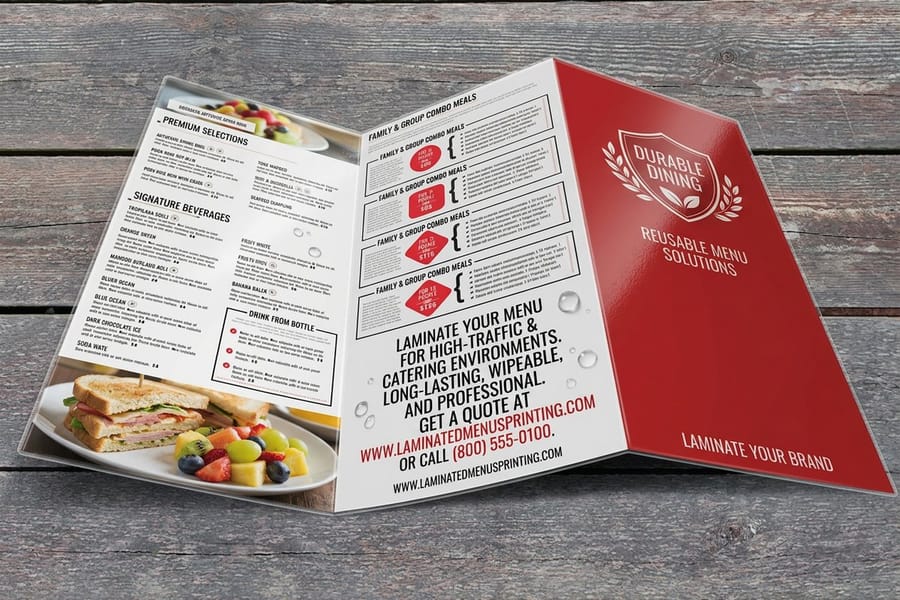
Menus print on text weight stock, not cover stock, which catches people out at the larger sizes. A 100 lb gloss text or a 70 lb uncoated text is right for a folded menu, because a fold in cover stock cracks unless it is scored. On a flat 8.5 by 14 held one handed, though, text weight flops over, and that flop is what makes a menu feel cheap in the hand. Paper weight in GSM, points and pounds explains why a text number and a cover number are not comparable.
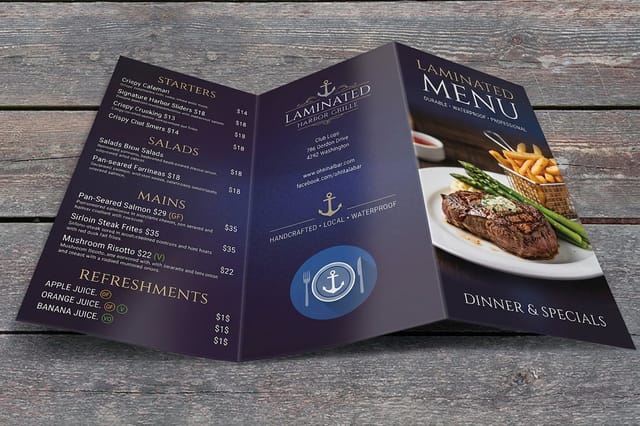
Lamination fixes the flop and the grease at the same time. A sealed laminate makes an 8.5 by 11 sheet rigid enough to stand up to a full service, wipes clean between seatings, and shrugs off condensation from a water glass. Laminated menus come in the same seven sizes as the uncoated version and start at the same $57.11 for 50, so durability is close to free at the entry quantity. The laminated menus story shows the product.
Name the catch, because it decides this for a lot of kitchens. A laminated menu cannot be corrected, cannot be reprinted in part, and cannot go in the paper recycling. If you change a price every week, taping over a number on a laminated sheet looks worse than the reprint you were avoiding, and you are better off on uncoated text at a low quantity, reprinting often. If your menu holds for a season, laminate it and stop replacing sheets. Liquid laminate explained covers what the coating actually does to the surface.
Setting Up Bleed and Safe Margins on a Menu File
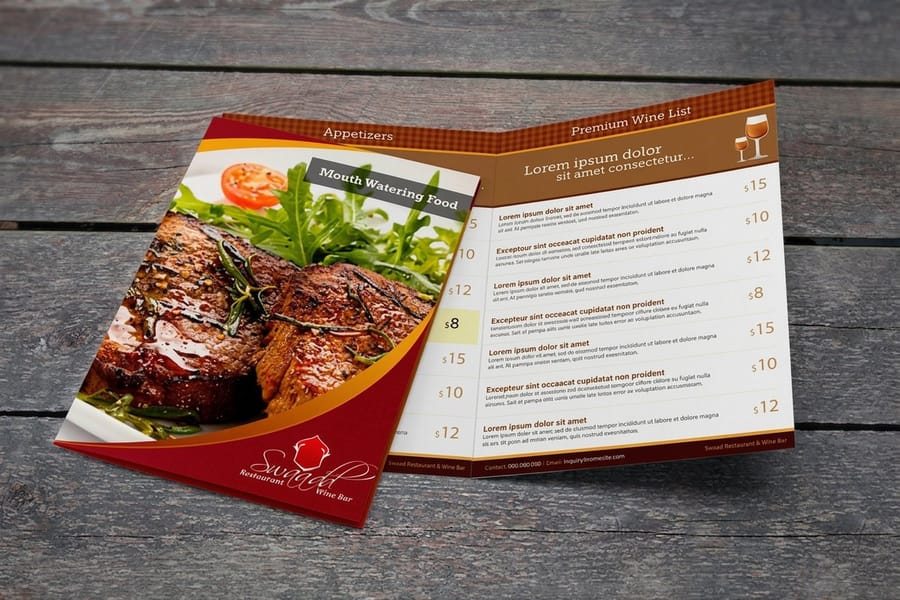
Every menu file needs an eighth of an inch of bleed on all four sides. An 8.5 by 11 menu is built on an 8.75 by 11.25 artboard, with any background color, photograph or border pushed out to that outer edge, and the sheet is trimmed back to 8.5 by 11 after printing.
The safe margin is the other half of the job and the one that ruins more menus. Keep text at least a quarter inch inside the trim line. Cutting tolerance is small but it is not zero, and a price sitting an eighth of an inch from the edge on a stack of 500 will clip on some of them. On a laminated menu, pull type in a little further, because the trim goes through the laminate and a bright edge draws the eye straight to anything sitting close to it.
Folds add a third rule. Leave a quarter inch clear either side of every fold line, and never place a price, a dish name or a logo across one. A fold flattens ink and the crease will land a fraction from where you drew it. Design each panel as if it were its own page.
The fastest way to get all three right is to start from a file that already has them. Every blank menu template in our library is built at the real trim size with the bleed and safe margin drawn in, at every size we print. What bleed is and why every file needs it covers the underlying reason in full, and designing custom menu cards picks up where the setup ends and the layout begins.
Wally sizes up a menu
Area first, then the table, then the fold
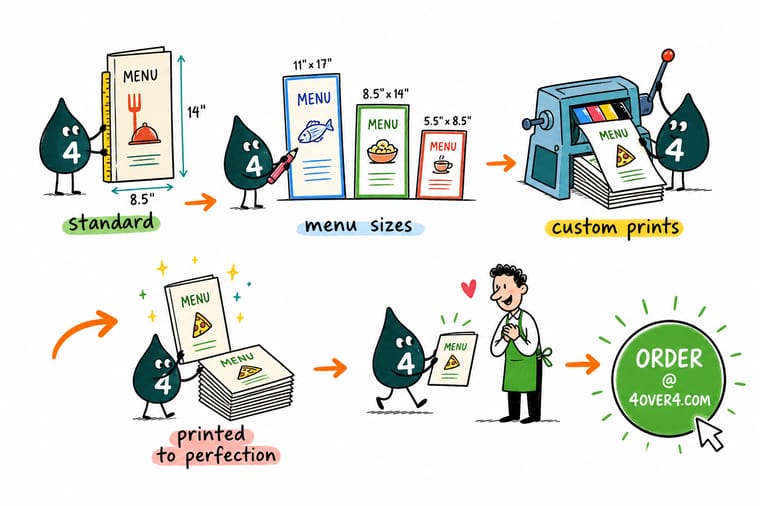
Wally starts with the list, not the sheet. He counts what has to fit at 10 point type, finds the smallest size that carries it, then puts it down on a two top with the plates and glasses to see whether a guest can actually lay it flat. If the list overruns, he goes up one size before he folds, because 8.5 by 14 buys 25.5 more square inches a side for nothing. Only when that runs out does he trifold an 11 by 25.5 sheet into six panels. Then he adds an eighth of an inch of bleed and keeps every price a quarter inch off the trim.
Print your menus →
Specs and pricing
Menu sizes, stocks, and starting prices
Menus and laminated menus print in seven sizes from 4.25 x 11 to 11 x 25.5 inches on 100# gloss or 70# uncoated text, flat, half folded or trifolded, from 50. Table tents fold to 4 x 6 inches from a 4 x 16.25 inch sheet of 14pt gloss cover, from 250. Set your size and fold on each widget to price it.
Print it
Order menus in the size your room needs
A standard 8.5 x 11 menu for most dining rooms, a laminated menu when it has to survive a full service and a wipe down, and a kraft menu on 18pt brown cover when the stock should do the branding.
Explore more
Where to go next
Design the menu card itself, build one in Canva, see what a liquid laminate adds, and pull the rest of the front of house set together.
By the numbers
Every menu trim we print, in one place
Common Questions
Your menu size questions, answered
What is the standard size for a restaurant menu?
8.5 by 11 inches. It is the size most kitchens land on because it takes four or five sections with a price column at type a guest can read in low light, and it still fits beside a place setting. At 4OVER4.COM it is one of seven stock sizes on standard menus, which run from a 4.25 by 11 slim up to an 11 by 25.5 sheet, with custom sizing available up to 11 by 26.
What size is a takeout menu?
Most takeout menus are 8.5 by 11 printed both sides, or an 11 by 25.5 sheet trifolded down to 11 by 8.5 when the kitchen has a long list. The practical limit is the bag. A flat letter sheet slides down the side of a paper bag or staples to the lid of a clamshell without being folded twice by a driver, and a 5.5 by 8.5 card fits almost anything. If servers write on the menu, order the 70 lb uncoated text rather than the 100 lb gloss, because ballpoint skates on a coated sheet.
How big is a table tent?
Ours finish at 4 by 6 inches and print on a flat 4 by 16.25 inch sheet that scores and folds into a freestanding tent. The extra length is the point: two 6 inch faces plus a base flap is what makes the tent stand on its own without a holder. Table tents run on 14pt gloss cover with a high gloss UV coating, from $554.39 for 250.
Should a menu be laminated or just coated?
Laminate when the menu will outlive the prices on it. A sealed laminate takes wipe-downs between seatings and shrugs off grease and condensation, which is why laminated menus survive months of service. Coating alone will not. The catch is that a laminated menu cannot be edited or recycled with paper, so a kitchen that reprices weekly is better off printing cheap uncoated sheets and reprinting. Laminated menus start at $57.11 for 50, the same entry price as the uncoated standard menus.
How much bleed does a menu file need?
An eighth of an inch on all four sides. An 8.5 by 11 menu is built on an 8.75 by 11.25 artboard with background art running to the outer edge, then trimmed back. Text should sit at least a quarter inch inside the trim line so a normal cutting tolerance never clips a price. Every blank menu template in our library is already drawn at trim with the 1/8 inch bleed and the safe margin in place.
When should I fold a menu instead of going up a size?
When the list stops fitting at 10 point type. Dining rooms are dim and guests read menus at arm length, so dropping body copy to 8 point to save a fold is a false economy. Go from 8.5 by 11 to 8.5 by 14 first, which buys 25.5 more square inches a side without any folding equipment. Past that, fold. A trifold gives you six panels to organize into courses, which reads better than one crowded page anyway.
What size should a drinks or dessert menu be?
4.25 by 11 inches. A narrow tall sheet reads as a list rather than a meal, it stands in a tent holder without leaning, and it takes up almost no table once the food menus are collected. If the list is short enough to fit a card, 5.5 by 8.5 holds the same 46.75 square inches in a shape that sits flat next to a wine glass.
Get Started
Catering menus run 50 for $57.11, kraft menus 100 for $166.04
Choose your size, pick gloss or uncoated text, add a half fold or a trifold, and we print menus that survive a full service and still read clean.
Legal Disclaimer
Gold Standard guarantees apply to all standard orders placed through 4over4.com. Price match requires verifiable proof of a competitor's published price for an equivalent product with matching specifications and turnaround time. Satisfaction guarantee covers manufacturing defects and print quality issues. Contact support with order number and documentation.
