
Direct Mail vs Digital Marketing and Which One Performs Better

Nadia is our customer education voice, built from the knowledge of our production team, with over 20 years in printing.
A printer's comparison of the two channels: how each one charges you, how fast each one answers, what each can target, the hybrid setup that finally makes a mail drop measurable, and the postcard, flyer or letter to print for it.
Direct mail performs better where the audience is definable by address and the purchase is worth enough to carry print and postage per household. Digital performs better where you need speed, a low test budget, and the ability to stop a losing campaign the same day. Judge them on the same number, cost per response, and remember that mail only produces that number if you print a QR code, promo code, or personal URL on the piece. The strongest setup runs both: mail the drop, run ads to the same addresses during the delivery window, and retarget everyone who scans.
Quick answer
One channel commits the budget, the other keeps it editable
Direct mail buys a physical object that survives the campaign. Digital buys attention you can stop paying for at any second. Mail pays the list, the print and the postage on the drop date and cannot be changed afterward. Digital charges per click or view and can be paused, rewritten, or reallocated within minutes. Both divide by the same denominator in the end: total spend over attributed responses. The chart below shows where each budget goes and why mail needs a printed QR code or promo code to produce a number digital reports automatically.
The Debate Is Framed Wrong, and That Is Why It Never Ends
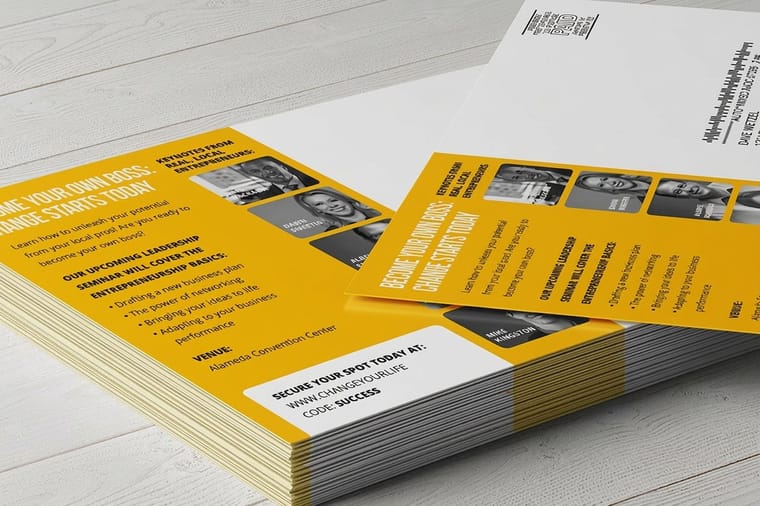
Mail and digital do not compete for the same job, so asking which one performs better is like asking whether a van beats a bicycle. The answer depends entirely on what you are carrying and how far. A 4 by 6 inch postcard on 14pt cover charges you the print and the postage once, on the drop date, while a search ad bills per click and stops the moment you pause it.
Digital ads are an auction. You bid against everyone else who wants the same attention, you pay in small increments, and you can stop at any moment. That flexibility is the whole product. Mail is a commitment. You choose the audience, print the piece, pay the postage, and hand it to USPS, and from that moment the campaign runs itself whether it is working or not.
Both facts cut in two directions. The digital advertiser can kill a losing ad by lunchtime, but the ad itself disappears the instant the budget stops and takes every impression with it. The mailer cannot pause anything, but the piece sits on a kitchen counter for a week, gets moved to a fridge, and gets handed to a spouse. One channel rents attention by the second. The other buys a physical object that outlives the campaign.
Where mail genuinely has the harder case to make is speed of learning. A paid campaign gives you a readable signal in days. A mail drop gives you one after the delivery window closes and the responses stop trickling in, which is usually two to four weeks later. If you are testing an offer you have never run before, test it digitally first and mail the winner.
Compare Cost Per Response, Not Cost Per Piece
Almost every direct mail versus digital argument collapses the moment someone divides properly. Cost per piece and cost per click are inputs. The number that decides the budget is total spend divided by the responses you can actually attribute to that spend.
Mail has three cost lines and print is usually the smallest of them. You pay for the list or the carrier routes, you pay for the printing, and you pay postage on every single piece that ships whether it is read or binned. Digital has a different shape: the creative is a fixed cost, the media is variable, and you only pay when someone clicks or sees the ad, which is why the spend feels so much easier to control.
| What you are comparing | Direct mail | Digital ads |
|---|---|---|
| How you pay | Whole budget committed on the drop date. | Charged per click or per thousand views as it runs. |
| Can you change it mid-flight | No. Once it is in the mail stream it runs as printed. | Yes. Pause, reallocate, or rewrite the headline in minutes. |
| When you see the result | Two to four weeks, spread across the delivery window. | Same day, often within the first few hundred impressions. |
| Attribution | Only what you printed on the piece: QR, promo code, or personal URL. | Counted by default, though blockers and privacy limits erode it. |
| Cost floor to test | Real. A meaningful drop needs enough pieces to read a response. | Low. A small daily budget produces a usable signal. |
Here is where our own catalog gives you a concrete anchor. Direct Mail Postcards start at $89.68 because the product includes the mailing work, while Standard Postcards start at $16.48 if you are addressing and mailing them yourself. Direct Mail Letters start at $238.73, and a letter in an envelope costs more for a reason: it gets opened by a different kind of prospect than a postcard does. Postage sits on top of all of these and scales with quantity and mail class, so quote it separately before you compare anything.
What a Printed Piece Does That an Impression Cannot
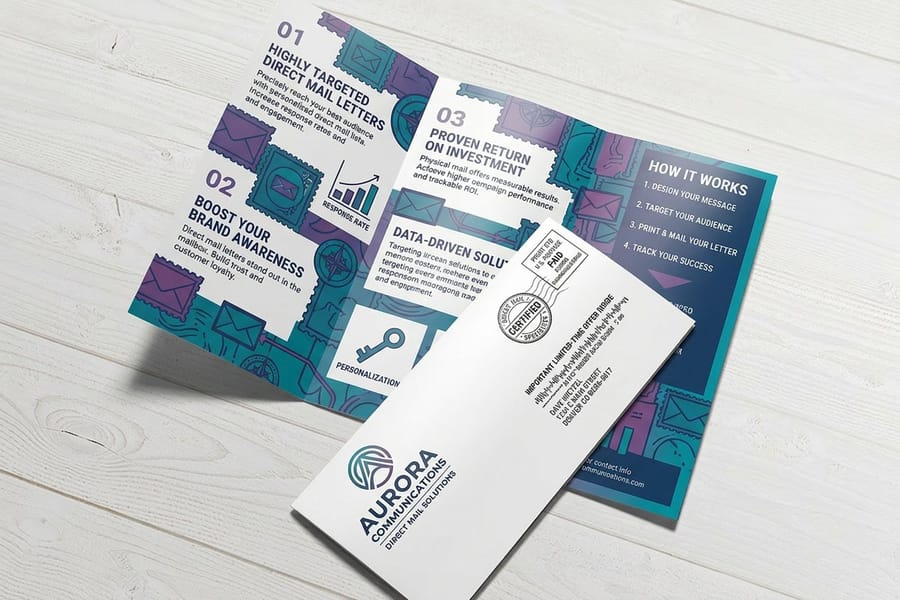
A mailed piece arrives in an inbox with almost no competition. The household gets a handful of items that day, they are sorted by hand over a bin, and every one of them gets a moment of attention before it is kept or dropped. Nothing in that sequence can be blocked, skipped, or scrolled past.
Physical also survives. A postcard with a service reminder on it lives on a fridge until the appointment. A letter with a printed number on it stays in a drawer. That persistence is the reason mail still works for local services with long consideration windows, where the customer is not ready today but will be in five weeks. A display impression cannot wait five weeks for anyone. Our article on 5 Reasons Postcard Marketing Still Works in 2026 lays out the rest of the case.
Now the limits, because they are real. Mail is slow, and a typo you catch after the drop is a typo you paid to print. Every piece costs whether it is read or not, so a sloppy list is expensive in a way a sloppy audience setting is not. And mail carries a credibility burden of its own: a thin, badly trimmed card signals a business that is cutting corners, which is why stock weight and finish do more work here than they do in almost any other format. Our postcard design guide covers the elements that separate a card people keep from one they bin at the recycling.
Targeting and Personalization on Both Sides
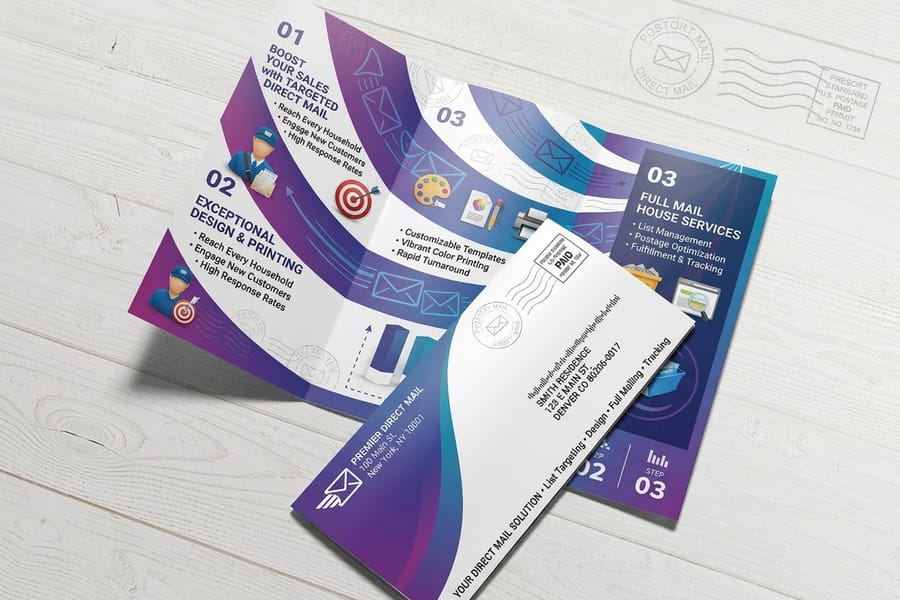
Digital targeting is behavioral and it is getting narrower. Platforms still let you reach people by interest, search intent, and lookalike modeling, but app tracking permissions and the retreat from third-party cookies have shrunk the pools that retargeting depends on. Audiences that were straightforward to rebuild a few years ago now need first-party data to work at all.
Mail targeting is geographic and demographic, and it has moved in the opposite direction. You can buy a list filtered by homeownership, household income band, length of residence, or business type, and every one of those attributes is tied to a real address rather than to a device that clears its identifiers. If you want to reach every household on a specific set of carrier routes and skip the list entirely, every door direct mail does exactly that. Our mailing list guide walks through building your own versus renting one, and the difference in response is usually larger than the difference in price.
Personalization runs deeper on paper than most people expect. Variable data printing puts the recipient name, a nearby store address, or a unique code on each piece in the same press run. That is how a personal URL campaign works: every household gets its own landing page address, so a scan or a visit identifies the responder by name without asking them to fill in anything.
The trade-off is correction speed. A wrong digital audience is a settings change. A wrong mailing list is a printed and posted mistake, which is why validating addresses and deduplicating the file before printing matters more than any design decision you will make on the piece.
When Direct Mail Wins, and When You Should Not Send It
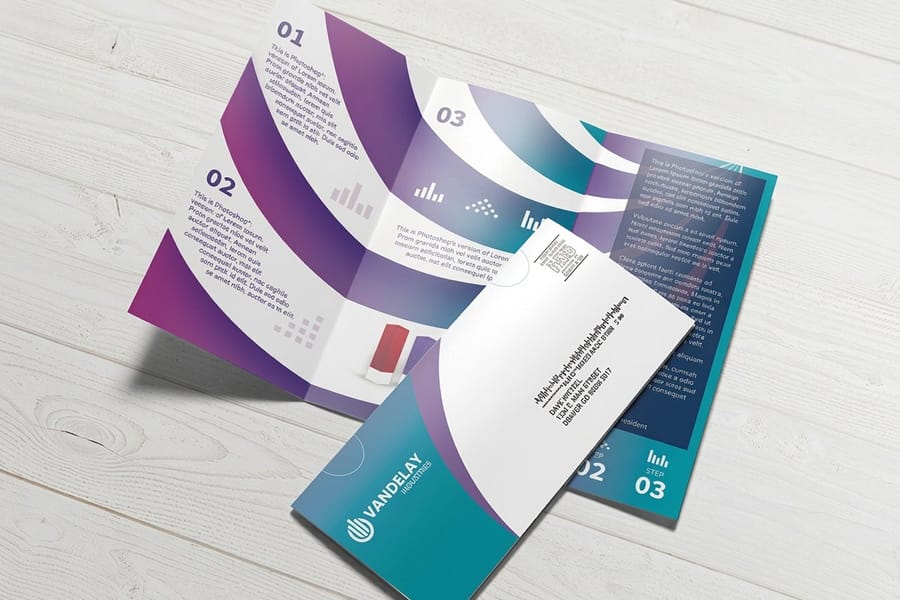
Mail wins when the customer is definable by address, the purchase is worth enough to absorb a per-household cost, and the decision is not made in the same minute it is prompted. Home services, dental and medical practices, real estate, restaurants, local retail openings, and B2B accounts with a known office address all fit that shape. It also wins for reactivation, because a lapsed customer file is the cheapest and highest-quality list you will ever mail.
- Local service with a defined radius. Roofing, HVAC, landscaping and dental all sell to households you can draw on a map, and a saturated route reaches them without any list cost.
- A high-value first purchase. If a new customer is worth hundreds of dollars, a print and postage cost per household is a rounding error against that value.
- Reactivation of your own customers. They already bought once, the addresses are already yours, and no auction stands between you and their attention.
- Audiences that are hard to reach online. Some buyers barely engage with paid social. Their mailbox still works exactly as it always did.
- Anything that benefits from being kept. A menu, a service reminder, a calendar, a coupon with a real deadline.
Do not mail when the margin per sale is small, when the audience is scattered nationally with no geographic logic, when you have not tested the offer anywhere else yet, or when you need an answer this week. In those cases a paid campaign gives you the same learning faster and cheaper, and you can always mail the version that won. The formats guide covers which piece suits which job, from a simple card to a mailed brochure.
The Hybrid Playbook, and How to Measure It
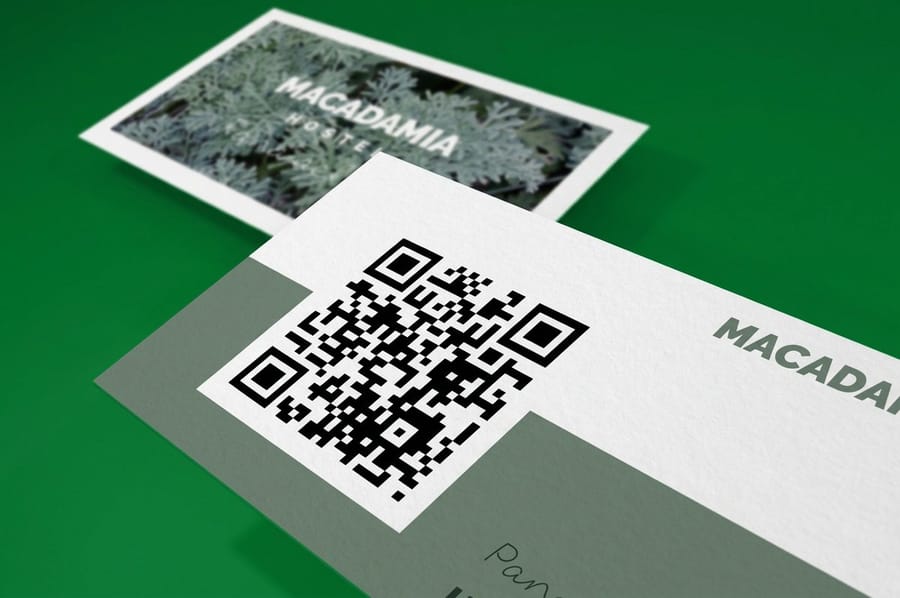
The strongest campaigns stop treating this as a choice. Mail creates the physical touch that no ad account can buy, digital catches the people it moved, and one tracked link connects the two so you finally know what the drop did.
Run it in this order:
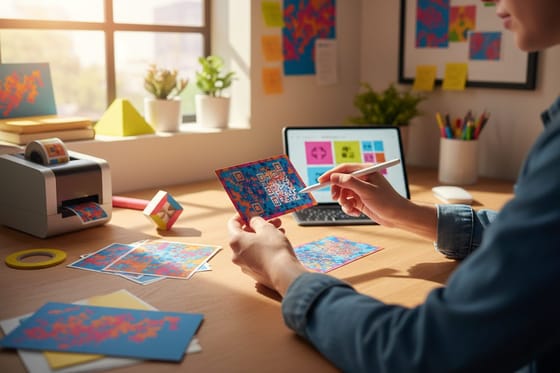
- Print the response path on the piece. A QR code that points at a landing page with its own campaign tag, plus a promo code for anyone who calls or walks in instead of scanning.
- Upload the mailing list as a custom audience on your ad platforms before the drop lands, so the same households start seeing the same offer while the mail is in transit.
- Run the digital layer across the delivery window. Most drops land across several days, so hold the ad budget steady for the whole window rather than spending it in one burst.
- Retarget the scanners who did not convert. They raised their hand by scanning. That is the warmest audience the campaign will produce.
- Match responses back to the drop. Compare orders and leads by address and by date against the mailed file, then add the untracked ones you can identify to your QR and code totals.
Measurement is the part that decides whether mail gets a second budget. Give every drop its own landing page or its own campaign tag, keep a control group of similar households you deliberately do not mail, and read the difference between the two groups rather than the raw response number. Our guide to adding a QR code to your postcards covers placement, size, and the contrast a scanner needs, and improving direct mail results goes deeper on offer and frequency.
One caution on QR codes: print them large enough and leave a quiet margin around them. A code crammed into a corner at half an inch with artwork running into its edges fails to scan often enough to ruin the only attribution you have. The same rule applies to QR code business cards, which start at $17.57 and make a useful companion piece for the same campaign.
Choosing the Mail Piece Before the Drop
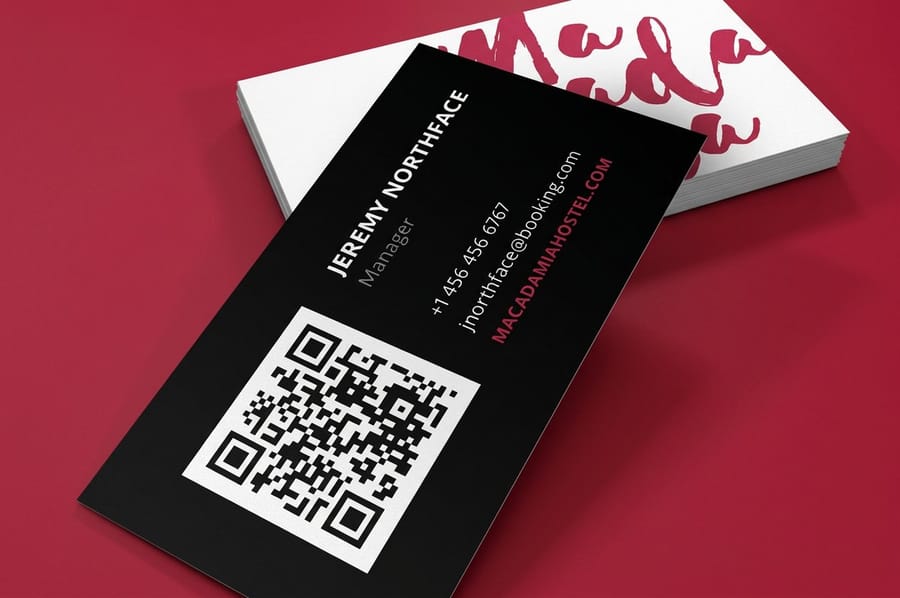
The comparison only turns into a result when the piece is set up to be measured. Four choices do it.
- Size. A 4 by 6 inch postcard carries one offer and a QR code. Go to 6 by 9 or 6 by 11 inches when the offer needs a photo, a map or a price list, and to a folded 8.5 by 11 inch letter when the message needs paragraphs.
- Stock. 14pt cover survives the mail; 16pt holds up for the weeks a reminder spends on a fridge. Letters print on 100# gloss or silk text.
- Finish. A high gloss UV front makes a photo offer stand out, and a matte front reads quieter for a service reminder.
- File. Put a unique QR code and short URL on the back, inside the safe area, away from the address block, and run the background 1/8 inch past the trim.
Order a free online proof and scan the code from the screen before you approve. Direct mail postcards then print in 4 business days and letters in 6.
Launching a Direct Mail Campaign With 4OVER4.COM
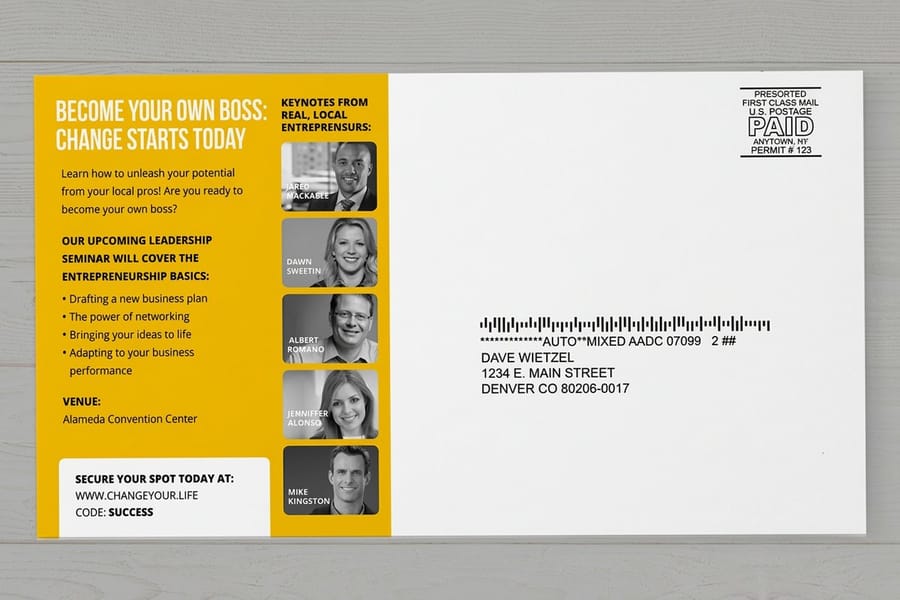
You can hand us the whole job or just the printing, and the choice mostly depends on whether you already have a mailing process that works.
If you do not, our direct mail service prints, addresses, sorts and delivers the drop to USPS, which removes the two steps most businesses get wrong: addressing accuracy and postal sorting. Direct Mail Postcards start at $89.68 and are the default choice for a local offer. Direct Mail Flyers and Direct Mail Letters both start at $238.73, and the letter format earns its cost when the message is long or personal enough to deserve an envelope.
If you already mail in-house, print with us and handle the rest yourself. Standard Postcards start at $16.48, and the full range of sizes and stocks sits under postcard printing. Before you send the file, read the USPS rules for postcards, because the address block, the clear zone and the size limits decide which postage rate you qualify for, and getting that wrong costs more than any design change.
Whichever route you take, print the tracking on the piece before you approve the proof. It is the one thing you cannot add later, and it is what turns the next version of this argument into a decision you can make with your own numbers.
Wally settles the direct mail vs digital argument
Stop picking a side and connect the two
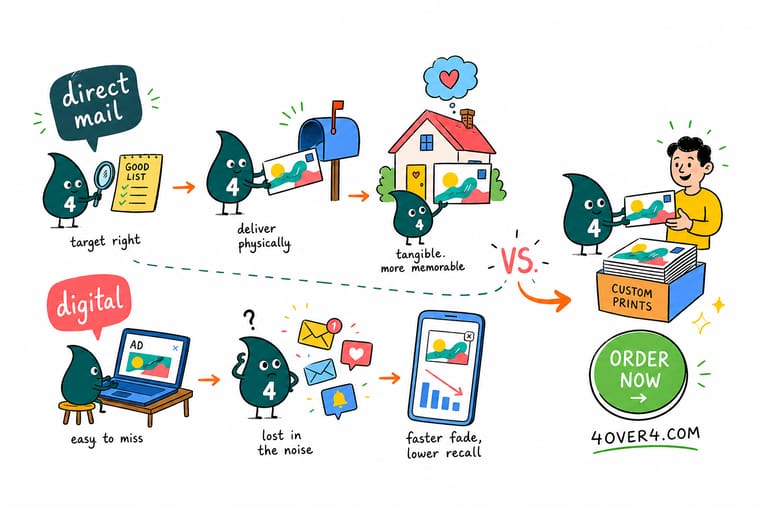
Wally mails the postcard, then loads the same addresses into the ad account so those households see the offer while the mail is still in transit. The card carries a QR code, so every scan lands on a page he can count. Anyone who scans and leaves gets retargeted. At the end he divides total spend by the responses he can prove, for both channels, and lets that number choose the budget instead of the argument.
Price direct mail postcards →
Specs and pricing
Mail formats, sizes, and starting prices
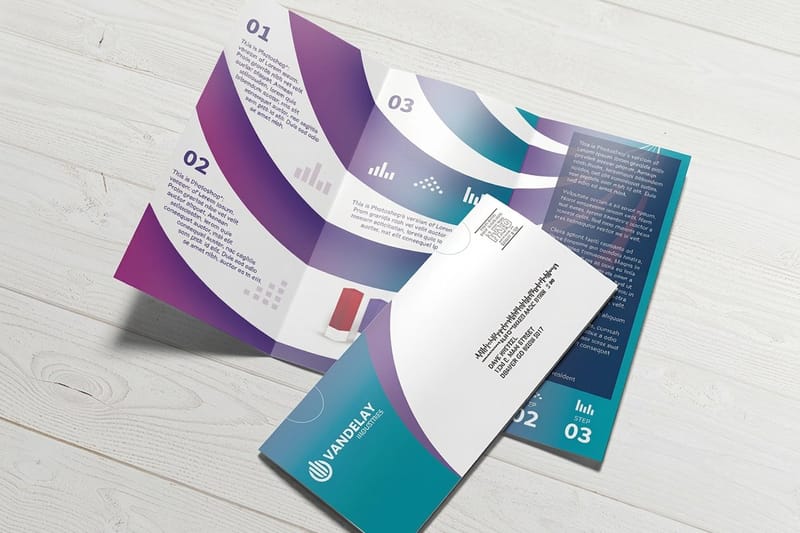
Direct mail postcards come in nine sizes from 4 by 6 to 6 by 11 inches from 500 pieces, standard postcards in 14 sizes from 50, and direct mail letters at 8.5 by 11 up to 11 by 17 inches on text stock with nine folds. Compare the mailing formats side by side, with live configuration choices and starting prices straight from the 4OVER4.COM configurator.

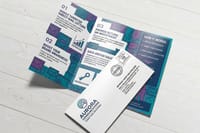
Print it
Start the drop with a piece worth keeping
Pick 16pt cover for a reminder meant to stay on a fridge, print the tracking code on the back, and run a 500 piece test before the full list.
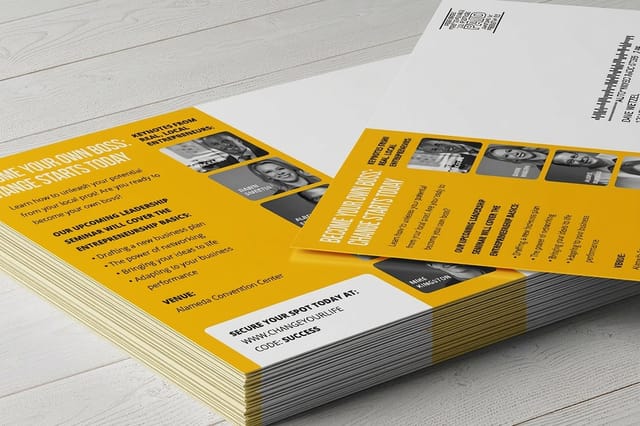
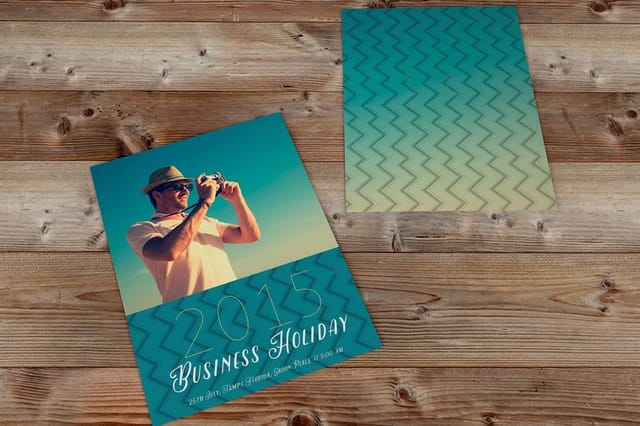
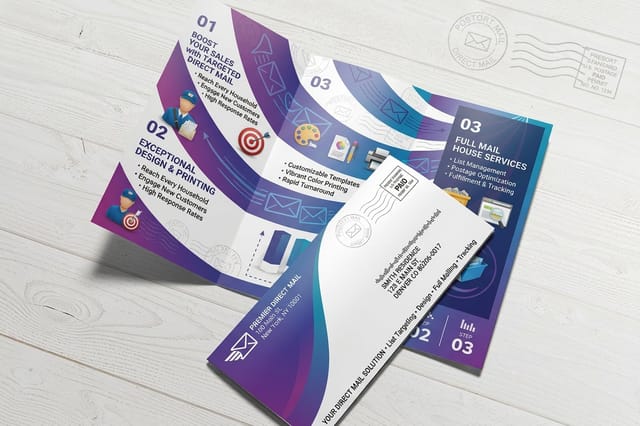

Explore more
Where to go next
Building a direct mail campaign, renting or building a list, adding a QR code to a postcard, and EDDM without a list.
By the numbers
The print half of this comparison, by the numbers
Common Questions
Your direct mail vs digital questions, answered
Is direct mail still effective compared to online marketing?
Yes, for the jobs it is suited to, and no for the jobs it is not. Mail still works when the offer is local, the audience is definable by address, and the purchase is worth enough to carry a print and postage cost per household. It performs badly when the product is cheap, the audience is scattered across the country, or the buying decision happens on a phone within seconds. The honest answer to "which performs better" is that they measure different things at different speeds, and the only comparison worth trusting is your own cost per response on both.
What response rate should I expect from a postcard campaign?
Anyone who gives you a single number without seeing your list is guessing. Response depends on the list quality, the offer, how many times the household has heard from you, and how easy you made the next step. Rather than chase an industry average, run a small drop with a tracked response path, calculate your own rate, then scale what worked. A first drop to a cold rented list and a fourth drop to your own customers are not the same campaign and will not produce the same number.
How much does a direct mail campaign cost to run?
Three line items, and print is usually the smallest. You pay for the list or the carrier routes, the printing, and the postage on every piece that ships. At 4OVER4.COM, Direct Mail Postcards start at $89.68 and Direct Mail Letters start at $238.73, while Standard Postcards you address and mail yourself start at $16.48. Budget the postage separately, because it scales with quantity and mail class in a way the print price does not.
How do I track direct mail results?
Print the tracking onto the piece. A QR code pointing at a landing page with its own campaign tag is the simplest option and works on every format. A promo code that only appears on the mailer works when you sell in person or over the phone. A personal URL, one per household, gives you response by name. A dedicated phone number works for service businesses. Pick one, print it large enough to use, and match the responses back to the drop date.
Do I need a mailing list, or can I use EDDM?
If you can define a good customer by neighborhood rather than by name, EDDM removes the list cost entirely because you buy USPS carrier routes instead of individual addresses. EDDM Retail caps at 5,000 pieces per ZIP code per day and the piece has to exceed standard letter dimensions, so it fits oversized postcards and flyers rather than a normal card. If your best customers are scattered across a metro area, a targeted list beats saturating a route even though it costs more per household.
Should I run mail and digital at the same time or separately?
At the same time, and deliberately overlapped. Upload the mailing addresses as a custom audience so the same households see your ads while the mail is in transit, keep the offer and the artwork consistent across both, and start retargeting anyone who scans the QR code but leaves without converting. Running them in separate quarters means you never learn which one carried the result, which is how most businesses end up arguing about the wrong channel.
Get Started
500 direct mail postcards cost $89.68, no auction to win
Pick a size and stock, print the QR code on the piece, and we print, address and hand the drop to USPS so you can measure what it actually did.
Legal Disclaimer
Gold Standard guarantees apply to all standard orders placed through 4over4.com. Price match requires verifiable proof of a competitor's published price for an equivalent product with matching specifications and turnaround time. Satisfaction guarantee covers manufacturing defects and print quality issues. Contact support with order number and documentation.
