
5 Reasons Postcard Marketing Still Works in 2026


Nadia is our customer education voice, built from the knowledge of our production team, with over 20 years in printing.
Yes, postcard marketing still works in 2026, because the advantage is mechanical rather than sentimental: a postcard has to be picked up and looked at before it can be thrown away, while an email can be filtered before a person ever sees the subject line. What has changed is the margin for error. Postage costs the same whether the card is good or bad, so the list and the offer now decide whether a drop pays, and the size you pick decides the postage class before you draw a single box.
Does postcard marketing work
Yes, when three numbers line up before the drop. Every card below is built around them.
- The size keeps the postcard rate. Stay at or under 4.25 by 6 inches, because one eighth of an inch more pays letter rate.
- The print cost is known per card. 50 standard postcards cost $16.48, and 500 direct mail postcards, printed and mailed for you, cost $89.68.
- Each card carries one offer and one tracked response. A code or a QR that exists nowhere else tells you what the drop earned.
Postcard sizes, postage class and what each one is for
| Size | USPS class | What fits on it | Where it earns its keep | Product at 4OVER4 |
|---|---|---|---|---|
| 4 x 6 in | Postcard rate | One headline, one offer, one way to respond | Cheap test drops, reminders, repeat mailings | Standard Postcards |
| 5 x 7 in | Letter rate | Headline plus two or three proof points | Announcements, invitations, grand openings | Standard Postcards |
| 6 x 9 in | Letter rate | Offer, a map, and a coupon with room around it | Local service offers that need to be seen first | Oversized Postcards |
| 6.5 x 9 in and up | Flat rate | A full menu or several coupons | EDDM saturation drops to whole carrier routes | Oversized Postcards |
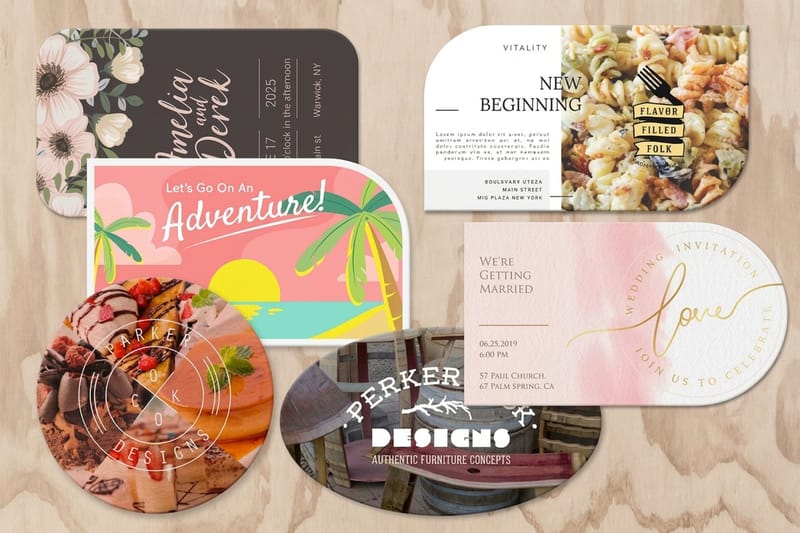
| Cut to a shape | Confirm before the run | One bold idea, not much copy | Standing out in a stack of rectangles | Die-Cut Postcards |
The rate ceiling is the number worth memorising: 4.25 by 6 inches. Above it every piece pays letter rate, and above 6.125 inches tall the piece becomes a flat. Confirm current USPS dimensions before a drop, then size your postcards in the configurator.
Reason 1: postcards get handled before they get ignored
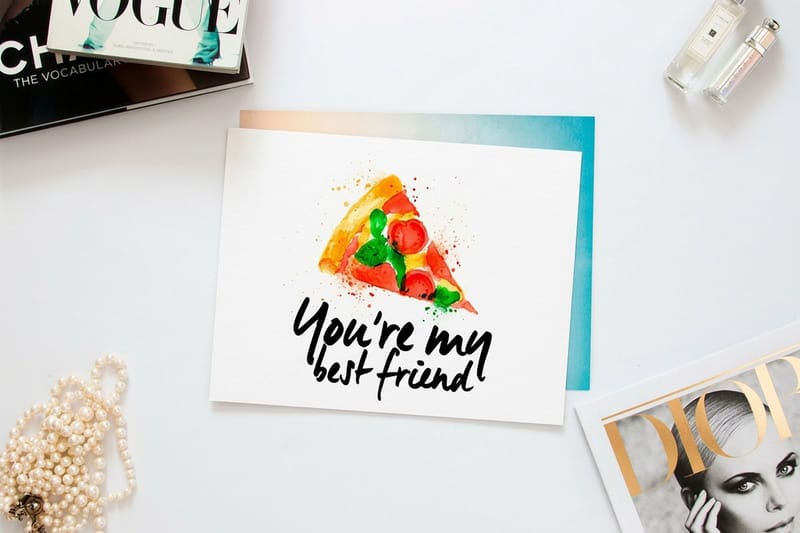
The advantage is physical, not emotional. Mail has to be carried in from the box, sorted over a bin, and held for a second before it lands in the recycling. That second is the whole product. An email never earns it, because a filter can remove the message before a human is involved, and a crowded inbox removes the rest without any decision being made.
A postcard also skips the step that kills most mail: nothing has to be opened. There is no envelope to slit, no flap, no reason to set it aside for later. The offer is face up in the hand that is deciding what to keep. That is why a postcard usually outpulls a letter for a simple local offer, even though the letter looks more serious.
Size is the lever on attention, and it costs real money. A 6 by 9 inch card sits on top of a stack of 4 by 6 envelopes and is hard to miss, but it is over the postcard rate ceiling, so every piece pays letter rate. That trade is the honest version of "postcards get read". Bigger gets seen more and costs more per contact. Our collection of sourced direct mail statistics is the place to check the published response figures rather than trusting a number in a sales pitch.
Write for the two seconds you actually get
The card is read at arm’s length while someone walks. One offer, in type large enough to read without focusing, and one way to respond. A card that carries three offers is a card that carries none, because the reader is not going to rank them for you.
Put the offer on the address side too, in the left third. Roughly half of the people who look at your card will see the back first, and a blank back wastes the only impression you paid postage for.
Reason 2: you know the cost per contact before you spend it
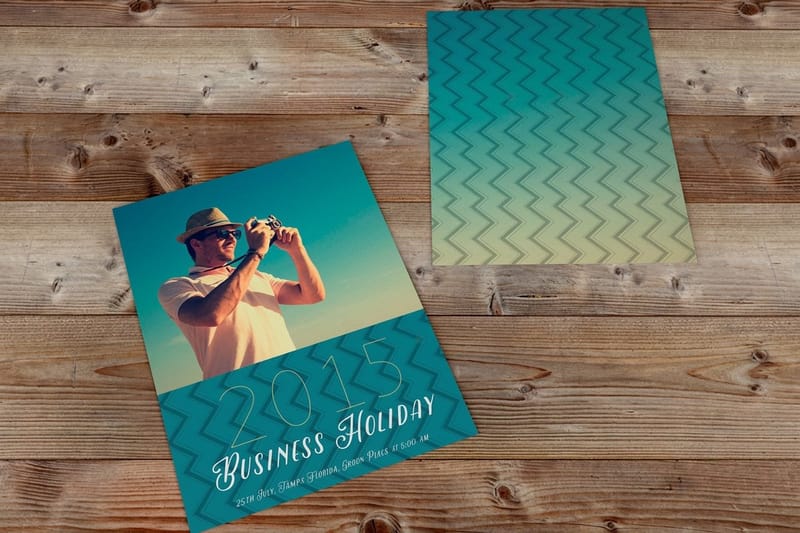
A mail drop has three cost lines and all three are knowable before you commit: printing, the list, and postage. Digital advertising prices the third line at auction after you have already written the ad, which is why a campaign that worked in March can quietly stop working in June without anything on your side changing.
Printing you can price right now. Standard postcards start at $16.48, oversized postcards at $51.62, and direct mail postcards, which include addressing and the drop into the mail stream, start at $89.68. The unit price falls as the run grows, so the configurator is worth opening before you settle on a quantity.
Postage is set by USPS and it changes, so build the budget against the current rate rather than a figure from an old campaign. The list is the third line, and it is the one people forget: a targeted list is priced per record, while an EDDM saturation drop has no list cost at all. We break the arithmetic down piece by piece in the direct mail cost per piece guide.
Where the money actually goes wrong
It is almost never the printing. A campaign that loses money usually mailed a good card to the wrong list, or mailed once to a list that needed three touches. Postage is charged per piece whether the piece is any good or not, so the cheapest saving available is a smaller, better list rather than a cheaper card.
Test at a quantity you can afford to be wrong about. Mail a few hundred, count the responses honestly, then scale the version that worked. Printing a short run costs a fraction of the postage on a full drop, and a proof caught before the run costs nothing at all, which is why every order gets a free proof first.
Reason 3: you can pick the street, not just the audience

Postcard targeting is geographic in a way online targeting is not. You can mail every household on the four streets around a new location, or every homeowner in three ZIP codes, and nobody outside that boundary pays for an impression. For a business that serves a drive time rather than a country, that is the whole argument.
There are two ways to do it and they behave differently. Every Door Direct Mail buys entire carrier routes with no names and no list cost, which makes it the cheapest way to reach a neighborhood, but the piece has to be large enough to qualify as a flat and you cannot leave anyone out. A targeted list costs per record and lets you filter by homeowner status, length of residence, or new movers, which is how new homeowner mailings by ZIP code get built.
Choose by how narrow your customer is. A pizzeria wants every door within a mile. An orthodontist wants households with children, which means a list. Getting this wrong is the most expensive mistake in direct mail, because it is paid for at full postage on every piece.
EDDM against a targeted list
EDDM requires a flat sized piece, so a 4 by 6 card is not eligible. That single rule pushes most EDDM campaigns to 6.5 by 9 inches or larger, which costs more per piece to print and to mail, and it is why EDDM is not automatically the cheap option people assume. The EDDM postcard size rules lay out the dimensions before you design anything.
A targeted list wins whenever the wasted half of a saturation route costs more than the list does. Run that comparison with real numbers, not instinct. If you would rather not handle the sorting, bundling and paperwork, our direct mail service handles the drop and covers print, addressing and delivery in one order.
Reason 4: the card stays in the house
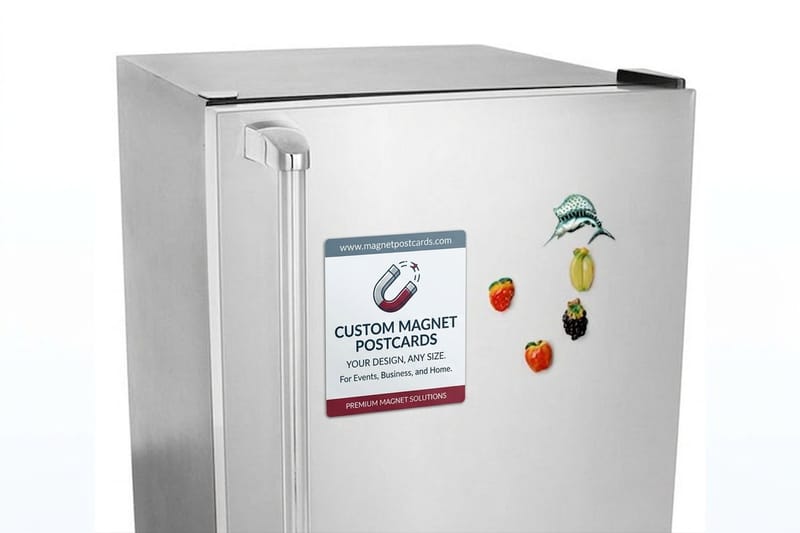
An email is read once and archived. A postcard gets put on the counter, pinned to a board, or handed to whoever in the household actually makes the decision. Nothing about digital advertising survives being passed from one person to another that easily.
You can design for that on purpose. Put something on the card worth keeping: a service schedule, a measurement chart, a seasonal checklist, a code that only works once. A magnet postcard takes it further and starts at $19.68, which is a low price for a piece of paper that is still on a fridge nine months later, in front of the person who calls a plumber.
Keeping is not the same as responding, and it is worth being straight about that. A card on a fridge is doing brand work, not lead generation, and it will not show up in this week’s numbers. Measure it by asking new customers where they heard about you, and take the answer seriously even when the attribution software disagrees.
Make the keepable thing the point
Pick one useful item and give it room. A filter size chart for an HVAC company, a dosage guide for a veterinary clinic, a school term calendar for a family restaurant. The offer sits beside it, not on top of it, and the card earns its place on the wall. For the technician on the call, watch the HVAC Business Cards video.
Print a date on it. A card with a season or a year printed on it gets replaced by next year’s card rather than quietly ignored, which gives you a reason to mail the same list again without inventing a new campaign.
Reason 5: a drop can be designed and mailed in the same week
A postcard has two sides and no folding, no binding, no assembly, and no bindery step that can go wrong. That is why it is the fastest printed piece to get from an idea to a mailbox, and why it is the format most businesses reach for when something needs to move now.
Start from a size that already exists rather than an artboard. Our free design templates and the print-ready blank library come with the bleed and trim already marked, and the online designer lets you finish the card in a browser without opening design software. If you want a second opinion before the run, the direct mail design guide is the checklist we use.
The limit is not the printing, it is the mail stream. Delivery lands across an in-home window of several days rather than on one date, so a card promoting a single day event should be timed to arrive seven to ten days ahead, not two. Plan backwards from the in-home window and the schedule stops being tight. The five step send checklist walks the whole sequence.
What slows a job down
Three things, in order: artwork without bleed, a list that arrives in a format nobody can use, and a decision about size made after the design is finished. Fix all three at the start and a drop moves at the speed of the press.
Send the list as a clean spreadsheet with one field per column and no merged cells. A list that needs rebuilding costs a day, and that day is usually the one you were counting on.
How to design a postcard that converts
Design the address side first. USPS needs the lower right of that side clear for the barcode and the address block, and a layout that ignores it comes back for a redesign after the artwork is signed off. Everything else on the card is built around that reserved rectangle. The anatomy of a postcard shows exactly which zones are yours and which belong to the mail stream.
Then set the offer. One offer, a deadline, and a response method that matches how your customers already behave. A phone number for a trade, a short URL for a booking, a code that ties the response back to the drop. Without a code you will never know which mailing worked, and you will end up arguing about it instead of measuring it.
Build the file at 300 DPI in CMYK with 0.125 inch of bleed on every side, and keep anything that must not be cut at least 0.125 inch inside the trim. A die-cut postcard starting at $34.05 buys a shape nobody else in the stack has, but it needs a cut line supplied as a separate path, so ask before you design one.
The coating trap on mailed cards
A UV gloss coating looks excellent and it is the wrong choice for the address side of a mailed card. Inkjet addressing does not dry on a UV coated surface, so the addresses smear or lift and the mailing house rejects the run. Order a mailed postcard with the gloss on the front only, or specify a matte or uncoated back.
The same rule catches anyone who plans to hand write a personal line. If a human is going to write on it, the surface has to accept ink. This is the single most common reason a beautiful postcard cannot be mailed as printed, and it is fixed by one line on the order.
Where postcards are the wrong tool
A page that only lists advantages is a sales sheet. There are jobs postcards lose, and knowing them saves more money than any design tip on this page.
- A complicated sale. Anything that needs a specification, a comparison table or a long explanation belongs in a brochure or a letter. A postcard can carry the invitation to that conversation, not the conversation.
- A national audience with no geography. Postage is charged per household. If your buyer could be anywhere, you are paying to reach the whole country to find them.
- Fast iteration. Email lets you rewrite a subject line at nine and see the result by noon. Once a card is printed, it is printed, so test the offer on a small drop before the full run.
- A one day deadline. Delivery arrives across an in-home window of several days. A card that must land on an exact date is a card that will disappoint you.
- A bad list. This is the only one that is fatal. No stock, finish or headline recovers a mailing sent to the wrong households, and the postage was spent before anyone read it.
If any of those describe your campaign, the honest answer is a different format. We set postcards against the alternatives in direct mail against digital marketing, and response rates by industry is the sanity check to run before a budget is signed.
Postcard printing costs at 4OVER4.COM
A test drop is cheap to print: 50 standard postcards are $16.48, magnet postcards start at $19.68 at 2 by 3.5 inches on 17pt magnet stock, soft touch at $29.44 and die-cut shapes at $34.05. The numbers below come straight from the live configurator, so you can size the print line of your budget before you talk to anyone about postage.
Quantity and price
Postcard pricing and specs
Real configurator numbers on standard postcards, where the more you order the lower the per unit cost drops.
| Quantity | Price Per Unit | Total |
|---|---|---|
| 50 | 33.0¢ | $16.48 |
| 100 | 24.2¢ | $24.16 |
| 200 | 15.9¢ | $31.86 |
| 300 | 12.8¢ | $38.45 |
| 400 | 11.3¢ | $45.04 |
| 500 | 10.3¢ | $51.62 |
Every order also earns coins that come off future printing, and bulk discounts apply once the quantity climbs, which matters on a campaign built around repeat drops rather than one big mailing. If the size or the stock you want is not in the list, get an instant online quote instead of guessing.
Stock, coating and the address side
Two decisions carry most of the quality difference on a mailed card: how thick it is, and what is on the back. Thickness is what a card feels like in the hand, and a 16pt stock is noticeably more rigid than a 14pt one at 6 by 9 inches, where a thin card arrives with a bent corner. The back is where campaigns actually fail, because a UV gloss coating stops inkjet addressing from drying, and a mailing house will return the run rather than smear it.
Print and mail it
Direct mail postcards, drop included
Printed, addressed and handed to USPS, so the only thing you supply is the artwork and the list.
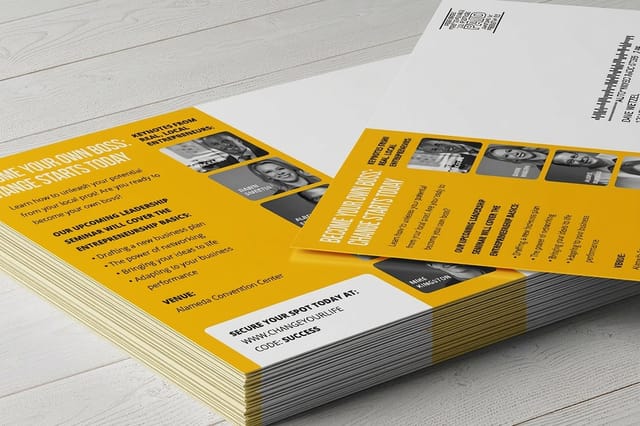
Finish changes both the look and how the card behaves. Gloss lifts photography and shrugs off a wet mailbox. Matte reads calmer and takes a pen. Uncoated stays writable, which suits appointment reminders and fill in offers. A soft touch postcard feels different enough that people turn it over, which is worth more than it sounds on a card competing with a stack of envelopes. For a two sided piece, check how double sided postcard printing works before you commit the layout.
Who mails postcards, and what they mail
The format is the same everywhere. What changes is the list and the reason to open the mailbox.
- Home services. Saturation drops on the streets around a job already completed. The van has been on that road for two days, so the card lands with recognition behind it.
- Restaurants and cafes. A keepable card with a menu on one side and a first visit offer on the other, mailed to the delivery radius rather than the city.
- Real estate. Just listed and just sold cards to a tight farm area, mailed on a schedule rather than in bursts, so the name is the one people already know when they decide to sell.
- Dental and medical practices. A targeted list filtered by household composition, because a saturation route wastes postage on the wrong ages. Recall reminders repeat well.
- Retail and salons. Seasonal drops with a dated code, so the response can be counted at the till and the next drop can be sized from real numbers.
- Nonprofits and churches. Event postcards timed to land seven to ten days ahead, with the date large enough to read from the mailbox.
Where a mail piece should start
Starting from a blank artboard is how bleed problems begin. 4OVER4.COM sizes its templates to exact product specs, from 4 by 6 up to 6 by 11 inches, so the trim line, the 1/8 inch bleed and the safe area are already drawn and your artwork lands where you expect it to.
Start fast
Postcard templates and print-ready blanks
Blanks with the trim line drawn, so the bleed problem never starts.

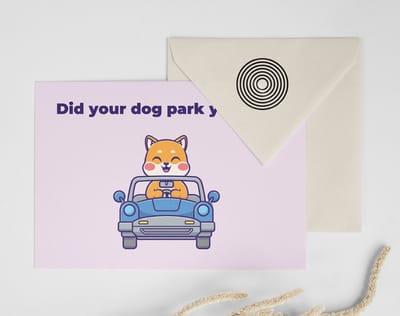

Wally sizes the card before he designs it
The postage class is decided by the ruler, not the artwork
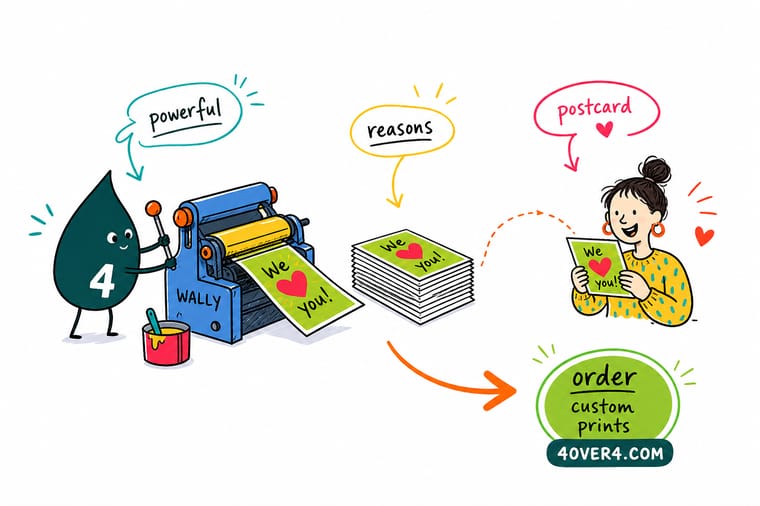
Stay at or under 4.25 by 6 inches to keep the postcard rate, go to 6 by 9 inches when the card has to win on top of a stack, and go past 6.125 inches tall only for an EDDM flat. Leave the lower right of the address side clear for the barcode, build at 300 DPI in CMYK with 0.125 inch of bleed, and keep UV gloss off any side that gets inkjet addressed.
Print and mail postcards →Why the format still earns its postage
Design rules that hold at every size
- One offer, not a menu. A card with three offers gets ranked by nobody and answered by nobody. Pick the one you want more of and give it the whole front.
- Reserve the address block first. The lower right of the address side belongs to USPS. Lay it out before the artwork, not after the client has approved a design that covers it.
- Put a deadline on it. A date turns a card from information into a decision. Without one, the card is kept and then forgotten, which looks the same as being thrown away.
- Code every drop. A code, a dedicated number or a unique URL is the only thing that tells you which mailing paid. Everything else is a story told afterwards.
- Match coating to the job. Gloss on the front, matte or uncoated on the address side of anything that gets inkjet addressed or hand written. Confirm it on the order.
- Mail again before you mail wider. The second and third drop to the same list almost always beat a first drop to a bigger one. Budget for repetition rather than reach.
Explore more
More ways to print and mail
Soft touch postcards run 50 for $29.44 on 32pt uncoated and magnet postcards print on 17pt indoor magnet.
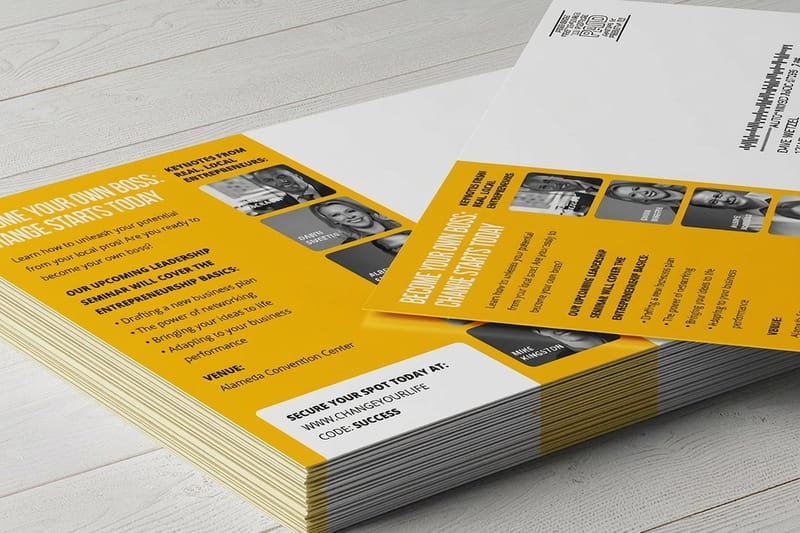 Product Direct Mail Postcards Printed, addressed and dropped into the mail stream for you. Product Standard Postcards The cheapest way to test an offer at the postcard rate. Product Oversized Postcards Large formats that sit on top of the stack, including EDDM sizes. Product Die-Cut Postcards Cut to your own shape instead of a rectangle. Product Magnet Postcards A card that stays on the fridge instead of the recycling. Category Postcard Printing Every postcard size, stock and finish in one place.
 Ready to put a card in the mailbox?
Pick the size, drop in your design or start from a free template, and 4OVER4.COM prints it sharp, addresses it and hands it to USPS on your schedule.
Common questions about postcard marketing
What does it cost to print and mail 1,000 postcards?
Three separate lines add up to the answer, and only two of them are ours. Printing is priced in the configurator and drops per unit as the run grows: standard postcards start at $16.48 and direct mail postcards, which include addressing and the drop, start at $89.68. Postage is set by USPS and changes, so price it against the current rate rather than a figure from a previous campaign. The list is the third line, priced per record for a targeted mailing and nothing at all for an EDDM saturation drop. Open the configurator with your real size and quantity and you will have the print number in under a minute.
What size postcard should I mail?
Start at 4 by 6 inches unless you have a reason not to, because it is the largest size that still pays the USPS postcard rate and it is the cheapest way to reach the same household more than once. Move up to 6 by 9 inches when the card has to win a fight on top of a stack and you have the budget for letter rate on every piece. Go to 6.5 by 9 inches or larger only if you are running an EDDM saturation drop, since that program requires a flat sized piece. The size decision sets your postage class before you draw anything, so make it first.
Can I mail postcards without buying a mailing list?
Yes, through Every Door Direct Mail, which buys whole USPS carrier routes rather than names and addresses. You select the routes on a map, the card goes to every address on them, and there is no list cost and no addressing. The trade is control: you cannot exclude anyone on the route, and the piece has to be large enough to qualify as a flat, which rules out a 4 by 6 card and raises the print cost. It suits a business that serves everybody nearby, such as a restaurant or a home services trade, and suits a specialist practice much less well.
How many times should I mail the same list?
Plan for at least three drops before you judge the list. A single mailing catches only the people whose need happened to line up with the week the card arrived, which is a small slice of any list, and it is the reason most first campaigns are written off as failures. Spacing them four to six weeks apart keeps the name familiar without becoming noise. If the budget only covers one option, mail a smaller list three times rather than a large list once.
Should the back of a mailed postcard be coated?
Not with UV gloss. Inkjet addressing does not dry on a UV coated surface, so the addresses smear or refuse to adhere and the mailing house sends the run back. Specify gloss on the front only, or a matte or uncoated address side, and the same applies if anyone plans to hand write a note on the card. Ask for it on the order rather than assuming, because a full gloss postcard is a perfectly normal product for a piece that is handed out rather than mailed.
