
Door Hanger Paper, 14pt vs 16pt Gloss Cover and What Survives Outside


Nadia is our customer education voice, built from the knowledge of our production team, with over 20 years in printing.
Two stocks, one coating, and a die-cut hole that decides how long the card lasts. The caliper buys you stiffness, and the heavier sheet is worth it past a certain panel length.
Door hangers print on 14pt or 16pt gloss cover, both sealed with a High Gloss UV Coating, and there is no uncoated or matte option in the line. 14pt measures 0.014 inch and is enough for a short trim dropped in dry weather. 16pt measures 0.016 inch and is the one to order for a 4.25 by 14 panel, a windy route, or cards left out overnight, because the extra caliper holds the die-cut hole together longer.

Quick answer
Gloss cover in two calipers, and one coated finish
The stock list for door hangers is short on purpose: 14pt gloss cover or 16pt gloss cover, both with a High Gloss UV Coating. Points are thousandths of an inch, so the two sheets sit 0.002 inch apart, and that gap shows up on long trims and windy handles rather than on a short card. Both are cover stock rather than text, because a hanger has to carry its own weight from a hole near the top. The coating seals the two printed faces, not the cut edge, which is why a soaked hanger gives way at the knob hole first.
What 14pt and 16pt Actually Measure

A point is a thousandth of an inch. 14pt gloss cover measures 0.014 inch through the sheet, 16pt measures 0.016 inch. Written down that gap looks like rounding. In your hand it is the difference between a card that stands out from the door and one that curls toward it by mid afternoon.
Points measure thickness, not weight, and the two are not the same thing. Two sheets can weigh the same per ream and measure different calipers because one is bulkier, which is exactly why printers quote door hangers in points and quote flyers in pounds. When you compare a door hanger quote against a flyer quote, you are comparing two different units, and the flyer number will always look cheaper because a flyer is a flat sheet nobody has to hang.
Both door hanger stocks are cover, never text. That matters more than the two thousandths between them. Cover stock is engineered to hold a shape without support, and a door hanger spends its whole working life doing exactly that, suspended from a hole near the top with the full panel pulling down. Run the same artwork on 100 lb gloss text and it hangs like a wet leaf inside the hour.
| 14pt vs 16pt | 14pt gloss cover | 16pt gloss cover |
|---|---|---|
| Thickness | 0.014 inch | 0.016 inch |
| Best trims | 3.5 x 8.5 and 3.5 x 11 in, and 4.25 x 11 in for a same day drop | 4.25 x 14 in every time, and 4.25 x 11 in left overnight or in wind |
| Finish | High gloss UV coating | High gloss UV coating |
| Order | From 250 hangers, one or both sides | From 250 hangers, one or both sides |
| Production | 7 business days | 7 business days |
| What to upload | A print PDF built on the hanger template for your trim, with the hole and slit left clear of type | |
The table is the short version of a choice the rest of this page argues in detail. If you want the longer version of how stock numbering works across the catalog, our paper weight guide reads the whole scale.
Gloss Cover and UV, and Why There Is No Uncoated Option
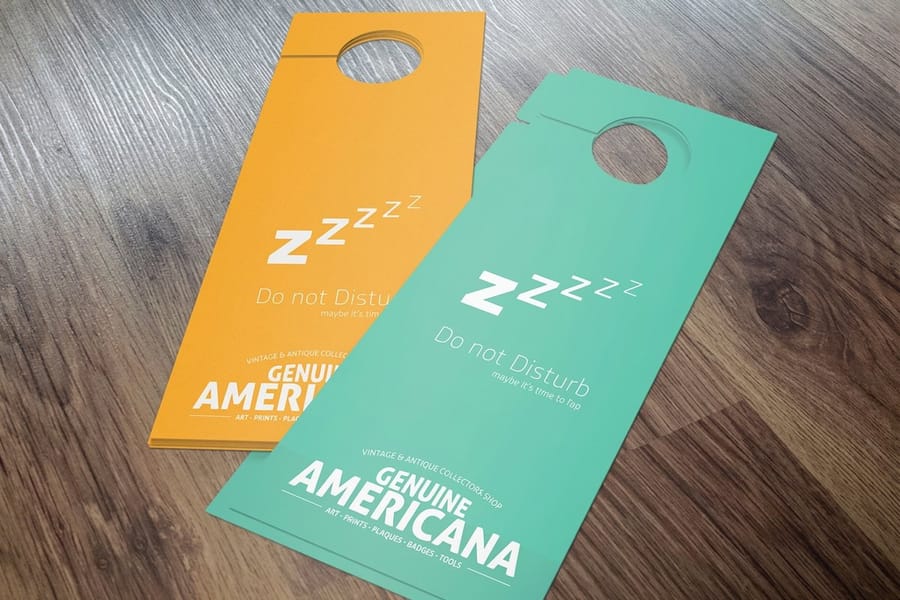
Every door hanger we print leaves the plant on gloss cover with a High Gloss UV Coating. That is the whole finishing menu, and it is deliberate: an uncoated hanger goes soft the first time it rains on a handle, and a matte sheet gives back the color punch you need to be read from the sidewalk.
The coating buys three things. Color stays saturated instead of sinking into the fiber, fingerprints from a crew handling 500 cards wipe off, and drizzle beads on the surface rather than soaking through. It also costs you one thing, and nobody mentions it until the box arrives: you cannot write on it. A ballpoint skids across UV gloss and a felt pen smears. If your hanger needs a handwritten service date, a room number or a technician name, print a knocked-out white panel for it and hand your crew permanent markers.
| Stock | Caliper | On the door hanger form | Where it wins |
|---|---|---|---|
| 14pt gloss cover | 0.014 in | Yes, with High Gloss UV Coating | Short trims, dry same-day drops, the biggest run for the budget. |
| 16pt gloss cover | 0.016 in | Yes, with High Gloss UV Coating | Long 4.25 by 14 panels, windy routes, cards left overnight. |
| 100 lb gloss text | About half a cover sheet | No, flyers only | Handouts and inserts that never have to hold their own weight. |
| 14pt uncoated cover | 0.014 in | No, flyers only | Anything that has to be written on, at the cost of weather resistance. |
Read the third column before the fourth. Two of these are on the door hanger printing order form and two are not, so if your job genuinely needs a writable or matte surface, you are ordering flyers with a different finish, not a door hanger. For the trade-off in both directions, the UV coating guide covers where the gloss layer helps and where it gets in the way.
The Die-Cut Hole Is Where the Stock Fails First
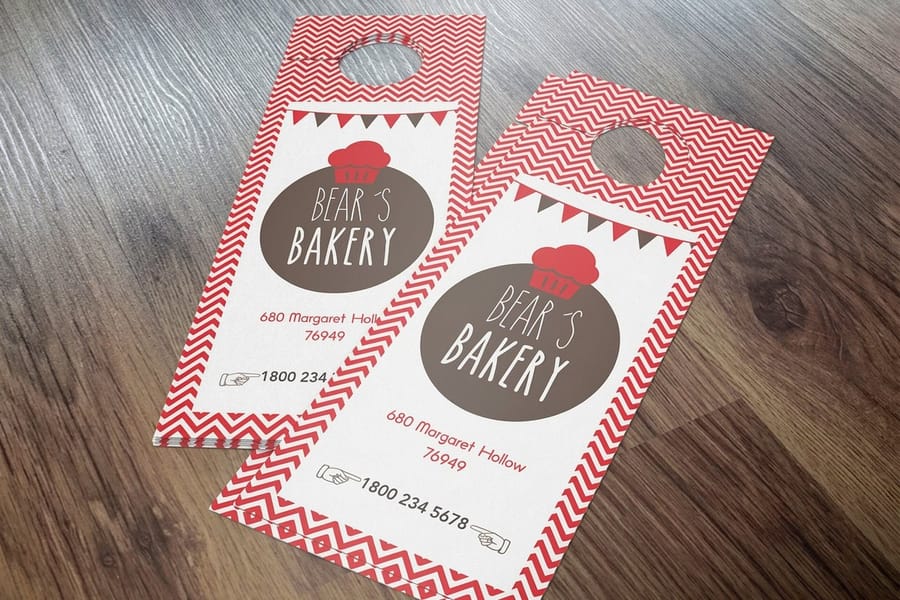
Stock arguments usually stop at thickness. The part that decides whether your cards are still readable at 6pm is the 1.5 inch die-cut hole near the top, and the narrow slot running from it to the edge.
Two things meet at that cut. The UV coating covers the printed faces and stops at the trim, so the inside of the hole and the slot are open fiber with nothing sealing them. And the entire weight of the panel hangs from that ring. Add moisture to raw fiber under constant load and the hole elongates, the slot starts to travel, and the card ends up on the porch instead of the handle. It is not a printing fault, it is the geometry of the format.
Three habits fix most of it. Order 16pt when the drop is exposed or the panel is long, because more caliper at the ring means more material to soften before it gives. Drop in the morning of a dry day rather than the evening before rain. And treat the optional tear-off perforation, which sits 2 inches from the bottom, as the second engineered weak line it is: it is there so the household keeps the coupon, but on a windy handle the bottom strip can flap and start tearing before anyone touches it. If the coupon is the whole point of the piece, rip hangers are built around that perforation and live indoors at the shelf, from $362.99 for 250.
Design around the cutout as well. Keep headlines and logos clear of the top 2 to 3 inches, which the hole and slot occupy. Our door hanger dimensions breakdown maps the safe area for every stock trim, and the door hanger blank templates already have the cut drawn in.
Choosing Between the Two Stocks for Your Route

Match the stock to the trim and to how long the card has to survive on the handle. That is the whole decision, and it takes about ten seconds.
- 3.5 by 8.5, dry same-day drop. 14pt. The panel is short, the pull on the hole is small, and the money is better spent on a bigger run.
- 4.25 by 11, the default trim. 14pt for an afternoon campaign, 16pt if the cards go out in the evening and get read the next morning.
- 4.25 by 14, the long panel. 16pt, every time. Length adds bending force, and this is the trim where 14pt visibly bows.
- Storm doors, wind, coastal routes. 16pt, and plan for the card to be read the same day rather than to hang for a week.
- Indoor hangers. Hotel tags on guest room handles and shelf coupons never see weather, so 14pt is the sensible spend.
Neither stock changes the schedule. Both run on the same 7 business day standard production, so choosing 16pt costs you nothing in time. Quantity is where the money actually moves: door hangers start at $290.41 for 250, 1,000 costs $332.08, and the per-card price slides to about $0.09 at 25,000. Quadrupling that first order adds roughly $42 and cuts the unit cost by two thirds, which is why a test drop of 250 is almost always the most expensive way to buy them.
Trade-specific versions carry the same two stocks under a different name, so pick by artwork rather than by material. Real estate door hangers start at $252.51 for 250 with the listing layout already set up, and plastic door hangers sit in the same family. Check the material list on the order form before you assume any hanger is a synthetic sheet, because the printed choices on ours are the same 14pt and 16pt gloss cover. If you want the questions to put to any printer before you commit, the door hanger printer checklist runs through them, and how to make door hangers covers the layout end.
Wally explains door hanger stock
Two calipers, one coating, and one weak point

Wally holds both stocks up to the light. 14pt is 0.014 inch, 16pt is 0.016 inch, and both wear the same High Gloss UV Coating on their printed faces. He does not argue about which feels nicer. He looks at the trim size and the weather, because a long panel on a windy handle pulls on the die-cut hole all day, and the inside of that hole is bare fiber the coating never reached. Short card, dry morning, 14pt. Long card, overnight, wind, 16pt.
Order door hangers →%22%2F%3E%3Ccircle%20cx%3D%2236%22%20cy%3D%2220%22%20r%3D%2231%22%20fill%3D%22%23a78bfa%22%20opacity%3D%220.15%22%2F%3E%3Ccircle%20cx%3D%2233%22%20cy%3D%2229%22%20r%3D%2210%22%20fill%3D%22%23a78bfa%22%20opacity%3D%220.1%22%2F%3E%3Crect%20x%3D%2276%22%20y%3D%2210%22%20width%3D%2221%22%20height%3D%2220%22%20rx%3D%224%22%20fill%3D%22%23a78bfa%22%20opacity%3D%220.08%22%20transform%3D%22rotate(16%2080%2030)%22%2F%3E%3C%2Fsvg%3E)
Specs and pricing
Stocks, trims, and starting prices
Standard and real estate hangers come in 4.25 by 11, 4.25 by 14, 3.5 by 8.5 and 3.5 by 11 inches, and rip hangers in 4.25 by 11 or 3.5 by 11 inches with a perforated tear-off, all on 14pt or 16pt gloss cover with high gloss UV, from 250. Compare the styles side by side, with the live stock choices and starting prices straight from the 4OVER4.COM configurator.


Print it
Order hangers on the stock that suits the route
Pick 16pt for the 4.25 by 14 inch trim or an overnight route and 14pt for a short same day drop. Plastic door hangers start at $290.41 for 250, rip hangers at $362.99, and every style prints in 7 business days.



Explore more
Where to go next
What to ask a door hanger printer, how to lay one out, hanger dimensions, what UV coating does, and the paper weight scale.





By the numbers
Door hanger stock printed for 150,000+ businesses
Common Questions
Your door hanger paper questions, answered
What paper are door hangers printed on?
At 4OVER4.COM there are two choices and they are both cover stock: 14pt gloss cover and 16pt gloss cover, each sealed with a High Gloss UV Coating on the printed faces. Cover stock is the point. A door hanger has to hold its own weight from a hole near the top for hours, which text stock cannot do. That is also why the same two stocks appear under every door hanger product we sell, from standard door hangers to the trade versions.
Is 14pt or 16pt better for door hangers?
It depends on the trim and the route, not on which sounds sturdier. For a 3.5 by 8.5 card dropped in the morning and read that afternoon, 14pt is genuinely enough and costs less. Move up to 16pt when the panel is 4.25 by 11 or longer, when the route runs overnight, or when the doors are exposed to wind, because a longer panel puts more bending force on the same die-cut hole. If your crew works screen doors and storm doors that clamp the card, 16pt also creases less.
What does the UV coating actually do?
It puts a hard gloss layer over the ink so color stays saturated, fingerprints wipe off, and light rain beads instead of soaking straight into the sheet. What it does not do is waterproof the card. The coating covers the two faces and stops at the trim, so the cut edges and the knob hole are open fiber. Leave a hanger through a rainstorm and it softens at the hole first, then tears under its own weight.
Can I get matte or uncoated door hangers?
Not on the door hanger order form. Both stocks are gloss cover with High Gloss UV Coating, which is the right call for a piece that lives outdoors but a problem if you planned to handwrite on it. A ballpoint or a felt pen skids on UV gloss. If the piece needs a written service date or a room number, either print a knocked-out white panel and use a permanent marker, or run the job as a flyer instead, where silk and uncoated stocks are on the list.
How much do door hangers cost at each stock?
The stock step sits inside the same price ladder rather than on top of it, so the honest number to plan around is the run size. A set of 250 door hangers starts at $290.41, 1,000 costs $332.08, and the per-card price keeps falling to roughly $0.09 at 25,000. Rip hangers with the tear-off coupon built in start at $362.99 for 250, and real estate door hangers start at $252.51. Pick your trim and quantity in the configurator and the live total shows both stock options.
Does the heavier stock slow the job down?
No. Both stocks run on the same 7 business day standard production schedule, because the press and the die do not care about two thousandths of an inch. Choose the stock for how the card has to behave on the door, then book your walkers for after delivery rather than before, and add transit time on top of the production days.
Get Started
250 plastic door hangers cost $290.41 on 30mil synthetic
Pick your trim, choose 14pt or 16pt gloss cover with High Gloss UV Coating, add the tear-off perforation, and approve a free proof before anything runs.
Legal Disclaimer
Gold Standard guarantees apply to all standard orders placed through 4over4.com. Price match requires verifiable proof of a competitor's published price for an equivalent product with matching specifications and turnaround time. Satisfaction guarantee covers manufacturing defects and print quality issues. Contact support with order number and documentation.
