
How a Double Sided Retractable Banner Stand Works and What It Costs


Tobias is our voice for cutting, binding and large format, built from the knowledge of our production team, with over 20 years in printing.
Two graphics, one base, one footprint on the floor. The double stand includes a fixed set of parts, the sizes are locked, and there is a case where two cheaper stands do the job better.
A double sided retractable banner stand hangs two separate printed banners back to back from one support pole, which gives a single spot on the floor a face for each side of the aisle. At 4OVER4.COM it is $525 for the complete unit: the base plus both 33 by 81 inch faces on 13oz smooth blockout vinyl, with the option of one design on both sides or a different design on each. Two single stands cost $278 together, so the double is not the cheaper way to get two graphics. It is the way to make one position work in two directions. For layout inspiration, see 12 retractable banner design ideas that get noticed at events.
Quick answer
Two banners, one base, one spot on the floor
The double stand solves a placement problem, not a printing problem. Two 33 by 81 inch banners hang back to back off a single pole and retract into a shared base, and the 13oz blockout core between them stops the back graphic ghosting through the front. That gets you a display that reads from both aisles in one footprint, packs into one case, and sets up in about a minute. What it does not get you is a discount on print, since two single stands cover two locations for $278 against $525 here.
What $525 Buys, and When Two Single Stands Beat It
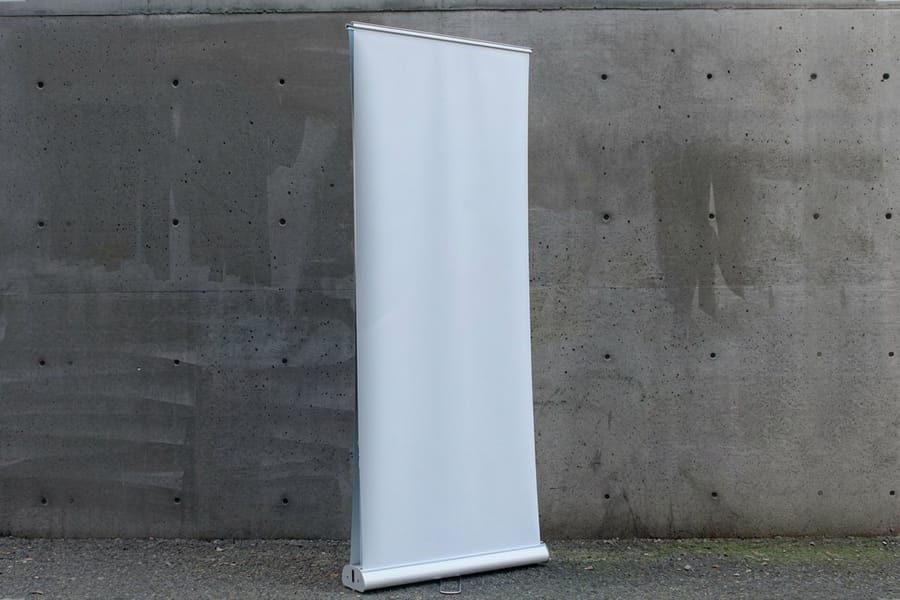
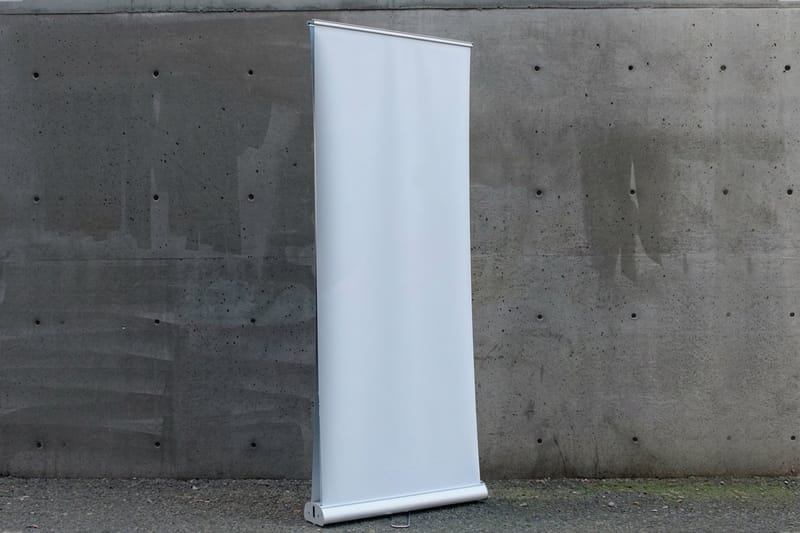
A double retractable stand is $525 for the complete unit: one base, one support pole, and two 33 by 81 inch banners printed on 13oz smooth blockout vinyl. Nothing else is added at checkout to make it two sided, because both faces are the product.
The comparison people expect to win is the one that loses. Two single retractable stands are $139 each, so $278 buys two printed graphics with two bases. Set them back to back and you have a two sided display for roughly half the money. What you also have is two cassettes that never line up perfectly, a visible seam of aluminum down each edge, and two cases to carry through a loading dock.
So the double stand is not a saving on print. It is a saving on floor space, setup time, and how the thing looks from an angle. Buy it when one position has to work in two directions. Buy two singles when you have two positions to fill, which on a corner booth or a two entrance lobby is the more common problem.
| Stand | Printed faces | Graphic size | Material | From |
|---|---|---|---|---|
| Double Retractable Stands | 2, back to back | 33" x 81" fixed | 13oz smooth blockout vinyl | $525 |
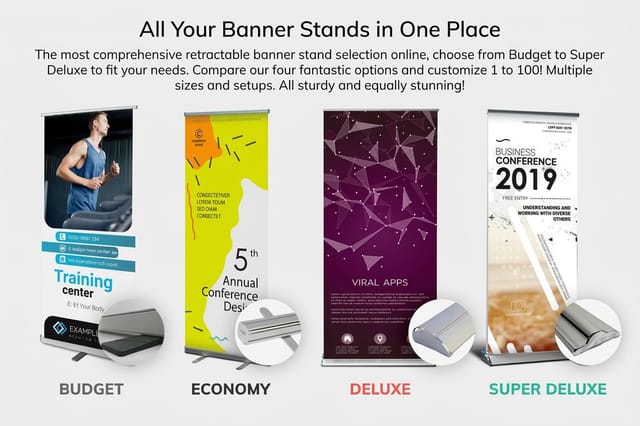
| Retractable Banner Stands | 1 | 13 sizes, 24" x 79" to 59" x 92" | 13oz blockout vinyl | $139 |
| Retractable Fabric Banner Stands | 1 | 8 sizes, 23" x 66" to 60" x 92" | 9oz coated polyester | $159.85 |
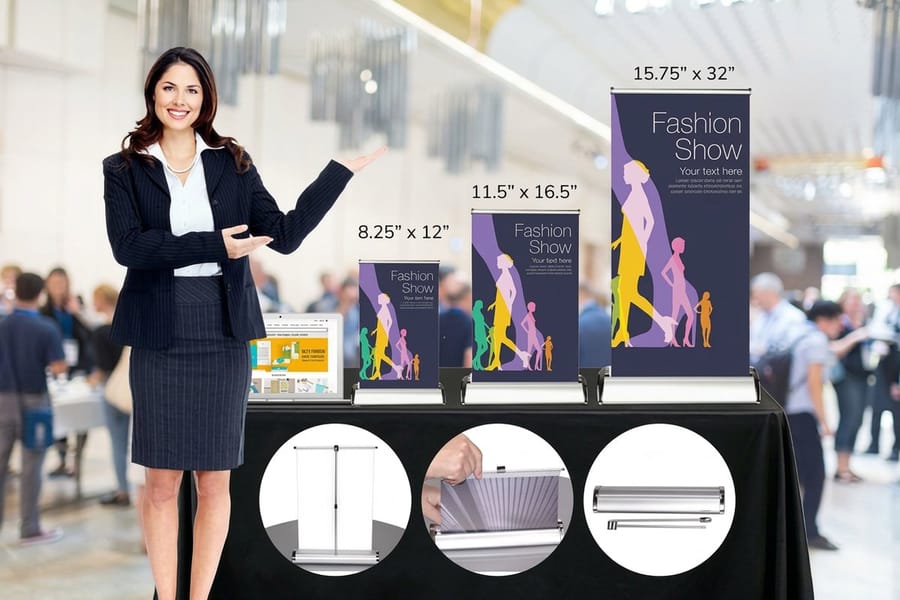
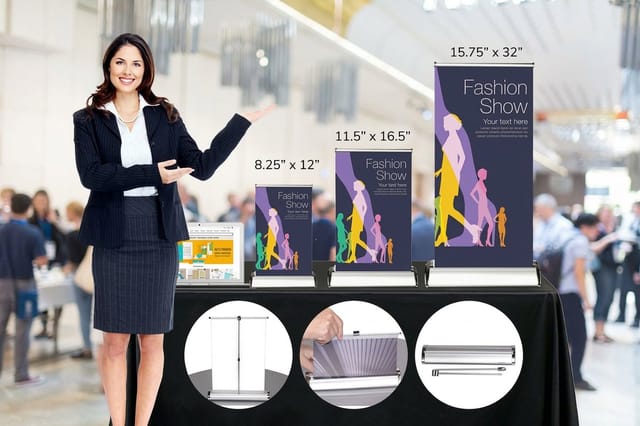
| Mini Retractable Banner Stands | 1 | 8.25" x 12" to 15.75" x 32" | 10 mil premium vinyl | $49.41 |
Read the size column before the price column. The double stand is the only one here with a locked size, which is a fair trade for a fixed piece of hardware but a real constraint if your artwork was built for a 92 inch tall display. The full range sits on banner stands printing if you want to see the sizes next to each other.
Same Artwork on Both Faces, or Two Different Ones
You choose this in the configurator before anything prints, and it changes what you have to supply. Same Design Both Sides takes one file. Two Different Designs takes two, each built to the same 33 by 81 inch canvas.
Pick the same design when the stand sits in open floor and people approach it from any direction. A registration desk in the middle of a lobby, a stand at the mouth of an island booth, a display beside an escalator. One message read from everywhere beats two messages half read.
Pick two designs when the two sides genuinely face different people. A stand at a doorway sees arrivals on one face and departures on the other, so brand goes on the way in and the offer or a QR code goes on the way out. A bilingual room is the other clean case: English on one face, Spanish on the other, one unit on the floor.
The blockout core is what makes either version hold up. Vinyl that is not opaque lets the back graphic shadow through the front the moment a window, a spotlight or a booth light sits behind the display, and dark type reversed on a light field is where it shows first. The 13oz smooth blockout stock has an opaque layer between the printed faces, so face A stays clean regardless of what is on face B. That single spec is why blockout is standard on two sided hardware and why a cheap non blockout banner looks fine in a warehouse and dirty on a show floor. Our banner material guide covers where the other stocks earn their place.
Ordering and Setting One Up, Step by Step

The whole job splits into what you decide before you upload and what you do on site. Neither half takes long, but the first half is where mistakes get expensive.
- Decide the design mode first. Same design or two different designs changes how many files you build, and it is easier to plan than to retrofit once one face is finished.
- Build each face at full size, 33 by 81 inches. Anything you place has to survive that enlargement, so a logo pulled off a website will fall apart. Start from vector art or from a source file big enough to hold up at nearly 7 feet tall, and grab a correctly sized layout from the blank template library.
- Keep live content away from both ends. The bottom of the graphic feeds into the cassette and the top edge clamps into the rail, so a logo or a phone number sitting hard against either edge risks being trimmed by the hardware rather than by us.
- Choose a Free Online Proof or Straight To Production. The proof costs hours, not money. Skip it only when the file is genuinely final, because it is the last free chance to catch a wrong extension or a stale web address.
- Set the turnaround against your real date. Standard is 3 business days. A 2 business day rush adds 25 percent, a 1 business day rush adds 50 percent, and the total updates in front of you.
- On site, work one face at a time. Stand the base flat, extend and lock the support pole, then draw up the first banner and hook its rail before touching the second. Pulling both at once puts an uneven load on the pole and is the usual reason a graphic ends up leaning.
- Retract slowly. Let the spring take the banner back under control rather than releasing it, because a banner that snaps home creases at the leading edge and that crease will read on the next setup.
If you want the mechanics in more detail, the retractable stand setup guide walks a single unit through the same sequence, and how retractable standing banners work covers the cassette itself.
Designing for the Part of the Banner People Actually See
An 81 inch banner does not give you 81 inches of readable space. The lowest foot and a half is regularly behind a table skirt, a chair, a case, or a person standing at the booth edge, and nobody bends down to read it. Treat that strip as background and put nothing there you need read.
What works is a strict order from the top. The brand mark and the single line that has to land sit in the upper half, roughly between 45 and 75 inches off the floor, which is where a standing adult is already looking. Supporting copy goes in the middle. Contact details, a QR code and any fine print go low, where a person who has already stopped will look for them.
One message per face. A two sided stand tempts people into treating each face as a brochure page, and a booth visitor gives a stand about three seconds from ten feet away. Type has to be heavy enough to read at that distance, which in practice means the main line is measured in inches rather than points. The banner fonts guide gets specific about weights and sizes that survive a floor.
Also plan the pair as a pair. When two faces carry different artwork, keep the background color, the type family and the logo position consistent so somebody circling the stand reads one display rather than two unrelated posters bolted together.
Where a Double Stand Earns Its Cost, and Where It Wastes Money
Check it against the floor plan: count how many directions people reach the spot from. At two or more, the double stand earns its cost, as it does at an island booth with aisles on all four sides, in the middle of a lobby that people cross both ways, at a check-in desk with open floor around it, or in a hallway between two conference rooms, where the same unit works the arriving crowd and the leaving one.
It wastes money against a wall. Put a double stand in front of a booth backdrop or a curtain and you have paid $525 to show one graphic to a piece of fabric. That placement is a single retractable stand at $139, every time. Same answer for a stand tucked into a corner or parked at the end of a table run.
Two more limits worth naming. It is indoor hardware: a 33 by 81 inch face is a sail, the base is weighted for a level floor rather than for wind, and a stand that blows over creases the vinyl permanently. And it needs about seven feet of clear height, so a room with a low soffit or a hotel meeting space with a dropped ceiling can defeat it before you unroll anything.
If the display is going on a counter instead of a floor, the mini retractable banner stands start at $49.41 and cover the same job at desk scale. If glare from show lighting is the worry, retractable fabric banner stands print on a matte 9oz polyester weave that throws far less reflection than vinyl. The retractable banner stands video overview, the mini retractable banner stands video and the retractable fabric banner stands video show each one up close. And for a whole booth plan rather than one stand, choosing trade show banners and the banners collection lay out the rest of the kit.
Wally explains the double stand
One base, two faces, nothing showing through
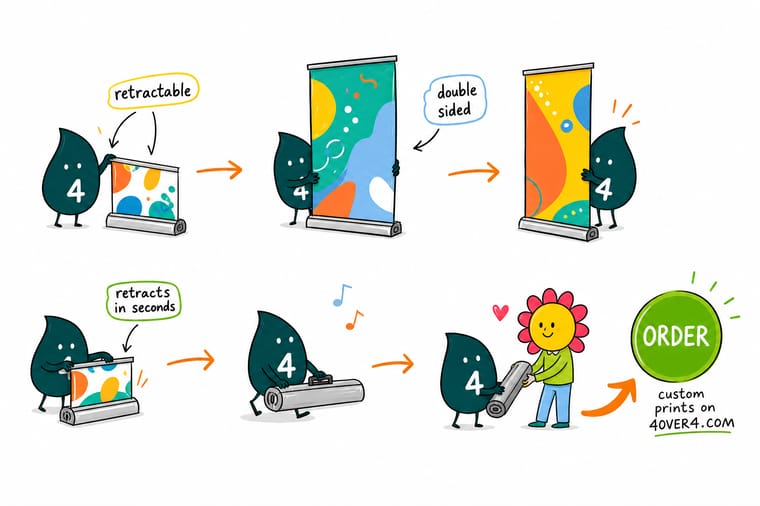
Wally hangs two banners back to back on the same pole and drops them into one base. The aisle on his left reads one face, the aisle on his right reads the other, and the blockout layer in the middle keeps them from bleeding into each other. He will tell you the honest part too: if the back of the stand is facing a curtain, he would sell you a single stand at $139 and keep the difference in your pocket.
Configure a double retractable stand →
Specs and pricing
Sizes, materials and live starting prices
The double stand prints two fixed 33 by 81 inch faces on 13oz smooth blockout vinyl in 3 business days. The single vinyl stand comes in 13 sizes from 24 by 79 inches, and the fabric stand in 8 sizes from 23 by 66 to 60 by 92 inches on 9oz UV printed coated polyester. Configuration options and starting prices come straight from the 4OVER4.COM configurator.

Print it
Order the stand that fits your floor
Mini stands come in 8.25 by 12, 11.5 by 16.5 or 15.75 by 32 inches for a counter, and the single and double floor stands print in 3 business days. Measure the ceiling first: the double needs about seven feet of clear height.

Explore more
Where to go next
Setting up a retractable stand, how the cassette works, banner materials compared, choosing trade show banners, and the stand and display ranges.

By the numbers
What buyers report on the double stand
Common Questions
Double sided stand questions, answered
Is a double sided retractable banner stand one banner printed on both sides?
No. It is two separate printed banners hung back to back on one support pole, each retracting into its own half of a shared base. That construction is what lets you run different artwork on each face, and it is also why the material matters: each banner prints on 13oz smooth blockout vinyl, which has an opaque core so the graphic behind never shows through the one in front. A single sheet printed on two sides would fight itself the moment a window or a booth light sat behind the display.
Can I put a different design on each side?
Yes. When you configure the stand you choose Same Design Both Sides or Two Different Designs. Same design suits a stand in the middle of a floor where you want one message read from every angle. Two designs suit a stand between two zones: brand on the face people see walking in, offer or QR code on the face they see walking out. Two languages on one unit is the other common use, and it costs the same as running the design twice.
What size are the graphics?
Each face is 33 inches wide by 81 inches tall, which is roughly 2 feet 9 inches across and 6 feet 9 inches high. That size is fixed on this product rather than selectable, so both faces share the same canvas and a layout built for one drops straight onto the other. If you need a wider or shorter display, the single face Retractable Banner Stands offer 13 sizes from 24 by 79 inches up to 59 by 92 inches.
Is a double stand cheaper than buying two single stands?
No, and that is the honest trade. Two single retractable stands are $139 each, so $278 gets you two graphics standing in two different places. The double is $525 for two graphics standing in one place. You pay the difference for a display that reads from both directions in a single footprint, one base to carry instead of two, and no visible second stand parked back to back. If your problem is covering two rooms rather than one aisle, buy the two singles.
Can I use one outdoors?
Keep it inside. Retractable stands are indoor hardware: the base is weighted for a level floor, not for wind, and a 33 by 81 inch face is a sail the moment a gust catches it. A stand that goes over lands on its graphic and creases the vinyl, which is not repairable. For anything outdoors, use a feather flag on a ground spike or a grommeted vinyl banner tied to a frame, and keep the retractable for the booth.
How fast can I get one, and what does rush cost?
Standard production is 3 business days at the base price. A 2 business day rush adds 25 percent and a 1 business day rush adds 50 percent, and the configurator shows the adjusted total before you commit rather than after. Choosing Straight To Production instead of a Free Online Proof also saves the hours a proof round takes, but only do that when the file is genuinely finished, because the proof is the last point where a wrong phone number is free to fix.
Get Started
A mini retractable stand costs $49.41, so two is often cheaper
Upload one design or two, pick your turnaround, and we print both 33 by 81 inch blockout faces and ship them in a single base you can set up on your own.
Legal Disclaimer
Gold Standard guarantees apply to all standard orders placed through 4over4.com. Price match requires verifiable proof of a competitor's published price for an equivalent product with matching specifications and turnaround time. Satisfaction guarantee covers manufacturing defects and print quality issues. Contact support with order number and documentation.
