
Comparing Flyer Printers on the Things That Actually Change the Price


You have three flyer quotes and they are hundreds of dollars apart. Forcing them onto one spec is the only way to compare, and there are questions to ask before the cheapest turns into the slowest.
Re-quote every printer on one written spec: exact quantity, flat size, stock weight and coating, ink sides written as 4/4 or 4/1, and turnaround in business days from proof approval. Most of the gap between two flyer quotes closes the moment those five match, and what is left is shipping to your real address, whether the job runs ganged or on a dedicated press sheet, and what happens when a file fails preflight.

Quick answer
One spec, sent to everyone, in writing
A flyer quote only means something next to an identical flyer quote. Fix the five variables that carry the cost, send the same sentence to every printer, and read the differences that survive. Those survivors are the real decision: whether the sheet is ganged with other jobs or run alone, when the production clock starts, whether transit sits inside the quoted days, and what the shop does at 5pm on a Friday when your bleed is missing.
The Five Variables That Have to Match Before Price Means Anything

A flyer quote is a sentence with five nouns in it, and printers write that sentence differently. Line the five up first and most of the mystery in the price gap disappears.
| Variable | What a quote usually says | What to pin down | Why the price moves |
|---|---|---|---|
| Quantity | 5,000 flyers | The exact count, not the nearest bracket | Setup is fixed, so the per piece cost falls in steps, not smoothly |
| Flat size | Letter size | 8.5 by 11 inches flat, and whether it folds | A fold is a second machine pass, and an odd size wastes press sheet |
| Stock | Gloss text | Basis weight and gsm, plus coated or uncoated | Paper is the largest single input on a long run |
| Ink sides | Full color | 4/4, 4/1 or 4/0 spelled out | A black only back saves plates on offset and ink on digital |
| Turnaround | 2 day | Business days, from proof approval, transit excluded | Rush pricing buys press priority, and priority is expensive |
Stock is where the biggest silent difference hides. The everyday flyer sheet is 100lb gloss text, roughly 148 gsm. Drop to 80lb text, around 118 gsm, and the quote falls while the flyer gets floppier and shows more of its back side through the front. Go the other way to 100lb gloss cover, near 270 gsm, and you are holding something closer to a postcard. All three are legitimately called flyers. Only one of them is the one you priced. If the size column is where your quotes disagree, the flyer size and dimensions guide lists what each standard size does to cost and to postage.
Why the Cheapest Quote Is Almost Always a Gang Run

When a printer comes in well under everyone else on the same spec, they are rarely being generous. They are ganging.
A gang run places several customers’ jobs on one large press sheet. Everyone on that sheet shares the plates, the makeready, the wash up and the press minutes, which is the single biggest cost in offset printing. That is how a real printer sells 5,000 letter flyers for a price that looks impossible. The print quality is ordinary offset quality, which is to say good.
The cost sits somewhere else. The operator has to balance ink across every job on the sheet, so a heavy solid belonging to somebody else can nudge your reds and your skin tones. Run the same file again next month, on a sheet shared with different jobs, and it can land slightly differently. That does not matter for a flyer handed out at a door. It matters when the flyer sits on a table next to a brochure that has to be the same brand red, and in that case you want a dedicated run and you should expect to pay for it. If your artwork lives on one or two brand colors, printing it as spot color sidesteps the whole problem and often costs less than full color.
Quantity decides which press you are even talking about. Below roughly a thousand letter size flyers, digital usually wins, because there are no plates to make and no makeready to pay for. Push into several thousand and offset pulls ahead and keeps pulling ahead as the count climbs. A quote that is wildly cheap at 500 and wildly expensive at 10,000 is simply a digital shop, and the reverse is an offset shop. Our overview of presses and equipment used in printing explains which class of machine your run belongs on.
Turnaround: Whose Clock, Starting When

Two printers both promise two business days. One of them lands on your desk on Thursday and the other one on the following Tuesday. Neither of them lied.
Three things move independently. First, when the clock starts. On most online printers production begins after proof approval, not after upload, so a file uploaded at 4pm and approved the next morning has already burned a day. Second, the daily cutoff, which is a real hour on a real clock and is usually early afternoon local time at the plant. Third, transit, which sits outside the quoted number almost everywhere and runs one to five business days by ground depending on distance from the plant.
Add those to a two day production quote and the honest answer is closer to six business days from upload to hand. That is not a complaint about printers, it is how the shop floor works, and any printer will tell you the same across a counter. Just make sure you are asking all of them the same question, because a quote that quietly includes transit will look slower than one that quietly excludes it while actually being faster.
If the event date is fixed, work backwards from it: delivery date, minus transit, minus production days, minus your own approval time, equals the last hour you can upload. Build the campaign around that hour. The rest of the flyer printing guides cover the file and design decisions that need to be finished before it arrives.
Running the Comparison in One Row Per Printer

Put the quotes in a table with one row per printer and stop reading marketing copy. Nine columns settle it.
- Re-quote everyone on one spec. Write it out once: 5,000, 8.5 by 11 flat, 100lb gloss text, 4/4, standard turnaround. Send that exact string to each printer.
- Record price, per piece price, and next quantity up. The next step often costs a few dollars more for a thousand extra pieces, which is the cheapest marketing you will buy that week. The price break guide shows where those steps land.
- Record landed shipping to your real address. Not an estimate, a checkout number.
- Record the clock. Production days, whether they start at approval, the cutoff hour, and transit days to your zone.
- Ask whether the run is ganged or dedicated. Any honest printer will answer. The answer tells you what a reprint will look like.
- Order samples before the big run. Paper arguments end the moment two sheets are in your hands. Ours are free to request.
Then take the top two and place a small order with each. A short run costs less than a bad five thousand, and it tells you the two things a quote never will: what the color actually looks like on that stock, and how the shop behaves when your file has a problem. Once you know that, the same five variables let you price everything else the campaign needs, from outdoor banners at $79 to the a-frame signs that carry the same offer on the sidewalk. Names differ, the arithmetic does not, and the same logic applies to a leaflet versus a flyer once you strip the words away.
Wally compares three quotes
Same word, three different flyers
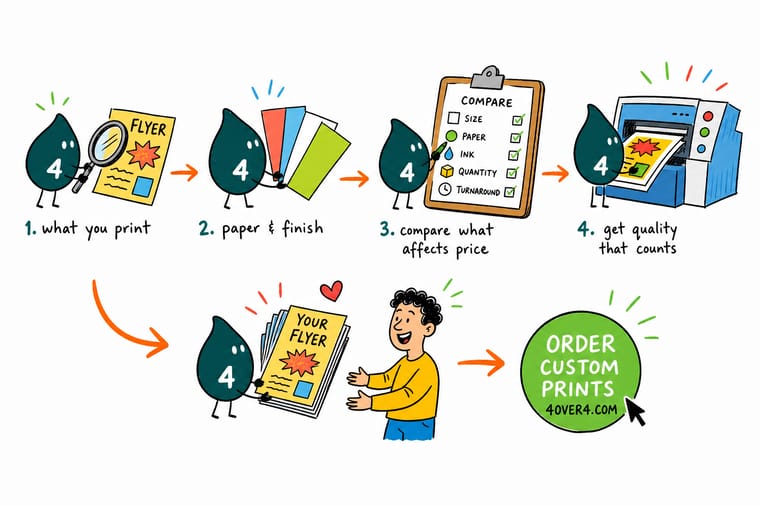
Wally lines the quotes up and reads the small print instead of the big number. The first one is 80lb text, the second is 100lb gloss text, the third is full color on one side and black on the other. Three prices, three products. He rewrites the spec once, sends the same sentence to all three, and the gap shrinks to shipping and turnaround. Then he asks the one question that decides a reprint: is my flyer sharing a press sheet, or running on its own.
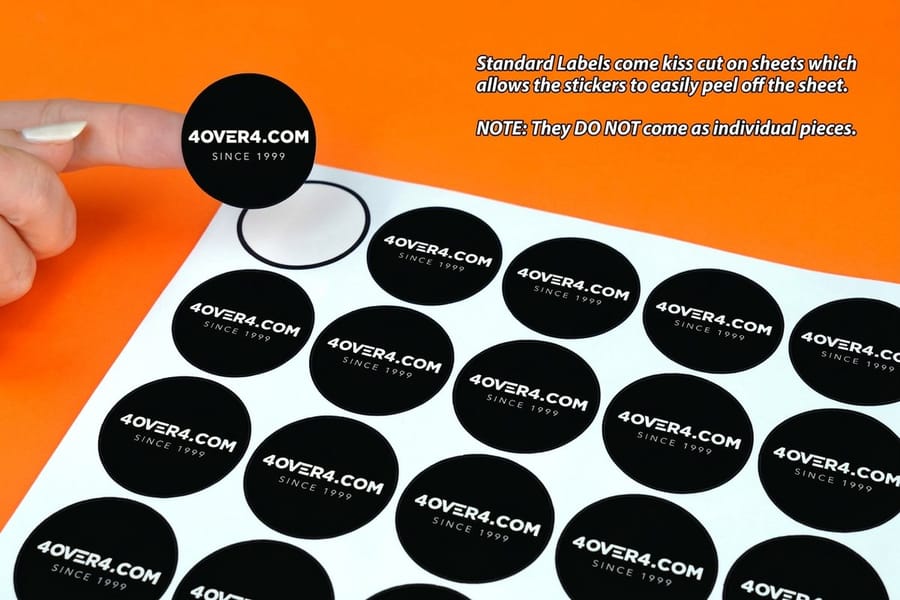
Price standard labels live →Specs and pricing
See how a live quote is built, option by option
Every option that moves a price on a flyer moves it the same way on the rest of the catalog. Open a configurator, change one variable at a time, and watch the number react before you send a quote request anywhere else.



Print it
Price the rest of the campaign the same way


Explore more
Where to go next





By the numbers
What you are comparing us against
Common Questions
The questions buyers ask once the quotes are on the table
Why is one flyer quote half the price of another?
Nine times out of ten the two quotes are not for the same object. Check the stock first, because 80lb gloss text and 100lb gloss text look identical in a quote line and feel completely different in a hand. Then check sides, since a 4/1 job with a black only back is cheaper than full color both sides. Then check quantity, because 2,500 and 5,000 sit on different price steps. If all of that matches and the gap survives, the cheaper printer is almost certainly ganging your flyer onto a shared press sheet while the other one is running it alone.
What is a gang run, and does it hurt the print?
A gang run puts several customers’ jobs on one large press sheet so they share the plates, the makeready and the press time. The printing itself is normal offset work and the quality is good. The trade is color consistency: the press operator balances ink across every job on that sheet, so your red can land slightly differently on a reprint that shares the sheet with a different set of jobs. For a handout flyer nobody will notice. For a flyer that has to sit next to a printed brochure in the same brand red, ask for a dedicated run and expect to pay for it.
Does the turnaround a printer quotes include shipping?
Usually not, and this is where most schedules break. The number in the quote is production time in business days, and on most sites that clock starts when you approve the proof rather than when you upload the file. Miss the daily cutoff and you lose a day before anything is printed. Ground transit then adds one to five business days depending on how far you are from the plant. Ask two questions of every printer: when does the clock start, and is transit inside the number.
Should I pay for a hard copy proof on a flyer?
For a straight reprint of a file you have run before, no. For a first run with a critical brand color, a large solid area, or heavy ink coverage on an uncoated stock, a hard proof is cheaper than reprinting five thousand pieces. What a hard proof cannot promise you is an exact match on a gang run, since your sheet shares its ink balance with other jobs. If the color is that important, the real answer is a dedicated run, not a better proof.
Is it cheaper to print 5,000 flyers at once or 2,500 twice?
One run of 5,000 is nearly always cheaper, because the expensive part of an offset job is everything before the first good sheet: plates, makeready, wash up. Split that setup across two orders and you pay for it twice, plus a second shipment. Two smaller runs only win when the content changes between them, when storage is a real problem, or when the extra 2,500 would sit in a closet until the offer on them expired. Our guide to how price breaks work walks through where the steps sit.
What should I check on a printer besides price and speed?
Three things that only appear when something goes wrong. What happens if a file fails preflight, meaning whether you get a call and a fix or a silent hold that eats two days. What the reprint policy covers, meaning whether a color complaint on a gang run counts. And whether the shipping quote is real, since a hundred pound skid of flyers to a residential address is not the same shipment as a box to a loading dock.
Get Started
Put our configurator price next to your other two quotes
Configure the job, watch the price move as you change stock, quantity and turnaround, and see the shipping cost to your address before you commit to anything.
Legal Disclaimer
Gold Standard guarantees apply to all standard orders placed through 4over4.com. Price match requires verifiable proof of a competitor's published price for an equivalent product with matching specifications and turnaround time. Satisfaction guarantee covers manufacturing defects and print quality issues. Contact support with order number and documentation. On-time delivery rate based on tracked orders 1999 to 2026. Individual results may vary based on shipping carrier performance.
