
How to Make an Accordion Fold Book That Opens Clean Every Time


An accordion fold turns a flat sheet into a book that expands like a bellows. The inward panels have to run about a sixteenth narrower, or the book bows when it closes.
An accordion fold book, also called a concertina fold, is a single sheet folded in alternating directions so the panels open and close like a bellows. To make one, divide your sheet into equal panels, make the inner tuck panels about 1/16 inch narrower so they nest without buckling, score heavier stock before folding, and lay out your art panel by panel with the reading order in mind.
Start here
A bellows made from one sheet
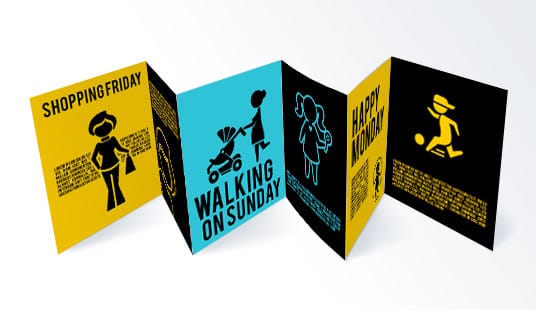
An accordion fold book is one sheet creased in alternating directions so it stretches open like a paper bellows. Split the sheet into panels, trim the inner tuck panels a hair narrower so they nest cleanly, score heavy stock before folding, and lay your artwork out panel by panel in the order a reader will see it. Do that and your concertina book opens flat, folds tight, and tells its story in sequence. The diagram below shows the panel math behind a clean fold.
What is an accordion fold book?

An accordion fold, also called a concertina fold, is a series of parallel folds that alternate direction down a single sheet. Fold one, reverse the next, reverse again, and the sheet no longer nests inside itself the way a letter or roll fold does. Instead it expands and contracts like the bellows of an accordion, which is exactly where the name comes from. Open it fully and you get one long continuous strip of panels; close it and the whole thing collapses into a neat stack the size of a single panel.
That structure suits anything that benefits from a reveal or a timeline: event programs, menus, maps, product lineups, and mini lookbooks. It is a close cousin of the standard folded brochure, just with more panels and a different fold logic. If you have only ever folded a tri-fold, our guide on accordion fold brochures shows where the format shines before you commit to a build.
Set up your panels and the tuck math

One mistake trips up most first builds: treating every panel as the exact same width. In an accordion, the panels that fold to the inside have to be a touch narrower than the outer panels, or they buckle and bow when the book closes. The fix is to trim each inward-tucking panel by roughly 1/16 inch. On a four-panel piece that difference is small, but skip it and your carefully centered art creeps across a fold every time the book is closed and reopened.
Start by measuring the finished panel size, then set vertical guides on every fold line before you place a single element. Treat each panel as its own small page with its own safe margin, and keep important text and logos away from the creases. If you would rather not do the panel math by hand, our online design tool and the product templates start you at the right panel widths with the folds already marked.
Fold counts, sizes, and stock

Accordion books scale by panel count. A four-panel fold gives you two folds and a compact program or menu. Six and eight panels open into a longer strip for timelines, maps, and product lineups. Common flat sizes start from a letter sheet and go up, and the closed size is simply one panel wide, so a piece that fits a pocket or an envelope closed can open into something much larger. Pick the closed size first if it has to mail or fit a display, then divide into panels from there.
The bigger the piece and the heavier the ink coverage, the more the paper matters. Text weights fold easily but feel flimsy when extended, while cover weights stand up on a shelf but demand scoring. For a booklet-style feel, our booklets and folded flyers are worth comparing, and ordering the full quantity at once earns our bulk discounts.
Choosing stock and scoring the folds
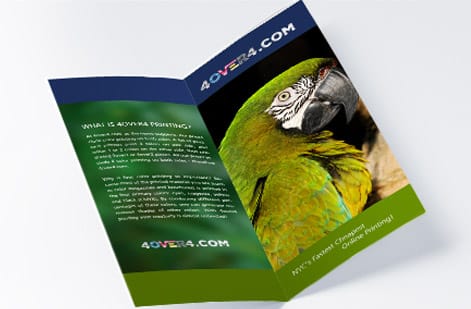
Fold quality lives and dies on the stock and the score. Light text stock creases fine with just a fold, but anything from a heavy text weight up through cover stock needs a scored line first. Scoring presses a channel into the paper so the fibers bend instead of breaking, which keeps the fold crisp and stops the ink from cracking along the crease. Without a score, a dark or solid-color panel edge can show a pale fracture line the moment it folds.
Coating matters too. A matte or uncoated finish hides fold stress better than a high gloss, which can telegraph every imperfection along a crease. When you are unsure how a given weight will behave, proof it. Every order includes free proofs, and you can request stock samples so you feel the fold before you print the run.
Designing across the panels
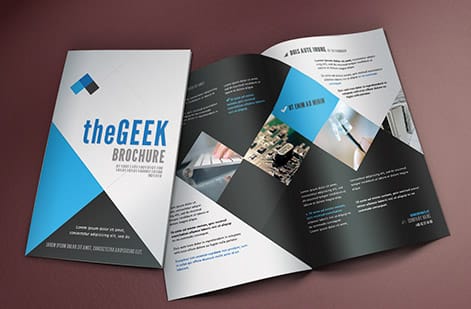
An accordion has two faces and a reading order that changes as it opens, so plan the sequence deliberately. One side usually carries the front-to-back reveal a reader sees panel by panel as they unfold it, while the reverse can hold a single large image or a map that only makes sense fully open. Decide which story goes on which face before you design, and number your panels so nothing lands out of order at the folder.
You can let a background image span the whole extended strip for drama, or keep each panel self-contained for a step-by-step feel. Either way, respect the safe margin on every panel and keep headlines off the folds so no key word gets creased. A strong grid ties the panels together, the same discipline covered in our guide on print folding options.
Print-ready files, cost, and turnaround
When the layout is set, export a flattened, press-ready PDF with bleed on every outer edge and your fold marks indicated, not drawn into the art. Keep the color in CMYK and images at full resolution so nothing goes soft when it prints at size. Because the folds are the trickiest part, confirm your panel widths against the product's fold layout one last time before you upload. Our guide on how to fold a brochure covers the same bleed-and-fold checks that apply here.
Cost follows quantity, flat size, stock, paper, and finish, and the configurator updates the price live as you set each option, so a heavier stock or a larger run shows its effect before you commit. If it is your first accordion job, you can order free printing samples to feel the fold, and rush delivery keeps an event deadline on track.
Wally folds the panels so the book opens flat
Concertina done right, no buckling at the spine
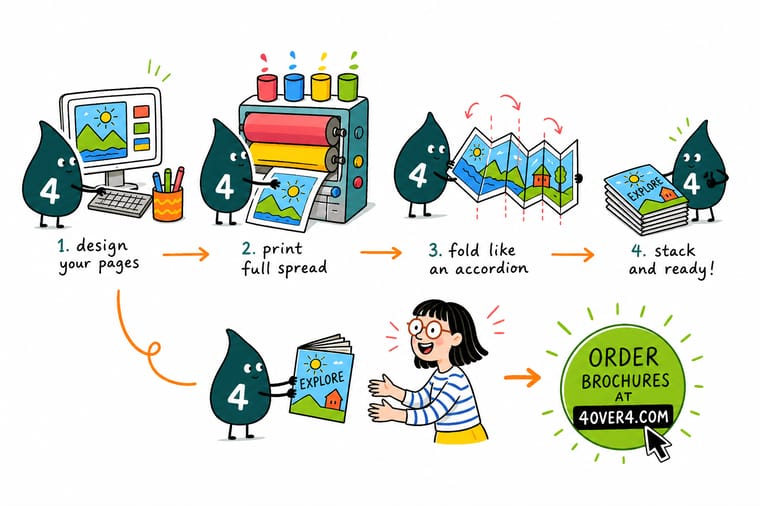
Wally splits the sheet into even panels, trims the inner tuck panels a hair narrower so they nest, and scores the heavy stock so every crease stays crisp. He lays the art out in reading order, runs the background past each edge, and exports a flattened press-ready PDF. Open it and it lies flat, close it and it stacks tight.
Print your accordion book →Quick reference
Accordion fold setup at a glance
Nail these settings and your concertina book opens flat, closes tight, and reads in the right order.
| Setting | Get it to | Why it matters |
|---|---|---|
| Fold pattern | Alternating creases | Each fold reverses so the sheet zigzags open like a bellows. |
| Panel count | 4, 6, or 8 panels | More panels give a longer reveal for timelines and maps. |
| Tuck panels | About 1/16 in narrower | Inner panels nest without buckling when the book closes. |
| Stock | Text to cover weight | Heavier stock stands up open but needs a scored crease. |
| Scoring | Score above text weight | A pressed crease keeps folds crisp and stops ink cracking. |
| Bleed | 0.125 in past edges | Backgrounds run off the trim so no white sliver shows. |
| File | Flattened CMYK PDF | A press-ready PDF prints predictably with folds marked. |
| Bone folder | One, used on every crease | It presses the fold flat without the burnished shine a fingernail leaves on a coated sheet. |
| Scoring board | Board plus scoring tool | It drops the crease in the same spot on every sheet, so an accordion fold booklet closes square instead of fanning at the edge. |
| Metal ruler | Steel, longer than the sheet | A steel edge does not shave under a blade the way a plastic ruler does, so panel cuts stay straight. |
| Cutting mat | Self-healing mat | It saves the table and keeps the knife tracking on long trims across the open strip. |
| Glue | PVA or double-sided tape | Use it to splice two sheets into a longer strip, or to mount cover boards on the two end panels. |
Step by step
Build an accordion fold book in 6 steps
- Pick the closed size and panel count Choose the folded size first if it must mail or fit a display, then divide into four, six, or eight panels. Four panels keep an accordion fold booklet pocket sized, six or eight stretch the reveal far enough for a timeline, a map, or a full product lineup.
- Draw the panel guides Set the finished panel width, then trim each inward-tucking panel about 1/16 inch narrower and place guides on every fold. Mark which creases point up and which point down while you are still on screen, because the inward panels are the ones that vanish inside the closed book and they are the ones that buckle if you skip the 1/16 inch.
- Design panel by panel Treat each panel as its own page with its own safe margin, and lay the content out in the order a reader unfolds it. Number the panels front face first and back face second, so the story still reads in sequence when the strip gets turned over.
- Choose a stock that folds clean Pick text weight for easy folding or cover weight for shelf presence, and plan to score anything heavier than text. Score first on the scoring board, one pass per crease, then fold against the metal ruler on the cutting mat and set each crease with the bone folder. Alternate the direction of every fold, mountain, valley, mountain, valley, so the sheet zigzags rather than nesting, and square the stack against a flat edge before you press the closed book down.
- Add bleed and export a press-ready PDF Run backgrounds past every edge, keep color in CMYK, and export a flattened PDF with fold marks indicated. Bleed 0.125 in past each trim, and pull type and logos well clear of the creases so nothing important lands in a fold.
- Proof, then print the run Confirm the fold and panel widths on a proof, order the full quantity for the volume price, and add rush if needed. Fold the proof by hand and close it: if a panel edge sticks out past the others, the tuck panels are still too wide, and that is cheaper to fix on one sheet than on the whole run.
Specs and pricing
Folded printing specs and live pricing
Accordion books print on our folded brochure line, at 50 for $57.11, which is $1.14 each.

| Quantity | Price Per Unit | Total |
|---|---|---|
| 50 | $1.14 | $57.11 |
| 100 | 82.4¢ | $82.38 |
| 200 | 53.3¢ | $106.55 |
| 300 | 41.0¢ | $123.02 |
| 400 | 34.9¢ | $139.49 |
| 500 | 31.2¢ | $155.97 |
| 600 | 26.7¢ | $160.36 |
| 700 | 23.5¢ | $164.75 |
Print it
Print your accordion fold book at 4OVER4

See it in use
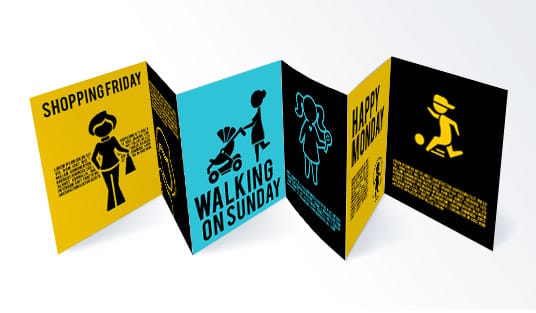
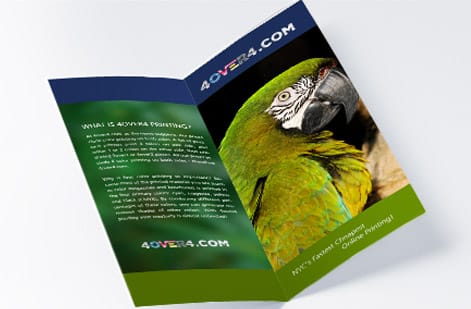
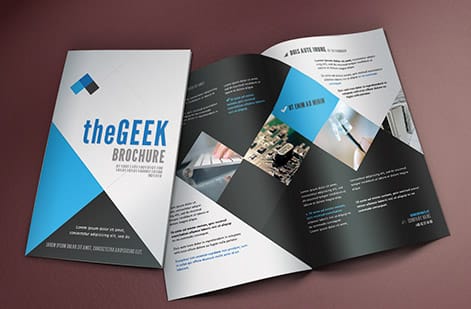
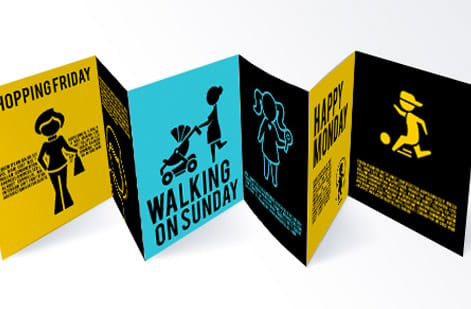
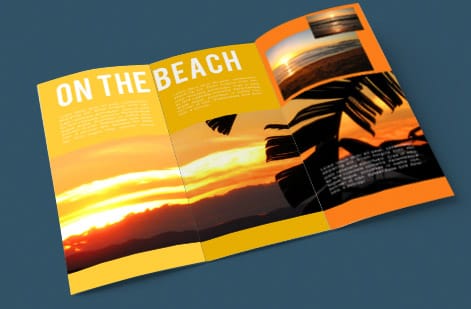
Folded pieces we scored and creased here



Explore more
Where to go next


By the numbers
The stock list behind an accordion fold
Common Questions
Common questions about accordion fold books
What is an accordion book?
An accordion book, also called a concertina fold, is a single sheet creased in alternating directions so the panels open and close like a paper bellows. Fully extended it forms one long strip of panels, and closed it collapses to the width of a single panel. The format suits event programs, menus, maps, timelines, and product lineups that benefit from a reveal as they unfold.
Is an accordion fold booklet the same as a concertina fold?
Yes. Concertina fold is the bookbinding name and accordion fold is the printing name for one and the same thing: a single sheet creased in alternating directions so the panels open like a bellows. Zigzag fold and fanfold describe it too. What it is not is a roll fold, where every panel wraps inside the one before it and each panel has to step down by far more than the 1/16 inch an accordion needs. Ask for it by either name and you will get the same folding pattern. If you would rather have it scored and folded on press than by hand at the kitchen table, an accordion fold booklet runs as folded brochures when it stays one long scored sheet, or as booklets when the piece needs bound pages instead of a strip.
How many panels before the sheet gets unwieldy?
Start with the closed size if the piece must mail or fit a display, then pick a panel count: four for a compact program, six or eight for a longer reveal. Choose text weight for easy folding or cover weight for shelf presence, remembering that heavier stock needs scoring. Match the fold count and size to the amount of content and the story you want to tell.
What does an accordion book cost and how are prices set?
Price scales with quantity, flat size, stock, paper weight, and finish. Quantity matters most because setup is spread across the run, so a larger order costs less per piece. Heavier stocks, larger flat sizes, and added finishes raise the unit price. The configurator shows the live total as you set each option, so you can see the effect of every choice before ordering.
What sizes, stocks, and finishes are available for an accordion book?
Flat sizes start around a letter sheet and go up, with the closed size equal to one panel width, and panel counts of four, six, or eight are common. Stocks range from foldable text weights to sturdier cover stocks, with matte, uncoated, or gloss finishes. Scoring is recommended on heavier stocks, and an optional coating adds durability for pieces that get handled often.
How long does an accordion book take to print and ship?
Turnaround depends on the product, quantity, stock, and finish, and the configurator shows the current estimate before you order. Folding and scoring are part of the production time, so factor those in for a tight deadline. A rush option is available, and you can order free printing samples first to feel the fold and stock before committing to a full run.
Why do the inner panels need to be narrower?
When an accordion book closes, the panels that fold to the inside have to fit within the panels that wrap around them. If every panel is the exact same width, the inner ones buckle and push the art out of alignment. Trimming each inward-tucking panel by about 1/16 inch lets them nest cleanly, so the book closes flat and your layout stays put through repeated use.
Get Started
Order 50 folded flyers at $1.37 each
Set your panel count, size, stock, and finish, and watch the price update live. We score and fold every piece so your concertina book lies flat open and stacks tight closed.
Legal Disclaimer
Gold Standard guarantees apply to all standard orders placed through 4over4.com. Price match requires verifiable proof of a competitor's published price for an equivalent product with matching specifications and turnaround time. Satisfaction guarantee covers manufacturing defects and print quality issues. Contact support with order number and documentation. On-time delivery rate based on tracked orders 1999 to 2026. Individual results may vary based on shipping carrier performance.
