
How to Order a Logo Tablecloth That Fits Your Table and Prints Sharp


Sofia is our design and templates voice, built from the knowledge of our production team, with over 20 years in printing.
Ordering a logo tablecloth comes down to four decisions: the table, the style, the fabric, and where the logo sits. This guide takes each one, with the numbers and the traps.
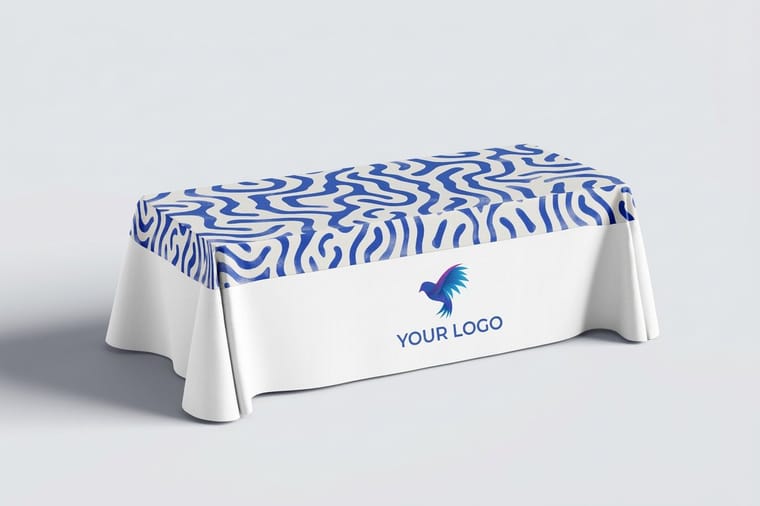
To order a logo tablecloth, measure the table length and height, choose a throw, a fitted cover, a stretch cover or a runner, choose the fabric, then supply artwork with the logo centered in the top third of the front drop. The printer works the flat cut out from the table size, so a 6 ft banquet table becomes a 132 by 90 inch four sided throw, or 132 by 60 with the back left open for staff and storage.
Quick answer
Measure the table, then let the drop do the arithmetic
The one number that decides everything is the height of the table. Whatever it measures from the floor is the drop, and the flat cut is the top plus one drop for every side you cover. That is why a 6 ft banquet table takes a 132 by 90 inch cover with the back closed and a 132 by 60 with it open, and why a 42 inch cocktail round will not accept a cover cut for a 30 inch banquet table. Style and fabric change how the cover looks and how it ages. Size is the part that either fits or does not. To heat transfer a logo to a tablecloth, you send the artwork and the press does the heat work: dye sublimation drives the dye into the polyester fiber, so the logo does not crack along a fold and comes through a cold wash intact.
The Four Cover Styles, and What Each One Looks Like on the Floor
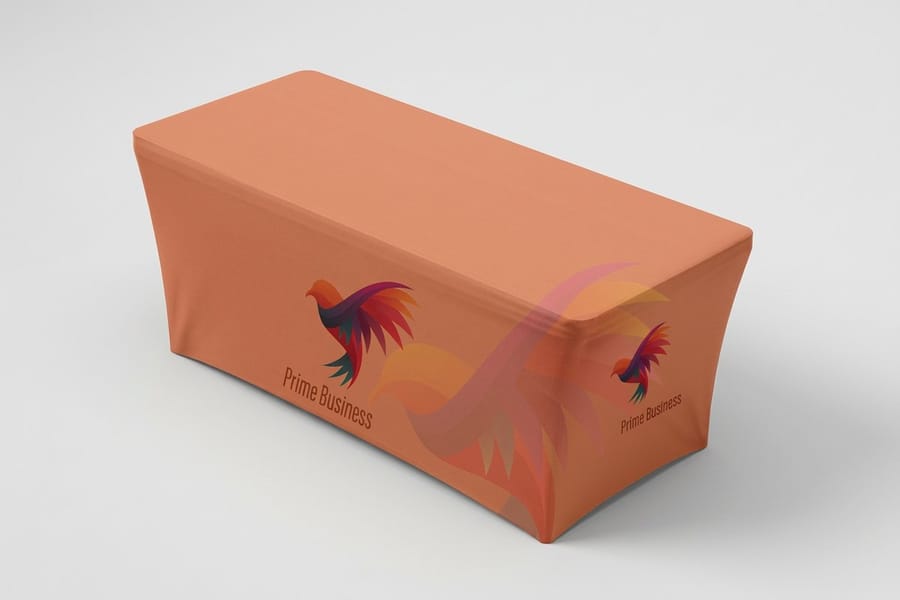
Style is the first decision because it changes the shape of the artwork panel, and changing your mind later means a new cut. Four styles cover almost every booth.
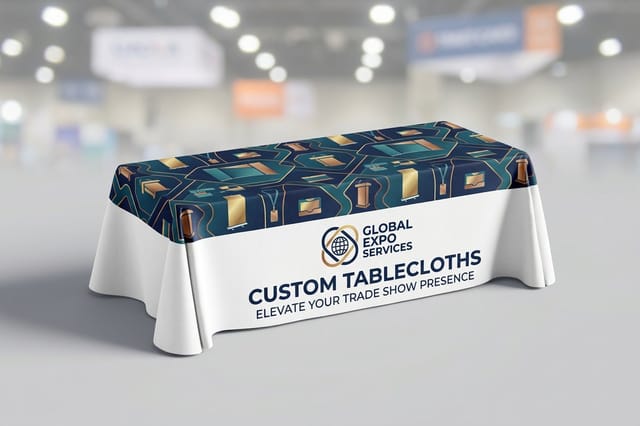
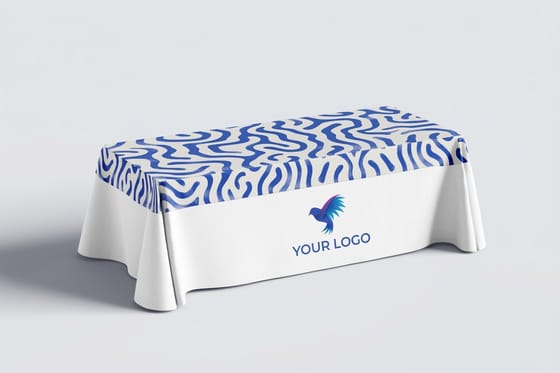
A throw is one printed panel that drapes over the table with loose corners. It is the classic trade show cover, it fits a range of table depths without complaint, and the soft corners read as relaxed rather than sloppy. Table throws start at $225.00.
A fitted cover has the corners sewn, so it sits square and the front panel stays flat instead of pooling. Use it when the table is on camera or when the artwork has straight rules that a soft corner would bend. It is less forgiving about table size than a throw.
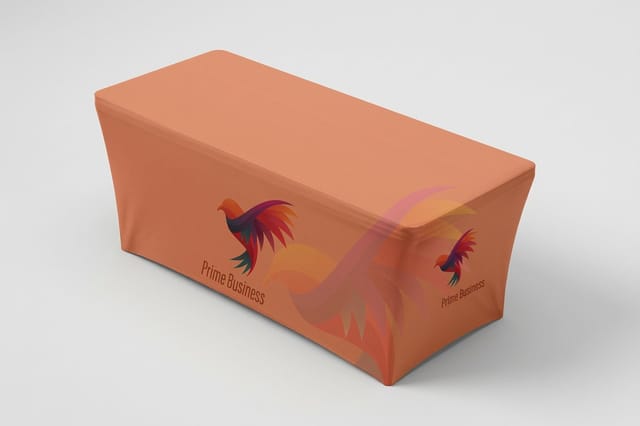
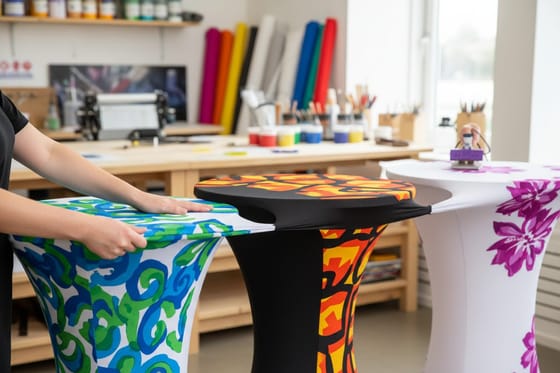
A stretch cover is a knit that pulls tight over the top and down the legs, sometimes with pockets that hook under the feet. It photographs sharper than anything else here because there is no slack anywhere. The catch is the size window: a stretch cover made for a 6 ft table will sag on a 4 ft table and will not reach the corners of an 8 ft one. Stretch table covers start at $250.00.
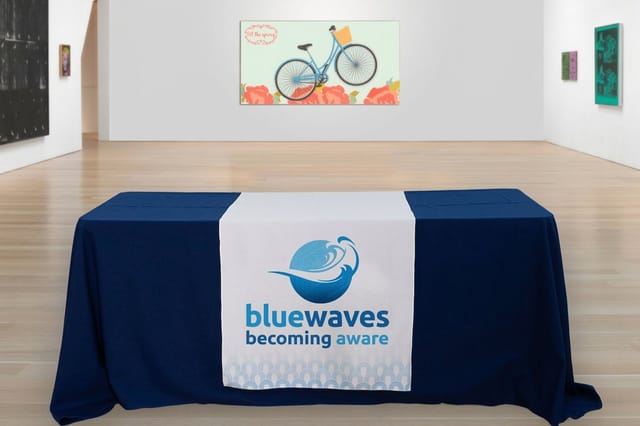
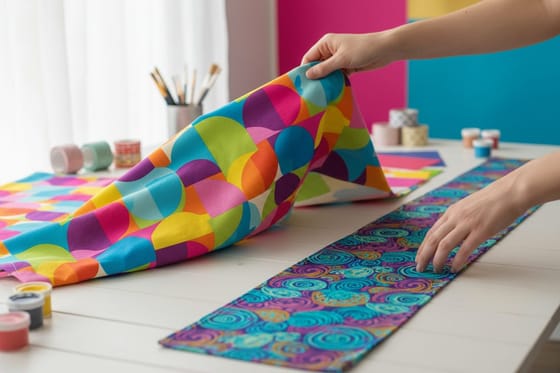
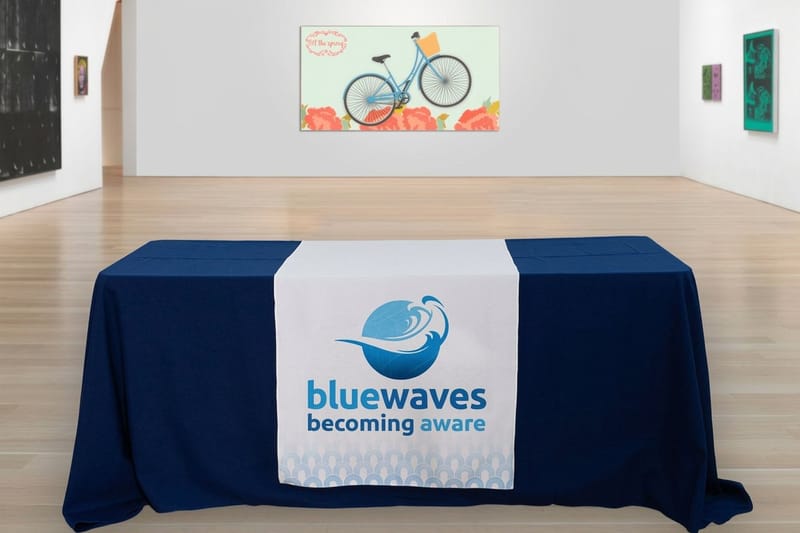
A runner brands a strip across the table and leaves the rest exposed. It is the right answer when the venue supplies its own linen and forbids you to remove it, or when the budget is thin, and the wrong answer when you want the whole table to read as yours. Table runners start at $97.76. The covers against runners comparison walks through the cases where each one wins.
Sizing to Your Table: Length, Height, and How Many Sides
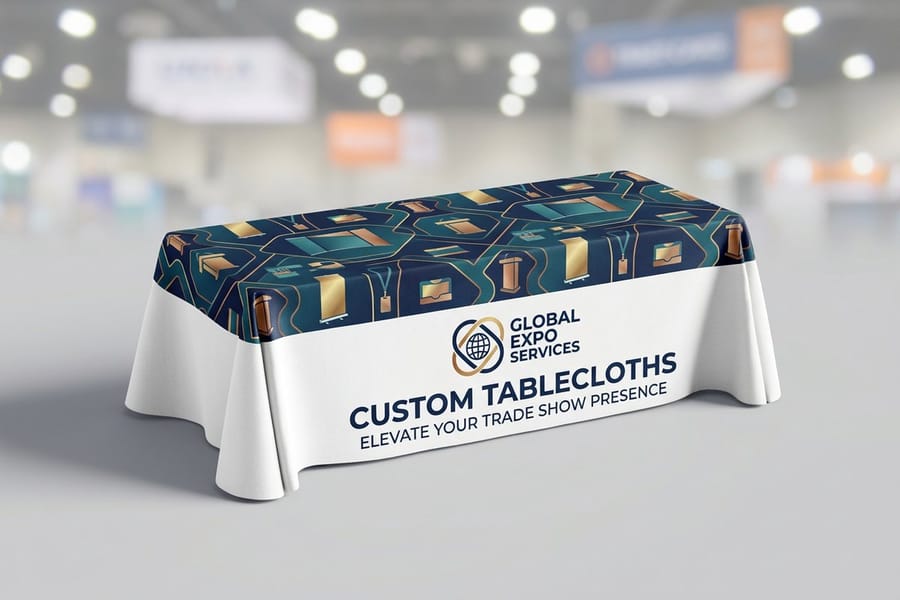
Measure three numbers before you open the order form: the length of the table, the depth of the top, and the height from the floor. Length picks the product. Height sets the drop. Depth only matters if the table is unusual.
The rule underneath every size on the site is simple. The flat panel is the top plus one table height for each side you cover. Cover four sides of a 6 ft banquet table and you are cutting 132 by 90 inches. Leave the back open and the same table takes 132 by 60. The same arithmetic sizes the 6 ft and 8 ft versions of our vinyl table covers.
| Table | Top | Height | Four sided cut | Open back cut |
|---|---|---|---|---|
| 4 ft banquet | 48 x 30 in | 30 in | 108 x 90 in | 108 x 60 in |
| 6 ft banquet | 72 x 30 in | 30 in | 132 x 90 in | 132 x 60 in |
| 8 ft banquet | 96 x 30 in | 30 in | 156 x 90 in | 156 x 60 in |
| Cocktail round | 30 in diameter | 42 in | 114 in diameter | not applicable |
Two traps live in that table. The first is height: a cocktail or bar height round stands 42 inches, not 30, and a cover cut for a banquet table will hang a foot off the floor on it. Order round table covers by the round you actually have, starting at $149.00. The second is the venue: hotels and convention halls hand out 6 ft tables far more often than 8 ft, but the floor plan rarely says which, so ask the show organizer rather than guessing. Full dimensions for every standard size sit in the table cover sizes and fit guide, and the round table covers video runs through the round cover in under two minutes.
Choosing the Fabric, and What Each One Costs You
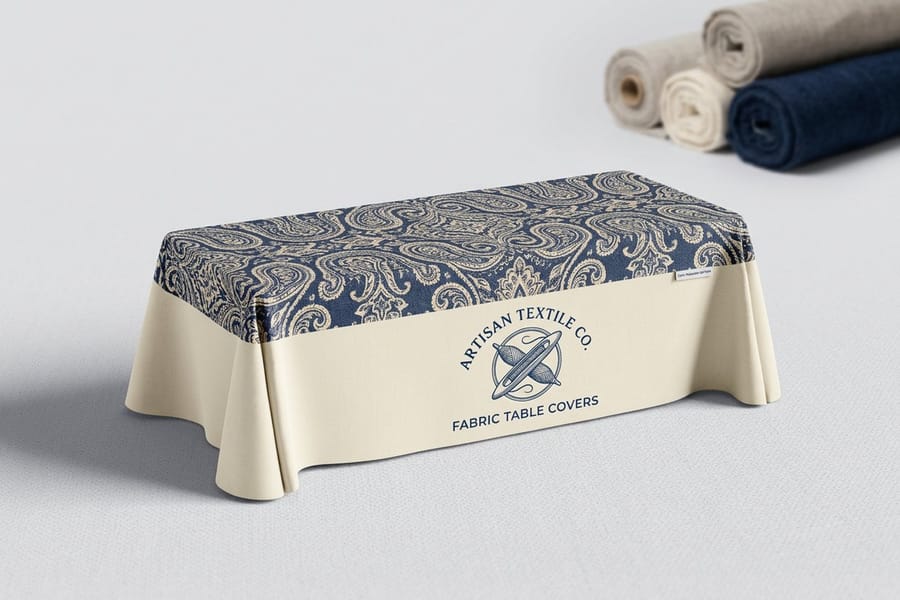
Fabric decides how the cover survives its second show, not its first. Everything looks fine out of the box.
Printed polyester is the default for good reason. The graphic is dye sublimated, which means heat drives the dye into the fiber instead of laying ink on the surface, so the print does not crack along a fold and it comes through a cold wash intact. It also breathes, which matters more than it sounds when a cover spends three days under booth lights. Fabric table covers and polyester table covers both work this way, and the polyester table covers story shows the finished cover up close.
Stretch knit trades forgiveness for sharpness. It grips the table, kills every wrinkle, and gives the drum tight look that reads well in photographs. It also shows the shape of anything stored on the table and it only fits the size range it was cut for.
Vinyl wipes clean and shrugs off a spilled drink, which is why it turns up on food service and outdoor tables. It is stiff, it holds a crease that no steamer will remove, and it will not go in a washing machine. If the cover lives at a farmers market stall it earns its place. If it lives in a show crate it does not. The polyester against stretch against vinyl comparison tests the three side by side.
One more thing about color. A mid tone or a pattern hides the low ridges that any fabric picks up in a crate. A flat, deep, saturated background is the least forgiving choice you can make, because every fold line reads as a lighter stripe under booth lighting. Designers who like black covers should plan on a steamer.
Artwork, the Front Panel, and What to Send Us
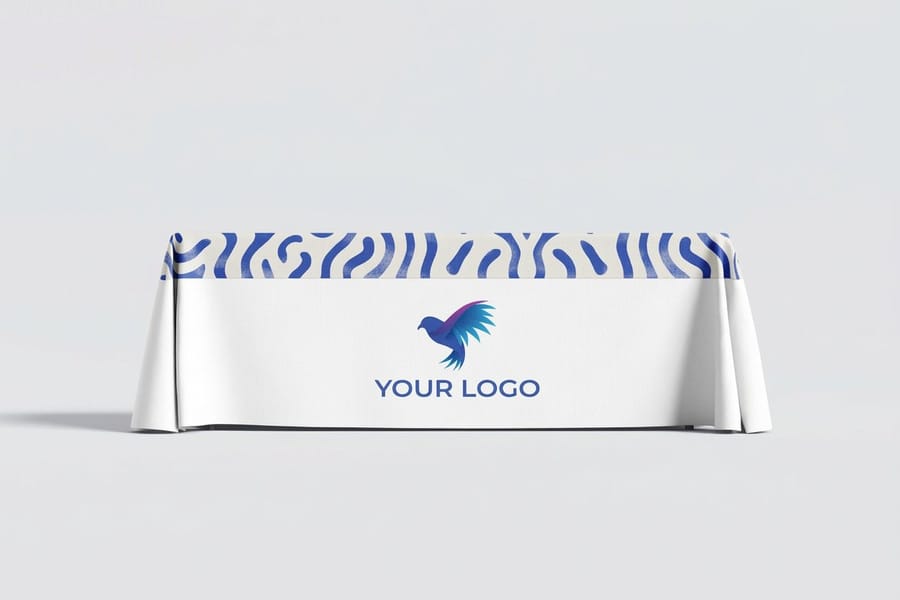
Only one part of a table cover does any work: the band across the front, from the table edge down about a third of the drop. Everything below it is behind a chair by ten in the morning.
So build the artwork around that band. Center the logo on it, put the web address on the same line or just under it, and stop. A tagline in small type along the bottom hem is money spent on a strip of fabric nobody will read from four feet away across a hall. If the booth needs more to say, say it on a retractable banner stand at eye level where there is room for it.
- Send vector artwork where you can. A logo enlarged to 20 inches wide from a small raster file shows its edges on fabric even though fabric is more forgiving than paper.
- Convert fonts to outlines before you export, the same as any print job.
- Build at the flat cut size, not at the table size, and keep live artwork clear of the seams and the hems.
- Expect a fabric print to read slightly softer than the same color on coated paper. The fiber scatters light in a way a coated sheet does not, so a dead flat corporate blue lands a touch warmer.
Start from a correctly sized layout in the blank template library rather than drawing a rectangle by hand. If you want the design side worked through properly, from grid to logo placement, read how to design a branded business tablecloth.
Placing the Order Without a Late Surprise
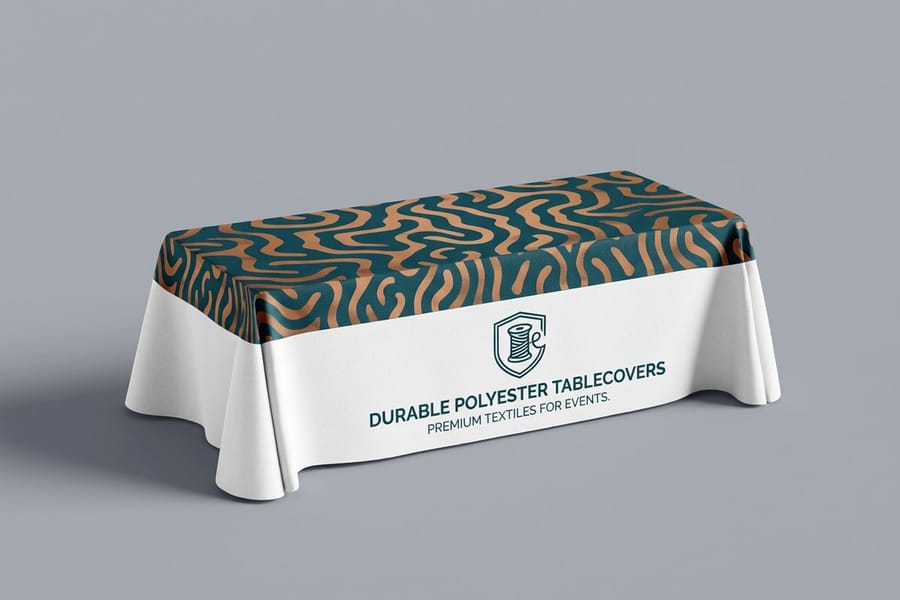
The order itself takes five minutes. The mistakes happen around it.
Pick the table size, pick the style, pick open or closed back, upload the file, and check the proof against a tape measure laid on the real table if you own one. A printed cover is made to order, so it does not move on the same schedule as a box of cards. Order it before you book the freight, not after, and give yourself a day to open the box and look at it in daylight.
Ordering for more than one show or more than one team is a different exercise, and buying six covers one at a time is the expensive way to do it. The wholesale table covers buying guide covers what changes at volume. If this is the first booth you have ever built, the trade show planning checklist puts the cover in sequence with everything else that has to be printed.
When the cover is settled, the rest of the table is quick. Small printed pieces such as table tents handle prices and offers without competing with the logo, and the wider trade show printing collection lists what else usually ships in the same crate. Browse every style side by side in table covers printing.
Wally measures before he orders
Table height is the drop, and the drop is the whole job
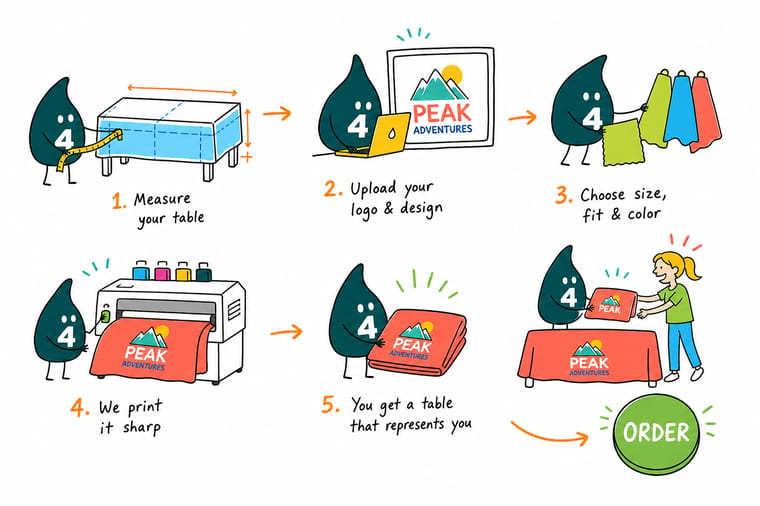
Wally puts the tape on the floor and runs it up the table leg. That number is the drop, and it repeats on every side he covers, so a 30 inch high 6 ft table turns into a 132 by 90 inch panel. Then he checks the back. Staff sitting behind it means an open back, which keeps the length and loses 30 inches of width. Last he holds the logo against the front and slides it up, because by ten in the morning the bottom half is behind a chair.
Configure a printed table throw →
Specs and pricing
Table cover sizes and starting prices
Compare the styles side by side, with live size choices and starting prices straight from the 4OVER4.COM configurator. Table throws print on 9oz premium polyester with a 1 inch hem on every side, from $225.00 for one cover or $445.00 for two. Stretch table covers use 8.8oz tension fabric from $250.00, and table runners come 24 to 48 inches wide in 72, 80 and 90 inch lengths from $97.76. All three take 4 business days of production.

Print it
Order the cover your booth actually needs
Custom tablecloths come in a 6 ft and an 8 ft size on 9oz premium polyester from $225.00. Choose the stretch cover at $250.00 when the table sits on camera, or a runner from $97.76 when the venue keeps its own linen on the table.

Explore more
Where to go next
Still choosing? These reads give the flat cut for every standard table, test polyester, stretch and vinyl side by side, weigh a runner against a full cover, and set up the artwork grid.

By the numbers
Logo tablecloths from 25 years of trade show printing
Common Questions
Your logo tablecloth questions, answered
What size tablecloth do I need for a 6 foot table?
Order the cover made for a 6 ft table and let the printer handle the arithmetic. The standard 6 ft banquet table is 72 inches long, 30 inches deep and 30 inches high, so a cover that drops to the floor on all four sides is cut 132 by 90 inches, and an open back version is cut 132 by 60. Measure the height before you order anything, because a 42 inch bar height table takes a completely different cover and a 30 inch cloth will hang short by a foot.
Should I order an open back or a closed back cover?
Open the back if staff sit at the table or if you store cases underneath, which covers most trade show booths. Close the back if the table stands in the middle of a room, or against a walkway where people see it from behind, such as a registration desk in a hotel lobby or a demo table in a store aisle. The visible difference is only at the back edge, so decide by where people will walk, not by how the cover looks in the product photo.
Where should the logo go on a printed table cover?
Center it on the front panel and keep it inside the top third of the drop. On a 30 inch drop that means the artwork lives roughly in the top 10 inches. Chairs, brochure stands, product and the shipping case you push under the table all block the lower half once the hall opens, and photographers shoot the booth from standing height. Put the web address on the same band as the logo rather than along the bottom hem.
How do I get the creases out before the doors open?
Roll the cover for transport instead of folding it, and a crease never forms in the first place. If it arrives folded, hang it overnight in the hotel room and most of the fold relaxes on its own. A handheld steamer clears the rest in a few minutes. Do not press a hot iron directly onto the printed face of a dye sublimated polyester cover, and if you must iron, work from the reverse side with a cloth between.
Can I wash a printed tablecloth?
A dye sublimated polyester cover washes, because the color sits inside the fiber rather than on the surface. Cold machine wash, no bleach, and hang it to dry rather than tumbling it hot. Vinyl covers are wiped down with a damp cloth instead. This is the practical reason most exhibitors choose polyester over vinyl even though vinyl shrugs off a spilled coffee more easily.
How much does a logo tablecloth cost?
At 4OVER4.COM a printed table throw starts at $225.00 and a stretch table cover starts at $250.00, because both are cut and sewn to order after the graphic is printed. A table runner starts at $97.76 and brands a strip down the middle instead of the whole table, which is the cheapest way to put a logo on a table you do not own. Round covers for cocktail tables start at $149.00.
How far ahead should I order?
A printed cover is made to order, so it does not ship on the same clock as a stack of business cards. Order it before you book freight, not after, and build in time to open the box and look at it. The configurator on the product page shows the live production and shipping choices once you pick a size and quantity, so you can see the real dates before you commit.
Get Started
Order a round table cover from $149.00
Pick the table size, choose a throw, a fitted cover, a stretch cover or a runner, upload the artwork, and we cut and sew it to your table.
Legal Disclaimer
Gold Standard guarantees apply to all standard orders placed through 4over4.com. Price match requires verifiable proof of a competitor's published price for an equivalent product with matching specifications and turnaround time. Satisfaction guarantee covers manufacturing defects and print quality issues. Contact support with order number and documentation.
