
Fitting a Printed Table Cover to the Table the Venue Actually Provides


Sizes for 6 foot and 8 foot tables, the flat dimensions behind each one, what separates a full drape from an open back, and the two numbers to confirm with the show before you print.
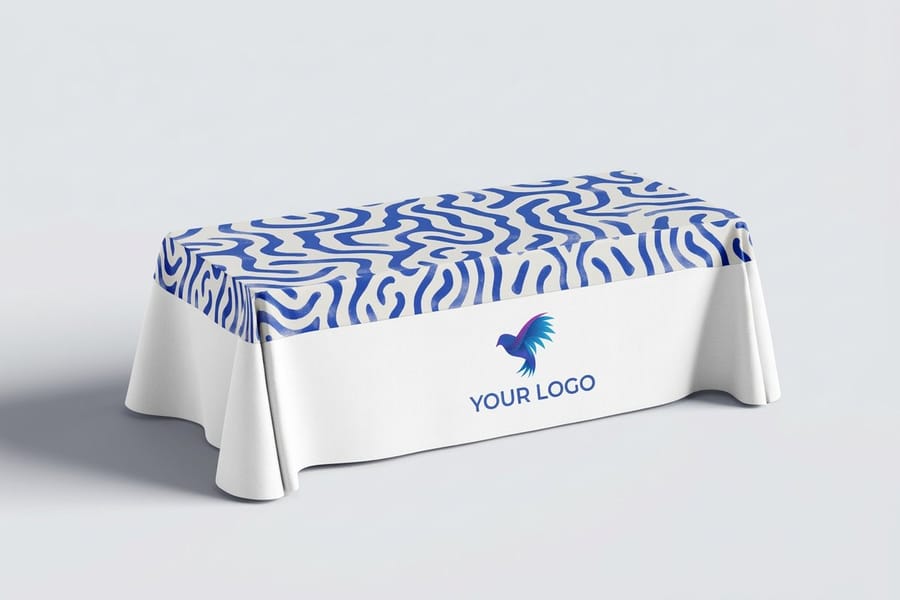
Order the cover by table length: 72 inches for a 6 foot table, 96 inches for an 8 foot table. Then confirm two things with the show before printing, because they change the cover: the table depth, which is 30 inches on a banquet table but often 24 inches on a table the decorator supplies, and the height, which is 30 inches for a seated table and 42 inches for a counter. A four sided throw for a 6 foot banquet table finishes at 132 by 90 inches flat, since the drop on every edge equals the table height.
Quick answer
Length picks the cover, depth and height decide whether it fits
The length is fixed at 72 or 96 inches, and everything that goes wrong goes wrong on the other two dimensions. Depth is 30 inches on a banquet table and often 24 inches on a table rented through the show decorator. Height is 30 inches seated and 42 inches at counter height, and the drop on a floor length cover equals that height exactly. Get all three from the exhibitor service kit, then pick the style: four sided if the table is display only, open back if anyone works behind it.
The Table the Show Gives You Is Rarely the Table You Pictured
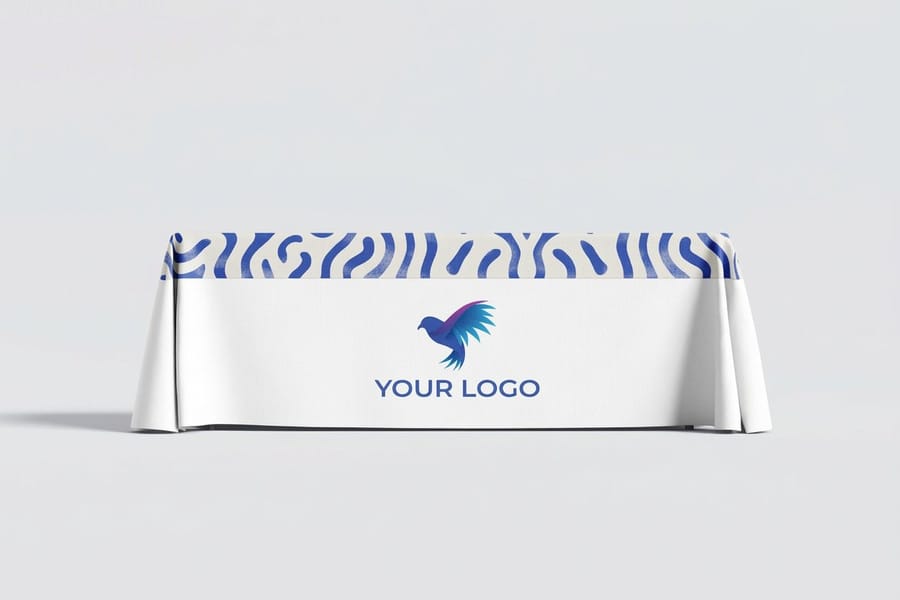
Length is the easy part. A 6 foot table is 72 inches long, an 8 foot table is 96 inches, and that single number decides which cover you buy. Depth and height are where orders go wrong.
Hotel and banquet tables are usually 30 inches deep and 30 inches high. The tables show decorators rent out are frequently 24 inches deep, and plenty of shows also offer a 42 inch counter height version for booths where staff stand. Those are three different covers, not one cover with a little give in it. A throw cut for a 30 inch deep table dropped onto a 24 inch table carries six extra inches of fabric that has to go somewhere, and it goes into slack folds down each side. A 30 inch drop on a 42 inch counter stops a foot above the carpet, which no amount of adjusting will fix.
The dimensions are published. Every show issues an exhibitor service kit, and the furniture section lists the table it supplies down to the inch. Read that before artwork goes to print, and if the kit is vague, email the decorator and ask for the depth and the height in writing. It takes five minutes and it is the difference between a cover that looks tailored and one that looks borrowed.
| Table | Top size | Height | Four sided cover, flat |
|---|---|---|---|
| 6 foot banquet | 72 x 30 in | 30 in | 132 x 90 in |
| 6 foot show draped | 72 x 24 in | 30 in | 132 x 84 in |
| 8 foot banquet | 96 x 30 in | 30 in | 156 x 90 in |
| 8 foot show draped | 96 x 24 in | 30 in | 156 x 84 in |
| 6 foot counter height | 72 x 24 in | 42 in | 156 x 108 in |
| Cocktail round | 30 in diameter | 42 in | 114 in diameter |
| Banquet round | 60 in diameter | 30 in | 120 in diameter |
The flat sizes in that last column are not a secret formula. They are the top plus the drop on both edges, and the drop is the table height. Our table covers are cut to those standards, and the round sizes carry over to round table covers for cocktail and banquet rounds.
The Booth Sizes Behind the Table, and Which Cover Each One Takes
The table is chosen for you by the booth, so it helps to know what the three standard booth sizes usually come with. American shows sell space in 10 foot increments, and the furniture package scales with it.
- 10 by 10 foot inline. The standard first booth, with pipe and drape on three sides and one 6 foot draped table, most often the 24 inch deep decorator table at 30 inches high. One 6 foot cover, open back, because someone will be sitting behind it for three days.
- 10 by 20 foot inline. Two spaces knocked together, usually with two 6 foot tables or one 8 foot. Order the cover by the table the kit lists rather than by the booth, and consider a runner over the second table if the budget only stretches to one printed throw.
- 20 by 20 foot island. Open on all four sides, which is where the 42 inch counter height table turns up, since staff stand rather than sit. That table needs the 156 by 108 inch cover, and a 30 inch drop on it hangs a foot short.
Whatever the booth, the exhibitor service kit lists the table it supplies down to the inch, and that line beats any assumption from the floor plan. Match the table throw to that line, then let the booth size decide how many you need and whether a runner covers the extra table.
Full Drape, Open Back, Fitted or Runner

Four styles cover almost every booth, and the choice is less about looks than about what happens behind the table for the next eight hours.
| Style | Sides to the floor | Can staff sit and reach storage | Best for |
|---|---|---|---|
| Four sided throw | All four | No, the back panel has to be lifted | Display tables nobody works behind, and booths shot from every angle |
| Three sided, open back | Front and both ends | Yes, chairs and boxes slide straight under | Staffed booths, which is most of them |
| Fitted stretch cover | All four, tailored | Depends on the cut | One table you own and use every time |
| Runner | Front and back only | Yes | Branding a table the venue has already dressed |
The four sided throw wins on photographs and loses on the show floor. Everything under the table disappears, the corners hang straight, and the booth reads as one clean block of color. Then somebody needs the second box of brochures, and getting it means hauling a panel of fabric up over the table edge while holding a coffee. Exhibitors who have done a three day show usually order the open back next time and never look back.
Fitted stretch covers are the sharpest looking option because the fabric is tensioned rather than draped, so there is nothing to wrinkle and no folds at the corners. The catch is that they fit one table size and nothing else. If your shows supply different furniture, a fitted cover is a gamble. Table runners start at $97.76 and sit at the other end of that trade: they cover the least, but they work over any cover the venue puts down and they pack into a laptop bag. Pair one with table top displays from $49.41 and a small table stops looking bare without a full reprint.
Working Out the Flat Size, the Drop and the Print Area
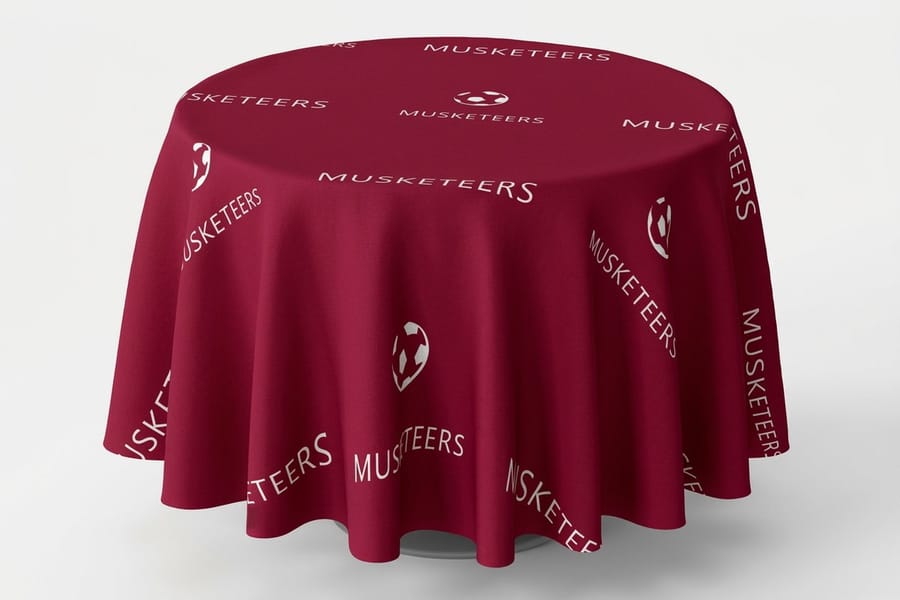
The arithmetic takes one line. Flat length is the table length plus one drop at each end. Flat width is the table depth plus one drop front and back. The drop equals the table height when you want the cover to reach the floor, so a 72 by 30 inch table standing 30 inches high gives 132 by 90 inches flat. Round tables use the same idea on a diameter: a 30 inch cocktail round at 42 inches high needs a 114 inch circle.
Aim for the hem to finish about an inch clear of the carpet. Fabric that touches the floor gets stepped on at the corners, picks up whatever the aisle carpet has collected by day two, and can catch a heel when somebody steps behind the table. A cover that stops an inch short reads as full length from three feet away and stays clean.
Print area deserves more thought than most people give it. The top of the table is the largest panel and the one nobody sees, because it spends the show under laptops, literature and a scanner. The front drop is the panel that does the work, and on a 6 foot table that is a 72 by 30 inch canvas seen from across the aisle. Center the logo on it and keep anything you actually want read in the upper third of the drop, above the line where boxes and chairs start blocking the view. Small type near the hem is wasted ink.
One more detail on four sided throws: the corners can be sewn closed or left as open pleats. Open corners let the fabric hang free and forgive a table that is an inch or two off spec, while sewn corners hold a crisper line on the exact table they were cut for. If your artwork wraps a corner, check where the seam lands so a wordmark does not break across it. For the tall graphics that stand behind the table, the trade show banner sizes guide covers how high to go before the booth neighbors start complaining.
Fabric, Fire Marshals and Getting It Flat by Opening Bell
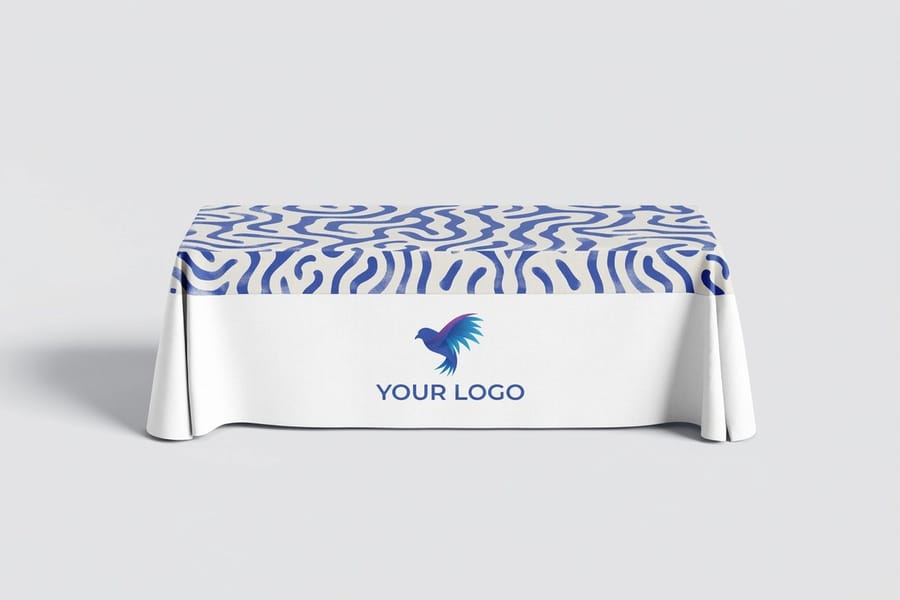
Printed covers are dye sublimated onto polyester. The ink turns to gas under heat and bonds into the fiber rather than sitting on top of it, which is why the color does not crack along a fold, does not peel at the hem, and survives washing. It also means the color is slightly softer than the same file printed on vinyl, so a brand red that has to match exactly is worth checking against a proof rather than assuming.
Fire regulations are the step exhibitors skip. Convention centers commonly require booth fabric to meet NFPA 701 or the local equivalent, and the fire marshal can ask for the certificate during the walkthrough. The rule lives in the exhibitor service kit under fire regulations, alongside the rules on your booth height and your electrical drop. Read it before you order, not while an inspector is standing at your table.
Care is simple and worth doing right. Wash cold on a gentle cycle, hang to dry, and skip the dryer, which is where polyester picks up permanent creases. On site, hang the cover the night before setup if the hall is open, and the weight of the fabric pulls most shipping creases out by morning. If you are setting up the same day, a handheld steamer held a few inches from the surface handles it. Never park a hot iron on the printed face.
Roll the cover for transport instead of folding it. A fold across the middle of a logo becomes a crease line that shows in photographs even after steaming, and it lands right where the camera is pointed. Table throws start at $225.00 and last several seasons if they travel rolled. If the same booth also needs small printed pieces on the table, table tents handle pricing and offers without adding another large graphic, and the wider trade show printing collection lists what else goes in the crate. Exhibitors sizing up a whole program will find the case for the spend laid out in the benefits of exhibiting at trade shows.
Wally measures the table first
Length, depth, height, in that order
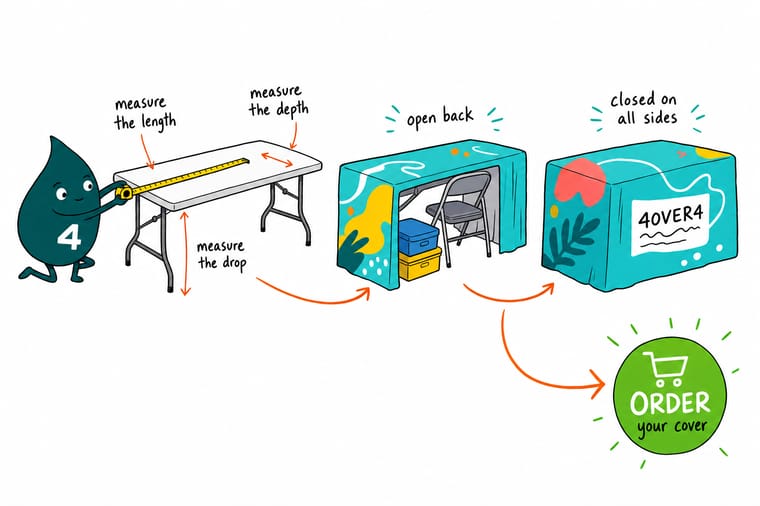
Wally runs the tape down the table for the length, across it for the depth, then straight down the leg for the height. Length tells him whether it is a 6 foot or an 8 foot cover. Depth tells him whether the show handed him a 24 inch table or a 30 inch banquet table. Height becomes the drop, which is why a 30 inch cover hangs a foot short on a 42 inch counter. He writes all three down before anyone opens the artwork file.
Configure a printed table throw →Specs and pricing
Covers, rounds and runners with live sizes and prices
Compare the table cover options side by side, with the size and quantity choices and starting prices straight from the 4OVER4.COM configurator.


Print it
Dress the table before the doors open

Explore more
Where to go next



By the numbers
Table covers printed for 150,000+ businesses
Common Questions
Your table cover sizing questions, answered
What are the standard sizes for exhibition tables?
A 6 foot table is 72 inches long and an 8 foot table is 96 inches, at 30 inches high for seated use or 42 inches at counter height. Depth is where they differ: hotel and banquet tables are 30 inches deep, while the draped tables a show decorator supplies are often 24 inches. Round tables come as a 30 inch cocktail round at 42 inches high and a 60 inch banquet round at 30 inches.
What is the typical size of a trade show booth?
The standard is a 10 by 10 foot inline booth, sold as a 100 square foot space with pipe and drape on three sides and usually one 6 foot draped table. Larger exhibitors take a 10 by 20 inline or a 20 by 20 island that is open on all four sides. The booth size decides the table you are given, so read the furniture line in the exhibitor kit before ordering the cover.
How much does a 20x20 trade show booth cost?
The space alone is priced per square foot and varies by show, commonly somewhere between $20 and $50 a square foot in the United States, which puts a 400 square foot island at roughly $8,000 to $20,000 before anything goes in it. The display, the furniture, drayage, electrical, travel and staff usually add as much again or more. A printed table throw is one of the smallest lines in that budget.
What size table cover do I need for a 6 foot table?
Order a 6 foot cover, which is cut for a 72 inch long table. If the table is a 30 inch deep banquet table standing 30 inches high, the four sided throw finishes around 132 by 90 inches flat: 72 inches of top plus a 30 inch drop at each end, and 30 inches of depth plus a 30 inch drop front and back. A three sided open back version is the same length and roughly 60 inches across, because the back panel is left off.
Are trade show tables 24 or 30 inches deep?
Both exist, and they are not interchangeable. Hotel and banquet tables are typically 30 inches deep. The draped tables show decorators rent out are commonly 24 inches deep, which is why a cover cut for a banquet table can sit with a few extra inches of slack down each side. The exhibitor service kit lists the exact table dimensions the show provides, so read that before you send artwork rather than guessing from a floor plan.
Can I use an 8 foot table cover on a 6 foot table?
You can, but it will look like a mistake. An 8 foot cover is 24 inches longer than a 6 foot table, so a foot of fabric pools at each end and the front graphic sits off center. Going the other way is worse: a 6 foot cover on an 8 foot table leaves a foot of bare table showing at both ends. If you exhibit at shows that supply different tables, a table runner over whatever cover the venue provides is the flexible option.
Do I need a fire retardant certificate for my table cover?
Many convention centers do ask for one. Booth fabric usually has to meet NFPA 701 or the equivalent local fire code, and the fire marshal can request documentation during the walkthrough. The requirement and the paperwork it wants are spelled out in the show's exhibitor service kit under fire regulations. Check it before ordering, because a cover that fails inspection comes off the table for the rest of the show.
Should I get a full drape or an open back cover?
Choose the open back if anyone will sit at the table or store anything under it. The front and both ends still reach the floor, so from the aisle it looks identical, and staff can get to boxes without wrestling a panel over the table edge. Choose the four sided drape when the table is a display surface nobody works behind, or when the booth gets photographed from an angle where the open back would show.
How do I get the creases out of a table cover on site?
Hang it the night before if you can. Polyester relaxes on its own once the weight of the fabric pulls on it, and most creases from shipping fall out overnight. If you are setting up the same morning, a handheld steamer held a few inches off the surface clears them in minutes. Do not press a hot iron directly onto the printed face, and roll the cover rather than folding it for the trip home so the next show does not start with a crease across the logo.
Get Started
Ready to print a cover that fits the table you were given?
Pick the length, choose four sided or open back, and we dye sublimate your artwork into polyester that travels rolled and hangs straight.
Legal Disclaimer
Gold Standard guarantees apply to all standard orders placed through 4over4.com. Price match requires verifiable proof of a competitor's published price for an equivalent product with matching specifications and turnaround time. Satisfaction guarantee covers manufacturing defects and print quality issues. Contact support with order number and documentation. On-time delivery rate based on tracked orders 1999 to 2026. Individual results may vary based on shipping carrier performance.
