
Large Poster Board Dimensions for Presentations, Fairs, and Displays


The sizes that exist above the 22 by 28 classroom board, how a tri-fold really splits, and how to pick the one that fits the table, the booth, or the frame you were given.
Standard poster board is 22 by 28 inches, and the large formats above it are the 28 by 44 inch full sheet, foam board at 30 by 40 and 32 by 40, and the tri-fold display board that opens to 36 by 48 inches. Conference posters run 36 by 48 or 42 by 60 inches, or A0 at 33.1 by 46.8 inches outside the US. Pick by the space you were assigned rather than by how much you have to say, because the tri-fold only shows 24 inches of its 48 straight on, and most fairs cap a project at 30 inches deep by 48 wide.
Quick answer
The board is chosen by the space, not by the word count
Measure the table, the wall, or the frame first, then pick the largest board that clears it by an inch on every side. A tri-fold at 36 by 48 stands on its own and gives you a 24 inch center panel plus two 12 inch wings. A flat 36 by 48 gives you one clean canvas and needs an easel or a stand you have to buy separately. Anything wider than the table it sits on will be moved by show staff, and anything printed at A0 will not match a US board.
Every Board Size Above 22 by 28, and Where It Comes From
Poster board sizes look arbitrary until you know they are cutting decisions. A mill makes a 28 by 44 inch sheet, and the 22 by 28 board everyone buys is that sheet halved. Foam board follows a different logic entirely, because it comes off 4 by 8 foot panels, which is where 30 by 40 and 32 by 40 come from.
| Format | Size in inches | Stands up how | Typical use |
|---|---|---|---|
| Standard poster board | 22 x 28 | Needs a wall or an easel | Single topic classroom display, one clear message |
| Full sheet poster board | 28 x 44 | Needs a wall or an easel | The uncut sheet, used when one large image has to stay whole |
| Foam board | 20 x 30, 30 x 40, 32 x 40 | Rigid, but still needs a stand | Mounted photos, short run event signage |
| Tri-fold display board | 36 x 48 open, 24 center plus two 12 wings | Free standing on a table | Science fairs, school expos, tabletop recruiting |
| Conference poster | 36 x 48 or 42 x 60 | Pinned or clipped to a provided board | Academic poster sessions |
| A0 poster | 33.1 x 46.8 | Pinned or clipped to a provided board | International conferences and anything specified in millimetres |
The row that catches people out is the last one. A0 is narrower and taller than 36 by 48, so a file laid out for a US board arrives at an A0 frame either cropped or floating in white space. If the rules name a paper size rather than inches, rebuild the canvas rather than scaling the old one. Our complete poster board size guide lists the smaller formats under 22 by 28 if the piece you have in mind is a countertop sign rather than a display.
Anything past this chart is a print rather than a stock board. Large format posters start at $25 and are cut to the dimensions you enter, which is the practical route once a display needs a size that no board is sold in.
Poster Board Sizes in Inches and Centimetres
Most rules that reach you from a school, a conference or a European supplier state the board in centimeters, and most boards on a US shelf are labelled in inches. The conversions below cover every size in the chart above, rounded to the nearest tenth of a centimeter, so you can match a rule to a board without a calculator.
- 22 by 28 inches, the standard poster board, is 55.9 by 71.1 cm.
- 28 by 44 inches, the full sheet, is 71.1 by 111.8 cm.
- 20 by 30 inches foam board is 50.8 by 76.2 cm, and 30 by 40 is 76.2 by 101.6 cm.
- 36 by 48 inches, the open tri-fold and the US conference poster, is 91.4 by 121.9 cm.
- 42 by 60 inches is 106.7 by 152.4 cm.
- A0 is 84.1 by 118.9 cm, which is where the 33.1 by 46.8 inch figure comes from.
Two habits keep the conversion honest. Set the file in the unit the rule uses, and never scale a US layout into a metric frame, because A0 is a different shape rather than a different size.
The Tri-Fold Is 48 Inches Wide and 24 Inches of It Faces Forward
Open a standard tri-fold and you get 36 inches of height and 48 inches of width. That width is not one canvas. It is a 24 inch center panel with a 12 inch wing on each side, and the wings angle backward so the board can stand, which means a judge standing in front of you sees the center panel square on and the wings at roughly 45 degrees.
Design in three columns, not one. Titles that span a hinge get broken by the fold and distorted by the angle, and a photograph placed across the crease loses its subject to a vertical line. Put the title and the headline result on the center panel, background and method on the left wing, and conclusions and next steps on the right.
Then measure the space you were assigned. The Intel ISEF display and safety rules cap a project at 30 inches deep from front to back, 48 inches wide side to side, and 108 inches tall measured from the floor, and regional fairs almost always adopt the same limits. A 48 inch tri-fold uses the full width allowance with nothing to spare, so anything you set in front of it counts against the 30 inch depth.
- Center panel, 24 inches wide. Title, the question, and the single chart that proves the point.
- Left wing, 12 inches wide. Background and method, read first because visitors approach from the left of a table row.
- Right wing, 12 inches wide. Results, conclusion, and contact details.
- Keep 1 inch clear inside every edge. Clips, frame lips and the table itself eat the outer inch of a board more often than people expect.
If you would rather print one continuous panel and skip the hinges, a rigid board does the job without the fold. Reflective PVC board starts at $29 and stays flat where foam board dents, which matters for a display that gets packed and unpacked more than once.
The Right Poster Board Size for a School Project or an Easel
A school project rarely needs a decision. Most teachers mean the 22 by 28 inch board when they say poster board and the tri-fold when they say display board, and the rubric usually names one or the other. A 22 by 28 board holds a title at 72 point, four short paragraphs and two images with room left, which is about what a grade school project wants. When the project is judged from a table, the tri-fold wins because it stands on its own.
An easel changes the numbers. A tabletop easel takes a 22 by 28 board comfortably and a 24 by 36 print at a stretch, while a floor easel with a wide lip carries a 30 by 40 foam board without tipping. Anything above that wants a stand rather than an easel. A frame is the tightest fit of all, since off the shelf poster frames are cut for 24 by 36, 18 by 24 and 22 by 28, so print to the frame you already own rather than framing after the fact.
Trade Show and Conference Boards: Match the Booth, Not the Ambition
At a fair or a booth the size is chosen for you and the mistake runs one direction: too big. A 10 by 10 foot booth with a 6 foot table leaves roughly 8 feet of usable back wall once the corners and the aisle line are gone, and a board wider than the table overhangs into the neighbouring space, which show floor staff will ask you to move.
Height matters more than width in a crowded hall, because the crowd blocks the bottom third of anything you set on the floor. Keep the message that has to reach the aisle above 48 inches from the ground, which is why a 33 by 80 inch upright reads from further away than a wider board sitting on a table.
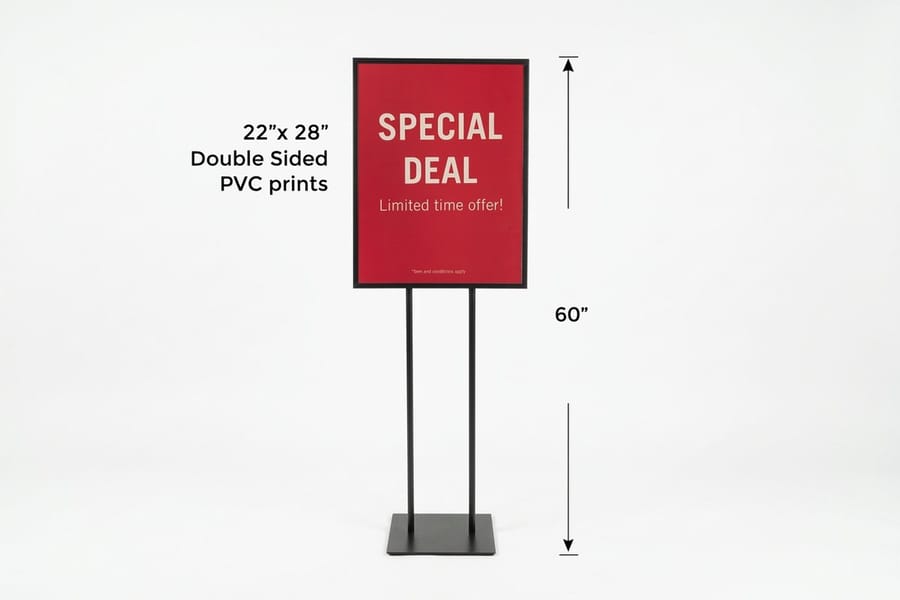
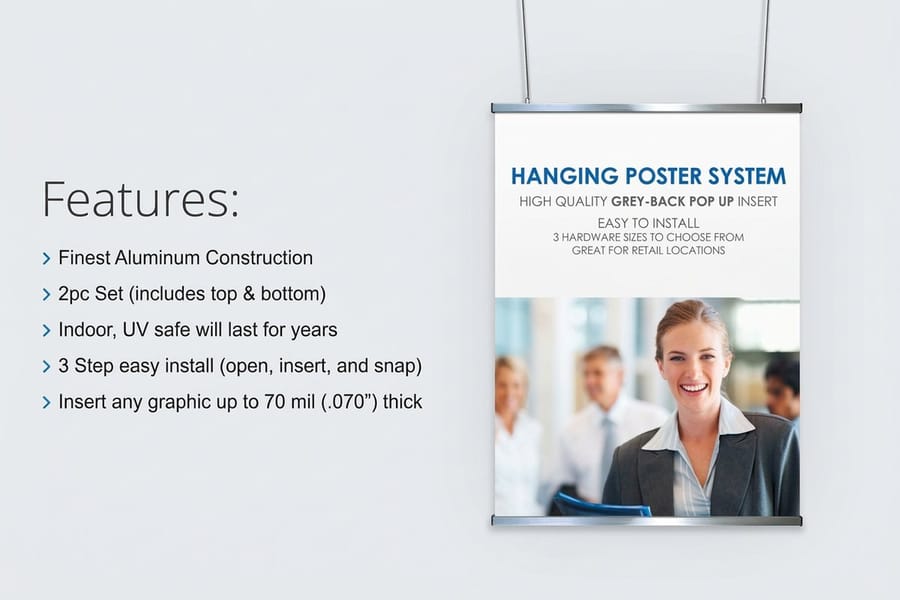
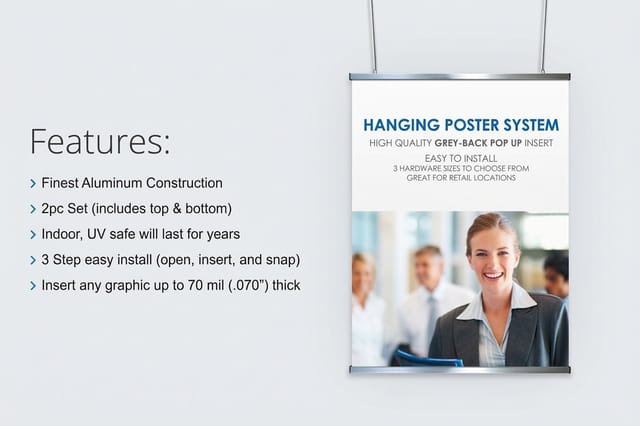
The two ways to get a large poster upright are worth pricing before you print. Standing poster displays start at $130.72 and hold a poster at eye height without touching the wall, which is what you need when the venue does not let you hang anything. Hanging poster displays start at $53.83 and suspend the poster from a rail or ceiling grid, cheaper but only usable where there is something above to attach to. Both are cataloged in display printing, and if the booth uses a fabric backwall the SEG display range is the system that takes a printed graphic into an aluminium frame.
One trade-off nobody mentions until you are standing under the lights: a high gloss or reflective surface looks brilliant in a photo and throws glare straight back at anyone approaching from the side under a hall spotlight. In a venue whose lighting you do not control, matte reads better from more angles.
How Far Away It Has to Read Decides the Type, and the Type Decides the Size
Pick the board first and people cram text until it fits. Work the other way. Decide the distance the title has to carry, set the type that carries it, and the board size falls out of the layout.
The working rule in signage is roughly 1 inch of capital letter height for every 10 feet of viewing distance, and 1 inch of caps is around 72 point. From there a poster session hierarchy looks like this.
| Element | Minimum size | Reads from | Words it can carry |
|---|---|---|---|
| Title | 72 pt and up | Roughly 10 feet | 10 words at most, ideally 6 |
| Section headings | 36 to 48 pt | Roughly 5 feet | A short phrase, not a sentence |
| Body text | 24 pt | Roughly 4 feet | Around 800 words total across a 36 by 48 |
| Captions and credits | 18 pt | Arm's length | One line under each figure |
Run the arithmetic honestly and most people find their content does not need a bigger board, it needs less text. If 24 point body copy does not fit on 36 by 48, moving to 42 by 60 buys about 45 percent more area and roughly one more paragraph per column, which is rarely the fix it feels like. Cutting the method section usually is. The fonts that hold up on poster boards matter here too, since a thin display face at 72 point disappears under hall lighting that a medium weight would survive.
Printing It, Mounting It, and Getting It There Intact
Set the file up at full size in the exact dimensions of the board. Half scale at double resolution is a habit from smaller work and it invites a scaling error at the worst moment. Build at 150 dpi at final size for photographs, keep logos and type as vectors, and add 0.125 inch of bleed on anything where colour runs to the edge. Sized layouts for the common formats sit in the blank template library.
Then decide flat or rolled, because it changes what you can do on arrival. A printed poster rolls into a tube, travels in a car without complaint, and needs something to hold it: a wood poster hanger frame starts at $32.75 and grips the top and bottom edge so the sheet hangs straight instead of curling off a wall. A rigid board arrives ready to stand and cannot be rolled, so past roughly 40 by 60 inches it becomes an oversize shipment with a matching cost.
Two habits save the day. Print the title panel a day early and look at it from across a room, because a title that fails at 15 feet on a proof will fail at 15 feet in a hall. And carry the board flat between two rigid sheets rather than upright in a trunk, since every crushed corner we see came from a board standing on its edge over a bump. If you want the full run of substrates and sizes we cut to order, the large format printing category is the place to compare them side by side.
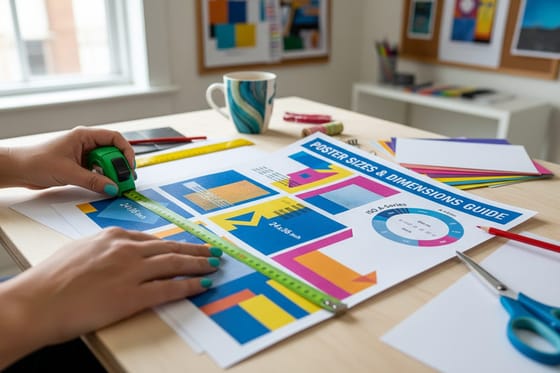
Wally measures the board
48 inches wide, but only 24 of them look you in the eye
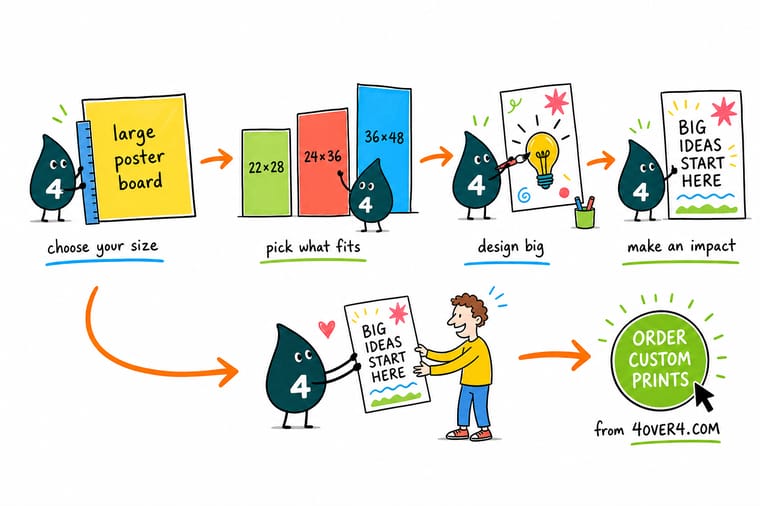
Wally opens the tri-fold and runs the tape across it. Forty eight inches, sure, but the wings fold back at an angle so the panel facing a visitor is the 24 inch middle. He puts the title and the one chart that matters there, method on the left wing, results on the right, and nothing across a hinge. Then he measures the table before he prints, because a board wider than the table is a board somebody asks him to move.
Print a large format poster →Specs and pricing
Boards, posters and stands, sized and priced
Set the dimensions you measured and see the live configuration options and starting prices straight from the 4OVER4.COM configurator.



Print it
Order the board your space actually fits
Explore more
Where to go next

By the numbers
The large format line behind a presentation board
Common Questions
Your poster board size questions, answered
Is 24 by 36 a normal poster size?
Yes. It is the most common large poster size and the one most off the shelf poster frames are cut for. It is a print rather than a stock board, because paper poster board stops at 22 by 28 and foam board jumps to 30 by 40, so a 24 by 36 poster is printed and then mounted or framed. On a table it needs an easel, and its title reads from roughly 15 feet at 72 point.
How big is the poster board from Dollar Tree?
The standard sheet sold there is 22 by 28 inches, the same classroom board that comes off the 28 by 44 sheet halved, and the tri-fold display boards are the usual 36 by 48 inches open. Check the label before you design, because a board bought for a rubric that names a different size is a wasted board, and a store sheet is thin enough to want a rigid backing for anything that travels.
Is a 40 by 60 poster big?
Yes. It is larger than any stock poster board and larger than the 36 by 48 limit most US poster sessions post. At that size it is a large format print, it ships rolled in a tube once it passes roughly 40 by 60, and a rigid version becomes oversize freight. It reads from across a hall, which is why 40 by 60 turns up at trade show booths far more often than at fairs.
What is the largest standard poster board size?
For paper poster board sold by the sheet, 28 by 44 inches is the full size, and the familiar 22 by 28 board is that sheet cut in half. Above that you are into rigid substrates rather than poster board: foam board is stocked at 30 by 40 and 32 by 40 inches and sold in 4 by 8 foot sheets for signage, and PVC board is cut to order. Printed posters go larger still, because the only hard limit is the roll width on the press, with length running well past 60 inches.
What size is a science fair tri-fold board?
The standard tri-fold measures 36 inches tall by 48 inches wide when it is open. That 48 inches is split as a 24 inch center panel with two 12 inch wings, so the panel facing a judge straight on is only 24 inches wide. Some fairs also allow a header board on top, which adds roughly 6 to 8 inches of height. Larger tri-folds exist at 36 by 60 inches, but they overhang a standard table and many fairs will not accept them.
How big should a conference poster be?
Check the call for posters, because the board you are assigned decides it and the two common systems do not match. Most US sessions post a 36 by 48 inch or 42 by 60 inch limit. International and many science conferences specify A0, which is 33.1 by 46.8 inches, narrower and taller than the US 36 by 48. Design at full size in the exact dimensions given, and if the rules state a maximum rather than a fixed size, print an inch or two under it so the clips do not cover your margin.
Can I print a poster larger than 36 by 48 inches?
Yes. Large format printing is limited by the width of the roll, not by a size chart, so long banners and oversized posters are routine. What changes at that scale is handling: anything past about 40 by 60 inches ships rolled in a tube rather than flat, and a rigid board that big becomes an oversize freight item. If the piece has to travel repeatedly, print it as a poster and mount it on site rather than shipping a rigid sheet back and forth.
Should I use foam board or a printed poster for a display?
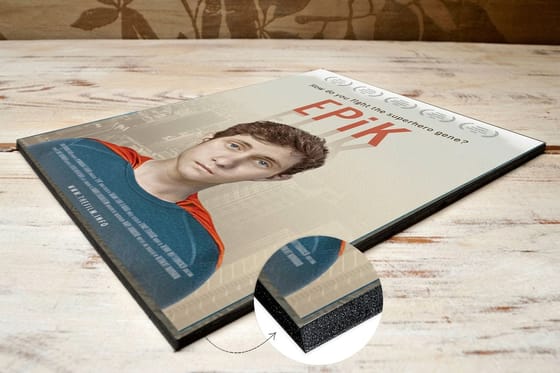
Foam board is light and cheap and it dents. One knocked corner in a car trunk and the edge is permanently crushed, which is fine for a one day fair and poor for a display you reuse. PVC board is heavier, takes a scuff without denting, and survives being packed and unpacked all season, which is why booth signage tends to be PVC while classroom projects stay on foam. A paper poster costs the least and needs a frame, a hanger, or a stand to hold it flat.
What resolution does a 36 by 48 inch poster need?
Build the file at full size at 150 dpi and it will look sharp from the two to three feet people actually stand at. Going to 300 dpi at 36 by 48 inches quadruples the file for detail nobody can resolve at that distance, and it is a common reason a poster file becomes too large to upload the night before a deadline. Vector logos and live type stay crisp at any scale, so the resolution question really only applies to photographs.
Get Started
Measured the space? Print the board to match it.
Enter your exact dimensions, pick paper or rigid board, and we cut it to size so it clears the table with an inch to spare.
Legal Disclaimer
Gold Standard guarantees apply to all standard orders placed through 4over4.com. Price match requires verifiable proof of a competitor's published price for an equivalent product with matching specifications and turnaround time. Satisfaction guarantee covers manufacturing defects and print quality issues. Contact support with order number and documentation. On-time delivery rate based on tracked orders 1999 to 2026. Individual results may vary based on shipping carrier performance.
