
Rectangle Sticker Sizes and How to Match Them to the Job


Jordan is our labels, packaging and sustainability voice, built from the knowledge of our production team, with over 20 years in printing.
Eight sizes cover nearly every rectangle sticker job there is. The chart below sets each size against the material its surface demands, for products, packaging and branding.
The most common rectangle sticker sizes are 2 x 1 inches for barcodes and ingredient labels, 3 x 2 for logo and giveaway stickers, 4 x 2 to 4 x 3 for product and packaging labels, 4 x 6 for shipping, and 11.5 x 3 for bumpers. Match the sticker to the flattest face of the surface, choose paper for dry indoor jobs and laminated vinyl for anything wet, sunlit, or handled daily, and round the corners so they do not peel.
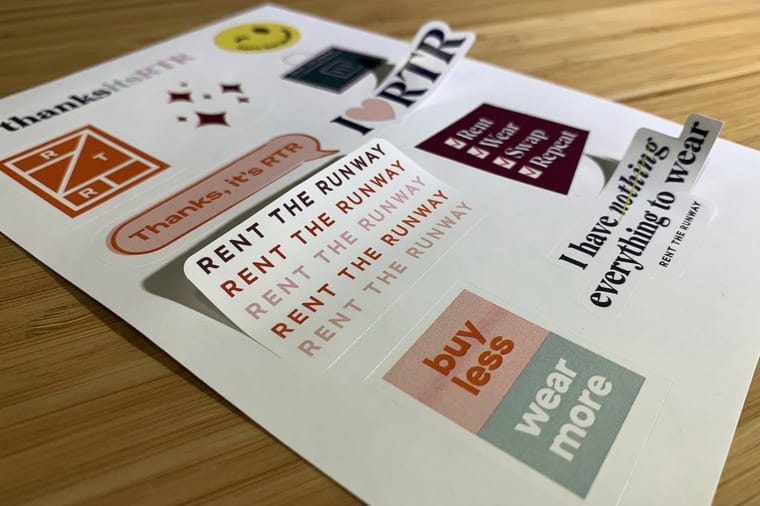
Quick answer
Eight sizes, three jobs, one rule about corners
Rectangle stickers do three jobs, and each pulls toward its own sizes. Product labeling runs small, 2 x 1 through 4 x 3, sized to the flattest face of the container. Packaging and shipping run 4 x 2 through the fixed 4 x 6 carrier standard. Branding starts at 3 x 2, the size that fits laptops, bottles, and giveaway tables alike. Whatever the size, a 1/8 inch corner radius and 1/8 inch of bleed are the two cheap decisions that keep the sticker on its surface and the cut off your text.
The Rectangle Sticker Sizes That Cover Almost Every Job
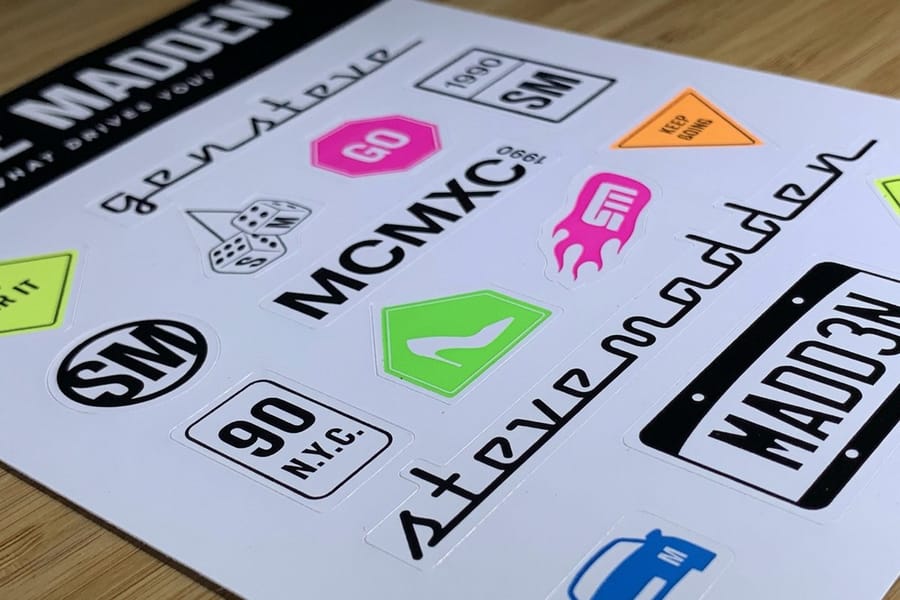
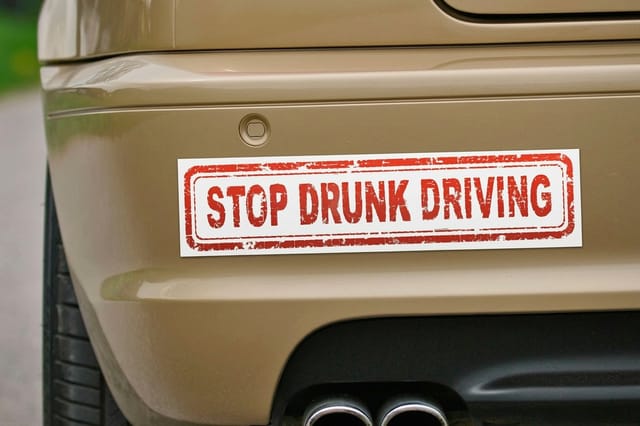
Rectangle stickers cluster around a handful of proven sizes, and there is a reason each one exists. Small sizes carry data. Mid sizes carry brands. Long, narrow sizes were shaped by the object they live on, which in one famous case is the back of a car.
| Size | What it carries | Where it lands |
|---|---|---|
| 2 x 1 in | Barcodes, QR codes, batch and ingredient info, tamper seals. | Small packaging, jars, bags, box flaps. |
| 3 x 2 in | A logo plus one line of text. The default branding sticker. | Laptops, packaging, giveaways, mailers. |
| 3.5 x 2 in | Business-card layouts reused as a sticker, contact info included. | Order inserts, packaging, handouts. |
| 4 x 2 in | Product name and brand on a front panel, return addresses. | Cartons, envelopes, boxes. |
| 4 x 3 in | A fuller label: brand, product, variant, small print. | Larger boxes, tubs, equipment. |
| 4 x 6 in | Shipping information. The standard carrier label size. | Shipping boxes and poly mailers. |
| 6 x 4 in | Large-format branding you can read across a room. | Cases, bins, doors, large equipment. |
| 11.5 x 3 in | One short message in large type. | Car bumpers, beams, long flat surfaces. |
Two of these deserve a flag. The 4 x 6 shipping label is a fixed convention, so fighting it buys you nothing. And the long bumper format has enough of its own rules, letter height, contrast, viewing distance, that it earned a separate page: the bumper sticker size guide covers it properly, and bumper stickers are printed as their own product for exactly that reason. For the build itself, see how to make a car bumper sticker that survives the weather.
The chart sets the size. These are the products that print it, with the specifics you need to order:
| Format | Sizes | Stock | Starts at | Standard turnaround |
|---|---|---|---|---|
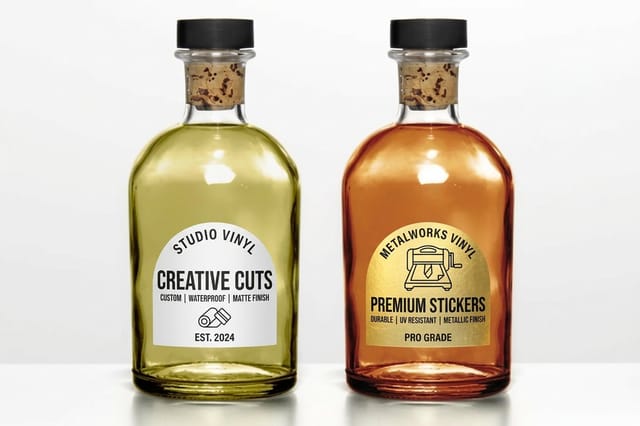
| Vinyl stickers | 2 x 3.5 in to 5 x 7 in, or any size | White vinyl, permanent or repositionable | $25 | 3 business days |
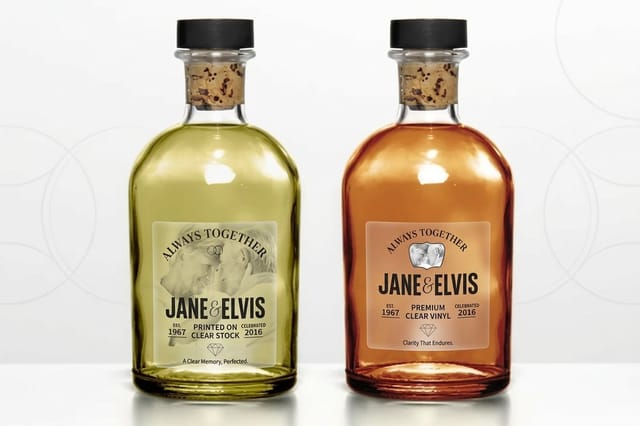
| Clear stickers | 2 x 3.5 in to 5 x 7 in, or any size | Clear film, permanent or repositionable | $25 | 3 business days |
| Bumper stickers | 2 x 5 in to 2.75 x 15 in, or any size | White permanent vinyl with UV coating | $38.44 | 5 business days |
| Roll labels | 102 sizes from 0.25 x 1 in | White gloss, white or clear BOPP, silver foil, felt | $322.98 for 100 | 6 business days |
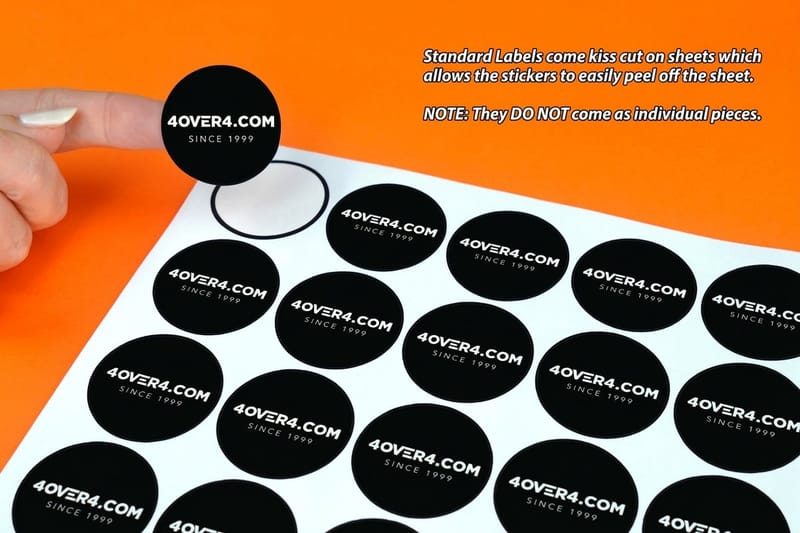
| Sticker sheets | 5 x 7 in to 11 x 11 in, kiss cut | Paper or white vinyl | $181.24 for 25 | 5 business days |
Upload the file at the trim size plus 1/8 inch of bleed on every side, keep text 1/8 inch inside the trim, and pick a 1/8 or 3/8 inch corner radius on vinyl and clear stickers.
Materials and Finishes, and What Each One Survives
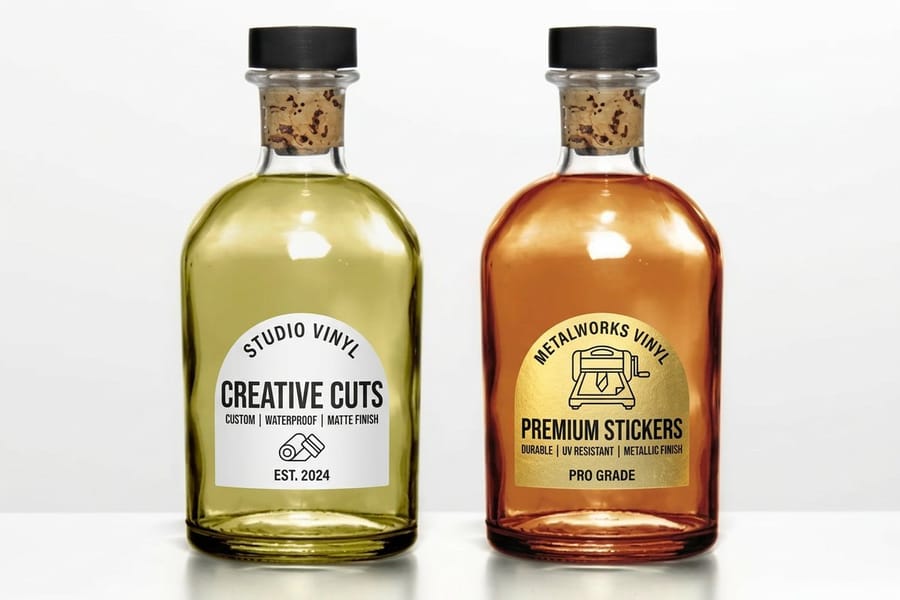
The size question and the material question are really one question, because the material decides where the sticker is allowed to live. Get the material wrong and the perfect size still fails.
Paper is the budget pick and the only one you can comfortably write on, which makes it right for indoor jobs: packaging seals, order inserts, name labels, anything that stays dry. Its limit is honest and immediate: moisture wrinkles it and rubbing dulls the print, so it does not belong on a water bottle or outdoors.
Vinyl is the durable generalist. It is waterproof, holds its color in sunlight for years rather than months, and stretches slightly, so it conforms to gentle curves that would make a stiffer film lift at the corners. Vinyl stickers are the default for laptops, bottles, cars, and anything handled daily.
BOPP is the packaging-label film, resistant to water and oil, which is why it dominates food, soap, and cosmetic labels. Bar and bottle labels for soap sit in our soap labels printing range. It is happiest applied flat or on smooth cylinders by machine, and less forgiving than vinyl on compound curves. Clear film, as used on clear stickers, gives the printed-on-the-surface look on glass and white packaging, with one catch worth knowing before you order: whatever sits behind it shows through, so light-colored artwork on a dark surface needs white ink printed behind it to stay visible.
Finish is the last call. Gloss laminate saturates color and wipes clean; matte kills glare and reads calmer and more premium. Either laminate, on any material, adds the scratch and moisture protection that separates a sticker that survives handling from one that does not. The full breakdown lives in our sticker materials guide.
Matching Size to Use: Product, Packaging, and Branding
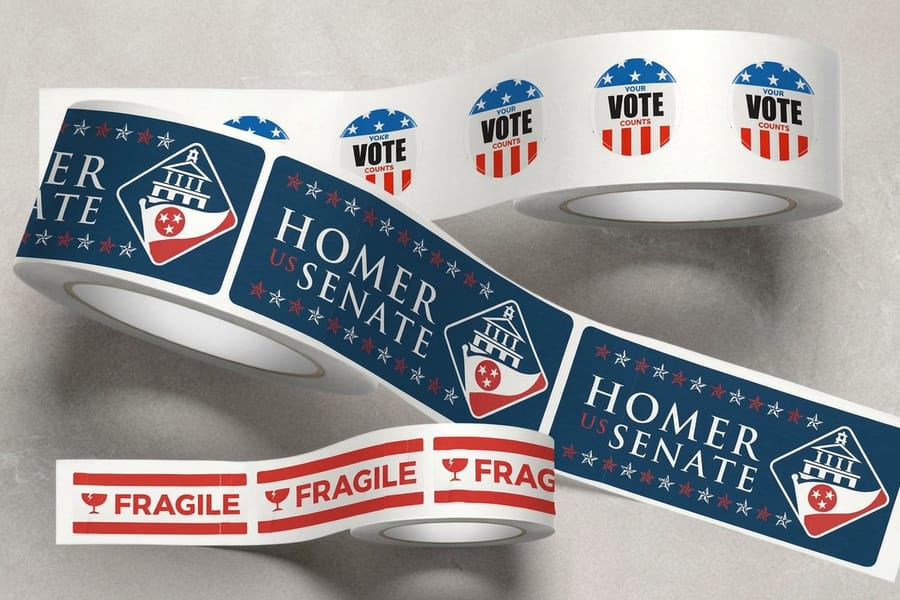
Each of the three jobs a rectangle sticker does pulls toward a different size and format, and that mapping decides most orders.
Product labeling runs small: 2 x 1 to 4 x 3. The sticker identifies the thing it is on, so it must fit the flattest face of the container with margin to spare. A useful rule from the application table: cover half to two thirds of the panel, never edge to edge, and never past where a curved surface flattens out, because the overhang wrinkles. This is also where format matters most. Ten packages a week are fine from sheets; hundreds are not, and that is when roll labels earn their place, feeding one label after another in the same orientation, by hand or through an applicator. Anything destined for a shelf next to competitors belongs in the wider label printing range, where materials meet food and cosmetic requirements.
Packaging and shipping run mid to large: 4 x 2 to 4 x 6. Return address labels at 4 x 2, box-top branding at 4 x 3, and the immovable 4 x 6 for carrier labels. A branded packing-tape effect can be had cheaply by running 6 x 4 rectangles across a box seam.
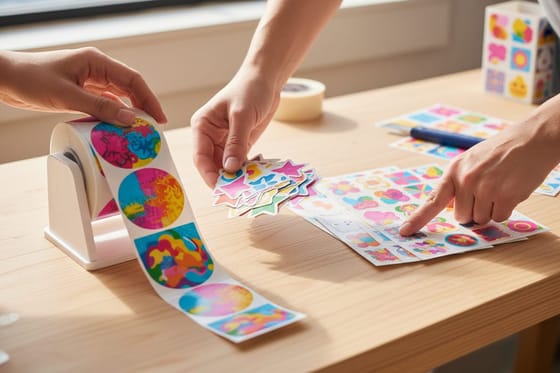
Branding runs 3 x 2 and up, in exactly the places you do not control. A giveaway sticker succeeds when someone else chooses to display it, so it has to fit the surfaces people actually own: laptop lids, water bottles, phone cases, toolboxes. 3 x 2 fits nearly all of them. Go to 6 x 4 only when the destination is big and flat. For mixed sets, sticker sheets put several sizes on one peelable sheet, and the rolls vs sheets vs die-cut guide settles the format question when quantity makes it real money.
Corners, Bleed, and Setting Up a File That Cuts Clean
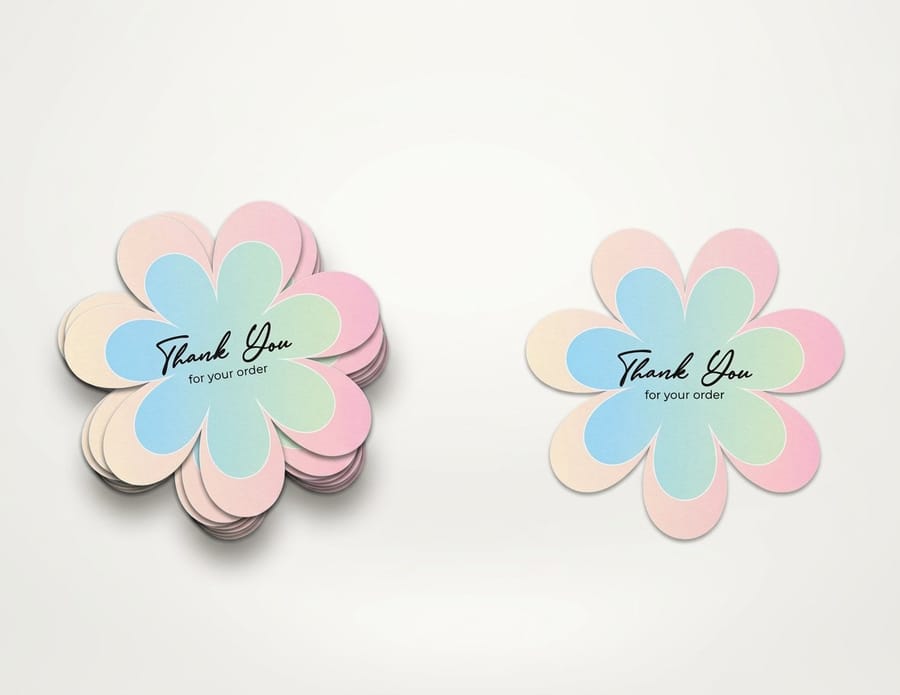
A rectangle is the easiest sticker shape to set up, and the few rules it has exist because of how cutting actually works.
Round the corners. A square corner is a snag point: it catches a sleeve or a thumbnail, lifts, and the peel spreads from there. The standard 1/8 inch corner radius removes the snag without visibly shrinking the design. Keep square corners only when the sharp look is the point, on warning and barcode labels that live out of reach of hands.
Build in bleed and a safe zone. Run the background 1/8 inch past the trim on all sides, and keep text 1/8 inch inside it. Blade and laser cutting is accurate to well under a millimeter, but across thousands of stickers the cut wanders slightly, and these two margins are what make that wander invisible. A white hairline down one edge of a dark sticker is the signature of a file built without bleed.
Size type for the viewing distance. On a 2 x 1 label, 6 to 8 point type is readable in the hand. A sticker meant to be read from a few feet away wants its main line at 30 points or more. If the text does not fit at a readable size, the fix is a bigger sticker or less text, never a smaller font.
The blank template library has correctly sized layouts with trim, bleed, and safe zones already drawn, and if the design outgrows the rectangle entirely, contour-cut die-cut stickers follow any outline you give them. For a plain rectangle, start from the standard sticker blank template. For everything the file needs beyond dimensions, our guide to how stickers are printed walks the job from upload to cut.
Wally explains rectangle sticker sizes
Measure the surface first, then pick the sticker
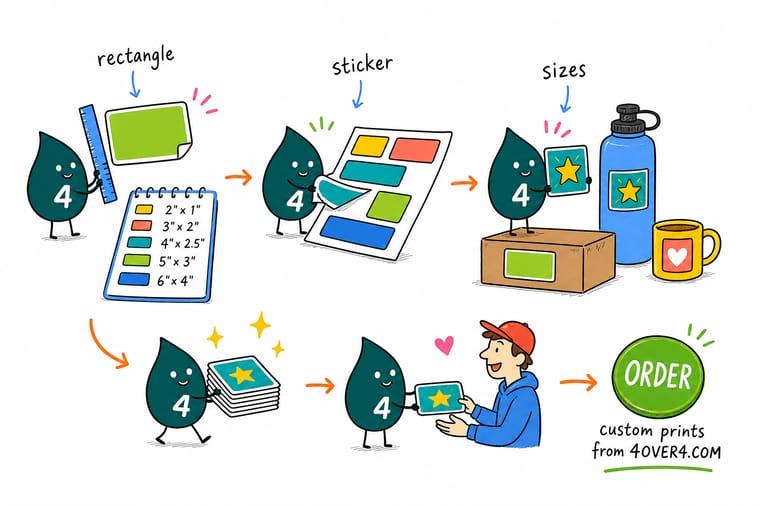
Wally never starts with the artwork. He measures the flattest face of the box, the jar, or the laptop lid, then picks the rectangle that covers about two thirds of it: 2 x 1 for a barcode, 3 x 2 for the logo, 4 x 3 for the full product label, 4 x 6 when it ships. He rounds every corner an eighth of an inch so nothing catches and peels, and he reaches for laminated vinyl the moment a sticker has to live outdoors or get handled every day.
Order die-cut stickers →
Specs and pricing
Rectangle sticker formats, sizes, and live prices
Compare the three formats side by side, with live size, material, and quantity choices straight from the 4OVER4.COM configurator. Die-cut stickers come in set sizes from 2 x 2 in to 9 x 9 in from 25 for $93.37, roll labels ship on a 3 in core with an optional gloss or matte laminate, and sticker sheets carry from one to more than 26 kiss cut stickers per sheet.

Print it
Order rectangle stickers built for their surface
Vinyl and clear stickers start at $25 and take 3 business days at standard turnaround, and bumper stickers on UV coated white vinyl start at $38.44 and take 5.

Explore more
Where to go next
An article covers every standard sticker size, three guides cover circle sizes, materials and rolls against sheets, and two category pages price every sticker and label.

By the numbers
Die-cut, clear, vinyl and roll stickers
Common Questions
Your rectangle sticker questions, answered
What is the most popular rectangle sticker size?
3 x 2 inches. It is large enough for a logo with a tagline or web address underneath, small enough to fit a laptop lid, a water bottle flat, or a packaging seal, and it reads clearly from a normal handling distance. If you are printing one general-purpose sticker for giveaways and branding, this is the size to print. Its close relative, 3.5 x 2 inches, matches a standard business card exactly, which makes it easy to design for because any business card layout drops straight in.
What size rectangle sticker should I use on product packaging?
Measure the flattest face of the package and choose a sticker that covers roughly half to two thirds of it, leaving visible margin on every side. In practice that means 2 x 1 or 3 x 2 inches on small boxes, jars, and pouches, and 4 x 2 up to 4 x 3 inches on larger cartons. A label that runs edge to edge looks like a patch rather than a label, and on a curved jar anything wider than the flat area of the curve will wrinkle at the ends no matter how carefully it is applied.
Should rectangle stickers have rounded or square corners?
Rounded, in almost every case. A sharp corner is the first point of failure: it catches on sleeves, fingernails, and box edges, lifts, and starts the peel. A standard 1/8 inch corner radius removes that snag point and softens the look without changing the usable print area in any meaningful way. The exception is a deliberately sharp, technical look, such as warning labels or barcode labels, where square corners read as intentional and the sticker usually lives somewhere it will not be brushed against.
How much bleed do rectangle stickers need?
Extend the background 1/8 inch past the trim line on all four sides, and keep text and logos at least 1/8 inch inside it. Cutting is accurate but not perfect, and the bleed is what prevents a hairline of unprinted white appearing along one edge when the cut drifts slightly. The inner safe zone does the same job in the other direction, keeping your text from being clipped. Start from a correctly sized layout in the blank template library and both zones are already drawn for you.
Are rectangle stickers cheaper than custom die-cut shapes?
Generally yes, for a simple reason: rectangles pack edge to edge on the press sheet with almost no wasted material, while a custom outline leaves unused space around every curve. A rectangle also needs no custom cutting path. The gap is not enormous on small runs, but on larger quantities it adds up, which is why product labels, barcodes, and shipping stickers, the things printed by the thousand, are nearly always rectangles while die-cut shapes are saved for stickers meant to be noticed as stickers.
What material should an outdoor rectangle sticker be?
Vinyl, with a laminate over the print. Paper stock fades and wrinkles the first time it gets properly wet, and uncoated ink chalks in direct sun. Laminated vinyl shrugs off rain and daily UV for years rather than months, which is why bumper stickers and equipment labels are vinyl by default. If the sticker also has to survive scraping, pressure washing, or fuel splash, that is the point to talk to us before ordering rather than after the first batch fails.
Get Started
Sticker sheets run 25 for $181.24, roll labels 100 for $322.98
Pick your dimensions down to the quarter inch, choose paper, vinyl, or clear film, and we cut rectangle stickers with clean edges and corners that stay down.
Legal Disclaimer
Gold Standard guarantees apply to all standard orders placed through 4over4.com. Price match requires verifiable proof of a competitor's published price for an equivalent product with matching specifications and turnaround time. Satisfaction guarantee covers manufacturing defects and print quality issues. Contact support with order number and documentation.
