
Sticker Sizes in 2026 and the Jobs Each One Wins


Jordan is our labels, packaging and sustainability voice, built from the knowledge of our production team, with over 20 years in printing.
Your quick-reference sticker size buckets
Choosing the right sticker size does not need to be complicated. A well-organized chart breaks dimensions into three simple buckets, small, medium, and large, and each one maps to real-world jobs with no guesswork. A bakery seals its boxes with 2 inch circles, a band sells 3 x 3 inch stickers at the merch table, and a contractor puts a 3 x 11 inch bumper sticker on the truck.
- Small sizes, 1 to 2 inches. Envelope seals, lip balm tubes, cosmetic jars, and quiet logo touches. They punch above their size without taking over the surface. Order them as 2 inch standard stickers, or gang several to a page on 1 inch sticker sheets.
- Medium sizes, 3 to 4 inches. The sweet spot for laptops, water bottles, and packaging accents. A 3 by 3 inch sticker is roomy enough for detailed art and readable text. Print it as a 3 by 3 inch standard sticker, or cut it to your outline with 4 inch die cut stickers.
- Large sizes, 5 inches and up. Car bumpers, storefront windows, and big shipping boxes. These grab attention from a distance and usually need weatherproof vinyl. Look at 5 inch bumper stickers for cars and large clear stickers for glass.
Browse the full range of custom stickers and labels to see what is possible at every dimension. The single question that should drive the choice is simple, subtle product accent or high-impact promo piece?
Still not sure? Print our printable sticker size chart (PDF) at 100 percent scale, cut out the 1, 2, 3 and 4 inch squares and circles, and hold them against the jar, laptop or box you are labelling.
A sticker sizes chart that ends the guesswork
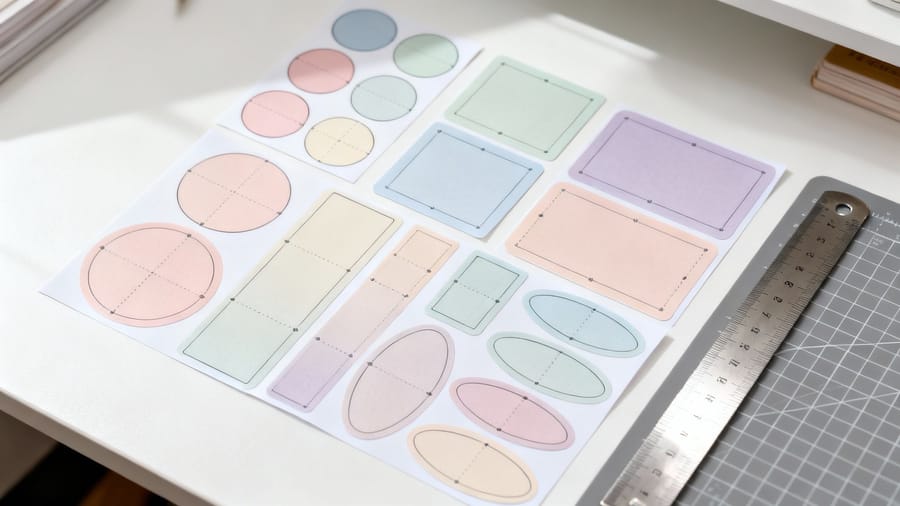
A sticker sizes chart is the fastest way to match your design to the right dimensions. Small stickers from 1 to 2 inches handle product seals and quiet branding. Medium stickers from 3 to 4 inches fit laptops, water bottles, and packaging. Large stickers of 5 inches and up cover bumpers, windows, and shipping boxes. 4OVER4.COM prints custom stickers across all of these sizes and more than 1,000 products in the catalog. Round designs follow their own sticker sizes, from half inch dots to 4.5 inch circles.
The wrong size quietly kills the whole effect. Too small and nobody notices your logo. Too big and it looks awkward on the surface it lands on. Getting the dimension right the first time saves a reprint and makes the design look intentional.
This guide walks every common sticker dimension by shape, material, and use case, so you can order with confidence. For more hands-on printing tips, the 4OVER4.COM printing guides cover the rest of the workflow.
Match sticker sizes to real-world use cases
Knowing the dimensions is one thing. Knowing which size to pick for your project is where a sticker sizes chart earns its keep. Product packaging usually wants a 2 to 3 inch sticker with a quarter inch of margin so nothing wraps around a seam. Promotional giveaways at trade shows and festivals land on the 3 by 3 inch standard, big enough to show off and small enough to pocket.
Laptop and personal decals live best between 2 and 4 inches, where round and die-cut shapes stand out against the flat lid. Vehicle and window stickers need 5 inches and up so they read from several feet away, always on vinyl with UV lamination. Envelope seals go small, a 1 to 1.5 inch round on the back flap adds a professional touch for pennies.
Want to see how brands turn these sizes into reach? These logo sticker design ideas show how a well-placed sticker becomes a mobile billboard, and the size you pick decides how far it travels.
Material and finish by sticker size
Size is only half the decision. The material sets where a sticker can live and how long it lasts. Vinyl is the toughest option, waterproof, UV-resistant, and tear-proof, so it is the default for outdoor stickers, vehicle decals, and anything that gets wet or sits in the sun. It comes in every size from 1 inch rounds to full vehicle wraps.
Paper stickers cost less and shine indoors on product labels, packaging seals, and planner sheets, as long as you keep them away from moisture. Clear stickers create a no-label look where the design appears printed straight onto glass or a bottle, and sizes from 1 to 6 inches are the most common there.
Finish changes how the sticker feels and catches light. Gloss makes colors pop and wipes clean, matte kills glare for a modern, premium look, and soft-touch lamination adds a velvety texture people want to touch. For anything living outdoors, a UV coating works like sunscreen against fading.
Design tips for every sticker size
Your design has to work inside the dimension you choose. For small stickers from 1 to 2 inches, keep it to one icon, one word, or a clean logo mark that reads from a short distance. For medium stickers from 3 to 4 inches, you have room for a logo plus a tagline or URL, with fonts at 8pt minimum so the text stays legible.
For large stickers of 5 inches and up, you can go wild with illustration and detail, as long as your file sits at 300 DPI at the final print size. A graphic that looks sharp on screen at 72 DPI turns blurry when it prints at 8 inches wide. Always add 0.125 inches of bleed so the background runs past the cut line and no white slivers appear.
Need a head start? Browse the 4OVER4.COM design templates for ready-to-customize sticker layouts in every standard size, or grab print-ready blanks for 3D lenticular stickers and bumper stickers so your artwork lands inside the cut line.
Print it
Standard stickers in every preset size
Preset shapes and sizes, the fastest way to get your design on a sticker at the right dimension.
Standard sticker dimensions by shape
Shape changes how a sticker performs. A round reads differently than a rectangle, and an oval feels different than a die-cut. Knowing the standard dimensions for each shape helps you picture the final product before you spend a dime on printing. Sizes below are in inches with the millimeter equivalent for total clarity.
Round sticker sizes
Round stickers are a classic. Their symmetrical shape works for logos, seals, and minimalist designs, and they sit cleanly on any surface with no sharp corners to catch or peel.
- 1 inch by 1 inch (25.4mm): Tiny branding touches like envelope seals, cosmetic jar labels, and thank-you card accents.
- 2 inch by 2 inch (50.8mm): The most popular round size, clear enough for a logo on packaging, coffee cups, or craft beer bottles.
- 3 inch by 3 inch (76.2mm): Great for giveaway stickers at events, big enough to read from a short distance.
- 4 inch by 4 inch (101.6mm): Bumper-sticker territory that works on car windows, large water bottles, and retail displays.
If you want something that pops off the surface, look at 3D lenticular stickers, which add motion and depth that flat stickers cannot match.
Square sticker sizes
Square stickers give a clean, modern look. They are popular with tech brands, food packaging, and social QR code stickers, where the equal sides frame a centered design.
- 1.5 inch by 1.5 inch (38.1mm): Small product labels, price tags, or QR code stickers for menus.
- 2 inch by 2 inch (50.8mm): A versatile mid-range option for social handle stickers and small packaging seals.
- 3 inch by 3 inch (76.2mm): Laptop stickers, notebook covers, and retail bag closures.
- 4 inch by 4 inch (101.6mm): Window clings, product box branding, and event handouts.
Rectangular sticker sizes
Rectangles are the workhorses of the sticker world. They handle text-heavy designs, address labels, product descriptions, and bumper stickers better than any other shape, since the extra horizontal or vertical room gives the layout space to breathe.
- 2 inch by 1 inch (50.8 by 25.4mm): Return address labels and small product identifiers.
- 3 inch by 2 inch (76.2 by 50.8mm): Name tags, small promotional stickers, and jar labels.
- 4 inch by 3 inch (101.6 by 76.2mm): Shipping labels and product information stickers.
- 5 inch by 3 inch (127 by 76.2mm): Bumper stickers, toolbox decals, and larger product labels.
- 8 inch by 3 inch (203.2 by 76.2mm): Full bumper stickers and banner-style decals.
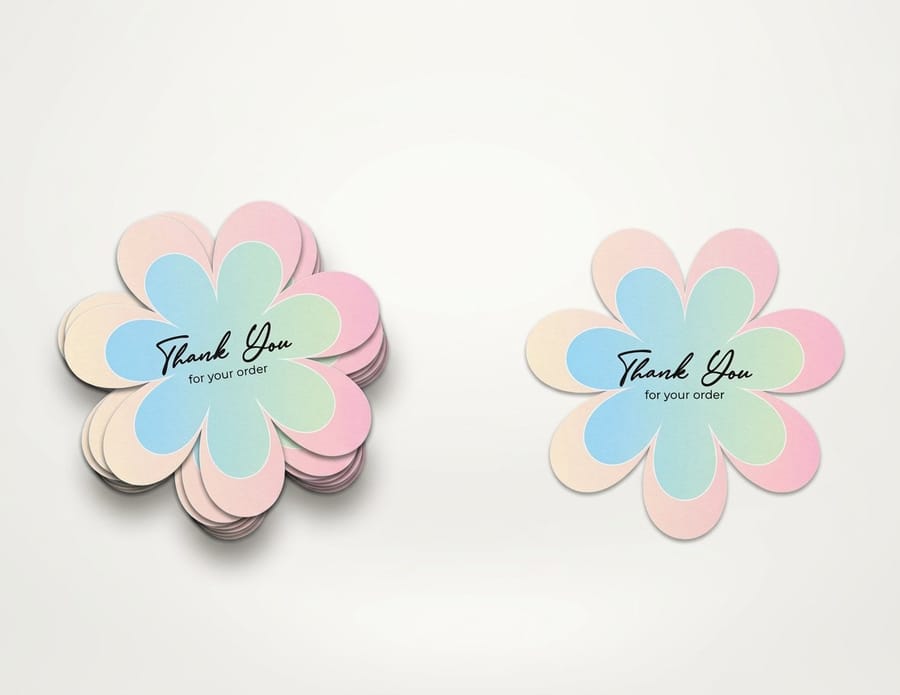
Need a shape that is completely your own? Custom die-cut stickers cut around any outline, your logo, a mascot, or a product silhouette, with no standard shape required.
Oval sticker sizes
Oval stickers bring a softer, more elegant feel than rectangles or squares. They are a go-to for artisan products, wine labels, candle branding, and vintage-style designs, where curved edges give a premium, handcrafted look.
- 2 inch by 1.5 inch (50.8 by 38.1mm): Small labels for handmade goods and spice jars.
- 3 inch by 2 inch (76.2 by 50.8mm): Candle labels, wine bottle stickers, and bakery packaging.
- 4 inch by 3 inch (101.6 by 76.2mm): Larger product labels and gift-basket branding.
| Shape | Inches | Millimeters | Best use |
|---|---|---|---|
| Round | 1" diameter | 25.4mm | Envelope seals, cosmetic jar lids, and small logo marks. |
| Round | 2" diameter | 50.8mm | The most ordered round size, sized for packaging and cups. |
| Round | 3" diameter | 76.2mm | Event giveaways that still read from a few feet away. |
| Round | 4" diameter | 101.6mm | Car windows, large bottles, and retail display marks. |
| Square | 1.5" x 1.5" | 38.1 x 38.1mm | Price tags, menu QR codes, and small product labels. |
| Square | 2" x 2" | 50.8 x 50.8mm | Social handle stickers and packaging seals. |
| Square | 3" x 3" | 76.2 x 76.2mm | Laptop lids, notebook covers, and retail bag closures. |
| Square | 4" x 4" | 101.6 x 101.6mm | Window clings, box branding, and event handouts. |
| Rectangle | 2" x 3.5" | 50.8 x 88.9mm | Standard business card size, perfect for name tags. |
| Rectangle | 3" x 4" | 76.2 x 101.6mm | Product labels for bottles, jars, and boxes. |
| Rectangle | 4" x 6" | 101.6 x 152.4mm | A popular choice for shipping and mailing labels. |
| Oval | 1.5" x 2.5" | 38.1 x 63.5mm | Ideal for candle labels or sealing food packaging. |
| Oval | 2" x 3" | 50.8 x 76.2mm | Great for branding products with a logo and text. |
| Oval | 3" x 5" | 76.2 x 127mm | Often used for vehicle decals or larger containers. |
Quantity and price
Standard sticker pricing and specs
Real configurator numbers, the more you order, the lower the per-unit cost drops.
| Quantity | Price Per Unit | Total |
|---|---|---|
| 25 | 95.5¢ | $23.88 |
| 50 | 72.9¢ | $36.44 |
| 100 | 42.7¢ | $42.72 |
| 150 | 32.7¢ | $49.01 |
| 200 | 27.6¢ | $55.29 |
| 250 | 24.6¢ | $61.57 |
Individually cut stickers and kiss cut sheets
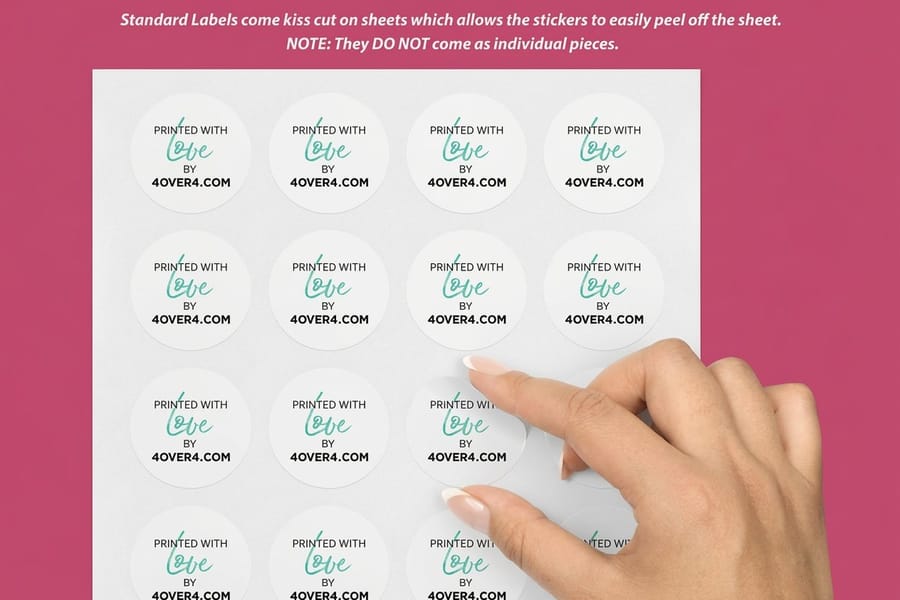
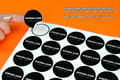
The same 3 inch design arrives two different ways. Individually cut stickers come off the press as separate pieces, each one trimmed to its own outline with the backing cut through, so you peel a single sticker off a stack. Kiss cut stickers stay on one shared backing, cut through the vinyl but not the paper behind it, so several designs travel together and lift off one at a time.
How they are delivered changes the size you should order. On a shared sheet every piece has to fit inside that sheet with a gap around it, so a group of 2 inch pieces sits comfortably where a single 5 inch piece would not. Individually cut pieces have no such ceiling, which is why anything above 4 inches is normally ordered that way. Pieces under 1 inch are easier to handle on a sheet, because a loose sticker that size is hard to get a fingernail under.
Sizing by real-world job
Beyond shape, the job the sticker does sets a floor on its size. Here is how three common jobs push the dimension up or down.
- Product labeling. Food and drinks need room for ingredients, nutrition facts, and barcodes, so a tiny cute sticker will not cut it. Size for all the required info without looking cluttered.
- Shipping and logistics. Shipping labels are a standard 4 inch by 6 inch for a reason. They fit carrier requirements and keep the address and tracking readable at a glance.
- Warning and safety labels. For industrial equipment or chemical products, safety text has to be legible from a set distance, which dictates the minimum sticker and font size.
Sticker sizes by surface: laptops, bottles, packaging and more
The fastest way to size a sticker is to start from the surface it lands on, then picture the dimension against an everyday object. A 1 inch circle is about a quarter, a 2 inch circle is about an Oreo cookie, a 3 by 3 inch square is about a drink coaster, and a 2.5 by 4 inch rectangle is about a deck of playing cards. The rule that ties it together: a sticker should cover 50 to 70 percent of the flat surface it sits on. Bigger looks cramped, smaller looks lost.
| Surface | Recommended size | Metric | Popular shapes | About the size of |
|---|---|---|---|---|
| Laptops and tech | 3" x 3" or 4" x 4" | 7.6 x 7.6 cm or 10.2 x 10.2 cm | Circle, square, die-cut | A coaster or a baseball |
| Water bottles and tumblers | 2.5" x 4" or 3" x 5" | 6.4 x 10.2 cm or 7.6 x 12.7 cm | Rectangle, oval, die-cut | A deck of playing cards |
| Product packaging, boxes and bags | 2" x 2" or 3" x 2" | 5.1 x 5.1 cm or 7.6 x 5.1 cm | Circle, square, rectangle | An Oreo cookie or a business card |
| Car bumpers and windows | 10" x 3" or 5" x 5" | 25.4 x 7.6 cm or 12.7 x 12.7 cm | Rectangle, die-cut | A #10 envelope |
| Phone cases and small items | 1" x 2" or 1.5" x 1.5" | 2.5 x 5.1 cm or 3.8 x 3.8 cm | Die-cut, circle, rectangle | A large postage stamp |
| Hard hats and helmets | 2" x 2" | 5.1 x 5.1 cm | Circle, die-cut | A golf ball |
| Mailing envelopes and flyers | 1.5" circle or 2.5" x 1" | 3.8 cm or 6.4 x 2.5 cm | Circle, rectangle | A bottle cap |
- Laptop lids. A 13 inch lid has room for a 3 to 4 inch sticker. A 1 inch sticker on a laptop looks like a speck, so this is the one surface where going bigger pays off.
- Bottles, tumblers and helmets. Keep the sticker width under the curve radius. A 2.5 by 4 inch rectangle wraps a tumbler cleanly, and narrow, tall rectangles conform to curves better than wide squares. For extreme curves, flexible vinyl stretches without tearing.
- Jars and candles. On a standard 8 oz candle jar, a 2 to 2.5 inch circle or a 2 by 3 inch rectangle covers the label area without crowding it. A 4 inch sticker on the same jar looks like a price tag slapped on by accident.
- Bumpers. A bumper sticker needs at least 10 inches of width to read from a car length away, and 10 by 3 inches is the standard. A 5 by 5 inch square is about the size of a CD case and is visible from across a room, which is why it suits window decals.
- Envelope seals. A 1 to 1.5 inch circle stays clear of the address and postage. For wedding invitations and event mailers, a 1.5 inch circle with a foil or embossed finish adds elegance without bulk.
Die-cut stickers are sized by their bounding box, the smallest rectangle that contains the whole design, so a 3 inch die-cut mascot occupies a 3 inch square on the surface even though its outline is irregular.
Roll sticker specs
Roll sticker materials and sizes
Indoor and outdoor stocks, lamination, and roll sizes for high-volume labeling.

Prep your file for a clean cut
Size only pays off when the file is built right. A few production basics keep every dimension sharp from the first proof to the final peel.
Set up your die-line
- Define the outline. Draw a solid line around your design in a vector program like Adobe Illustrator. That line becomes the cut path.
- Set a margin. Offset the die-line slightly from your artwork, about one eighth of an inch, for a clean, uniform border.
- Simplify your paths. Avoid die-lines with tons of sharp points or tiny details. Smoother curves cut cleaner and last longer.
- Put it on its own layer. Lock the finished artwork layer, then draw the cut path on a new layer named Dieline or Cut Line so nothing shifts by accident.
- Set the stroke. Give the path a unique spot color, bright magenta is the common choice, at a 0.25 pt stroke, so the printer software reads it as a cutting instruction, not something to print.
Trim, bleed, and safe zone
- Trim line. The exact edge where the sticker is cut. It is the final dimension you chose, like a 3 inch by 3 inch square.
- Bleed area. A safety buffer of 0.125 inches beyond the trim line. Background color or images must fill it so no white slivers show if the cut shifts.
- Safe zone. The area just inside the trim line. Keep your logo, text, and key graphics at least 0.125 inches away from the edge so nothing gets clipped.
Two file settings decide whether the print looks crisp or muddy at any size.
- Resolution at 300 DPI. Web images are often 72 DPI, which looks fine on screen but prints blurry. Build and save artwork at 300 DPI at the final size, so a 3 inch by 3 inch sticker needs a file of at least 900 by 900 pixels.
- CMYK color mode. Monitors show RGB, but printers use CMYK. Designing in CMYK from the start keeps your brand colors true and avoids color shifts.
File formats that hold up
- PDF, preferred. A high-quality PDF locks in fonts, images, and vector paths so nothing moves when we open it.
- AI, Adobe Illustrator. The native file is ideal for custom die-cuts because it keeps all vector paths intact.
- EPS. Another solid vector format that holds scalability and quality with no loss.
Material and finish, the full menu
The material decides where a sticker can live and the finish decides how it feels. Match both to the size and the surface.
Materials
- Weatherproof vinyl. Waterproof, scratch-resistant, and fade-proof. The go-to for car decals, window graphics, and equipment labels.
- Classic paper. Budget-friendly and popular for indoor use like packaging, shipping labels, and giveaways with that classic tactile feel.
- Transparent polyester. A clear, no-label look that is great on glass, water bottles, and containers where you want the surface to show through.
Finishes
- Gloss finish. A high-shine coat that makes colors pop and wipes clean, with a little extra protection from moisture and scuffs.
- Matte finish. A non-glare, satin surface that feels smooth and suits sophisticated branding and softer palettes.
- UV coating. A cured clear coat that acts like sunscreen, protecting against fading for stickers that live outdoors.
Which finish at which size
Size changes which finish works. A gloss coat on a 1 inch sticker looks crisp and bright. The same gloss on a 10 inch sticker shows fingerprints and glare.
- Small stickers, under 2 inches. Gloss or semi-gloss works best. It makes colors pop and gives fine detail extra clarity, while matte can make small text harder to read at this scale. White vinyl or clear vinyl both work, and clear gives cosmetics and artisan products a no-label look.
- Medium stickers, 2 to 4 inches. The most flexible range. Matte, gloss, satin, holographic and metallic all work here. Holographic and metallic catch light and draw the eye when you want to stand out in a crowd.
- Large stickers, 5 inches and up. Matte or satin reduces glare and fingerprints, which show on a 10 inch gloss sticker. Lamination is almost always worth the small extra cost at this size because it protects against UV fading, water and scratching.
Want to feel the materials first? 4OVER4.COM offers free samples so you can hold the finishes in person before you order.
Sticker sheet specs
Sticker sheets for mixed sizes
Group multiple designs and sizes on one kiss-cut sheet, great for events and variety packs.

How to pick the right size in one pass
When the options blur together, weigh these three factors and the right dimension usually falls out on its own. If you would rather settle it with your hands than with a screen, print the sticker size chart PDF at 100 percent and hold the shapes against the real surface.
- Viewing distance. A storefront window sticker needs to be far larger than one on a lip balm tube. Size for where people will see it.
- Design complexity. Fine detail and small text need a bigger sticker to stay legible. A bold, simple icon can shrink way down.
- Surface shape. For curved surfaces like bottles and candles, an oval or flexible vinyl hugs the shape better than a rigid square with corners that peel.
Test the size before you order
A quick paper test beats a guess every time.
- Measure the surface. Grab a ruler and work out the maximum and minimum space you have on the final product.
- Print a test. Print your design on regular paper at the actual size and physically place it on the surface.
- Check for legibility. Step back to the distance someone would normally see it from. If the text and graphics still read sharp, the size is right.
Sizing mistakes to avoid
Even experienced designers trip up on sticker sizing. These are the mistakes the 4OVER4.COM production team sees most often.
- Designing at screen size instead of print size. A sticker that looks great at 100 percent zoom on your monitor may only be 72 DPI. Check the document setting, it should be 300 DPI at the final print size, or start from a blank template that comes pre-configured.
- Forgetting bleed and safe zones. No bleed means white edges. No safe zone means cut-off text. Both are the most common file errors and both are avoidable.
- Choosing the wrong size for the surface. Measure the target surface first, then pick a size that covers 50 to 70 percent of the available space. When in doubt, go slightly smaller. A sticker with breathing room looks intentional and clean.
- Ignoring curved surfaces. Flat stickers on curved surfaces wrinkle. If it is going on a bottle, tumbler or helmet, keep the width under the curve radius and favor narrow rectangles over wide squares.
- Forgetting that shape changes usable area. A 3 inch circle gives you about 7 square inches of design space, while a 3 inch square gives you 9. Text-heavy designs usually belong on a square or rectangle.
Compare formats
Popular sticker products, side by side
Stock, finish, quantity, turnaround, and from-price across our most-ordered stickers.
 Standard Stickers |  Premium Stickers |  Roll Stickers | 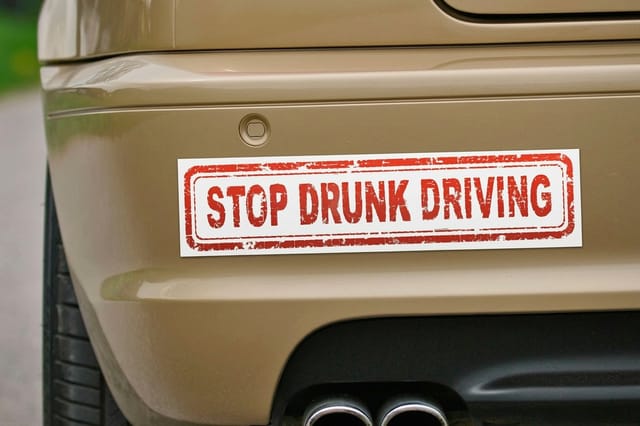 Bumper Stickers | |
|---|---|---|---|---|
| Min price | $23.88 | $29.16 | $322.98 | $38.44 |
| Paper / stock | Standard Uncoated Label | Uncoated Label | White Gloss (Indoor) | White Vinyl Permanent |
| Finish | - | - | - | UV Coating |
| Size | .375" x 1" | 3" x 5" | 1" x 1" | 2" x 5" |
| Default qty | 25 | 25 | 100 | 25 |
| Turnaround | 3 business days | 3 business days | 6 business days | 5 business days |
| Rating | ||||
| View & customize | View & customize | View & customize | View & customize |
Ordering custom stickers at 4OVER4.COM
4OVER4.COM has printed more than 10 billion cards and print products since 1999, which is 25 plus years of getting dimensions, materials, and finishes right. With 150,000 plus businesses trusting their print work, you are in good company whether you need 50 stickers or 50,000.
The ordering flow is simple. Pick your shape and size, choose material and finish, upload your design or start from a template, and review the proof. Explore the full range of custom sticker options, and for more ideas browse the 4OVER4.COM printing articles or these funny print ad examples.
Start fast
Templates and print-ready blanks
Sticker design templates and exact-size blanks so your artwork lands inside the cut line at any dimension.
Wally sizes it up for you
Small seals, medium laptops, large windows, matched in one pass
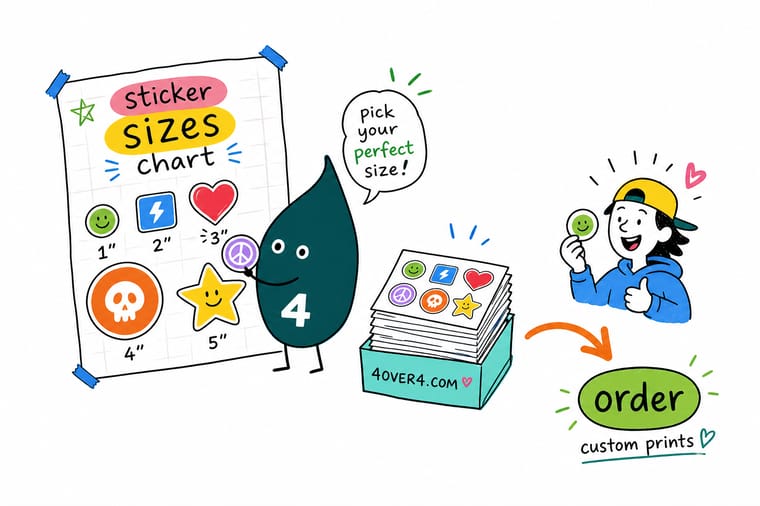
A sticker only works at the right size. Go 1 to 2 inches for seals, 3 to 4 inches for laptops and bottles, and 5 inches and up for bumpers and windows. Pick vinyl for outdoors or paper for indoors, design at 300 DPI with a 0.125 inch bleed, and 4OVER4.COM cuts it clean at any dimension.
Configure your stickers →What to remember from this sticker sizes chart
Explore more
More ways to size, print, and brand with stickers
Every related page type on 4OVER4.COM, one card each, so you can keep exploring sticker sizing and printing.
 Shop Stickers Printing Every sticker format and size in one place. Hub Sticker & Label Printing The full sticker and label hub.
  Product Die-Cut Stickers Contour-cut custom stickers at any size.
  Article Logo Sticker Design Ideas Turn the right size into real reach. Article 10 Reasons Bumper Stickers Are Awesome Why big horizontal sizes win outdoors.
  Showcase Custom Sticker Options Quality, materials, and design examples.
  Case study Food Brand Labels How the right label size won shelf space.
  Alternative Sticker Mule Alternative How 4OVER4.COM compares for custom stickers.
  Benefit Same Day Printing Order today, ship today on rush jobs.
 Ready to order stickers in the right size?
Pick a shape and dimension, drop in your vector design or a free template, and 4OVER4.COM prints it sharp, as fast as same day.
Common questions about sticker sizes and dimensions
What are the standard sizes of stickers?
There is no official standard, but the sizes ordered again and again are 2 by 2, 3 by 3 and 4 by 4 inches for squares, 2 and 3 inch circles for rounds, and 2 by 4 or 3 by 5 inch rectangles for labels. Bumper stickers hold at 10 by 3 inches. Anything under 1 inch behaves like a seal, and anything past 5 inches behaves like a decal.
What is the typical size of a wall sticker?
Wall pieces start where regular stickers stop. A small accent decal runs 5 to 12 inches, a feature piece such as a logo behind a desk runs 24 to 36 inches, and anything covering a full wall is printed on adhesive wall fabric rather than sticker vinyl, because a single vinyl sheet that size cannot be laid flat without trapping air under it.
What size is a 2x2 sticker?
A 2x2 sticker is 2 inches wide by 2 inches tall, which is 50.8 by 50.8 millimeters. Held against something real it is about the size of an Oreo, so it reads clearly in the corner of a laptop lid, on a jar lid or as an envelope seal. It is the smallest square that still carries a logo and one short line of text.
What are the best practices for using a sticker sizes chart?
Start by measuring the surface where the sticker will go and leave at least 0.25 inches of margin on all sides. Match your design complexity to the size, simple logos for 1 to 2 inch stickers and detailed artwork for 4 inches and up. Always check dimensions in both inches and millimeters to avoid conversion errors. For wall-sized graphics, adhesive wall fabric handles the largest formats.
How do I choose the right sticker size for my project?
Weigh three things, the surface area available, the viewing distance, and the design complexity. Product labels usually need 2 to 3 inch stickers, laptop decals work best at 3 to 4 inches, and vehicle stickers need 5 inches and up for readability. A sticker sizes chart lets you cross-reference these fast so you do not over-order the wrong size.
What makes sticker sizes effective for marketing campaigns?
The right size turns a simple decal into a walking billboard. A 3 inch branded sticker on a laptop gets seen by dozens of people a day, and stickers stay visible for months or years, which builds strong brand recall. For floor-level marketing, aluminum floor graphics offer a durable alternative at larger scales.
How much should I budget for custom stickers in different sizes?
Pricing depends on size, material, quantity, and finish. Smaller stickers from 1 to 2 inches cost less per unit than larger formats, and paper runs cheaper than vinyl. Ordering in bulk drops the per-unit price sharply. At 4OVER4.COM you get an instant quote by selecting your exact size and material, with no hidden setup fees or surprise charges at checkout.
What sticker size fits a laptop, a water bottle, or a jar?
A laptop lid takes a 3 by 3 inch or 4 by 4 inch sticker. A water bottle or tumbler takes a 2.5 by 4 inch or 3 by 5 inch rectangle, kept narrower than the curve so it does not wrinkle. A standard 8 oz candle jar takes a 2 to 2.5 inch circle or a 2 by 3 inch rectangle. In every case aim to cover 50 to 70 percent of the flat surface, and print a paper test at actual size before you order.
How big should a bumper sticker be?
A bumper sticker needs at least 10 inches of width to read from a car length away, and 10 by 3 inches is the standard. For window decals, 5 by 5 inches or larger gives enough visibility. Both need weatherproof vinyl with UV lamination, and at this size a matte or satin finish cuts glare better than gloss. Order them as bumper stickers.
