
Matching a Remittance Envelope to the Reply Card It Has to Hold


Exact dimensions for the two sizes people ask about, the largest insert each one takes, and the flap that turns a plain envelope into a giving form.
A number 6 3/4 remittance envelope is 3-5/8 by 6-1/2 inches and takes an insert up to 6-1/4 by 3-3/8 inches. An A7 is 5-1/4 by 7-1/4 inches and takes a 5 by 7 card. The working rule for both families is a quarter inch of clearance: subtract 1/4 inch from each envelope dimension to get the biggest insert you should draw. A reply piece also needs a deep wallet flap, because that flap is where the donor writes the amount and the card details.
Quick answer
Two sizes, one clearance rule
Number 6 3/4 measures 3-5/8 by 6-1/2 inches and holds up to 6-1/4 by 3-3/8 inches. A7 measures 5-1/4 by 7-1/4 inches and was built around the 5 by 7 card. Both follow the same arithmetic: take a quarter inch off each envelope dimension and that is your maximum insert. The 6 3/4 suits a folded statement and a check-height reply form. A7 suits a flat card, and in most donor packs it is the outer envelope rather than the reply. Add a wallet flap deep enough for the giving fields, keep the sealed piece under a quarter inch thick, and the mailing stays at the letter rate.
The Two Sizes and the Insert Each One Takes
Number 6 3/4 and A7 solve two different problems, and choosing between them is really a choice about what the donor has to write on. Both sizes are stocked as remittance envelopes, so the decision is about the insert rather than about availability.
The 6 3/4 is a commercial size. It is long and low, it was designed around a folded statement and a check, and it is the shape almost everyone pictures when they hear the words reply envelope. A7 comes from the announcement family, where sizes are built around cards rather than folded sheets. It is nearly square by comparison, and it exists because a 5 by 7 card had to go somewhere.
| Envelope | Outside size | Largest insert | What it is for |
|---|---|---|---|
| No. 6 3/4 | 3-5/8 x 6-1/2 in | 6-1/4 x 3-3/8 in | Donation and statement reply, check-height forms, anything that folds down flat. |
| No. 9 | 3-7/8 x 8-7/8 in | 8-5/8 x 3-5/8 in | The reply envelope built to ride inside a No. 10 outer. |
| A2 | 4-3/8 x 5-3/4 in | 5-1/2 x 4-1/8 in | The 4-1/4 x 5-1/2 RSVP card that travels inside an A7. |
| A6 | 4-3/4 x 6-1/2 in | 6-1/4 x 4-1/2 in | A 4-1/2 x 6-1/4 card, and a middle ground when A7 feels oversized. |
| A7 | 5-1/4 x 7-1/4 in | 7 x 5 in | The 5 x 7 reply card, gala pledge cards, and folded notes. |
Read the third column, not the second. Buyers order by envelope number and then discover their artwork was drawn to the outside dimension, which is a quarter inch too big in both directions. If you are laying out the card first, our RSVP card size guide lists the reply card sizes that match each A-series envelope, and the greeting card size guide covers folded pieces that have to open inside the same envelope.
One correction worth making early. A7 is rarely the right reply envelope for a mailed appeal. It is the outer for a 5 by 7 invitation, and the reply envelope that goes inside it is an A2. If a vendor has quoted you A7 remittance envelopes for a direct mail ask, check whether they meant the outer.
The Quarter Inch Rule, and Where It Runs Out
Take the envelope size, subtract a quarter inch from the height and a quarter inch from the width, and that is the largest insert you should draw. The rule is that simple, and it holds for both families.
Where it stops holding is on stacks. A single 5 by 7 card in an A7 has an eighth of an inch on each edge and goes in without thinking. Put a reply card, a folded letter, and a return envelope in together and the pieces slide against each other as you push, so the leading corner catches the seam and folds. For a three-piece stack, take the largest piece down another eighth of an inch. Hand insertion tolerates 1/8 inch of clearance. An inserting machine wants the full 1/4 inch and will jam below it.
Nesting is the other place it runs out, because you spend the clearance twice: once fitting the card into the reply envelope, again fitting that envelope into the outer.
| Reply envelope | Outer | Clearance, short side | Verdict |
|---|---|---|---|
| No. 6 3/4 | No. 10 | 1/2 in | The easy pairing. Nearly 3 inches of length to spare, and machines like it. |
| No. 9 | No. 10 | 1/4 in | The standard courtesy reply pair. Tight but proven, provided the reply envelope is dropped in square. |
| No. 6 3/4 | No. 9 | 1/4 in | Fits by hand, jams on an inserter. The reply flap catches on the outer fold. |
| A2 | A7 | 7/8 in | Generous. Room for the reply envelope, the card, and a folded letter behind them. |
There is a floor as well as a ceiling. USPS will not take a letter smaller than 3-1/2 by 5 inches or thinner than 0.007 inch, and the sealed piece has to stay under 6-1/8 by 11-1/2 inches and a quarter inch thick to keep the letter rate. Length divided by height also has to land between 1.3 and 2.5 for a machinable letter, which is where the near-square sizes get interesting: A7 works out at 1.38 and A2 at 1.31, so both clear it, but only just. When you cut a reply card to a size nobody publishes, that is worth checking before the run. Our custom die-cut paper starts at $87.00 and will hold any trim you specify, so the constraint is the envelope and the postal rules rather than the cutting.
Flap Style Is the Whole Point of a Remittance Envelope

Two envelopes can share the same outside dimensions and behave completely differently, because the flap is doing a job that has nothing to do with sealing.
A commercial flap on a 6 3/4 is roughly an inch and a half deep. It closes the envelope and that is all it was asked to do. A remittance flap runs most of the way up the back panel, sometimes the full height, and it exists so the donor has somewhere to write. That surface carries the name and address block, the amount checkboxes, the card number and expiry fields, a tribute or in-memory-of line, and the box people tick to ask that their gift stay anonymous.
Three details decide whether that surface actually works:
- Side seam, not diagonal seam. A diagonal-seam envelope puts glue ridges across the back panel, and a ballpoint skips over them. Side seams leave the panel flat.
- Regular gum over peel-and-seal. Peel-and-seal is faster in the office and slower in the mail, because a share of donors return the envelope with the liner still attached. It also costs more per thousand.
- Field size before font size. Handwriting needs about a quarter inch of line height. Shrinking the type to fit one more field produces forms that come back unreadable, which is worse than the field being absent.
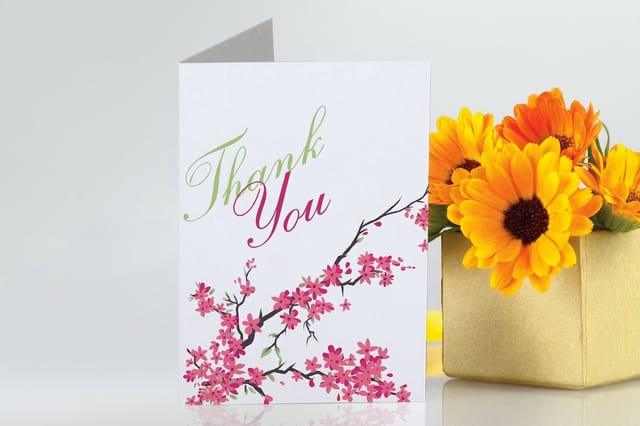
Print the reply form the same way you would print any small-type piece: fonts converted to outlines, artwork at final size, and a proof read on paper rather than on screen. Correctly sized starting layouts live in the blank template library. If your reply piece is a folded note rather than a flat card, greeting cards from $56.02 give you a printed inside panel that carries the same fields with more room.
Who Sends Remittance Envelopes, and How the Form Changes
Three kinds of sender account for almost all of these envelopes, and each one wants a different set of fields on the flap.
- Non-profits. The flap carries the gift amount checkboxes, the card number and expiry, a tribute or in-memory-of line, and the box a donor ticks to stay anonymous. This is the deepest flap of the three, because it is doing the work of a form.
- Utilities and statement billing. The 6 3/4 was designed around a folded statement and a check, so the flap here is shallower and mostly carries the account number, the amount enclosed and an address change block. Ask for a security tint inside when the account number shows through.
- Membership organizations. Renewals sit in between. The flap needs the member name and number, the level or tier being renewed, and one line for a change of contact details.
Match the depth to the field count rather than ordering a deep flap by default. A shallow commercial flap on a donation envelope wastes the piece, and a full-height flap on a simple bill return costs paper nobody writes on.
Ordering the Set: Paper, Reply Mail Rules, and What Not to Enclose
Once the sizes are settled, three ordering decisions account for most of the reprints we see on reply mailings.
Paper weight. Twenty-four pound wove is the floor for the envelope itself. Twenty pound is cheaper and lets a check show through, which generates exactly the kind of phone call a finance office does not want. If the reply envelope carries account numbers, ask for a security tint on the inside. Check the stock options on the donation envelopes before artwork goes final, because a heavier sheet folds a deep flap less tightly and changes where your fields sit. For the card, something around 80 pound cover takes a signature without the pen tearing through and still folds flat where it needs to.
Reply mail artwork. Courtesy reply mail, where the donor supplies the stamp, needs nothing from USPS: just a clear return address and a clean lower right corner for the stamp and barcode. Business reply mail, where you pay postage on the pieces that come back, needs a permit, the facing identification mark, and a barcode placed to the USPS template. Pull the template before art goes to press. Reply mail is the single most reprinted piece in a donor pack, and it is almost always a placement error rather than a design one.
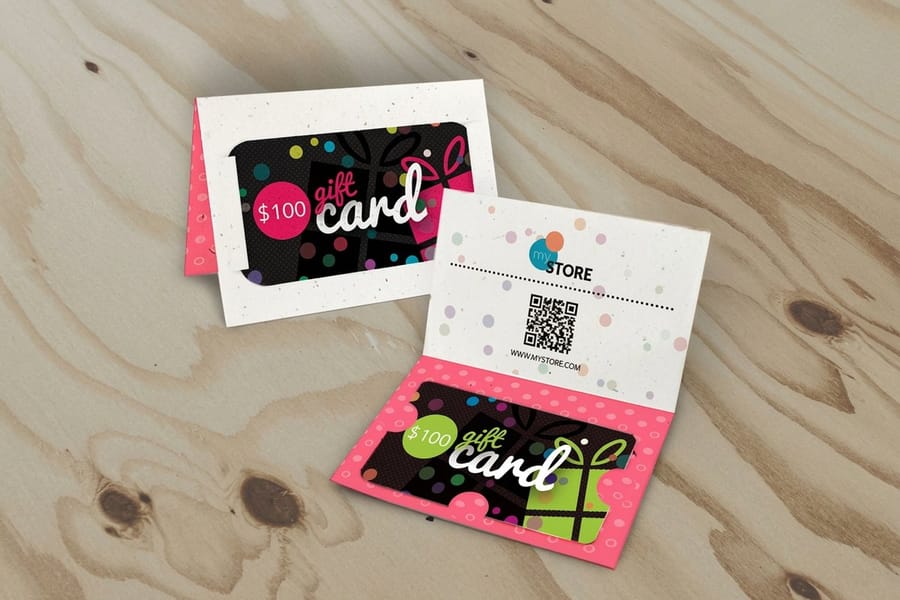
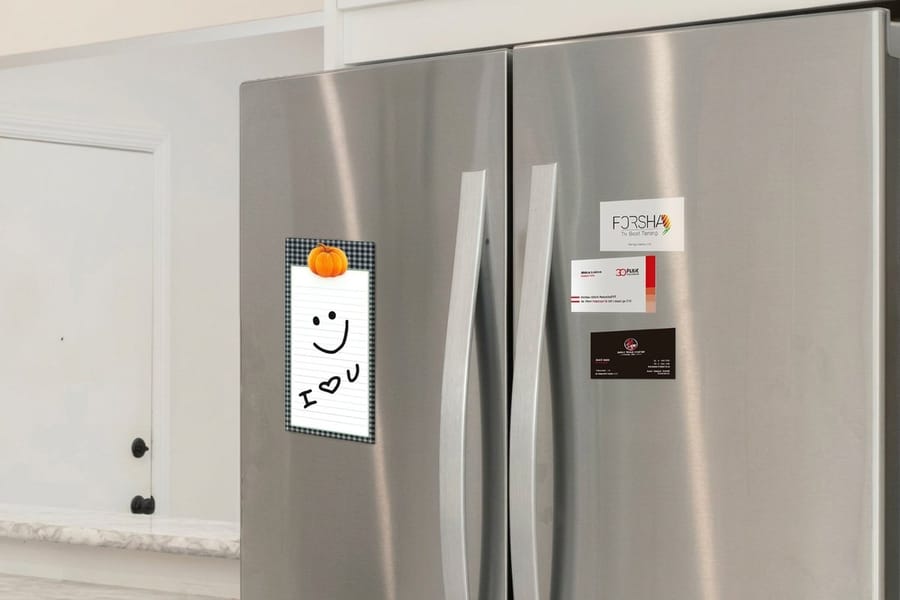
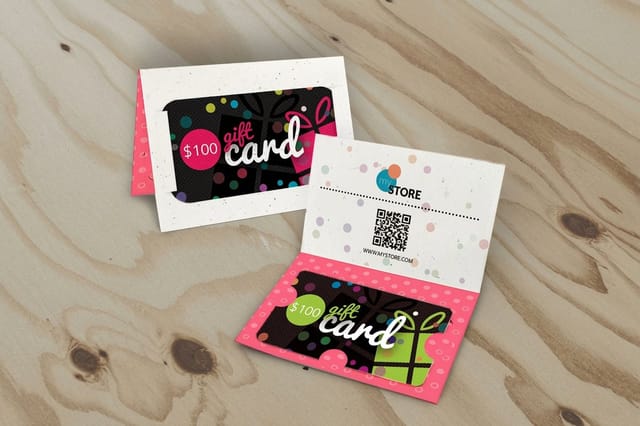
What goes in the outer, not the reply. Rigid or lumpy contents cost the letter rate. A sealed piece that is uneven, or thicker than a quarter inch, is nonmachinable, and the surcharge lands on the mailing rather than on the one odd envelope. Keepsakes still work in a donor pack, they just belong in the outer envelope with the ask: business card magnets from $19.68 sit on a fridge for years, and a gift card holder from $170.03 turns a thank-you card into something with a pocket. Send them out with the appeal and keep the reply envelope thin, flat, and cheap to return.
If you are sizing a family of pieces at once rather than a single reply envelope, the invitation card guides cover the whole set, the gift card dimensions guide handles anything that has to travel inside a carrier, and the business card size guide is the one to read before you tuck a card into the pack. For the metric equivalents, card sizes in inches and millimeters lists them side by side.
Wally sizes the reply envelope
Take a quarter inch off, then check the flap
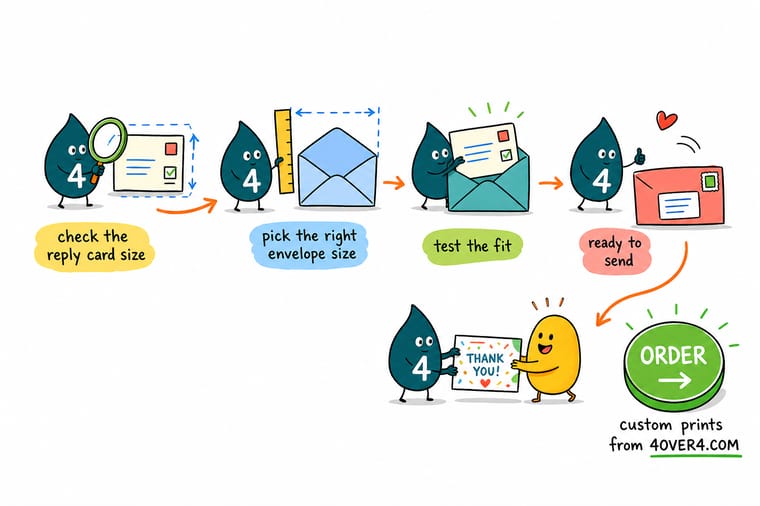
Wally measures the envelope, subtracts a quarter inch from the height and a quarter inch from the width, and draws the card to whatever is left. On a 6 3/4 that is 6-1/4 by 3-3/8 inches. On an A7 it is a plain 5 by 7. Then he turns the envelope over, because a reply envelope lives or dies on its flap: deep enough to hold the amount and the card fields, side seams so the pen does not skip, and regular gum rather than a peel strip donors forget to remove.
Cut a reply card to any size →Specs and pricing
Sizes, stocks, and starting prices for the pieces that go inside
Configure the reply card, the folded note, or the carrier with live size and stock choices straight from the 4OVER4.COM configurator.



Print it
Print the pieces that have to fit
Explore more
Where to go next



By the numbers
Reply pieces printed to size at 4OVER4
Common Questions
Your remittance envelope questions, answered
What are the different sizes of envelopes?
Business envelopes run on numbers and card envelopes run on letters. The common commercial sizes are the No. 6 3/4 at 3-5/8 by 6-1/2 inches, the No. 9 at 3-7/8 by 8-7/8 inches, and the No. 10, which is the standard outer that a No. 9 rides inside. The announcement family is built around cards: A2 at 4-3/8 by 5-3/4 inches, A6 at 4-3/4 by 6-1/2 inches, and A7 at 5-1/4 by 7-1/4 inches. Whichever family you are in, subtract a quarter inch from each dimension to find the largest insert.
What are the dimensions of a number 9 remittance envelope?
A No. 9 measures 3-7/8 by 8-7/8 inches and takes an insert up to 8-5/8 by 3-5/8 inches. It exists to ride inside a No. 10 outer, which is the classic courtesy reply pairing, and the fit leaves a quarter inch on the short side. On a remittance version the outside dimensions are unchanged and the flap is what differs, running far up the back panel so it can carry a printed giving or payment form.
Is there a template for a remittance envelope?
Yes. Correctly sized starting layouts live in the blank template library, with the trim and the flap area already drawn, so you are placing fields rather than measuring an envelope. Build the form at final size, convert fonts to outlines, and give each handwritten field about a quarter inch of line height. Print the proof on paper and write in the fields with a pen before you approve the run, because a form that reads fine on screen can be unusable at actual size.
What size is a number 6 3/4 remittance envelope?
It measures 3-5/8 by 6-1/2 inches, the same outside dimensions as a standard number 6 3/4 commercial envelope. What changes on a remittance version is the flap, which extends far up the back panel so it can carry a printed giving form instead of just a gum line. The largest insert that goes in comfortably is 6-1/4 by 3-3/8 inches. Note that it is not the same as a number 6 1/4, which is 3-1/2 by 6 inches and sits right on the USPS minimum letter size of 3-1/2 by 5 inches.
Will a 5 by 7 card fit an A7 envelope?
Yes, and that pairing is the reason the size exists. An A7 is 5-1/4 by 7-1/4 inches, so a 5 by 7 card leaves 1/8 inch of clearance on each edge. It slides in by hand without buckling. If you are adding a reply card, a return envelope, and a folded letter to the same A7, measure the stack rather than the sheets: three loose pieces shift as you push them in, and the fit that worked for one card will fold a corner on three.
Can a number 6 3/4 reply envelope go inside a number 9 outer?
It fits, barely. A 6 3/4 is 3-5/8 inches tall and a number 9 is 3-7/8 inches tall, so you have 1/4 inch of total height clearance and the reply envelope has to be dropped in square. Hand-stuffed, it works. On an inserting machine it is the size pairing that produces the most jams, because the reply envelope catches on the outer flap fold. Use a number 10 outer for the 6 3/4 and keep the number 9 for the classic number 9 into number 10 courtesy reply pairing.
What flap style should a donation reply envelope have?
A deep wallet-style remittance flap on a side-seam envelope. The side seams keep the back panel free of glue ridges, so the printed form lies flat and a pen does not skip across a seam. Depth is a judgment call: a flap that carries name, address, amount checkboxes, and a card number needs most of the envelope height, while a simple return envelope only needs a standard commercial flap. Ask for gum you moisten rather than peel-and-seal on a mailed reply piece, since peel liners add cost and older donors tend to leave them on the sheet.
Does a remittance envelope need a business reply permit?
Only if you are paying the postage. Courtesy reply mail, where the donor applies their own stamp, needs no permit and no special artwork beyond a clear return address and enough blank space in the lower right for the stamp and the barcode. Business reply mail, where you pay on delivery, requires a USPS permit, the facing identification mark, and a barcode positioned to their template. Get the template from USPS before art goes to press, because reply mail artwork is the piece most often reprinted.
What paper weight should the reply envelope and the reply card be?
Twenty-four pound wove is the sensible floor for the envelope. Twenty pound shows the check through the paper and a security tint costs less than the phone calls that show-through generates. The reply card is the opposite problem: too light and it creases in the mail stream, too heavy and it will not fold flat inside a 6 3/4. Around 80 pound cover holds a signature line and still stacks, and any custom card size we cut can be quoted at that weight.
Can I put a magnet or a rigid card in the reply envelope?
You can, and it will cost you at the counter. USPS treats a letter as nonmachinable when the contents make it rigid, lumpy, or thicker than 1/4 inch, and a nonmachinable surcharge applies to the whole mailing rather than to the odd piece. Business card magnets are a good keepsake for a donor pack, but send them in the outer envelope with the ask, not in the thin reply envelope that has to run back through the mail stream.
Get Started
Have a card that has to fit an envelope you already bought?
Give us the trim size and we cut to it. Reply cards, folded notes, and carriers printed to the dimension your envelope actually needs, not the nearest standard.
Legal Disclaimer
Gold Standard guarantees apply to all standard orders placed through 4over4.com. Price match requires verifiable proof of a competitor's published price for an equivalent product with matching specifications and turnaround time. Satisfaction guarantee covers manufacturing defects and print quality issues. Contact support with order number and documentation. On-time delivery rate based on tracked orders 1999 to 2026. Individual results may vary based on shipping carrier performance.
