
Tension Fabric Stands That Hang Wrinkle Free and Fold Into a Bag


Jordan is our labels, packaging and sustainability voice, built from the knowledge of our production team, with over 20 years in printing.
Tension fabric display stands for trade show backdrops, compared on which stand to buy, how the fabric grips the frame, what to do about fold lines an hour before doors open, and where vinyl is still the better answer.
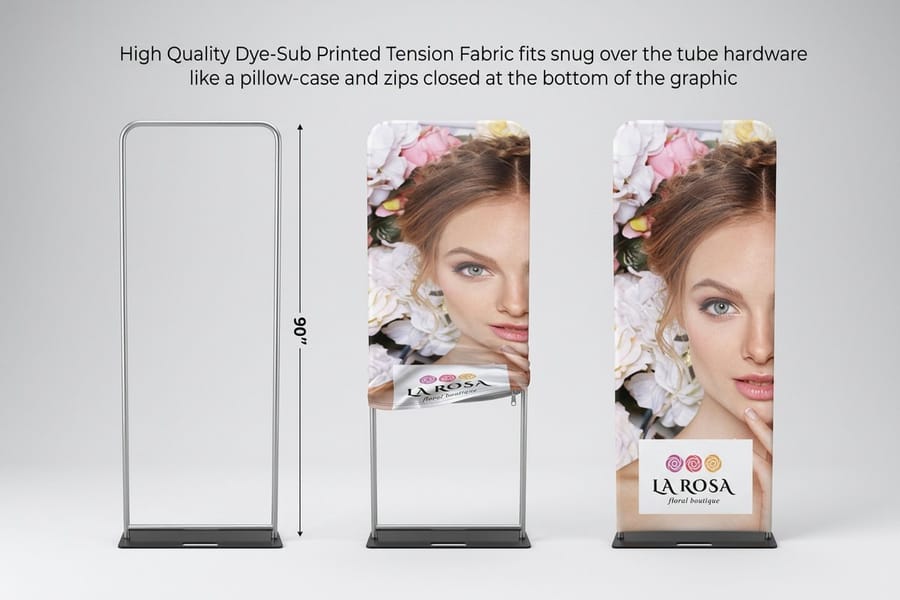
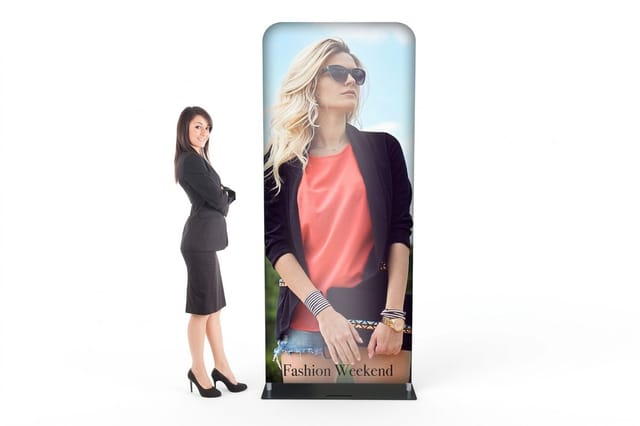
A tension fabric stand is an aluminum frame that holds a dye sublimated polyester panel under constant pull, so the graphic hangs flat instead of curling, creasing or reflecting a spotlight. The fabric attaches three ways: a pillowcase sleeve over a tube frame, a silicone edge pressed into an SEG channel, or a roll wound into a retractable base. Panels fold into a bag, wash in cold water, and reprint on their own from $69 while the frame stays. The pillowcase slip is the tool free option: a sewn sleeve on 8.8 oz tension fabric that slides over a 36 x 90 or 48 x 90 inch tube frame and zips shut along the bottom edge.

Quick answer
Aluminum pulls it flat, polyester keeps it flat
The frame is what makes a fabric backdrop hang without a wrinkle. A dye sublimated polyester panel is stretched across aluminum and held under constant tension, so fold lines from the case relax out on their own within a few hours. Choose by how the fabric attaches: a sleeve over tubes for value, a silicone edge in an SEG groove for the sharpest corners, or a retractable cassette when one person has sixty seconds. Indoors fabric beats vinyl on glare and on packing. Outdoors it does not.
What a Tension Fabric Stand Is, and the Three Ways Fabric Attaches
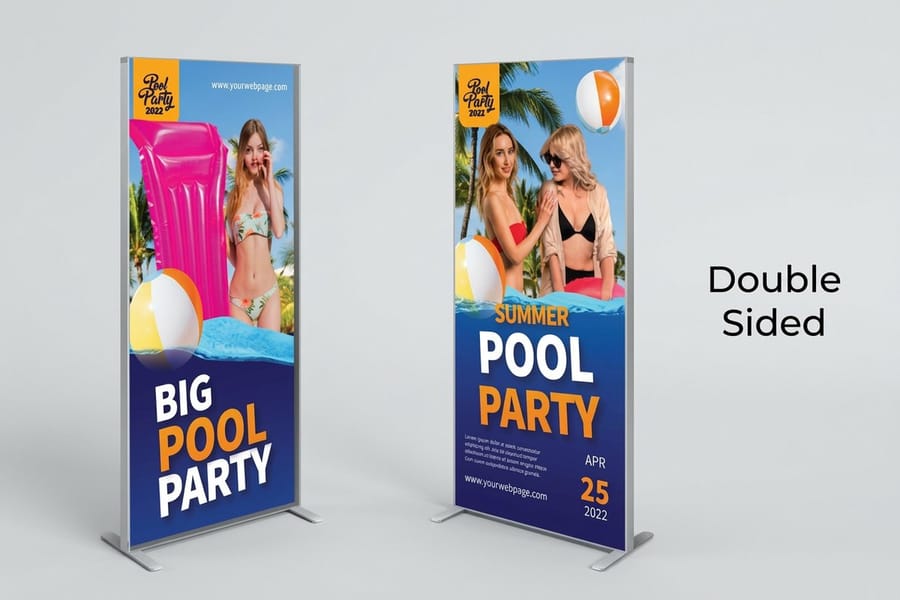
Start with the print. The panel is dye sublimated, which means the ink is heated into a gas and bonds with the polyester fibers instead of drying on top of them. That is why the finished graphic still folds, stretches and breathes. A vinyl banner carries its image as a surface layer, so it scuffs and cracks. A fabric panel carries its image inside the yarn, so it survives a wash cycle.
The frame is the second half. Fabric on its own sags. Pulled tight across aluminum it behaves like a drum skin, and every crease that survived the flight gets flattened by the tension itself. How the fabric grips the frame is the real decision:
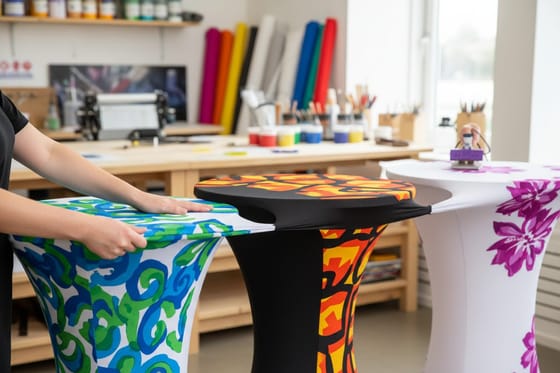
- Pillowcase sleeve over a tube frame. The panel is sewn into a closed sleeve that slides over the assembled tubes and zips shut along the bottom edge. No tools, no fiddly edges, slightly soft corners. This is how fabric tube displays and most curved backdrops work.
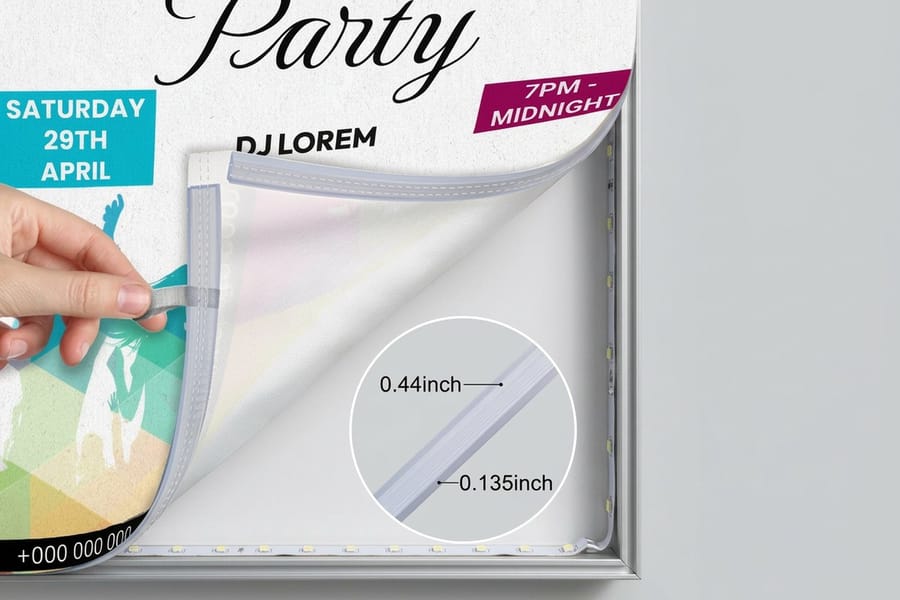
- Silicone edge into a channel. A thin silicone strip is sewn around the panel and pushed by hand into a groove milled all the way round the extrusion. The result is the flattest, squarest edge available, with no visible hardware. That is the SEG in SEG displays.
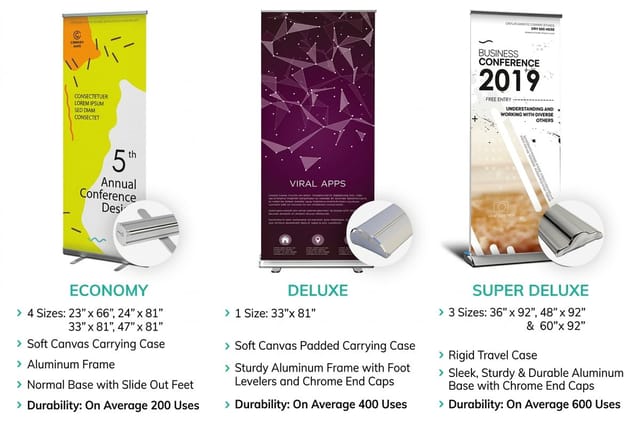
- Wound into a cassette. A retractable stand keeps the panel rolled inside a weighted base. You pull it up, hook it on a single pole, and you are done in under a minute. Retractable fabric banner stands use this, and they are the only fabric option one person can set up while holding a coffee.
If you want the frame mechanism in detail, including why the printed panel is deliberately cut a little smaller than the frame opening, our guide on how a tension fabric display frame works takes it apart piece by piece.
Which Stand Fits Your Space, Your Crew, and Your Budget
Most people buy the wrong size before they buy the wrong type. Measure the wall you are allowed to fill first, then work down this list.
| Stand | Fabric attaches by | Best for | Starts at |
|---|---|---|---|
| Retractable fabric | Rolls into a weighted cassette base | One person, quick setup, a narrow panel beside a table | $159.85 |
| Fabric tube display | Pillowcase sleeve over push fit tubes | The value back wall, straight or gently curved | $163.67 |
| SEG display | Silicone edge into a milled groove | Sharp square corners and a frameless look | $229.00 |
| Curve tube display | Sleeve over a pre bent tube frame | A wrap around booth wall with real depth | $548.09 |
| Pop up display | Magnetic panels on a scissor frame | Repeat exhibitors who set up in minutes, weekly | $752.39 |
| SEG backlit display | Silicone edge on a light box frame | Dim halls where a glowing wall stops traffic | $1899.00 |
Two patterns show up over and over. Companies doing one or two shows a year overbuy on hardware and underbuy on graphics, then find the artwork is out of date before the frame has paid for itself. Companies doing a show a month should do the opposite: buy the frame once, then reprint the panel as often as the brand changes, since replacement SEG fabric starts at $69 against $229.00 for a whole new display.
If the whole booth still needs filling, a trade show booth kit bundles the back wall, counter and accessories from $2599.00, and the trade show collection lists the individual pieces.
Fabric Against Vinyl, and When Vinyl Is Still the Right Call
Light is the argument that decides most indoor jobs. Polyester has a matte, slightly textured surface that scatters light in every direction, so a booth spotlight lands as an even glow. Vinyl has a smooth, semi gloss face that reflects that same spotlight straight back, and the hot spot usually lands somewhere unhelpful, like the middle of your logo. Point a camera at it and the blowout is worse.
Packing is the second argument. Fabric folds. You can put an 8 by 8 foot backdrop in a soft case that fits a checked bag, unfold it at the venue, and let tension deal with the lines. Vinyl has to be rolled, because a fold in vinyl becomes a permanent white crease line, so the same size graphic travels as an oversized tube. Anybody who has paid an airline for that tube already knows which one they prefer.
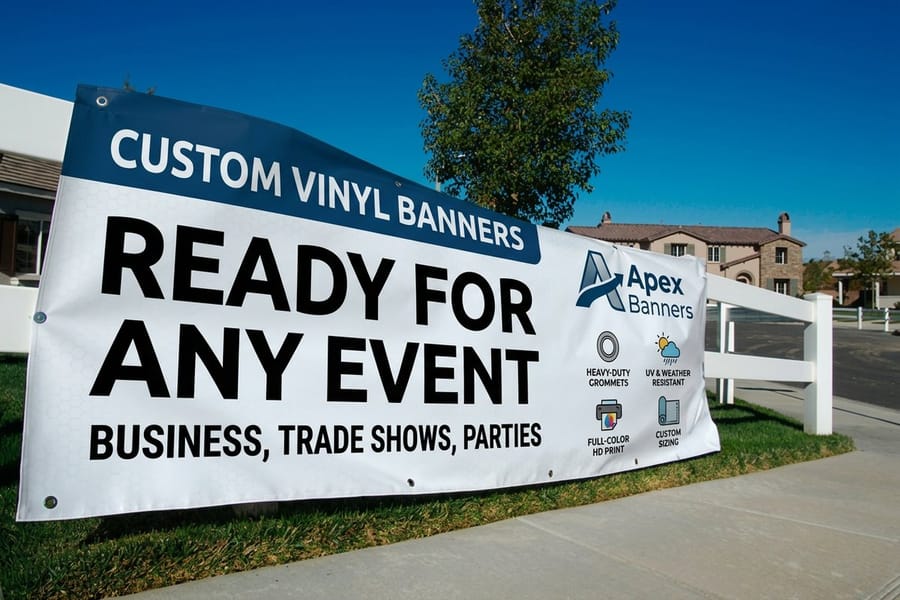
Vinyl still wins in three places. Outdoors, where rain soaks fabric and wind turns a large panel into a sail. Anywhere the banner is grommeted and tied to a fence or railing. And on price at large sizes, since vinyl banners start at $79 and scale cheaply per square foot. There is a middle option too: fabric banners at $57.20 give you the matte finish with a hemmed edge, for when you need the look but not the frame.
For a fuller breakdown of substrates, including mesh for windy sites, read our guide on banner material types.
Washing, Steaming, and the Creases People Actually Panic About
The panel arrives folded. That surprises people who expected a tube, and it is the first call our team gets before a show. Hang it on the frame and leave it. Tension pulls the fold lines out over two to four hours, and a warm room speeds it up. Setting up the night before rather than an hour before doors is the whole trick.
If a stubborn line is still there, a handheld garment steamer held about six inches from the back of the panel, moving steadily, relaxes the fibers and the tension finishes the job. What you must not do is press a hot iron onto the printed face. Polyester glazes under direct iron heat, leaving a permanent shiny patch, and no amount of washing takes it back out.
Washing is the part that separates fabric from every other backdrop material. Cold water, gentle cycle, mild detergent, no bleach and no fabric softener, then hang it damp so the water weight pulls it flat as it dries. Because the dye lives inside the fiber, the image does not lift. A backdrop that picked up coffee, handprints and floor dust across three days of a show goes back in the case looking like it did on day one.
- Fold along different lines each time. Repeating the same fold in the same place is what eventually wears a visible seam into a panel.
- Keep it out of the sun between shows. Storage in a hot car window is what fades a graphic, not the show floor.
- Do not force a bent pole. A tube that no longer seats cleanly stresses the sleeve seam. Replace the section, not the graphic.
Sizing a Backdrop for Booths, Photos and Step and Repeat Walls

A 10 foot inline booth normally gives you an 8 foot back wall, and a panel around 8 feet wide by 8 feet tall fills it without fighting the venue pipe and drape. Go to 10 feet wide only after you have checked the exhibitor kit, because a panel that overhangs the boundary gets asked to come down. For the sides of the booth, a narrow retractable at roughly 33 by 80 inches frames the entrance without eating floor space.
Photo walls follow different rules. Eight feet wide by eight feet tall holds one or two people comfortably; 10 feet wide handles a small group. Repeat the logo lockup every 12 to 18 inches so a tight crop still catches at least one whole mark, and keep the bottom foot free of anything critical, because bodies cover it. Our guide on building a step and repeat wall works through the artwork spacing in detail.
Whatever size you land on, build the artwork at full scale with the bleed the product page specifies, keep live text well inside the frame line, and supply fonts as outlines. Sizes and safe areas for every display are in the blank template library, and the fabric printing collection lists the finished sizes each stand is cut to. If the whole show is closer than the calendar likes, the next day trade show displays guide covers what can still be printed in time.
Wally explains tension fabric stands
Folded in the bag, flat on the frame
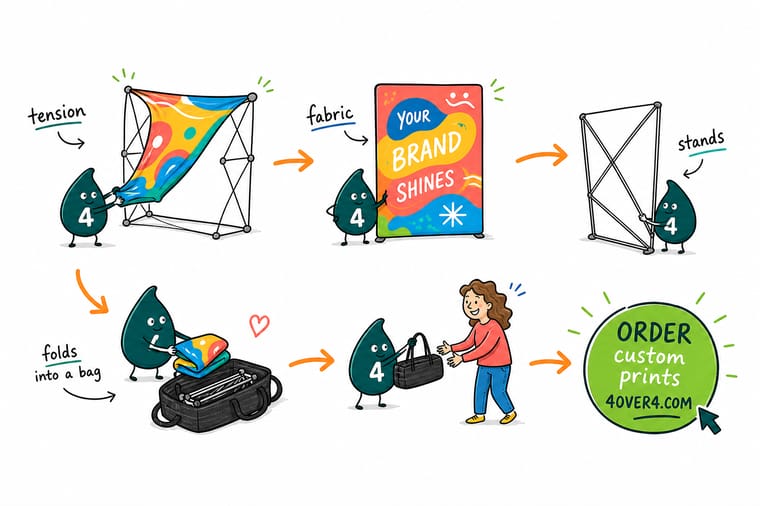
Wally unfolds the panel out of a soft case, slides it onto the aluminum, and the fold lines start disappearing while he sets up the rest of the booth. The pull of the frame is doing the ironing. If one line is stubborn he steams it from the back, never from the printed side, because a hot iron glazes polyester and that shine is permanent. When the brand changes he reprints the fabric and keeps the frame, which is the cheap half of the job.
Order an SEG fabric display →
Specs and pricing
Fabric displays, sizes, and starting prices
The replacement panel is 6 oz fabric with a sewn in 10 mm silicone keder, cut to any size, non lit or backlit. SEG displays come in 3, 10 and 20 foot widths, single or double sided, and the retractable fabric stands run from 23 x 66 up to 60 x 92 inches on 9 oz coated polyester. Configure the panel, the complete frame, or a retractable stand side by side, with live options and starting prices straight from the 4OVER4.COM configurator.

Print it
Order a fabric display that travels folded
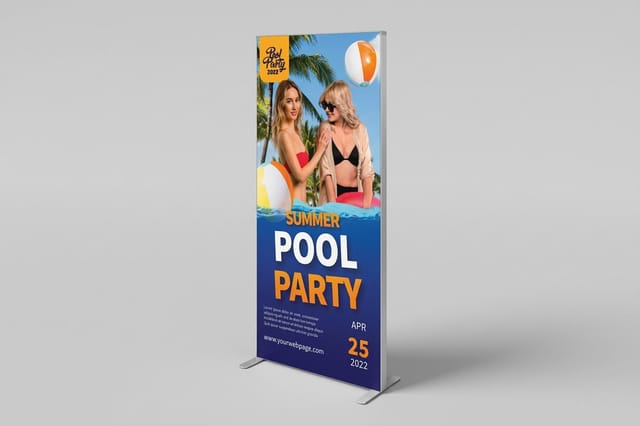
Take the SEG display for square corners on a 10 or 20 foot wall, the fabric tube display when you want the frame, fabric and carrying bag in one order with an option for 2 LED lights, and the retractable when one person sets up beside a table.
%22%2F%3E%3Ccircle%20cx%3D%2243%22%20cy%3D%2245%22%20r%3D%2228%22%20fill%3D%22%23a78bfa%22%20opacity%3D%220.15%22%2F%3E%3Ccircle%20cx%3D%2280%22%20cy%3D%2262%22%20r%3D%2226%22%20fill%3D%22%23a78bfa%22%20opacity%3D%220.1%22%2F%3E%3Crect%20x%3D%2273%22%20y%3D%2221%22%20width%3D%2228%22%20height%3D%2232%22%20rx%3D%224%22%20fill%3D%22%23a78bfa%22%20opacity%3D%220.08%22%20transform%3D%22rotate(8%2080%2030)%22%2F%3E%3C%2Fsvg%3E)
Explore more
Where to go next
Open the SEG frame guide before you order a replacement panel, since it explains why the fabric is cut a little under the frame opening. Planning a photo wall, read the step and repeat guide for logo spacing and wall height.

By the numbers
Tension fabric frames, curved and backlit
Common Questions
Your tension fabric questions, answered
What is a tension fabric stand?
It is an aluminum frame that holds a printed polyester panel under constant tension so the graphic hangs flat. The print is dye sublimation, meaning the ink turns to gas and dyes the fibers themselves rather than sitting on top as a coating, so the fabric still folds, stretches and breathes after printing. The frame is what makes it a stand: push fit tubes, a snap together SEG extrusion, or a spring loaded cassette in a weighted base. Names you will see for the same idea include SEG display, fabric backdrop stand and tube display.
Will the fold creases come out of the fabric?
Almost always, and usually on their own. Hang the panel on the frame and the tension pulls fold lines out over two to four hours, faster in a warm room. If you set up an hour before doors open and a line still shows, hold a garment steamer six inches off the back of the panel and move it steadily. Never press a hot iron onto the printed face. Polyester glazes at iron temperatures and the shine does not come back out.
Can you machine wash a fabric display graphic?
Yes, and that is the practical advantage over vinyl. Cold water, gentle cycle, mild detergent, no bleach and no fabric softener, then hang it damp so the weight of the water pulls the wrinkles out. Because the dye is in the fiber rather than printed on the surface, washing does not lift the image. Scuffed vinyl, by contrast, is scuffed permanently. Wash a booth backdrop after a show where it picked up coffee or hand marks and it goes back in the case looking new.
How is fabric different from vinyl for a backdrop?
Three things separate them. Fabric scatters light so a spotlight does not leave a white blowout across your logo, while vinyl is glossy enough to reflect one straight into a camera. Fabric folds into a bag with no crease damage, while vinyl has to be rolled to avoid permanent kinks. Vinyl is tougher outdoors and takes weather that would soak and flap a fabric panel. Indoors, fabric wins. Outdoors, order vinyl banners instead.
What size backdrop do I need for photos or a 10 foot booth?
For a standard 10 foot inline booth, an 8 foot tall by roughly 8 to 10 foot wide back wall fills the space without fighting the pipe and drape. For a step and repeat photo wall, 8 feet wide by 8 feet tall covers one or two people, and 10 feet wide covers a small group. Keep the logo lockup repeating every 12 to 18 inches so a tight crop still catches a whole mark. Leave the bottom 12 inches of any photo backdrop free of critical artwork, because bodies cover it.
How long does a tension fabric display last?
The frame outlives the graphic by years. Aluminum tubes and SEG extrusions survive dozens of shows if you keep the connectors clean and do not force a bent pole. The fabric is what ages, mostly through repeated packing and the occasional bad washing rather than fading. Plan on reprinting the panel when the brand changes or after the edges start to fray, and keep the frame. That is why replacement SEG fabric is sold on its own at $69.
How does a fabric display ship and travel?
Frame poles break down into sections and the fabric folds, so a full back wall goes into a soft case or a wheeled hard case rather than a shipping tube. That matters at the airport: a folded fabric panel fits a checked bag, while a rolled vinyl backdrop of the same size has to travel as an oversized tube. If you fly to shows regularly, the packed size is a bigger deal than the purchase price.
Get Started
Fabric tube displays cost $163.67, curve displays $548.09
Pick the frame, upload the artwork, and we print a dye sublimated panel that hangs flat, washes clean, and reprints on its own when the brand moves on.
Legal Disclaimer
Gold Standard guarantees apply to all standard orders placed through 4over4.com. Price match requires verifiable proof of a competitor's published price for an equivalent product with matching specifications and turnaround time. Satisfaction guarantee covers manufacturing defects and print quality issues. Contact support with order number and documentation.
