Interesting Facts About Logo Design You Need to Know in 2026

Interesting Facts About Logo Design That Will Change How You See Brands
Logo design is a discipline packed with hidden stories, psychological tricks, and design decisions most people never notice. One of the most interesting facts about logo design? The Nike Swoosh cost just $35 when it was originally commissioned in 1971. That single mark is now valued at over $26 billion as part of Nike's brand identity. 4OVER4 has helped 150,000+ businesses bring their brand visions to life through print, and understanding what makes a logo work is the first step toward building materials that actually get noticed.
Whether you're designing your first logo or refreshing an old one, these facts about famous logos, color psychology, and design history will give you a sharper eye. And once your logo is locked in, you'll want it printed on everything from business cards to stickers to banners. That's where the real fun starts.
Hidden Messages Inside the World's Most Famous Logos
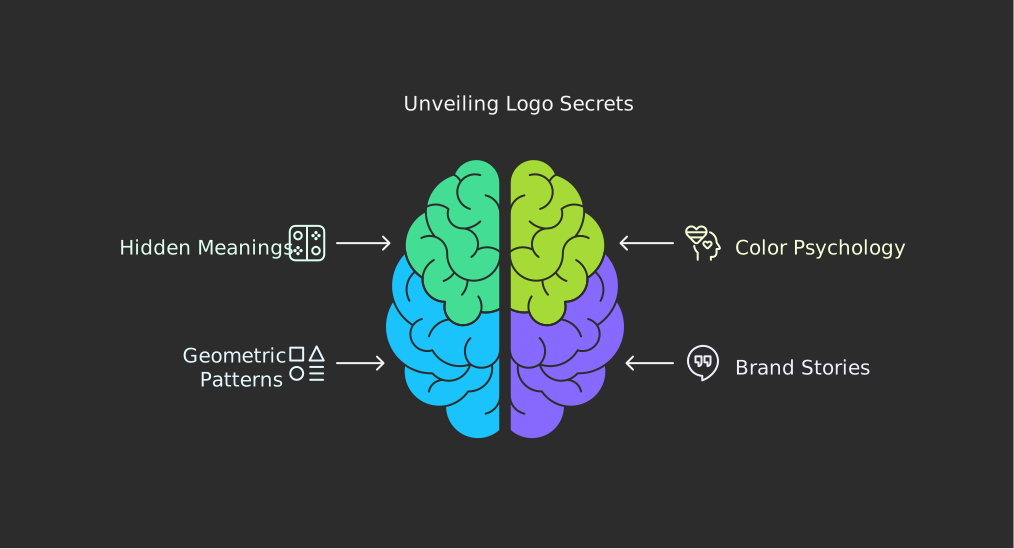
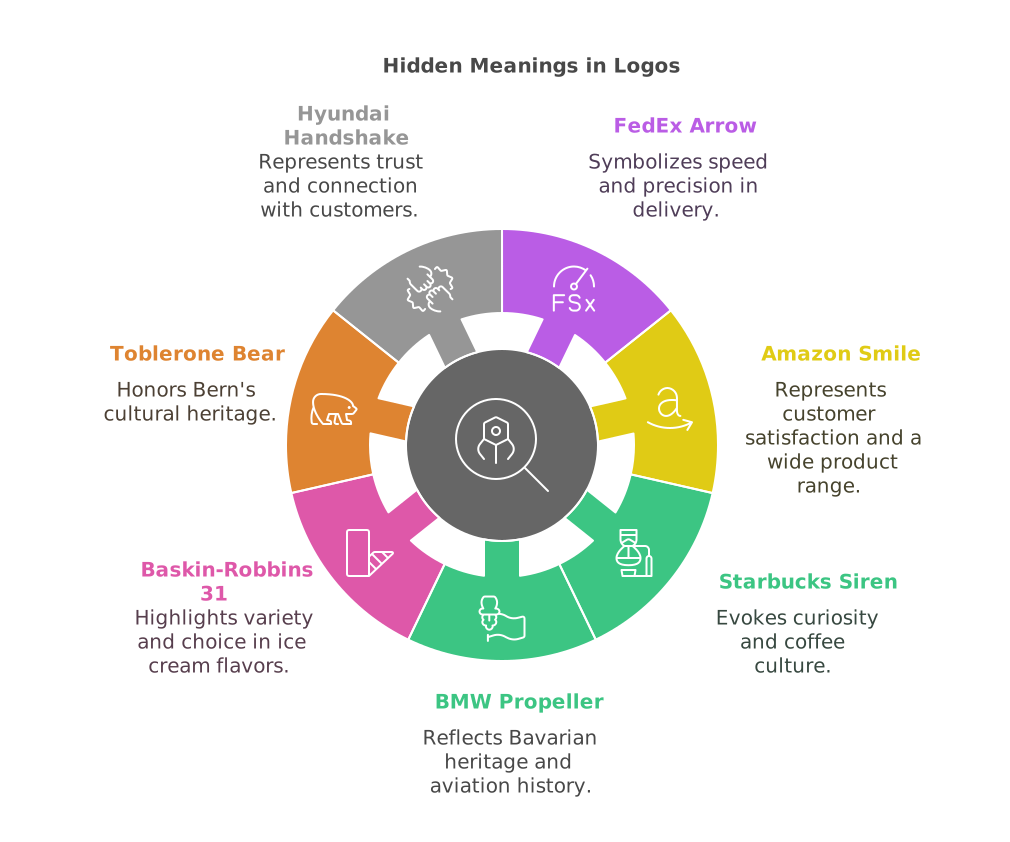
Great logos don't just look good. They hide clever details that reinforce what the brand stands for. These hidden elements are intentional, and once you spot them, you can't unsee them.
The FedEx Arrow You Almost Missed
Look at the space between the "E" and the "x" in the FedEx logo. There's a forward-pointing arrow sitting right there. Designer Lindon Leader created this in 1994 to represent speed and direction. It's become one of the most studied examples of negative space in graphic design. The arrow wasn't an accident. Leader tested over 200 iterations before landing on the version where the arrow appeared naturally between the letterforms.
Amazon's A-to-Z Smile
The curved arrow beneath "amazon" points from the letter "A" to the letter "Z." It tells you the company sells everything from A to Z. But it also forms a smile, which is a subtle nod to customer satisfaction. Turner Duckworth designed this version in 2000, and it's remained largely unchanged since. Simple. Effective. Memorable.
The Starbucks Siren's Long History
The Starbucks logo features a two-tailed siren from Greek mythology. The original 1971 version was far more detailed and risqué. Over four redesigns, the siren became more stylized and zoomed-in. Today's version dropped the company name entirely from the mark in 2011, a move that only works when your logo is already universally recognized. If you're looking for Graphic Design Portfolio Examples that show this kind of evolution, studying logo redesigns is a great place to start.
BMW's Bavarian Roots
The blue-and-white quadrants in the BMW logo reference the Bavarian flag, honoring the company's Munich origins. A common myth says it represents a spinning propeller, but BMW's own historians have clarified that the propeller connection was a marketing association added later. The actual design dates back to 1917 and has been simplified over the decades while keeping those Bavarian colors intact.
Patterns That Repeat Across Great Logos
Many iconic logos use geometric shapes to communicate specific ideas. Circles suggest community and trust. Triangles imply stability or new idea. Coca-Cola's classic red triggers excitement and warmth. These aren't random choices. They're rooted in color psychology and shape theory that designers have refined over a century of commercial art.
Understanding these hidden elements helps you think more critically about your own branding. When you're ready to put your logo on printed materials, check out 4OVER4's design templates to see how logos translate from screen to paper.
"A logo doesn't sell the company. A logo identifies the company. If the logo needs explaining, it's failed." - Paul Rand, designer of the IBM and ABC logos
Color Psychology in Logo Design - Why Brands Choose Specific Palettes
Color is one of the most powerful tools in logo design. Research from the University of Loyola found that color increases brand recognition by up to 80%. That's not a small number. It means the palette you pick for your logo directly affects whether people remember you.
Red Logos Demand Attention
Red is the most popular color in logo design. Coca-Cola, YouTube, Netflix, Target, and CNN all use it. Red triggers urgency, excitement, and appetite. That's why fast food chains lean heavily on red and yellow combinations. McDonald's, Wendy's, Burger King, In-N-Out - the pattern is everywhere once you notice it.
Blue Builds Trust
Blue is the go-to color for tech companies and financial institutions. Facebook, LinkedIn, PayPal, Samsung, Intel, and Chase all use blue logos. The color communicates reliability and professionalism. It's also the world's most universally liked color across cultures, which makes it a safe bet for global brands. If you're exploring Classy Business Card Design Inspiration, you'll notice blue shows up constantly in premium designs.
Black and White Logos Never Go Out of Style
Nike, Apple, Chanel, and Adidas all use monochrome logos. Black communicates sophistication, luxury, and timelessness. A black-and-white logo also has a practical advantage: it works on any background, any material, and any print method. When you're printing logos on products like 30Mil Clear Plastic Cards, a clean monochrome logo reproduces with sharp clarity every time.
Green Signals Growth and Health
Whole Foods, Spotify, Starbucks, and Animal Planet use green logos. Green connects to nature, health, and freshness. It's also increasingly popular among fintech brands like Robinhood and Mint, where green implies financial growth. The color works hard across industries because its associations are almost universally positive.
The Cost of Famous Logos - From $0 to $1.8 Million
One of the most interesting facts about logo design involves price. The gap between what companies pay for logos is staggering. Some of the world's most recognizable marks cost almost nothing. Others cost a fortune.
The Google logo was designed by co-founder Sergey Brin using the free graphics program GIMP. Cost? $0. The Coca-Cola logo was hand-drawn by bookkeeper Frank Mason Robinson in 1886. Also essentially $0. On the other end, BP spent $211 million on its sunflower rebrand in 2000. Pepsi paid $1 million for its 2008 redesign. And Symantec (now NortonLifeLock) reportedly spent $1.28 billion on a rebranding effort that included a new logo.
The takeaway? Price doesn't determine quality. The Nike Swoosh, designed by Portland State University student Carolyn Davidson for $35, is arguably the most successful logo in history. What matters is the thinking behind the design, not the budget.
For businesses working with tighter budgets, 4OVER4's user-friendly online design tools make it possible to create professional branded materials without hiring an agency. You don't need a million-dollar budget to look like a million-dollar brand.
Logo Design Speed Records and Surprising Timelines
Some logos take years of development. Others come together in minutes. The Twitter bird (now X's former logo) went through multiple versions over 6 years before settling on the simplified geometric bird in 2012. That bird was constructed from 15 overlapping circles, a technique borrowed from classical geometry.
The Apple logo took designer Rob Janoff about two weeks in 1977. The bite was added for scale, so people wouldn't confuse it with a cherry. The rainbow stripes were Steve Jobs' idea, meant to highlight the Apple II's color display capabilities. When Apple dropped the rainbow in 1998, it marked a shift toward the minimalist design language that defines the brand today.
The Airbnb "Bélo" symbol was designed by DesignStudio in 2014 after a year-long process involving over 100 concepts. The final mark represents belonging, and it's built from four simple elements: a head (people), a location pin (place), a heart (love), and the letter A (Airbnb). Every curve serves a purpose.
"Design is not just what it looks like and feels like. Design is how it works." - Steve Jobs
If these timelines inspire you to think more carefully about your own brand's visual identity, browse Logo Sticker Design Ideas for creative ways to put your finished logo to work.
Typography Facts That Shape Logo Recognition
Font choice in logos isn't decoration. It's strategy. About 37% of the world's top 100 brands use custom typefaces in their logos. These aren't fonts you can download. They're built from scratch to give the brand a unique visual fingerprint.
Serif vs. Sans-Serif Tells a Story
Serif fonts (like those used by Vogue, Tiffany & Co., and The New York Times) communicate tradition, authority, and elegance. Sans-serif fonts (Google, Facebook, Spotify) feel modern, clean, and approachable. In the last decade, there's been a massive shift toward sans-serif logos. Luxury brands like Burberry, Balmain, and Saint Laurent all dropped their serif logos for clean sans-serif wordmarks between 2017 and 2019.
Custom Fonts Cost Serious Money
Netflix commissioned a custom typeface called "Netflix Sans" partly to save money on font licensing fees, which were costing them millions annually. Samsung, Apple, Google, and Airbnb have all done the same. When you use a font millions of times across products, packaging, apps, and ads, owning it outright makes financial sense.
Legibility at Every Size
A logo that looks great on a billboard but turns into a blob on a business card has a serious problem. The best logos are designed to work at every scale. That's why many companies maintain multiple logo versions: a full lockup for large applications, a simplified icon for small ones. When printing logos on materials, this matters. Check out Diy Greeting Card Design Ideas to see how logos adapt to different print formats.
Logo Redesigns That Backfired (And What They Teach Us)
Not every logo change goes well. In 2010, Gap replaced its classic blue-box logo with a Helvetica wordmark and a small blue gradient square. The backlash was immediate and intense. Social media exploded with criticism. Gap reverted to the original logo within six days. The failed redesign reportedly cost the company $100 million in lost brand equity and redesign expenses.
Tropicana's 2009 packaging redesign is another cautionary tale. The brand replaced its iconic orange-with-a-straw image with a generic glass of juice. Sales dropped 20% in two months, costing an estimated $50 million. Tropicana switched back to the original design.
These failures highlight a core principle: logos build equity over time. Changing them without understanding what customers are attached to is risky. If your current logo works, sometimes the smartest move is to refine it rather than replace it.
For more examples of design decisions that made an impact (for better or worse), explore Funny Print Ad Examples that show how creative risks play out in the real world.
How Logo Design Has Changed in the Digital Age
Logos used to be designed primarily for print. Letterheads, signage, newspaper ads. Today, a logo needs to work on a 16x16 pixel favicon, an app icon, a social media avatar, a smartwatch screen, and a highway billboard. That's a massive range of contexts.
This shift has driven the "simplification trend." Mastercard dropped its name from the logo in 2019, keeping only the overlapping circles. Google simplified its logo in 2015, switching from a serif to a sans-serif font and reducing the file size from 14,000 bytes to 305 bytes. That 98% reduction in file size means the logo loads faster on every device.
Responsive Logos Are the New Standard
Responsive logo design means creating multiple versions of a logo that adapt to different screen sizes and contexts. Think of how Spotify uses its full wordmark on desktop but switches to just the green circle icon on mobile. This approach requires thinking about your logo as a system, not a single image.
Motion Logos and Animation
With video content dominating digital platforms, animated logos are becoming standard. Netflix's "ta-dum" sound paired with the red N animation, Google's playful doodles, and Slack's bouncing logo all add personality through motion. Static logos still matter for print, but brands increasingly need both static and animated versions.
When you're ready to see how your logo translates to physical products, 4OVER4's Printing Articles cover everything from file preparation to finish selection. And if you run into questions during the design process, the Help Center has answers.
Putting Your Logo to Work on Printed Materials
Knowing these interesting facts about logo design is one thing. Applying them to real-world branding materials is where it gets practical. Your logo will appear on business cards, stickers, postcards, packaging, banners, and signage. Each format has different requirements for resolution, color mode, and sizing.
For print, always use vector files (AI, EPS, or SVG). Vector logos scale to any size without losing quality. If you only have a raster file (PNG or JPG), make sure it's at least 300 DPI at the final print size. Anything lower will look blurry.
Color matters too. Logos designed for screens use RGB color. Print uses CMYK. The conversion can shift colors slightly, so always check a proof before approving a large print run. Pantone (PMS) colors give you the most accurate color matching across different print jobs and materials.
"Ordered interesting facts about logo design from 4OVER4 and the quality blew me away. Sharp colors, premium feel, arrived 2 days early."
"Been using 4OVER4 for interesting facts about logo design for a year. Consistent quality every time. The online designer made it easy."
"Switched to 4OVER4 and saved 40% on interesting facts about logo design. Better quality than my old printer. 60+ paper options."
"4OVER4's interesting facts about logo design helped us look more professional. Clients notice the difference."
"We ordered business cards with our new logo on 32pt stock, and the color match was spot-on. The texture made our brand feel real in a way that digital never could." - Marcus T., ⭐⭐⭐⭐⭐
4OVER4 prints on 60+ paper types with multiple finish options, so you can match your logo's personality to the right material. A bold, modern logo might look best on smooth matte stock. A vintage-inspired mark could shine on textured kraft paper. The material becomes part of the brand experience.
What to Remember About Logo Design Facts
- Hidden details drive recognition. Logos like FedEx, Amazon, and Starbucks embed meaning in their designs that reinforce brand messaging at a subconscious level.
- Color choice is strategic, not decorative. Red triggers urgency. Blue builds trust. Black communicates luxury. Your palette shapes how people feel about your brand before they read a single word.
- Price doesn't equal quality. The Nike Swoosh cost $35. The Google logo cost $0. What matters is the thinking behind the design.
- Simplification is the trend. Digital-first design has pushed logos toward cleaner, more adaptable forms that work across screens, print, and physical products.
- Print brings logos to life. 4OVER4 offers 60+ paper types and multiple finishes to match your logo's personality to the right material. Explore options like 30Mil Frosted Plastic Cards for a modern, standout effect.
- Always use vector files for print. Vector logos (AI, EPS, SVG) scale to any size without losing quality, keeping your brand sharp on everything from business cards to banners.
Free Interesting Facts About Logo Design Templates

Common Questions About Logo Design Facts and Branding
What are the best practices for applying interesting facts about logo design to my brand?
Start with simplicity. The most iconic logos use clean shapes, limited colors, and hidden meaning. Study how brands like FedEx and Amazon embed messages in their marks. Test your logo at multiple sizes - it should read clearly on a favicon and a billboard. Use vector files for all print applications, and consider printing on specialty materials like 30Mil White Plastic Cards to make your logo feel premium in person.
How do I choose the right logo style for my business?
Match your logo style to your industry and audience. Serif fonts communicate tradition and authority, while sans-serif fonts feel modern and approachable. If you want a truly unique identity, explore 3D Lenticular Business Cards that add motion to your logo on printed materials. Consider whether your logo needs to work primarily on screens, in print, or both, and design accordingly.
What makes interesting facts about logo design effective for marketing?
Logo trivia grabs attention and makes your brand more relatable. Sharing facts like "the Nike Swoosh cost $35" or "Gap's failed redesign cost $100 million" creates conversation. Use these stories in social media posts, blog content, and presentations. They humanize design decisions and help clients or customers understand why branding matters. Visit the Help Center for tips on turning your logo into effective printed marketing materials.
How much should I budget for professional logo design?
Freelance designers typically charge $300 to $2,500 for a professional logo. Agencies range from $5,000 to $50,000 or more. But remember, Google's logo was made for free and the Nike Swoosh cost $35. What matters most is the strategic thinking behind the design. Allocate budget not just for the logo itself but also for brand guidelines, file formats, and your first round of printed materials to bring the logo into the physical world.