
Vintage Political Campaign Button Guide


Vintage political campaign buttons, history you can hold
A vintage political campaign button is a small metal badge that carried a candidate face, name, or slogan into the streets, and this guide helps you identify, collect, value, and appreciate them. These are not just old pins in a drawer. They are portable pieces of democracy, each one tied to a real moment when someone pinned it on and said they were with a candidate. 4OVER4.COM has printed Custom Buttons for modern campaigns, events, and brands, so we know what makes a button worth wearing.
Custom button pins are small round badges you can personalize with any design, slogan, or image. They have been a go-to tool for promotion and self-expression since the late 1800s. Pin one to a jacket, a tote bag, or a backpack and you become a walking billboard. That is the beauty of buttons. They are cheap to make, easy to hand out, and hard to ignore when someone wears one right at eye level.
In political campaigns these pinbacks carry weight far beyond their size. For more than a century they have rallied voters, spread messages, and built the kind of grassroots energy that wins elections. If you like creative printed keepsakes, DIY greeting card design ideas show how print connects people to moments that matter. Below we dig into why these small circles of metal and ink still matter, and how to start collecting, identifying, or creating your own.
Why vintage political campaign buttons are worth collecting
The appeal of vintage political campaign buttons runs deeper than nostalgia. Collectors and history buffs love the detailed artwork, punchy slogans, and bold imagery packed onto a circle no bigger than a drink coaster. Picture a portrait of Teddy Roosevelt, an I Like Ike slogan, or a psychedelic McGovern design from 1972. Each one captures a moment in time with more personality than a textbook ever could.
Every button is a piece of memorabilia. Even mass-produced runs from major campaigns pick up their own quirks over time, slight color shifts, different pin mechanisms, or regional variations that make certain versions rarer than others. That is what makes collecting them addictive. You are not just buying objects. You are building a timeline of American political culture, one pin at a time.
How button design evolved across political eras
The story of political button design mirrors the story of American communication. In the 1890s the first celluloid pinback buttons appeared during the McKinley versus Bryan race. They were simple, a candidate photo and maybe a name, printed under a thin clear layer and crimped onto a metal back. No flash, no frills, just a face and a name.
By the 1930s and 1940s lithographed tin buttons became common. Printing improved, so campaigns reached for bolder colors, sharper text, and more creative layouts. The FDR era produced some of the most recognizable buttons in collecting history. Slogans got punchier and designs got more graphic.
The mid-century shift to mass production
The 1960s changed everything. Offset printing and cheaper materials let campaigns produce millions of buttons at low cost. JFK buttons, with their clean type and patriotic color, set a new standard for political branding. The anti-war movement of the late 1960s and early 1970s pushed design into wilder territory, with peace signs, protest slogans, and countercultural imagery worn by millions.
Modern buttons use digital printing and can reproduce photographic images in sharp detail. Even so, collectors still prize the older hand-set designs. The slight imperfections, the limited palettes, and the tactile feel of lithographed tin give vintage buttons their soul. If you appreciate bold visual work, these graphic design portfolio examples show how design principles from the button era still shape creative work today.
Materials that tell you when a button was made
Knowing your materials is a shortcut to dating a button:
- Ferrotype or tintype, 1860s to 1870s. A photo printed straight onto thin iron sheet. Extremely rare, and older than the modern pinback.
- Celluloid, 1896 to the 1920s. A paper image under a clear celluloid disc, crimped over a metal shell. The classic early pinback format.
- Lithographed tin, 1920s to 1960s. The image printed directly onto tin. Durable, colorful, and the most commonly collected type.
- Plastic and acetate, 1960s to today. Cheaper to produce and able to carry photos, but less prized by serious collectors.
The pin mechanism on the back also tells a story. Early buttons used simple straight pins or C-clasps, and by the mid-20th century safety-pin style clasps became standard. Those small details help you spot reproductions and fakes, a real concern in the collecting world.
Cultural impact beyond the ballot box
Political buttons did not stay strictly political for long. The same format that promoted presidential candidates became a vehicle for social movements, cultural identity, and personal expression. Women suffrage buttons from the early 1900s rank among the most sought-after pieces in any collection, and civil rights buttons from the 1960s carry enormous historical and emotional weight.
LGBTQ+ rights buttons, anti-war pins, environmental badges, the button became a universal tool for anyone who wanted to say something without opening their mouth. That is the genius of the format. It is small, visible, and personal. You choose to wear it, and it becomes part of your identity for the day. For more on how small printed items make a big promotional impact, look at these logo sticker design ideas, since stickers and buttons share the same grassroots, street-level marketing DNA.
How to identify and authenticate vintage campaign buttons
If you get serious about collecting, authentication matters. Reproductions flood the market, especially for high-value buttons from early presidential campaigns. Here is what to check when you evaluate a vintage political campaign button.
Check the back first
Flip the button over, because the back tells you more than the front. Original vintage buttons often carry maker marks from companies like Whitehead and Hoag, Bastian Brothers, or Green Duck. A manufacturer name stamped or printed on the back is a strong sign of authenticity.
Study the pin mechanism. If a button claims to be from 1900 but has a modern spring-loaded clasp, something is off. Early buttons used simple wire pins or C-clasps, and the curl pattern of the metal rim also varies by era and maker.
Examine the printing quality
Under magnification, vintage lithographed buttons show a distinct dot pattern from the printing process. Modern reproductions printed with inkjet or laser have a different dot structure, or none at all. A jeweler loupe or a 10x magnifier is your best friend here.
Color is another clue. Vintage inks fade in predictable ways, so a button that looks too bright or too perfect for its age deserves extra scrutiny. Genuine patina, a slight yellowing of celluloid, minor surface scratches, even light rust on the back, actually raises a button credibility and often its value.
Research the campaign
Cross-reference your button against known campaign materials. Groups like the American Political Items Collectors keep databases and reference guides. If a design does not match any documented campaign, it may be a fantasy piece, made to look old but never used in a real election. For clean, impactful print ideas, classy business card design inspiration shows how professional layout translates to real business materials.
Vintage buttons as a fashion statement and conversation starter
Vintage political campaign buttons have broken free from collector cases and landed on denim jackets, messenger bags, and lapels at coffee shops. People of all ages wear them, not always because they backed that candidate, but because the design is cool, the history is interesting, or the irony is too good to pass up.
A Nixon button on a 22-year-old backpack is not an endorsement. It is a style choice and a conversation starter. Someone sees it, asks about it, and suddenly you are talking about Watergate over lunch. No other accessory does that quite so easily.
Pinned to a jacket, displayed on a corkboard, or framed on a wall, these buttons add personality to any space. They are tiny art pieces with built-in stories, and unlike a poster or a bumper sticker, a button moves with you. If you enjoy creative print projects that double as conversation pieces, 3D lenticular bookmarks offer a similar blend of visual appeal and everyday use.
Preserving democracy, one button at a time
Collecting vintage political campaign buttons is more than a hobby. It is an act of preservation. Every button you save from a garage sale, an estate auction, or an online marketplace is a piece of democratic history that stays alive instead of ending up in a landfill.
These buttons remind us that democracy is participatory. Someone designed that button, someone printed it, someone handed it out at a rally, and someone pinned it on and walked into a voting booth. That chain of hands connects us to the physical experience of political engagement, something easy to forget in an age of digital campaigns and social ads.
Through preservation we make sure future generations can hold these artifacts and understand what it felt like to be part of a movement. The slogans, the colors, and the faces all carry lessons about what worked and how Americans have voiced their political passions for more than a century. For more print stories and how-tos, browse the full library of printing articles, and to see how humor and bold design meet in print, look at these funny print ad examples.
Best promotional buttons for political campaigns today
If you are ordering buttons for a campaign right now, the short answer is that the 2.25 inch round pinback is still the workhorse. It is the size those vintage pins made famous, it is big enough for a name and a slogan that reads across a room, and it is small enough that a volunteer keeps it on a lapel all day. Whether you are running for local office, organizing a community event, or launching a brand, custom buttons remain one of the most effective grassroots marketing tools around. They are affordable, portable, and people actually want to wear them, which is more than you can say for most promotional items.
Before you upload artwork, settle three things: size, back style, and where the button has to survive. Size decides how much copy fits, so a portrait plus a name plus a year needs more room than a single word. Back style depends on who wears it. A pin back goes through a jacket, a canvas tote, or a volunteer apron. A magnet back is the polite option for people who will not put a hole in a suit, a uniform, or a union jacket. A clip back suits lanyards and event badges where the button rides with a credential. Finish decides the rest: a mylar-covered face shrugs off a rally in the rain and a folding table full of thumbs, and it keeps solid reds and blues from scuffing grey.
Vintage inspired design ideas for a modern campaign
The eras above are a free design library. Borrow the flat two-color lithography of the 1896 celluloid pins when you want a serious, institutional look for a judicial or school board race. Borrow the tight portrait crop of the mass-production years when the candidate is the message and the face should do the work. Borrow the loud, saturated psychedelia of a 1972 McGovern pin when the campaign is young, local, and wants to be photographed on a jacket. Whichever era you raid, keep the rules that made those buttons work: one message, high contrast, and type a stranger can read at arm reach.
4OVER4.COM prints Custom Buttons that carry the same spirit as those vintage campaign pins, with modern print quality. You get sharp colors, durable materials, and the freedom to upload any design. A small run for a school board race or a large order for a statewide campaign follows the same simple process, and the per-unit price falls as the run grows, so quote the canvassing team, the rally, and the county-wide push at their real quantities instead of reordering the same small box three times. Formats and live per-quantity pricing sit on the custom campaign buttons page, with the wider range in buttons printing. If you design buttons for a business or event, you can also earn coins through the 4OVER4.COM rewards program and put the savings toward your next print order.
Design tips inspired by vintage buttons
- Keep it simple. One message, one image, one call to action. Icons like I Like Ike and Hope work because they do not try to say everything at once.
- Use bold, contrasting colors. Red, white, and blue dominate for a reason. High contrast reads from across a room.
- Make text readable at arm reach. If someone cannot read your button from three feet away, the font is too small or too fancy.
- Include a human element. A face, a hand, or a silhouette. People connect with people, even on a 2.25 inch circle.
Custom button formats, pricing, and templates
Whether you want to reproduce a classic design or launch something new, 4OVER4.COM prints custom buttons with modern quality. Upload your art, pick a size, and choose your quantity, and the per-button cost drops the more you order.
Print it
Custom buttons, ready to pin
Upload a design and 4OVER4.COM prints your pinback buttons in sharp, durable color.
Quantity and price
Custom button pricing and specs
Real configurator numbers, so the more you order, the lower the per-button cost drops.
| Quantity | Price Per Unit | Total |
|---|---|---|
| 50 | $1.86 | $93.15 |
| 100 | $1.09 | $108.94 |
| 150 | 83.2¢ | $124.73 |
| 200 | 75.0¢ | $149.99 |
| 250 | 68.8¢ | $172.11 |
| 500 | 59.7¢ | $298.41 |
Start fast
Templates and print-ready blanks
Button design templates and exact-size blanks so your art lands inside the safe area.
Building from scratch? Start from premium campaign and political sticker templates or roll campaign and political sticker templates, then drop your logo and slogan inside the cut lines.
Wally reads a button like a history book
A century of campaigns, pinned to a jacket
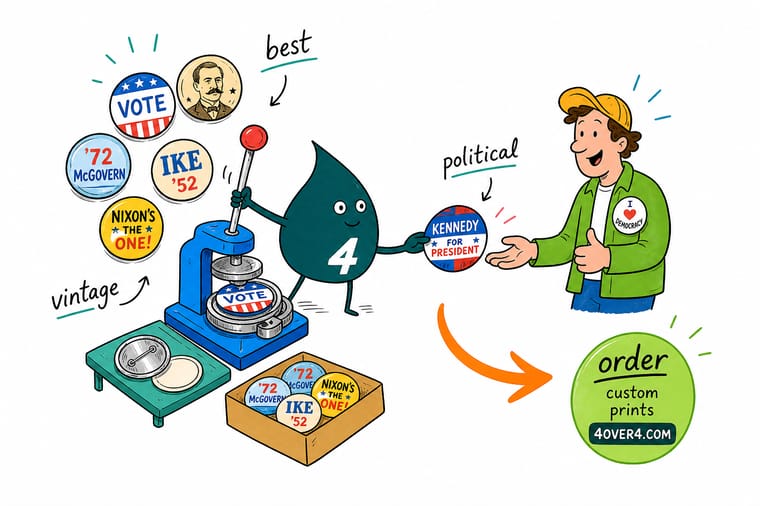
Every vintage campaign button is a tiny time capsule. Check the back for a maker mark, date it by the material, and look for a real dot pattern under a loupe. When you want your own, 4OVER4.COM prints custom buttons in sharp, durable color from your design, the same grassroots tool that has rallied voters since 1896.
Order custom buttons →What to remember from this guide
Explore more
More ways to print, collect, and brand
Related pages across 4OVER4.COM, one card each, so you can keep exploring buttons and beyond.
Ready to pin your message on a button?
Pick a size, drop in your design, and 4OVER4.COM prints custom buttons in sharp, durable color, as fast as your campaign needs them.
Common questions about vintage political campaign buttons
What are the best practices for collecting vintage political campaign buttons?
Store buttons in acid-free containers away from direct sunlight and humidity, and handle them by the edges so you do not transfer oils to the surface. Use a reference from a group like the American Political Items Collectors to verify authenticity before you buy, and join collector communities to learn pricing trends and spot reproductions. When you are ready to make your own, a custom pinback button puts the same format to work for modern marketing.
How do I choose the right vintage political campaign button for my collection?
Focus on a specific era, candidate, or movement that interests you. Condition matters, so look for minimal rust, an intact pin mechanism, and clear imagery, and remember that rarity drives value. Start with affordable mid-century buttons before you invest in pre-1920 pieces. For creative print projects beyond collecting, 3D lenticular notebooks offer another way to combine art with function.
What makes vintage political campaign buttons effective for marketing?
Buttons work because people choose to wear them, which turns every supporter into a walking endorsement. The most effective designs use bold contrast, a short slogan, and a single clear image, a formula that has held up for more than a century. Modern custom buttons from 4OVER4.COM follow the same principles with sharper print quality and faster turnaround.
How much should I budget for vintage political campaign buttons?
Common mid-century buttons from the 1950s to the 1970s usually cost between $5 and $25 each. Rare pre-1920 celluloid buttons from major presidential campaigns can range from $100 to several thousand dollars, since condition, rarity, and candidate popularity all affect price. For creating new custom buttons, 4OVER4.COM offers affordable bulk pricing, and our Help Center covers ordering details and design support.
