
Custom Packaging Inserts That Personalize Every Delivery


Jordan is our labels, packaging and sustainability voice, built from the knowledge of our production team, with over 20 years in printing.
What a Packaging Insert Actually Does Inside the Box
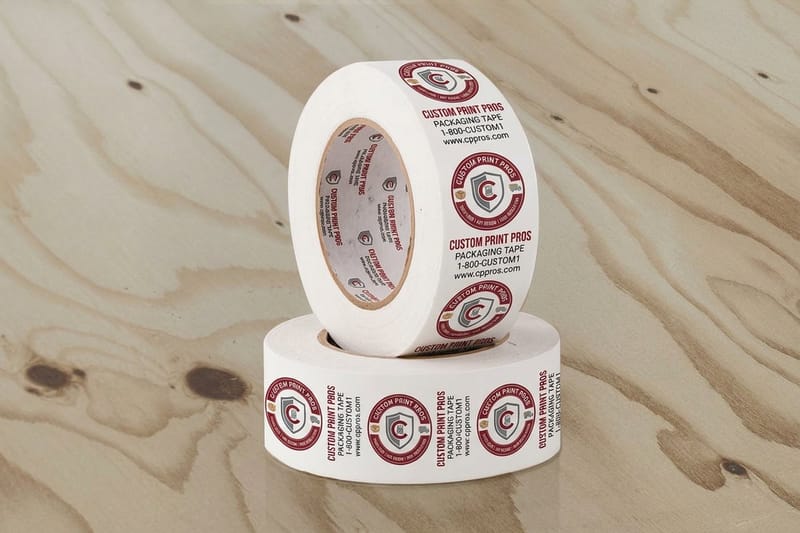
The packaging insert ideas that pay back are cards your customer can use, like a reorder code, a care guide, a review request or a referral card, and at 4OVER4.COM a run of 100 insert cards costs $17.57. That card is the one piece of marketing your customer opens with their hands, alone, already holding the thing they paid for, with no scroll, no competing tab and no auction to win. The box is open, attention is at its peak for maybe fifteen seconds, and a small printed card sitting on the tissue gets read far more often than the email that lands an hour later.
Most brands treat that moment as packing material. They drop in a folded flyer with a logo and the website address the buyer already typed, then wonder why nobody redeems the code. Printed inserts earn their keep when they ask for exactly one action and make that action easy to take before the box hits the recycling.
4OVER4.COM has printed more than 10 billion pieces for small shops and high volume shippers since 1999, and inserts sit near the bottom of every one of those invoices. Custom Business Cards start at $17.57, which puts a thank you note, a care guide, or a referral offer in the box for less than the tape holding it shut. That is the entire argument for printed inserts. Tiny unit cost, direct access to somebody who has already proven they will buy from you.
Give the buyer one next step
One card, one job. A reorder code, a review link, or a refill reminder. The second you add a second ask, response on the first one drops, because the customer has to decide what you want instead of simply doing it.
Answer the question support keeps getting
Pull the three tickets your team answers every week and print the answers. Washing instructions, first use setup, storage, warranty registration. Every ticket you prevent pays for a few hundred cards.
Put a human voice in the box
A signed line beats a paragraph of brand copy. Name the person who packed it or the founder who wrote it, keep it to two sentences, and print it on uncoated stock so it reads like a note rather than a flyer.
Ask for the review while the box is open
The best moment to request a review is before the product has been used long enough to disappoint anyone. Ask plainly, point at one place to leave it, and never make the request conditional on a five star rating.
Shop the box
Packaging printing collection
Boxes, tape, labels, and insert cards printed as one matching system.

Packaging Insert Ideas With the Size and Stock for Each
Pick the idea first, then let the idea set the trim and the paper. Each of the six below names the size and stock that suit it, drawn from the insert formats this page covers and the options in the Custom Business Cards configurator.
- Reorder code card. A 3.5 x 2 card on 14pt Gloss Cover, with the code printed large on the front and a use by date on the back.
- Numbered offer card. Choose Yes, Variable Data and every card in the run carries its own code, so one redemption tells you exactly which box it came from.
- Care and setup card. A 4 x 6 on 16pt coated with a product photo on the front and the three setup steps on the back.
- Signed thank you note. A 5 x 7 on uncoated stock that takes pen ink, for premium and fragile orders.
- Kraft referral pair. Two 3.5 x 2 cards on 18pt Kraft Uncoated Cover, 100% post consumer waste, one for the buyer and one to hand away.
- Buckslip offer. A 3.67 x 8.5 slip on 16pt that lies flat along the length of a shipper box, on top of the tissue.
What Package Inserts Cost at Real Run Sizes
A standard 3.5 x 2 insert card printed full color on the front on 14pt Gloss Cover costs $17.57 for 100, $36.26 for 500, $65.91 for 1,000 and $109.84 for 3,000 in the configurator today. The default turnaround is 3 business days. Printing the back as well, rounding the corners or moving to a heavier stock adds to those numbers, and the configurator shows the new total as you choose each option.
The 3,000 card run costs about six times the 100 card run and gives you thirty times the cards. That gap is why an evergreen care or thank you card belongs on a long run while a dated offer stays short.
Insert Ideas That Lift Repeat Purchase and Reviews
The inserts that move numbers all share a shape. They give the customer something they wanted anyway, then attach the ask to it. A care card that saves a sweater is worth keeping. A discount card with no expiry gets filed under maybe and never seen again. Design for the version that survives the kitchen counter for a week.
Food and beverage brands can push the same idea onto the wrapper itself. Our custom printed food wrappers guide covers printing directly on the material that touches the product, and everything in packaging and labels can be ordered on the same stock family so the insert, the label, and the seal look like one decision. For the packaging around the product, our guide to custom printed food packaging covers keeping ink off the food.
- Dated reorder card. A code with a real deadline printed large enough to read without hunting for glasses.
- Care and setup card. The three steps that keep the product working, which quietly reduces returns and refund requests.
- Review request card. One sentence, one destination, and a QR code that lands directly on the product page.
- Referral card built to be handed away. Print two, one for the buyer and one for whoever they tell about you.
- Range card. Show the four products this customer does not own yet, with the reason each one pairs with what they just bought.
Track it or you are guessing. Use a distinct code or landing path per insert batch, print the batch identifier in small type on the back, and compare redemption between runs. Two cards printed in the same order, split across shipments for a fortnight, will tell you more about your customers than a month of survey answers.
Print picks
Three formats that carry an insert program
Live prices, ready to customize with your artwork and codes.
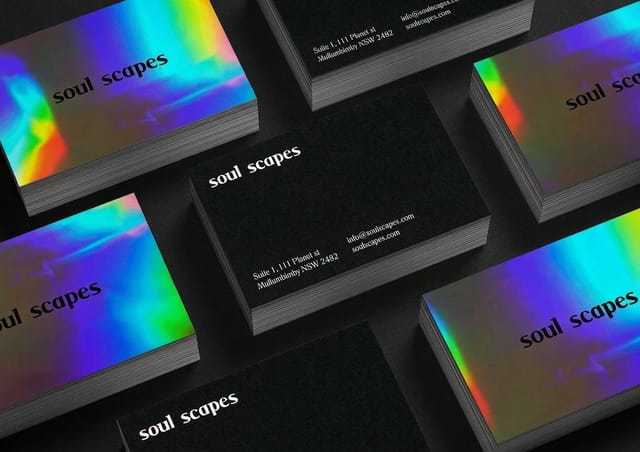 Custom Business Cards 100 for $17.57 The classic insert card size, cheap enough to drop in every single order.
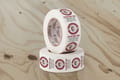
 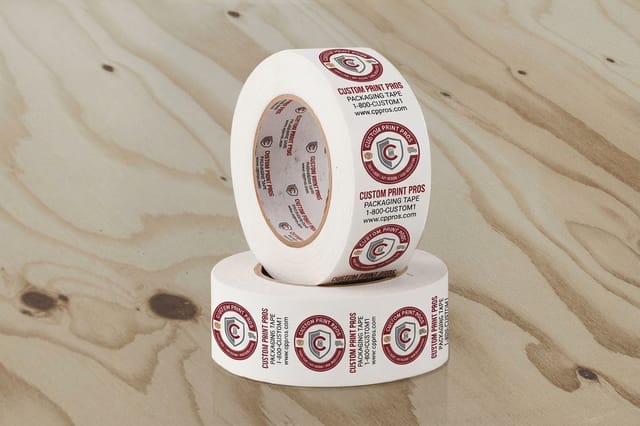 Custom Printed Packaging Tape $347.11 each Brand the seam of the box so the unboxing starts before the lid opens.
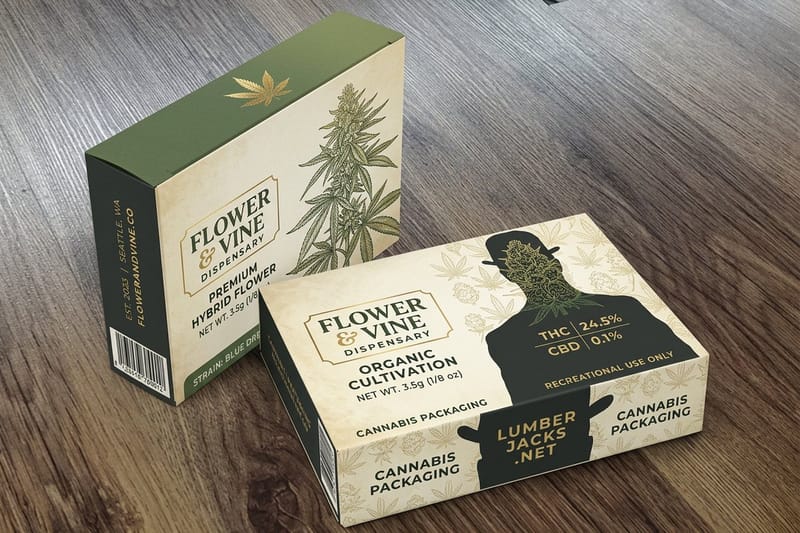
 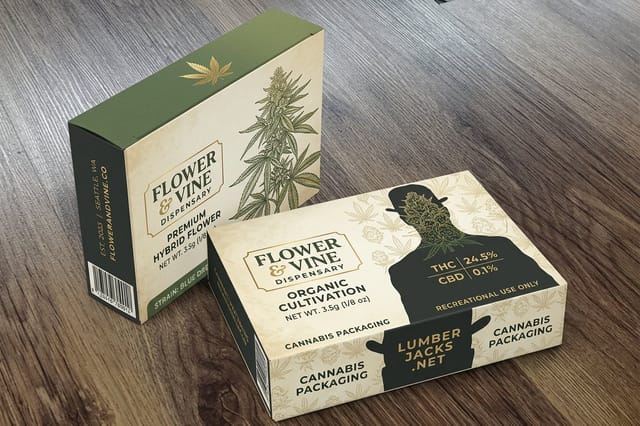 Cannabis Packaging 250 for $711.78 Compliant printed packaging sized to hold product, insert, and required copy. Packaging and Labels Browse the range Every packaging and label format, priced live in the configurator.
 Sizes and Stocks That Fit Real Shipping Boxes
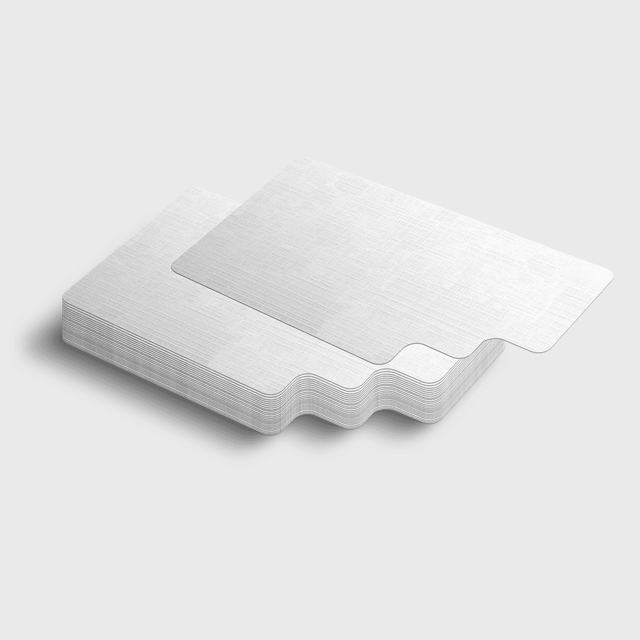
Four sizes cover almost every insert job. The 3.5 x 2 card is the cheapest and slips into poly mailers without bending. The 4 x 6 postcard gives room for a photo and a headline. The 3.67 x 8.5 buckslip lies flat along the length of a shipper box and is the standard for offer cards. The 5 x 7 note card feels like a gift enclosure and suits premium orders.
Stock does the talking before anyone reads a word. Coated 14pt and 16pt hold saturated color and photography, which suits range cards and offers. Uncoated stock takes pen ink, so use it for anything handwritten or signed. Kraft reads as considered and low waste, and it pairs naturally with brown corrugated boxes. Match the insert to the box rather than to your website, because the box is the only context the customer sees.
- Poly mailers and soft goods. 3.5 x 2 or 4 x 6, 14pt, no heavy varnish so the card does not slide out of the folds.
- Corrugated shippers. Buckslip or 5 x 7, 16pt, sitting on top of the tissue where it is seen first.
- Fragile and premium orders. Uncoated 5 x 7 with a written line, because the pause it creates is the point.
- Subscription boxes. Rotate a new 4 x 6 card each cycle so regulars have a reason to look rather than an insert they already ignore.
Quantity and price
Printed packaging tape pricing and specs
Real configurator numbers. Unit cost falls hard as the run gets longer.
| Quantity | Price Per Unit | Total |
|---|---|---|
| 1 | $347.11 | $347.11 |
| 2 | $302.40 | $604.80 |
| 5 | $272.53 | $1,362.67 |
| 10 | $233.28 | $2,332.75 |
| 20 | $189.39 | $3,787.89 |
| 30 | $176.79 | $5,303.65 |
How to Write an Insert Card Nobody Throws Away
Insert copy fails in predictable ways. It opens with the brand instead of the buyer, it stacks three offers, and it ends with a URL nobody will retype. Write it the way you would speak while handing the box over in person, then cut it until only the useful part remains.
Read the finished card out loud. If it takes longer than eight seconds, it is a flyer, not an insert. Keep one headline, two short lines, and one thing to do. Print the code in the largest type on the card, because that single element carries the whole result.
- Lead with what they get. Fifteen percent off the refill beats thank you for supporting a small business as an opening line.
- Name the deadline. Use within 30 days converts far better than an offer that will still be there whenever.
- Make the path one step. A QR code plus a short vanity path, never a tracked link the length of a paragraph.
- Sign it. A first name and a role turns a card into a message from somebody.
- Leave the back working. Care steps, sizing, or a reorder checklist, so the card has a reason to stay on the counter.
Bundling Inserts With the Rest of the Unboxing
An insert is one part of a printed set, and the set is what people photograph. Sealed tape, a labelled box, tissue, and the card together read as a brand that decided how the delivery should feel. A beautiful card inside an unbranded box still lands like an afterthought stapled to a shipment.
Start on the outside. Custom Printed Packaging Tape from $347.11 turns the seam into signage before the lid opens, and the argument for it is laid out in our piece on custom business tape. Inside, regulated categories need the box itself to carry copy, which is where Cannabis Packaging from $711.78 does the compliance work while the insert stays free to sell.
Hospitality and food brands extend the same system across everything the guest touches. Printed paper cups, deli paper and food wrap, and printed napkins use the same logo, the same two colors, and the same stock family, so a delivery order and a table order look like the same business.
Regulated packaging
Cannabis packaging built to hold an insert
Compliant printed boxes with space inside for a dosage or care card.
Buckslips, Stuffers, and Thank You Cards Side by Side
The three formats overlap enough that brands order the wrong one. A buckslip is a 3.67 x 8.5 flat offer card on 16pt coated stock, laid along the length of a shipper box and built to be scanned in a second. A stuffer is a 3.5 x 2 card on 14pt that rides free in the void space of a poly mailer and usually carries a code. A thank you card is the 5 x 7 note on uncoated stock, heavy enough to feel like a gift enclosure and there to make the order feel personal rather than to sell anything.
Pick by job, not by price. If you want a measurable redemption number, print a buckslip or a stuffer with a unique code. If you want the customer to remember the brand next month, print the thank you card on uncoated stock and sign it. High value orders can carry both without the pairing feeling pushy.
Compare formats
Popular packaging print, side by side
Stock, size, quantity, turnaround, and price in one view.
Keeping Unit Cost Low on Small Insert Runs
Insert economics are simple. The setup is the expensive part and the paper is cheap, so the price per card falls fast as quantity climbs. Ordering three months of inserts in one run usually costs a fraction more than ordering one month, and the difference between those two invoices is often smaller than the shipping on the second order.
The trap is printing dated copy on a year of stock. Keep evergreen content, care steps, brand story, referral offers, on the big long run, and print the seasonal or dated offers in short runs you can burn through. Gang the two designs into a single order where quantities allow, and reuse the same trim size so both slot into the same packing station without retraining anyone.
Lowest unit cost
Custom business cards as insert cards
The 3.5 x 2 card is the cheapest way to put print in every box, and it scales with the run.
Files, Templates, and Bleed That Print Clean
Inserts fail at the file stage more often than at the press. Background color that stops at the trim line leaves a white hairline on one edge, and a code parked too close to the cut gets clipped on part of the run. Build with 0.125 inch bleed, keep everything important 0.125 inch inside the trim, and supply a print ready PDF with fonts outlined.
Test the QR code from the proof rather than the screen. Print it at final size, scan it with a cheap phone in poor light, and confirm it lands where you expect. The same discipline that keeps a printed pizza box readable at speed applies to a card somebody reads once while unpacking, and the same rules govern short run pieces like printed napkins.
Set the file up once and reuse it
- Build a master layout. One trim size, one bleed, one safe area, then swap only the copy layer per campaign.
- Keep the code on its own layer. Swapping a batch code should take a minute, not a redesign.
- Use CMYK from the start. RGB brand colors shift on press, so convert early and approve the shifted version.
- Print the batch mark small. A discreet code on the back tells you which run produced which result.
Start fast
Insert templates and print-ready blanks
Free layouts plus exact-size blanks so bleed and safe area are right the first time.





Wally packs the card that earns the second order
One ask, one useful side, printed on stock that matches the box
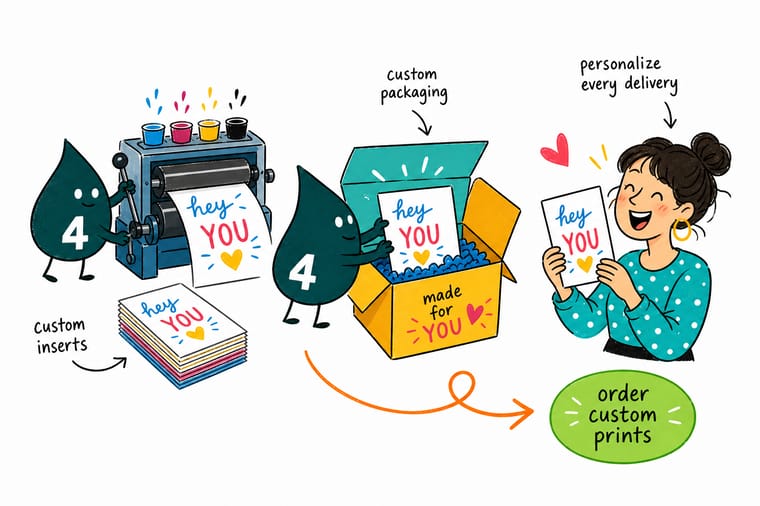
An insert only works if the customer keeps it. Wally's rule is simple. Put something useful on one side, care steps, sizing, or setup, and put one clear ask on the other, with a code big enough to read across the kitchen counter. Print it on stock that matches the box rather than the website, add a batch mark on the back so you can measure which version won, and reorder the evergreen version in bulk while the dated offers stay short.
Design your insert cards →Turning a Cheap Printed Card Into a Repeat Order
By the numbers
Why brands print their packaging with 4OVER4.COM
10B+ Pieces printed, for brands since 1999
150,000+ Businesses served, across every industry
60+ Paper stocks, from 14pt gloss to 18pt kraft for insert cards
99.8% On-time delivery, tracked orders
Guides
Go deeper on printed packaging
Materials, layouts, and file rules for everything that ships with the order.
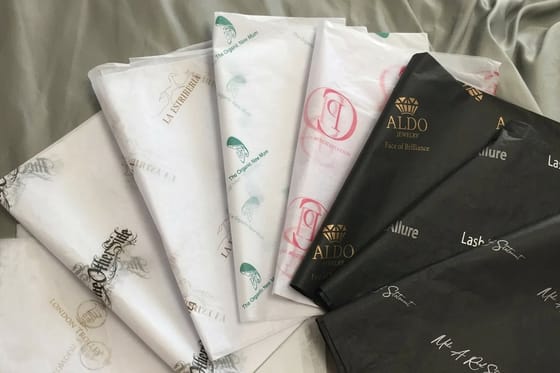 Guide Custom Printed Food Wrappers Guide Print the brand onto the material that touches the product.
 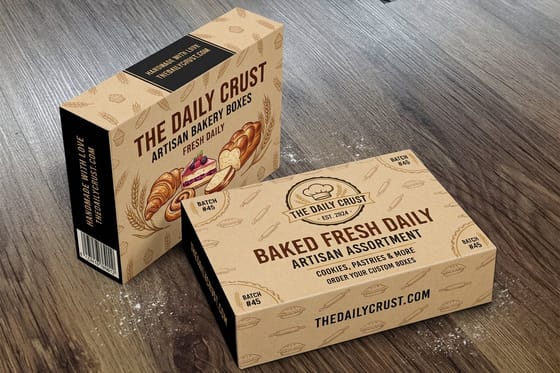 Guide Custom Pizza Boxes Guide Design and printing rules for boxes read at a glance.
 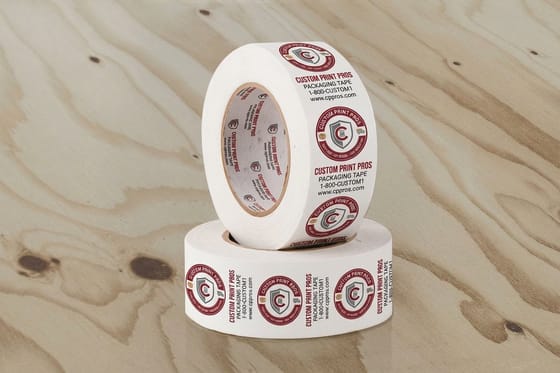 Guide Custom Business Tape Brand the seam so unboxing starts before the lid opens.
 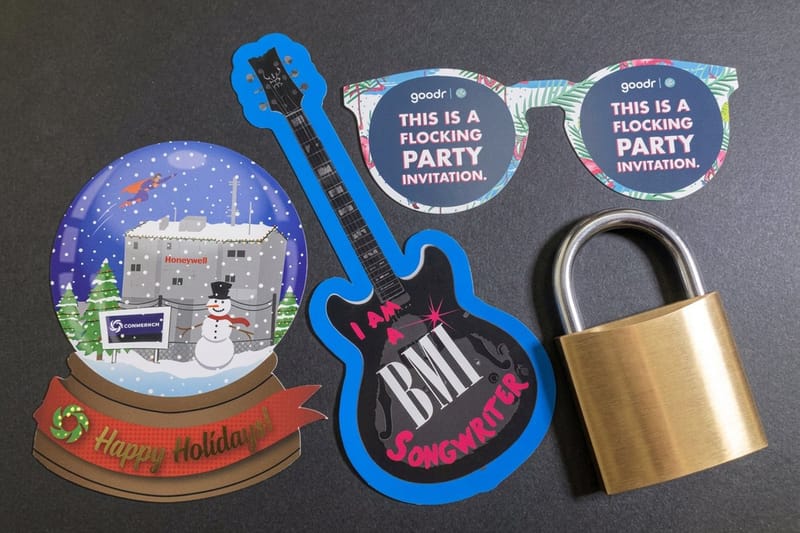 Guide Custom Deli Paper and Food Wrap Food safe printing for counters, trays, and delivery.
 Explore more
More ways to brand the delivery with print
Related pages across 4OVER4.COM, one card per direction.
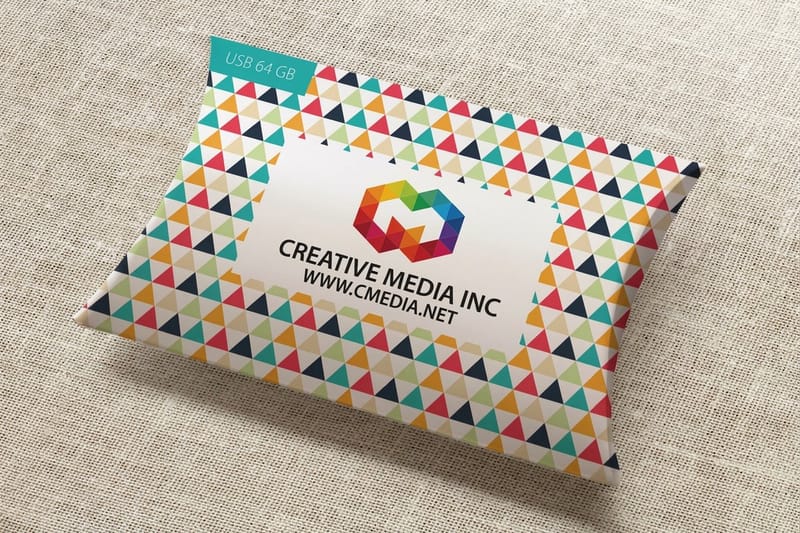 Collection Packaging Printing Boxes, tape, labels, and inserts in one printed system.
 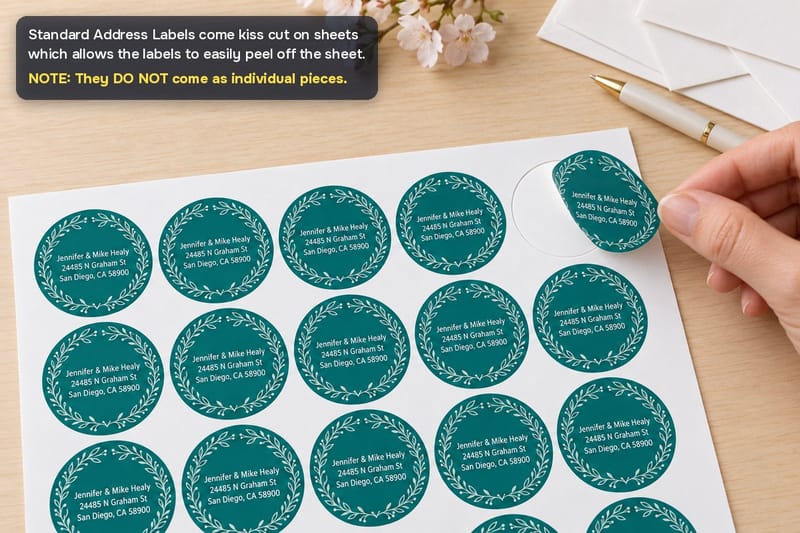 Shop Packaging and Labels Browse every packaging and label format we print.
 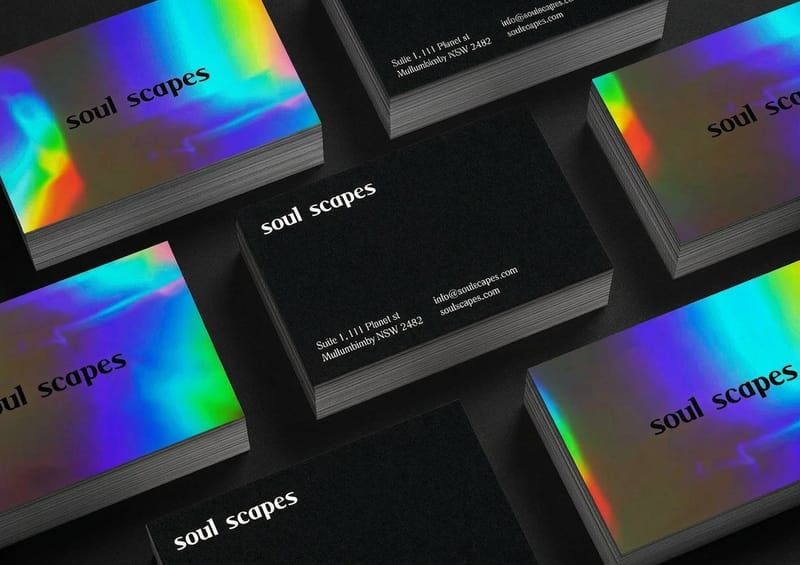 Product Custom Business Cards The cheapest insert card, from $17.57 per run. Product Custom Printed Packaging Tape Branded tape that seals and sells at the same time. Product Cannabis Packaging Compliant printed boxes with room for a dosage insert. Guide Printed Food Wrappers Guide Materials, inks, and layouts for food safe printing. Guide Custom Pizza Boxes Guide Print a box that still reads across a busy counter. Article Custom Business Tape Turn every shipment into a branded delivery. Article Deli Paper and Food Wrap Branded wrap for counters, trays, and takeaway.
  Article Custom Printed Paper Cups Design and branding for cups people carry outside.
  Article Printed Cocktail Napkins Short run printed napkins for events and service.
 Ready to put a card in every box you ship?
Pick the format, print the evergreen run long and the dated run short, and let the insert do the asking while the box is still open.
Packaging Insert Questions, Answered
What are printed inserts?
Printed inserts are the small cards, buckslips, and stuffers packed inside a shipment alongside the product. They carry a thank you note, care instructions, a reorder code, a referral offer, or a review request. Unlike an email, an insert reaches the customer at the moment the box opens, when attention is highest and the purchase is still fresh. Our guide on how to use packaging inserts shows how to turn one order into repeat sales. The same thinking applies to printed materials that touch the product itself, such as custom deli paper and food wrap.
How do I choose the right printed inserts?
Start from the single action you want. A measurable redemption calls for a buckslip or stuffer with a unique code. Loyalty and brand memory call for a heavier thank you card on uncoated stock that takes a signature. Returns and support tickets call for a care card printed with the three answers your inbox repeats every week. Choose the format by job first, then pick the size that fits your mailer or shipper without folding.
What do printed inserts cost and how are prices set?
Price is driven by quantity, size, stock weight, and finish, and the setup is the expensive part rather than the paper. Custom Business Cards start at $17.57, which is the entry point for a small card insert. Printed Packaging Tape starts at $347.11 and Cannabis Packaging starts at $711.78 when the outside of the shipment needs branding too. Because unit cost drops sharply with volume, printing a quarter of evergreen inserts in one run usually beats three monthly orders.
What sizes, stocks and finishes are available for printed inserts?
The common trims are 3.5 x 2 for card stuffers, 4 x 6 for postcard style inserts, 3.67 x 8.5 for buckslips, and 5 x 7 for gift enclosure notes. Stocks run from 14pt and 16pt coated for saturated photography to uncoated sheets that accept pen ink and kraft for a low waste look. Finishes include matte, gloss, soft touch, and spot gloss. Match the stock to the box the card ships in rather than to the website.
How long do printed inserts take to print and ship?
Turnaround depends on the product, the stock, and the finish you select, and the live options appear in the configurator on each product page once you set quantity and size. Simple card inserts on standard coated stock move fastest, while specialty finishes and rigid packaging take longer. Order proofs early, approve them the same day, and keep evergreen inserts on a standing reorder so a slow week in production never leaves your packing station without cards.
