
Why Some Campaigns Need Posters and Others Need Flyers


Sofia is our design and templates voice, built from the knowledge of our production team, with over 20 years in printing.
Use a poster when you have a wall in front of the right people, and a flyer when the person has to leave holding your offer. A poster repeats to whoever passes and cannot be taken away; a flyer is one impression per piece but travels home, which is why an event with a date usually wants both and a coupon campaign only ever wanted the flyer.
Flyer vs poster decision matrix
| Campaign goal | Poster | Flyer | What we would print |
|---|---|---|---|
| An event on a fixed date | Strong. The venue wall reminds the same regulars every day | Strong. The date goes home in a pocket | Both, poster inside, flyer at the door |
| A discount code or a coupon | Weak. Nothing to take away | Strong. The piece is the coupon | Club Flyers |
| Presence in a shop or a lobby | Strong. Works for weeks with no staff effort | Weak. A counter stack goes stale | Mounted Posters |
| Door to door reach on a route | Not possible | Strong. Letterbox routes scale cleanly | Standard Flyers or Mailing Flyers |
| A trade show or market stall | Strong. Read across the aisle | Support. Handed over after the conversation | Large Format Posters plus flyers |
The matrix answers most campaigns on its own. Where it says both, an 18 by 24 inch poster holds the site from ten to fifteen feet and a $16.48 run of club flyers carries the detail, and the two are ordered together from poster printing and flyer printing.
When a poster wins
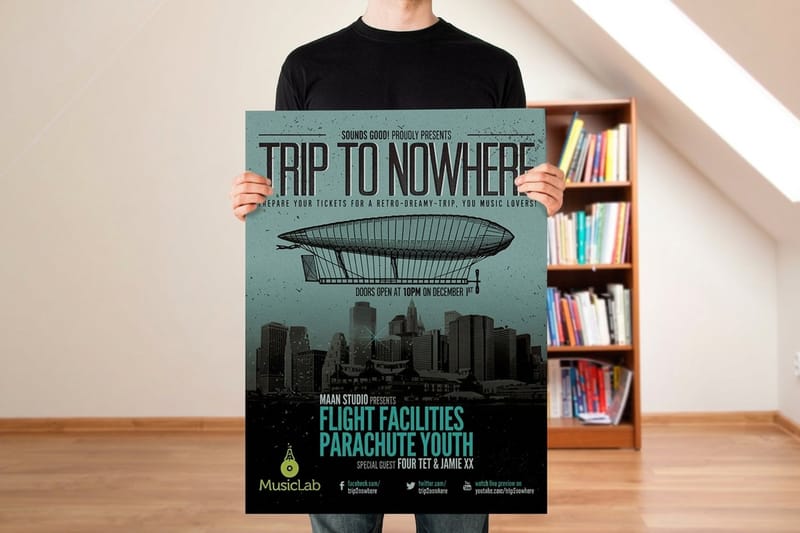
A poster wins when the audience comes to the message instead of the message going out to find the audience. A gym lobby, a venue wall, a campus corridor, a counter behind a till: places where the same people pass repeatedly and one printed sheet keeps working for weeks without anybody staffing it.
The limit is that nobody can take it away. Everything the viewer needs has to survive being read from six feet away in about two seconds, which is why a phone number set in body copy on a poster is wasted ink. One message, one date, one way to act. If the campaign needs a paragraph of detail, the poster is the wrong carrier for it.
Size follows viewing distance, not budget. A working rule printers use is roughly one inch of cap height for every ten feet the reader stands back, which puts an 18 by 24 inch standard poster in the read-across-a-room bracket and pushes anything meant to catch an aisle into large format. Our horizontal poster sizes guide lays the common formats out side by side.
Where a poster earns its price
The good sites are the ones with a queue: the wall people face while they wait. A mounted poster at $39.99 survives being moved, leaned and re-hung, which matters in a lobby where it will be handled by staff rather than pinned once and forgotten. A framed poster at $87.86 buys a site that a taped sheet will never get, because a manager who says no to tape will say yes to something that looks finished.
Outdoors the calculus changes again. Weather ends a paper poster fast, so anything living on a fence, a stand or a pavement belongs on a rigid or vinyl format instead. The sidewalk signage guide covers what actually holds up out there. When the date is close, our guide to fast poster printing shows how to order so the poster arrives before the event.
Where a poster quietly fails
Three ways, and none of them are about the printing. The site was never agreed, so the poster sits in a tube. The site was agreed but faces away from the traffic. Or the site is a community board already carrying twenty other sheets, where the only thing that gets read is whatever went up last.
Walk the site before you set the artboard size. Stand where the reader will stand, look at what competes for the same two seconds, and pick the size from that rather than from a price list.
When a flyer wins
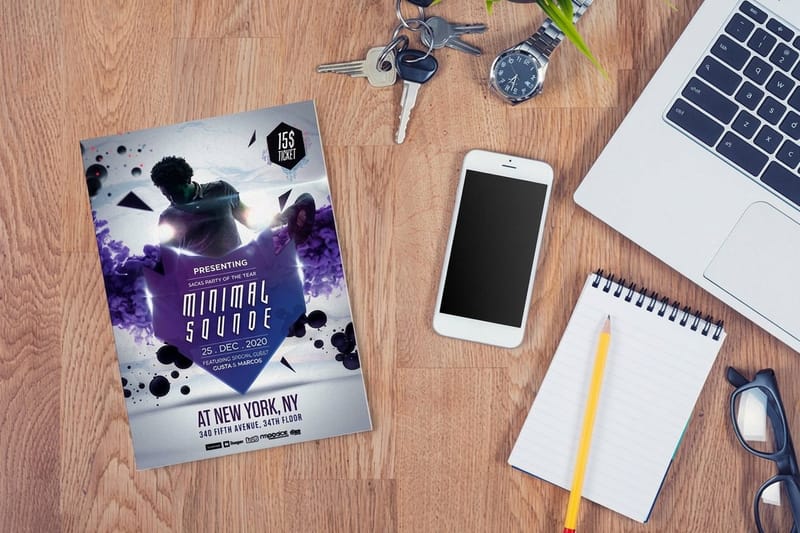
A flyer wins when the person has to leave holding something. It is the format that travels: into a pocket, onto a fridge, through a letterbox, across a table after a handshake. If the campaign depends on somebody acting later, at home, with a phone in their hand, the flyer is doing the work and the poster is only the reminder.
Because it goes home, a flyer carries detail a poster cannot. A class timetable, a menu, a price list, a code with an expiry date on it. That is also the honest reason to print one: not reach, but the ability to hand over information somebody will still have tomorrow.
Now the part most flyer articles skip. Most flyers handed out cold are never read. That is the trade the format makes. The unit cost is low enough that a poor response rate still works out, but only when the distribution is aimed at people who plausibly want the thing. A thousand standard flyers given to the wrong crowd cost less than one bad poster site and achieve exactly the same nothing.
Stock decides how long the flyer survives
A thin text-weight flyer is creased within a block and binned by the evening. A heavier cover stock feels like something worth keeping, which is why club flyers at $16.48 became the nightlife standard: they are handed out in a crowd, shoved in a jacket, and still readable the next morning.
Shape does the same job by a different route. Die-cut flyers at $34.05 get kept because they are not a rectangle, and folded flyers at $68.54 buy four panels of room when there is a real timetable or menu to print.
Give the flyer a reason to be kept
A discount with a date, a map to the door, a class schedule, a code that only exists on paper. Any one of those turns the flyer from litter into a thing with a job, and it also gives you a way to count what came back.
For a route you cannot walk yourself, mailing flyers at $89.68 print and go into the mail stream instead of a hand, which trades the personal contact for coverage you can actually plan.
Cost and print run, compared honestly

The two formats price on different axes, so a straight per-piece comparison misleads. Flyers price in bulk and get cheaper fast as the run grows. Posters price close to per piece, because each one is large, printed on heavier stock, and often finished or mounted.
The number that matters is cost per person reached, and it moves in opposite directions. A poster in a busy lobby is seen by the same hundred people every day it hangs, so its cost per impression falls toward nothing over a month. A flyer is one impression per piece, permanently. That single difference is why a poster in a strong site beats a flyer run outright, and why a poster in a weak site is the most expensive item on the order.
Posters also punish mistakes harder. A flyer run with the wrong date can be reprinted for the price of the mistake and the old stack thrown away without much pain. A mounted or framed poster cannot be treated that casually, so proof the poster twice and the flyer once.
Order to what you will use, not to the best unit price
Flyer pricing steps down with quantity, which tempts people into five thousand of a design that changes after two weeks of feedback. Work out how many you will genuinely hand over before the offer or the date changes, then order to that number. The leftover box in the stockroom is not a saving.
For posters the equivalent discipline is counting sites. Two confirmed walls means two posters plus one spare, not twenty-five on the chance that somebody says yes later. Confirm the site, then print.
Distribution that actually places the piece
Printing is the easy half. Both formats die in a stockroom for the same reason: nobody decided in advance where each piece was going. Settle distribution before you settle artwork, because it changes the size, the stock and the quantity.
- Ask the gatekeeper first. Wall space belongs to a manager, a landlord or a committee. Ask before the artwork is set, because the answer usually comes with a size limit and a review date.
- Offer to refresh it. A site is easier to get when you promise to swap the poster monthly. It also stops your campaign becoming the faded sheet nobody reads.
- Hand out at the hour, not the day. Flyers land when the person is already thinking about the thing. Outside a gym at six in the evening beats a shopping street at midday for a fitness offer.
- Partner counters and bag inserts. A neighboring business with the same customers and no competing offer will often take a stack or slip one in a bag. This is the cheapest distribution that exists.
- Letterbox routes need counting. Walk the route, count the doors, then add about ten percent for gates you cannot reach and doors you miscount. Print to that number.
Print it
Standard flyers, ready to hand out
Preset sizes and stocks, the fastest route from a finished file to a box you can carry.
One rule covers both formats: never print more than you have a plan for. A confirmed wall is a poster. A counted route is a flyer run. Everything past that is stock you paid for and will throw away when the date changes. If the campaign is heading into the mail instead of a hand, mailing flyers handle the print and the send in one step.
Running both on one budget
The combined play is simple and it is the reason we get asked this question at all. The poster holds the site and repeats the message to everyone who walks past. The flyer sits at the same site, in a holder or in a hand, and gives the interested few something to take away. One is reach, the other is capture, and they cost different money for different reasons.
A practical split for an event: order posters only for the sites you have already confirmed, then put the rest of the budget into flyers, because flyers scale and posters do not. Keep the headline word for word identical across both. The flyer should read as the poster somebody already walked past, which is what makes the second exposure count rather than starting over.
Then instrument it. Put a different code or a different QR destination on each piece so you can tell at the end which format brought people in. Most campaigns never find this out, and they reorder the same split next time on a guess. For a poster-led campaign with several sites, the campaign posters guide covers sequencing and refresh cycles.
Poster and flyer pricing at 4OVER4.COM
A split campaign costs less than it sounds. Standard Posters start at $108.75 and Large Format Posters at $25, while Club Flyers start at $16.48, Standard Flyers at $39.54 and 50 die-cut flyers at $34.05. The table below pulls the live configurator for both, so you can price one poster per site plus a flyer run before committing to the split.
Quantity and price
Flyer pricing and specs
Real configurator numbers, where the per-unit cost falls as the run grows and the stock options change what survives a pocket.
| Quantity | Price Per Unit | Total |
|---|---|---|
| 50 | 79.1¢ | $39.54 |
| 100 | 57.1¢ | $57.11 |
| 200 | 37.3¢ | $74.69 |
| 300 | 28.6¢ | $85.68 |
| 400 | 24.4¢ | $97.76 |
| 500 | 21.8¢ | $108.75 |

You can also earn coins on every order and put them against the next run, which matters on a campaign that reprints each season. Terms for turnaround and proofing sit on our printing terms page.
Design must-haves for each format
The two pieces are read at different distances, and almost every design mistake in this category comes from ignoring that. These are the rules worth holding to on both.
- Poster, one message. Headline, what it is, when, and one way to act. Anything else competes with the thing you actually want read.
- Flyer, the offer and the proof. A flyer is read at arm’s length, so it can hold the detail, the price and the code. It still needs one clear headline at the top.
- Same family, different jobs. Matching color, type and image across both makes the flyer read as the poster the person already saw. Do not copy the poster layout onto the flyer.
- Bleed and safety on both. Add 0.125 inch of bleed to every edge and keep live copy well inside the trim. Trimming stacks shifts slightly, and copy against the cut line is what shows it.
- Build in CMYK at 300 DPI. Screen color converts on press. Set the file in CMYK from the start so the deep blue you approved is the deep blue that prints.
- Two codes, not one. If both pieces carry a QR or a promo code, use a different one on each. It is the only cheap way to find out which format brought the customer.
Blanks that settle the setup argument
Set up the two files at their real sizes before anyone argues about layout. A standard poster blank at 18 by 24 inches, with Standard Posters from $108.75, and a flyer blank for a $16.48 club flyer or a $34.05 die-cut run both arrive with bleed and trim marked, so the headline that reads from ten feet on the wall is not sitting on the cut line of the flyer. Grab one from the blank template library or start from a design template.
Start fast
Flyer templates and exact-size blanks
Layouts and blanks sized to the real product, so artwork lands inside the cut line first time.




Wally splits the campaign between the wall and the hand
One holds the site, the other goes home
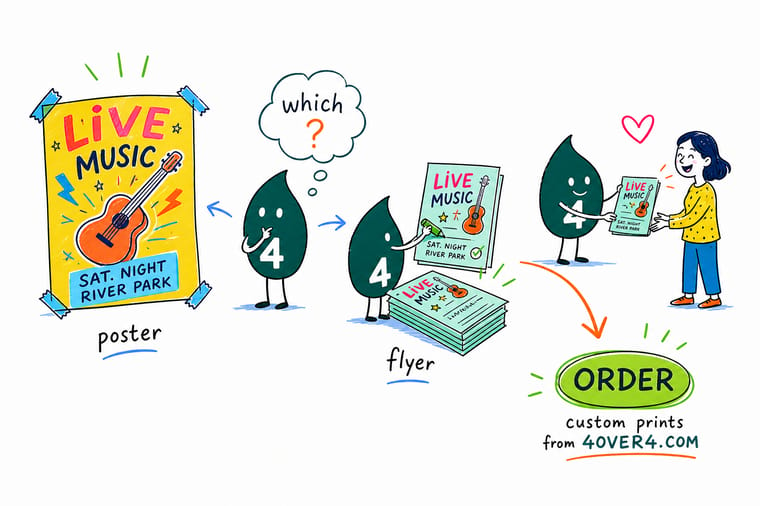
Confirm the wall before you print the poster, and size the type from where the reader stands, roughly one inch of cap height per ten feet. Put the detail on the flyer instead, on cover stock if it has to survive a pocket. Keep the headline identical on both, add 0.125 inch bleed, build in CMYK at 300 DPI, and give each piece its own code so you learn which one worked.
Order flyers →What to remember about posters and flyers
Explore more
More ways to print and promote
Die-cut flyers run 50 for $34.05 in 5 business days and folded flyers 50 for $68.54 in 3.
Product Standard Posters Wall posters for venues, lobbies and campus corridors. Product Standard Flyers The everyday hand-out and letterbox format. Product Club Flyers Heavy cover stock that survives a jacket pocket.  Product Mounted Posters Rigid backing for a lobby site that gets handled.
 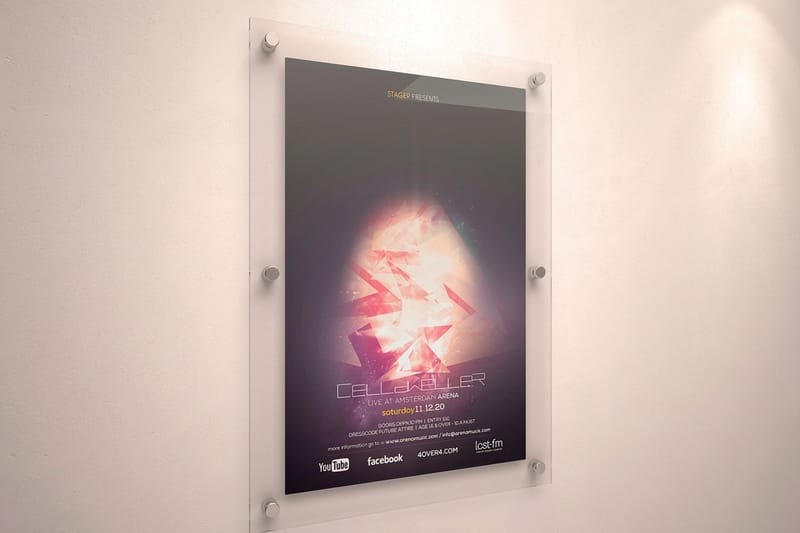 Product Large Format Posters Read across an aisle at a show or a market. Category Flyer Printing Every flyer size, stock and shape in one place. Category Poster Printing Standard, mounted, framed and large format.
 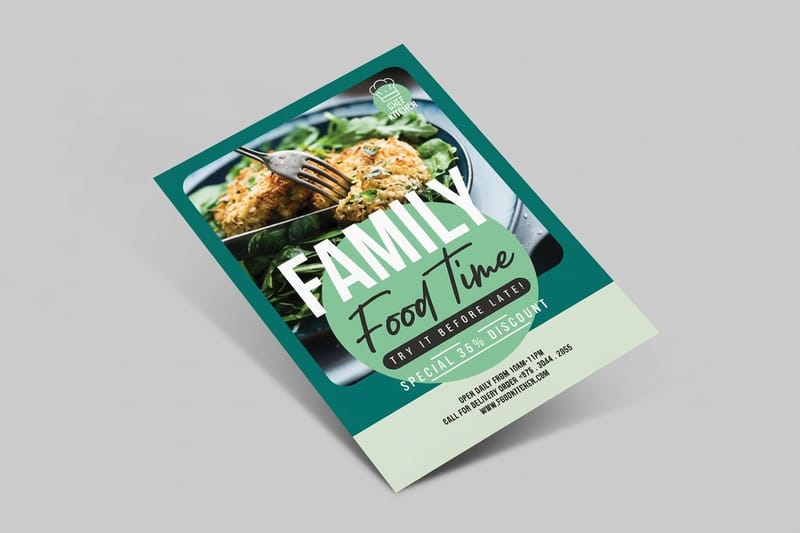 Guide Nightclub Flyer Design What works on a flyer handed out in a crowd.
 Ready to print the campaign?
Pick the poster for the wall you have, the flyer for the hand you want it in, and 4OVER4.COM prints both sharp on stock that suits the job.
Common questions about flyers and posters
Is a poster or a flyer better when the budget is small?
Flyers, in almost every case, because the entry price is lower and the pieces go where you send them. Club Flyers start at $16.48 and Standard Flyers at $39.54, against $108.75 for a run of Standard Posters. The exception is when you already have a strong site: one poster on the wall of a busy lobby you have permission to use will out-work a few hundred flyers handed out on a street with no particular reason to stop. If the site exists, spend on the poster. If it does not, spend on flyers and put them where your customers already are.
What size should a poster be for a shop window?
Work back from where the reader stands. A window read from the pavement directly outside suits 18 by 24 inches, which carries a headline legible from about ten to fifteen feet. If people read it from across a street or a car park, go up to a large format size instead, because scaling the type on a small sheet only leaves you with a headline and no room for anything else. Measure the glass first, subtract any frame or vinyl already on it, and check the poster is not covering the part of the window staff need to see through. If they do need the view, print a see through poster instead.
How many flyers do I need for a neighborhood?
Count the doors on the route rather than guessing from the population. Walk it, or trace it on a map, then add about ten percent for gated properties, miscounts and the pieces that get damaged in the bag. For a hand-out campaign instead of a letterbox run, count contact opportunities: how many hours you will actually stand there and how many people you can hand one to per hour without becoming a nuisance. Both counts give you a real number to print to, which is better than ordering five thousand because the unit price looked good.
Can I use the same artwork for a poster and a flyer?
Use the same family, not the same file. The color, the typeface, the photograph and the headline should match so the flyer reads as the poster somebody already walked past. The layout should not, because the two are read at completely different distances. A poster scaled down to flyer size gives you a nearly empty sheet with an oversized headline, and a flyer scaled up gives you body copy nobody can read from six feet. Set the poster first with one message, then build the flyer around the detail the poster had no room for.
Do posters and flyers need the same file setup?
The setup is the same, the resolution planning is not. Both want CMYK, 0.125 inch of bleed on every edge, and live copy kept clear of the trim. Both want 300 DPI at final size, and that last phrase is where posters catch people out: an image that is plenty at flyer size becomes soft when the same file is placed on a 24 by 36 inch sheet. Check the effective resolution after scaling, not before. Our printing at any size guide covers what happens to artwork as the sheet grows.
