
A-Frame Sign Boards Explained, Sizes That Fit and What They Cost


Tobias is our voice for cutting, binding and large format, built from the knowledge of our production team, with over 20 years in printing.
An A-frame poster size is the size of the printed board, 24 x 36, 22 x 28 or 24 x 18 inches, and the frame is one size bigger than the board it holds. Each A-frame size takes a specific board, each board has its own material, and the second print has its own price.
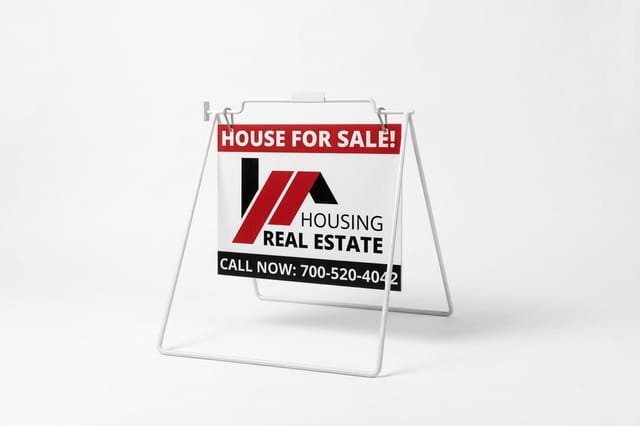
An A-frame sign board is the printed panel that sits in a folding sidewalk frame, and it is always smaller than the frame around it. A 25 by 45 inch Signicade frame takes a 24 by 36 inch board; a 27.75 by 31.5 inch metal rod frame takes a 24 by 18 inch one. Nearly every board prints on 4mm corrugated plastic, some frames hold one double sided board and some hold two, and complete kits run from $65.90 to $196.60. See both frame styles on the street in the Metal A-Frame Signs and Plastic A-Frame Signs stories.

Quick answer
Order the board size, never the frame size
The printed board always measures less than the frame that holds it. Signicade, Signicade Deluxe and the large aluminum frame take a 24 by 36 inch board. Simpo and the standard aluminum frame take 22 by 28 inches. Metal rod, real estate and Quik Sign frames take 24 by 18 inches. Almost all of them print on 4mm corrugated plastic, the frame lip covers roughly half an inch of the outer edge, and the number of boards per frame is one on the grommeted steel frames and two on the moulded plastic and aluminum ones. The frames themselves measure 25 x 45 inches for Signicade, 27 x 46.125 for Signicade Deluxe, 26 x 44.5 for aluminum, 24.375 x 37.25 for Simpo and 27.75 x 31.5 for metal rod.
The Frame and the Board Are Two Different Things
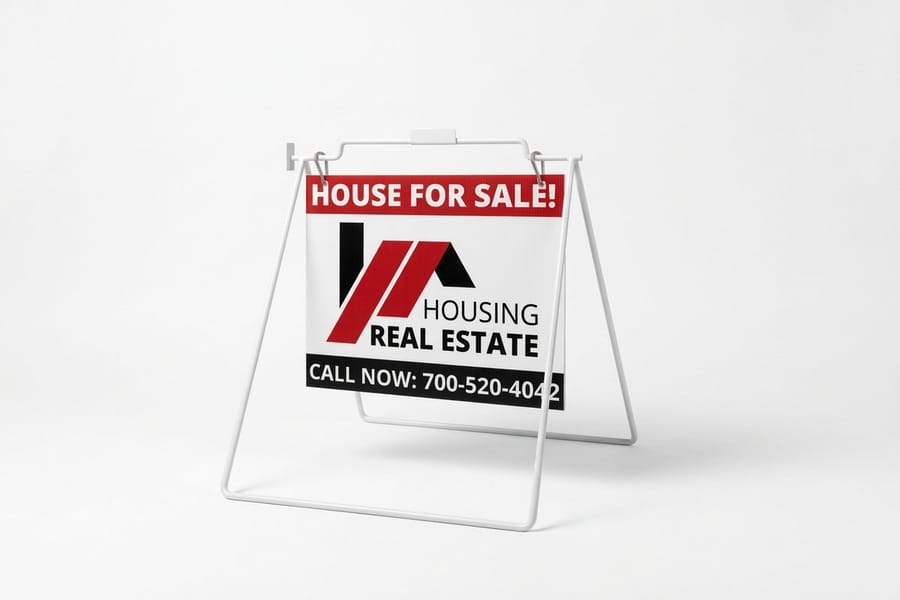
Every A-frame is two parts that get quoted as one. The frame is the hinged body that stands on the pavement and folds flat. The board is the printed sheet it holds. Mix the two up and the file ends up at the wrong dimension.
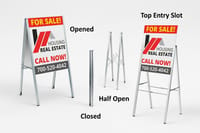
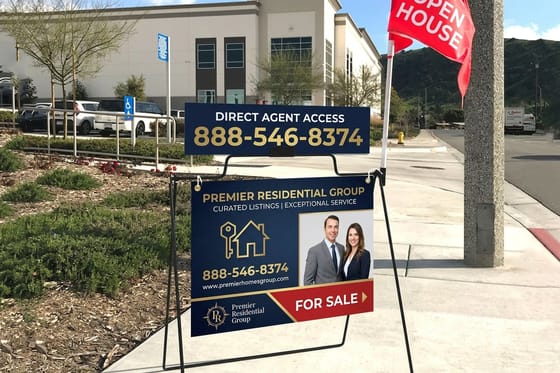
How the two connect changes with the frame. A metal rod A-frame is a black steel skeleton, 27.75 by 31.5 inches, and the board hangs from grommets at the top corners. One board, printed on both faces, does the whole job. A Signicade A-frame works the opposite way: the 25 by 45 inch molded plastic body has a recess on each face, and a separate board locks into each one. Two boards per frame, two prints, two files.
That difference decides your reprint cost for the life of the frame. If your message changes every season, the single-board frame costs half as much to refresh. If you want the sidewalk facing two different messages at once, the coming direction reading one thing and the going direction another, only a two-board frame can do it, and the Signicade Deluxe at 27 by 46.125 inches is the largest version of that.
Frames last years. Boards last as long as the offer printed on them. Buy the frame once, and plan the board as a consumable.
Which Board Size Fits Which Frame
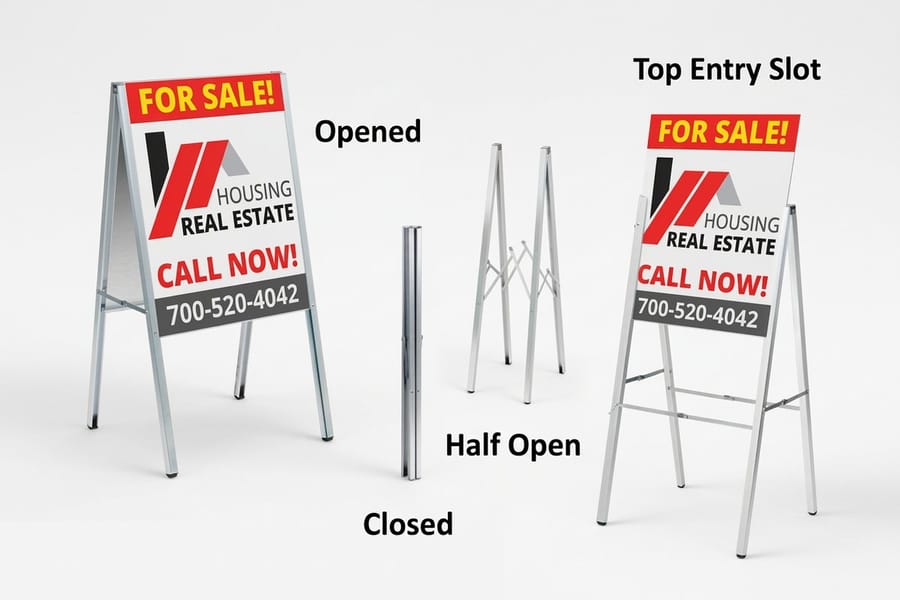
Three board sizes cover the entire sidewalk range, and none of them matches the frame dimension. Read the middle column before you set up artwork.
| Frame | Board size | Frame size | Boards per frame | From |
|---|---|---|---|---|
| Metal rod | 24 x 18, 24 x 24 or 18 x 24 in | 27.75 x 31.5 in black steel | One, printed both sides | $65.90 |
| Real estate | 24 x 18 in | 27.75 x 31.5 in black steel | One, printed both sides | $65.90 |
| Aluminum | 22 x 28 or 24 x 36 in | 26 x 44.5 in satin silver | Two, one per face | $146.07 |
| Simpo | 22 x 28 in | 24.375 x 37.25 in white plastic | Two, one per face | $163.67 |
| Quik Sign | 24 x 18 in | 31.7 x 26 in white plastic | Two, one per face | $163.67 |
| Signicade | 24 x 36 in | 25 x 45 in white plastic | Two, one per face | $182.32 |
| Signicade Deluxe | 24 x 36 in | 27 x 46.125 in white plastic | Two, one per face | $196.60 |
The gap between the two columns is the frame lip, the moulded edge that grips the board and holds it flat. On a Signicade that lip covers roughly half an inch all the way round, so anything closer than an inch to the trim edge is at risk of being half hidden. Pull the phone number, the arrow and the closing line of type well inside, and treat the outer inch as decoration rather than information. A correctly sized starting layout saves the argument entirely, and the blank template library has one for each board size.
Each size comes with its own print choices. The metal rod board prints double sided, with the same image or two different images, and has grommets at the top corners, with 3 business days standard production. The Signicade, Simpo and aluminum kits print two front-only boards, with the same art on both or different art on each, and take 4 business days standard. Every one offers a Free Online Proof before the boards go to press.
If you are still choosing a size rather than a frame, our complete guide to standard A-frame sign sizes lays the dimensions out next to legibility distance, and the A-frame signs range shows what each frame costs with a live configurator.
If the frame is still open, how to choose an A-frame sidewalk sign narrows it down, and how to design an A-frame sign covers the layout once the board size is set.
A-Frame Poster Sizes and What Each One Costs
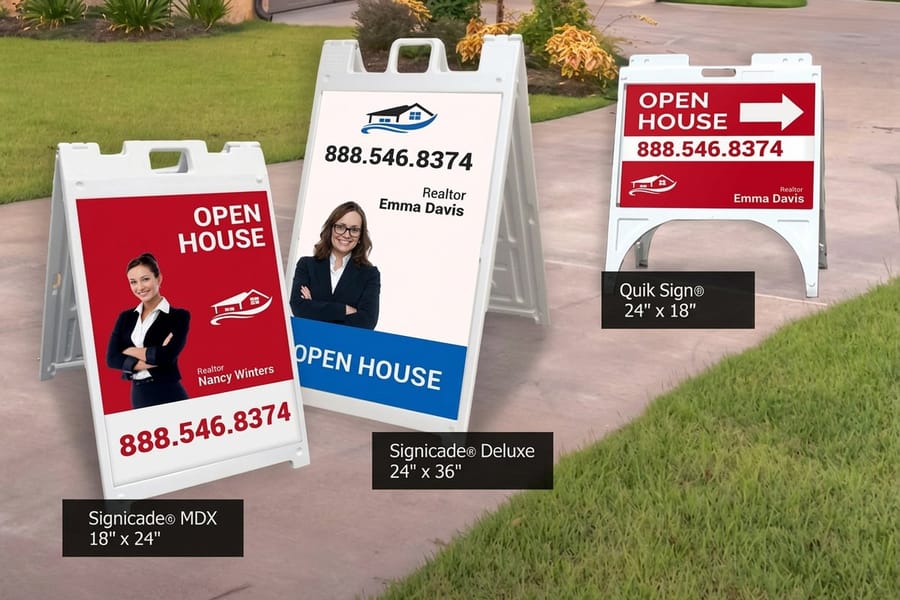
The poster in an A-frame comes in three sizes, and the price follows the frame and the face you pick rather than the poster alone.
- 24 x 36 inches. The tall poster for the Signicade family. A Signicade with two coroplast posters costs $182.32, the Signicade Deluxe $196.60, the dry erase Signicade $185.63 and the reflective Signicade $163.67. The aluminum frame takes this size too.
- 22 x 28 inches. The middle size, for the Simpo at $163.67 and the standard aluminum frame from $146.07 for one.
- 24 x 18 inches. The short, wide poster for metal rod, real estate and Quik Sign frames, from $65.90 for one metal rod kit.
Set the artwork to the poster size, not the frame size, and keep the text an inch inside the edge so the frame lip does not cover it.
Coroplast, Adhesive Vinyl, Dry Erase and Reflective
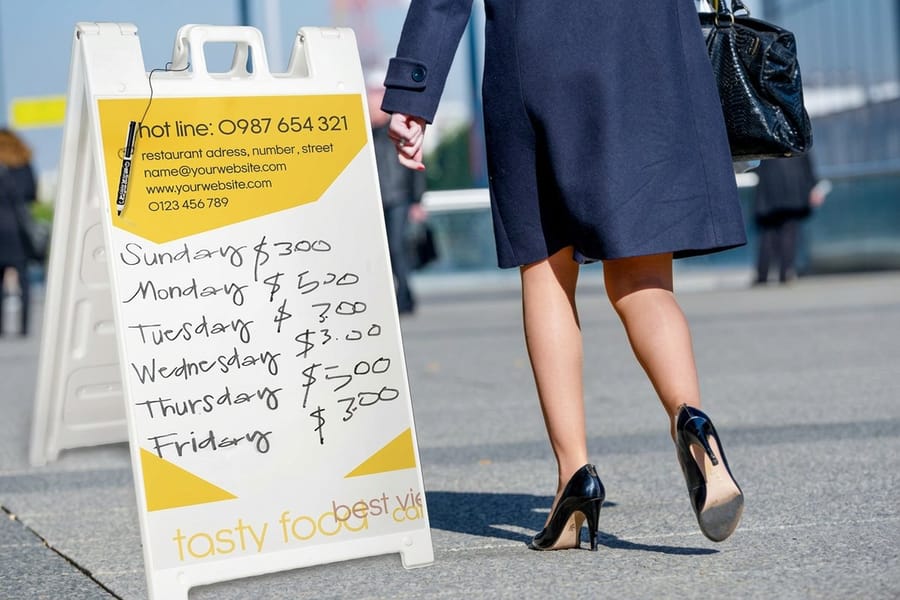
Board material is a shorter decision than it looks, because one option does most of the work and the other three exist for specific problems.
- 4mm corrugated plastic. The default, on nearly every frame we ship. Two polypropylene skins with a fluted core between them, so it stays rigid at 24 by 36 inches, sheds rain, and weighs almost nothing. Buy this unless you have a reason not to. The same sheet is what a plain coroplast sign is cut from, priced from $25 for one sign at 11 by 17 inches.
- Adhesive vinyl on the frame face. Used where the surface itself has a job to do. It is a graphic applied to the panel rather than a loose board you slide out.
- Dry erase lamination. A writable coating over a printed vinyl face, so your logo and layout stay fixed and the daily line changes with a marker. The dry erase Signicade starts at $185.63 for one and is the honest answer for a soup special or a wait time.
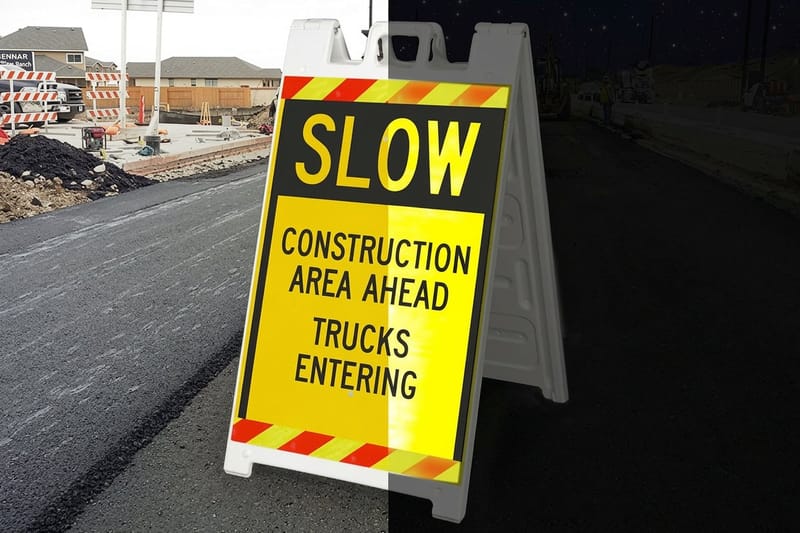
- Reflective film. Full color in daylight, and headlights and streetlight come back off it after dark. The reflective Signicade starts at $163.67 for one and earns its keep on an unlit corner or an evening event, not on a bright shopping street.
The trade-off is reprints. A coroplast board is a panel: it slides out, you file it, and you put it back next season. A dry erase or reflective face is bonded to the frame, so changing the printed part means a new sign rather than a new board. Choose the writable surface for a message that moves daily and the plain board for a message that moves quarterly.
Flute direction is worth thirty seconds of attention too. Corrugated plastic is stiff along the flutes and floppy across them, so a tall panel wants its flutes running the long way. On a grommeted metal rod frame that is the difference between a board that hangs flat and one that curls in a crosswind. If you want the material in more depth, what coroplast signs are covers how the sheet is built and how it ages outdoors.
Showing a Paper Poster, and Swapping Boards Between Promotions

Sometimes the artwork already exists as a paper poster: a tour print, a movie one-sheet, an event design a designer handed over. A loose sheet has nothing to hold it flat in the frame, so it ripples within hours, and outdoors it wicks water at the edges and tears at the grip points. Mount it first and keep it indoors. Mounted posters start at $39.99 for an 8 by 10 and run to a custom 40 by 60, mounted on 3/16 inch foam core in white or black, which sits securely in the 4mm channel of most frames. Foam core prints start at $49.99 for one when you want the board cut to the artwork instead of a stock size.
The limit is water. Foam core is paper skin over polystyrene, and rain gets in through the cut edge, so a lamination on the face does not save it. A mounted poster in an A-frame belongs in a lobby, a showroom or a trade show booth. The day the sign moves to the sidewalk, reprint the art on coroplast. If the poster is headed for a wall instead, the guide on hanging a poster without damage covers the frameless options.
Changing a board takes no tools. On a Signicade or an aluminum frame, tip the frame back, lift the old board out of the top of the channel and drop the new one in. On a metal rod frame, unhook the grommets at the top corners and hook the replacement. Keep your panel file as a template with the layout locked and only the offer, price and dates editable, so a seasonal change is a ten minute edit. Store retired boards flat, because corrugated plastic left leaning in the heat takes a permanent curve, and a metal rod frame that drops to $53.82 a unit at ten frames makes a spare set for each location cheap to keep.
Wind, Permits, and Getting the Second Print Right
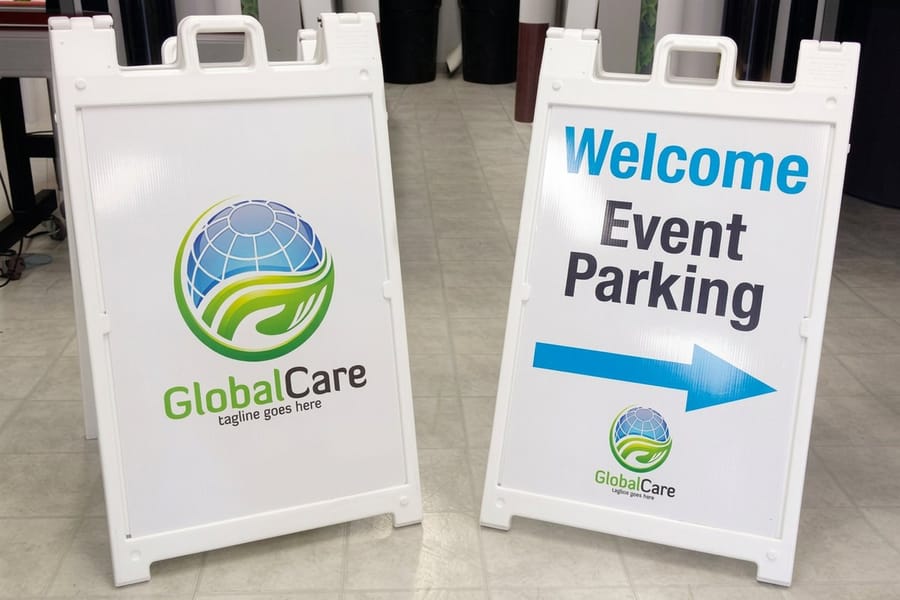
Two things put A-frames in the bin early, and neither is print quality. The first is wind. A 24 by 36 inch board is 6 square feet of sail per face, and on an exposed corner that is enough to walk a frame into traffic. The 24 by 18 inch board on a metal rod frame is half that area and stays put in conditions that flatten the tall ones. Either size down, weight the base, or accept that the sign comes in when the wind gets up.
The second is the permit. The pavement outside your door is usually public right of way, and cities regulate sandwich boards on it by width, distance from the curb and hours. Rules are municipal rather than statewide, so a rule you read for one city means nothing three towns over. Check before you print, not after: our sign permit guide points you at the right office.
When it is time for the second print, measure the old board rather than trusting the product name. Confirm the size, count the grommets, and note whether the frame takes one panel or two. Send a print-ready PDF, JPG or PNG, take the free online proof seriously, and remember that standard turnaround on these runs 3 to 4 business days with rush options down to next day on most frames and same day on the metal rod.
Still deciding between formats? Yard signs vs A-frames vs banners compares the three on cost per impression and where each one physically fits, and Signicade vs aluminum vs plastic settles the frame body question. To see the full curbside range in one place, browse sidewalk signs. The Aluminum A-Frame Signs story shows the satin silver frame with a board in each face.
Wally explains A-frame boards
Measure the panel, not the frame
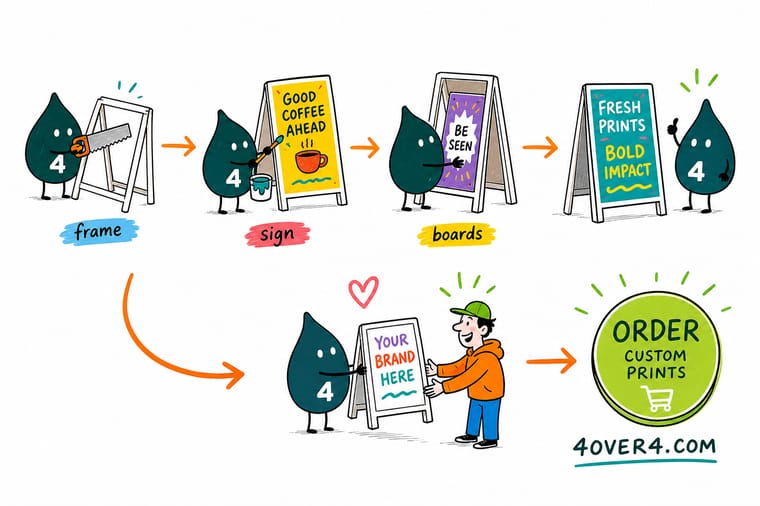
Wally opens the frame, measures the recess, and orders the board to that number rather than to the outside of the plastic. A 25 by 45 inch Signicade swallows a 24 by 36 inch panel, and the lip eats half an inch of every edge, so he keeps the phone number well inside the trim. He checks one more thing before ordering: does this frame take one board printed on both faces, or two boards, one per side. That answer is the whole reprint bill.
Order a Signicade A-frame →%22%2F%3E%3Ccircle%20cx%3D%2234%22%20cy%3D%2219%22%20r%3D%2229%22%20fill%3D%22%2314b8a6%22%20opacity%3D%220.15%22%2F%3E%3Ccircle%20cx%3D%2233%22%20cy%3D%2229%22%20r%3D%229%22%20fill%3D%22%2314b8a6%22%20opacity%3D%220.1%22%2F%3E%3Crect%20x%3D%2274%22%20y%3D%229%22%20width%3D%2234%22%20height%3D%2219%22%20rx%3D%224%22%20fill%3D%22%2314b8a6%22%20opacity%3D%220.08%22%20transform%3D%22rotate(14%2080%2030)%22%2F%3E%3C%2Fsvg%3E)
Specs and pricing
Frames, board sizes and starting prices
The Signicade costs $182.32 with two 24 x 36 inch boards, the aluminum frame starts at $146.07 with 22 x 28 or 24 x 36 inch boards, and the metal rod frame costs $65.90 with one double sided board in 24 x 18, 24 x 24 or 18 x 24 inches. Compare the three side by side, with live configuration choices and starting prices straight from the 4OVER4.COM configurator.

Print it
Put a board on the sidewalk this week
The metal rod A-frame has 3 business days standard production, and the Signicade and the dry erase Signicade each take 4, and we ship every kit complete with its printed boards.


Explore more
Where to go next
Every standard frame and panel dimension, three frame bodies compared, the coroplast behind most boards, and yard signs against A-frames and banners.


By the numbers
A-frame boards among a thousand printed products
Common Questions
Your A-frame board questions, answered
Can you put a paper poster in an A-frame sign?
Only if you mount it first, and only indoors. An A-frame has no glass and no backing board, so a loose paper sheet ripples within hours, and outdoors it wicks water at the edges and tears at the grip points. Bond the print to 3/16 inch foam core and it behaves like a proper board for indoor use. For a sidewalk, print straight onto 4mm corrugated plastic, which is what the frames are built around.
Will an A-frame board fade outdoors?
Yes, eventually, and full coverage dark inks show it first. Expect a coroplast board that faces full sun all year to drift, reds first. Treat the board as a consumable. If the sign has to stay legible for years, a rigid substrate under a lamination is the better spend.
What is an A-frame sign board?
It is the printed panel that sits in the face of a folding sidewalk frame. The frame is the hinged plastic, aluminum or steel structure that stands on the pavement and folds flat; the board is the flat printed sheet it holds. At 4OVER4.COM the two ship together as a kit, so a Signicade A-frame at $182.32 includes the 25 by 45 inch frame plus two 24 by 36 inch printed boards, and a metal rod A-frame at $65.90 includes the 27.75 by 31.5 inch frame plus one double sided 24 by 18 inch board.
What size board fits an A-frame sign?
It depends on the frame, and the board is always smaller than the frame. Signicade and Signicade Deluxe take a 24 by 36 inch board. The aluminum A-frame takes either 22 by 28 or 24 by 36. The Simpo takes 22 by 28. Metal rod, real estate and Quik Sign frames take 24 by 18. Ordering a board cut to the frame dimension is the mistake to avoid, and a 25 by 45 inch print will not go into a 25 by 45 inch frame.
What are A-frame sign boards made of?
Most are 4mm corrugated plastic, usually called coroplast: two thin polypropylene sheets with a fluted core running between them. It is rigid enough to stand in the frame without bowing, waterproof, and light. The dry erase and reflective versions work differently, using an adhesive vinyl graphic on the frame face rather than a loose panel, which is what makes the writable and light-returning surfaces possible.
Can you replace just the board and keep the frame?
Yes, and that is where the money is. The frame is the expensive part and it outlasts many messages. A metal rod frame needs one new board because a single panel is printed on both faces. A Signicade needs two, one per face. Before you reprint, check the grommet or slot positions on the old board and match them, because a panel that fits the frame but has holes in the wrong place will not sit square.
How do you stop an A-frame from blowing over?
Cut the sail area or add weight at the base. A 24 by 36 inch board is 6 square feet of surface per face, which is a lot of wind load on an exposed corner, while the 24 by 18 inch board on a metal rod frame is 3 square feet and stays put in conditions that flatten the taller ones. On a windy site, either drop to the smaller board or hang a sandbag on the crossbar and bring the sign in overnight.
Do I need a permit to put an A-frame on the sidewalk?
Often, yes. The sidewalk in front of your door is usually public right of way, and many cities regulate sandwich boards there by size, placement distance from the curb, and hours of display. Rules vary city by city rather than by state, so check with your local buildings or transportation department before ordering. Our guide to sign permits in every U.S. state is the place to start if you do not know which office to call.
Get Started
A metal rod A-frame kit prints in 3 business days
Pick the frame, set the board size it actually takes, upload your file, and we print the panels and ship the kit complete.
Legal Disclaimer
Gold Standard guarantees apply to all standard orders placed through 4over4.com. Price match requires verifiable proof of a competitor's published price for an equivalent product with matching specifications and turnaround time. Satisfaction guarantee covers manufacturing defects and print quality issues. Contact support with order number and documentation.
