
What a Coroplast Yard Sign Costs Once You Add Stakes and Quantity


What a run of coroplast signs really costs, which stake holds it up in your ground, and where the quantity break stops being a saving.
Coroplast yard signs start at $25 at 4OVER4.COM, and the per-sign price falls as the run grows because setup is charged once and spread across every piece. Two specs decide whether the cheap sign actually stands up: the flutes must run vertically so a wire H-stake can slide into the channels, and the stake has to be heavy enough for the ground you are pushing it into. Order dated artwork for the campaign in front of you and save the deep quantity break for panels that stay true next season.
Quick answer
The sign is cheap, the mounting is what costs you
Price a coroplast yard sign on four things: size, one side or two, quantity, and turnaround. Full color adds nothing on a digital run, so artwork complexity is not a cost driver. Quantity is, because setup is a fixed charge divided across the run, and the saving per sign is steepest on the first jump up rather than the last. The specs that decide whether the sign survives the season are flute direction, which has to match the way the stake enters, and the stake itself, which bends in hard ground long before the panel gives out.
What Actually Moves the Price of a Coroplast Yard Sign
A yard sign quote is built from five choices, and they do not carry equal weight. Quantity moves the number most, turnaround second, and the specs people agonize over move it least.
| Choice | The cheaper option | What the upgrade buys | Worth paying for when |
|---|---|---|---|
| Quantity | A short run for one placement | Setup spread across more pieces, so the per-sign cost falls | The artwork has no date on it and you have somewhere to store the rest. |
| Sides | One printed face | A second face that reads from the opposite approach | Traffic passes in both directions or the sign sits on a corner. |
| Size | Standard 18 by 24 | More area, read from further back | The sign sits well off the road or competes with other signage. |
| Board thickness | 4mm corrugated plastic | Stiffness across the width and survival through repeated handling | The panel is wide, exposed to wind, or reused every weekend. |
| Turnaround | Standard production | Days back, not much else | An event date is fixed and cannot move. |
Notice what is missing from that list. Full color costs the same as one color on a digital run, so a photo, a gradient and a two-tone logo all price identically. Designers who strip a sign back to a single ink to save money on coroplast are solving a problem that belonged to screen printing.
Start with the size decision rather than the price, because everything else follows from it. Our guide to yard sign dimensions covers the standard sizes and the reading distance each one holds, and coroplast yard signs start at $25 once you have picked one.
Flute Direction, and Why the Stake Sometimes Will Not Go In
Coroplast is not a solid sheet. It is two thin skins of polypropylene with vertical walls running between them, like a flattened stack of straws, and those channels are called flutes. Every practical property of the material comes from which way they run.
A wire H-stake works by sliding its two legs up inside those channels. That means the flutes have to be open at the bottom edge of the finished sign. On an 18 by 24 landscape panel, that is what the trade calls vertical flutes, running parallel to the 18 inch dimension. Order the same sign with horizontal flutes and the legs meet a sealed edge. The stake does not go in, and there is no fixing it on site short of drilling the panel and cable-tying it to something.
The trade-off nobody mentions at the counter: flutes make the board stiff along their length and floppy across it. Vertical flutes give you a sign that resists sagging top to bottom, which is what the stake needs, but that same sign bows across its width when wind hits the face. It is why a wide panel in an exposed spot either goes to a heavier board or gets a second stake. It is also why signs meant for an A-frame or a fence are often ordered with horizontal flutes instead, since nothing is being speared into them.
If you are comparing coroplast against something rigid enough not to care about any of this, the aluminum, coroplast and PVC comparison lays out where each one stops making sense. For everything that stays on a lawn, the coroplast printing collection is the shorter list.
Choosing a Stake, and Where Each One Fails
Almost every leaning, spinning or missing sign is a mounting failure rather than a printing one. The panel is fine. Something below it gave up.
| Mount | How it holds | Ground it suits | How it fails |
|---|---|---|---|
| Wire H-stake | Two legs slide up inside the flutes, crossbar pushed by foot | Lawn, garden bed, anything you can press a heel into | Thin wire bends against gravel and dry clay before it enters. |
| Step stake | A wider foot plate takes body weight down the shaft | Compacted or stony ground where a plain H-stake buckles | Costs more per unit and is bulkier to transport in volume. |
| A-frame or sign stand | The panel drops into a rigid frame that stands on the surface | Sidewalks, parking lots, gravel, anywhere with no soil | Walks away in real wind unless it is weighted, and it is the expensive option. |
| Zip ties through drilled holes | Panel fixed flat to a fence, post or railing | Existing structures, event barriers, construction fencing | Ties saw through 4mm board at the hole under repeated flexing. |
Two habits fix most of it. Push the stake in with your foot on the crossbar rather than hammering the top, because the wire bends where it is unsupported. And in soaked ground, the stake does not break, it pivots, so a sign that was upright on Friday leans on Monday after rain. Placement in firm, drained ground beats any upgrade in stake gauge.
If you are drilling for zip ties, put the hole a full inch in from the edge and go through both skins, then run the tie loosely enough that the panel can move slightly instead of working against a tight loop. Grommets in 4mm board sound like the tidy answer and are not, since they crush the flute they sit in and pull through in the first real gust. Heavier board or a frame is the honest fix. The full range of panels sits in coroplast signs printing, and plastic coroplast signs cover the non-lawn placements.
How Quantity Breaks Work and How Deep to Buy
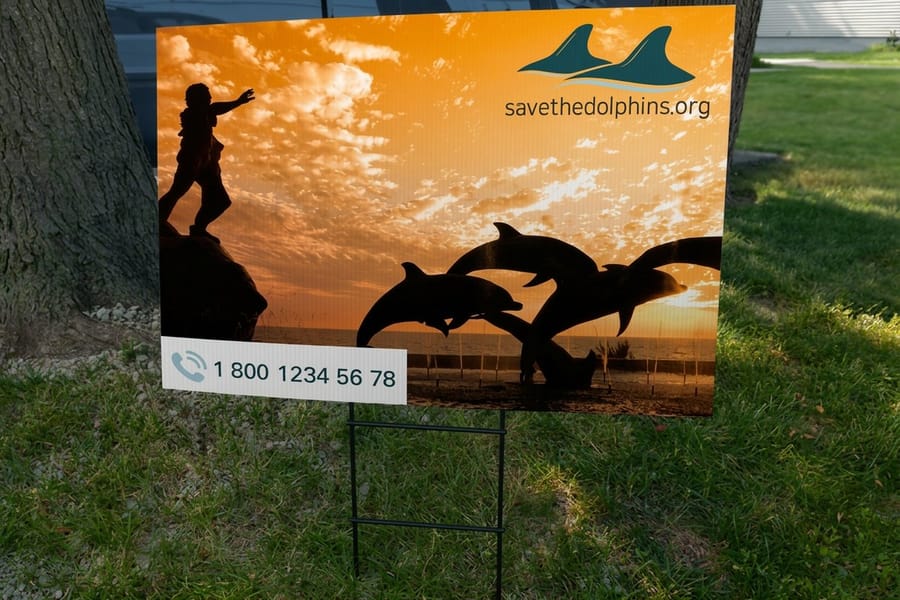
The reason 250 signs never cost ten times what 25 cost is that most of a short run is setup. The file is prepped once, the press is made ready once, the cutter is set once, and those hours land on the invoice whether four sheets or four hundred come off the line.
That shape has a practical consequence. The steepest saving per sign is in the first jump, from a handful up to around a hundred, because you are dividing a fixed cost across four times as many pieces. Push further and the curve flattens, since board, ink and packing are per-sign costs that never go away no matter how many you order. Doubling from a few hundred to a few thousand improves the unit price, but nothing like the first step did.
So the real question is not how cheap the sign gets. It is how many signs you will genuinely put in the ground. Count the placements you have permission for, add around one in ten for signs lost to weather, mowers and the neighbor who does not want it there, and compare that number to the next break. If the break is close, take it. If it means buying triple what you need, the per-sign price stopped mattering.
Split the order by how long the artwork stays true. A panel with a company name, a service and a phone number is good for years, so buy it deep. A panel with a date, an open house time or an address should be sized to this campaign, which is the split most real estate sign programs settle into: an evergreen base plate ordered in volume, and short runs of dated riders alongside it. Before you commit to a long run, read how to design a yard sign, because a legibility mistake reproduced 250 times is the most expensive thing on this page. General purpose yard signs and standard coroplast signs both start at $25, and the rest of the sign and banner library is in the banner and sign guides.
Wally explains coroplast yard signs
Flutes the right way, a stake that does not bend, and a quantity you will actually use
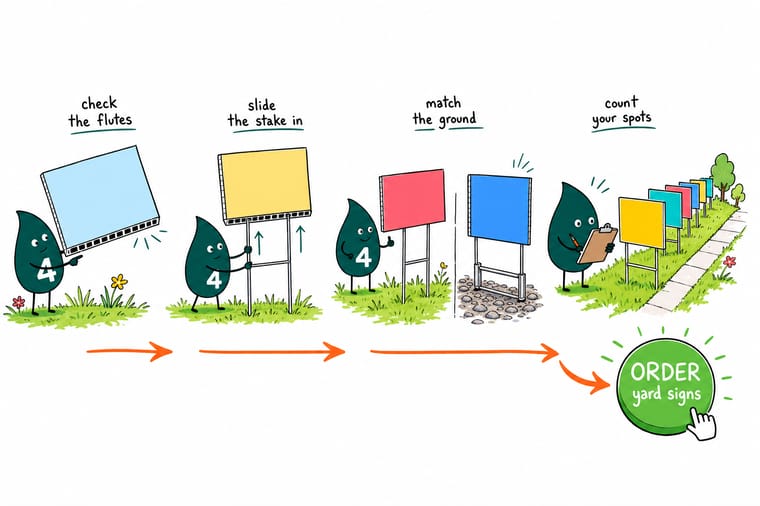
Wally holds the sign up to the light and looks at the bottom edge. If he can see the little open channels, the H-stake legs slide straight up inside them and the sign stands. If that edge is sealed, the flutes ran the wrong way and no amount of pushing will help. Then he checks the ground. Soft lawn takes a plain wire stake, stony ground bends it, and a sidewalk takes no stake at all. Last, he counts the spots he can legally put a sign in, adds a few for the ones that disappear, and orders that number rather than the number that looked cheapest per piece.
Price coroplast yard signs →Specs and pricing
Sizes, stake options and starting prices
Standard coroplast signs ship in 3 business days and yard signs in 5, all on 4mm white coroplast.


Print it
Order signs that are still standing next month
Explore more
Where to go next


By the numbers
Panels, stakes, and the quantity break
Common Questions
Your coroplast yard sign questions, answered
How much does a coroplast yard sign cost?
Coroplast yard signs start at $25 at 4OVER4.COM, and the price you actually pay depends on five choices: the finished size, 4mm or a heavier board, one printed side or two, the quantity, and the turnaround. Quantity is the biggest lever of the five. Because press setup and cutting setup are charged once no matter how many signs come off the run, the cost per sign drops sharply between a small order and a hundred, then flattens as ink and sheet cost take over. Configure the run on the coroplast yard signs page to see the live break for your exact size.
Do yard signs come with stakes included?
Treat stakes as a separate decision rather than assuming they are folded into the sheet price, and check the option on the product page before you check out. Order a few more stakes than signs. Wire H-stakes bend on the first hard push into compacted ground, and a bent leg holds the sign at an angle that reads as neglect from the road. Spares cost very little compared with driving back out to replace one.
Which way should the flutes run on a yard sign?
For a sign that sits on a wire H-stake pushed in from the bottom, the flutes must run vertically, meaning parallel to the short dimension on a landscape sign. The stake legs slide up inside the open channels, and that is the entire mechanism holding the panel. If you order flutes running horizontally on that same sign, the legs meet a closed edge and the stake is useless. Horizontal flutes only make sense when the sign is going onto an A-frame, a fence or a post, where it is bolted or zip-tied rather than speared.
Is 10mm coroplast worth the extra over 4mm?
On a standard 18 by 24 sign in an ordinary yard, no. 4mm holds its shape at that size and the money is better spent on a heavier stake. The heavier board earns its cost on wide panels, on signs that get moved and stacked every weekend, and on exposed sites where wind hits the face straight on. Because flutes make coroplast stiff along their length and floppy across it, a wide sign with vertical flutes is the one that bows first, and that is exactly where the thicker board pays.
How long will a coroplast sign last outdoors?
Plan in seasons rather than years. The panel itself outlives the print: polypropylene shrugs off rain, and what degrades is the ink under direct sun, where reds and purples shift before blacks and blues. Signs in shade or facing north hold their color noticeably longer than the identical sign baking on a south-facing corner. Cold matters too, because polypropylene stiffens as temperatures drop, so forcing a stake into a frozen panel is a good way to split a flute.
Should I print one side or two?
Print both sides when traffic passes the sign in both directions, and one side when it does not. A sign at the end of a driveway, backed against a hedge or a house, is only ever read from one approach, so the second side is money spent on something nobody sees. On a two-way street, a corner lot, or a route where people drive past on the way in and again on the way out, the second side roughly doubles the number of readings for far less than double the price.
How many signs should I actually order?
Count the placements you have permission for, add roughly one in ten for signs that get damaged, stolen or lost to a mower, then check whether the next quantity break costs less than the extras are worth. Split the order by shelf life. Artwork with a name, a service and a phone number can be bought deep because it is still good next season. Artwork with a date, an address or an event time should be ordered for this campaign only, since a stack of expired signs in a garage is not a saving.
Get Started
Coroplast signs print on 4mm white board in 3 business days
Pick your size, choose one side or two, set the quantity and watch the per-sign price move. We print, cut and ship coroplast that is still upright when the campaign ends.
Legal Disclaimer
Gold Standard guarantees apply to all standard orders placed through 4over4.com. Price match requires verifiable proof of a competitor's published price for an equivalent product with matching specifications and turnaround time. Satisfaction guarantee covers manufacturing defects and print quality issues. Contact support with order number and documentation. On-time delivery rate based on tracked orders 1999 to 2026. Individual results may vary based on shipping carrier performance.
