What You Need to Know About Flyer Sizes Before You Print
The right flyer size can make or break your campaign. Standard US Letter flyers measure 8.5 x 11 inches, while half-letter flyers come in at 5.5 x 8.5 inches. International A4 flyers run 8.27 x 11.7 inches. Each size serves a different purpose - from event handouts to direct mail inserts. 4OVER4 offers 60+ paper types across all popular flyer dimensions, backed by 25+ years of printing experience. This flyer size dimensions guide breaks down every option so you pick the right one.
Why Flyer Dimensions Matter More Than You Think
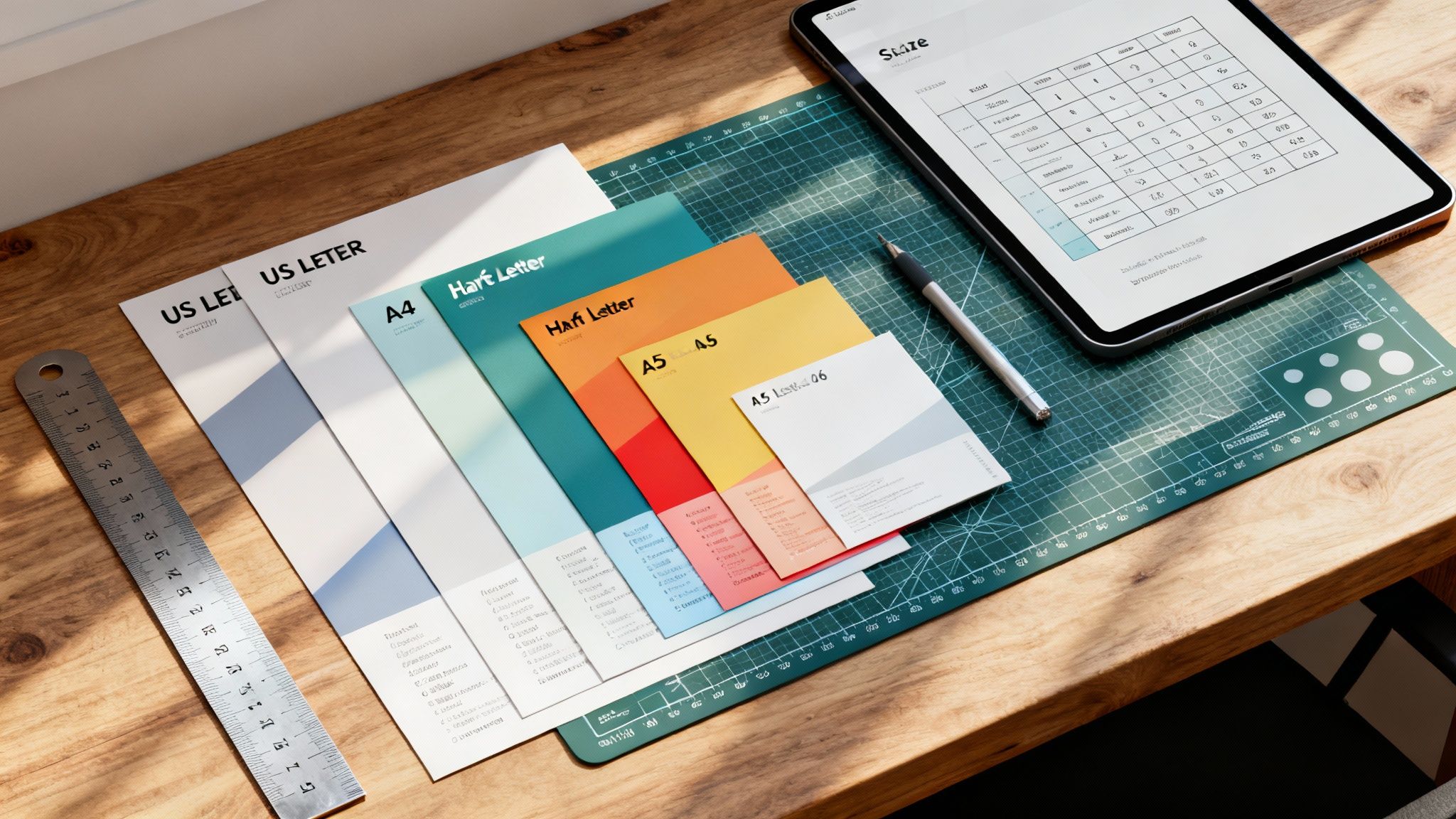
Choosing the wrong flyer size wastes money and dilutes your message. A flyer that's too large for a mailbox gets folded and crumpled. One that's too small gets lost in a stack. This flyer size dimensions guide walks you through every standard size, when to use each one, and how to set up your files so nothing gets cut off at the printer.
Whether you're promoting a grand opening, advertising a sale, or handing out menus at a food festival, size dictates design. It affects how much text you can fit, how images render, and what your printing costs look like. If you want to learn the full creative process, check out our guide on How To Make Flyers for a step-by-step walkthrough.
4OVER4 backs every flyer order with a Price Match guarantee, so you're getting the best deal no matter which size you choose. Let's dig into the numbers.
Every Flyer Size Explained - Dimensions, Uses, and Setup Tips
US Letter Flyers: 8.5 x 11 Inches
The US Letter flyer is the workhorse of North American print marketing. At 8.5 x 11 inches (215.9 x 279.4 mm), it's the same size as a standard sheet of printer paper. That familiarity is actually an advantage - people know how to handle it, file it, and pin it to a corkboard.
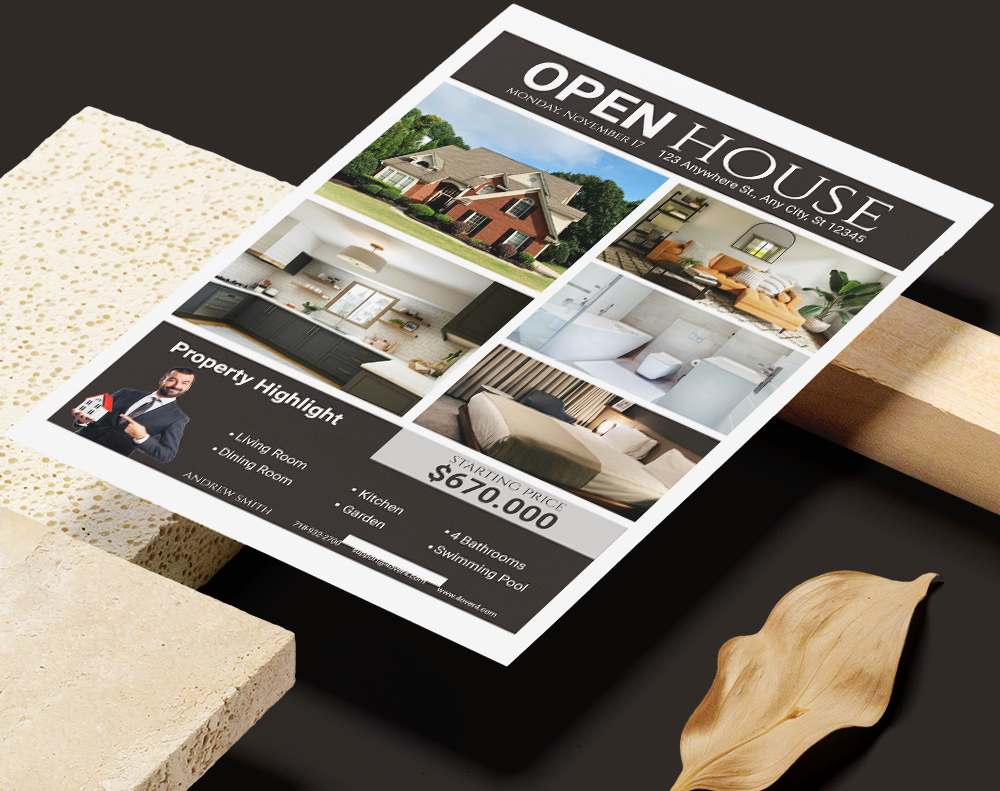
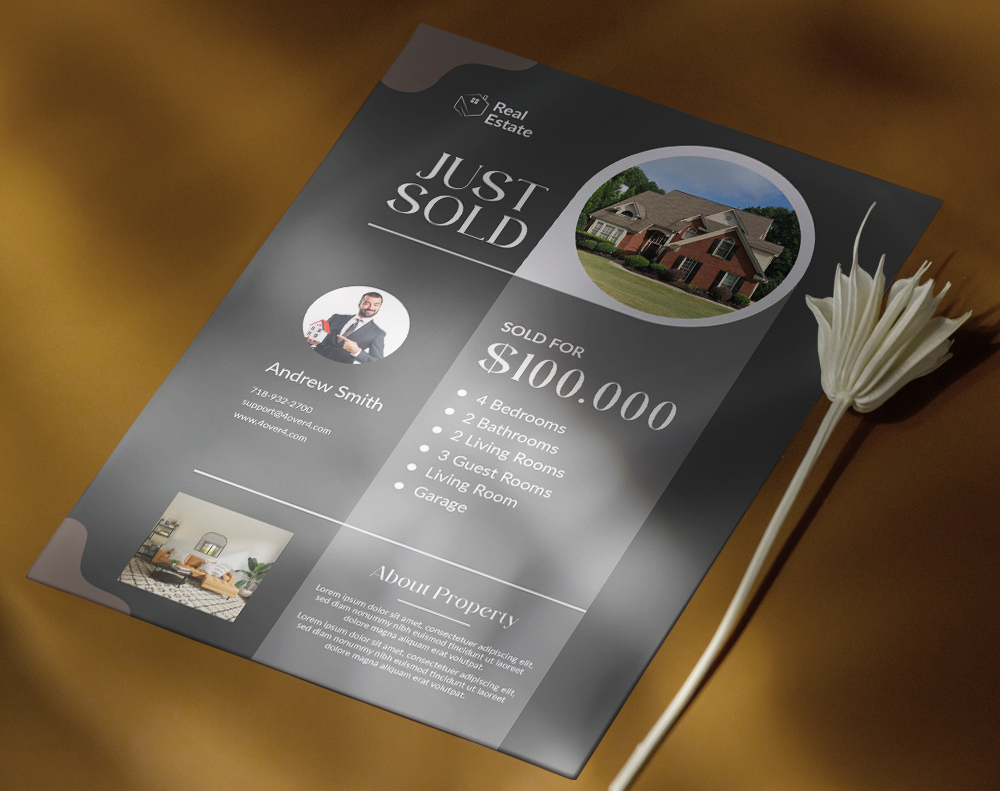
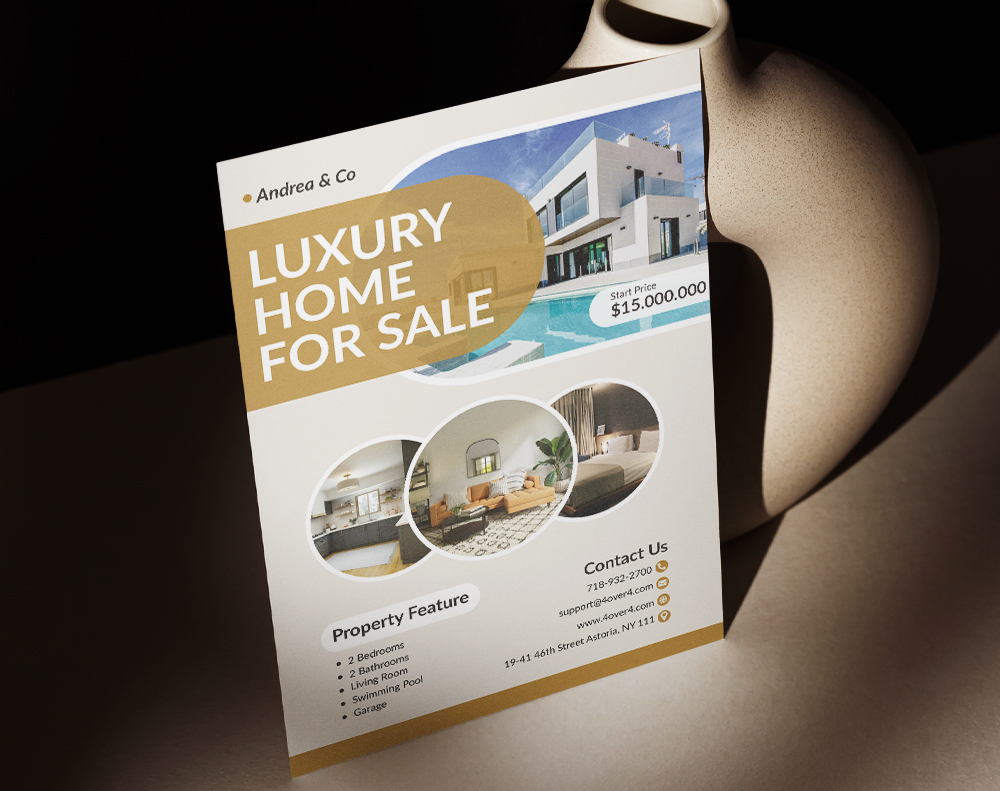
This size gives you plenty of room for detailed content. Real estate agents use it for property listings with multiple photos. Restaurants print full menus on it. Event organizers pack in schedules, maps, and sponsor logos without feeling cramped. If your message needs breathing room, US Letter is your go-to.
The downside? It doesn't fit in a standard #10 envelope without folding. And it's not exactly pocket-friendly. If you're handing flyers to people on the street, they'll need to fold it themselves or carry it flat. For direct mail campaigns, you'll want to pair this size with the right packaging - our guide on How To Make Envelopes covers your options.
Half Letter Flyers: 5.5 x 8.5 Inches
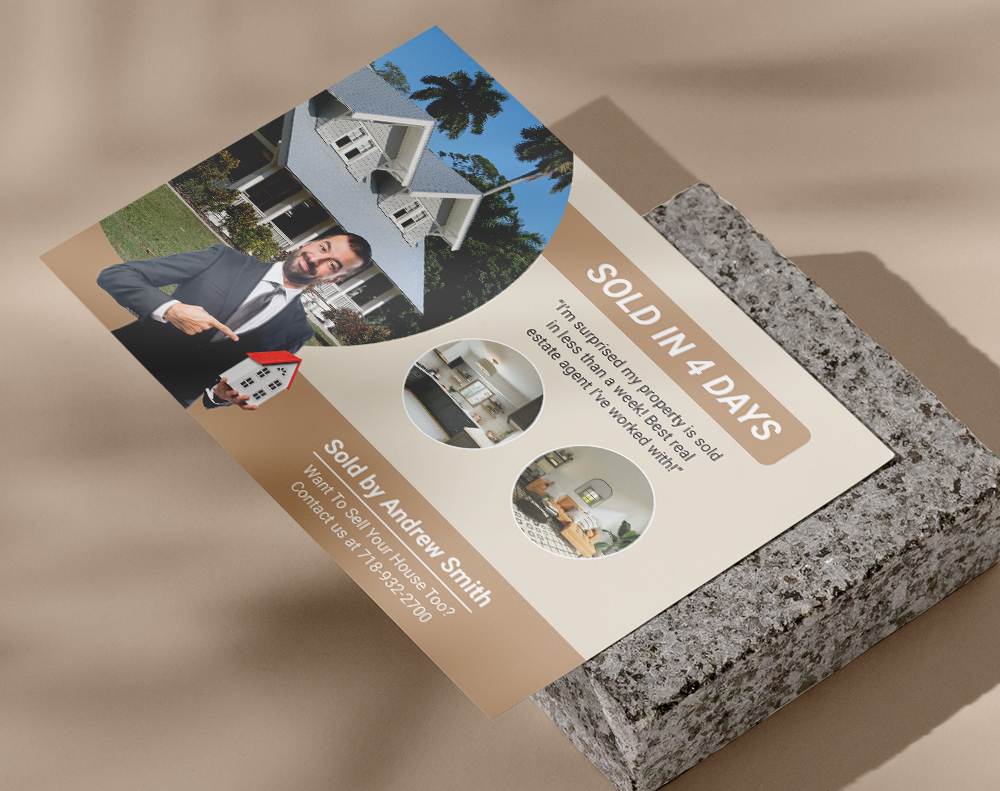
Cut a US Letter in half and you get the 5.5 x 8.5 inch half-letter flyer. This is one of the most popular sizes for direct mail inserts, event invitations, and promotional handouts. It fits inside a standard A2 envelope without folding.
Half-letter flyers strike a sweet spot between having enough space for your message and being compact enough to slip into a bag or pocket. Gyms use them for class schedules. Salons hand them out with appointment reminders. Nonprofits include them in donation packets.
Because you're working with less real estate, design discipline matters here. Stick to one clear headline, one call-to-action, and maybe one or two supporting images. Don't try to cram a US Letter's worth of content into half the space. That's how you end up with a flyer nobody reads.
"We switched from full-size to half-letter flyers for our farmers market booth. People actually kept them instead of tossing them in the trash. The smaller size felt less like junk mail and more like a personal invite."
- Rachel K., ★★★★★
A4 Flyers: 8.27 x 11.7 Inches (International Standard)
If you're printing for an international audience, A4 (8.27 x 11.7 inches / 210 x 297 mm) is the global standard. It's slightly narrower and taller than US Letter. The difference is small - about a quarter inch in width and nearly half an inch in height - but it matters when you're designing for print.
A4 is the default paper size in Europe, Asia, South America, and most of Africa. If your business operates internationally or you're printing materials for overseas events, A4 keeps everything consistent with local expectations. Printers outside North America are set up for A4, so using US Letter dimensions can cause alignment issues abroad.
When designing for A4, don't just resize a US Letter layout. The different proportions mean your margins, text blocks, and image placement all shift slightly. Build your design from scratch in A4 dimensions for the cleanest result.
A5 Flyers: 5.83 x 8.27 Inches
The A5 flyer (5.83 x 8.27 inches / 148 x 210 mm) is the international equivalent of the half-letter. It's half an A4 sheet, and it's wildly popular for event flyers, product announcements, and leaflets across Europe and Asia.
A5 works great for content that needs to be scannable in seconds. Think concert promotions, restaurant specials, or grand opening announcements. The compact format forces you to prioritize your strongest selling point and a single clear call-to-action.
For businesses that do both domestic and international marketing, keeping A5 templates alongside your half-letter templates saves time. You won't need to redesign from scratch when switching between markets. If you're exploring other print formats for your marketing mix, the Faq Hub has guides covering everything from postcards to banners.
A6 Flyers: 4.13 x 5.83 Inches
A6 flyers (4.13 x 5.83 inches / 105 x 148 mm) are about the size of a postcard. They're perfect for quick, punchy messages - a discount code, a QR code linking to your website, or a simple "we've moved" announcement.
Because A6 is so compact, it's the cheapest option to print in bulk. Street teams love this size. So do retail shops that want to slip a promo into every shopping bag. The small footprint means lower paper costs and more flyers per print run.
Design-wise, less is more with A6. One image, one headline, one action item. That's it. If you need more space, step up to A5 or half-letter.
DL Flyers: 3.94 x 8.27 Inches
The DL flyer (3.94 x 8.27 inches / 99 x 210 mm) is a tall, narrow format that fits perfectly inside a standard DL envelope. "DL" stands for "dimension lengthwise," and this size is a staple for rack cards, tourism brochures, and restaurant takeout menus.
DL flyers are designed to stand upright in display racks - the kind you see in hotel lobbies, visitor centers, and waiting rooms. The vertical format naturally draws the eye from top to bottom, making it ideal for step-by-step offers or tiered pricing displays.
If you're creating folded materials, DL dimensions also work as the base for tri-fold brochures. Our guide on How To Fold A Brochure explains how to set up fold lines correctly so your panels align.
Setting Up Your Flyer File for Print
Bleed, trim, and safe zones - these three terms will save you from a bad print job. Here's what they mean in practice.
Bleed is the extra area beyond your trim line. For most flyers, add 0.125 inches (3mm) of bleed on all sides. This means an 8.5 x 11 inch flyer should be set up as 8.75 x 11.25 inches. The bleed gets cut off during trimming, so extend any background colors or images to the bleed edge.
Trim line is where the paper actually gets cut. This is your final flyer size.
Safe zone is the area inside the trim line where all important text and logos should stay. Keep everything at least 0.125 inches inside the trim line. Anything closer to the edge risks getting clipped.
Set your resolution to 300 DPI minimum. Anything lower and your images will look fuzzy in print, even if they look fine on screen. Use CMYK color mode, not RGB. RGB is for screens. CMYK is for ink on paper. The colors will shift if you don't convert before sending your file.
Save your final file as a press-ready PDF with fonts embedded and images at full resolution. Most printing issues come from files that weren't set up correctly, not from the printer itself.
Choosing the Right Size for Your Campaign
Your distribution method should drive your size choice. Mailing flyers? Half-letter or A5 fits standard envelopes without folding. Handing them out at events? A6 or DL fits in a back pocket. Posting on bulletin boards or walls? US Letter or A4 is visible from a distance.
Budget matters too. Smaller flyers cost less per unit and you get more per print run. A business printing 1,000 A6 flyers will spend a lot less than printing 1,000 US Letter flyers on the same paper stock.
Think about your content volume. If you've got a lot to say - multiple products, a detailed event schedule, a full menu - go bigger. If your message is "50% off this weekend, here's the address," go small. When you're ready to order, 4OVER4's Business Flyers page lets you customize size, paper, and finish in a few clicks.
"I printed DL-size flyers for our yoga studio's rack card display. They fit the holder perfectly and looked way more professional than the half-letter flyers we'd been folding in half. Lesson learned - pick the right size from the start."
- Marcus D., ★★★★★
Folded Flyer Dimensions
Folding changes everything. A US Letter flyer folded in half becomes 5.5 x 8.5 inches - same as a half-letter. Tri-folded, it becomes roughly 3.67 x 8.5 inches, which fits a #10 business envelope.
When designing folded flyers, you need to account for panel widths. On a tri-fold, the inside panel should be about 1/16 inch narrower than the other two panels so it folds cleanly without buckling. Your printer's template will usually have this built in, but double-check.
Folded flyers work great for content that unfolds like a story. The front panel hooks attention. The inside panels deliver details. The back panel closes with contact info or a call-to-action. If you're exploring other creative print projects alongside your flyers, check out our guides on Custom Magnets Faq and How To Clean Rubber Stamps for more hands-on print tips.
Here are some ready-to-use flyer templates to help you get started with the right dimensions already built in.
Blank Templates
Flyer Sizing Mistakes That Waste Your Money
Even experienced designers trip up on flyer dimensions. Here are the most common errors to avoid when using this flyer size dimensions guide.
No bleed area. Forgetting to add 0.125 inches of bleed means you'll get thin white edges on your finished flyers. It looks cheap and unprofessional. Always extend backgrounds and images past the trim line.
Designing in RGB instead of CMYK. Your bright neon green on screen turns into a muddy olive in print. Convert your color mode before you start designing, not after.
Text too close to the edge. Keep all important content at least 0.125 inches inside the trim line. Cutting isn't pixel-perfect - there's always slight variation.
Using the wrong size for your envelope. A US Letter flyer doesn't fit a #10 envelope without folding. An A5 doesn't fit a US envelope at all. Match your flyer size to your distribution method first.
Low resolution images. 72 DPI looks fine on a website but terrible on paper. 4OVER4 recommends 300 DPI minimum for all flyer artwork. Check your image resolution before uploading your file.
Print Your Flyers on the Right Stock
Now that you've nailed your flyer size dimensions guide basics, it's time to pick the paper. 4OVER4 offers a wide range of paper stocks and finishes for flyers of every size. Thicker stocks like 14pt or 16pt add a premium feel - perfect for luxury brand promotions or high-end event invitations. Lighter stocks work great for high-volume handouts where budget matters most.
If you're printing event invitations alongside your flyers, check out Free Invitations from 4OVER4. You can also grab Free Invitations to test paper quality before committing to a large flyer order.
Here's a breakdown of available flyer options, specs, and what past customers have to say.
| Flyer Name | Dimensions (Inches) | Dimensions (Millimeters) | Best For |
|---|---|---|---|
| Letter (US) | 8.5" x 11" | 215.9mm x 279.4mm | Corporate handouts, event promos, menus, real estate listings |
| Half Letter (US) | 5.5" x 8.5" | 139.7mm x 215.9mm | Program notes, event invites, coupons, direct mail inserts |
| A4 (International) | 8.27" x 11.7" | 210mm x 297mm | Business correspondence, formal documents, magazine-style flyers |
| A5 (International) | 5.83" x 8.27" | 148mm x 210mm | Booklets, direct mail, notepads, informational handouts |
| A6 (International) | 4.13" x 5.83" | 105mm x 148mm | Postcards, pocket guides, simple announcements, coupons |
| Fold Type | Base Paper Size (US) | Base Paper Size (ISO) | Final Panel Dimensions (Approx.) |
|---|---|---|---|
| Bi-Fold | 8.5" x 11" | A4 (210 x 297mm) | 5.5" x 8.5" (each panel) |
| Tri-Fold | 8.5" x 11" | A4 (210 x 297mm) | 3.66" x 8.5" (uneven panels) |
| Z-Fold | 8.5" x 11" | A4 (210 x 297mm) | 3.66" x 8.5" (equal panels) |
- Letter (8.5" x 11"): This is the undisputed champion. It's perfect for just about anything—corporate handouts, detailed service lists, school announcements, you name it. Its familiarity and the fact that it fits in every office printer make it the go-to choice for many.
- Half Letter (5.5" x 8.5"): A more compact and budget-friendly option. This size is great for event invitations, program notes, and promotional offers where you don't need to overwhelm the reader with too much information.
- A4 (210mm x 297mm): The international counterpart to our US Letter size. A4 is the standard for business letters, official documents, and slick, magazine-style flyers.
- A5 (148mm x 210mm): Exactly half the size of an A4 sheet. The A5 is a very popular choice for booklets, notepads, and flyers sent through the mail.
- A6 (105mm x 148mm): This small, postcard-like size is ideal for things you can stick in your pocket, like event announcements, coupons, or mini guides. For those looking for design ideas, many resources that offer free church graphics templates provide layouts already set up for these standard dimensions.
- Corporate Handouts: Perfect for sharing company info or service details at trade shows.
- Restaurant Menus: The ideal canvas for single-page menus or takeout lists.
- Event Promotions: Great for tacking onto bulletin boards or handing out directly to people.
- Real Estate Listings: Provides just enough space for property photos and all the important details.
- A4 (210 x 297 mm or 8.27" x 11.7"): This is the global cousin to the US Letter size and the undisputed champion of versatility. It’s the go-to for corporate brochures, official documents, detailed sell sheets, and any flyer that needs plenty of room for both compelling text and sharp visuals.
- A5 (148 x 210 mm or 5.83" x 8.27"): Exactly half the size of an A4, the A5 is a crowd-pleaser for event invitations, small booklets, and promotional handouts. It’s compact enough to be convenient but still feels substantial in hand, making it easy to distribute and for people to carry.
- A6 (105 x 148 mm or 4.13" x 5.83"): A quarter of an A4, the A6 is essentially a postcard. It’s perfect for pocket-sized promos, discount coupons, and quick announcements where you need to get straight to the point.
- Base Sheet (US Letter): An 8.5" x 11" sheet becomes a 5.5" x 8.5" flyer when folded.
- Base Sheet (A4): A 210mm x 297mm sheet folds into an A5-sized flyer, measuring 148mm x 210mm.
- Bleed: This is the part of your design that extends past the final cut edge. The industry-standard requirement is an extra 0.125 inches (or about 3mm) on all four sides. If you have a background color or an image that's supposed to go right to the very edge, it must extend all the way into this bleed area. This is how you prevent those ugly white slivers from showing up after the flyer is trimmed.
- Trim Line: Simple enough—this is the exact line where the machine will cut your flyer to its final intended size. For an 8.5" x 11" flyer, the trim lines are set at precisely those measurements.
- Safe Margin: Also known as the "safety line," this is an inner boundary set 0.125 inches inside the trim line. You need to keep all your critical information—think text, logos, and key graphic elements—within this margin. This guarantees nothing important gets accidentally sliced off during trimming.
- 100lb Gloss Text: This is a fantastic, versatile choice for many projects. It's noticeably thicker than regular office paper, so it has enough durability for mailers and handouts while staying flexible. The glossy sheen really makes colors pop.
- 16pt Cardstock: Step up to this, and you're in premium territory. It’s significantly thicker and more rigid, giving it a substantial, high-quality feel. This stock is perfect for flyers that need to double as small signs or high-end promotional cards that you want people to keep.
"Ordered flyer size dimensions guide from 4OVER4 and the quality blew me away. Sharp colors, premium feel, arrived 2 days early."
"Been using 4OVER4 for flyer size dimensions guide for a year. Consistent quality every time. The online designer made it easy."
"Switched to 4OVER4 and saved 40% on flyer size dimensions guide. Better quality than my old printer. 60+ paper options."
"4OVER4's flyer size dimensions guide helped us look more professional. Clients notice the difference."
"Ordered half-letter flyers on 16pt stock for our brewery's tap list. The paper feels sturdy - customers actually take them home instead of leaving them on the table. Already reordering in a bigger batch."
- Devon L., ★★★★☆
Free Flyer Size Dimensions Templates

Your Flyer Size Questions, Answered
What is the most common flyer size in the US?
The most common flyer size in the US is 8.5 x 11 inches (US Letter). It's the standard for event promotions, restaurant menus, real estate listings, and corporate handouts. This size is compatible with standard home and office printers, making it easy to proof before sending to a professional printer like 4OVER4.
What size flyer fits in a standard envelope without folding?
A 5.5 x 8.5 inch half-letter flyer fits inside an A2 envelope without folding. For #10 business envelopes, you'll need to tri-fold a US Letter flyer down to approximately 3.67 x 8.5 inches. DL flyers (3.94 x 8.27 inches) fit DL envelopes, which are standard in international markets.
How much bleed should I add to my flyer design?
Add 0.125 inches (3mm) of bleed on all four sides of your flyer. This means an 8.5 x 11 inch flyer should have a total document size of 8.75 x 11.25 inches. The bleed area gets trimmed off during cutting, so extend all background colors and edge-to-edge images into the bleed zone. This flyer size dimensions guide recommends always checking your printer's specific bleed requirements before finalizing artwork.
What's the difference between US Letter and A4 flyer sizes?
US Letter measures 8.5 x 11 inches while A4 measures 8.27 x 11.7 inches. A4 is slightly narrower and taller. The difference is small but affects layout - margins, text columns, and image placement all shift. If you're printing for international distribution, use A4 to match local standards.
What resolution should my flyer images be?
All images should be 300 DPI minimum in CMYK color mode. Lower resolution images (72 DPI or 150 DPI) will appear blurry or pixelated when printed, even if they look sharp on your computer screen. For questions about file setup or printing specs, visit the 4OVER4 Help Center for detailed submission guidelines.
Which flyer size is cheapest to print in bulk?
Smaller sizes like A6 (4.13 x 5.83 inches) and half-letter (5.5 x 8.5 inches) cost the least per unit in bulk orders. You get more flyers per sheet of paper, which reduces material costs. For budget-conscious campaigns where you need high volume - like street team handouts or bag inserts - smaller formats give you the best cost-per-piece.