
Hotel Key Cards Explained From Magnetic Stripe to RFID


Jordan is our labels, packaging and sustainability voice, built from the knowledge of our production team, with over 20 years in printing.
What the card actually stores, why magnetic stripe cards die in a purse, where the antenna hides in a contactless card, and how to brand and reorder a run without wasting the artwork.
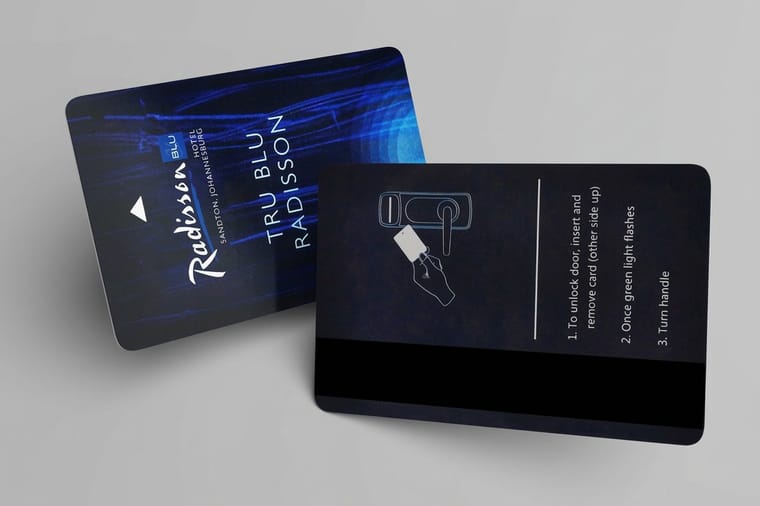
A hotel key card is a CR80 plastic card, 3.375 by 2.125 inches at 30 mil, carrying a short credential that a battery powered door lock recognizes: the room, an expiry time and a sequence number. Older systems write that credential to a magnetic stripe on the back, where a swipe can read it and a purse magnet can erase it. Newer ones store it on a 13.56 MHz chip with an antenna laminated inside the card, read through a wallet without contact. Everything else about the card, the stock, the color, the finish, is print work.
Quick answer
One card body, two places to keep the data
The plastic is identical, the data layer is not. A magnetic stripe sits on the outside of the card, so every read touches it and a magnet can wipe it. A contactless chip sits inside the core with a wire antenna looping just under the card edge, so nothing rubs and nothing wears, but a slot punch through that band ends the card. Both are CR80 at 30 mil, both take full color on two sides, and both are re-encoded at the desk rather than reprinted, which is why the artwork should carry nothing that expires.
What Is Actually Written on a Hotel Key Card
Very little, and that is the point. The card holds a short credential: a property or site code, the room it opens, an expiry time, and a sequence number. The room number itself is normally not printed on the card, which is a security habit rather than a design choice, since a lost card with a room number on it is a lost room.
The reason the credential is so small is that guest room locks are usually offline. There is no cable running back to the front desk, no network, just a battery and a reader in the door. The lock cannot ask anything whether a card is valid, so it has to decide by itself from what the card carries. That single fact explains most of the behavior guests find strange.
It explains expiry. The encoded checkout time is compared against the lock's own clock, which is why a card can die at eleven in the morning even though nothing about it changed.
It explains cancellation. When the desk cuts a replacement for a room, the new card carries a higher sequence number. The first time it is used, the lock records that sequence and refuses everything below it. The old card is not erased anywhere. It is simply outranked.
And it explains re-encoding. Cards are not reprinted between guests, they are rewritten, so one print run has to serve thousands of stays. Order the printed card once, encode it forever. That is why hotel key cards are a print job with a long life rather than a consumable. The hotel key cards story shows finished cards, and our hotel key cards printing video shows the card up close.
Magnetic Stripe or Contactless, and What Each One Costs You
There are really three choices on the table, not two, because the two magnetic stripe grades behave nothing alike. Coercivity is the measure of how hard the stripe is to write and to erase, and it is stated in oersteds.
| Card type | How the lock reads it | Where it fails | Who it suits |
|---|---|---|---|
| Low coercivity stripe, 300 Oe | Insert or swipe, contact with the read head. | Erases against a magnetic clasp, a magnetic phone case or another magnet in a pocket. | Properties with existing magstripe locks that re-encode constantly and accept the odd dead card. |
| High coercivity stripe, 2750 Oe | Insert or swipe, same reader. | Still wears physically from repeated swipes, and the encoder has to be set to write high coercivity. | The same locks, where guests keep killing cards and the desk is tired of reissuing them. |
| Contactless, 13.56 MHz | Tap or hold near the lock, read through a wallet or pocket. | The antenna runs inside the card edge, so a badly placed slot punch or a hard crease ends it. Chip family has to match the lock. | New installs, renovations, and any property adding mobile keys later. |
Read the failure column before the price column. If the complaint at your desk is dead cards, high coercivity fixes it for a few cents. If the complaint is worn cards and slow check-in queues, no stripe fixes that and contactless is the real answer. Older 125 kHz proximity cards still exist in the field, and they are worth replacing rather than restocking, because they hold less data and are trivially cloned.
One caution that costs properties real money: contactless cards are not interchangeable across systems. The chip has to be the family your lock reads. A magnetic stripe card has no such lock-in, which is why stripe work is straightforward print work and a chip order starts with your lock vendor's specification sheet.
Designing a Key Card That Survives the Stay
A key card is handled more than any other piece a property prints. It goes in a pocket, on a nightstand, into a wallet, and back to the reader several times a day. Design for that and the card outlives the season.
- Build at 3.375 by 2.125 inches with bleed past the trim and type pulled well inside it. Card corners are rounded after cutting, so anything sitting in a corner gets clipped.
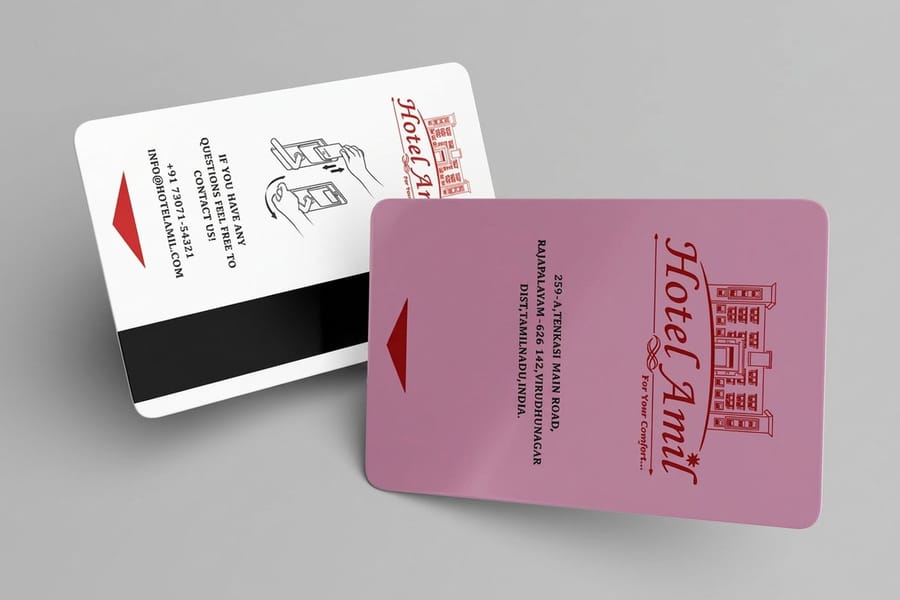
- Leave the stripe band alone. Artwork printed over a magnetic stripe interferes with reading it, so the back layout is designed around the band rather than under it.
- Use the back. Wifi network name, the desk extension, breakfast hours and the checkout time earn their place there. A guest reads the back of the key card more often than any brochure in the room.
- Skip anything dated. Rates, seasons, event names and years turn a reusable card into scrap. Put those on hotel brochures or a door hanger where they belong.
- Watch the finish. A high gloss card shows every fingerprint after a day in a pocket. Matte hides handling and scans just as well.
- Mind the punch. On a contactless card the antenna loops just inside the perimeter, so a slot punch has to go where the card maker allows it. When in doubt, do not punch, and hand the guest a holder instead.
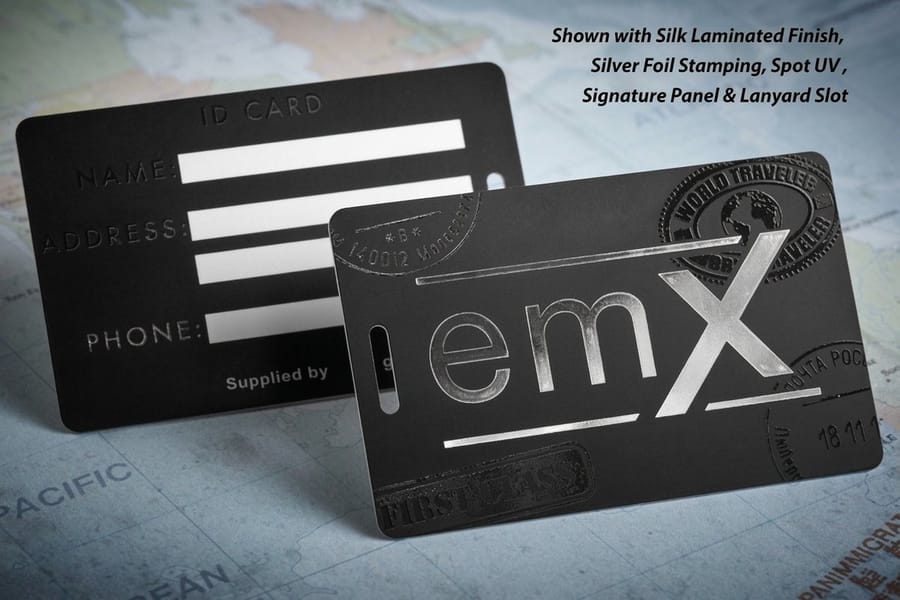
Full color on both sides is standard on 30mil plastic, and the same stock carries options like magnetic stripes, signature panels, barcodes and sequential numbering. If you want the material behavior before you commit, the 30mil plastic card materials guide covers how white, frosted and clear stock each print, and the plastic versus paper comparison explains why plastic is worth the premium on anything handled daily.
The hotel key card dimensions on the order page are fixed: 2.125 by 3.375 inches, which is 54 by 85.6 mm, on 30mil white plastic about 0.76 mm thick, with a 1/8 inch corner radius. A lanyard slot, if you add one, goes on the 2.125 inch side or the 3.375 inch side.
| Option | Choices on the hotel key card |
|---|---|
| Full color on the front only, or on both sides | |
| Finish | UV gloss, or silk laminated matte |
| Magnetic stripe | None, LoCo or HiCo |
| Data and marks | Signature panel, Code 128, Code 39, UPC-A or EAN-13 barcodes with numbering, sequential variable data, embossed numbers, foil on one or both sides |
| Quantity and time | From 250 for $226.11, 1,000 for $377.68, with 15 business days of production |
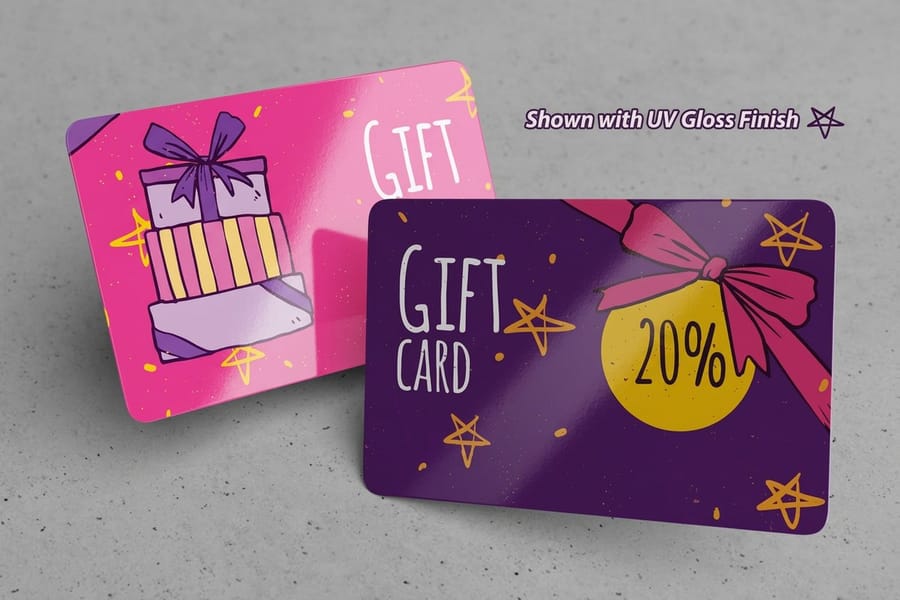
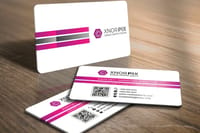
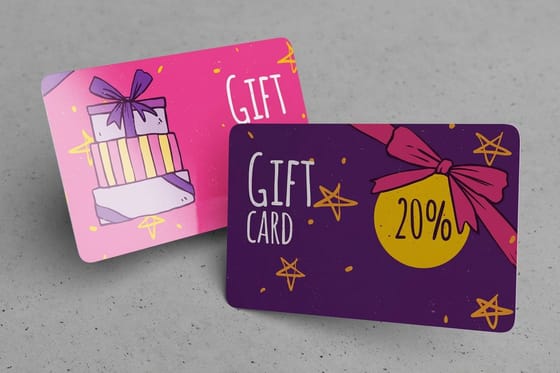
Other hotel cards come in other sizes. Plastic gift cards share the same 2.125 by 3.375 inch body, key tags are 1.125 by 2.375 inches on the same 30mil plastic with a 3/16 inch hole, and plastic business cards run 2 by 3.5 inches on 20 point white, frosted or clear vinyl.
Ordering, Reordering and the Rest of the Card Program
Plastic card pricing is driven by run length far more than by artwork, so the ordering strategy is simple: fewer, larger orders. Hotel key cards start at $226.11 at 4OVER4.COM, and because the print file does not change between runs, the second order is the same job with a bigger number on it.
Size the run from doors, not from occupancy. Two cards for every double room, spares for housekeeping, engineering and the front desk, then a real allowance for the cards guests take home in a coat pocket. That last figure is the one properties consistently set too low, and running short means paying rush pricing for the exact card you already had artwork for.
Proof the file properly before the run, because a plastic card has no forgiving reprint. Check the trim, check the clearance around the stripe band, and check that the phone extension on the back is still the right extension. Every order at 4OVER4.COM includes a free proof, and you can start from a correctly sized layout in the blank template library.
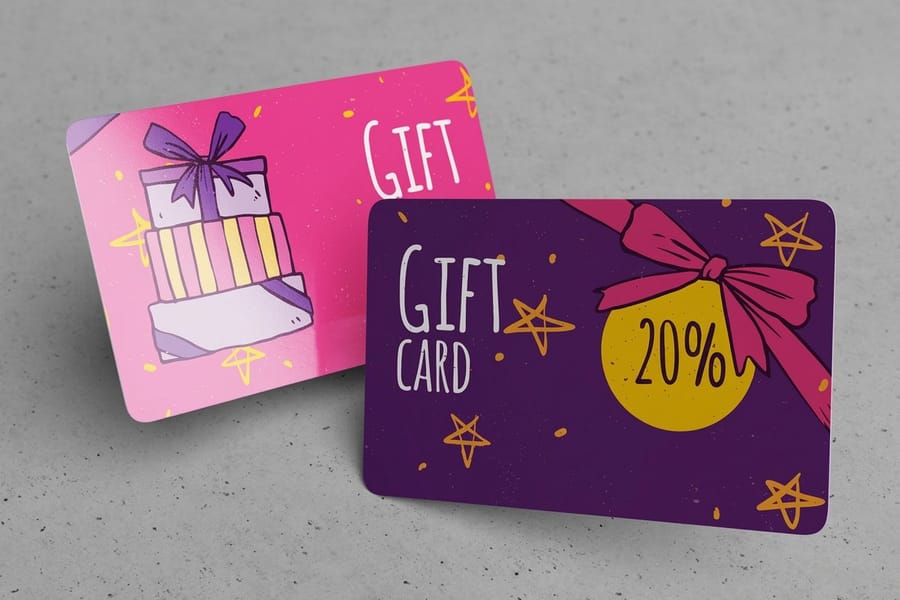
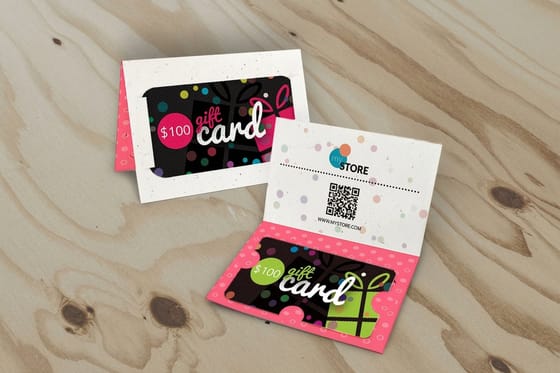
The key card also rarely travels alone. Plastic gift cards at $226.11 turn the spa and the restaurant into something a guest can hand to someone else. Key tags from $309.69 cover parking, staff areas and back of house. Plastic business cards from $180.02 give the sales and events team something that does not soften in a pocket. And hotel brochures from $57.11 carry the dated information you deliberately kept off the card; the hotel brochures story shows a finished set. The Plastic Card with Key Tag video shows a card and its tag side by side. The hospitality printing collection lists the full set, and the plastic cards collection covers every 30mil card we print. For a property running conferences, event badge printing uses the same stock and the same setup rules.
Wally explains hotel key cards
Same card, different place to keep the secret
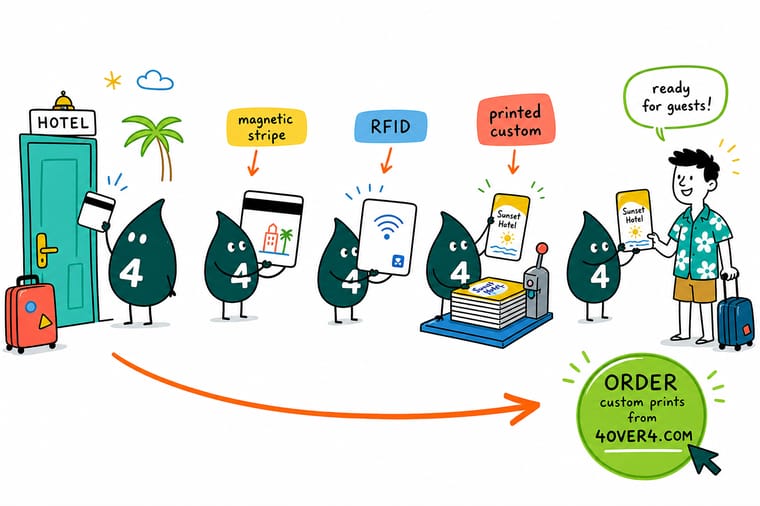
Wally hands you two cards that look identical. The first keeps its secret in the stripe on the back, so the lock has to touch it, and so does the magnet on your handbag clasp. The second keeps it on a chip with a wire loop running around the inside of the card, so the lock reads it through your pocket and nothing ever rubs. Both are the same 30mil plastic, both take full color front and back, and both get rewritten at the desk instead of reprinted. So keep the dates off the artwork and one print run lasts years.
Order hotel key cards →
Specs and pricing
Card options, sizes and starting prices
Hotel key cards and plastic gift cards both print on 30mil white plastic at 2.125 by 3.375 inches, from 250 for $226.11 with 15 business days of production. Plastic business cards run seven sizes on 20 point white, frosted or clear vinyl, from 250 for $180.02 in 7 business days. Configure the card family side by side, with live options and starting prices straight from the 4OVER4.COM configurator.
Print it
Order the cards your property hands over every day
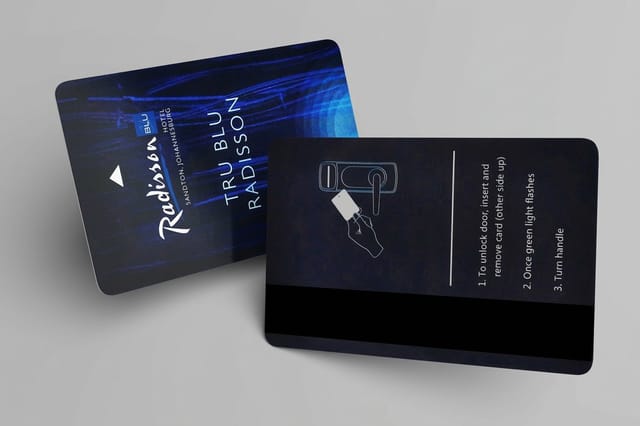
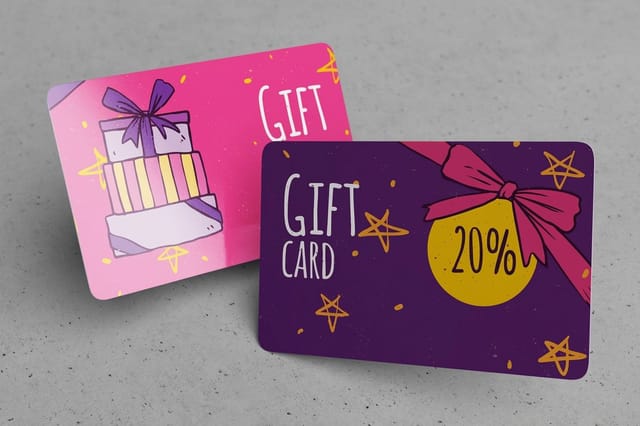
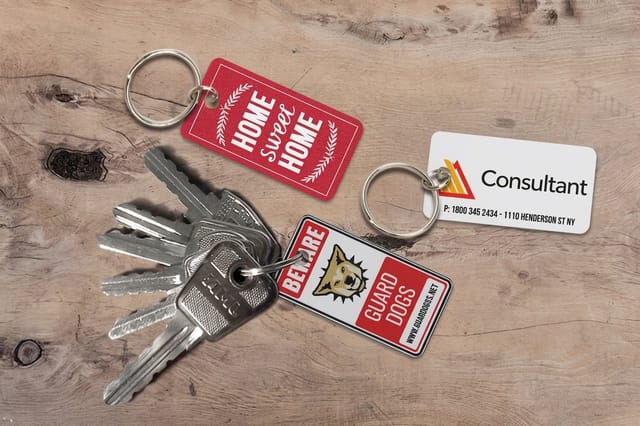
Key cards carry a LoCo or HiCo stripe for the door, gift cards carry barcodes and numbering for the spa and restaurant, and key tags at 1.125 by 2.375 inches start at 500 for $309.69 for parking and back of house.

Explore more
Where to go next
Eight next reads: white, frosted and clear 30mil stock, key card holders, stripes, barcodes and numbering, hotel brochure design, the hospitality and plastic card ranges, hotel signage and our printing FAQs.


By the numbers
The plastic card line on our production floor
Common Questions
Your hotel key card questions, answered
What size is a hotel key card?
CR80, the same ID-1 footprint as a credit card: 3.375 by 2.125 inches, or 85.6 by 54 mm, at 30 mil thick, which is about 0.76 mm. Lock readers and front desk encoders are built around that dimension, so it is not a size you get to choose. Design at that trim with bleed past the edge and a safe margin inside it, because plastic cards are cut and the corners are rounded after printing.
What is the difference between a magstripe key card and an RFID key card?
A magstripe card stores the credential in an oxide stripe on the outside of the card, and the lock reads it when the card is inserted or swiped. A contactless card stores it on a 13.56 MHz chip wired to an antenna laminated inside the card body, and the lock reads it through the air at a couple of inches. The practical difference is wear and speed. The stripe is touched thousands of times and eventually stops reading; the contactless card is never touched at all, and a guest can tap it without taking it out of a wallet.
Why do hotel key cards stop working?
Four causes cover almost all of it. The stripe was demagnetized, usually by a magnetic purse clasp, a magnetic phone case or a laptop lid. The stripe is physically worn or scratched from repeated swipes. The card expired, because the encoded checkout time passed and the lock is enforcing it. Or a replacement card was issued for that room, and its higher sequence number retired the older card the moment the new one was used in the lock. Two cards issued together at check-in are fine; a card cut at the desk after one has already been used is the one that stops working.
Can you print full color on both sides of a key card?
Yes. A 30mil plastic card takes full color on both sides, and the back is usually the more useful side because it is where the wifi network, the front desk extension, the breakfast hours and the checkout time go. Two rules apply. Keep artwork clear of the magnetic stripe band, since a printed layer over the stripe interferes with reading it. And if the card carries an embedded chip, expect a very slight surface rise over it, which is more visible under a heavy solid dark than under a lighter design.
Do I have to buy key cards from my lock vendor?
Not for a magnetic stripe system. A magstripe card is a printed 30mil plastic card with a stripe applied, and the front desk encoder writes the data, so the printing is ordinary print work. Contactless is different: the chip family has to match what the lock reads, and a card with the wrong chip is a coaster no matter how well it is printed. Check your lock vendor's card specification before you commit any contactless run, ours included.
How many key cards should a property order at once?
Work from rooms rather than from guests. Count two cards per key for a double occupancy room, add spares for housekeeping, engineering and the desk, then allow for the ones guests take home, which is the number most properties underestimate. Plastic card printing prices drop hard with volume, and the artwork does not change between runs, so a single larger order beats four small ones. Hotel Key Cards start at $226.11 at 4OVER4.COM.
Are old hotel key cards recyclable?
PVC cards are not accepted in ordinary curbside recycling, and a card with a chip in it is not recyclable as plastic at all because of the metal antenna. Reuse is the realistic answer for magstripe cards, since the front desk simply re-encodes them for the next guest, and that is one more argument for undated artwork. Cards that are scratched past reading are waste, which is why properties that churn through cards often move to contactless and stop replacing them.
Get Started
Order 250 hotel key cards from $226.11
Full color on both sides of 30mil plastic, CR80 trim, magnetic stripe and numbering options, and a free proof before we run it.
Legal Disclaimer
Gold Standard guarantees apply to all standard orders placed through 4over4.com. Price match requires verifiable proof of a competitor's published price for an equivalent product with matching specifications and turnaround time. Satisfaction guarantee covers manufacturing defects and print quality issues. Contact support with order number and documentation.
