
How Retractable Displays Work and What Makes One Last


Tobias is our voice for cutting, binding and large format, built from the knowledge of our production team, with over 20 years in printing.
A spring, a roller and a pole. Something specific is sealed inside the base, the graphic pulls hardest at full height, and a few handling mistakes end a display early.
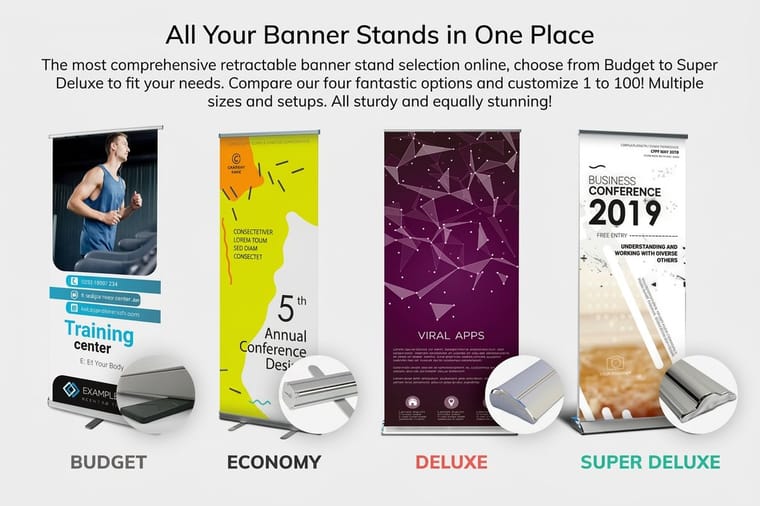
A retractable display is a printed graphic wound on a roller inside an aluminum base, with a flat spiral steel spring in that roller pulling it back in and a telescopic pole holding it up. Pulling the graphic out winds the spring tighter, so its return torque peaks at full height and the spring tension is also what holds the print flat without a frame. Everything else about a retractable, from why the base is heavy to why the leading edge creases, comes out of that one mechanism.
Quick answer
A wound spring, a roller, and a pole holding the two apart
The graphic lives wound on a roller tube inside the base, and a flat spiral spring in that tube is always pulling it back down. You draw the print up by the rail clamped to its top edge, hook that rail onto a telescopic pole, and the spring load that is now fighting the hook is the same load holding the print flat across its width. Wind a spiral spring further and it pushes back harder, so the display is under its greatest pull at full height. That single fact explains the creased leading edges, the heavy bases and the reason nobody sets one of these up outdoors twice.
What Is Actually Inside the Base
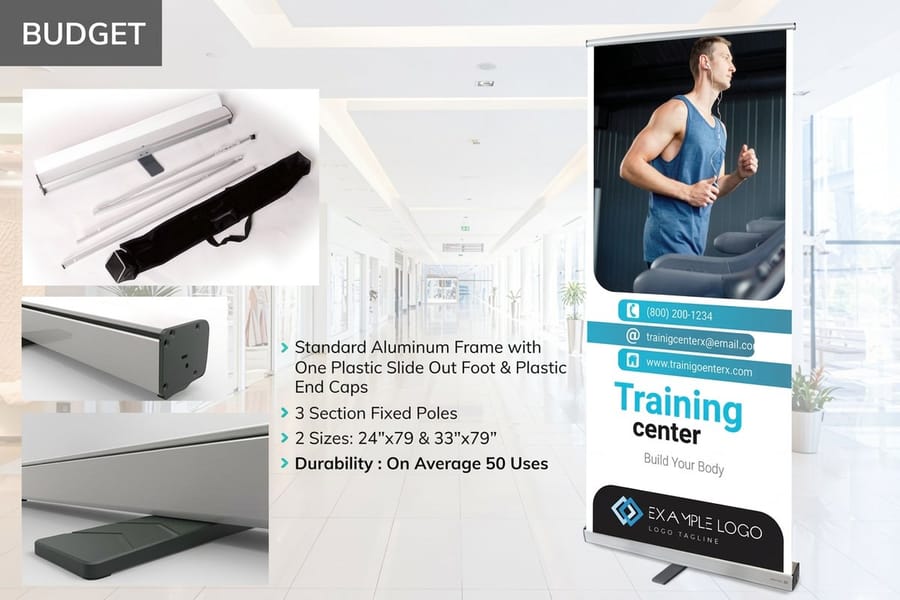
Pop an end cap off and there is less in there than people expect. A retractable display holds five parts: an extruded aluminum shell, a roller tube, a flat spiral steel spring inside that tube, two end caps carrying the tube on a fixed shaft, and a felt-lined slot the print passes through.
The spring is the one that matters. It is a coiled ribbon, the same idea as the return spring in a tape measure, anchored to the fixed shaft at one end and to the inside of the tube at the other. Pull the graphic out and the tube rotates, winding the ribbon tighter. Wind a spiral spring tighter and its return torque goes up, so the force trying to swallow your print is weakest when the banner is down and strongest when it is fully up.
Two things follow from that, and they are the two things people get wrong. First, the pole is not decorative. It is a tension member carrying the entire spring load through the hook at the rail, which is why a half-seated telescopic joint shows up as a lean an hour into a show. Second, the moment of maximum danger is the moment you unhook. Our setup guide runs the sequence in order, but the rule is short: keep a hand on the rail all the way down.
The felt lip does quiet work too. It wipes the face of the print as it winds in, which keeps hall dust off the graphic. Once that felt packs with grit it stops wiping and starts scratching, and the scratches land as fine vertical lines down the middle of the print. Wipe the slot with a dry cloth every few shows. It costs nothing and it is the cheapest way to make a retractable banner stand outlive its first graphic.
Economy, Standard and Cartridge Hardware Are Not the Same Machine
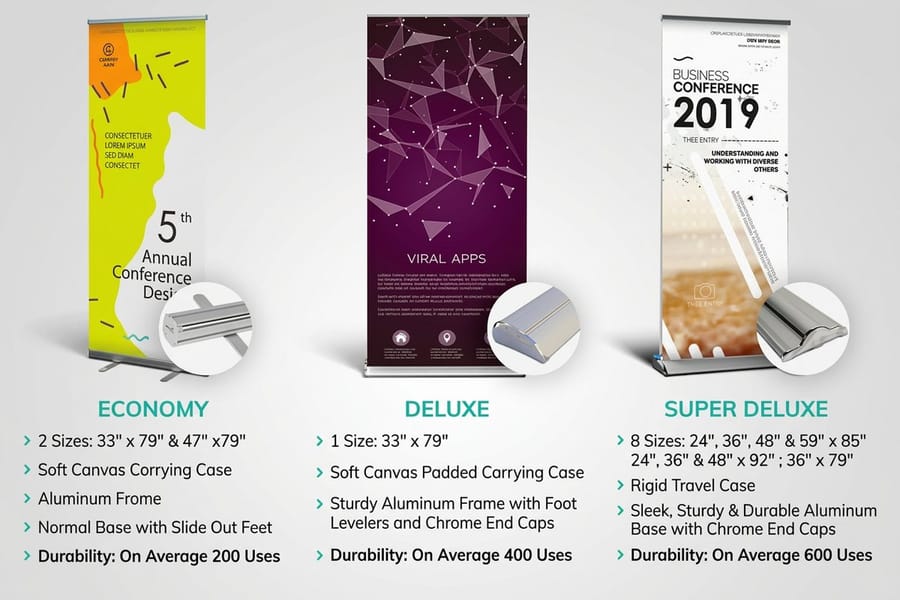
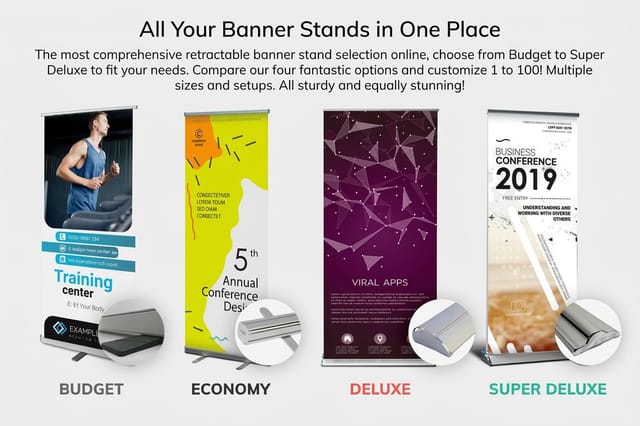
Every retractable on the market uses the spring and roller described above, so the price differences sit in the base, the spring quality and whether the roller comes out. Those three decide how long the display lasts and what a rebrand costs you later.
| Grade | The base | New graphic later | Where it belongs |
|---|---|---|---|
| Economy roll up | Narrow, shallow foot, light gauge aluminum, often a plastic end cap. | Sealed unit, so a new message means a new stand. | A one-off event where the message dies with the day. |
| Standard retractable | Wider extrusion, feet that swing out at both ends, enough mass to stand in traffic. | Usually replaceable, worth confirming before you order. | The default for a booth entrance, a lobby or a showroom. |
| Cartridge system | Heavier base built to accept a drop-in roller assembly. | Buy a cartridge with the new print and keep the base. | Anyone who reprints seasonally or runs several campaigns a year. |
| Double-sided | Two rollers back to back in one wider base, so it needs the most floor. | Both graphics change together, so plan artwork in pairs. | Aisles and walkways where people approach from both directions. |
Read the base column first. A retractable tips around the front edge of its foot, so how far that foot reaches front to back matters more than how heavy the whole thing feels in the bag. A shallow foot under a seventy-something inch graphic goes over when someone brushes past with a rolling case, and it will happen in a busy aisle. That is also why a double-sided unit is more stable than it looks: two rollers make a deeper base.
The graphic column decides the second order rather than the first. If you print one message and keep it for years, a sealed stand is fine. If you change a headline every quarter, cartridge hardware pays for itself on the second reprint. When you are deciding between mechanisms altogether, retractable against X-frame compares them side by side, and the double-sided guide covers the two-graphic version.
Where a Retractable Sits Among the Other Displays

A retractable is a one-message sign that stores itself. That is its whole job, and the rest of the display range exists because a single vertical sign cannot do everything a booth needs.
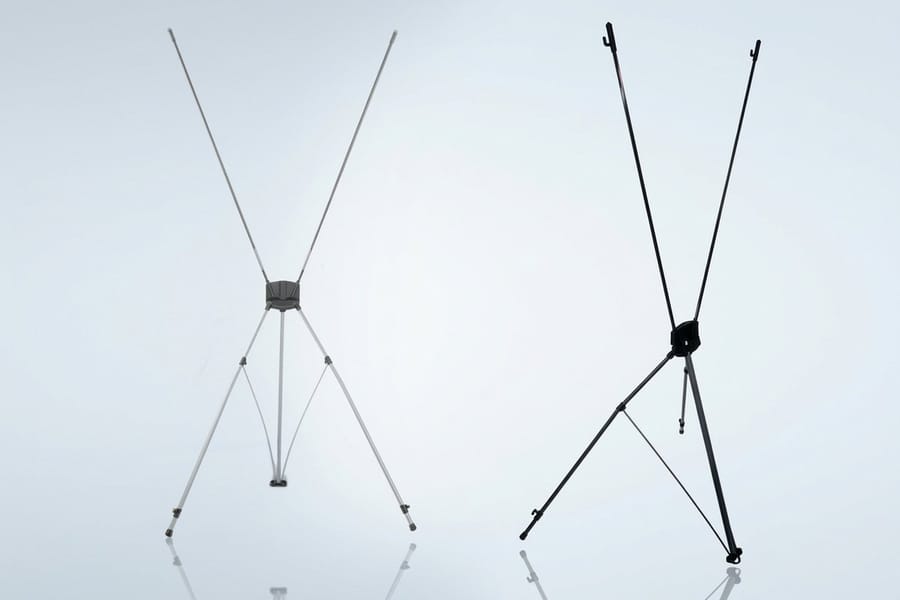
Retractable banner stands start at $139 and go up in under a minute with no tools, which is why most exhibitors own several before they own anything else. X-frame banner stands start at $91 and hang a grommeted print from four corners on a folding cross frame. They are lighter and cheaper, they read as the budget option from three feet away, and the graphic is not held flat the way spring tension holds it.
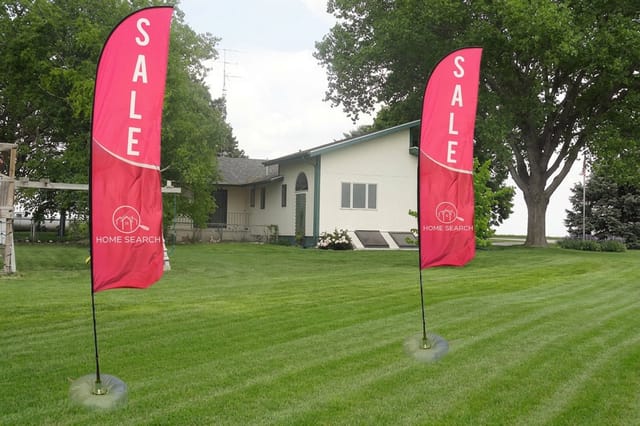
Above that, the shape of the problem changes. Pop up displays start at $752.39 and open into a curved wall that fills the back of a booth, so you are buying a backdrop rather than a sign. A full trade show booth kit starts at $2,599 and packages the wall, the counter and the graphics as one system. Ideas for drawing visitors into a 3 in 1 trade show booth sit in our booth marketing article, and the durable trade show booth print pack lists the pieces for a booth that has to last several seasons. Feather flags start at $108.75 and are the only member of this group designed to stand outside, because the flag flexes and spills wind instead of catching it. You can watch wind feather flags in their product video, and every other trade show piece we print sits in one place.
The practical order for a first booth is a retractable at the aisle, a pop up or fabric backdrop behind the table, and a flag outside if the venue allows one. Our trade show signage guide works through that plan by budget, and tension fabric stands covers the seam-free backdrop option if your booth gets photographed.
The Five Ways a Retractable Display Dies
Almost none of these are manufacturing faults. They are handling, and every one of them is avoidable in about two seconds.
- The leading edge crease. Unhook at full height, let go, and the spring fires the print into the slot. The fold lands right across the top of the artwork. Walk the rail down with your hand on it.
- A corner tear. Pulling up by one corner racks the graphic and puts the whole spring load on a few inches of the rail seam. Take the rail in the middle with both hands and draw straight up.
- Rail adhesive letting go. The top rail is taped to the print. A closed car in summer softens that tape, the rail slides sideways, and the graphic hangs crooked forever. Carry the bag in the cabin, not the trunk, in hot weather.
- A tired spring. Stored extended for weeks, the ribbon sits at full wind and the print sits stretched. The stand comes back with a lazy return that no longer holds the graphic flat. Wind it down before it goes in the bag.
- Scratches from the slot. Grit trapped in the felt cuts fine vertical lines into the face over a season of shows. A dry wipe across the lip clears it.
The limit worth naming is wind, and it is not a handling problem you can fix. A full-height graphic is close to twenty square feet of sail sitting on a base of a few pounds with no stake, no ballast point and nothing to tie off. Outdoors it is a question of when. For exposed work, hang a grommeted vinyl banner from $79 on a fence or a wall, or use a mesh banner from $75 where air needs to pass through the graphic instead of pushing on it. Our guide to using a retractable banner outdoors covers the narrow set of conditions where it is defensible.
Build the artwork from a correctly sized blank template at full size, keep the message in the band between roughly waist and eye height, and the display will do the rest. The mechanism is simple enough that treated properly it becomes the piece of booth kit you stop thinking about.
Wally explains the retractable
A wound spring, a hooked rail, and a print that stays flat
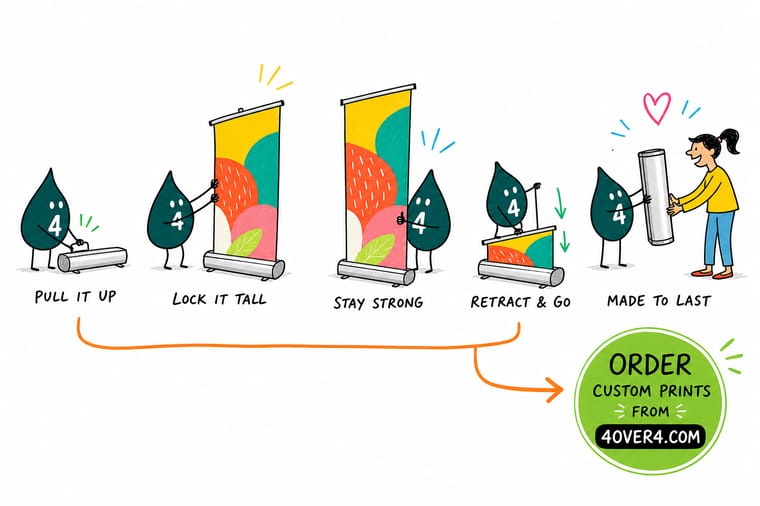
Wally pulls the graphic up by the rail and hooks it on the pole. Inside the base a flat steel ribbon winds tighter with every inch, and it is that tension, not a frame, that keeps the print flat across its full width. The catch is that the spring is strongest right at the top. Unhook it up there and let go and it swallows the leading edge in one crease. Walk it back down with a hand on the rail and the same display goes to twenty shows.
Order retractable banner stands →
Specs and pricing
Display hardware, sizes, and starting prices
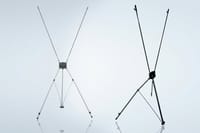
Compare the three display mechanisms side by side. Retractable banner stands come in 13 sizes from 24 by 79 up to 59 by 85 inches on 13 oz smooth blockout vinyl, X-frame stands in four sizes from 24 by 60 to 48 by 78 inches, and pop up displays as 8 or 10 foot curved or straight walls in 8.8 oz tension fabric. The live configuration choices and starting prices come straight from the 4OVER4.COM configurator.


Print it
Order a display that goes up in a minute
A retractable stand ships as a single unit after 3 business days of production and a pop up display after 6. Feather flags take 4, in heights from 8 to 15 feet on 3 oz polyester, with a stake for outdoors or a cross base for indoors.

%22%2F%3E%3Ccircle%20cx%3D%2247%22%20cy%3D%2220%22%20r%3D%2222%22%20fill%3D%22%23a78bfa%22%20opacity%3D%220.15%22%2F%3E%3Ccircle%20cx%3D%2254%22%20cy%3D%2227%22%20r%3D%22-3%22%20fill%3D%22%23a78bfa%22%20opacity%3D%220.1%22%2F%3E%3Crect%20x%3D%2277%22%20y%3D%22-9%22%20width%3D%2232%22%20height%3D%2220%22%20rx%3D%224%22%20fill%3D%22%23a78bfa%22%20opacity%3D%220.08%22%20transform%3D%22rotate(42%2080%2030)%22%2F%3E%3C%2Fsvg%3E)
Explore more
Where to go next
Weigh a retractable against an X-frame, see where a double-sided stand earns its price, compare pop up and tension fabric walls, plan a 10 by 10 booth in the order to buy it, and shop display printing.


By the numbers
Stands, pop ups and booth kits shipped as hardware
Common Questions
Your retractable display questions, answered
How does a retractable display work?
The printed graphic is attached to a roller tube sealed inside an aluminum base, and inside that tube sits a flat spiral steel spring anchored to a fixed shaft. Pulling the graphic out rotates the tube and winds the spring tighter, so the spring is always trying to pull the print back in. A telescopic pole drops into a socket behind the roller and hooks onto the rail clamped along the top edge of the print, and that hook is the only thing resisting the spring. The tension it holds is also what keeps the graphic flat, which is why a retractable needs no frame around its edges.
Why does the banner snap back so hard when I unhook it?
Because a spiral torsion spring gets stronger the further it is wound, not weaker. At full height the ribbon has taken every turn it is going to take, so return torque is at its peak exactly when you reach up to unhook the rail. Let go there and the leading edge hits the exit slot at speed and folds. Keep a hand on the rail and feed it down. That single habit is the difference between a display that survives twenty shows and one with a crease at eye level after three.
Can I replace just the graphic and keep the stand?
On hardware built around a cartridge, yes. The roller, spring and end caps lift out of the base as one unit, and a new cartridge with a new print drops in, so a rebrand costs you the graphic rather than the whole display. Sealed economy stands do not come apart that way, and a new message means a new stand. If you expect to reprint within a year or two, that difference usually outweighs the price gap on the first order.
Why is the back of the graphic gray?
That is the blockout layer in the film. Without it, the roll of graphic still sitting in the cassette ghosts through the visible section whenever a window or a spotlight is behind the stand, and the artwork reads dirty. The blockout core also stiffens the print enough to hang flat across the full width with only a top rail and spring tension holding it. Ordinary banner vinyl in the same stand waves down the middle once the hall warms up.
Should I store a retractable display rolled up or extended?
Rolled up, in its bag, lying flat or standing on its base. Leaving it extended for weeks keeps the spring wound at full torque and keeps the print stretched against the rail adhesive, and heat makes both worse. A car trunk in summer is the worst place for one: the double-sided tape holding the rail to the print softens, the rail slides, and the graphic hangs crooked from then on. Store it indoors and it will outlast several graphics.
What does a retractable display cost compared with the alternatives?
Retractable banner stands start at $139 at 4OVER4.COM, and that includes the printed graphic and the hardware it rolls into. X-frame banner stands start at $91, a grommeted vinyl banner starts at $79, feather flags start at $108.75, pop up displays start at $752.39 and a full trade show booth kit starts at $2,599. The jump from a banner to a retractable buys the cassette, the spring and the base. The jump from a retractable to a pop up display buys a curved wall rather than a single sign.
Get Started
Order a retractable stand, printed in 3 business days
Pick a size, upload the artwork, and we print the graphic and ship it in the base it rolls into, ready to stand up in under a minute.
Legal Disclaimer
Gold Standard guarantees apply to all standard orders placed through 4over4.com. Price match requires verifiable proof of a competitor's published price for an equivalent product with matching specifications and turnaround time. Satisfaction guarantee covers manufacturing defects and print quality issues. Contact support with order number and documentation.
