
How to Advertise With Large Format Outdoor Signs That Get Read


Where the sign stands sets the letter height, the letter height sets the word count, and the weather sets the material. Here is the order to work in, with the numbers behind each decision.
Advertising on a large format outdoor sign is four decisions in a fixed order: pick the spot, size the letters for the distance and the traffic speed, choose a material that survives that spot, then cut the copy down to what fits the reading time. The sizing rule is ten feet of comfortable reading distance per inch of capital letter height, so 12 inch caps read from about 120 feet, which at 45 mph is 1.8 seconds. That budget is what decides whether you need a staked panel, a mounted aluminum sign or a poster sized frontage.

Quick answer
Distance first, letters second, words last
An outdoor sign works when the letters are tall enough for the distance and short enough to finish before the reader passes. Size the caps at one inch for every ten feet of reading distance, then divide that distance by the traffic speed to find how many seconds you actually have: 66 feet per second at 45 mph, about 37 at 25 mph. Choose the substrate for how the sign mounts and how long it must last, and write the copy to fit the seconds rather than the panel.
Start With the Spot, Because the Spot Decides Everything Else

Stand where your audience will actually be and measure two things: how far away they are when the sign enters their view, and how fast they are moving. Those two numbers decide the panel size, the letter height, the word count and, in the end, the material. Everything else on this page is downstream of them.
There are really three placements, and they behave nothing alike. Walking distance covers a sidewalk, a doorway, a lobby entrance or a booth: people are 10 to 25 feet away, moving at walking pace, and they will read a full line of type. Parking lot and slow street covers a driveway entrance, a strip mall frontage or a residential corner at 25 mph, where you have a few seconds and 60 to 120 feet. Open road covers a 45 mph arterial or a highway frontage, where the whole message has to land in about a second and a half from 200 feet.
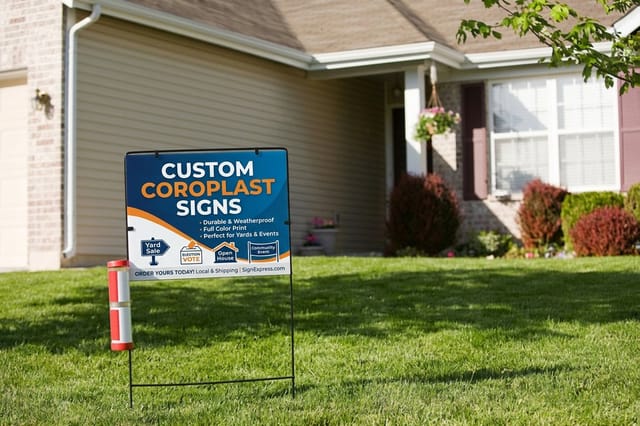
The mistake that wastes the most money is buying for the wrong tier. A 24 by 18 inch staked sign is a fine slow street sign and a useless highway sign, because a panel that size cannot hold letters tall enough for the distance. If the spot is fast, the sign has to grow, which usually means a large format poster panel, a mounted rigid board, or a fence wrap rather than a stake.
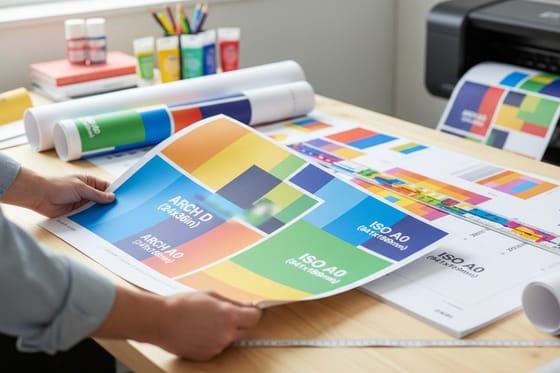
Check the rules before you check the price. Cities set limits on panel area, height above grade, setback from the curb and how long a temporary sign may stay up, and those limits differ street by street. Signs in the public right of way get pulled. If the sign lives on property you do not own, get written permission from the owner first, and see the large format printing explainer for how oversize panels are produced and shipped.
Size the Letters for the Distance, Then Check the Clock

The sign trade sizes copy with one rule: every inch of capital letter height buys about ten feet of comfortable reading distance. Six inch caps read from 60 feet. Twelve inch caps read from 120 feet. That rule is where the design starts, and it is also where most homemade signs go wrong, because a headline set to fill the panel is not the same as a headline sized for the viewer.
The second half is the part people skip. Reading distance is only useful if the reader has time to use it. At 25 mph a driver covers about 37 feet per second, at 45 mph exactly 66 feet per second, and at 55 mph roughly 81 feet per second. Divide the readable distance by that number and you get your true message budget.
| Cap height | Comfortable reading distance | Reading time at 25 mph | Reading time at 45 mph |
|---|---|---|---|
| 3 in | 30 ft | 0.8 sec | 0.5 sec |
| 6 in | 60 ft | 1.6 sec | 0.9 sec |
| 9 in | 90 ft | 2.5 sec | 1.4 sec |
| 12 in | 120 ft | 3.3 sec | 1.8 sec |
| 18 in | 180 ft | 4.9 sec | 2.7 sec |
| 24 in | 240 ft | 6.5 sec | 3.6 sec |
Read the last column and the whole argument for going bigger becomes obvious. Twelve inch letters on a 45 mph road give a driver 1.8 seconds, which is a name and an offer, nothing more. Wanting three full seconds at that speed means about 20 inch caps, and 20 inch caps need a panel roughly 4 feet tall once you add a second line and margins. That is the honest cost of a fast road, and it is why choosing the poster size before writing the copy usually leads to a sign that cannot say what you wanted it to say.
Match the Material to the Weather and the Mounting

Outdoor signs fail in four predictable ways: the ink fades, the wind flexes the panel until it creases, water lifts a poorly bonded edge, or the mounting gives out before the sign does. Pick the substrate by which of those you are exposed to.
| Material | Where it belongs | How it fails | Practical life |
|---|---|---|---|
| 4mm corrugated plastic | Staked into ground, wired to a fence, rotated between locations. | Wind creases the flutes, unprotected ink chalks in strong sun. | A season, longer in shade. |
| Aluminum panel | Bolted to a post, wall or gate where it stays put. | Rarely the panel. Hardware, mounting holes and impact damage. | Years of full weather. |
| Large format poster or banner | Fence wraps, construction barriers, the biggest area per dollar. | Tears at the corners if it is not hemmed, grommeted and wind vented. | Weeks to a season outdoors. |
| A frame panel | Sidewalk and storefront, carried out each morning. | Tips in wind, and gets taken if it is left overnight. | Years for the frame, seasons for the face. |
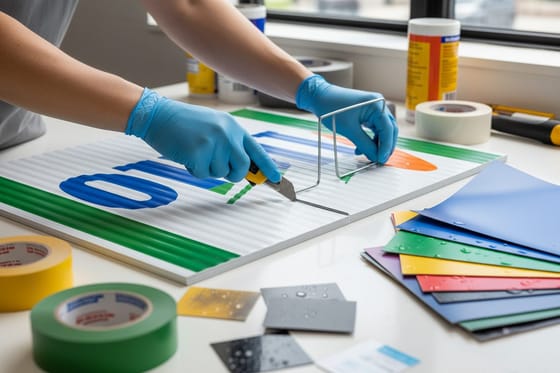
One detail costs people real money on corrugated plastic. The board has hollow flutes running one direction, and an H stake slides into those flutes, so on a staked sign the flutes have to run vertically. Order a wide horizontal layout without saying so and you can end up with a panel whose flutes run side to side, which will not take a stake and bends across the middle in the first gusty afternoon. Say how the sign will be mounted when you order plastic coroplast signs, and the flute direction gets set correctly.
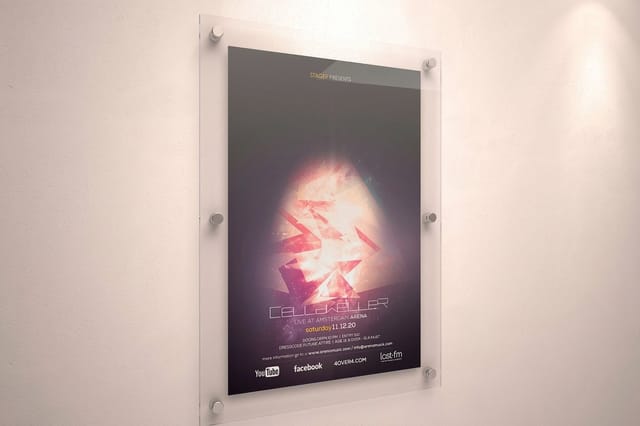
For a permanent frontage, aluminum is worth the jump. It holds a flat face, takes drilled mounting holes and does not chalk the way thin plastic eventually does, which is the whole argument behind aluminum sign printing. For sidewalk work where the sign comes indoors at night, an A frame sign solves the wind problem by simply not being there when the weather turns. If the piece is going in a lobby or a reception wall instead, the acrylic business sign buyer’s guide covers the indoor equivalents, and the outdoor yard sign material guide goes deeper on what survives a full year outside.
Write Copy That Survives a Windshield at Speed

Once you know the reading time, the copy writes itself, because you are choosing which three or four words earn the space. Lead with the thing the reader wants, not with your name. A stranger driving past does not know your business name yet, so "Same Day Oil Change" in the biggest type with the name underneath beats the name in the biggest type every time.
Contrast matters more outdoors than it does on screen. Dark type on a light field stays legible in flat overcast light and when the surface is wet, while light type on a dark field loses edges in glare and in rain. Keep the stroke weight solid, avoid thin geometric faces and tight letter spacing, and give the type real margin: a headline crowding the panel edge reads smaller than the same headline with an inch of air around it. Our roundup of easy to read fonts covers the typefaces that hold their shape at distance.
Then decide on one action, and only one. A phone number nobody can memorize at 45 mph is wasted space, but the same number works on a slow street sign or a storefront panel where people can stop and photograph it. A short brand name people can search later usually outperforms a long web address. Arrows work, because they need no reading time at all. Two calls to action compete with each other and both lose.
Photographs are the last thing to consider. A single high contrast product image at large scale can carry the whole panel, but small photos, gradients and busy backgrounds all reduce legibility, and they cost letter height that you need. If you want examples of the idea done well, the roundup of large format print advertisements is a good reference, and outdoor business sign ideas shows the formats that get looked at outside a storefront.
One Big Sign, or a Route of Small Ones

Reach and frequency pull in different directions, and the budget usually only covers one. A single large panel at a busy intersection buys distance and looks established. A run of small signs staked along the approach roads buys repetition, and repetition is what actually moves people who are not looking for you yet.
For anything with a date attached, an open house, a grand opening, a seasonal service, a fundraiser, the route generally wins. A driver who misses the first sign sees the third, and each sign can carry one short piece of the message rather than the whole thing. Since yard signs start at $25 and the price per piece drops as the run grows, a set of small signs and one large panel often land in the same budget bracket. If the date is close, getting signs printed fast is mostly about choosing a stock product size and skipping custom cutting.
Order spares. Signs get taken, snapped by mowers, bent by wind and knocked over by the plow, and a route with three gaps in it stops working as a route. Ten percent extra on the initial run costs far less than a rush reprint two weeks later. Storefront panels take a different approach: a single well made sign like a set of barber shop signs stays up for years, so spend on the substrate rather than on quantity.
Last, plan the retire date at the same time as the print date. Temporary sign permits expire, event signs left up after the event read as neglect, and faded panels do more brand damage than no panel at all. Put the pull down date in the calendar the day the signs arrive, and browse the full range of oversize options under large format printing when you are ready to scale a design up.
Owning the Sign or Renting the Billboard
Large format outdoor advertising splits into two markets that share a name. In one, you rent space on someone else's structure: a roadside billboard, a bus shelter, a transit panel or a screen in a mall. In the other, you print your own panel and put it on ground you control: a fence wrap on the site, a banner on the storefront, a route of staked signs down the approach road.
Rented space sells you the audience. The owner picks the location and the traffic count, the contract runs by the month, and the creative changes when the next campaign starts. Printed signage sells you the panel. You pay once, you own the location as long as you own or lease the property, and the same $25 yard sign works every weekend until the message expires.
The distance arithmetic above is identical on both. A billboard reads from further away because its letters are taller, not because it is a billboard. Measure the distance, size the caps, count the seconds, then decide whether a rented panel or a printed one puts those letters in front of the right driver for less. For a local business with a date attached, the printed route usually wins on cost. For a highway audience on frontage you do not own, rented space is the only way in, and banner sizes for events and displays covers the printed formats that come closest.
Wally sizes a roadside sign
Ten feet of reading distance per inch of letter
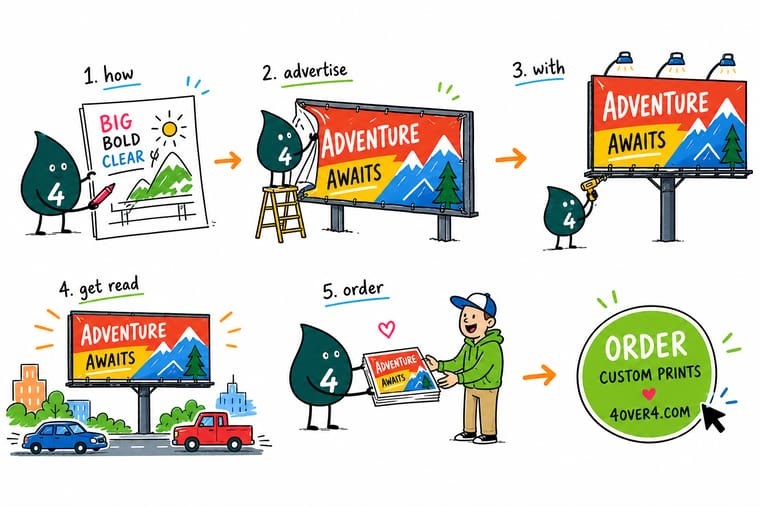
Wally does not start with the sign, he starts with the driver. He measures how far away the car is when the sign comes into view, divides that distance by ten to get the letter height in inches, then divides the distance by the speed to see how many seconds the driver gets. At 45 mph that is 66 feet every second, so a sign readable from 120 feet buys 1.8 seconds, which is about four words. Whatever will not fit in those seconds comes off the panel, and the letters that remain get bigger.
Order yard signs →Specs and pricing
Outdoor sign sizes and starting prices
Compare the three workhorse outdoor formats side by side, with live size choices and starting prices straight from the 4OVER4.COM configurator.

Print it
Print the sign the spot actually needs
Explore more
Where to go next

By the numbers
Outdoor advertising drawn from 1,000+ products
Common Questions
Your outdoor sign questions, answered
Who is the largest outdoor advertising company?
JCDecaux of France is usually cited as the largest outdoor advertising company in the world by revenue, with street furniture, transit and billboard inventory across dozens of countries. In the United States the billboard market is led by Lamar, Outfront Media and Clear Channel Outdoor. All of them rent space on their own structures, which is a different business from printing a sign you own.
How much does outdoor advertising cost?
Rented space is priced per month per panel and swings with location and traffic, from a modest sum on a rural road to a large one on a major city artery, with production of the vinyl face billed on top. A printed sign you own is a one-time cost: yard signs start at $25, a mounted aluminum panel and a hemmed banner cost more per piece, and the price falls with quantity. Size the letters for the distance first, then price the two routes against the same audience.
Which are the three main types of outdoor advertising?
Billboards along roads, street furniture such as bus shelters and kiosks, and transit advertising on buses, trains and stations. Those three are the rented out-of-home market. Printed on-site signage, from staked signs to fence wraps and storefront banners, is the fourth kind, and the one you own rather than rent.
What is the largest city that has banned outdoor advertising?
Sao Paulo in Brazil, which removed billboards, transit ads and most outdoor advertising under its Clean City Law from 2007. Smaller cities have followed in part, and several US states, including Vermont, Maine, Hawaii and Alaska, ban roadside billboards. On-premise signs on a business's own property are usually still allowed under local size and setback rules, which is why a printed sign on your frontage keeps working where rented billboards do not exist.
How big do the letters need to be on an outdoor advertising sign?
Work backwards from the distance. The rule sign shops use is ten feet of comfortable reading distance for every inch of capital letter height, so 6 inch caps read from about 60 feet, 12 inch caps from about 120 feet, and 24 inch caps from roughly 240 feet. Then check the reading time. A driver at 45 mph covers 66 feet every second, so 120 feet of readable distance is under two seconds of reading. If your headline needs more than that, the letters are too small for the road, not the road too fast for the sign.
What material should I use for an outdoor sign that stays up for months?
For anything staked into ground and rotated every few weeks, 4mm corrugated plastic is the standard answer because it is light, cheap per piece and takes an H stake. For a sign bolted to a wall, a post or a fence that has to stay put through a full year of weather, aluminum is the honest choice, since corrugated plastic eventually chalks and the flutes soften after long sun exposure. Large format posters and banner material cover the biggest area for the least money, which suits a fence wrap or a construction barrier, but they need hems, grommets and wind slits or the wind will tear them at the corners.
How many words should be on a roadside sign?
Three to five, plus your name. That is not a style preference, it is arithmetic: at 45 mph a sign readable from 120 feet gives a driver under two seconds, and nobody reads a sentence in under two seconds while steering. Put the offer or the category first in the largest type, the business name second, and one way to act third. If you cannot decide what to cut, print the layout at a quarter scale and look at it from across the room. Whatever you cannot read is the part to remove.
Do I need a permit for a large outdoor sign?
Usually yes for anything permanent, and often yes for temporary signs too. Cities regulate the panel area, the height above grade, the setback from the curb or property line, illumination, and how many days a temporary sign can stay up, and the rules change between a commercial corridor and a residential street. Signs placed in the public right of way beside a road are the ones most commonly removed. Call the local building or zoning office before you print, and if the sign goes on someone else's property, get the owner's permission in writing.
Is one large sign better than several small ones?
It depends on whether you need reach or frequency. One large panel at a busy intersection buys distance and authority. A set of small signs along an approach route buys repetition, which is usually the better trade for events, open houses, seasonal promotions and anything with a deadline, because a driver who misses the first sign still sees the third. Since yard signs start at $25 and the per piece cost falls as the run grows, a route of small signs often fits the same budget as a single big one.
How long will an outdoor sign last before it fades?
Plan on a season for staked corrugated plastic and years for a mounted aluminum panel. Sun and freeze cycles do most of the damage: UV fades unprotected ink, wind flexes a thin panel until the flutes crease, and repeated wet and dry cycles lift edges on anything laminated poorly. Sign faces on the south side of a building fade fastest. If a sign has to hold its color for more than a season, budget for a laminate or a rigid substrate up front rather than reprinting twice.
Get Started
Ready to put your message where the traffic is?
Pick the size the distance demands, choose a substrate that survives the season, and we print outdoor signs that still read at full speed.
Legal Disclaimer
Gold Standard guarantees apply to all standard orders placed through 4over4.com. Price match requires verifiable proof of a competitor's published price for an equivalent product with matching specifications and turnaround time. Satisfaction guarantee covers manufacturing defects and print quality issues. Contact support with order number and documentation. On-time delivery rate based on tracked orders 1999 to 2026. Individual results may vary based on shipping carrier performance.
