
How to Design an Advertisement Flyer People Actually Respond To


Sofia is our design and templates voice, built from the knowledge of our production team, with over 20 years in printing.
To design an advertisement flyer, build it around one offer, one deadline and one way to reply, sized and printed so the small print survives the trim. This guide covers the anatomy, the file setup, and where you are allowed to hand them out.
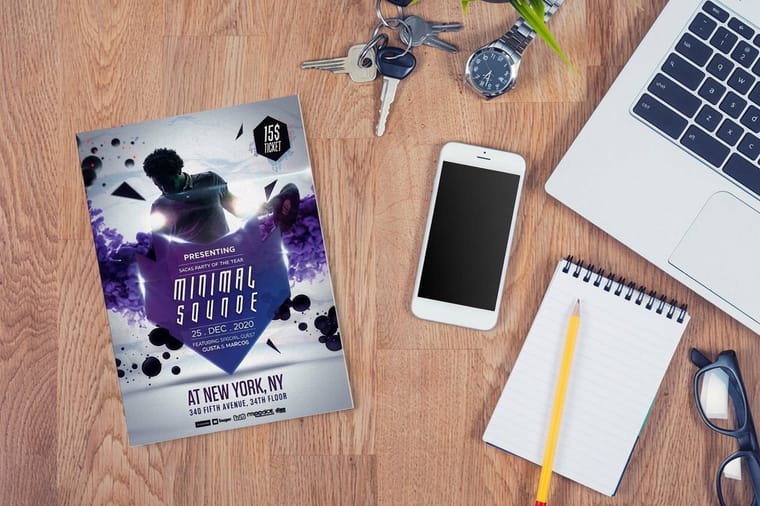
An advertisement flyer needs one offer stated as a number, a real expiry date, and a single way to respond, laid out so the offer reads from six feet and the response block reads at arm’s length. Build the file with 0.125 in bleed and a 0.25 in safety margin in CMYK, choose text weight stock for handouts and cover weight for anything that gets kept, and plan distribution before you design, because a mailbox is off limits by federal law. As a printed flyer, a quarter page ad is 4.25 x 5.5 inches, one quarter of an 8.5 x 11 sheet, and it has room for the offer and little else.
Quick answer
One offer, one deadline, one way to respond
The flyer that works carries a single offer, a printed expiry date and one response path, and it is laid out so each part lands at the distance it gets read from. Set the offer large enough to read from six feet, give the image the middle of the sheet at 300 ppi, and keep the phone number, address and redemption code a quarter inch inside the trim so the guillotine cannot shave them off. Then decide where the flyers go before you finish the design, because a handout, a windshield drop and a counter stack each need a different amount of copy.
The Three Parts an Advertisement Flyer Cannot Do Without
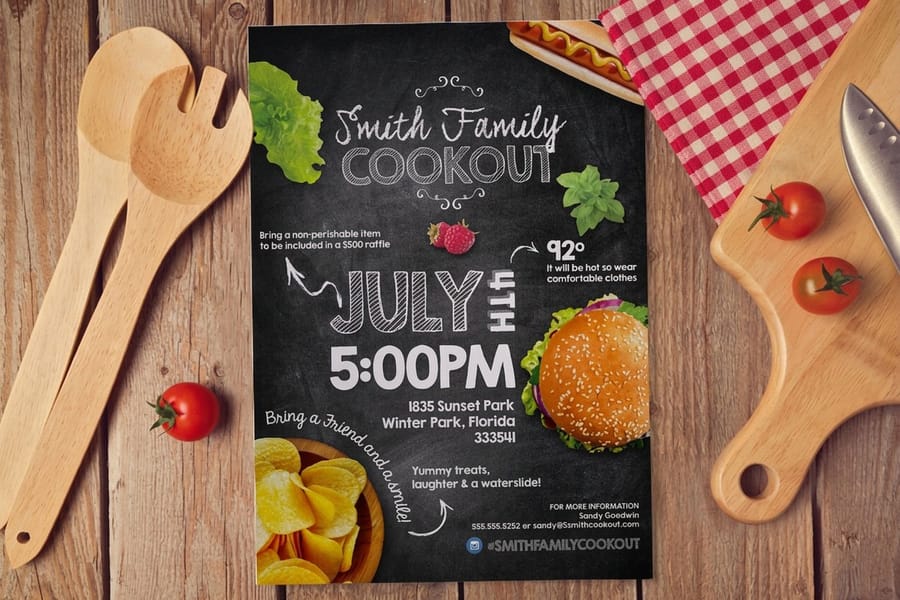
Strip an advertising flyer back and three things are load bearing: the offer, the deadline, and the single action you want taken. Everything else on the sheet exists to support those three or it is taking up space.
The offer is one thing, stated as a number where possible. Twenty dollars off a first visit beats great prices on all services, because the first is a fact the reader can picture and the second is an opinion. If your business genuinely has three offers worth running, that is three flyers or three staggered print runs, not three boxes on one sheet. A flyer that lists options is asking the reader to make a decision on a sidewalk, and the decision they make is to keep walking.
The deadline is what stops the flyer being filed. Print a real date rather than a vague limited time, because a date is checkable and a phrase is not. Thirty days out is usually enough to feel achievable and short enough to force a choice. If the offer genuinely never expires, invent a reason to act instead: first fifty customers, this weekend only, while the winter stock lasts.
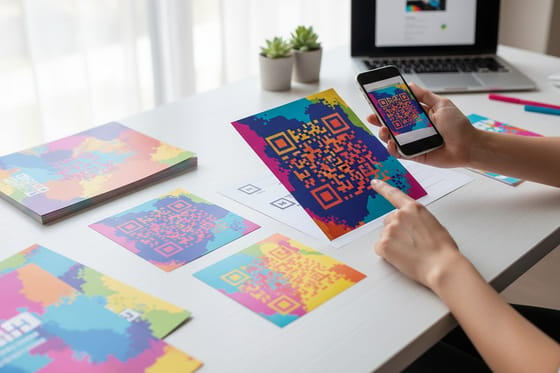
The action is one action. Call, scan, or bring the flyer in. Printing a phone number, a website, a QR code, three social handles and a store address gives five exits and dilutes all of them. Pick the one you can actually staff, make it the largest thing at the foot of the sheet, and let the rest be small print. Our guide to QR codes on print covers how to size and track a code properly if scanning is the route you choose.
Lay It Out for the Distance It Gets Read At

A flyer is not read once. It is glanced at from a few feet away, picked up and skimmed, then read properly later if it survived the first two passes. Design each zone for its own moment.
At six feet the reader sees one thing. That is the offer, and it needs to be genuinely large, the sort of size that feels wrong on your screen at 100 percent and looks correct once the sheet is printed. Print a draft, tape it to a wall and stand back. If you have to lean in to read the headline, it is too small, and no amount of clever type will fix it.
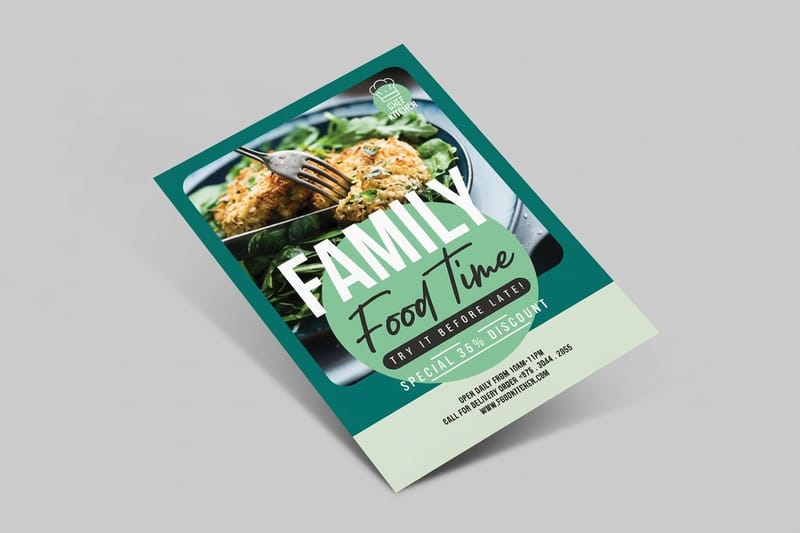
At three feet the sheet is in a hand. This is where a single image does its work: the food, the room, the finished lawn, the actual thing being sold. One good photograph beats four small ones, and a photograph beats a stock illustration of a smiling person almost every time. Keep the image at 300 ppi at its final printed size, because a picture that looks crisp on a screen at 72 ppi turns to mush on paper.
At arm’s length, hours later, the flyer is in a pocket or on a fridge. Now the small print matters: the expiry date, the address, the phone number, the redemption code. Keep all of it at least a quarter inch inside the trim edge. Text placed nearer than that is inside the cutting tolerance, and a stack of flyers trimmed on a guillotine shifts slightly through the lift, so the bottom sheets lose a sliver that the top sheets keep.
Size, Stock and Finish, and What Each Choice Costs You

Size and paper are where a flyer budget is won or lost, and the choices interact. A bigger sheet on lighter paper often reads as cheaper than a smaller sheet on a heavier one, because people judge print by feel before they judge it by size.
| Format | Best for | What it does well | Where it falls down |
|---|---|---|---|
| 8.5 x 11 in | Counter stacks, notice boards, mail inserts | Room for an image and real copy, cheapest per square inch | Awkward to hand over, gets folded and creased in a bag |
| 5.5 x 8.5 in | Handouts, table drops, bag stuffers | Lower cost per piece, fits a jacket pocket unfolded | Forces you to cut the copy hard, no room for a second image |
| 4.25 x 5.5 in | Street promotion, club and event nights | Cheap in volume, easy to carry a hundred of them | Only the offer fits, so the offer has to carry everything |
| 11 x 17 in | Wall postings, window displays, in-store signage | Readable across a room, doubles as a small poster | Too big to hand out, and the cost per piece climbs fast |
On stock, the practical split is simple. Text weight, roughly 70 lb to 100 lb, is the flyer standard: it is what people expect a flyer to feel like, and it is the reason standard flyers start at $39.54. Cover weight feels like a card and holds up on a counter or a pinboard for weeks, which is why business flyers start at $57.11. Club flyers start at $16.48 because the format is small and the runs are large.
Gloss coating deepens photographs and makes color look richer, and it also makes the sheet unwritable with most pens. If a server has to jot a table number on it or a customer has to write in a name, go matte or uncoated and accept slightly flatter images. Anything with a fold, such as a menu or a program, moves you into folded flyers from $68.54, and if you are weighing that against a multi panel piece, our comparison of flyers, brochures and booklets draws the line clearly. The full range of stocks sits in the flyer paper stocks guide, and sizes in the flyer sizes guide.
Building the File So the Press Gives You What You Designed
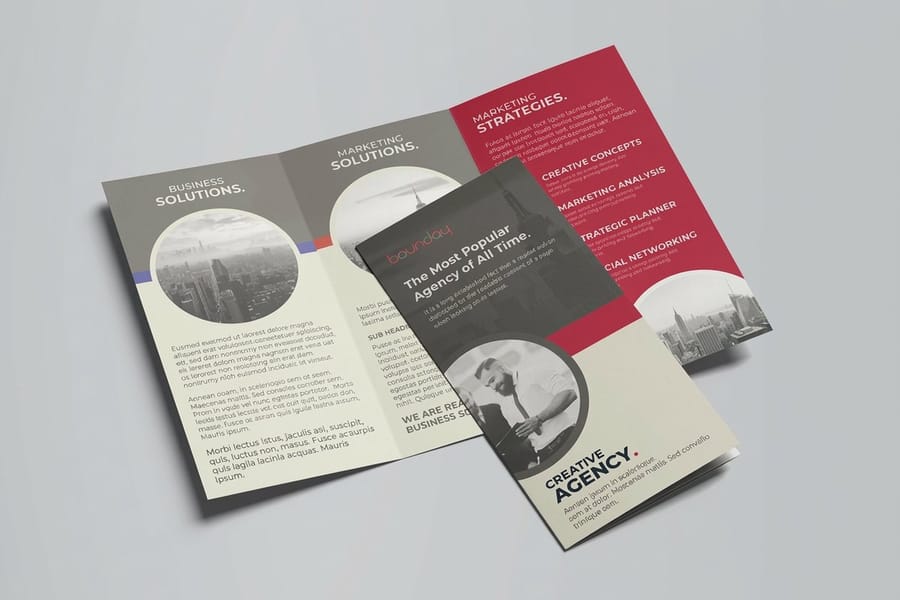
Most flyers that come back looking wrong were wrong in the file. Four settings account for nearly all of it.
- Bleed of 0.125 inches on every edge. Any color or image that touches the edge of the finished flyer has to run past the trim line by an eighth of an inch. Without it, the shift in the cutting stack leaves a white hairline down one side.
- A safety margin of 0.25 inches. Live text and logos stay inside that line. It is the single most common correction we send back on flyer artwork.
- CMYK, not RGB. Bright screen blues and neon greens have no ink equivalent and will print duller. Convert and look at the result before you approve it rather than being surprised by the box.
- Small black text at 100 percent K only. Body copy built from all four inks needs perfect registration to stay sharp, and at 8 or 9 point it will look slightly fuzzy or fringed if the press drifts even a fraction.
Export a flattened, press ready PDF at 300 ppi with fonts embedded or converted to outlines. If you would rather not build the geometry yourself, start from a correctly sized layout in the blank template library and drop your artwork in. For the wider workflow from file to delivery, the guide to how online printing works walks through the handoff, and if you are comparing suppliers on more than price, how to compare flyer printing companies lists what actually differs between them.
Where You Hand Them Out, and the One Place You Cannot
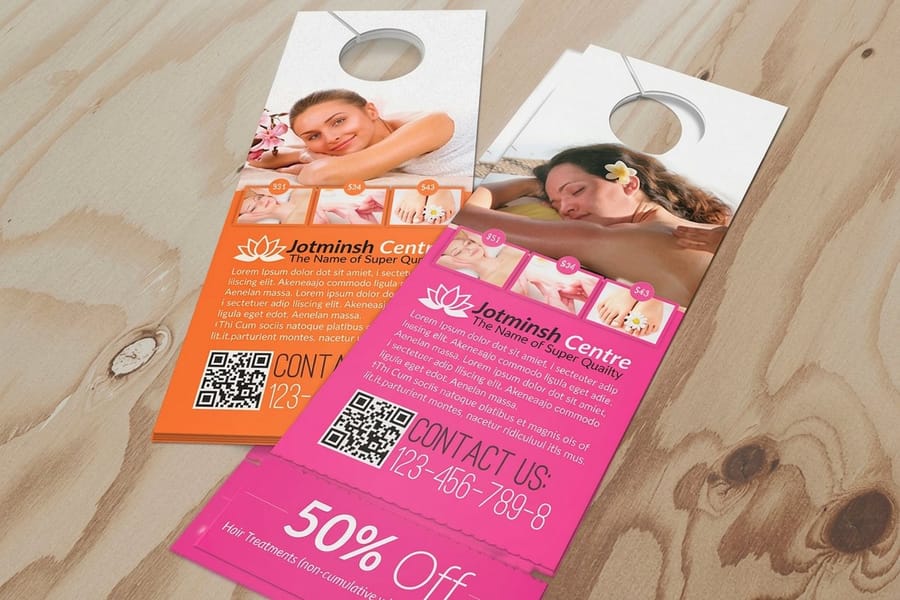
The distribution plan should exist before the design does, because it changes the design. A flyer handed over at a counter can carry more words than one wedged under a windshield wiper, and one pinned to a community board needs a headline that works from across a hallway.
The one hard rule: do not put a flyer in a mailbox. In the United States a residential mailbox is USPS property, and only material carrying postage may be placed in it. That covers the flag, the door of the box and the attached newspaper tube. The penalty is assessed per piece, so a single afternoon of well meant delivery can turn expensive. We set out the detail, and the routes that stay legal, in the guide to flyers and mailboxes.
What is left works well. Hand delivery to the door, wedged in the frame or under the mat, is legal in most places and gets read. Door hangers from $290.41 solve the problem properly because they hang where a hand will meet them and they cannot blow away, and the trade-offs against a flat sheet are laid out in door hangers against flyers. Counter stacks and bag inserts cost nothing to place and reach people who already chose to walk in. Windshields are legal in some cities and prohibited in others, so check the local ordinance before you print a thousand.
If you want the flyer to arrive in a mailbox properly, that is direct mail, with postage and an address list, and it is a different piece of print. Our EDDM guide explains the route that lets you mail a whole carrier route without buying a list. Whichever channel you pick, print more than you think you need: the marginal cost of the last five hundred is small, and running out mid campaign wastes the momentum you paid for. Ready to order, the full range sits under flyer printing.
The spelling question
Flier or flyer, settled
Both spellings are correct English and both appear in every major dictionary, so nobody is going to mark you wrong. Our own range spells it one way, as standard flyers, club flyers, business flyers and folded flyers, and the two words have separated by job. Flyer is now the standard spelling for a printed advertising sheet, and it is the form the AP Stylebook uses for a handbill, keeping flier for the idiom take a flier, meaning to gamble on something. British and Australian writers have used flyer throughout. Flier lingers in older American newspaper copy and in aviation, where frequent flier is still the fixed form.
Practically, this matters twice. Write flyer in your copy so it matches what your customers type into a search box, and use flyer in your file names and product pages so a search engine sees one consistent term rather than two thin variants of the same thing. If you inherited a site that mixes both, pick flyer, change the rest, and stop thinking about it. The same tidy-up logic applies to the word leaflet, which we untangle in the leaflet against flyer guide.
Wally explains the advertisement flyer
One offer, one date, one way to answer
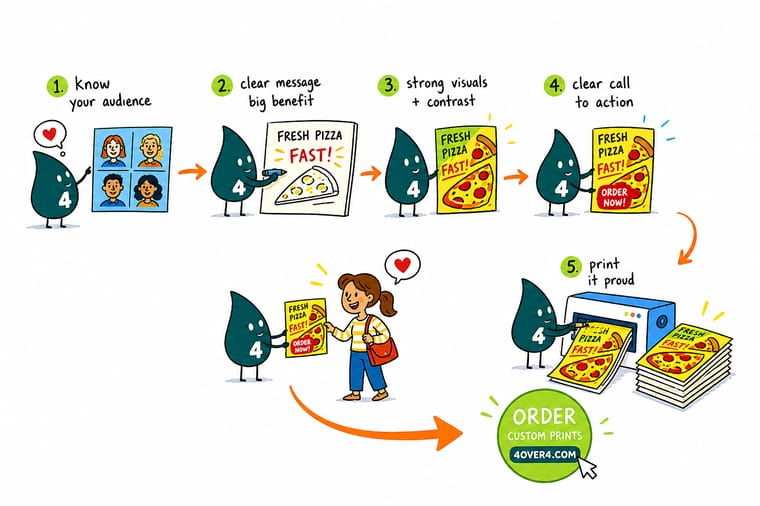
Wally puts the offer at the top big enough to read from across the street, one honest photograph in the middle, three short lines of proof under it, and at the foot the expiry date with a single way to respond. He keeps every word a quarter inch inside the cut line so the guillotine cannot take the phone number, and he runs the background an eighth of an inch past the edge so there is no white sliver. Then he decides where the stack is going before he exports, because a windshield drop needs half the words a counter stack can carry.
Configure your flyer printing →%22%2F%3E%3Ccircle%20cx%3D%2249%22%20cy%3D%2220%22%20r%3D%2224%22%20fill%3D%22%232dd4bf%22%20opacity%3D%220.15%22%2F%3E%3Ccircle%20cx%3D%2254%22%20cy%3D%2227%22%20r%3D%22-3%22%20fill%3D%22%232dd4bf%22%20opacity%3D%220.1%22%2F%3E%3Crect%20x%3D%2279%22%20y%3D%22-9%22%20width%3D%2234%22%20height%3D%2220%22%20rx%3D%224%22%20fill%3D%22%232dd4bf%22%20opacity%3D%220.08%22%20transform%3D%22rotate(44%2080%2030)%22%2F%3E%3C%2Fsvg%3E)
Specs and pricing
Flyer sizes, stocks and starting prices
Standard flyers start at $39.54 for 50, club flyers at $16.48 for 50, and folded flyers at $68.54 for 50, with sizes set on each product page.


Print it
Order the flyer that fits your drop
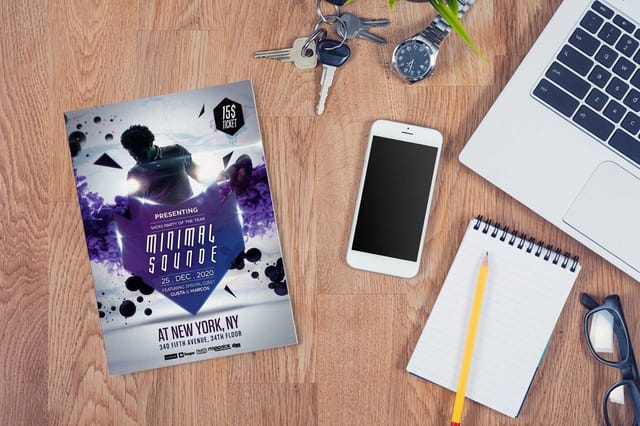
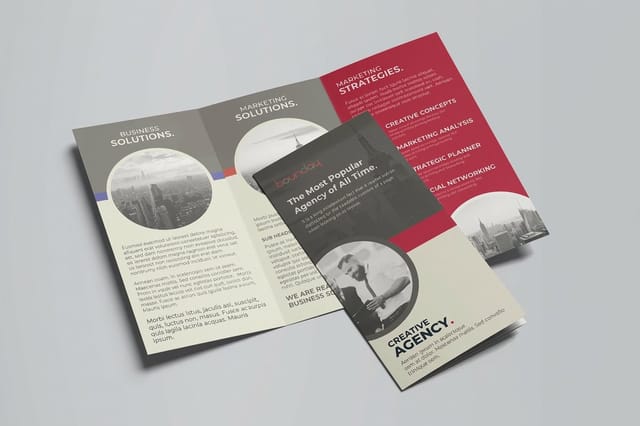
Club flyers print on 14pt gloss cover in sizes from 2.5 x 2.5 inches for street promotion and event nights, standard flyers print on 100 lb gloss text from 4.25 x 5.5 up to 11 x 17 inches for counter stacks and notice boards, and folded flyers carry a menu or a program that needs panels.


Explore more
Where to go next
Each flyer size set against its reach, text weight against cover weight, the legal routes around the mailbox rule, and how to size and track a QR code on a handout.
By the numbers
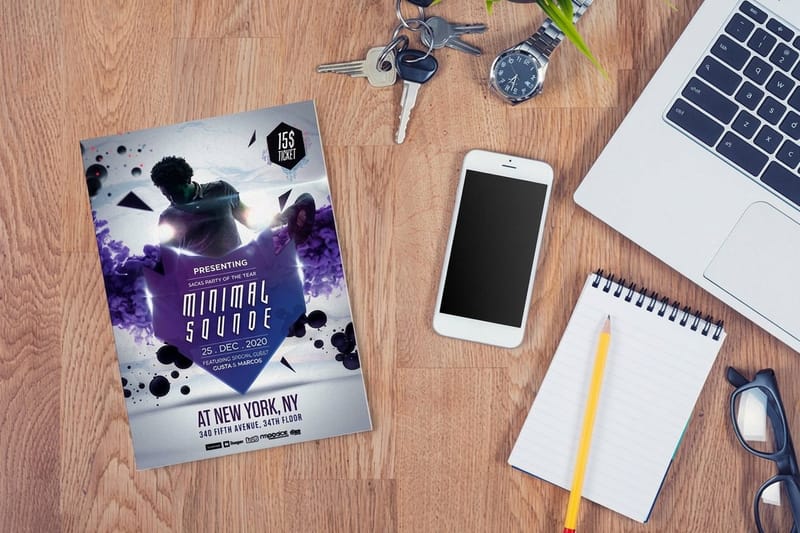
Flyers in three formats off one press
Common Questions
Your advertisement flyer questions, answered
Is it spelled flier or flyer?
Both are real words and both are in the dictionary, but they have drifted apart. For a printed sheet of advertising, flyer is now the standard American spelling: the AP Stylebook switched to flyer for a handbill and kept flier only for the idiom take a flier, meaning take a risk. British and Australian usage has always preferred flyer. Flier survives mostly in older American newspaper copy and in aviation, as in frequent flier. Use flyer in your headline, your file names and your web copy, and nobody will blink.
What size should an advertisement flyer be?
Letter size, 8.5 by 11 inches, is the default and the cheapest per sheet because it is the native size of the press sheet layout. Half page, 5.5 by 8.5, costs less per piece at the same quantity and is easier to hand to someone because it does not need folding to fit a bag. Quarter page, 4.25 by 5.5, is the handout size for street distribution and club promotion. Go up to 11 by 17 only if the flyer will be posted on a wall or a board where people read it from across a room.
What paper should I print advertising flyers on?
For a flyer that gets handed out and discarded within a week, 100 lb gloss text is the usual pick: it feels substantial, the colors are punchy, and it is inexpensive at volume. For anything that gets pinned up, left on a counter, or kept as a coupon, move to a cover weight so it does not curl or tear at the corner. Choose matte or uncoated if anyone needs to write on it, because a pen skates across a gloss coating and smears.
Can I put advertising flyers in mailboxes?
No. A residential mailbox is USPS property under federal law and only mail carrying postage may be placed in it, so a flyer tucked into a mailbox exposes you to a fine per piece. Wedging it into the flag, the door of the box or the newspaper tube counts as the same violation. The legal routes are hand delivery to the door, a door hanger on the knob, an insert under a doormat or windshield wiper where local rules allow it, or paying postage and mailing it properly.
How do I know whether a flyer campaign worked?
Give the flyer a response path that exists nowhere else. A redemption code printed next to the expiry date, a QR code pointing to a landing page that nothing else links to, or a phone extension used only on the flyer will each tell you exactly how many people came from the print run. Without one of those, you are guessing, and every flyer you print after that is a guess built on a guess.
How far ahead of an event should I print flyers?
Work backwards from distribution, not from the event. If you are handing flyers out for two weeks before an event, the print run has to be in your hands before that window opens, and you want a few days of slack for a proof correction. Two to three weeks ahead of the first distribution day is comfortable for a standard run. If the date is tight, order early in the week rather than Friday, because production days are business days.
Get Started
Upload the ad flyer with bleed and print it
Pick your size, choose a text or cover weight stock, upload the artwork with bleed, and we print flyers that hold their color and keep every word inside the trim.
Legal Disclaimer
Gold Standard guarantees apply to all standard orders placed through 4over4.com. Price match requires verifiable proof of a competitor's published price for an equivalent product with matching specifications and turnaround time. Satisfaction guarantee covers manufacturing defects and print quality issues. Contact support with order number and documentation.
