
Where to Hand Out Fliers and the Tactics That Get Them Taken


Sofia is our design and templates voice, built from the knowledge of our production team, with over 20 years in printing.
The spots where a stack of printed fliers keeps moving, how to work a street shift, the permission to ask for, the mailbox rule that carries a fine, and the point where a mailed postcard costs less than walking fliers and door hangers.
Hand fliers out where people have already stopped moving, and leave stacks only where a member of staff has agreed to keep them. A crossing wait, a queue outside a venue and a lobby counter all beat a mid block sidewalk, because somebody who is walking has an easy way to refuse and somebody standing still does not. Everything after that is logistics: ask before you leave anything behind, keep fliers out of and off mailboxes because federal law reserves them for stamped mail, and switch to a door hanger or a mailed postcard once the doors get too far apart to walk. Print the walk pieces as fliers or door hangers, and the mailed piece as direct mail postcards.

Quick answer
Position decides the take rate, permission decides the stack
Stand where the crowd is already stopped and hand the flier over yourself. Crossings, queues, market lines and lobby waiting areas all outperform an open sidewalk on the same shift. Indoors, the stack lives or dies on whether the person behind the counter agreed to it, so ask, leave twenty five, and come back. At residential doors the flier goes on the handle, in the storm door or under the mat, never in or on the mailbox. When the driveways get long and the doors thin out, stop walking and mail it.
Handing out flyers
Handing out flyers on a street shift, step by step
Handing out fliers works best with a small sheet, a stopped crowd and your own hand. Print a 4.25 by 5.5 or 5.5 by 8.5 inch flier on 100 lb gloss text, or 14pt gloss cover if it has to stand in a counter stack, from a run of 50. Watch the spot for fifteen minutes before you book the shift, stand at the crossing, queue or lobby where people are already waiting, and hand each flier over instead of offering it from a stack. Ask the counter staff before you leave twenty five behind, and keep every flier out of and off the mailbox.
Where Fliers Get Picked Up, and Where They Get Binned
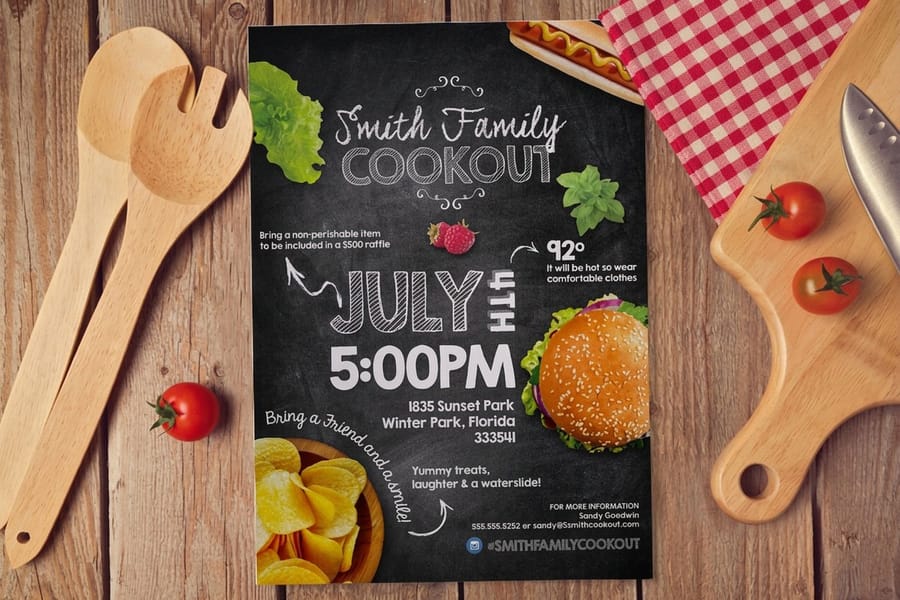
A flier only works in a place where somebody has a reason to look down. That is why counters, waiting areas and community boards carry stacks well, and why a table by an exit door does not.
The venues that reliably keep a stack share three traits: people wait there, staff are not too busy to say yes, and the audience overlaps with yours. Independent coffee shops, laundromats, public libraries, community and leisure centers, barbershops and salons, dental and veterinary waiting rooms, climbing gyms, hostels and hotel lobbies, university notice boards, tool hire counters and small grocery stores all qualify. Chains usually do not, because the manager on shift is rarely allowed to approve it.
- Ask the person actually working the counter. Not the owner by email, not head office. One sentence: what the offer is, who it helps, and that you will come back to top the stack up.
- Leave twenty five, not two hundred. A tall pile reads as clutter and gets moved to a back room. A short stack that runs out gives you a reason to return and a rough read on interest.
- Bring your own holder for a counter. A loose stack slides and gets tidied away. An acrylic stand keeps the top piece upright and visible.
- Date the bottom corner in small type. When you come back you can see whether the pile moved, which tells you more than any conversation with the staff.
Format matters at a counter more than people expect. A flat sheet lies down and disappears, so for a permanent lobby or a rack you are better off with rack cards, which start at $42.84 and stand up in a standard display. Keep the full sheet for the routes where somebody hands it over. Our list of twenty places to leave print fliers goes venue by venue if you want a route to work through.
Piggyback on Someone Who Is Already Making the Trip
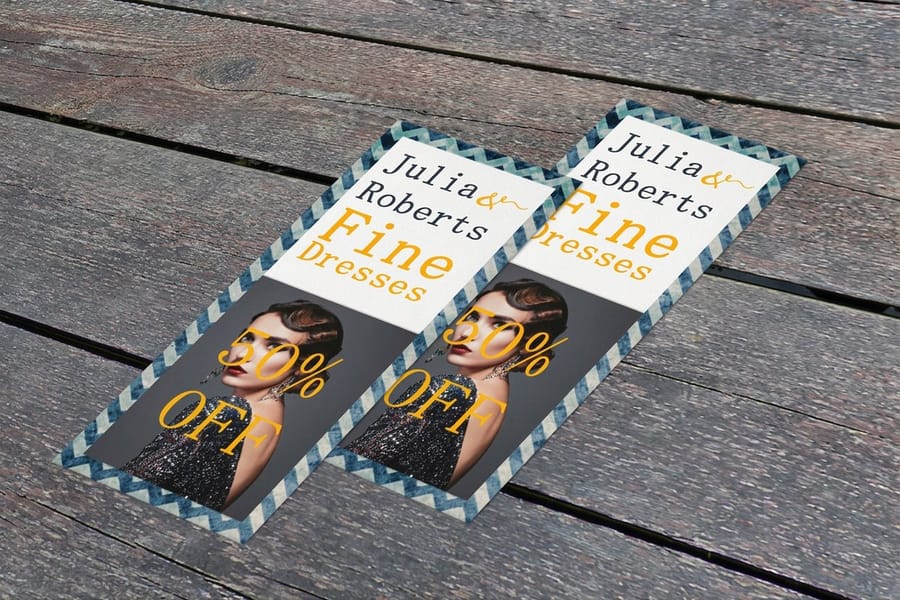
The expensive part of distribution is the walking, not the printing. Every route where somebody else has already gathered the audience is cheaper than one where you gather it yourself.
Local publications are the obvious version. Community papers, parish and school newsletters, and neighborhood association mailings all sell loose insert space, and the rate is usually quoted per thousand with your printed pieces delivered to them by a deadline. Ask two questions before you book: what the trimmed size limit is, and what weight they can take without changing the postage band on the whole issue. Both answers change what you print, which is why our guide to standard flyer sizes is worth reading before you commit to a layout.
The less obvious version is another business. A non competing shop with the same customer will often drop your flier into their bags for a fortnight, especially if you reciprocate. A gym and a physiotherapist, a florist and a photographer, a hardware store and a decorator: each pair shares a customer without sharing a sale. Get the reciprocation in writing with dates on it, or it quietly stops after the first week.
Trade shows, farmers markets and neighbourhood events are the third route, and there the flier usually needs a partner. A folded piece survives a tote bag better than a loose sheet, so brochures from $57.11 carry more when the recipient is going to read it later at home. If your booth needs both, print the flier for the handout and the brochure for anybody who stops to talk.
Working a Street Shift So the Flier Actually Gets Taken
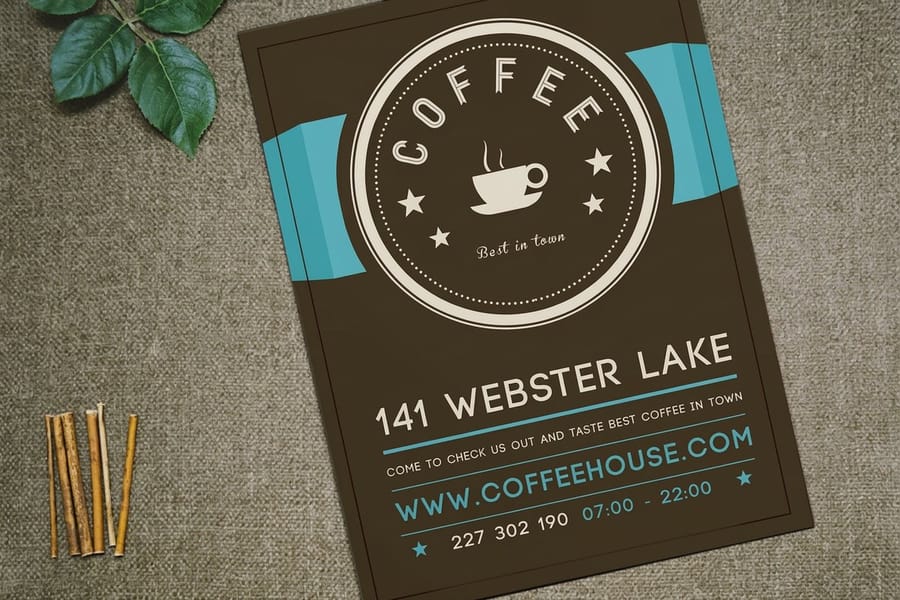
Hand to hand distribution is decided by where you stand, not by how good the design is. A person walking has an easy refusal available, and a person standing still does not.
Find the pause. Crossings where the light is long, the twenty feet past a transit exit rather than the exit itself, the queue outside a venue before doors, the tail of a market stall line, the smoking area outside an office block at lunch. Set up just past the thing that makes people stop, facing them as they come out of it. Standing directly in the doorway feels efficient and works badly, because the crowd is still accelerating and you are in the way.
- Hold the flier out flat and low, at chest height, image side up. A fan of paper waved at face height reads as an obstacle.
- Say one short line and make it about them. Free trial class Saturday. Half price lunch until three. Not the company name, which means nothing to a stranger.
- Two people on opposite sides of the flow beat two people together. A pair standing side by side gives the crowd a single wall to walk around.
- Wear something that reads at ten feet. An apron or a branded tee turns you from a stranger with paper into staff, and staff get taken from.
- Stop after ninety minutes. Take rate drops with the walker before it drops with the crowd, and a tired distributor works a shift out of the campaign budget for nothing.
Track the shift while it happens. Count out the fliers in bundles of fifty so you know how many left your hand per location, and print a different short code or QR destination for each spot. The QR code guide covers how to set that up without reprinting the whole run, and it is the only honest way to learn which corner is worth going back to.
Doors, Letterboxes, and the Rule That Carries a Fine

Door to door delivery is the highest coverage route you can run yourself, and the one with the most ways to go wrong. Start with the rule that costs money: in the United States a mailbox is reserved for postage paid mail.
That covers more than people assume. Inside the box, under the flag, taped to the post and inside the newspaper tube bolted beneath it are all off limits, and the penalty is assessed per piece rather than per route. Nothing about the rule stops you using the door itself. Wedge the flier into the handle, slide it into the frame of a storm door, tuck it under the mat, or post it through a letter slot where the property has one. We wrote the full detail in the guide to fliers and mailboxes, and it is fifteen minutes well spent before you brief a walker.
Wind and weather decide the format. A loose sheet at a detached house with no mat and no storm door is on the lawn within the hour, which is why door hangers exist. They start at $290.41 and hang at eye level until somebody takes them off, so the piece is still working when the household gets home at six. On apartment corridors and dense terraces, where there is a mat and no wind, standard flyers at $39.54 do the same job for a fraction of the price.
| Route | What you hand over | Who controls delivery | Where it falls down |
|---|---|---|---|
| Hand to hand | A flier, given to a person who took it. | You, in real time. | Reach is capped by daylight, weather and how long a person can stand up. |
| Counter stacks | A stack or a rack card the venue agreed to keep. | The venue, once you walk away. | No proof the pile was ever put out, and staff turnover ends the arrangement. |
| Door to door | A flier at the door or a hanger on the handle. | You or your crew, unsupervised. | Slow on long driveways, and one walker cutting corners wastes the run. |
| Mailed | A postcard or a mailed flier with postage on it. | The USPS, along a fixed carrier route. | Costs more per piece and you cannot pick individual houses on a route. |
Read the last column first. Every route on that table is fine until the thing in that column is the thing your campaign cannot afford, which is usually proof of delivery or speed of coverage. Our door hanger campaign guide covers crew briefing, route splitting and spot checks if you are hiring walkers rather than doing it yourself.
Permission, Permits and the Local Rules Worth Checking First

Two questions settle almost every distribution argument before it starts. Whose land am I standing on, and am I handing this over or leaving it behind?
Public sidewalk and handing over is the freest combination. Private land, or leaving pieces behind, is where the restrictions live. Malls, campuses, supermarket car parks, apartment lobbies, station concourses and business parks are private even when they feel public, and the operator can end your shift on the spot. Ask the center management office rather than a shop inside it, because the shop cannot grant common area access.
- Handbill and peddler permits. Many cities require one as soon as you put out a table, a stand or a sign, even when handing fliers by hand needs nothing. The city clerk is the office to call.
- Windshields. A growing number of towns ban fliers on parked cars outright, and the ban is usually written as littering, which puts the fine on you rather than the driver.
- No soliciting signs. Treat one as a hard no on a residential door, both because it is the neighborly thing and because ignoring it is what triggers the complaint that gets your whole route reported.
- Community boards. Most have a posting limit, a removal date and a stamp. Fliers without the stamp come down on the next tidy, so ask at the desk rather than pinning and hoping.
- Political and election work. Distribution rules tighten near polling places and inside a set radius on election day. Check the state election office, not the city.
None of it is difficult, and all of it is cheaper to check than to fix. The one rule with a federal statute behind it rather than a local ordinance remains the mailbox, and it is worth repeating to every walker on the first morning. If you would rather not manage any of this, the guide to flyer distribution services lays out what a paid crew does and does not take off your hands. When you pass out flyers yourself, pick the size and stock from our flyer printing range before you plan the route.
When Mailing Beats Walking, and What Makes a Flier Worth Keeping
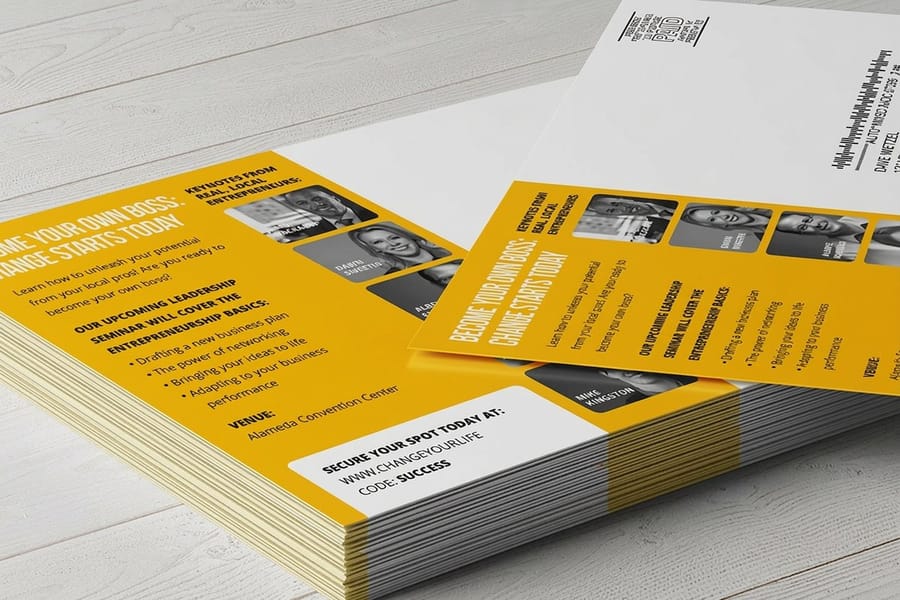
Walking a route is cheap right up to the moment it is not. The break point is distance between doors: on tight blocks a walker is unbeatable, and on quarter acre plots with long driveways the cost per delivered piece climbs with every gate.
Mailing removes the walk entirely, because the carrier is already on the street. Every door direct mail sends a piece to every address on a chosen carrier route without a purchased list, which suits a shop with a catchment rather than a list, and our EDDM explainer covers whether your business fits it. Where you need to pick specific households, direct mail postcards from $89.68 include the mailing, and standard postcards from $16.48 are the cheaper option when you have your own stamps and your own list. If the piece has to stay a full sheet, the guide to mailing fliers covers the folding and addressing rules that decide the postage band.
Whatever the route, the flier has to survive the first two seconds. One offer, not four. A deadline, because an offer without an end date gets put on a pile. The address and a map pin if you want visits rather than clicks. Enough white space that the offer is readable from arm's length in bad light. Print it double sided and treat the back as the side that gets seen when the piece lands face down at a door.
Stock does real work here. A thin sheet creases in a pocket and looks disposable, which is exactly the message you do not want on a piece somebody is meant to keep until Saturday. Our flyer paper weight guide explains the practical difference, and the blank template library gives you a correctly sized layout with the bleed already set so nothing important gets trimmed off. If you are still deciding between formats, postcards versus fliers compares them on cost, postage and how each one behaves in a hand.
Wally hands out the fliers
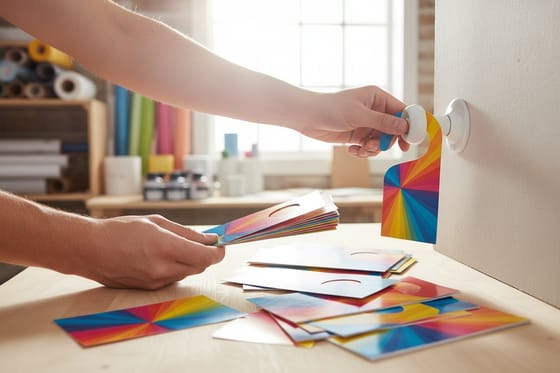
Stand where they stop, hang where the mailbox is not
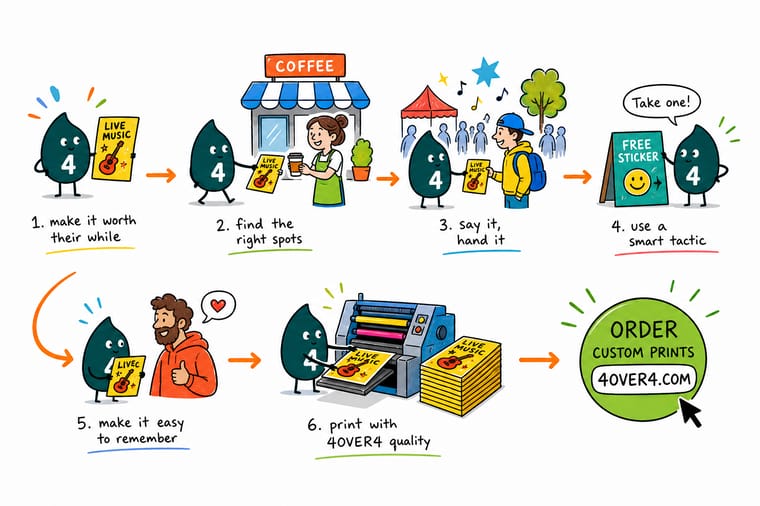
Wally does not chase anybody down the street. He waits at the crossing where the light is long, holds the flier out flat at chest height, and says one line about the offer rather than the company. Indoors he asks the person on the counter first, leaves twenty five instead of two hundred, and comes back on Friday to see whether the pile moved. At a house he uses the handle, the storm door or the mat, and he never touches the mailbox, because that box belongs to the postal service and the fine is charged per flier.
Print your fliers at 4OVER4.COM →%22%2F%3E%3Ccircle%20cx%3D%2243%22%20cy%3D%2245%22%20r%3D%2228%22%20fill%3D%22%23a78bfa%22%20opacity%3D%220.15%22%2F%3E%3Ccircle%20cx%3D%2280%22%20cy%3D%2262%22%20r%3D%2226%22%20fill%3D%22%23a78bfa%22%20opacity%3D%220.1%22%2F%3E%3Crect%20x%3D%2273%22%20y%3D%2221%22%20width%3D%2228%22%20height%3D%2232%22%20rx%3D%224%22%20fill%3D%22%23a78bfa%22%20opacity%3D%220.08%22%20transform%3D%22rotate(8%2080%2030)%22%2F%3E%3C%2Fsvg%3E)
Specs and pricing
Fliers, hangers and mailers, sized and priced
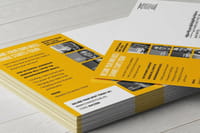
Fliers print from 4.25 by 5.5 to 11 by 25.5 inches on 100 lb gloss text from 50, door hangers at 3.5 by 8.5 to 4.25 by 14 inches on 14pt or 16pt gloss cover with a UV coating from 250, and direct mail postcards in nine sizes from 4 by 6 to 6 by 11 inches from 500, printed and mailed for you. Compare the three formats a distribution campaign uses, with live configuration options and starting prices straight from the 4OVER4.COM configurator.


Print it
Print the piece before you plan the route
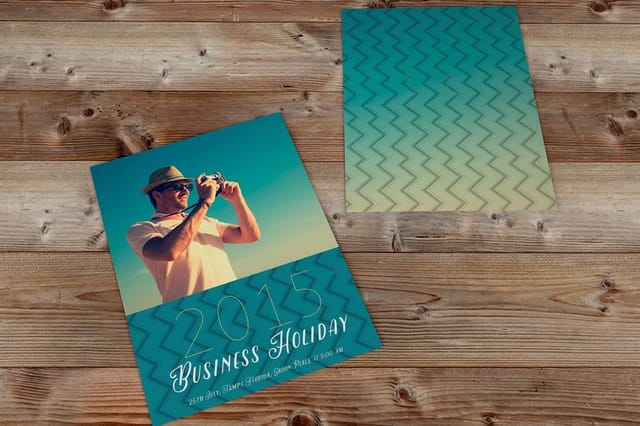
Print fliers for crossings, queues and counter stacks, door hangers for streets of detached houses where the flier has to hang on a handle, and postcards when the doors are too far apart to walk. A 4.25 by 5.5 inch flier on 14pt gloss cover stands up in a counter stack of twenty five better than a thin sheet.


%22%2F%3E%3Ccircle%20cx%3D%2242%22%20cy%3D%2249%22%20r%3D%2227%22%20fill%3D%22%23f59e0b%22%20opacity%3D%220.15%22%2F%3E%3Ccircle%20cx%3D%2278%22%20cy%3D%2258%22%20r%3D%2214%22%20fill%3D%22%23f59e0b%22%20opacity%3D%220.1%22%2F%3E%3Crect%20x%3D%2272%22%20y%3D%2229%22%20width%3D%2227%22%20height%3D%2234%22%20rx%3D%224%22%20fill%3D%22%23f59e0b%22%20opacity%3D%220.08%22%20transform%3D%22rotate(37%2080%2030)%22%2F%3E%3C%2Fsvg%3E)
Explore more
Where to go next
The distribution services guide compares a paid crew, EDDM and hand to hand on cost and proof, and the mailbox guide spells out the federal rule and the legal drop points at a door. The door hanger comparison shows which format a street of houses rewards, and the 20 places list names venues that keep a stack.



By the numbers
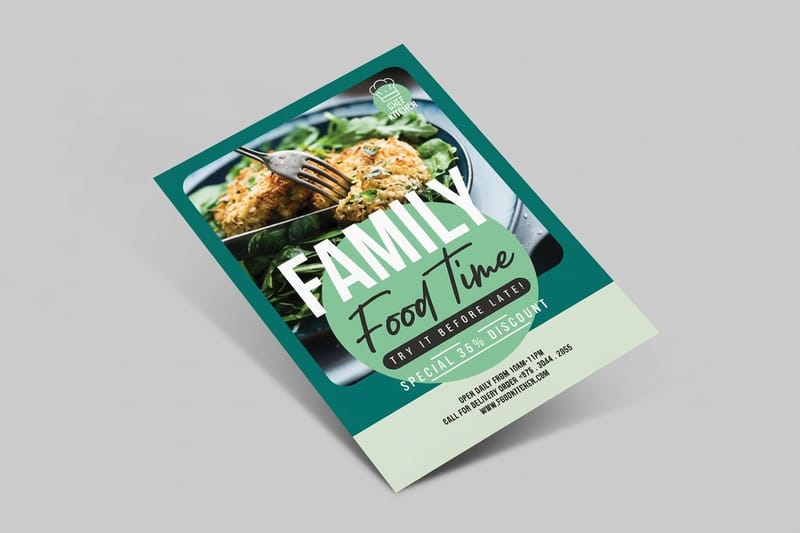
Flier runs that ship when you need to walk them
Common Questions
Your flier distribution questions, answered
Is it legal to hand out fliers on the street?
On a public sidewalk in the United States, handing a flier to somebody who takes it is normally allowed, and it is the drop that gets people in trouble rather than the handover. What changes by city is everything around it: many municipalities require a permit once you set up a table, a stand or an A frame, and some restrict commercial handbills in specific districts near stadiums, parks or transit entrances. Private property is a separate question entirely. A mall concourse, a campus quad, a supermarket forecourt and an apartment lobby are all private, and the owner can ask you to leave without giving a reason. Call the city clerk before a big campaign, and get the venue manager to say yes in writing before you work anywhere indoors.
Can I put flyers in mailboxes?
No. In the United States the mailbox is reserved for matter that carries postage, and that reservation covers the inside of the box, the flag, the post and the newspaper tube attached to it. Fines are assessed per piece, so a single walker on a long route can turn a cheap campaign into an expensive one in an afternoon. Use the door instead: wedged into the handle, tucked into the storm door frame, weighted on the porch or slipped under the mat. If a route really needs the mailbox, the piece has to be mailed, which is what our guide to sending fliers through the post and the every door direct mail route both cover.
How many fliers should I print for a walking route?
Count the doors, then order the next quantity break above that number rather than the exact count. Two things eat into a run: pieces that get creased, rained on or dropped, and the doors you decide to hit a second time when the first pass lands during a holiday week. Ordering the next break up is usually cheaper than a reprint, because the setup cost is spread over the whole run either way. If you are working several neighborhoods, split the order into batches by route and label the boxes, so a walker is not carrying fliers for a street they are not covering.
What is the best time of day to hand out fliers?
Whenever your specific crowd is standing still, which is a different hour for every venue. Office districts pause between roughly noon and one thirty. Transit exits back up at the evening peak. Event doors form a queue twenty to forty minutes before the show starts. A farmers market is busiest in its first two hours and empties fast. Gym foot traffic is heaviest early morning and immediately after work. Go and watch the spot for fifteen minutes before you book a shift, because the answer is visible from a bench and no general rule will beat it.
Should I use a flyer or a door hanger for door to door?
A door hanger stays where you put it and a flier often does not. On detached houses with wind, screen doors and no mat, a hanger is worth the extra cost because it hangs at eye level until somebody removes it, and it is still visible from the driveway that evening. A flier is the better buy on apartment corridors and dense terraced streets where there is a mat, a letter slot or a door frame to tuck it into, and where the door count per hour is high enough that the price per piece matters. Our comparison of door hangers against fliers goes through the durability and cost trade off in detail.
When does mailing beat walking a route?
When the addresses are spread out, when you are paying somebody by the hour, or when you need proof the piece was delivered. A walker is efficient on tight blocks and slow the moment driveways get long, so the cost per delivered piece climbs quietly as the neighborhood thins out. Mailing flips that: the carrier is already walking the route, so distance stops being your problem. Standard Flyers start at $39.54 and Direct Mail Postcards start at $89.68 at 4OVER4.COM with the mailing built in, which is the practical comparison to run before you commit a weekend to a route.
Get Started
Order 50 flyers from $39.54 for the first route
Pick a size, choose a stock heavy enough to survive a pocket, and print double sided so the piece still works when it lands face down at a door.
Legal Disclaimer
Gold Standard guarantees apply to all standard orders placed through 4over4.com. Price match requires verifiable proof of a competitor's published price for an equivalent product with matching specifications and turnaround time. Satisfaction guarantee covers manufacturing defects and print quality issues. Contact support with order number and documentation.
