
How to Run a Door Hanger Marketing Campaign That Books Jobs


Nadia is our customer education voice, built from the knowledge of our production team, with over 20 years in printing.
Route, offer, artwork, crew, and the quantity to order. The five decisions that separate a door hanger campaign you can measure from a box of paper in the garage, printed on door hangers, rip hangers with a tear-off stub, or plastic door hangers for wet weeks.
Run a door hanger campaign by picking a walkable route around a job you already did, printing one dated offer with a tracking code on it, hanging it on knobs rather than mailboxes, and ordering the door count you can actually reach plus about ten percent. The print is the cheap half. Crew hours usually cost more than the paper, and the campaign is only measurable if the unique phone number, QR code or tear-off stub was in the artwork before the press ran.

Quick answer
Route, offer, code, crew, quantity
A door hanger campaign works when the route is walkable, the offer is single and dated, and the tracking code is printed rather than promised. Choose the streets around a job you have already done, count the doors your crew can reach, print that number plus roughly ten percent, and give every neighborhood its own phone number or code so the second campaign is informed by the first. Hangers go on the knob, never in the mailbox. The funnel below shows which stages you can count for free and which one has to be designed in before the press runs.
A Door Hanger Campaign, From Order to Knob

A door hanger campaign runs in five steps: walk the route and count the reachable doors, write one dated offer, print a tracking code into the artwork, hang the pieces on knobs, and log the streets as the crew covers them. The printed piece is the part you order, and its specs are short.
| Product | Sizes | Stock and options | From |
|---|---|---|---|
| Door hangers | 3.5 by 8.5, 3.5 by 11, 4.25 by 11 or 4.25 by 14 inches | 14pt or 16pt gloss cover with High Gloss UV, printed one or both sides, optional perforation 2 inches from the bottom | $290.41 per 250 |
| Rip hangers | 3.5 by 11 or 4.25 by 11 inches | The same stocks with the tear-off stub perforated 2 inches from the bottom | $362.99 per 250 |
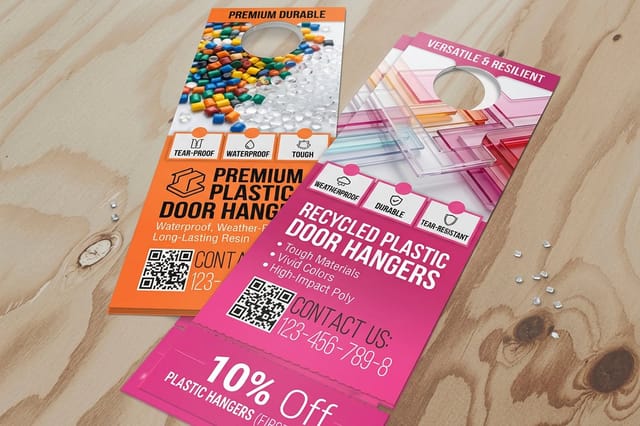
| Plastic door hangers | The same four sizes | For notices that have to stay on the door through rain | $290.41 per 250 |
Quantity steps are steep in your favor: 250 standard door hangers cost $290.41, 500 cost $311.24 and 1,000 cost $332.08, all on a seven business day standard turnaround. Order the door count your crew can reach plus about ten percent, and upload a PDF at the finished size with bleed and the die-cut zone clear.
Choose the Route First, Then Decide What to Print
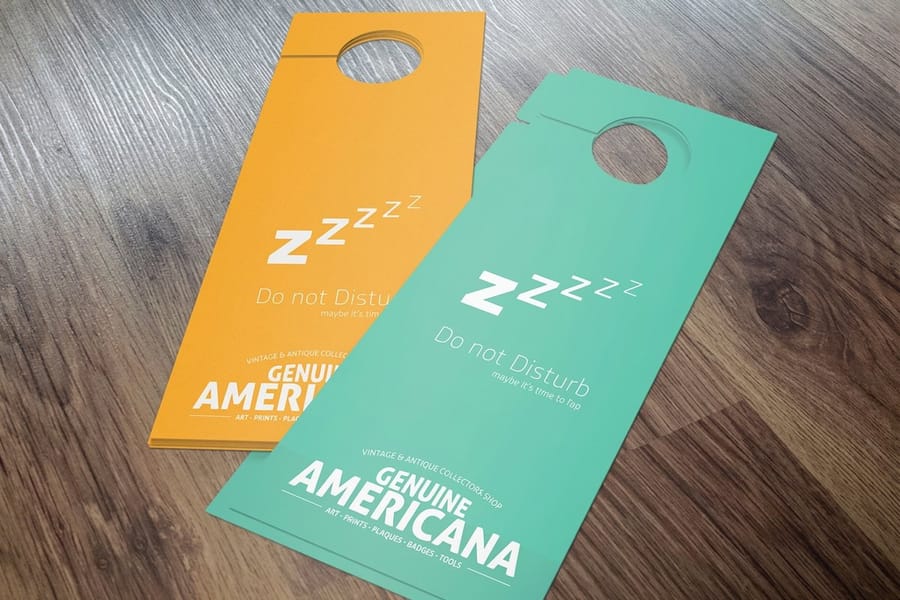
A door hanger campaign is a map exercise before it is a design exercise. The piece cannot be forwarded, cannot be re-targeted and cannot be sent to a list, so the only lever you have is which doors your crew walks past.
Start from a job you already did. Pick the street where you last installed a roof, resealed a driveway, or listed a house, and work outward from it. The neighbors watched the truck sit there for two days, which means the hanger arrives with context. That is the closest thing to warm distribution this channel offers, and it is why roofing door hangers and landscaping door hangers are usually hung in a ring around a finished job rather than scattered across a zip code. Our stories on a roofing door hanger and on landscaping door hangers show finished pieces, and the roofing door hangers video shows one on press.
Then walk the route once before printing. You are counting three things: doors you can physically reach, doors behind a controlled entry or a locked gate, and doors carrying a no-soliciting sign. Apartment buildings with a secured lobby drop out entirely. Long driveways slow a crew far more than the door count suggests. A street that looks like 200 addresses on a map is often 140 that a two-person crew can work in an afternoon.
Housing type matters more than income. Detached homes with a front door reachable from the sidewalk are the ideal case. Townhouse rows are faster still. Gated communities and high-rise buildings are not a targeting problem, they are a channel problem, and the answer there is direct mail rather than a longer walk.
The Offer Is the Campaign

Everything else on the hanger is packaging. A homeowner reads it standing at the door, one-handed, in the few seconds between taking it off the knob and deciding which pile it goes in, and in that window a single clear offer either survives or it does not.
Three rules hold up across trades. One offer, not two: a hanger promoting a spring tune-up and a referral bonus converts worse than either one alone, because the reader has to choose before they can act. A deadline, because an undated discount is a coupon that never gets used. And a specific action, which for local services almost always means a phone number rather than a form.
Make the offer match the season the piece is hung in. Gutter cleaning in late autumn, air conditioning service in the first warm week, snow clearing before the first forecast. Timing is worth more than the size of the discount, and it is free.
The tear-off stub deserves a decision of its own. Rip hangers carry a perforated section the customer detaches and keeps, which does two things at once: it puts your number in a wallet instead of a recycling bin, and it becomes the tracking token you hand back at redemption. They start at $362.99 against $290.41 for standard door hangers, so the stub costs real money. It earns it when the offer is redeemed in person and you want a physical count rather than an estimate. For a straight awareness drop with a phone number, the plain hanger is the better buy. Our guide on building an offer that creates new sales works through the discount structure itself.
Design for a Door, Not for a Desk

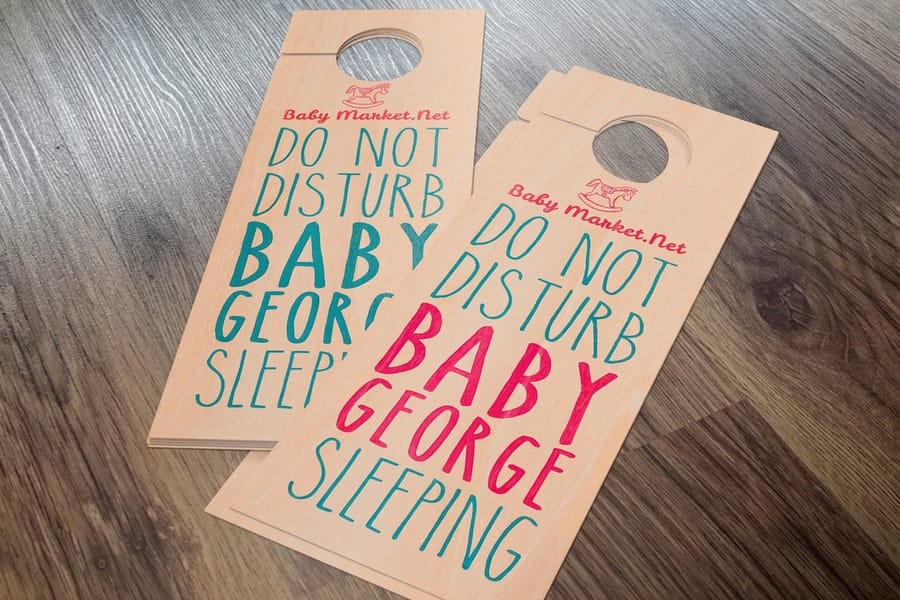
The layout constraint that catches people out is the hole. A door hanger has a die-cut opening at the top, usually with a slit down to it, and anything you place in that zone is either cut through or hidden by the knob. Treat the top two inches as unusable and start the headline below it.
Design the piece to be read at arm’s length. A headline that works on a monitor at 100 percent is often too small on a knob at chest height, so set it larger than feels comfortable in the file, keep the contrast high, and put the offer above the service list rather than under it. Photography competes with the offer for the same glance, which is why the hangers that perform are usually type-led with one supporting image.
Give the back a job. Most people flip a hanger once, so the back is where the service list, the license number, the service area and the tear-off code belong. A blank back is a wasted half of the piece.
| Element | Front | Back | Why |
|---|---|---|---|
| Offer and deadline | Yes, above the fold of the hand | Repeat it small | It is the only reason the piece gets kept. |
| Phone number | Large, once | Again with the tear-off | Local service buyers call, they rarely fill in forms. |
| QR code | Optional | Better here, with a caption | Needs a sentence telling the reader what it opens. |
| Service list | Three items maximum | Full list | The front sells one thing, the back proves range. |
| License, insurance, area | No | Yes | Reassurance is read second, after the offer lands. |
Build the file at the finished size with bleed, keep live copy clear of the die-cut, and outline your fonts before uploading. Start from a correctly sized layout in the blank template library, and if you are adding a scan target, our guide to QR codes on printed pieces covers size, quiet zone and the landing page they should point at. For the full artwork walkthrough, the door hanger design guide goes element by element.
Distribution, Crews, and the Rules That Actually Apply
The single legal rule you cannot bend is the mailbox. Title 18, Section 1725 of the US Code reserves mailboxes for material bearing postage, which is why door hangers hang and why the product is die-cut for a knob rather than folded for a slot. Do not tuck one behind a mailbox flag, wedge it in a mail slot, or leave it in the box because the door was awkward.
Everything else varies by jurisdiction. Plenty of cities require a solicitor or canvasser permit for door-to-door distribution, some require the crew to carry it visibly, and a few restrict hours. Posted no-soliciting signs and HOA rules should be treated as hard stops. One call to the city clerk before the first route settles it, and the door hangers legal guide lists what to ask.
Brief the crew on three habits. Hang, never wedge: a hanger jammed in a door frame falls into the yard and reads as litter. Skip a door that already carries one, since a second piece on top of a stale one is the fastest way to make a house look unoccupied. And log the streets as they are walked, because that log is the only record of stage two of the funnel above, and without it you cannot tell a weak offer from a route that never got covered.
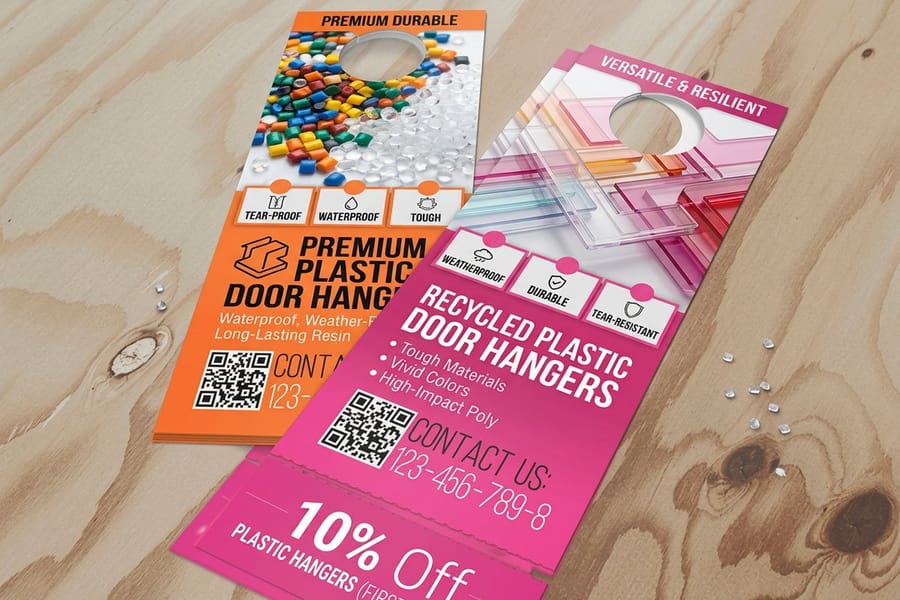
Weather decides the stock. Card stock is fine for a dry weekend drop and cheaper per piece. Plastic door hangers hold up through rain and wind, which matters for service reminders and property notices meant to stay readable for days. The tradeoff is straightforward: paper for a short promotional window, plastic when the piece has to outlast the weather. If your route keeps hitting gates and controlled entries, stop stretching the crew and read door hangers versus flyers before you spend more on walking.
Quantity Math and What the Campaign Really Costs
Work the arithmetic in two numbers: cost per door and cost per booked job. The first is fixed and knowable before you print. The second is the only one that decides whether you run the campaign again.
Cost per door is your print total plus your distribution cost, divided by the doors you actually reached. Standard door hangers start at $290.41 at 4OVER4.COM and rip hangers at $362.99, so the printing is the smaller half of most local campaigns. Two people walking an afternoon at a normal hourly rate usually costs more than the paper they are carrying, which is the number people forget when they compare printers on price alone.
Cost per booked job is that total divided by the jobs the campaign produced. You can only compute it if the artwork carried the tracking code, which is the point of the diagram above: stage three has to be designed in before the press runs. Give each neighborhood its own code or its own number and the second campaign stops being a guess.
Print for one repeatable route plus about ten percent. The margin covers rain damage, doors the crew has to skip and return to, and the second pass you will want on whichever street responded. Ordering triple what a crew can walk in a weekend does not buy scale, it buys a box in a garage. When the addressable area grows past what walking covers, that is the moment to move the overflow to postcards and read how to run a direct mail campaign, rather than printing more hangers than there are reachable doors.
One more line item worth budgeting: a second drop on the streets that responded. Repeating a proven route costs the same per door as the first attempt and lands on people who have now seen your name twice, which is a better use of the next $290.41 than opening a new neighborhood you have never walked.
Wally walks the route
One offer, one code, one street at a time
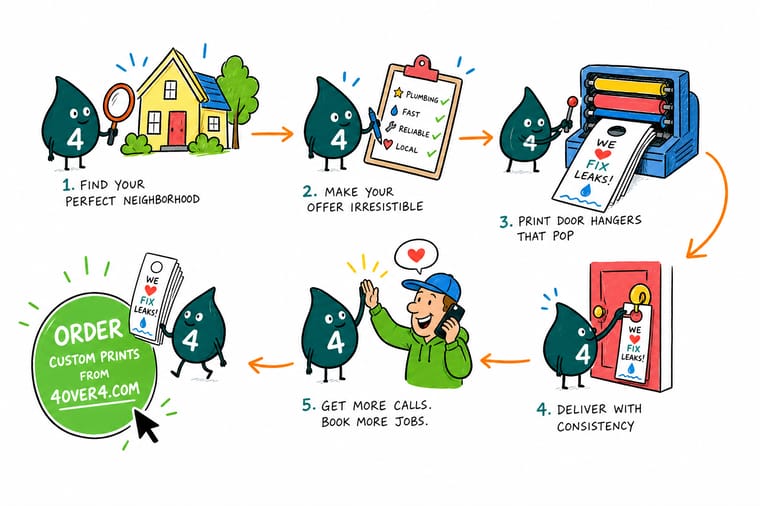
Wally picks the block around the job he finished last week, walks it once and counts the doors he can actually reach. He prints that many plus a few spare, puts one dated offer on the front and a tear-off code on the back, then hangs them on knobs and never near a mailbox. He writes down which streets he covered. When the calls come in quoting the code, he knows exactly which street to walk again.
Order door hangers →
Specs and pricing
Door hanger stocks, sizes, and starting prices
Door hangers and landscaping hangers both start at $290.41 for 250, rip hangers at $362.99, and each product page sets its own sizes.



Standard, rip and plastic
Print the hangers for your next route
Standard hangers for a dry weekend drop, rip hangers when the tear-off stub is your tracking code, and plastic hangers for service notices that sit on the door for days.



Sizes, rules and response data
Where to go next





Printed in our Queens plant since 1999
Door hanger campaigns run on 25 years of printing
Common Questions
Your door hanger campaign questions, answered
Is it legal to put door hangers on houses?
Hanging a printed piece on a doorknob is generally legal, and putting anything in a mailbox is not. Title 18, Section 1725 of the US Code reserves the mailbox for material that carries postage, and that includes the little flag-post box at the end of a driveway. The rules that actually vary are local: many cities and counties require a solicitor or canvasser permit for door-to-door distribution, some subdivisions and HOAs ban it outright, and a posted no-soliciting sign should be treated as binding whether or not your city enforces it. Call the city clerk before the crew starts, and read the full breakdown in our door hangers legal guide.
How many door hangers should I print for a first campaign?
Print for one repeatable route rather than for a number that sounds impressive. Count the addressable doors on the streets you chose, subtract apartments with controlled entry and any block you cannot legally canvass, then print that figure plus roughly ten percent for weather damage, misprints in the field, and the second pass you will want on the best street. A crew of two working detached homes covers a few hundred doors in an afternoon, so a first test that a single team can finish in one weekend is easier to judge than a citywide drop you cannot repeat.
What day should the hangers go out?
Hang them so they are found on the day the customer can act. Home services do better when the hanger is on the knob Thursday or Friday and the homeowner is standing in the yard on Saturday deciding what needs doing. Restaurants and takeaway offers want the piece to land close to the meal it is selling. What you should avoid is leaving a hanger out over a long absence: a piece that sits on a knob for four days signals an empty house, which is a real concern for the homeowner and a reason your crew should never double-hang a door that already has one.
How do I track responses from a door hanger?
Give the hanger a response path that nothing else in your marketing uses. The three that work are a dedicated phone number that only appears on this piece, a QR code pointing to a landing page with its own URL, and a tear-off stub carrying a code the customer hands over at the counter. Rip hangers exist for exactly this, since the stub separates cleanly and ends up in a wallet. Whichever you choose, it has to be in the artwork before the file goes to press, and the code should be different for each neighborhood so you learn which route to repeat.
Paper or plastic for door hangers?
Paper for a single-weekend promotional drop, plastic when the piece has to survive weather or stay on the door for a while. Standard door hangers print on card stock that holds a crisp fold-free hang and takes a heavy ink coverage well, and they are the cheaper option per piece. Plastic door hangers do not soften in rain, do not tear off the knob in wind, and suit service reminders, utility notices, and property management notes that need to stay legible for days rather than hours.
Do door hangers work better than flyers or mailers?
They win on placement and lose on reach. A door hanger sits at eye level on the one object every resident touches on the way in, so it is not competing with a stack of mail, and it can go out tomorrow without a mailing list. Direct mail reaches households a crew cannot walk, arrives regardless of gates and dogs, and scales past the point where walking is practical. The honest split most local businesses land on is hangers for the dense streets near the job they just finished, and postcards for everything beyond walking distance.
Get Started
Order 250 rip hangers from $362.99
Pick the stock, add the tear-off if you want a physical count, and we print hangers that survive a doorknob and a weekend of weather.
Legal Disclaimer
Gold Standard guarantees apply to all standard orders placed through 4over4.com. Price match requires verifiable proof of a competitor's published price for an equivalent product with matching specifications and turnaround time. Satisfaction guarantee covers manufacturing defects and print quality issues. Contact support with order number and documentation.
