
How to Design Custom Thank You Notes That Still Feel Handwritten


Sofia is our design and templates voice, built from the knowledge of our production team, with over 20 years in printing.
Four panels, one envelope size, and one decision about how much to print. Build it so a person keeps it instead of recycling it.
Design a custom thank you note on three panels and leave the fourth blank for the pen. Put one mark, monogram or photo on the front, keep a small name line on the back, and size the card at 4.25 by 5.5 inches so it drops into a standard A2 envelope. Choose uncoated stock near 14pt so ink dries instead of smearing, and print the message only once the quantity climbs past roughly 100 pieces.
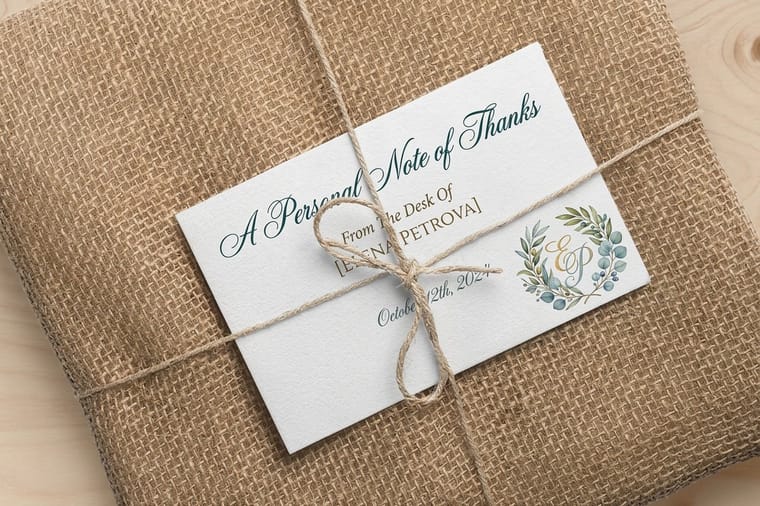
Quick answer
Three panels you design, one you leave alone
A customized thank you note is a folded or flat card printed on the outside and deliberately empty where the message goes. Size it at 4.25 by 5.5 inches so it fits a standard A2 envelope, print one idea on the front with an eighth of an inch of bleed, hold type an eighth of an inch inside the trim, and specify uncoated stock so a pen works. Print the message itself only when the quantity makes handwriting impractical, and even then sign each card by hand.
The Four Things You Actually Customize
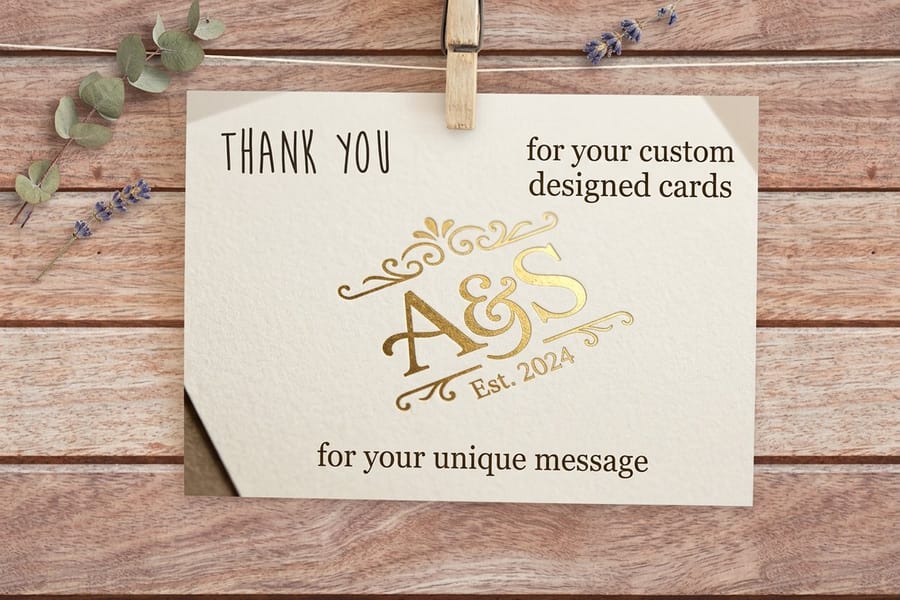
Custom on a thank you note means four decisions, and only four. Everything else in a design brief is a variation on one of them.
Format and size. Folded or flat, and which envelope it has to live in. A folded note gives you a blank inside spread and hides a shorter message comfortably. A flat card is cheaper and firmer, and it suits a printed message with a signature underneath.
The artwork. The front panel, and optionally a small mark on the back. This is where a monogram, a logo, a pattern or a photo goes.
The wording that gets printed. Anything from nothing at all, through a single Thank You on the inside left, to a full printed message with a printed signature.
Stock and finish. Weight, color of the sheet, coated or uncoated, and whether you add a foil or raised treatment.
The trade-off nobody warns you about lives in the third decision. Every extra printed word makes the note faster to send and less convincing to receive. A card that arrives with the entire message printed reads as a mailing, not a thank you, no matter how good the paper is. Design the first two decisions hard, keep the third one thin, and spend the saved effort on the fourth. If you want the full comparison of folded against flat before you commit, our folded card printing guide covers how the score and the panel order work.
Size the Card to an Envelope You Can Buy
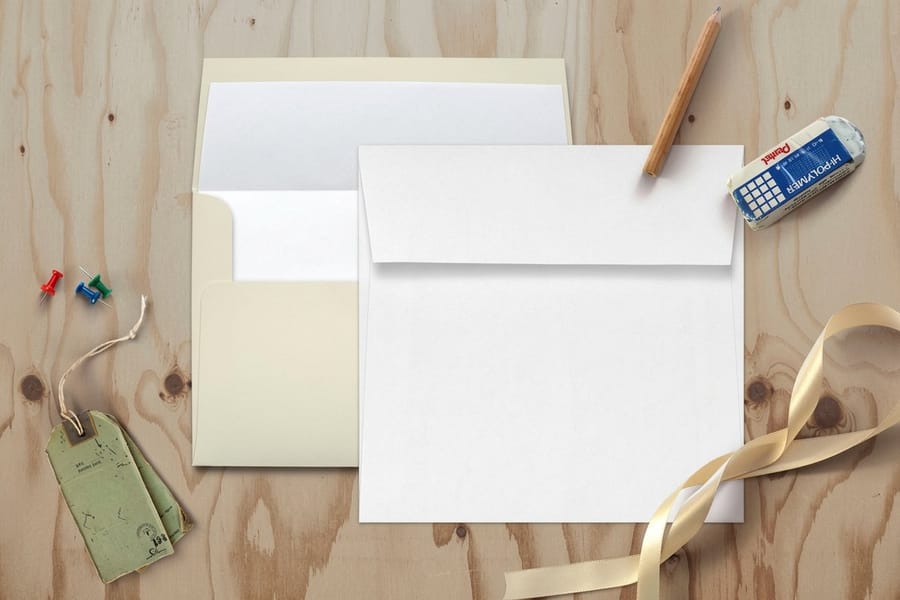
Pick the envelope first. Card sizes in the A series exist because envelopes in the A series exist, and every one of them leaves the same eighth of an inch of clearance so the card goes in without a fight and does not rattle around.
| Card size | Envelope | What it suits | The catch |
|---|---|---|---|
| A1, 3.5 x 4.875 in | A1, 3.625 x 5.125 in | Gift enclosures and two line notes. | Too small for a real message once you fold it. |
| A2, 4.25 x 5.5 in | A2, 4.375 x 5.75 in | The default thank you note, folded or flat. | None worth mentioning, which is why it is the default. |
| A6, 4.625 x 6.25 in | A6, 4.75 x 6.5 in | Longer messages and heavier stationery sets. | Envelopes are stocked less widely than A2 and A7. |
| A7, 5 x 7 in | A7, 5.25 x 7.25 in | Photo fronts, weddings, graduation sets. | Postage rises once the piece gets thick or rigid. |
| 4 x 6 in postcard | None | Fast business follow ups sent in volume. | Anyone at the mailbox can read the message. |
A folded A2 note prints flat as one 8.5 by 5.5 inch sheet with a score down the center, so build the file at the flat size and mark the fold. Order the envelopes at the same time. A bright white card arriving in a natural white envelope is the most common self inflicted wound on a custom set, and blank envelopes start at $13.17, which is less than the cost of reprinting because two whites did not match. The full size chart across every folded format sits in the greeting card size guide.
Design the Front Around One Idea
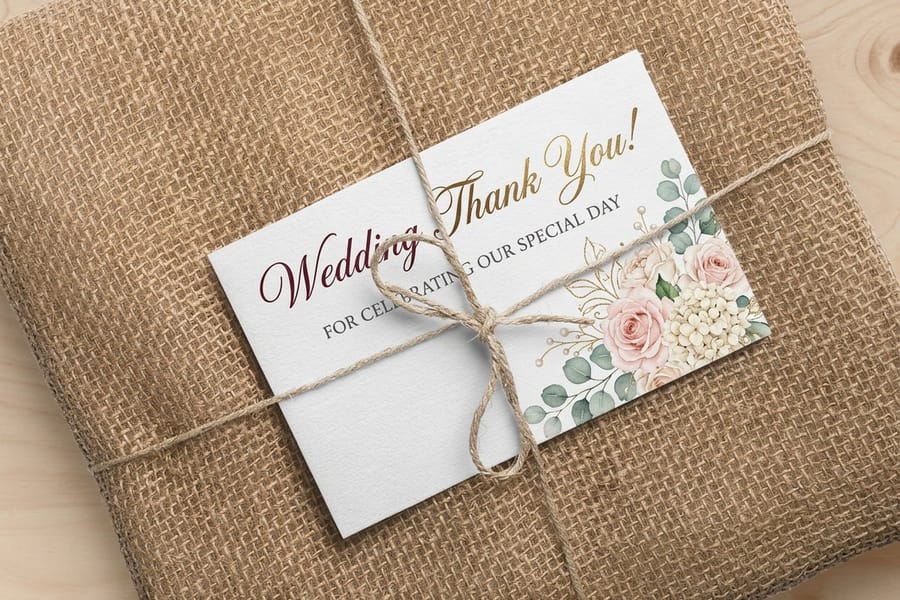
The front panel is roughly 4.25 by 5.5 inches. That is smaller than a postcard, and it holds one idea comfortably, two badly, three never.
Work out what that idea is before you open the file. For a wedding it is usually a monogram, a date, or one photograph. For a business it is the logo at a size that would look almost too large on a business card. For a graduation set it is the year and the school color. Then give it room: center it, let it occupy the middle half of the panel, and stop.
Three measurements do the rest of the work. Extend any background color or photo an eighth of an inch past the trim on all sides so the cut never leaves a white sliver. Hold every piece of type an eighth of an inch inside the trim, because a card trimmed a hair off center will otherwise clip a letter. And on a side folded card, remember the fold is on the left of the front panel, so a design that reads across the fold has to be built on the flat sheet, not on two separate pages. Start from a correctly sized layout in the blank template library, or build the whole thing in the browser with our online design templates if you do not have InDesign or Illustrator on the machine.
Set type at 8 point or above on a card this size, and resist a script face below 10 point. Scripts lose their thin strokes at small sizes on uncoated stock, which is exactly the stock you want for a note people write on.
Print the Message, or Leave the Space Empty
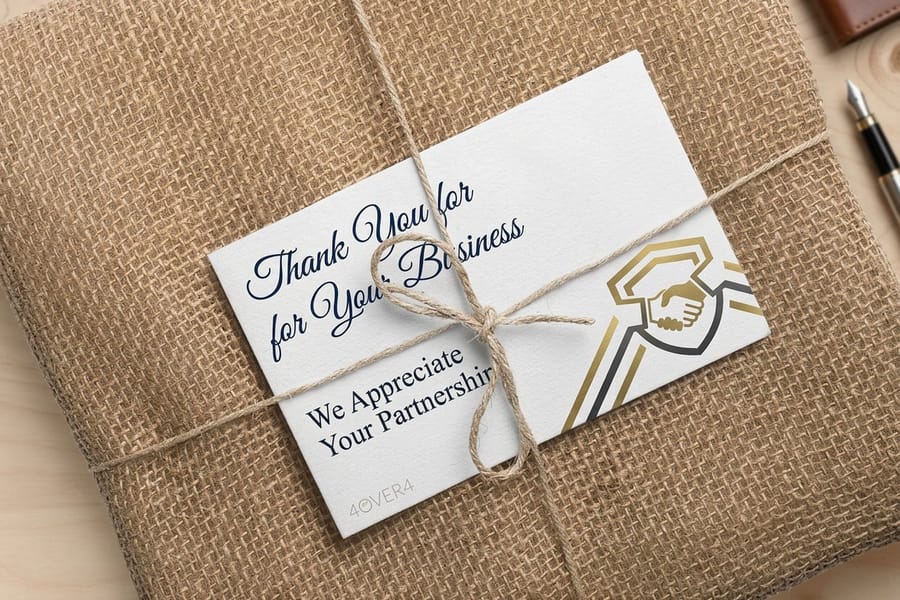
This is where a custom thank you note either works or quietly fails, and the deciding factor is quantity rather than taste.
Under about 100 cards, print nothing inside. Handwriting 40 notes takes an evening, and every one of them beats a printed paragraph. Over 100, print a short heading or a single opening line, then write two sentences and sign it. The economics flip because the writing time stops being an evening and becomes a week, but the signature still costs seconds and carries most of the sincerity.
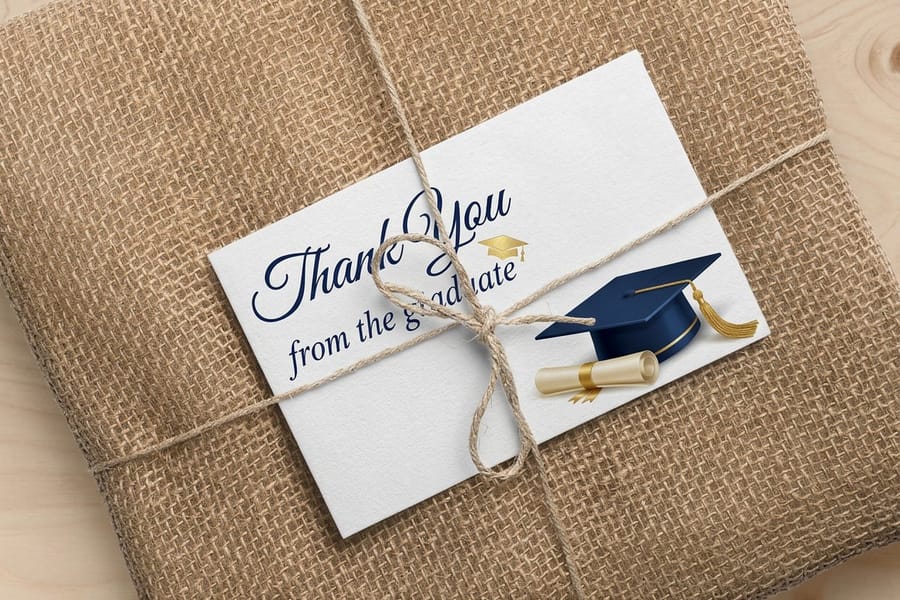
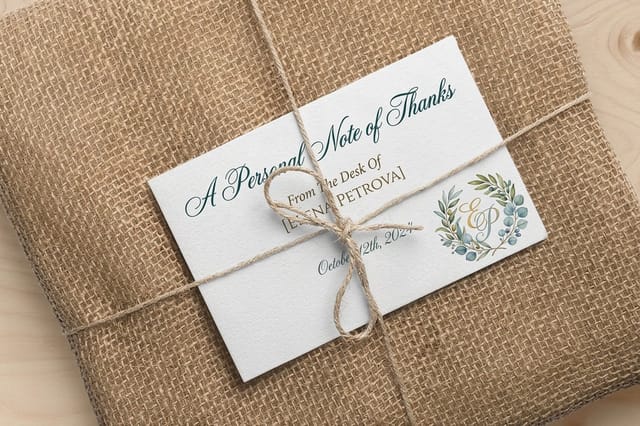
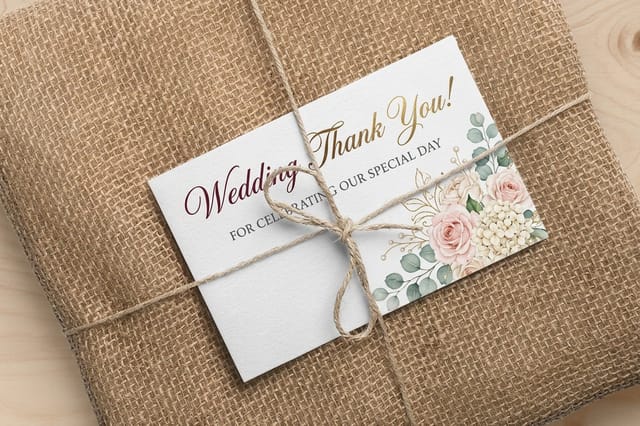
The occasion sets change what gets printed, not the principle. Business thank you cards from $19.77 usually carry the logo on the front and the company name on the back, with the inside kept blank so a salesperson can name the actual meeting. Wedding thank you cards at the same starting price often print a monogram and the date on the front, because the couple will name the specific gift by hand, and the wedding thank you cards story shows a finished set. Graduation thank you cards follow the same pattern with the year on the front. The general thank you cards product starts at $19.77 as well and lets you upload whatever front you have already designed.
One rule survives every occasion: name the specific thing. A note that says thank you for the generous gift is a form letter with better paper. A note that says the cast iron pan has already been used four times is the reason the card gets kept on a fridge. Printing that sentence is impossible, which is the whole argument for leaving the space empty. If your volume genuinely rules out handwriting, switch format rather than pretending, and send standard postcards from $16.48 instead, sized and worded for what they are. Our thank you postcard guide covers that route.
Stock, Coating, and Getting the File Out the Door
Uncoated is the answer whenever a pen is involved, and it is worth understanding why so you can argue the point with a designer who wants gloss. Uncoated fibers stay open, so ink soaks in and dries. A gloss or UV coating is a sealed film, and water based ink from a gel or rollerball pen beads on top of it and stays wet long enough to smear against the opposite panel when the card is folded shut.
For weight, 100 lb cover, near 14pt, is the sensible floor for a folded note. Step up to 130 lb, near 16pt, if the card is flat rather than folded, since a flat card has no fold to stiffen it and a thin one arrives bowed. Heavier than that and the score has to be deeper or the fold cracks along the fibers, which is a conversation to have before the file is built rather than after the box arrives.
Building the file takes four steps that never change. Set the document to the flat size, 8.5 by 5.5 inches for a folded A2, with an eighth of an inch of bleed on every edge. Put a guide at the center fold. Convert type to outlines and place images at 300 dpi at final size. Export a print ready PDF with bleed included and no crop marks unless the product asks for them. If you have never done a folded file before, the panel by panel walkthrough in how to design a greeting card in InDesign maps one to one onto a note card.
Then order for the whole set rather than the card alone. Cards, matching envelopes, and if the thank you note belongs to a wider identity, the letterhead and notecards that go with it. Our guide to personalized stationery and letterhead shows how the pieces line up, and the custom printing collection is where you configure size, stock and finish across the whole range. For a memorial service, funeral thank you cards personalized with a name and dates follow the same three panel rule.
Wally explains custom thank you notes
Print three panels, leave the fourth for the pen
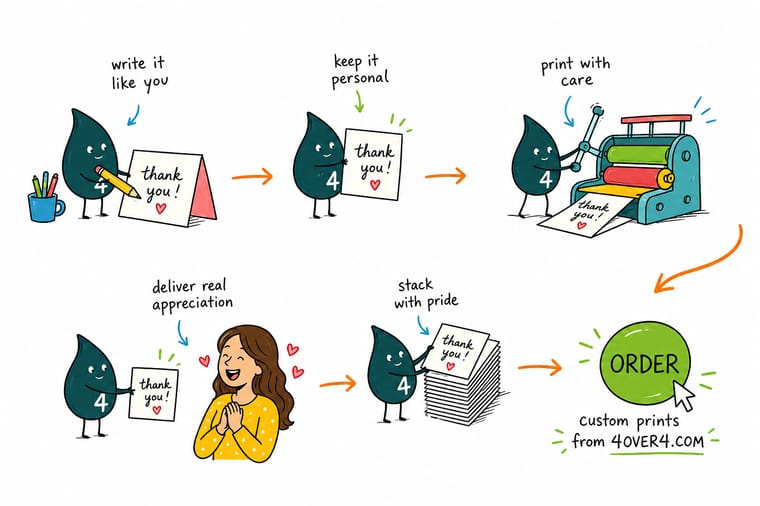
Wally puts one mark on the front, a small name line on the back, and maybe a light tint inside on the left. Then he stops. The inside right panel stays white, because that is where you write the sentence that names the actual gift, and no printed paragraph can do that job. He cuts the card at 4.25 by 5.5 inches so it slides into an A2 envelope, and he orders the envelopes at the same time so the two whites match.
Order custom thank you cards →%22%2F%3E%3Ccircle%20cx%3D%2248%22%20cy%3D%2220%22%20r%3D%2223%22%20fill%3D%22%23334155%22%20opacity%3D%220.15%22%2F%3E%3Ccircle%20cx%3D%2254%22%20cy%3D%2227%22%20r%3D%22-3%22%20fill%3D%22%23334155%22%20opacity%3D%220.1%22%2F%3E%3Crect%20x%3D%2278%22%20y%3D%22-9%22%20width%3D%2233%22%20height%3D%2220%22%20rx%3D%224%22%20fill%3D%22%23334155%22%20opacity%3D%220.08%22%20transform%3D%22rotate(43%2080%2030)%22%2F%3E%3C%2Fsvg%3E)
Specs and pricing
Thank you card sizes, stocks and starting prices
Thank you cards, business thank you cards and wedding thank you cards all print at 4.25 by 5.5, 5 by 7 or 6 by 6 inches from 25 cards, with matching blank envelopes as an option. Compare the occasion sets side by side, with live configuration choices and starting prices straight from the 4OVER4.COM configurator.

Print it
Order the cards and the envelopes together
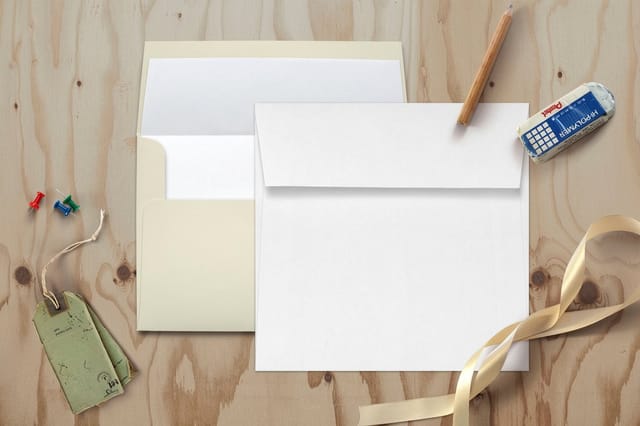
A 4.25 by 5.5 inch card takes an A2 envelope at 4.375 by 5.75 inches, so order the thank you cards and the blank envelopes in the same cart and the two whites match when the note is opened.
Explore more
Where to go next
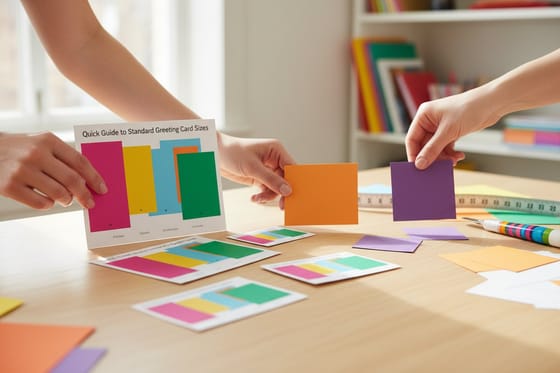
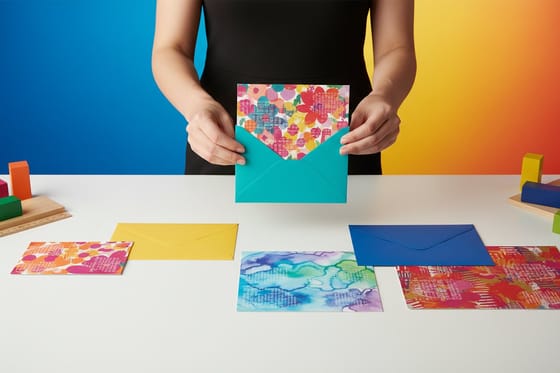
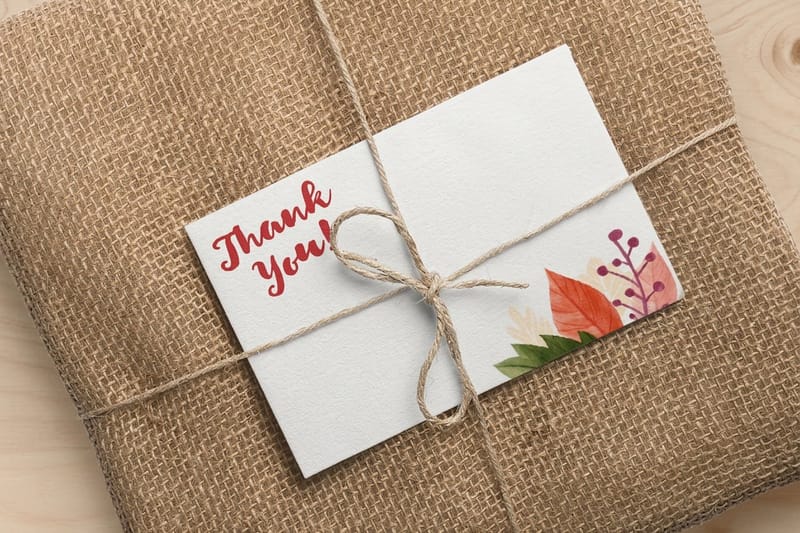
Flat against folded note cards, every standard card size with its envelope, matching a card to an envelope you can buy, and the thank you postcard when no envelope is needed.


By the numbers
The stationery printer, by customers and years
Common Questions
Your custom thank you note questions, answered
What size should a custom thank you note be?
A2 is the default for a reason. Folded, the card measures 4.25 by 5.5 inches and slides into a standard A2 envelope of 4.375 by 5.75 inches with an eighth of an inch of clearance all round. Printed flat before folding, that same card is one 8.5 by 5.5 inch sheet with a score down the middle. Go smaller with A1 at 3.5 by 4.875 inches if the note is a gift enclosure of two lines, or larger with A7 at 5 by 7 inches if a photo is the point. Anything outside the A series means sourcing envelopes separately, which is usually a worse trade than resizing the card.
Should the thank you message be printed inside or handwritten?
Handwritten, unless the quantity makes it impractical. The value of a thank you note is the evidence that someone spent two minutes on you specifically, and a printed paragraph removes exactly that. The workable middle is a printed heading such as Thank You on the inside left, or a short printed line at the top of the inside right, with the body and the signature written by hand. Around 100 pieces is the point where most people switch to a printed message, and even then signing each one by hand is worth the extra hour.
What stock takes a pen best on a thank you note?
Uncoated cover stock in the 100 lb to 130 lb range, which corresponds roughly to 14pt and 16pt thickness. Uncoated fibers absorb ink, so a ballpoint or gel pen dries instead of beading. Gloss and UV coatings sit on the surface and reject water based ink, which is why a glossy card smears under a thumb minutes after you write on it. If you want a coated front for the artwork, order uncoated on the writing side and check that the product allows a different finish per side before you build the file.
Do matching envelopes come with the cards?
Not automatically, so order them in the same cart. A2 envelopes are the match for a 4.25 by 5.5 inch card, and buying them alongside the cards keeps the white point consistent. A bright white card in a natural white envelope looks like two unrelated purchases the moment the recipient opens it. Blank Envelopes start at $13.17 at 4OVER4.COM, and if you want a return address printed on the flap, allow for that in the file setup rather than adding a sticker later.
How many custom thank you notes should I order?
Count the people you owe a note, add roughly 15 percent, and round up to the next quantity break. The spare covers spoiled cards, the two people you forgot, and the one that gets a pen blot. After a wedding, the usual undercount comes from couples counting invitations rather than gifts, because several households send more than one gift and a few guests who did not attend still sent something. Reprinting a small run costs more per card than the extra you would have bought the first time.
Can I put a photo on a custom thank you note?
Yes, and it works best when the photo fills the whole front panel with bleed rather than sitting in a frame in the middle. Supply it at 300 dpi at final print size, which for an A2 front means about 1275 by 1650 pixels, and keep faces and any type at least an eighth of an inch inside the trim. One caution on graduation and wedding photos taken on a phone: check the file at full size before you upload, since a shot that looks sharp on a screen can print soft at 5 inches wide.
How soon after the event should thank you notes go out?
Two weeks is the practical answer for most occasions, and for a business thank you the same week is better because the point is to be remembered while the meeting is still fresh. Weddings carry the longest grace period, commonly cited as up to three months, though notes that arrive in the first month get a noticeably warmer response. The design decision that follows from this is simple: order the cards before the event, not after, so the only thing standing between you and the mailbox is the writing.
Get Started
Order 25 thank you cards from $19.77
Pick the size, choose an uncoated stock a pen behaves on, add matching envelopes, and we print thank you cards that leave you the space to say something true.
Legal Disclaimer
Gold Standard guarantees apply to all standard orders placed through 4over4.com. Price match requires verifiable proof of a competitor's published price for an equivalent product with matching specifications and turnaround time. Satisfaction guarantee covers manufacturing defects and print quality issues. Contact support with order number and documentation.
