
How Sticker Sheets Work and When to Choose Them Over Singles


Jordan is our labels, packaging and sustainability voice, built from the knowledge of our production team, with over 20 years in printing.
A sticker sheet is a set of stickers sharing one backing, and we print it in six sheet sizes from 5 by 7 up to 11 by 11 inches. A kiss cut makes it possible, the machine needs a cut file, and a sheet is the wrong choice for some jobs.
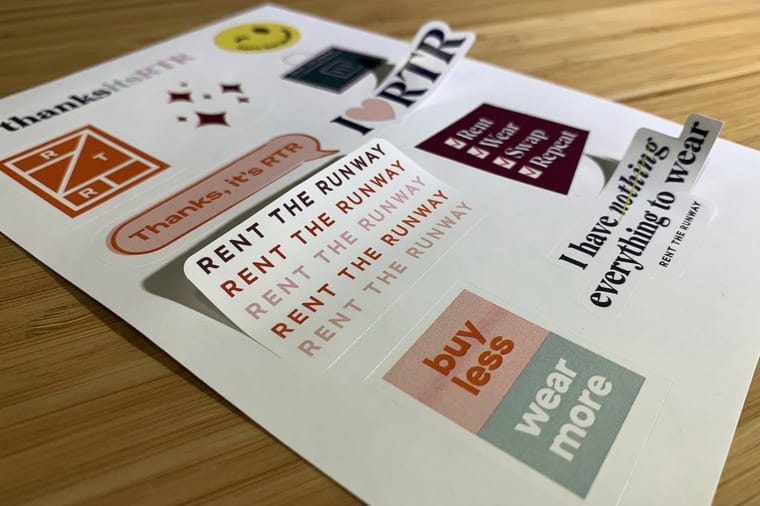
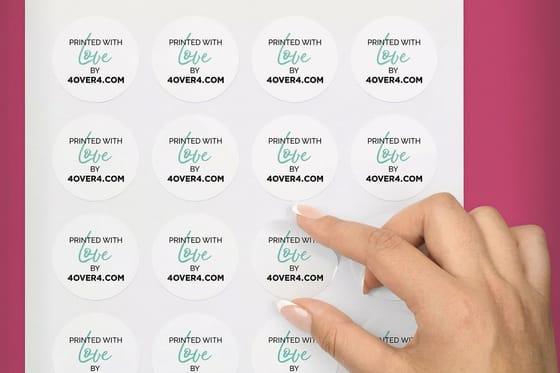
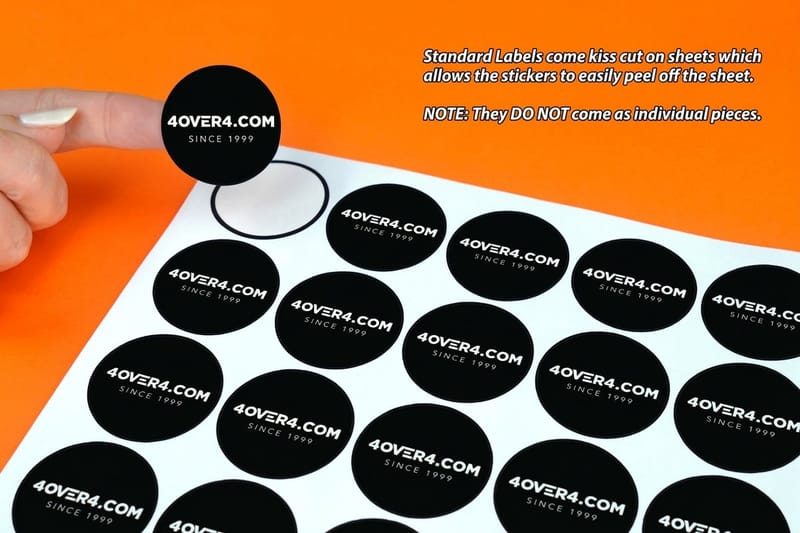
A sticker sheet is several stickers kiss-cut onto one shared liner, so the blade parts the printed face and the adhesive but stops before the backing. Each sticker peels off on its own while the sheet stays flat and whole. You use one when a set belongs together: a pack to sell, packaging seals, a product line, or event handouts. Sheets run 5 by 7 up to 11 by 11 inches on paper label or white vinyl, and every order needs a vector cut file alongside the artwork.
Quick answer
One backing, a whole set, and a blade that stops short
Sticker sheets exist because of where the blade stops. A kiss cut goes through the face material and the adhesive and halts on the liner, which leaves every sticker sitting in the sheet it was printed on. The set stays flat, posts cheaply, and can carry a different design in every position at no extra cost. The trade is that you are buying a printed sheet rather than a sticker, so a sheet only makes sense when the stickers genuinely belong together.
Sheet sizes
Sticker sheet sizes at a glance
We print sticker sheets in six sizes: 5 by 7, 5.5 by 8.5, 7 by 9, 8 by 10, 8.5 by 11 and 11 by 11 inches. Pick 5 by 7 for a small icon set or a pack dropped in an order, 7 by 9 when a retail pack of about a dozen 2 inch stickers has to fit, and 11 by 11 for a full variety pack or one large decal. Sheets print on uncoated, semi-gloss or hi-gloss label paper, or on white vinyl in a permanent or repositionable adhesive, and 25 sheets start at $181.24.
Definition
A sticker sheet, defined by its cut
A sticker sheet is one printed sheet holding several stickers, each kiss-cut through the face and adhesive so it peels off alone while the liner stays whole. You order it by sheet size and by how many stickers sit on each sheet, from one up to 26 or more, and every position can carry a different design. Send the CMYK artwork plus a vector cut file in 100% black at 0.5pt or 1pt, and the cutter follows that path.
What a Sticker Sheet Actually Is
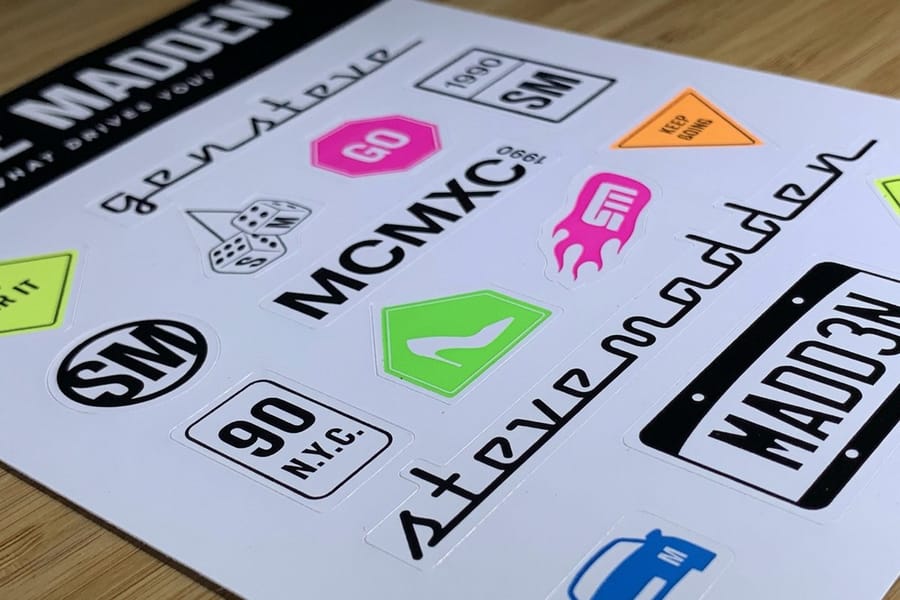
Pick up any sticker and you are holding three layers: the printed face, a layer of adhesive underneath it, and a silicone-coated liner that the adhesive releases from. A sticker sheet changes only one thing about that stack. Instead of giving each sticker its own scrap of liner, it puts a whole set of them on one large piece.
The cut that makes this work is called a kiss cut. The blade drops through the face material and the adhesive, then stops before it reaches the liner. Nothing is cut out. The stickers are still sitting in the sheet they came from, held by the backing alone, which is why the sheet arrives as one flat rectangle you could put in an envelope without a stiffener.
That single detail drives everything else on this page. It is why a sheet can carry twelve different designs for the price of one, why you have to supply a separate cut file, and why a sheet posts far more cheaply than the same twelve stickers loose. If you want the cut itself pulled apart in more depth, our kiss cut vs die cut guide walks through both blade depths. To see the finished article, look at sticker sheets in the configurator.
How the Kiss Cut Is Made and What Your Cut File Has to Do
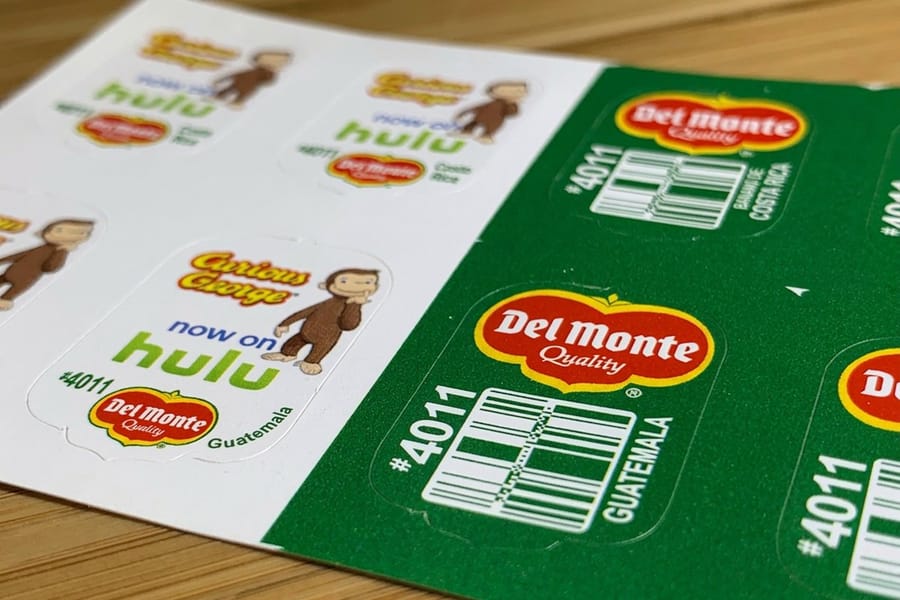
The press prints your artwork on the label stock in full color. The sheet then goes to a cutter that follows a vector path you supply, with the blade pressure set to part the face and the adhesive without scoring the liner. Get that pressure slightly high and the liner splits, which is the single most common way a sheet is ruined in production.
Because the cutter follows a path rather than reading your picture, the path has to arrive as its own file. Every sticker sheet order at 4OVER4.COM needs two things: the CMYK artwork for the front, and a cut file that is vector, saved as EPS or PDF, drawn in 100% black at either 0.5pt or 1pt line weight. Not a JPEG of an outline. Not a black shape filled solid. A stroked path, at that weight, in that color.
A few habits prevent almost every reprint. Keep the cut path closed, so it starts and ends at the same point. Put it on its own layer named clearly rather than mixed into the artwork. Extend the printed art about an eighth of an inch past the cut path on every sticker, so a small drift in registration still leaves color to the edge instead of a white sliver. And avoid cut paths that come within a hair of each other, because two stickers sharing a near-identical edge can tear each other when the first one is peeled.
Sticker Sheet Sizes and How Many Stickers Fit
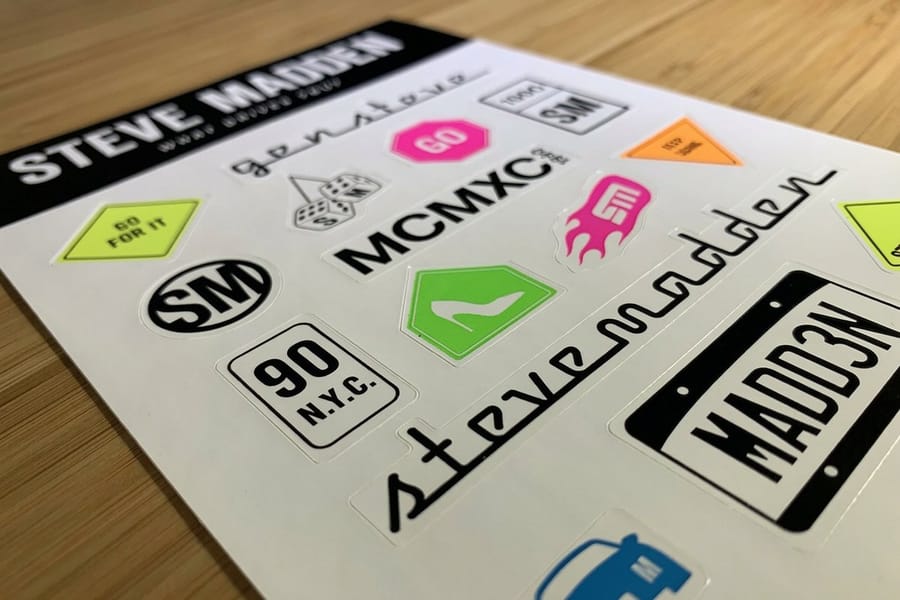
Sheets come in six sizes: 5 by 7, 5.5 by 8.5, 7 by 9, 8 by 10 and 11 by 11 inches, with a custom size available up to 11 by 11. The size question is really a layout question, so work it backwards. Decide how big each sticker needs to be, allow a quarter inch clear margin around the sheet and about an eighth of an inch between neighbours, then see what grid fits.
| Sheet size | Usable area at 0.25 in margins | 2 in squares that fit | Where it lands |
|---|---|---|---|
| 5 x 7 in | 4.5 x 6.5 in | 6 | The compact default. A small icon set, or a card-sized pack to drop in an order. |
| 5.5 x 8.5 in | 5 x 8 in | 6 | Half-letter. Same count as 5 by 7 at 2 inches, but far more room if your stickers are tall. |
| 7 x 9 in | 6.5 x 8.5 in | 12 | The size where a proper retail pack starts to make sense. |
| 8 x 10 in | 7.5 x 9.5 in | 12 | Frame-sized, easy to display on a peg wall or in a flat mailer. |
| 11 x 11 in | 10.5 x 10.5 in | 16 | The largest sheet. A full variety pack, or one large decal on its own liner. |
Two things to read into that table. First, the count is not linear with area, because margins and gutters eat a fixed amount off every sheet. Second, the sheet price does not change with the count, so an under-filled sheet is money left on the table. If you are laying out a grid and want the arithmetic in full, the sheet sizes and layout guide works through more sticker dimensions, and the blank template library gives you a correctly sized artboard to start from. For a sticker artboard, open the standard sticker blank template.
Where Sticker Sheets Earn Their Keep
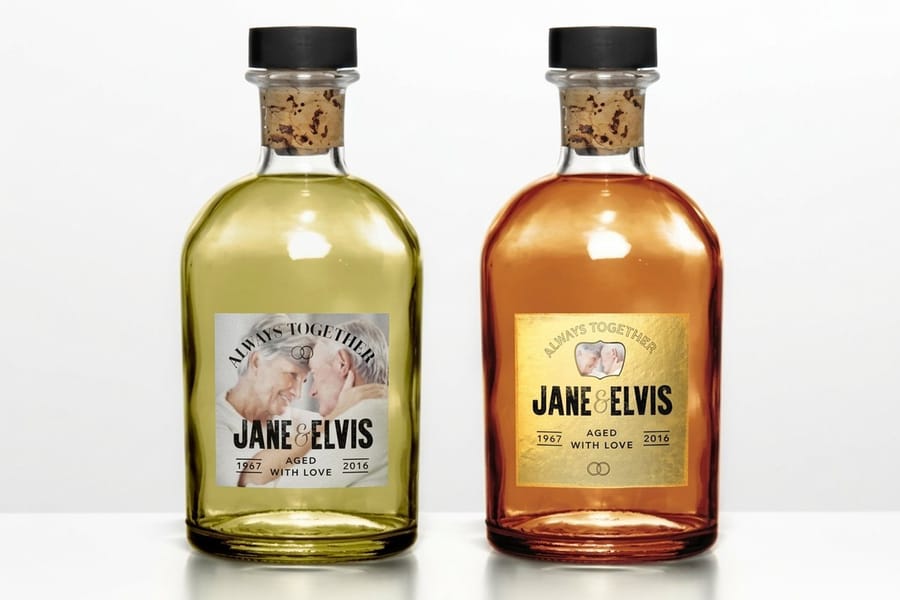
A sheet is the right format whenever the stickers belong together. The clearest case is a pack you sell: an illustrator with eight characters, a coffee roaster with a set of origin marks, a band with a run of tour art. The buyer gets one object with a clear front, it hangs on a peg or slots into a flat mailer, and you bought one printed item rather than eight.
The second case is a set that gets used up in order. Packaging seals, thank-you stickers, care instructions and a QR code can all live on one sheet that sits next to the packing bench, and the person packing pulls what each order needs. Product lines work the same way. Four flavors on one sheet means one file, one order and one place to look when a batch runs out, which is why sheets are common on shorter runs of product labels.
Third: anything handed to a group. Classroom reward sets, conference swag, kids party favours, gym and studio loyalty marks. A sheet of ten costs the same as a sheet of one, so variety is free and the recipient chooses. If you are building a pack to sell rather than to give away, our guide to building custom sticker packs covers pricing and presentation, and how to package stickers to sell covers what happens after the sheets arrive.
Where a sheet is the wrong call: one sticker handed over one at a time. Nobody wants to peel a single mark off an oversized backing card, and you are paying for liner nobody uses. That job belongs to die-cut stickers, which start at $93.37.
File Setup That Comes Back Right the First Time
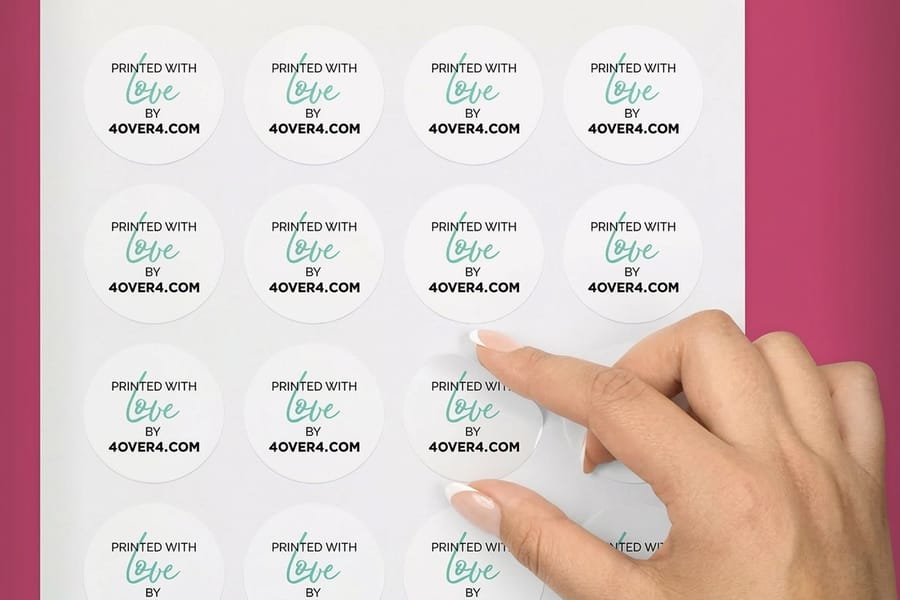
Build the sheet at final size, in CMYK, at 300 dpi, with all type converted to outlines. Then handle the three things specific to sheets.
- Bleed lives on every sticker, not just the sheet. Each shape needs about an eighth of an inch of artwork past its cut path, and each needs an eighth of an inch of clear space inside the path before any text or logo begins. A sheet with twelve stickers has twelve bleeds and twelve safety margins to check.
- Gutters are a design decision. Tight spacing looks dense and gets you more stickers, but leaves less liner for a thumbnail. An eighth of an inch is a workable floor. A quarter inch makes a sheet noticeably easier to peel and is worth the lost row on anything sold at retail.
- The cut file mirrors the art exactly. Same page size, same position, so the two line up when they are overlaid. Do not scale one after drawing the other.
Check the whole thing by printing the sheet at 100% on plain paper and cutting one shape out with a knife. Ninety seconds of that catches crowded gutters and text sitting too close to an edge better than any amount of zooming. Our bleed, cut line and safety checklist covers the general rules, and if you would rather not build the layout from nothing, the design template library has sticker layouts you can edit in the online designer.
Sheets, Die-Cut Singles, or a Roll
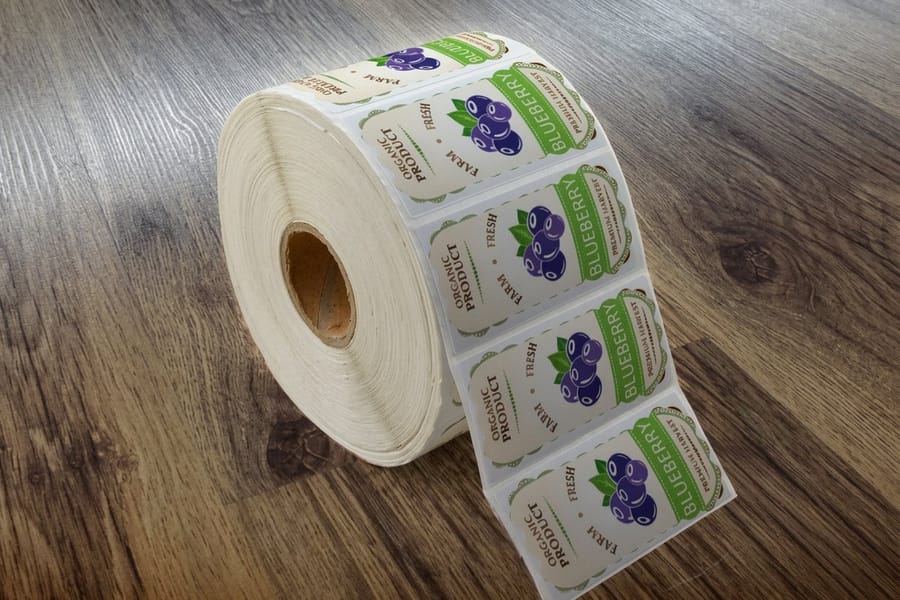
Three formats do three different jobs: sheets start at 25 for $181.24, die-cut singles at 25 for $93.37, and shaped roll labels at $300.05. The mistake is choosing on price per sticker alone, because the format decides how the sticker gets applied, and applying is where the time goes.
| Format | How it arrives | Starts at | Best for |
|---|---|---|---|
| Sticker sheets | A set kiss-cut on one flat liner. | $181.24 | Packs, variety sets, mixed designs, anything posted flat. |
| Die-cut stickers | Loose singles, each cut to its own outline through the liner. | $93.37 | One design given out one at a time, or a shape that has to read as a shape. |
| Shaped roll labels | Wound on a roll in sequence. | $300.05 | Volume application on a bench or by machine, where speed per unit matters. |
Read it as a question about who peels the sticker and how often. If a customer peels it once, a sheet or a single is right. If someone on your team peels a hundred in a row, a roll pays for itself in wrist time, because a roll feeds and a sheet does not. If the design has an outline that carries meaning, a mascot, a logo shape, a leaf, the die cut earns its cost because the silhouette survives.
Material matters as much as format. Paper labels are cheaper and take a pen. Vinyl survives water, sun and repeated handling. Our sticker materials guide lays out how each one ages, and the stickers printing category lists every format we run. Before you commit to a big order, order samples and rub the material with a wet thumb.
Wally explains sticker sheets
The blade stops on the liner, so the set stays together
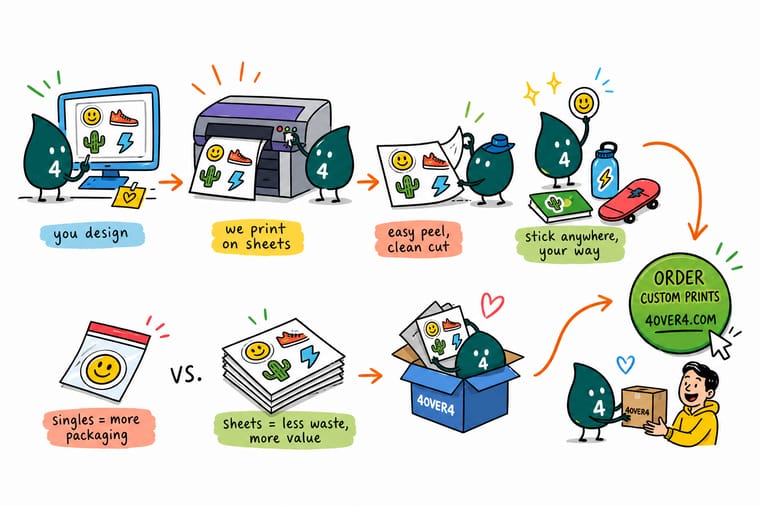
Wally prints a whole set of stickers on one piece of label stock, then sends it to the cutter with the blade set shallow. It parts the printed face and the glue and halts on the backing. Nothing falls out. Peel one and the other eleven sit exactly where they were. That shared backing is the sheet, it is why twelve different designs cost the same as twelve of the same, and it is why the order needs a vector cut file as well as artwork.
Configure your sticker sheet →%22%2F%3E%3Ccircle%20cx%3D%2247%22%20cy%3D%2220%22%20r%3D%2222%22%20fill%3D%22%23a78bfa%22%20opacity%3D%220.15%22%2F%3E%3Ccircle%20cx%3D%2254%22%20cy%3D%2227%22%20r%3D%22-3%22%20fill%3D%22%23a78bfa%22%20opacity%3D%220.1%22%2F%3E%3Crect%20x%3D%2277%22%20y%3D%22-9%22%20width%3D%2232%22%20height%3D%2220%22%20rx%3D%224%22%20fill%3D%22%23a78bfa%22%20opacity%3D%220.08%22%20transform%3D%22rotate(42%2080%2030)%22%2F%3E%3C%2Fsvg%3E)
Specs and pricing
Sheets, singles, and die-cut labels compared live
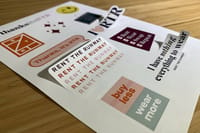
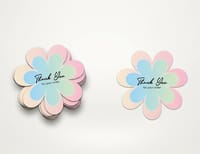
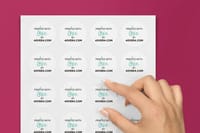
Sticker sheets run 5 by 7 to 11 by 11 inches from 25 for $181.24, while die-cut stickers and die-cut labels run 2 by 2 to 11 by 11 inches from 25 for $93.37. The cards below pull the live sizes, materials and prices from the 4OVER4.COM configurator, so you can see what each format costs before you build the file.
Print it
Order the format your set actually needs
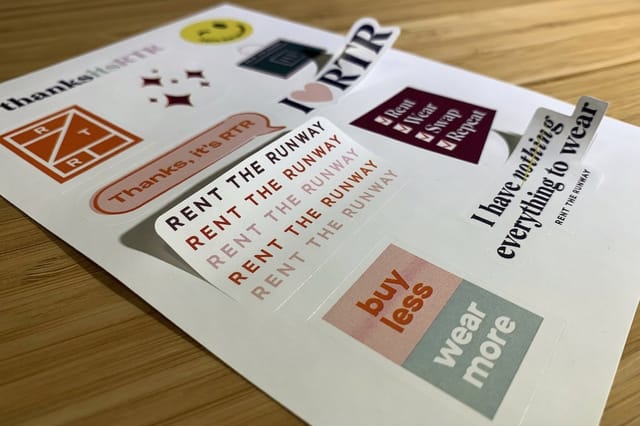
Choose sticker sheets when a set ships together and set the count per sheet, from one sticker up to 26 or more. Choose die-cut stickers for singles handed out one at a time, and premium stickers from 3 by 5 inches when you want stocks like brown kraft, clear vinyl or fluorescent paper.

Explore more
Where to go next
Open the kiss cut vs die cut guide if the blade depth is still unclear, the sheet design guide before you set gutters and bleed, and the rolls vs sheets comparison if you apply more than a hundred stickers at a time.



By the numbers
Sheets, singles and shaped roll labels
Common Questions
Your sticker sheet questions, answered
What is the difference between a sticker sheet and a kiss-cut sticker?
Kiss cut is the cutting method. A sticker sheet is what you get when that method is used on more than one sticker at a time. A single kiss-cut sticker sits alone on a small rectangle of liner with a border of backing around it, which makes it easy to peel. A sticker sheet applies the same cut to a grid of stickers on one larger liner. Every sheet is kiss-cut, but not every kiss-cut sticker is a sheet.
How many stickers can I put on one sheet?
As many as fit, and the sheet is priced the same either way, which is the part people miss. At 4OVER4.COM the die-cutting option groups the layout as one sticker per sheet, two to five, six to ten, or more, across seven layout choices. In practice, allow a quarter inch margin around the sheet and about an eighth of an inch between stickers, then count the grid. A 5 by 7 inch sheet holds six 2 inch squares that way. An 11 by 11 inch sheet holds sixteen.
Do I really need a separate cut file?
Yes. Every sticker sheet order must include the CMYK artwork file and the cut file that tells the machine where to kiss cut. The cut file has to be vector, saved as EPS or PDF, drawn in 100% black at either 0.5pt or 1pt line weight. Do not merge the cut lines into the artwork and do not draw them as a raster layer, because a scanned or rasterized line cannot be followed by the cutter.
Are sticker sheets waterproof?
Only on the right material. The three paper label options, uncoated, semi-gloss and hi-gloss UV, will wrinkle and lift once they are properly wet, so keep them indoors. The two white vinyl options handle moisture, handling and outdoor use. Choose permanent vinyl when the sticker should stay where it lands, and repositionable vinyl when it needs to come back up without tearing or leaving residue.
How much do sticker sheets cost?
Sticker sheets start at $181.24 for 25 stickers, and the per-sticker price falls steeply with quantity: $2.05 each at 100, 65.8 cents at 500, 50.6 cents at 1,000, 23.5 cents at 5,000 and 16.8 cents at 25,000. The jump between 100 and 500 is the biggest single saving on the whole curve, so if you are close to 500, order 500.
Can every sticker on the sheet be a different design?
Yes, and it costs nothing extra. The sheet prints as one full-color image, so twelve different designs cost the same as twelve copies of one design. That is the strongest argument for a sheet: variety is free. The limit is production time rather than price. Sheets run on a 5 business day standard turnaround with next-day rush available.
Get Started
Sticker sheets run 25 for $181.24, or $7.25 a sheet
Pick a size, choose paper label or white vinyl, upload your artwork with its cut file, and we kiss cut every sticker so the sheet arrives flat and whole.
Legal Disclaimer
Gold Standard guarantees apply to all standard orders placed through 4over4.com. Price match requires verifiable proof of a competitor's published price for an equivalent product with matching specifications and turnaround time. Satisfaction guarantee covers manufacturing defects and print quality issues. Contact support with order number and documentation.
