
Window Envelopes Explained and How to Line Up the Address Block


Tobias is our voice for cutting, binding and large format, built from the knowledge of our production team, with over 20 years in printing.
A window envelope lets the invoice address itself. The #10 window sits at fixed inches, only a narrow band of a folded letter shows through it, and the alignment can be proved before you print a run.
A window envelope has a die-cut opening, usually covered with clear film, that shows the recipient address printed on the document inside, so the address is printed once instead of twice. On a standard #10, 4-1/8 by 9-1/2 inches, the window is 4-1/2 by 1-1/8 inches, set 7/8 inch from the left edge and 1/2 inch up from the bottom. Fold an 8-1/2 by 11 sheet in thirds with the top panel outward and only the strip about 2-1/4 to 2-15/16 inches down the page lines up with it.
Quick answer
One address, printed once, seen through a hole
The window removes an addressing step, and in exchange it locks your document layout to the envelope. On a #10 the opening is 4-1/2 by 1-1/8 inches, 7/8 inch from the left edge and 1/2 inch up from the bottom. The folded insert can slide about a quarter inch in any direction, so the address block gets a band of roughly 11/16 inch of usable height rather than the full window. Design to the band, fold a real proof, and the run behaves.
What a Window Envelope Is, and Which Sizes Carry One
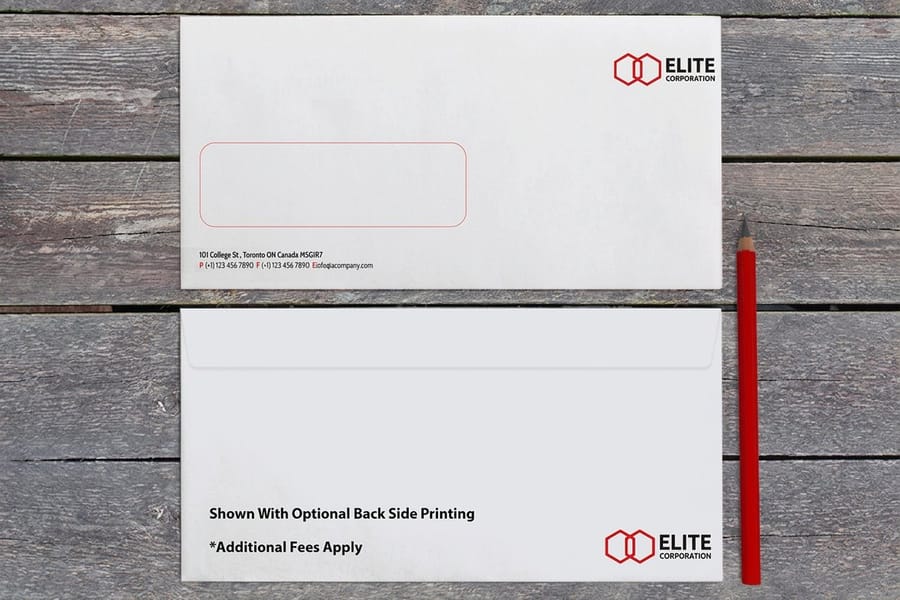
A window envelope is a plain envelope with a rectangle die-cut out of the front, backed with a thin clear film so the address printed on the document inside is readable from outside. That is the entire mechanism, and it is why the format survives: the invoice already has the customer address on it, so printing it again on the envelope is duplicated work.
The film matters more than people expect. Poly-film windows are the default and they are cheap and clear. Glassine windows are a translucent paper film that recycles with the envelope, which some mailers prefer, and open windows have no film at all, which saves the film but lets rain and handling get at the sheet. If a piece has to look premium, the film is the tell, so a poly window on a heavy cotton stock reads as cheaper than the paper it is cut into.
| Size | Dimensions | Window is common | What it usually carries |
|---|---|---|---|
| #10 | 4-1/8 x 9-1/2 in | Yes, single and double | Invoices, statements, letters, anything on a tri-folded 8-1/2 x 11 sheet. |
| #9 | 3-7/8 x 8-7/8 in | Sometimes, single | The reply envelope that ships unfolded inside a #10. |
| #6-3/4 | 3-5/8 x 6-1/2 in | Yes, single | Remittance and payment returns, a half-folded 8-1/2 x 11 or a folded stub. |
| A7 | 5-1/4 x 7-1/4 in | Rarely | Invitations and greeting cards, where a window would look wrong anyway. |
Read the third column as a warning as much as a spec. Windows on anything other than a #10 or a #6-3/4 usually mean a custom die, and a custom die means a setup charge and a minimum quantity. The full envelope size chart covers the rest of the family, and the remittance envelope guide explains what fits inside a #10 when a reply envelope has to travel with the bill.
These are the window envelopes you can order from 4OVER4, and what each order involves.
| Order | Sizes and closures | Stock and ink | Quantity and time |
|---|---|---|---|
| Blank window envelopes | #10 window at 4-1/8 x 9-1/2 in, regular, peel and seal, simple seal or simple seal with security tint; #9 window at 3-7/8 x 8-7/8 in | Unprinted, for your office printer | 50 to 1,000, from $13.17, 1 business day |
| Printed window envelopes | The same #10 and #9 window sizes and closures | White wove, royal laid or royal linen; black, one or two PMS inks, or full color on the front | From 250 at $142.99, 7 business days |
| The sheet inside | 8-1/2 x 11 letterhead, ordered flat or trifolded | 70# uncoated text, 24# royal laid or 28# royal linen | From 50 at $99.95, 5 business days |
For a printed envelope you upload front artwork only, the return address and branding, and the window stays clear of ink.
Where the Window Sits on a #10, in Inches
Start from the envelope, never from the document. A #10 is 4-1/8 inches tall and 9-1/2 inches wide. The window most converters cut is 4-1/2 inches wide by 1-1/8 inches tall, positioned 7/8 inch in from the left edge and 1/2 inch up from the bottom edge.
Turn that into working coordinates and the window occupies the strip from 1/2 inch to 1-5/8 inches above the bottom, and from 7/8 inch to 5-3/8 inches in from the left. Those four numbers are the only thing your layout has to satisfy.
Then subtract the movement. A tri-folded letter is 8-1/2 inches wide and about 3-2/3 inches tall inside an envelope that is 9-1/2 by 4-1/8, so it can slide roughly half an inch sideways and just under half an inch up. Nothing holds it still. That is the reason the usable band is much smaller than the window, and it is the reason a job that proofed perfectly on the desk comes back from the mail house with half the ZIP codes cut off.
One more caution before you commit a layout. Different converters cut the window in slightly different places, 3/4 inch from the left instead of 7/8 is common, and double-window stock moves both openings. Put a ruler on the actual envelope from the actual run. If you are buying blank envelopes to run through your own printer, measure a sample from the box rather than trusting the box.
Positioning the Address Block So It Lands in the Window
The fold decides everything. For the address to show, the sheet has to be folded with the top panel facing outward, which is how automated inserters fold for window stock: the bottom third goes back, the middle goes back behind it, and the top third ends up on the front of the packet. Fold a letter the usual way, with the top panel tucked inside, and the window shows a blank back.
With that fold, an 8-1/2 by 11 sheet becomes a packet 8-1/2 wide by 3-2/3 tall, and the top edge of the sheet is the top of the packet. Work the geometry back through the window position and the address block has to print in this box:
- Vertically, 2-1/4 to 2-15/16 inches from the top edge of the sheet. That is the safe band with 1/4 inch of clearance built in against slide. The raw window band is wider, from about 2 to 3-1/6 inches, but do not use it all.
- Horizontally, start at 1 inch from the left edge and stay under 3-1/2 inches wide. The packet can drift half an inch either way inside the envelope, and long company names are what run out of the right side of the window.
- Four lines at 12 point, five at 10 point. A 4-line block at 12 point on 14 point leading is about 0.78 inch and fits with room to spare. Five lines at 12 point does not.
- Dark type on white, left aligned, no reversed panels. Nothing else may be visible through the window, so keep logos, rules and watermarks out of that band entirely.
Then prove it physically. Print one page at 100 percent scale with no fit-to-page, fold it, put it in a real envelope, and push the insert hard left, hard right, and all the way up. If the block still clears the window edge in all three positions, the layout is finished. This costs two minutes and it is the only test that catches a printer driver quietly scaling your page to 96 percent. Our blank template library gives you a correctly sized sheet to start from, and the addressing guide covers the line order and abbreviations that scanners read cleanly.
Two habits save reprints. Draw the window as a locked, non-printing rectangle on a background layer in the document template so anyone who edits the file can see the boundary. And when the block is short, a two-line address for instance, anchor it to the top of the band rather than centering it, because the insert falls to the bottom of the envelope more often than it rides up.
Where Window Envelopes Pay for Themselves, and Where They Do Not

The saving is one production step, repeated. On a monthly invoice run you print the document once and stuff it. There is no label pass, no envelope pass, no chance of the wrong letter meeting the wrong envelope, which is the mismatch that turns a billing run into a privacy incident. On a recurring cycle that is worth real money, and it is why almost every statement you receive arrives this way.
The cost is rigidity. Once the layout is aligned, the address block is part of the mechanical spec of the document, not a design element. A designer who nudges the header down half an inch during a rebrand breaks every piece in the next run, and nobody notices until the mail comes back. Write the band into the template as a locked guide and note it in the file, or budget for the reprint. Double-window stock doubles that exposure, because the return address block is now load-bearing too.
Volume decides the rest. For a few hundred pieces, print the envelopes and skip the alignment work. Blank envelopes start at $13.17 and feed through most office printers. For recurring runs where the return address and branding should be printed properly, printed envelopes start at $142.99, and matching standard letterheads start at $99.95 so the sheet inside looks like it belongs with the envelope. If the bill carries a promotion, statement stuffers start at $27.46 and ride along at no extra postage until the piece crosses an ounce; the statement stuffers story shows the insert in hand.
Two places window envelopes are the wrong tool. Invitations and anything hand-addressed, where the window reads as a utility bill, so use printed envelopes in the size the card needs instead. And multi-part paperwork where the top sheet changes: if the customer copy of a carbonless form ends up in the envelope some months and the file copy in others, the addresses will not sit in the same place. Fix the document that goes in the envelope before you buy the die. The ordering guide walks through stock, flap and quantity once the layout is settled.
Wally explains the window
Print the address once, then fold it into view
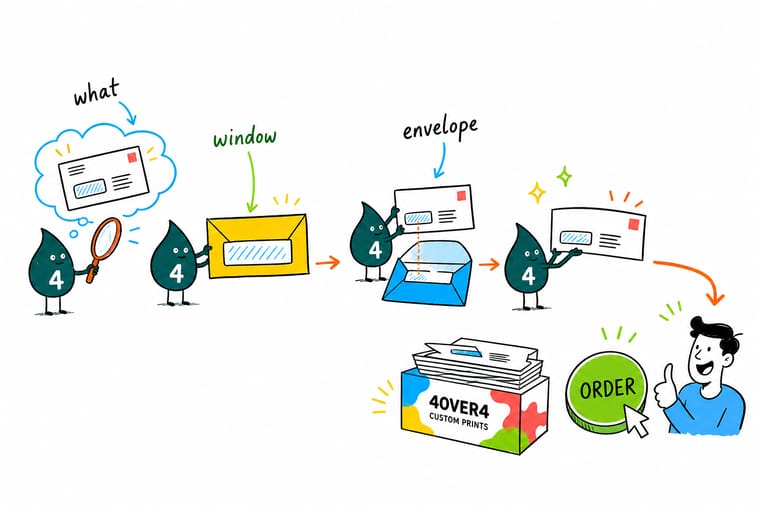
Wally prints the customer address on the invoice, folds the sheet in thirds with the top panel facing out, and drops it into a #10. The address lands behind the window because it was printed in the right band, about two and a quarter inches down the page. He shakes the envelope before sealing it. If the ZIP code slides out of sight, the block is too close to an edge and the whole run would come back.
Order printed envelopes →
Specs and pricing
Envelopes and letterheads, sizes and starting prices
Configure the envelope and the sheet that goes inside it. Window envelopes come blank from 50 at $13.17 in #10 and #9 window sizes, or printed from 250 at $142.99 with black, PMS or full color ink on the front in 7 business days. Letterheads start at 50 for $99.95 on 8-1/2 x 11 stock and can arrive trifolded, ready for the window.
Print it
Print the mailing, not just the envelope
Order the three pieces of the mailing together: printed #10 window envelopes from 250, letterheads from 50 on 70# uncoated text or 24# royal laid, and statement stuffers at 3.5 by 8.5 or 4 by 9 inches from 25 for $27.46.


More mailing guides
Where to go next

Envelopes from our Queens plant
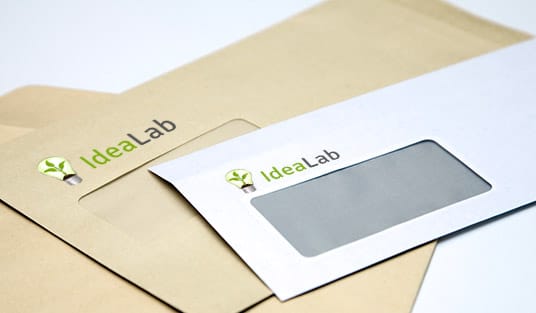
Window, blank and printed envelopes
Common Questions
Your window envelope questions, answered
What is a window envelope?
It is an envelope with a rectangular opening die-cut into the front, almost always backed with a thin clear film, so the recipient address printed on the document inside shows through. Nothing is printed on the envelope except your return address and any indicia. The whole point is that the address gets typed and printed once, on the invoice or statement itself, instead of a second time on the envelope or on a label.
Where is the window on a #10 envelope?
On the common single-window #10, which measures 4-1/8 by 9-1/2 inches, the window is 4-1/2 inches wide by 1-1/8 inches tall, set 7/8 inch in from the left edge and 1/2 inch up from the bottom edge. That is the position most converters cut, but it is not a law. Some run the window 3/4 inch from the left, and double-window stock differs again, so measure the envelope in your hand before you lock a layout.
Where should the address block sit on the letter?
On an 8-1/2 by 11 sheet folded in thirds with the top panel facing outward, the band that lines up with a standard #10 window runs from about 2-1/4 to 2-15/16 inches below the top edge, starting roughly 1 inch in from the left and no wider than about 3-1/2 inches. Keep it to four lines of 12 point type, or five lines at 10 point. Then fold a real printed proof and slide it into a real envelope before you print the run.
What is a double window envelope for?
The second, smaller window near the upper left shows the return or remittance address printed on the document, so the same sheet supplies both addresses and you buy plain stock instead of printed stock. It is the standard for statements and invoices that come with a payment stub. The catch is that you now have two blocks to keep aligned instead of one, and the vertical band for each is tighter than on a single-window envelope.
Will USPS accept mail in window envelopes at automation rates?
Yes, provided the entire address stays readable no matter how the insert shifts. The requirement that catches people is clearance: with the contents pushed to any edge, the address must not be clipped by the window and must keep clear space around it, which in practice means about 1/4 inch of margin designed into the layout. Nothing else may be visible through the window that a reader could mistake for an address, and reversed or light type on a dark background will fail.
Can I print my own envelopes instead?
For short runs, yes, and it is often the better answer. Printing 200 envelopes on an office printer costs nothing extra and skips the alignment work entirely. Window envelopes pay off at volume and on recurring cycles: monthly invoices, statements, renewal notices, anything where the same layout runs again and again and a second addressing pass would cost real labor. Blank Envelopes start at $13.17 at 4OVER4.COM if you want to feed them through your own printer, and full-color Printed Envelopes start at $142.99 when you want the return address and branding printed properly.
Get Started
Printed envelopes run 250 for $142.99, or 57 cents each
Pick the envelope size, print the sheet that goes inside it, and we ship both together so the address lands in the window on the first proof.
Legal Disclaimer
Gold Standard guarantees apply to all standard orders placed through 4over4.com. Price match requires verifiable proof of a competitor's published price for an equivalent product with matching specifications and turnaround time. Satisfaction guarantee covers manufacturing defects and print quality issues. Contact support with order number and documentation.
