
Journaling for Business and the Branded Journals Worth Gifting Your Team


Emma is our prepress and print production voice, built from the knowledge of our production team, with over 20 years in printing.
Business journaling sharpens focus because handwriting is too slow to transcribe, so it forces you to decide what matters before the pen moves. Four habits carry the value: three outcomes each morning, a shutdown page each evening, a decision log with a written prediction attached, and a Friday review that turns the pages into judgement. The book you keep them in is a printed piece, and three ideas cover most teams: a ready-made leather journal at 5.75 by 8.25 inches as the welcome gift, a deluxe spiral notebook in 4.25 by 5.5 or 5 by 7 inches for desks and field teams, and a notepad for the notes you tear off and hand over. Everything below is how to keep those four, and how to spec a branded journal your team will actually carry rather than shelve.
The business journaling habits at a glance
| Habit | When | What goes on the page | What it pays back |
|---|---|---|---|
| Morning three | Five minutes, before email | The three outcomes that would make today count | Stops the day being set by whoever emailed first |
| Decision log | Whenever you commit to something | The decision, the date, and what you expect to happen | Separates a good decision from a lucky outcome |
| Shutdown page | Last ten minutes of the day | What moved, what stalled, the one thing carrying forward | Ends the day cleanly so the open loops stop circling at night |
| Weekly review | Friday, thirty minutes, in the diary | Read the week back, mark the decisions that landed | This is the step that converts pages into judgement |
| Meeting spread | One page per meeting | Names, the ask, the date it is due, your own commitments | A searchable record when nobody wrote the minutes |
Adopt them in that order and stop after the fourth. The weekly review is the one that fails first in a busy week and the one that carries the value, so it goes in the calendar as a meeting. When you are ready to put the habit in a book worth keeping, order leather journals straight from the configurator.
Why writing it down changes how you think
Typing keeps pace with speech, so a laptop in a meeting becomes a transcription machine. Handwriting cannot keep up, and that limit is the whole point: you have to decide what matters before the pen moves. The page forces a summary, and the summary is the thinking.
The second effect is spatial. A page has a top, a margin and a foot, and your hand remembers where things sat. Two weeks later you can find the note about the supplier because you know it was on the left of a Tuesday spread, which is a kind of recall no scrolling app gives you.
The third is friction in the right direction. A notes app invites you to keep everything, so it fills with things you will never read again. A finite paper page makes you throw most of it away as you write, and what survives is worth reviewing. Our guide to starting a business journal takes the first fortnight step by step.
Where the phone still wins
Anything with a date on it belongs in software. Deadlines, reminders, recurring invoices, anything that has to find you rather than be looked up. Paper is bad at pinging you, and a journal used as a task list quietly becomes a list of things you failed to do.
The split that works: the calendar owns the when, the task app owns the what next, and the journal owns the why. Keep the journal out of the other two jobs and it stops feeling like admin.
The four habits that are worth the ink
Most business journaling advice is a long list, and a long list is why people stop by week three. Four habits carry almost all the value, and only one of them is non-negotiable.
Start with the morning three and the shutdown page, both under ten minutes. Add the decision log once the book feels like a habit rather than a chore. The weekly review is the one that turns the other three from a nice ritual into something that changes what you do next quarter.
The decision log, in detail
Write the date, the decision in one line, and then the prediction: what you expect to be true in thirty or ninety days if this was right. That last line is the part everyone skips and the only part that teaches you anything, because outcomes arrive tangled with luck and memory quietly rewrites what you thought at the time.
A hiring choice, a price change, a supplier switch, a decision to walk away from a customer. Six months of those, read back in an afternoon, will tell you more about how you make calls than any framework. It also makes handover easy: the next person can see the reasoning, not just the result.
Keeping the page structure fixed
Use the same layout on every page: date at the top, the three outcomes, the decision log in the middle, and a carry-forward line at the foot. Fixed zones mean you never spend attention on where to put something, and the margin stays empty until review day, when you mark what actually happened.
If you want that layout preprinted rather than drawn each morning, that is a printed interior rather than a stock book, which changes the product and the minimum order. See how to organize a work notebook before you commit a template to print.
What journaling will not fix

It will not give you time back. The four habits cost roughly twenty-five minutes a day and half an hour on Friday, and that time comes out of something else. The trade is real work for clearer work, and if the week is already collapsing, journaling makes the collapse legible rather than stopping it.
It also will not survive being optional. The weekly review is the first thing dropped in a busy week and it is the one that carries the value, so it goes in the calendar as a meeting with a wall around it. Without it you are keeping an expensive diary.
And it does not scale sideways by decree. Handing every manager a journal and asking them to journal produces thirty blank books. What spreads is a visible habit: one person bringing a decision log into a review and referring back to what they wrote in March.
When a notepad is the right answer instead
Not every writing job wants a bound book. If the output is a tear-off for someone else, an order slip, a spec handed across a counter, use a notepad. The glued head is there to give the sheet away, and a bound journal fights you every time you rip a page out.
The rough division: bound for thinking you keep, padded for notes you hand over. The notepad versus notebook comparison goes through the binding differences and where each one gets annoying.
Speccing a branded journal people actually carry
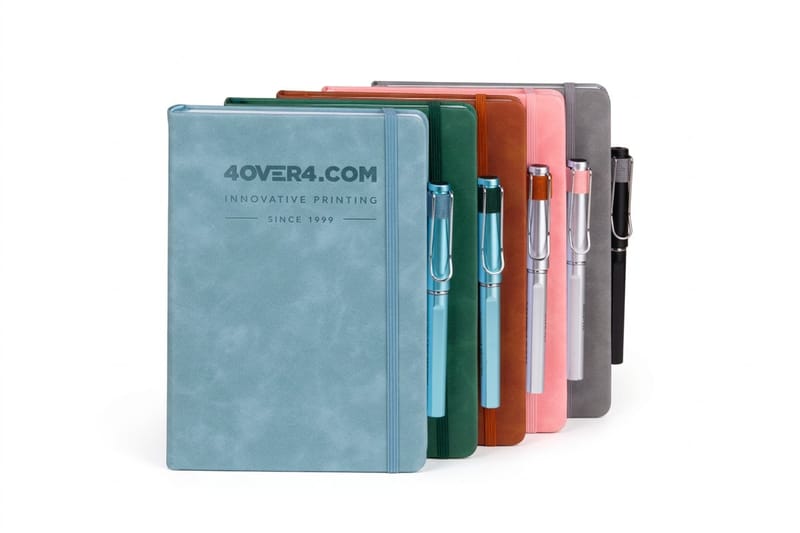
Here is the part most companies get backwards. The bigger the logo on the front, the less the book gets used, because a person will not carry someone else’s branding into a client meeting or a coffee shop. Put the mark small on the lower cover, or blind deboss it so it reads by touch, or move it to the inside first page where the owner sees it and nobody else does.
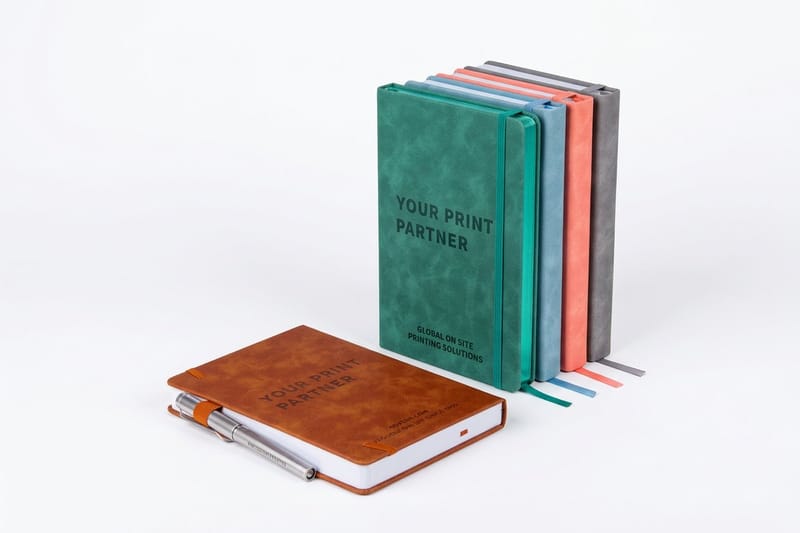
Our leather journals ship plain, with no logo, so nothing scuffs off a cover that lives in a bag. When a branded cover matters, an embossed notebook carries the mark instead.
Then the paper. Heavier text stock resists show-through, which matters if your team uses gel or fountain pens, and it is the complaint you will hear first if you go light to save money. Ruling is a taste call, and dotted grid is the safe middle: it takes lists, sketches and tables without imposing a format.
Binding, and the trade nobody mentions
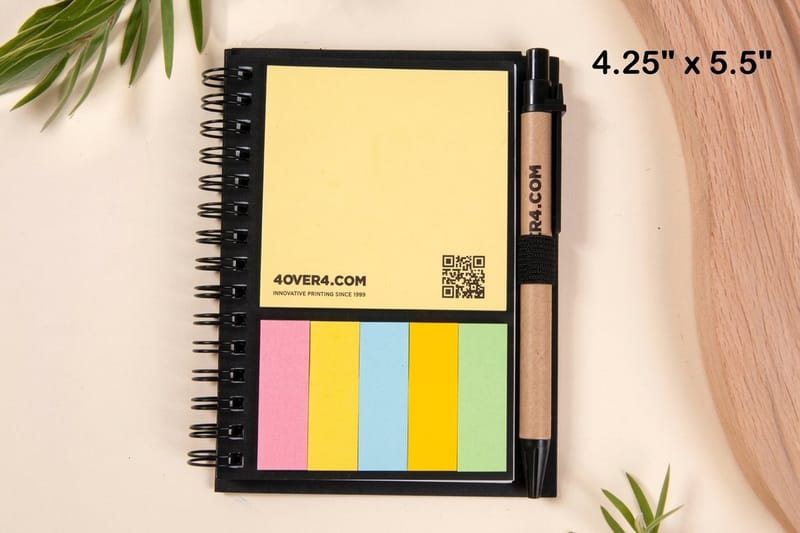
A wire-o or spiral book lays perfectly flat and folds back on itself, which is what you want on a cramped desk or standing on a warehouse floor. The cost is that the coil snags in a bag, bends, and looks less like a gift and more like stationery. A deluxe spiral notebook is the right call for working books handed to a team, from $5.00.
A sewn hardcover or a leather journal is the giftable one. It fights you a little at the very front and very back of the block, and then breaks in and lays flatter after a few weeks of use. If it is going in a welcome box, that is the one to buy. Prices start at $10.00.
Quantity, timing and the reorder trap
Order to headcount plus roughly fifteen percent. New hires arrive, books get damaged, and a small top-up run six months later costs far more per unit than the overage would have, because setup is a fixed cost spread across the run. Bulk notebook printing and quantity breaks shows where the price steps actually fall.
Time the handout to onboarding week or the start of a planning cycle, not to a December gift round. A blank book given to someone who has nothing to start writing yet goes on a shelf, and a book that sits unopened for a month rarely gets opened at all.
Journal pricing and specs at 4OVER4.COM
Leather journals come in one 5.75 by 8.25 inch size and five cover colors, blue, green, gray, mocha and pink, at $10.00 a book, the same rate at every quantity the configurator lists, so the budget grows in step with headcount. They ship in 1 business day, and so does the deluxe spiral notebook at $5.00. The numbers below come from the live configurator, so you can size a team order before anyone asks you for a figure.
Quantity and price
Leather journal pricing and specs
Real configurator numbers: the leather journal is a flat $10.00 each, sold ready-made with no logo.
| Quantity | Price Per Unit | Total |
|---|---|---|
| 1 | $10.00 | $10.00 |
| 2 | $10.00 | $20.00 |
| 3 | $10.00 | $30.00 |
| 4 | $10.00 | $40.00 |
| 5 | $10.00 | $50.00 |
| 6 | $10.00 | $60.00 |

You can also earn coins on every order and redeem them against later runs, which helps when the second wave of new starters arrives.
Cover, paper and binding, how they work together
Three choices decide whether a branded journal gets carried or shelved. The cover decides how it reads in someone else’s meeting: a leather journal in mocha or gray passes in a client room, while the 31pt cover on an embossed notebook carries a louder mark. The paper decides whether the pen behaves, and the binding decides whether it opens flat on the desk it will live on; embossed notebooks are wire-o bound on the long side with 50 blank uncoated sheets, so they fold back flat. A heavier text stock resists show-through from gel and fountain pens, which is the first complaint you will hear if you trim the spec to save money.
Print it
Leather journals, ready to give
The giftable spec: sewn block, ribbon, and a mark small enough that people carry it.
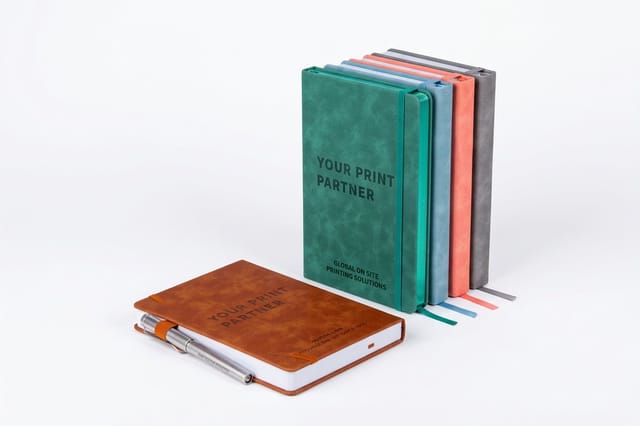
Cover finish is where budgets get spent badly. Blind debossing has no ink layer to scuff, so it survives a year in a bag better than a printed logo, and it reads as considered rather than promotional. Foil is louder and looks genuinely expensive on a dark cover, at the cost of showing wear on the high points with daily handling. If the mark has to be raised and obvious, embossed notebooks do that job without a printed interior. For the full run through of the options, read soft cover journals explained and our rundown of custom printed notebooks.
Who this works for, and what to order
The habit is the same everywhere. The book is not, and the difference is mostly about where it will be opened.
- Founders and small business owners. The decision log is the whole reason to bother. Six months of decisions with their predictions attached is the closest thing a small company has to an audit of its own judgement.
- Agency and consulting teams. One page per client meeting, dated, with the ask and the commitments. It becomes the record when nobody was taking minutes, and it settles scope arguments quietly.
- Operations and field teams. A spiral book that lays flat and takes a pencil on a cold morning. Function beats finish here, and the coil is a feature rather than a compromise.
- HR and people teams. Branded journals in the welcome box, sized to headcount plus fifteen percent, handed out on day one rather than at year end. See our corporate gifting guide for the rest of the box.
- Sales teams. A giftable leather journal for the client side of the relationship, plain with no logo, so it does not read as an advert on their desk.
Cover blanks sized to the book
If you are printing a cover or an opening page rather than buying stock, start from a blank sized to the product. Printed notebooks come in 4.25 by 5.5, 4 by 6, 5.5 by 8.5 and 8.5 by 11 inches, so pick the blank for the size you will order. 4OVER4.COM cuts its blanks to exact specs so your artwork lands inside the trim with bleed already marked, which saves the round of proofs where a debossed mark sits two millimeters off center. Grab one from the blank template library.
Start fast
Cover blanks sized to the book
Notebook design templates and exact size blanks so your cover artwork lands inside the cut line.

Wally keeps the page in four fixed zones
Date, three outcomes, decision log, carry forward
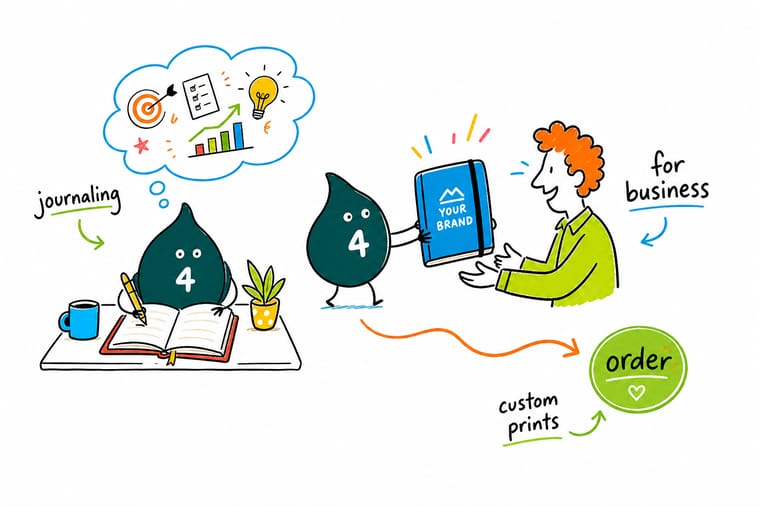
Put the date at the top, the three outcomes that would make the day count, the decision log with what you expect to happen, and the one thing carrying forward at the foot. Leave the margin empty until Friday, then mark what actually landed. Print it on a heavy text stock so gel pens do not show through, keep the cover mark small, and 4OVER4.COM debosses and ships the team run.
Order branded journals →What makes the habit stick
Spec decisions that separate a carried journal from a shelved one
- Shrink the logo. A small mark on the lower cover, or a blind deboss, gets carried. A full-cover logo gets left in the drawer, and an unused journal is a wasted budget line whatever it cost.
- Buy the paper weight, not the page count. Show-through is the first complaint you will hear. A heavier text stock costs a little more and removes the only reason someone stops using the book.
- Print the first page, not every page. A single printed opening page with your values, a prompt, or the review cadence costs far less than a fully printed interior and gets read once, which is when it matters.
- Match the binding to the desk. Lay-flat spiral for working books, sewn hardcover for gifts. Buying one book for both jobs means it is slightly wrong for both.
- Add a ribbon and an elastic. They sound like details. They are the difference between a book that opens where you left off and a book you have to hunt through every morning.
Explore more
More ways to print and gift
Embossed notebooks run 50 for $763.37 and take 22 business days, so a team order starts a month out.
Product Leather Journals The giftable one: suede cover, 180 lined pages and a pen, from $10.00. Product Deluxe Spiral Notebook Lays flat on a cramped desk, from $5.00. 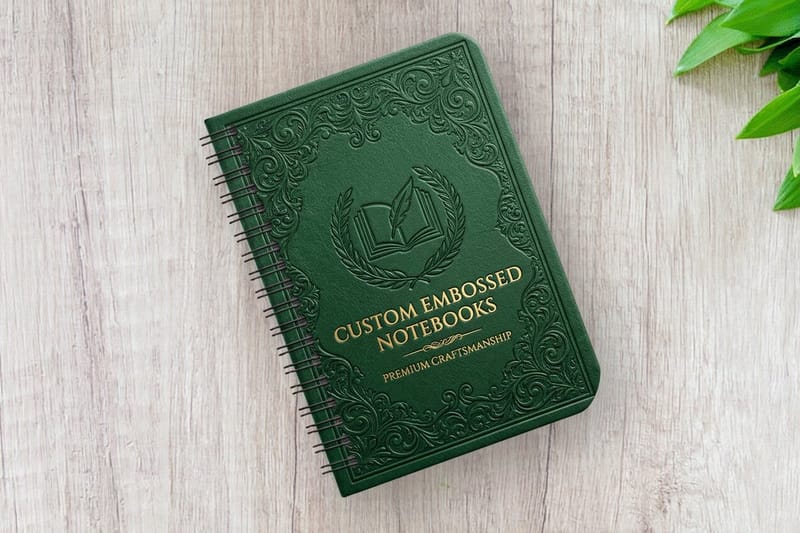 Product Embossed Notebooks A raised cover mark that reads by touch, not by ink.
 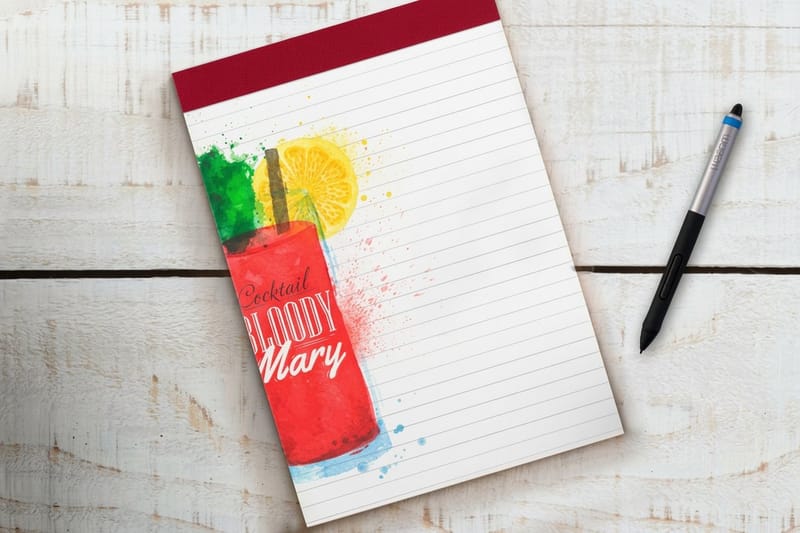 Product Notepads Glued head, for notes you hand over rather than keep. Category Notebook Printing Every cover, binding and interior in one place.
  Guide How to Brand Custom Logo Journals Deboss, foil or print, and where to put the mark.
 Keep reading: the notebook planner setup that holds up under a real week, employee appreciation gifts that get used, and branded merchandise for the rest of the welcome box.
Ready to print the team run?
Pick the cover, the binding and the page count, upload your mark or start from a free template, and 4OVER4.COM debosses it clean and ships as fast as your onboarding date needs.
Common questions about business journaling
Does business journaling actually improve focus, or does it just feel productive?
It changes what you pay attention to, which is a narrower claim than most articles make and a more useful one. Writing three outcomes before you open email means the day is shaped by your priorities rather than by whoever wrote to you first, and a shutdown page closes the open loops that otherwise circle at eleven at night. The part that genuinely sharpens judgement is the decision log read back weeks later, because it shows what you expected at the time rather than what you now remember expecting. None of that happens without the weekly review, so if you only adopt one thing, adopt the review.
How long should the daily entry take before it stops being worth it?
Five minutes in the morning and ten at the end of the day is the working range, plus roughly thirty minutes on a Friday. Past that it starts eating the work it is supposed to improve, and long entries are usually a sign the journal has quietly turned into a task list. If you find yourself writing for half an hour every morning, cut back to the three outcomes and the carry-forward line and let the calendar and the task app do their own jobs.
What should we actually print on a branded journal for staff?
Less than you think. A small mark on the lower front cover or a blind deboss gets carried into client meetings and coffee shops, while a full-cover logo turns the book into company merchandise and it stays in a drawer. If you want the branding to do more work, print the inside first page instead: your values, a prompt, or the review cadence you want people to keep. That is read once by the owner, costs far less than a printed interior, and does not stop anyone using the book in public.
Spiral or hardcover for a team order?
Spiral if the book lives on a desk or a shop floor, hardcover or leather if it goes in a welcome box. A wire-o binding lays completely flat and folds back on itself, which is the practical choice for cramped working surfaces, but the coil bends in a bag and reads as stationery rather than a gift. A sewn hardcover looks like something worth having and breaks in to lay flatter after a few weeks. Buying one book for both jobs leaves it slightly wrong for both, and the cost gap between a spiral notebook at $5.00 and a leather journal at $10.00 is small enough that most teams order both. If you go hardcover, our guide to hardcover journal printing covers the cover board, binding and foil.
How many should we order, and when should we hand them out?
Order to headcount plus about fifteen percent, and hand them out at onboarding or the start of a planning cycle rather than in a December gift round. The overage covers new starters and damaged books, and it is much cheaper than a small reorder six months later, because setup is a fixed cost spread over the run. The timing matters as much as the quantity: a blank journal given to someone with nothing to start writing goes on a shelf, and a book that sits closed for a month usually stays closed.
