
How to Make a House for Sale Flyer Buyers Actually Keep


Sofia is our design and templates voice, built from the knowledge of our production team, with over 20 years in printing.
The size, layout, paper, photo resolution and compliance lines of a house for sale flyer, in the order you need them to get the sheet into a curb box this week.
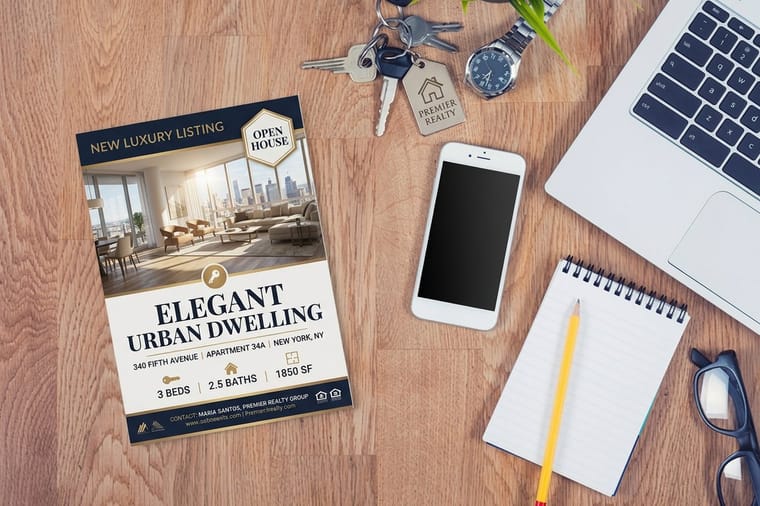
Build a house for sale flyer as an 8.5 by 11 inch portrait sheet with one full bleed exterior photo across the top, the price and street address directly under it, a single spec line, three short selling sentences, and your contact and brokerage block at the foot. Print it on 100 lb gloss cover if it lives in a curb box, use the photographer's full resolution files rather than MLS downloads, and carry the license number and Equal Housing Opportunity line on every copy.
Quick answer
One photo, one price, one phone number, in that order
A for sale flyer has one job at the curb and a different one in the car. At three feet a buyer registers the exterior photo and the price, so those two elements get the top half of the sheet and nothing is allowed to compete with them. The spec line, the selling sentences and your contact block earn their space on the second read, once the sheet has been kept. Print it letter size with bleed, pull the photography from the photographer rather than the MLS, and put the brokerage, license number and Equal Housing Opportunity line at the foot of every copy.
Build the Sheet in the Order a Buyer Reads It
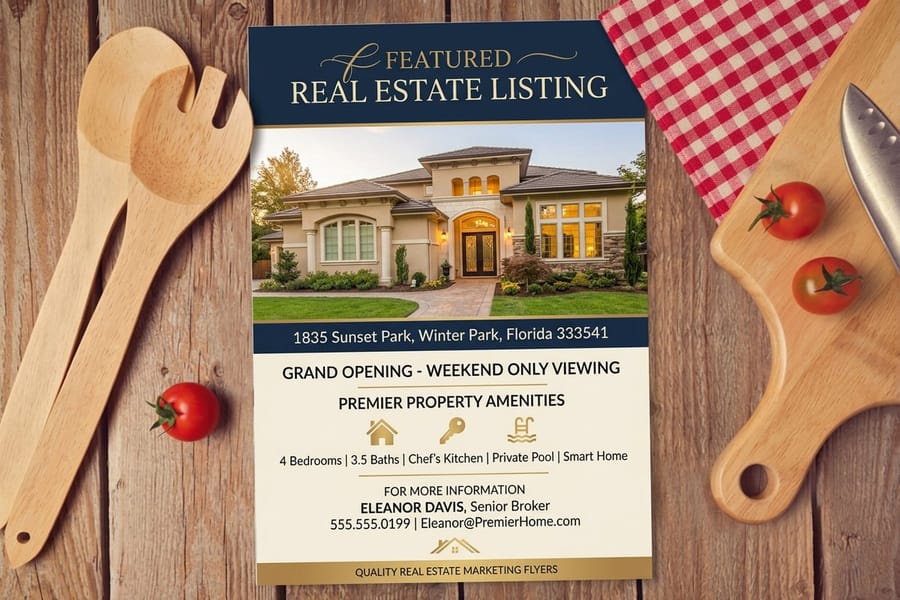
A for sale flyer is read twice, and the two readings want different things. The first happens at the curb: a driver stops, looks at the box, and decides in a second or two whether to take a sheet. The second happens in the car or at the kitchen table, where the specs and your phone number finally matter. Design for the first read and the second one looks after itself.
- One exterior hero photo across the top. Full width, full bleed, roughly the top 40 percent of the sheet. Shot from the angle that shows the front door and the driveway, in daylight. A collage of six small photos up top reads as clutter from three feet away.
- Price and street address directly beneath it. Price at 28 point or larger, address just under it at 18 to 24 point. Those two lines are the only text that survives the curb read, so nothing else on the sheet should compete with them.
- One spec line, not a spec table. Beds, baths, square footage, lot size, year built. Ten or eleven point, separated by dots or thin rules. A buyer scanning the sheet wants the shape of the house in one glance.
- Three or four short selling sentences. Name the things a photo cannot show: the new roof, the finished basement, the corner lot, the school walk. Cut every adjective that could apply to any house on the street.
- Your block at the bottom. Headshot, name, phone, email, brokerage, license number, and the Equal Housing Opportunity mark. Keep it to the bottom fifth so it never fights the price.
Letter size is the default real estate flyer size, and the listing decides when to move off it.
| Real estate flyer size | Where it works | What it holds |
|---|---|---|
| 8.5 x 11 in | Curb box, take one tube, open house table | The hero photo, price, spec line, selling sentences and your block, as laid out above. |
| 8.5 x 14 in | Larger homes and listing folders | The same order with room for a second photo row or a floor plan. |
| 5.5 x 8.5 in | Neighborhood drops and showing handouts | One photo, price, address and your phone, with the spec line on the back. |
| 11 x 17 in | A window or an office board | A poster read from across a room, with the photo carrying most of the sheet. |
All four print as real estate flyers on 100# gloss or silk text, 70# uncoated text, 80# gloss cover, 100# silk cover or 14pt cover, on one side or both, with an optional high gloss UV coating. A run of 100 costs $57.11 and 400 cost $97.76, so the price per sheet drops by more than half once a listing needs a refilled box.
Start from a correctly sized layout rather than a blank canvas. Our blank template library has the letter sized flyer file with the bleed and safety guides already drawn, and the bleed and trim guide explains why the photo has to run past the edge of the page.
Paper and Coating Decide Where the Flyer Can Live
The stock question only has one hard input: where does the sheet spend its life. A flyer in a curb box faces sun, humidity and a hundred hands. A flyer on an open house table gets picked up once. Those are different pieces of paper.
| Stock | Feel | Where it wins | Where it fails |
|---|---|---|---|
| 70 lb uncoated text | Light, matte, takes pen ink instantly. | Neighborhood drops and mailbox stuffers where cost per piece rules. | Photos look flat, and the sheet curls within a day in an outdoor box. |
| 100 lb gloss text | Substantial but still flexible, photos look rich. | Open house handouts printed in the hundreds, listing folders. | Glares under track lighting, and ink sits wet on the surface. |
| 100 lb gloss cover | Card weight, holds itself upright. | Curb boxes and take one tubes, where the stack has to stay flat. | Costs more per sheet, so it is overkill for a large drop. |
| 14 pt matte with a writable surface | Rigid, low glare, accepts a pen. | Sheets agents annotate during showings and leave with buyers. | Photography loses a little punch against a gloss coating. |
Gloss is the default for a reason: it deepens the blacks in a roofline and holds the greens in a lawn. It also throws a hard reflection under the spotlights most listings are staged with, which is why some agents run a matte sheet for the open house and a gloss one for the box outside. If you want to compare weights properly before you commit, the flyer paper weight guide lays out how each option behaves on press, and standard flyers start at $39.54 with the same stock choices.
One thing that catches people out: a sheet left in a south facing curb box will fade. Nothing on the market prevents that at flyer prices. Plan to refill the box rather than expecting one print run to last a whole listing.
Getting the Photography to Survive the Trip to Press

Most disappointing real estate flyers are not design failures. The layout was fine and the photos were too small, or the screen version looked nothing like the printed one.
Resolution first. Press work is set up at 300 dpi, which means a printed inch needs 300 pixels of real image. Do the division before you place anything: a 1024 pixel wide MLS download covers 3.4 inches. Across a letter sheet with bleed you need roughly 2,600 pixels for the hero. The listing photographer's originals almost always clear that, so ask for the folder rather than right clicking the MLS page. Interior shots running two inches wide in a photo strip need only about 600 pixels, so those can come from anywhere.
Then color. Your monitor makes color with light and the press makes it with four inks on paper, so the saturated blue sky and the vivid lawn you see on screen land quieter in print. Dark interiors suffer worst: shadow detail that reads fine backlit on a laptop goes to solid black on paper. Lift the shadows in the exterior and the darkest interior shot before you export, and convert to CMYK yourself so you get to judge the shift rather than discovering it in the box. There is a full walkthrough in our color profile guide.
Then the export. Flatten to a print PDF, embed or outline the fonts, and check that the hero photo actually extends into the bleed area rather than stopping at the trim. A white hairline along one edge of a delivered flyer is nearly always a photo that stopped at the page boundary.
The Legal Block, and the Copy That Gets Agents in Trouble
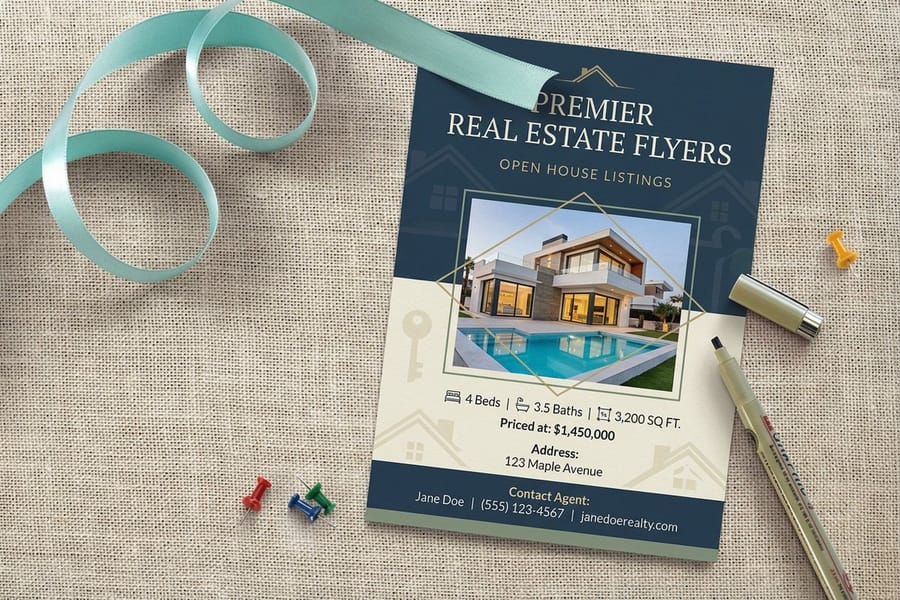
Three items belong at the foot of every sheet: the brokerage name exactly as it is licensed, your license number, and the Equal Housing Opportunity logo or statement. State real estate commissions set the specifics, including minimum sizes for the brokerage name in some states, so confirm yours before a large run. Seven point is a sensible floor for that block. Smaller than that and it is technically present but nobody can read it.
The copy carries more risk than the fine print. Fair housing law regulates how a property is advertised, and the trap is that the offending phrases usually sound friendly. Writing that a home is perfect for a young family, ideal for empty nesters, or in a quiet Christian neighborhood describes the people rather than the house, and each of those touches a protected class. The fix is mechanical: describe the property and let buyers decide who it suits.
- Instead of great for a growing family, write four bedrooms and a fenced back yard.
- Instead of walk to the Catholic church, write walkable to shops and services on Main Street.
- Instead of a safe neighborhood, name what is verifiable: the school district, the distance to the train, the year the roof went on.
Get the flyer right and the rest of the listing kit follows the same rules. The open house checklist covers what to print alongside it, flyer distribution practices cover where the extra copies go, and the agent print marketing kit maps the full set from sign to closing folder.
Wally explains the for sale flyer
Photo and price from the curb, the rest from the car
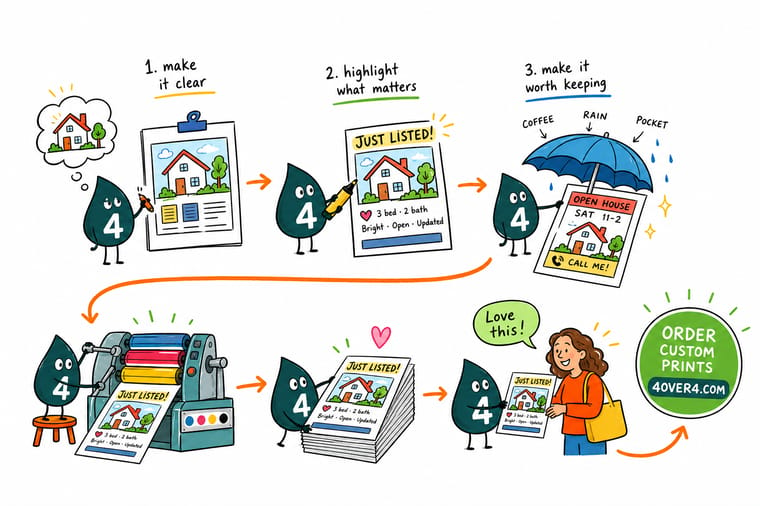
Wally puts the exterior shot across the top and the price right under it, because that is all anyone reads standing in a driveway. Beds, baths, square feet and his phone number sit lower down for the second read. He prints on gloss cover so the stack stays flat in the box through a humid week, and he never sizes a hero photo from an MLS download, because 1024 pixels only covers three and a half inches at press resolution.
Print real estate flyers →
Specs and pricing
Sizes, stocks and starting prices for listing sheets
Listing sheets print from 4.25 by 5.5 to 11 by 25.5 inches, with 8.5 by 11 the default, on text and cover stocks up to 14pt, from 50 sheets for $39.54. Configure the sheet the way you would order it, with live size, stock and quantity choices and starting prices straight from the 4OVER4.COM configurator.



Print it
The three pieces one listing needs
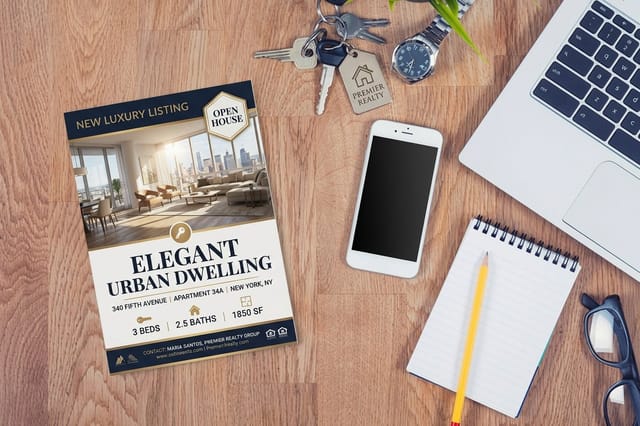
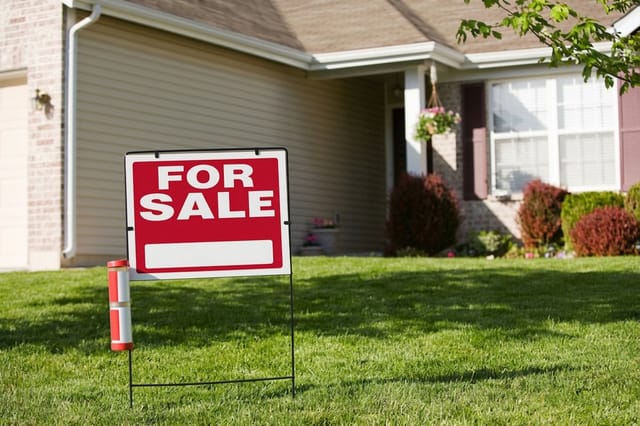
The flyer fills the curb box, a 4 by 6 or 5.5 by 8.5 inch postcard announces the listing to the block, and an 18 by 24 inch yard sign on 4mm coroplast points drivers to the box.

Explore more
Where to go next
Check the flyer size against the box, plan the just listed postcard mailing, confirm the sign rules for your town, and build the full print kit for the listing.

By the numbers
Listing print that arrives when the sign goes up
Common Questions
Your house for sale flyer questions, answered
What size should a house for sale flyer be?
8.5 by 11 inches, portrait. That is the size every acrylic curb box and every listing folder is built around, it stacks flat on an open house table, and buyers can file it without folding it. A 4 by 9 inch sheet works if you are handing flyers out at a door rather than leaving them outside, and 11 by 17 folded in half turns the same content into a small brochure for a higher priced listing. Whatever size you pick, set the document up with 0.125 inch bleed on all four sides and keep type at least 0.25 inch inside the trim line.
What paper should I print for sale flyers on?
For a sheet that sits in an outdoor box, 100 lb gloss cover. It holds its shape in humidity, resists the curl that makes a stack look abandoned, and the coating keeps the photography saturated. For open house handouts printed in the hundreds, 100 lb gloss text costs less and feels right in the hand. If agents write offer notes or comps on the back, choose an uncoated stock, because a pen skates across a gloss coating and takes minutes to dry.
How many flyers should I print for one listing?
Enough to refill the curb box twice a week for the expected time on market, plus a stack for the open house. Agents commonly land somewhere between 100 and 250 per listing. Print runs get cheaper per piece as quantity climbs, so if you list steadily it is worth printing a generic brokerage back side once in a larger run and pairing it with a listing specific front. Real estate flyers start at $39.54, which is why most agents print more rather than reprint mid campaign.
Can I use the photos straight from the MLS?
Usually not for the hero image. MLS systems serve web sized files, commonly around 1024 pixels wide, and at press resolution of 300 dpi that image only covers about 3.4 inches. Stretched across a letter sheet it goes soft and the roofline picks up visible edges. Ask the listing photographer for the full resolution originals, which are typically shot at several thousand pixels wide. Smaller interior shots in a photo strip can survive at MLS size because they print two inches wide or less.
What has to appear on a real estate flyer legally?
The rules are set by your state real estate commission and by federal fair housing law, so check your state, but three things are close to universal: the brokerage name as it is licensed, your license number, and the Equal Housing Opportunity logo or statement. Fair housing also governs the copy itself. Describe the property, never the buyer. Phrases like perfect for a young family or great for a Christian community reference protected classes and create liability even when they are meant kindly. Say four bedrooms and a fenced yard instead.
Should the back of the flyer be printed?
Print it if the listing is above your market average or if the flyer doubles as an open house handout. The back carries the interior photo strip, the floor plan, a short neighborhood and schools paragraph, and your headshot and contact block. On a quick moving entry level listing a blank back is defensible, because the sheet gets scanned in a driveway and discarded. Double sided printing adds far less than a second sheet would, so the choice is about attention, not budget.
Get Started
Order 50 real estate flyers from $39.54
Upload the sheet, pick your stock and coating, and we print listing flyers that stay flat in the box and hold their color through the open house.
Legal Disclaimer
Gold Standard guarantees apply to all standard orders placed through 4over4.com. Price match requires verifiable proof of a competitor's published price for an equivalent product with matching specifications and turnaround time. Satisfaction guarantee covers manufacturing defects and print quality issues. Contact support with order number and documentation.
