
Creative Business Name Ideas That Pass the Four Checks


Emma is our prepress and print production voice, built from the knowledge of our production team, with over 20 years in printing.
Build a long list of forty names without judging any of them, then put the survivors through four checks in order: say it out loud and have someone spell it back, search the domain and the social handles, search your state business registry, and search the trademark register by goods and services class. The name that clears all four is your name, and the last check is the one that quietly disqualifies most favorites. If you plan to buy a business name, a name marketplace sells you the domain only; the state registry and the trademark register still decide whether you can trade under it, so run all four checks before you pay. The creative business name ideas below come from five approaches, compared in the table under this answer, with ready name patterns by category after it. Once a name clears, print it small first: 100 standard business cards from $17.57 and a rubber stamp from $31.29 show you how it reads in a hand and on a box.
Naming approaches at a glance
| Approach | How it is built | What it is good at | Where it fails | Best fit |
|---|---|---|---|---|
| Founder or family name | Surname, initials, or two founders joined | Credible, easy to trademark, ages well | Says nothing about what you sell | Law, trades, agencies, studios |
| Descriptive | The category plus a modifier | Instant comprehension, easy local search | Weak trademark, blends into competitors | Local services, retail, food |
| Invented or coined | A new word, or two clipped words fused | Clean domain, strongest legal protection | You pay to teach people what it means | Products, software, brands with budget |
| Metaphor or borrowed word | A concrete noun with the right feeling | Memorable, visual, gives the logo a subject | Often taken, and the meaning can drift | Cafes, shops, studios, breweries |
| Place or landmark | Street, neighborhood, river, county | Roots you locally and builds trust fast | Hard to expand past the place you named | Restaurants, real estate, contractors |
Most founders land between descriptive and metaphorical. Riverside Dental Care explains itself on day one and sits in a row of look-alike competitors; Flour and Ash explains nothing at first and gives you a name you can own for years. Whichever you pick, test it on the first thing it goes on: fourteen characters sit comfortably across a 3.5 by 2 inch card, so order standard business cards straight from the configurator and see the name in the world.
Why your business name matters more than founders expect
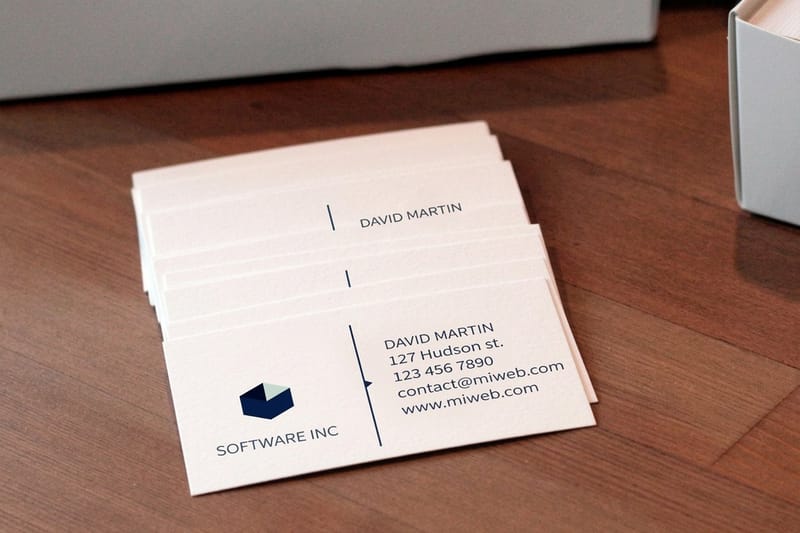
Choose a name in two passes: generate forty candidates without judging any of them, then run the survivors through four checks in this order, say it out loud, search the domain and social handle, search your state business registry, and search the trademark register by class. Most founders do the reverse, fall in love with one option, then discover on registration day that a company two states over has owned it since 2009.
The name matters because it is the one asset you repeat forever. It goes on the card you hand over, the invoice, the sign above the door, the voicemail greeting, the return address on every envelope. A name that is hard to spell costs you a small tax on every one of those, and you pay it for as long as the business exists.
It matters less than founders fear in one specific way. A good name will not save a bad offer, and plenty of ordinary names carry excellent businesses. Give it a week, not a quarter. The compounding value comes from repeating one name consistently, which is why deciding what the brand says is worth more attention than the fifth round of wordplay.
The out-loud test comes first because it is free
Read each candidate over a phone call, then ask the other person to spell it back. Anything that needs a correction is carrying a permanent cost. Names that fail here usually share one of three traits: a silent letter, a deliberate misspelling, or a double letter people cannot hear.
Say the full legal version too. "Ridgeline Cabinetry LLC" is fine on a voicemail greeting. A four-word name with an ampersand is not, and you will shorten it within a month anyway, so pick the short form now and register that.
Where the name has to fit physically
A name behaves differently at every size it prints at. Fourteen characters sit comfortably across a 3.5 by 2 inch card. The same name on a window decal read from the sidewalk needs to work at a glance, and on a rubber stamp it has to stay legible in a single ink color at under two inches wide.
Set your three or four finalists in plain type at those real sizes before you decide. A long name is not disqualified, but you should know before you commit that it will need two lines on the card and an abbreviation on the stamp.
Creative naming approaches that produce real candidates
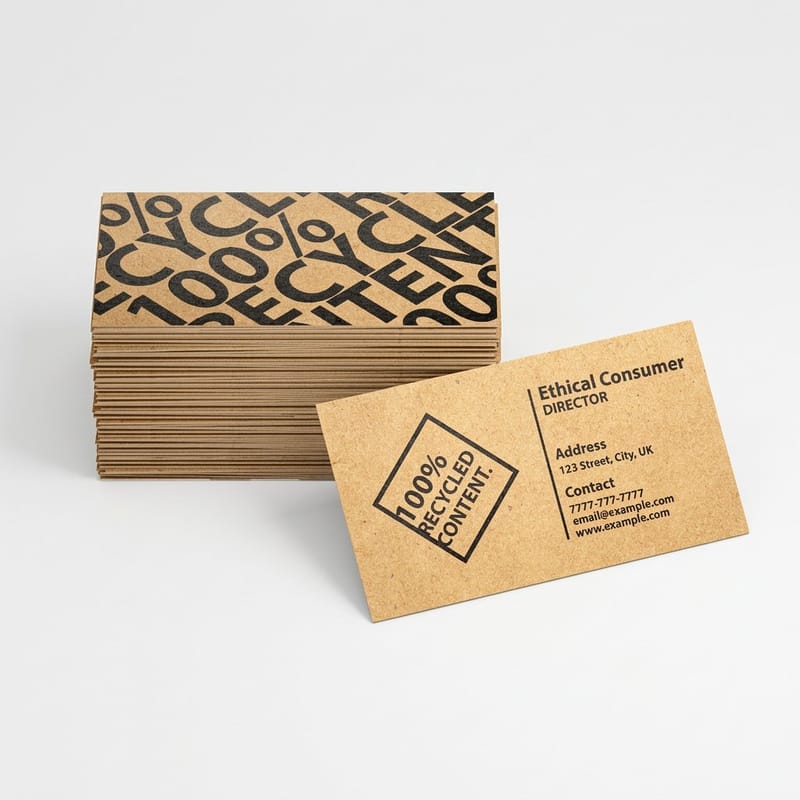
Every workable name comes from one of a handful of approaches. Knowing which one you are using stops the session from drifting, and it tells you in advance what the name will be good at and where it will let you down.
Work one approach at a time and set a target, say twenty candidates, before you allow yourself to reject anything. Judging while generating is what produces the same three safe options at the end of an hour. Keep the ugly ones on the list, because a discarded fragment often turns into the winner two approaches later.
Six generators worth an hour each
Compound two plain words. Take a noun from your craft and a noun from the feeling you want, then jam them together. Ironwood, Northbrew, Saltpine, Copperleaf. This is the highest-yield method for retail and food, and it usually produces a spellable domain.
Borrow from the process, not the product. Bakers have proof, kiln, sourdough starter, crumb. Printers have bleed, trim, plate, register. Process words feel insider without being jargon, and they carry a picture the designer can use.
Use a place you can defend. A street, a creek, a county line, a mountain. It roots you locally and it is easy to say, which is why so many contractors and restaurants land here. The limit is real: name yourself after a neighborhood and expanding across the state gets awkward.
Clip and fuse. Cut two words to their first syllables and join them. Verita, Lumina, Kavo, Brelia. Coined names clear trademark searches more easily and hold the domain, and they cost more in advertising because you are teaching a new word.
Go one degree off literal. Not Bakery, but Flour and Ash. Not Cleaning, but Fresh Slate. The half step keeps the category legible while giving you something to own, and it hands the logo designer a subject instead of a monogram.
Steal the rhythm of names you like. Ignore the meaning and count the syllables. Most names that stick are two to four syllables with a hard consonant near the front. Write your candidates against that pattern and the weak ones fall away quickly.
What to avoid, and why each one bites later
Skip the deliberate misspelling. Kwik, Lite, Xpress and a dropped vowel all made the domain available for a reason, and every one of them costs you a spelling correction on every phone call for the life of the business.
Skip the year, the founder count, and anything numeric that will date. Skip a name built around a service you might drop. And skip a name that only makes sense next to a logo, because the name has to work as text in an email signature, a Google listing and a printed letterhead where the mark is a quarter inch tall.
Business and store name ideas by category
Use these as starting fuel rather than as answers. Every one of them is a pattern with the words swapped, which is the point: take the shape, feed it your own nouns, and you will have a list of your own within twenty minutes. Check anything you like against the registry and the trademark register before you get attached.
If you want a longer runway, we have category-specific lists as well, including one hundred small business name ideas, gift shop names, and food truck names.
Retail and store names
Compound pattern. Northbrook Supply, Copperleaf Goods, Saltbox Mercantile, Fieldnote Provisions, Ironwood Trading.
Place pattern. Third Street Supply, Marion County Goods, Harbor Lane Shop, Two Rivers Outfitters.
One degree off literal. The Slow Aisle, Good Weight, Everyday Object, Open Shelf, Paper and Pine.
Store names carry an extra job the others do not: they have to be readable from across a street. Test your favorite at the width of your actual storefront before you commit, and read the guide to branded signage for how the name behaves once it is a sign.
Service, trade and studio names
Founder pattern. Halloran Electric, Bryce and Doyle, Mott Carpentry, Ellis Grove Interiors.
Process pattern. True Level, Plumbline, Right Angle Builders, Clean Cut Landscaping, Firstcoat Painting.
Trust pattern. Steady Hand Plumbing, Same Day Glass, Honest Grade Roofing.
Trades win on being remembered at the moment something breaks, so favour short, concrete and easy to spell over clever. A name a customer can say to a neighbor without checking their phone is worth more than a name that photographs well.
Food, drink and hospitality names
Ingredient pattern. Flour and Ash, Salt and Char, Buttermilk Row, Rye and Coal.
Process pattern. Proof Bakery, Slow Ferment, Cold Press Co, The Long Rise.
Place pattern. Canal House Kitchen, Millpond Coffee, Depot Diner, Alder Street Cafe.
Hospitality names get spoken more than they get read, in a room with noise. Say the candidate across a table to someone who has never heard it, and if they lean in, cut it.
Checking availability and trademark
Run the checks cheapest first, because each one eliminates candidates before you pay for the next. Ten minutes of searching in the right order saves the founders who skip it a reprint of every piece of stationery they own.
- Say it and spell it. Free, thirty seconds, and it kills roughly half a long list on its own.
- Domain and handles. Check the .com and the two or three social platforms you will actually use. Take them the same day you decide, not the week after.
- State business registry. Your Secretary of State business search tells you whether the entity name is free to register in your state. It says nothing about other states or about trademarks.
- Federal trademark search. Search the USPTO register for your name and for near misses in your goods and services class. This is the check that blocks people, and it is the one most founders leave until last.
The point that surprises people: trademark conflicts turn on likelihood of confusion within a class, not on identical spelling. A competing bakery called Kopperleaf can block your Copperleaf bakery, while an unrelated Copperleaf software company usually cannot. Different classes, different answer. If the name is going on a sign, a vehicle and a thousand pieces of print, an hour with a trademark attorney is cheap insurance against reprinting all of it. For a bakery, that print starts with the storefront, shown in our Bakery Signs video.
Building a brand around the name
A name becomes a brand through repetition in a consistent form. Lock three decisions once, the typeface, the color and the lockup, then repeat them without variation: across a 3.5 by 2 inch card, as a mark a quarter inch tall on a letterhead, and on a business banner from $43.92 above the door. The principles behind a working logo apply from the first card onward, and a color pairing that survives print is worth choosing before you order rather than after.
Quantity and price
Business card pricing and specs
Live configurator numbers for standard business cards, where the per unit cost falls as the run grows.
| Quantity | Price Per Unit | Total |
|---|---|---|
| 100 | 17.6¢ | $17.57 |
| 200 | 11.5¢ | $23.07 |
| 300 | 9.15¢ | $27.46 |
| 400 | 7.96¢ | $31.86 |
| 500 | 7.25¢ | $36.26 |
| 600 | 6.77¢ | $40.64 |

You can also earn coins on every order and redeem them against later printing, which helps when a new brand is buying cards, stationery and signage in the same month.
Printing your brand at 4OVER4.COM
Print the name first on the pieces people handle: standard business cards from $17.57 for the first real test, then premium business cards at $17.57 on heavier stock once the name is settled. If you carry more than one trading name, read the guide on cards with multiple businesses or logos before you lay anything out.
Print it
Business cards, ready for a new name
Preset sizes and stocks, the fastest way to see a name in someone else's hand.
Stationery comes next, because it is where the name appears as plain text with the mark shrunk small. Standard letterheads start at $99.95 and printed envelopes at $142.99, and printing them together keeps the alignment and the color identical across the pair. Then the pieces that carry the name outward: business banners from $43.92, window decals from $93.37, and a rubber stamp from $31.29 for packing slips and boxes. Logo stickers are the cheapest of the lot, and the sticker printing range covers the shapes and finishes.
Choosing an approach for your industry
Pick the approach by what your customers do with the name: read it on a sign, say it to a neighbor, or type it into a search bar.
- Retail and shops. Favour compound and place patterns, and test the name at storefront width before anything else. The sign is the largest thing you will ever print, and it is the most expensive one to redo.
- Trades and home services. Short, concrete and spellable beats clever every time. The name has to survive being repeated by a neighbor, and it has to fit a truck door and a yard sign in one line.
- Food and drink. Ingredient and process words carry appetite. Say it out loud in a noisy room, because a hospitality name is heard far more often than it is read.
- Professional services. Founder names still work here and they trademark cleanly. Keep the legal form out of daily use and register the short version people will actually say.
- Online and product brands. Coined names hold the domain and defend well. Budget for the fact that you are teaching a new word, and keep the spelling phonetic so people can find you after hearing it once.
Blanks that get the name printed the same week
Once the name is chosen, a template gets it printed the same week. Each blank carries the cut line, the bleed and the trim at the real product size, so the new name lands inside the cut on the first run. Pull a 2 x 3.5 inch card blank from the blank template library for cards from $17.57, or start from a layout in the business card range and drop the new name in. The rest of a first order works the same way: a rubber stamp from $31.29, a business banner from $43.92 and 250 printed envelopes from $142.99.
Start fast
Blanks that get the name printed the same week
Card design templates and exact-size blanks, so a new name lands inside the cut line the first time.





Wally runs a name through the four checks
Say it, search it, register it, then print it
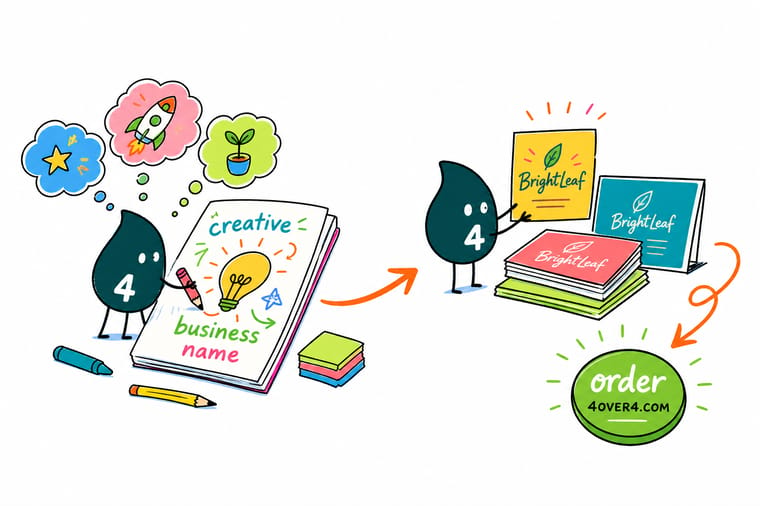
Read the name over a phone call and ask for it back, spelled. Take the domain and the handles the same day. Search your state business registry, then search the trademark register inside your own goods and services class, because a near miss in your class blocks you and an exact match in another class usually does not. Only then print a short run of cards and hand them out.
Order business cards →What to remember about naming a business
Tips that decide whether a name survives print
- Set it in plain type first. Look at the name in a neutral typeface before a logo exists. If it only reads well inside a mark, it will fail in an email signature, a Google listing and a legal document.
- Count the characters. Fourteen characters sit comfortably across a business card. Longer names are fine, but decide now whether the card gets two lines or the stamp gets an abbreviation.
- Check the ambiguous letters. Rn reads as m at small sizes, and I, l and 1 collapse in some typefaces. Print the name at final size before you approve it, and pick from a set of fonts that stay readable in print.
- Reserve the handle the same day. Take the domain and the social handles in one sitting, even before you register. Splitting that across a week is how founders end up with a name they own legally and cannot use online.
- Print one before you print a thousand. Order a short first run, hand a few out, and listen to how people say the name back to you. That feedback arrives faster than any focus group and it costs the price of a card order.
Explore more
More ways to print and promote
Rubber stamps run 1 for $31.29 and window decals 25 for $93.37, two cheap ways to see a new name in use.
Product Standard Business Cards The cheapest way to test a new name in the real world.  Product Premium Business Cards Heavier stock and finishes once the name is settled.
  Product Letterheads The name as text, where the logo shrinks to a quarter inch.
  Product Printed Envelopes Return address and mark, matched to the letterhead.
  Product Custom Window Decals Your store name read from the sidewalk.
  Category Business Card Printing Every stock, size and finish in one place.
 Ready to print the name you picked?
Choose your stock, drop in your design or a free template, and 4OVER4.COM prints it sharp, as fast as your opening date needs.
Common questions about naming a business
How do I know if a business name is already taken?
Check three registers, because each one covers something different. Your state Secretary of State business search tells you whether the exact entity name is available to register in that state. A federal trademark search on the USPTO database tells you whether someone holds rights to the name or a confusingly similar one in your goods and services class, which can block you even in a state where the entity name is free. A plain web and domain search catches unregistered common law use by a business that never filed anything. Availability in one of the three is not clearance in the other two, and a trademark attorney is worth an hour of fees before you print signage.
Should the business name say what the business does?
It helps at the start and limits you later, so decide which problem you would rather have. A descriptive name like Riverside Dental Care needs no explanation and picks up local searches without effort, but it is weak as a trademark and it sits in a row of near-identical competitors. A coined or metaphorical name explains nothing on day one and gives you something you can genuinely own. A practical middle ground is a distinctive name paired with a plain descriptor line underneath it, which is exactly how most cards and storefront signs are laid out anyway. The Dental Signs video shows signs for a practice like that one.
What if the .com domain is gone?
Treat it as a signal rather than a verdict. If the .com is parked and unused, the name may still be fine for a local business, though you will lose some direct traffic and you should expect a purchase offer in the four figures if you ever try to buy it. If the .com belongs to an active company in your category, drop the name, because the trademark problem is real and it will surface at the worst moment. If it belongs to an active company in an unrelated field, a modified domain plus your own strong presence usually works. Grab the matching social handles the same day you decide.
How long should choosing a name take?
A week of real work, not a quarter of deliberation. Give yourself two or three generation sessions of an hour each, sleep on the shortlist, run the four checks, then commit. Founders who spend a month on the name are almost always avoiding a harder decision about the offer or the pricing. The name gains its value from repetition, and repetition cannot start until you choose one.
Can I change the name later?
Yes, and it costs more than founders expect once the name is in circulation. The legal side is straightforward: file a name change or a DBA with your state. The expensive part is everything the name is printed on and linked to, including cards, signage, vehicle lettering, packaging, the domain, the email addresses, and the search equity attached to the old name. If a change is coming, do it while your print run is small. Our brand refresh checklist lists what has to change and in what order.
