
Free Yard Sign Templates With Bleed, Trim and Safe Zones Already Set


Tobias is our voice for cutting, binding and large format, built from the knowledge of our production team, with over 20 years in printing.
Download the panel size you plan to order, drop your artwork inside the safe zone, and pick the flute direction that matches how the sign will stand. That last one is not in any template file.
A free yard sign template is a layout file drawn at a real panel size with the bleed, the trim and the safe zone already set: for the standard 18 by 24 sign that means an 18.25 by 24.25 document, a cut at 18 by 24, and every word kept inside 17.5 by 23.5. Build at full size, place images at 100 to 150 dpi at that scale, export one flattened CMYK PDF with bleed. Then choose flute direction on the order so the wire H stake actually slides in.
Quick answer
Three guides on the file, one decision on the order
The template handles the measuring so the cut never surprises you. Bleed runs an eighth of an inch past the trim, the trim is the finished panel, and the safe zone holds your text a quarter inch inside it. Build at full size in CMYK, keep images at 100 to 150 dpi at that scale, export one flattened PDF. The only thing the template cannot decide for you is flute direction, and that is the difference between a sign that seats on its stake and one you end up taping.
Printing 100 yard signs? The templates on this page are free, and the signs are printed to order: one run holds 1 to 100 signs on 4mm white coroplast, from $25, printed on one side or both, with H stakes added on the order and 5 business days of standard production.
Get the Template for the Exact Panel You Will Order
Start from the size, not from the design. A yard sign template is a layout file drawn at a real cut panel with three guides on it, and each panel size has its own file because the bleed and safe margins are fixed distances rather than percentages.
Grab the file from the blank template library in the format your app opens, or start straight from a sized layout in our online design tool if you would rather not open Illustrator at all. Then set your document up like this.
| Panel | Document size with bleed | Safe area for text | Where it earns its place |
|---|---|---|---|
| 12 x 18 in | 12.25 x 18.25 in | 11.5 x 17.5 in | Directional arrows, open house pointers, anything read on foot or from a slow turn. |
| 18 x 24 in | 18.25 x 24.25 in | 17.5 x 23.5 in | The default. Listings, campaigns, contractor jobsite signs, service reminders. |
| 24 x 18 in | 24.25 x 18.25 in | 23.5 x 17.5 in | Landscape headlines and long business names that will not break over two lines. |
| 24 x 36 in | 24.25 x 36.25 in | 23.5 x 35.5 in | Road frontage and highway setbacks, where you need letter height above everything. |
Read the last column before you download anything. The right panel is the smallest one that still carries your headline at a readable height from where people will actually see it, and the yard sign dimensions guide walks through that distance math size by size.
Bleed, Trim and Safe Zone, Set Once
Three lines do all the work in the template, and they never move once you understand what each one is for.
- Bleed, 0.125 inch outside the trim. Any background that touches an edge has to run past the cut line by an eighth of an inch. Sheets shift slightly as they feed, and the bleed is what absorbs that shift instead of leaving a white sliver on one side.
- Trim, the finished panel. This is the 18 by 24 rectangle you will hold. It is the size you order and the size you should be designing to visually.
- Safe zone, 0.25 inch inside the trim. Text, logos and any element that would look broken if it lost a hair sits inside this line. On 4mm corrugated plastic the cut tolerance is wider than on a business card, so half an inch is calmer than a quarter and costs you almost no room on a panel this size.
Export one flattened PDF in CMYK with bleed included and crop marks off unless the file asks for them. The print ready PDF export guide covers the exact dialog settings, and if the three lines still feel abstract, full bleed printing explained shows what happens on press when the bleed is missing.
One trap worth naming: RGB blues and bright greens that glow on screen shift noticeably once they convert to CMYK ink, and a yard sign is mostly flat color. Convert and check before you send, rather than after the box arrives.
Flute Direction Decides Whether the Stake Fits

This is the part templates never tell you, and it is the single most common reason a correct file turns into a sign that will not stand up.
Corrugated plastic is two flat faces with hollow ribs between them. Those ribs are the flutes, and they run in one direction across the sheet. A wire H stake is two legs joined by a crossbar, and the legs slide up inside two of those flutes. So the flutes have to run parallel to the stake legs, which means parallel to the direction the sign stands.
A portrait 18 by 24 sign pushed into a lawn from below needs vertical flutes. Flip the same artwork to a landscape 24 by 18 panel and you now need horizontal flutes, because the stake still comes up from the ground. Flute direction is chosen when the sheet is cut, not in your file, so it is a line on the order rather than a layer in the template. Get it backwards and the only fixes are zip ties or tape.
Wind is the other stake question. A single H stake holds an 18 by 24 panel comfortably. On a 24 by 36 it becomes a sail, so use two stakes spread across the width, or move to a rigid panel entirely. The trade offs between plastic, reflective plastic and metal are laid out in the durable outdoor materials guide, and coroplast costs, stakes and quantity breaks covers how many stakes a run actually needs.
Design Rules That Survive a Car Doing 35
The template guarantees the cut. It does nothing about whether anyone can read the sign, and most yard signs fail on legibility long before they fail on setup.
The working rule in signage is one inch of capital letter height for every ten feet of viewing distance. A sign at the edge of a lawn read from thirty feet needs three inch caps for the headline. A driver passing at 35 miles per hour crosses your sign in roughly two seconds, which is enough for about five words. That is the entire brief: a name, one thing you do, and one way to reach you.
Contrast beats color choice. Dark type on a light panel holds up at a longer distance than the reverse, and a thin outline around reversed type helps it survive a bright afternoon. Skip gradients behind text, skip drop shadows at this scale, and give the headline room. On a heavily inked flood coat the flute ridges are more visible under raking light, so a lighter background usually reads cleaner from the road as well as costing less to cover. Sign color choices for maximum visibility goes deeper, and how to design a yard sign walks the whole layout from headline to phone number.
One more thing to check before you upload: where the sign is allowed to stand. Setback distances, sign counts, election windows and neighborhood association rules differ by town, and the state by state sign permit guide plus the real estate yard sign rules will tell you whether your 24 by 36 is legal on that corner.
Which Sign to Order Once the File Is Ready
The template is material neutral, so the last decision is what the artwork gets printed on. Match the stock to how long the sign has to stand rather than to the price.
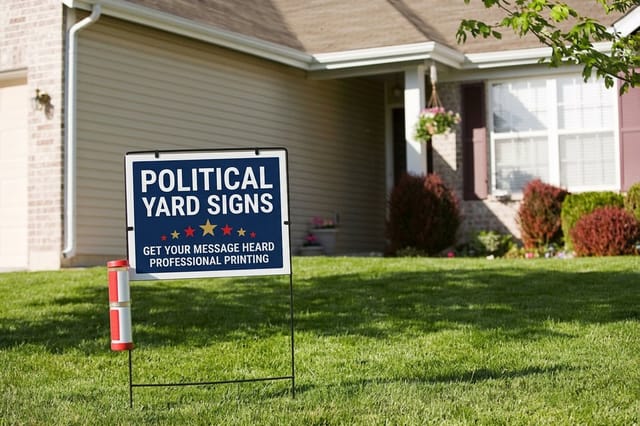
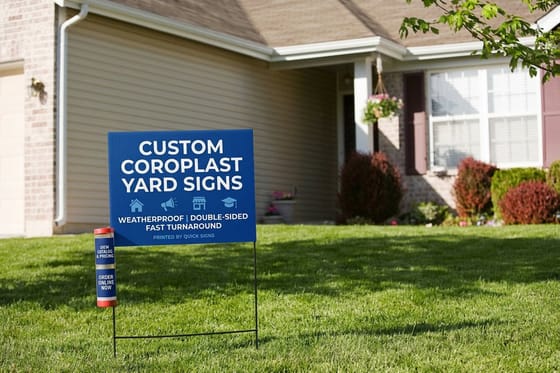
Yard signs start at $25 on 4mm corrugated plastic and cover the ordinary case: a listing, an event, a campaign season, a jobsite. Coroplast yard signs start at $25 for the same construction when you want to specify the stock by name. Real estate yard signs start at $29.89 and are set up for the sizes and rider hardware agents use. Political yard signs start at $25 and are built for the quantity breaks a campaign needs.
Two upgrades are worth knowing about. Reflective coroplast starts at $29 (see it in the reflective coroplast video) and puts a reflective face on the same panel, which matters for directional signs read after dark. Aluminum signs start at $36 and are the honest answer when the sign is going up for years rather than weeks, because 4mm plastic is built for a season and will show it.
Where corrugated plastic does not earn its place is anything permanent, anything mounted flat to a wall, and anything bolted to a post in real wind. Spend the difference on rigid stock instead. Browse everything side by side in yard sign printing or across the wider signs and banners range if the job needs a banner or an A frame alongside the lawn signs.
Wally explains the yard sign template
Three lines on the file, one choice on the order
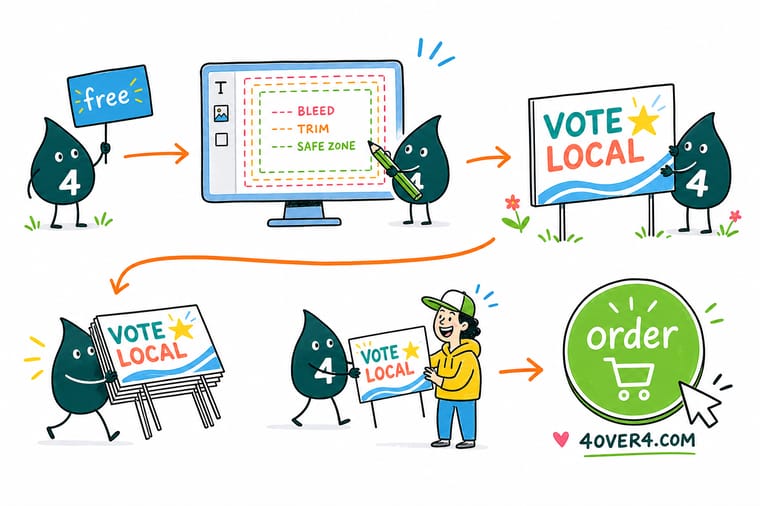
Wally opens the 18 by 24 template and finds three lines waiting for him: the bleed an eighth of an inch outside the cut, the trim where the blade lands, and the safe zone a quarter inch in that keeps his phone number off the edge. He builds the panel at full size, keeps the photos around 120 dpi at that scale, and sends one flat CMYK PDF. Then he does the part no template can do for him. He checks that the flutes run the same way the stake does, because the two legs slide up inside them, and a sideways panel gives the stake nothing to hold.
Order yard signs from your file →
Specs and pricing
Panel sizes, stakes, and starting prices
Coroplast and political yard signs run 5 business days, real estate signs and aluminum 4.



Print it
Send the template back to us and we print it
Yard signs print on 4mm white coroplast at 12 by 18, 12 by 24, 18 by 24 or any size up to 46 by 46 inches, on one side or both, with grommets and H stakes as options. You can order from 1 to 100 signs in a run, with 5 business days of standard production.

Explore more
Where to go next
Match the panel to the viewing distance, pick a material that lasts the season, lay out a sign read from the road, and count the stakes a run needs. The last two cards price every yard sign and open the template library.
By the numbers
Your finished template lands at a printer 25+ years into sign work
Common Questions
Your yard sign template questions, answered
What size is a standard yard sign template?
Eighteen by twenty four inches, portrait, is the panel most people mean by a yard sign. Set the document to 18.25 by 24.25 inches so the artwork carries an eighth of an inch of bleed on all four sides, draw the trim at 18 by 24, and keep type inside 17.5 by 23.5. The two other common panels work the same way: a 12 by 18 becomes a 12.25 by 18.25 document, and a 24 by 36 becomes 24.25 by 36.25.
Do I need bleed on a yard sign if the background is white?
If the panel is white to the edge, there is nothing to bleed and the file will cut fine. Add the bleed anyway. The moment you drop in a colored band, a photo or a border, that eighth of an inch is what stops a hairline of bare white plastic appearing along one edge when the cut drifts. Adding bleed to a file that does not need it costs nothing. Discovering you needed it after the run costs a reprint.
Which way should the flutes run on a coroplast yard sign?
The same way the stake goes in. A wire H stake has two legs about ten inches apart that slide up inside two flutes, so a portrait 18 by 24 sign pushed into a lawn from below needs vertical flutes. A landscape 24 by 18 panel on the same stake needs horizontal flutes. This is set when the sheet is cut, not in your artwork, so pick it on the order and not in the template. Getting it backwards leaves you taping the sign to the stake.
What resolution should a yard sign file be?
Build it at full size and place images at 100 to 150 dpi at that scale. Large format is viewed from ten feet and up, and the eye cannot resolve more than that at distance. A 24 by 36 inch file at 300 dpi is 7200 by 10800 pixels, which slows every save, bloats the upload and prints no sharper. Vector logos and live type stay crisp regardless, so keep them as vectors rather than rasterizing them into the background.
Can I resize a template made for a different panel?
No, and this is the most common way a good design goes wrong. Bleed and safe margins are fixed distances in inches, not percentages, so scaling a 12 by 18 file up to 24 by 36 doubles them and leaves your text floating an inch from where it should be. Any raster art in the file softens at the same time. Download the template for the size you are ordering and rebuild the layout inside it.
Is the back of a double sided sign a separate file?
Supply it as a second page or a second artboard at the same trim size, not as a second document with different dimensions. Both sides share one panel, one stake and one orientation, so a back that reads sideways relative to the front will be printed exactly as you sent it and will look wrong in the ground. A common approach on a listing sign is a full layout on the street facing side and a stripped back version with the phone number only on the reverse.
Get Started
Template filled in? Let us cut it.
Pick your panel size, choose the flute direction that matches your stake, and send one flat PDF. We check the file before it runs and ship the signs with the stakes you need.
Legal Disclaimer
Gold Standard guarantees apply to all standard orders placed through 4over4.com. Price match requires verifiable proof of a competitor's published price for an equivalent product with matching specifications and turnaround time. Satisfaction guarantee covers manufacturing defects and print quality issues. Contact support with order number and documentation.
