
Creative Calendar Design Ideas and the Print Format Each One Needs


Emma is our prepress and print production voice, built from the knowledge of our production team, with over 20 years in printing.
Creative calendar design ideas start with a cover that carries the year and your name, on a format that can actually hold the idea, so pick the format before the theme. Cover ideas that get a calendar hung include a hero photo of your work, a bold year number, a twelve month thumbnail mosaic and a brand pattern. Inside, a wall calendar gives artwork roughly the top half of the page and the date grid the rest, a desk tent hands most of the sheet to the grid, and a one page poster planner shrinks a date cell until nothing but the number fits.
Calendar ideas matched to a format
| Design idea | What it demands | Format that holds it | What happens to the grid | Product at 4OVER4 |
|---|---|---|---|---|
| Photography series | Twelve strong images, one per month | Wall, wire bound | Grid sits below the image, full width | Wire-O Coil Calendars |
| Illustration or pattern | One visual system, twelve variations | Wall or desk tent | Pattern can bleed behind the header | Standard Calendars |
| Year at a glance | All twelve months on one sheet | Poster calendar | Cells shrink to roughly a fingernail | Standard Posters |
| Promotional offer per month | Twelve offers written before design starts | Wall, wire bound | Offer lives in the header band | Standard Calendars |
| Fridge or locker mini | One panel, months as a compact block | Magnet | Dates only, no writing room | Standard Magnets |
| Save the date mailer | A short season, not a full year | Postcard | A strip of dates, not a grid | Standard Postcards |
Wire-O coil calendars print at 8.5 x 11, 9 x 12, 11 x 17 or 12 x 12 in with 12 or 18 months of pages, and Standard Calendars print at 8.5 x 11 in, saddle stitched, so measure the space the calendar will hang in before you set the artboard. Our standard calendar sizes breakdown lists wall, desk, poster and pocket side by side, and you can configure a calendar run straight from the product page.
Creative calendar design ideas, sized to the page
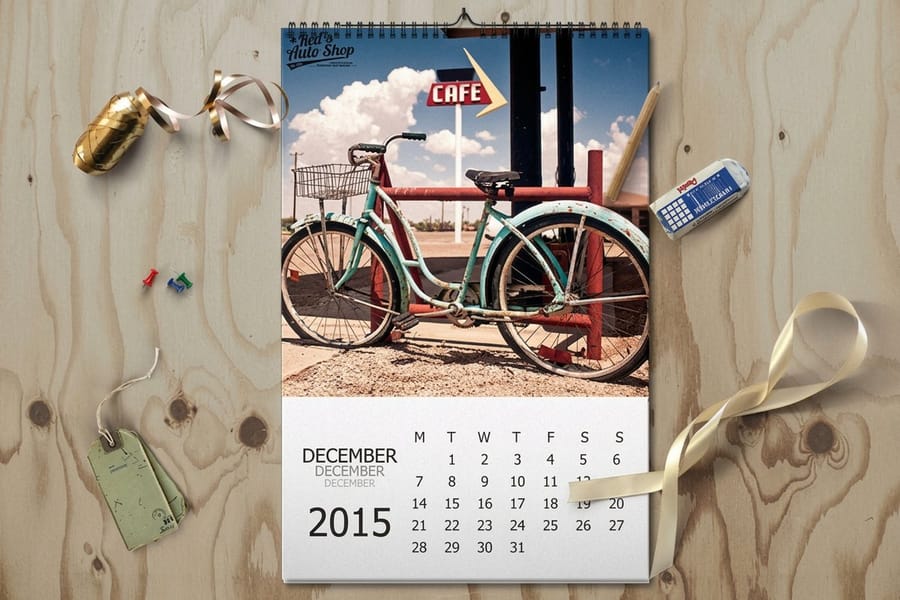
A creative calendar idea only works at the size you print it. Six that hold up on a 4OVER4.COM calendar:
- One photo per month, full width. On an 11 x 17 in Wire-O calendar the image band runs about 11 x 8.5 in, which wants a file near 3300 x 2550 pixels at 300 dpi.
- A brand pattern that changes color each month. Vector artwork scales to every size from 8.5 x 11 in to 12 x 12 in without a resolution check.
- An 18 month run. Wire-O calendars print with 26 pages for 12 months or 38 pages for 18, so a July start still covers the whole next year.
- A square calendar for square photos. The 12 x 12 in Wire-O size takes phone and social grid images without a crop to a horizontal band.
- Your own dates printed in. Sale days, service reminders or events set in the brand color inside the grid, so every month gives the customer a reason to call.
- An offer in the header band. A different offer each month in the one inch band above the grid, written before the design starts.
Every one of these prints in full color on both sides with a 14pt gloss or 80# gloss cover, and Wire-O runs start at 25 calendars for $812.59.
Why a custom calendar is year-long marketing
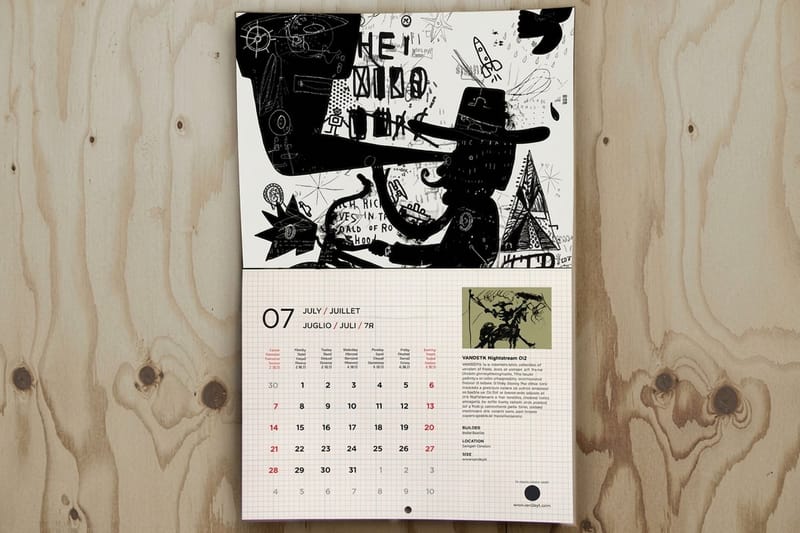
Nobody pins a flyer to the kitchen wall. A calendar earns that spot because it does a job the person actually needs doing, and your name rides along for a year at a cost that works out to pennies a month per household.
That changes what a good calendar design is. It is not the prettiest twelve pictures you own. It is the twelve pictures that still look right in November, printed on a format where the date grid stays usable, with your brand placed somewhere it does not crowd a single date. Our note on why a physical calendar still works covers the case for the format; this page is about what to put on it.
Start with the shortlist of formats we print, because the format decides how much of the page your idea gets: Custom Calendars, Wire-O Coil Calendars, a one sheet poster calendar, or a magnet for the fridge. Browse the lot on calendar printing.
The design brief a calendar really sets
Twelve pages means twelve chances to fail. A theme that carries one great image and eleven weak ones is worse than a modest theme executed twelve times, because the weak months are the ones on the wall longest. Write the twelve out as a list before you open a design file, and if you cannot fill all twelve, change the theme rather than padding it.
The second constraint is that the grid is not yours to move. Seven columns, six rows, and a header row of weekday names. That structure is fixed by the calendar, so your design works around it or fights it.
Who a calendar suits, and who it does not
It suits a business with a reason to be remembered later: a contractor, an insurance broker, a veterinary practice, a venue with a season. It suits anyone whose customer buys once a year and needs a phone number in the moment they need it.
It suits nobody who wants a response this month. A calendar pays back slowly, over the year, and the cost is front loaded into one run in the autumn. If the budget has to produce leads in six weeks, print postcards instead and keep the calendar money for next season.
Themes that make a calendar worth keeping
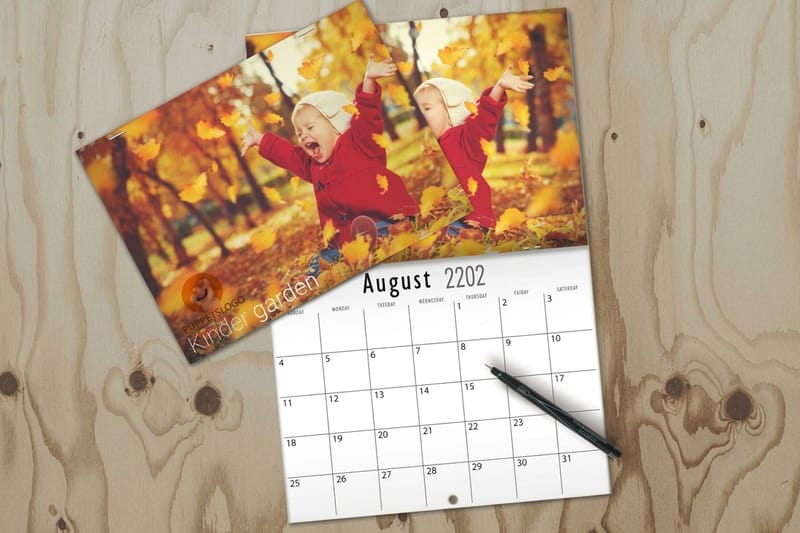
A theme survives twelve months if it has natural variation built in. Seasons, a product range, a set of locations, a cast of people, a technique repeated in different colors. Each of those gives you twelve without straining.
Themes that run out fast are the ones with a single hero idea. One clever concept stretched over twelve pages becomes eleven variations on a joke that stopped being funny in February. There is a longer gallery of directions in our calendar design inspiration set if you want to see the range before you commit.
Themes with twelve in them
The work itself. Twelve finished jobs, photographed properly. This is the strongest theme for any trade, because every page is a portfolio piece and the customer already wanted to see it.
A place, month by month. One landmark, one park, one street, shot across the year. Local businesses win with this because the calendar becomes a local object rather than an advert.
The people. Staff, members, animals in a shelter, the team behind the counter. It only works if the photography is consistent, so shoot all twelve in the same light on the same day.
A house style applied twelve ways. One illustration technique, one palette, twelve subjects. This is the cheapest theme to produce because a single illustrator can keep the style stable across the set.
Themes that quietly fail
Stock photography of generic seasons. It reads as filler on page one and nobody looks at page two. Quotes over a gradient, unless the quotes are genuinely yours and worth reading twelve times.
Anything that dates. A calendar hangs for a year, so a design tied to a campaign that ends in March leaves nine months of stale artwork. Keep the campaign in the header band where it can carry a monthly offer instead of a single one.
Calendar cover ideas that get the calendar hung
The cover decides whether the calendar goes on the wall or into a drawer, because it is the only page anyone sees before January. Every cover still has to carry two things: the year, large enough to read across a room, and the business name. On an 11 inch wide wall calendar the year can stand 2 inches tall and still leave room for a picture; on a desk tent of about 6 by 8 inches, cut both down and keep them on the top half of the first panel.
Six cover concepts that earn the nail
A hero photo of the business. Your best finished job, shop front or product, full bleed, with the year and name in a band across the bottom. On a desk tent, crop tight to the subject so it still reads at 6 inches wide.
A bold year number. The year set huge in the brand color with the name under it. It reads across a room on an 11 inch wall calendar and survives the shrink to a desk tent better than any photo.
A twelve month thumbnail mosaic. A 3 by 4 grid of the month images that previews the whole year. Keep the year and name in a solid strip so the mosaic does not swallow them, and cut it to six thumbnails on a desk tent.
A client or team photo. The people behind the counter, shot in the same light as the inside pages. The name goes in the photo band and the year in a corner.
An illustrated local scene. A street, park or landmark your customers know, drawn once in the house style. Vector art scales from a 12 x 12 in wall calendar down to a desk tent without a resolution check.
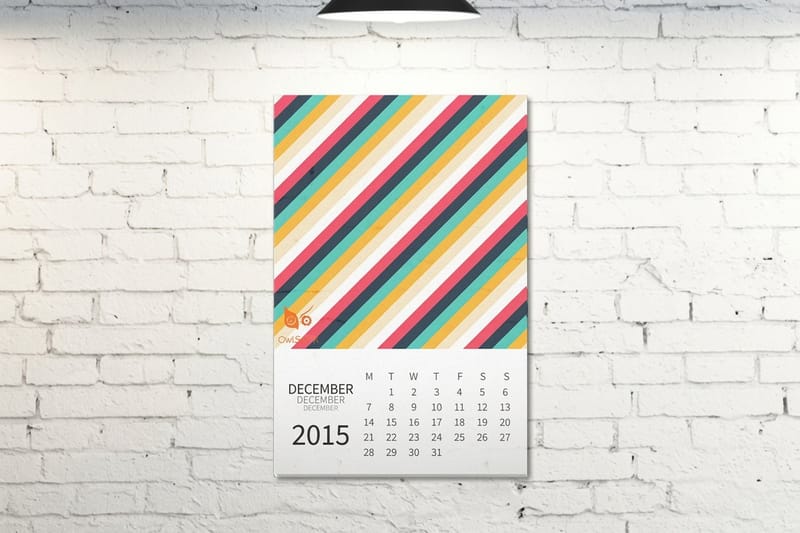
A brand pattern. The logo mark or a stripe in the brand colors repeated edge to edge, with the year and name reversed out of a solid panel. It is the cheapest cover to produce and the easiest to reuse every autumn with a new year.
Layout and grid ideas that stay usable
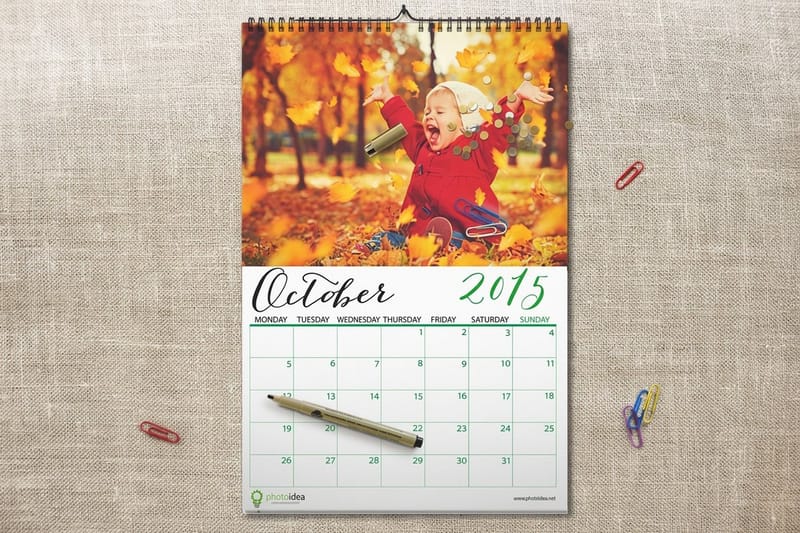
Here is the number that governs every layout decision. On a 12 by 18 inch wall calendar with half inch margins, the printable width is 11 inches, so each of the seven columns is about 1.57 inches. Give the grid six and a half inches of height and each of the six rows is about 1.08 inches. That is the box your date numeral, any holiday name, and any promotional line have to share.
Design six rows even when a month only needs five. A 31 day month that starts on a Saturday runs into a sixth row, and a grid that changes height between months looks like an error to the person hanging it.
Keep the top inch clear for the binding and the hanging hole. A wire binding punches through it, and any artwork or type placed there gets holes through it. Our bleed and trim explainer covers the safety margins that apply to the rest of the sheet.
The date cell is the design
Set date numerals at a size a person can read from across the room, which in practice means the numeral is the largest type on the lower half of the page. Set holiday names at 9 pt or above. Below that, on an offset press with any ink spread at all, small type in a colored cell starts to close up.
Leave writing room if you want the calendar used rather than admired. A cell packed with printed detail has nowhere for a person to write an appointment, and a calendar that cannot be written on comes off the wall by March.
Gray out the leading and trailing days from the neighboring months rather than leaving the cells empty. It reads faster and it stops the grid looking broken at both ends.
Where your own dates go
Mark your dates, not every date. A venue marks show nights, a school marks terms, a garage marks the two months when a service is due. Pick one marking device, a colored dot or a tinted cell, and use the same one all year.
Put the offer in the month header band, the one inch strip between the artwork and the grid. It holds a logo, a phone number and one line of copy without crowding a single date, and it changes month to month so the calendar keeps saying something new.
Photo, illustration and brand-led concepts

The three concept families behave differently on press, and that is what should decide between them.
Photography needs resolution. At 300 dpi an image band of 9 by 11 inches wants a file around 2700 by 3300 pixels, and a phone shot cropped hard will not get there. Check every one of your twelve before you lay out any of them, because the weak file always turns up after the design is finished. Our printing resolution guide has the arithmetic.
Photographic calendars
Shoot or select for a horizontal band. Most calendar images are wider than they are tall, and a beautiful portrait crop loses its subject in that shape. If your best twelve are all vertical, use a desk tent format where the image sits above a narrower grid, or reconsider the theme.
Color manage the set as a set. Twelve images processed on different days drift, and drift shows when the pages hang in sequence. Match them side by side on one screen, then convert once. The color profile guide covers the CMYK conversion.
Illustration and brand-led concepts
Illustration solves the resolution problem outright, because vector artwork scales to any calendar size without a quality question. It also lets you use the brand palette across all twelve months in a way photography rarely allows.
Brand-led means the calendar looks like the company without being an advert on every page. A restrained approach works: brand color in the header band and the marked dates, the artwork left alone. A logo repeated twelve times at full size is the fastest way to get a calendar left in the box. If you need help with the front, our calendar cover guide covers what the first page has to do.
Promotional and gift calendar ideas
A promotional calendar earns its cost by giving the recipient a reason to act inside a specific month. That means writing twelve offers before you design anything, because the design has to hold them.
Twelve offers is harder than it sounds and it is where most promotional calendars quietly become decoration. If you can only write four honest ones, put those four in their months and leave the other eight headers to a phone number and a line about what you do.
Ideas that give the calendar a job
A seasonal service reminder. Mark the months when a boiler, a car or a garden needs attention, with your number in that header. This is the most useful thing a trade calendar can do.
A month of the year discount. One offer per month, valid that month only. It gives the calendar twelve reasons to be looked at rather than one.
A season of dates. A venue, a team or a studio prints its own fixture list into the grid. See calendar ideas for venues and studios for how that plays out across a season.
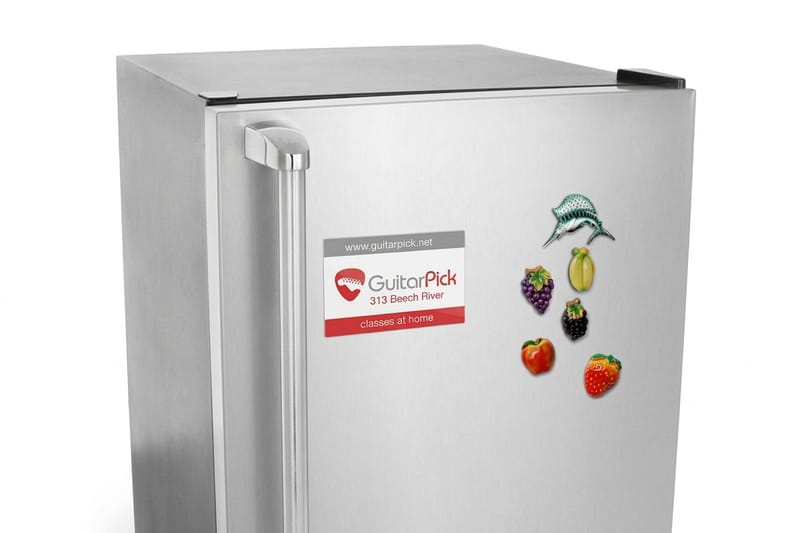
A fridge magnet mini. A single panel with the year compressed onto it, on standard magnets from $19.68. It is the cheapest way to test whether your customers want a calendar from you at all, and it sits at eye level in the kitchen. There is a full walkthrough in our fridge magnet calendar guide.
A poster year planner. All twelve months on one poster, from $108.75, for an office wall where people plan around each other. The date cells shrink to almost nothing, so this is a planning tool, not a place for artwork.
Handing it over
A calendar handed across a counter in December gets hung. A calendar posted in January competes with the one already on the wall, and loses. Print in October, distribute through November, and treat late December as the deadline rather than the start.
If you are mailing, budget for the weight. A bound wall calendar is a parcel, not a letter, and the postage can rival the printing. Many businesses solve this by mailing a postcard that invites the customer to collect the calendar in person, which also gets them through the door. There are more distribution ideas in our holiday campaign roundup.
Choosing a format: wall, desk or spiral
Four formats cover almost every calendar brief, and they differ in how much of the page the artwork gets. A wall calendar splits the sheet between an image band and a full width grid; on an 11 x 17 in Wire-O calendar that is roughly an 11 x 8.5 in picture above an 11 x 8.5 in month. A desk tent of about 6 by 8 inches stands on a counter and gives the grid most of the surface, which suits a business whose customer needs the dates more than the picture. A poster year planner puts all twelve months on one sheet for planning, not for looking at. A magnet compresses the year onto a single panel with no writing room at all.
Binding is the other half of the decision. Wire-O coil lets each page lie flat against the wall and turn cleanly at month end, which is why it is the wall default. The spiral bound calendar guide compares the bindings, and the binding, finishes and formats guide goes through the finishing options.
Quantity and price
Calendar pricing and specs
Live configurator numbers for Standard Calendars, where the per unit cost falls as the run grows.
| Quantity | Price Per Unit | Total |
|---|---|---|
| 25 | $32.50 | $812.59 |
| 50 | $21.12 | $1,055.76 |
| 100 | $12.19 | $1,218.87 |
| 200 | $8.79 | $1,758.61 |
| 300 | $6.52 | $1,957.30 |
| 400 | $5.01 | $2,004.75 |
You can also earn coins on the order and put them against next year's run, which matters on a print job you repeat every autumn.
Paper stock and finish for calendar pages
A calendar page has two jobs that pull against each other. It has to reproduce photography well, which favours a coated gloss stock, and it has to take a pen, which favours something less slick. Most wall calendars settle on a gloss or matte cover weight for the cover and a book weight for the month pages, with matte winning whenever people are expected to write on the grid.
Print it
Wire-O coil calendars
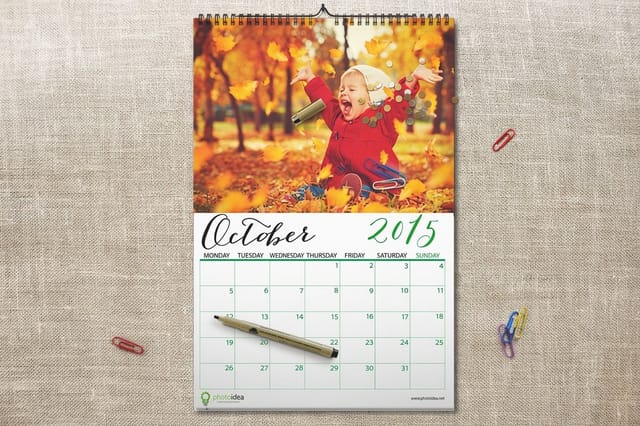
Wire bound month pages that lie flat on the wall and turn cleanly.
Gloss lifts color and makes photography snap, and it is the right call for an image led calendar that nobody will write on. Matte cuts glare in a room with overhead lighting and holds ballpoint ink, which is what a working family calendar needs. If you are unsure, order the smallest run you can and hang it for a week in the room it is meant for before committing to the full quantity. There is a fuller checklist in our six components of a custom calendar.
Calendar ideas by business type
The theme that works depends on what the customer needs from you across a year, so here is a breakdown by business type.
- Trades and contractors. Twelve finished jobs, photographed on site. Mark the months when maintenance is due and put the phone number in every header band.
- Venues, bands and studios. The season printed into the grid. The calendar becomes the fixture list, which is a reason to keep it rather than a favour to accept.
- Veterinary and healthcare practices. Animals or staff on the artwork, reminder months marked in the grid, and enough clear cell space that owners write appointments on it.
- Schools and community groups. Terms and events marked, artwork from the members themselves. Twelve contributors solve the twelve images problem in one step.
- Retail and hospitality. One offer per month in the header band, artwork that suits the room it will hang in. A magnet version for customers who will not take a wall calendar.
Grid blanks sized to the real calendar
A calendar grid is seven columns by six rows under a weekday header, and on an 8.5 x 11 in page the top inch goes to the wire and the hanging hole, so start from a blank sized to the real product. 4OVER4.COM sizes its blanks to exact specs, with bleed and trim already marked, from the blank template library. There is also a full walkthrough in our plan and print a custom calendar guide.
Start fast
Grid blanks sized to the real calendar
Design templates and exact size blanks so your grid lands inside the cut line.
Wally measures the date cell before the artwork
Format first, theme second, grid always six rows
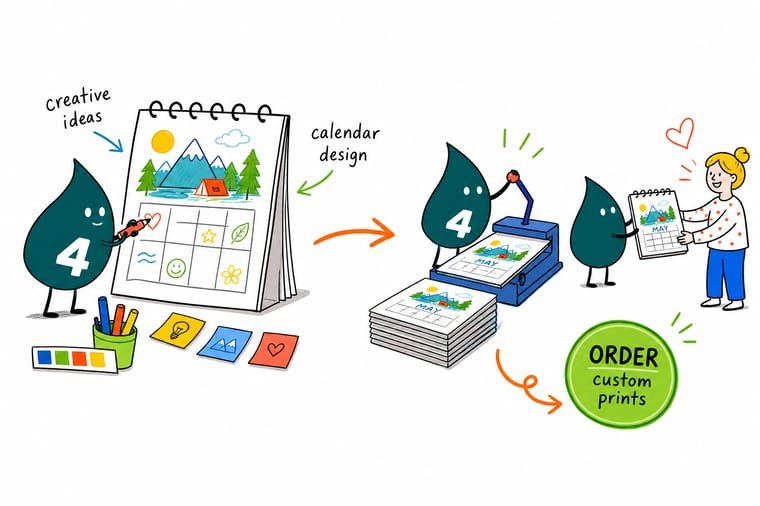
On a 12 by 18 inch wall calendar with half inch margins, each of the seven columns is about 1.57 inches and each of the six rows about 1.08 inches. Keep the top inch clear for the wire and the hanging hole, set holiday names at 9 pt or above, put your offer in the one inch month header band, and leave the cells empty enough to write in.
Print your calendar →What a wall calendar has to get right
Design tips that hold at every calendar size
- Write the twelve first. List all twelve months of content before you design one. A theme that cannot fill twelve is the wrong theme, and padding shows most in the months that hang longest.
- Respect the top inch. The binding and hanging hole live there. Artwork or type placed in that strip gets punched through.
- Six rows every month. A 31 day month starting on a Saturday needs the sixth row. A grid that changes height between months looks like a mistake.
- Leave writing room. A date cell packed with printed detail cannot hold an appointment, and a calendar nobody writes on comes off the wall early.
- Sell in the header, not the grid. The one inch month header carries a logo, a number and an offer without crowding a single date.
Explore more
More ways to print and promote
Wire-O coil calendars run 25 for $812.59 in 5 business days, two days ahead of the standard binding.
Product Custom Calendars Full color month pages, bound and ready to hang. Product Wire-O Coil Calendars Wire bound so every page lies flat against the wall. Product Magnets A fridge calendar that never leaves the kitchen.  Product Standard Posters One sheet year planners for an office wall. Category Calendar Printing Every calendar format, size and binding in one place.
 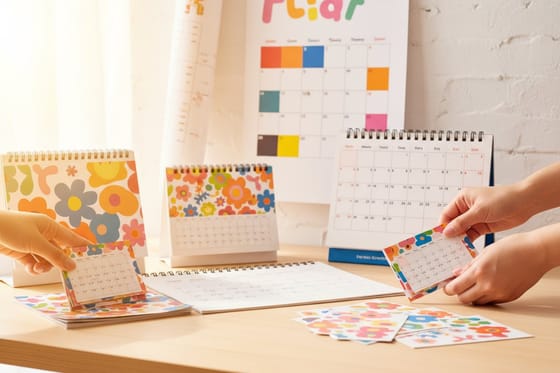 Guide Calendar Sizes Explained Which size fits the wall, the desk or the fridge.
 Ready to print next year's calendar?
Pick the format, drop in your twelve months or start from a free blank, and 4OVER4.COM prints it on premium stock with the binding your wall needs.
Common questions about calendar design
How many images do I actually need for a custom calendar?
Thirteen for a wall calendar: twelve month pages and a cover. Some designs reuse the cover image, but a separate cover is stronger because it is what the recipient sees before the calendar is ever hung. The practical test is whether you can list all thirteen subjects on paper before you open a design file. If you cannot, the theme is too narrow, and the months you improvise will be the ones hanging on the wall in September when everyone has stopped noticing the good ones.
What size should the artwork be on a wall calendar?
On a common 12 by 18 inch wall calendar the artwork band takes roughly the top nine inches, with half inch margins either side, so the live image area is about 9 by 11 inches. At 300 dpi that is a file of roughly 2700 by 3300 pixels before any bleed. Add an eighth of an inch of bleed on every edge that runs off the sheet. Keep the top inch of the page clear regardless of format, because the binding and the hanging hole occupy it.
Wire binding or saddle stitch for a wall calendar?
Wire is the practical choice for anything that hangs. A Wire-O coil lets each page lie flat against the wall and turn cleanly at the end of the month, which is why it is the default for wall formats. Saddle stitch suits a booklet you hold, not a page you hang, because the folded spine holds the sheet away from the wall. Our Wire-O Coil Calendars start at $812.59, and the spiral bound calendar guide covers the trade-offs in more detail.
When should a promotional calendar be printed and handed out?
Print in October and distribute through November. By the second week of January most walls already have a calendar on them, and yours goes in a drawer no matter how good the design is. Working backwards, that means the twelve pieces of content need to be finished by September, which is usually the part businesses underestimate. If you miss the window, a fridge magnet version still gets used, because a magnet does not have to displace anything.
Can I print a calendar that starts in a month other than January?
Yes, and for some businesses it is the better move. A school or a training provider often wants an academic year running from August or September, and a venue may want its calendar to follow the season rather than the calendar year. It costs no more to print, because the grid is artwork either way. The only thing to watch is that the run has to be right first time, since a calendar starting mid year has an even shorter useful window than a January one.
